
 0086-138 3838 9622
POULTRY FEED PLANT FOR SALE
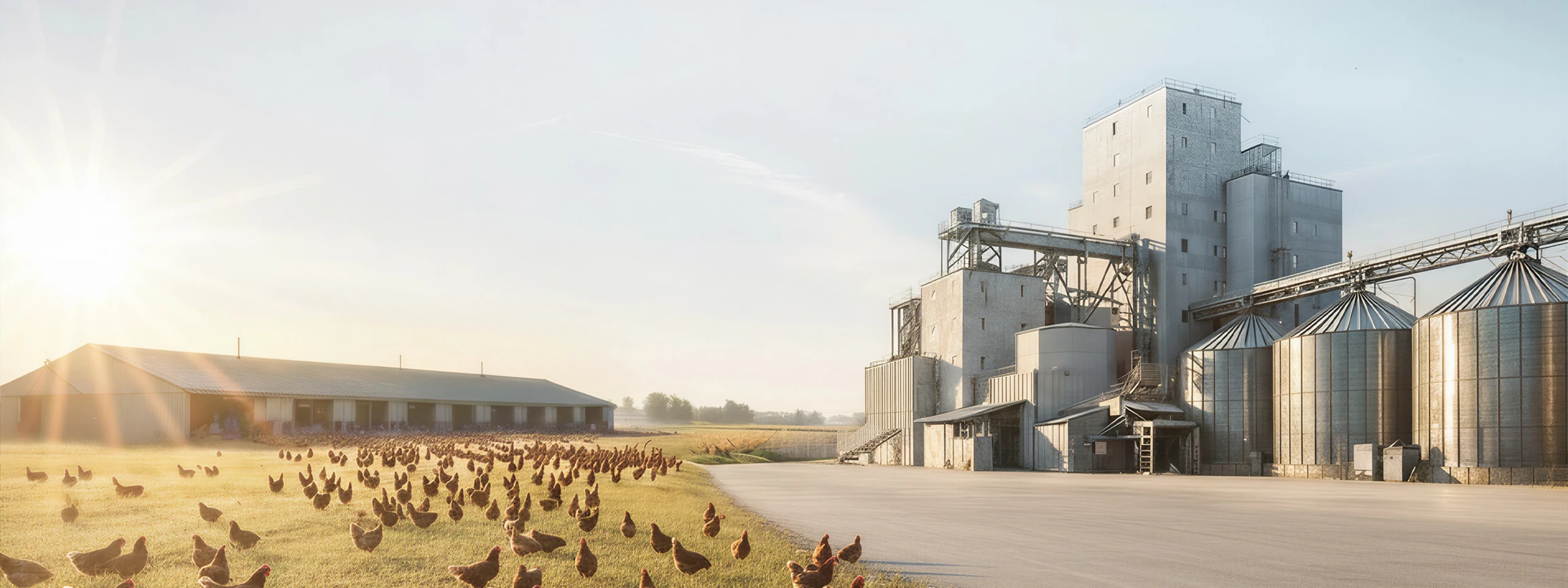
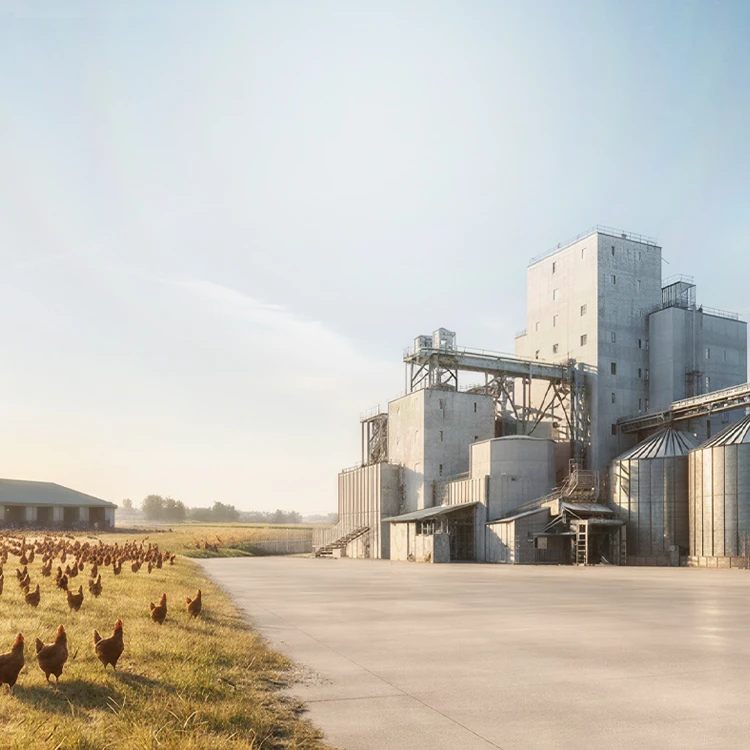
Poultry feed plants today are no longer limited to large commercial feed mills. We work with poultry integrators, feed manufacturers, egg producers, broiler farms, duck farms, breeder operations, feed distributors, agricultural cooperatives, and investors entering the animal nutrition sector for the first time.
Whether the goal is producing layer feed, broiler feed, breeder feed, duck feed, goose feed, quail feed, or multi-species poultry feed, the challenge is always the same: how to manufacture consistent, high-quality feed while controlling production costs and maintaining flexibility for future growth. That is exactly where RICHI’s engineering team comes in.
From compact 1-2 T/H feed mills to fully automated 30+ T/H industrial facilities, we design complete solutions tailored to the customer’s raw materials, production targets, available space, and local market conditions.
Some customers are building new facilities from the ground up. Others are upgrading aging feed mills, increasing capacity, or replacing outdated equipment. Regardless of the project size, they choose RICHI for the same reason: proven engineering, reliable poultry feed plant machinery, customized process design, and real-world project experience.
Talk to Us About Your Capacity Requirements
Five Feed Formats, One Poultry Feed Plant
Not every flock eats the same texture, and that’s the part buyers underestimate when they first start speccing equipment. A day-old chick can’t handle a hard pellet — its beak isn’t built for that yet. A finishing broiler three weeks out doesn’t want dust. A commercial poultry feed plant has to switch between formats without losing throughput, and the five below are the ones we configure most often.
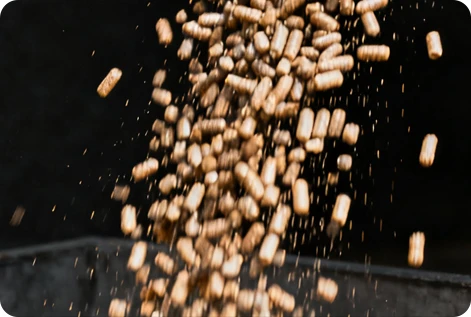
Poultry Pellet Feed
Ring die compression turns loose mash into dense, durable pellets — less feed wastage at the trough, better feed conversion ratio overall. Standard broiler grower/finisher rations run 3-4mm; breeder and layer feed sometimes goes up to 6-8mm depending on the die selected.
3.0 to 8.0mm diameter
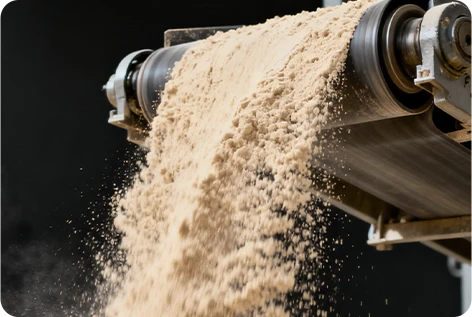
Poultry Mash / Meal Feed
No pelleting step here, just controlled grinding. Particle size comes from the hammer mill screen — finer screens for chick starter mash, coarser for layer mash. Lower processing cost, but flowability and ingredient segregation in the feeder become real issues at scale.
particle size 1.0 to 3.0mm
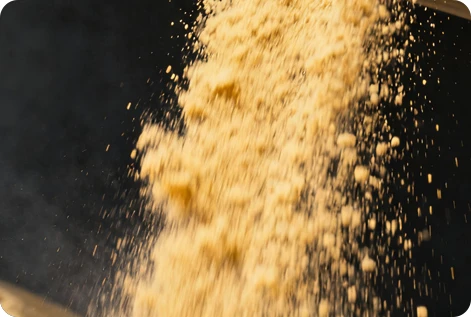
Poultry Premix Feed
Not a standalone feed. This is the vitamin and mineral concentrate mixed into a base ration at low inclusion levels, which means mixing accuracy matters more here than almost anywhere else in the line — a coefficient of variation above 5% and you’ve got uneven nutrient distribution across the batch.
blended at 0.5% to 5% inclusion rate
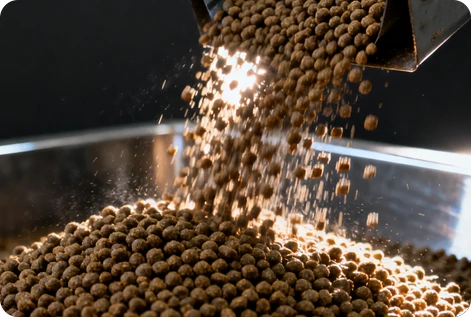
Poultry Expanded / Extruded Feed
Cooked under higher temperature and pressure than standard pelleting. Better starch gelatinization, higher digestibility, and it knocks out more pathogens in the process — though the equipment and energy cost run higher than a conventional pellet line, which is why we usually reserve this for specialty or high-value rations rather than standard broiler feed.
4mm to 10mm, density adjustable
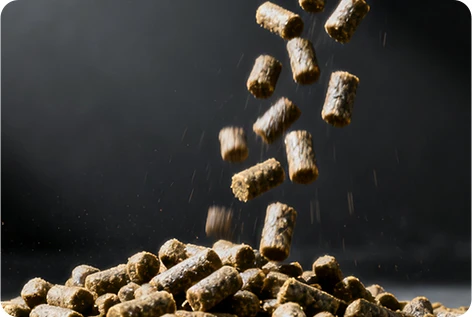
Poultry Crumble Feed
Pellets crushed and screened down to something a starter chick or young duckling can actually pick up. Sits between mash and full pellet — the transition feed most operations run during the first one to three weeks before switching the flock onto pellets.
1.5mm to 3.0mm crumble size
A single line might need to run pellets one shift and crumble the next, or mash and pellet on a rotating schedule depending on which house is being fed that week. Some clients go further — the same plant processes poultry feed alongside livestock or aquatic feed, switching die configuration and formula between runs. None of that is standard catalog equipment; it’s built around whatever combination your flock mix and customer base actually require.
Discuss Your Feed Format Requirements With Our Team

poultry feed plant videos
Every poultry feed mill looks good on paper. What matters is how it performs after installation.
Over the years, RICHI has delivered poultry feed plant projects for commercial feed manufacturers, poultry integrators, livestock groups, agricultural investors, and independent feed producers across Asia, the Middle East, Africa, Europe, Oceania, and the Americas. Some customers needed a compact feed mill to serve a local market. Others required fully automated production facilities capable of supplying thousands of tons of feed every month.
The project videos here showcase real poultry feed plant installations operating under different conditions, production capacities, raw material systems, and feed formulations. From custom plant layouts and automation systems to specialized pellet quality requirements and customer-specific equipment modifications, these projects demonstrate how RICHI transforms practical production challenges into reliable feed manufacturing solutions.
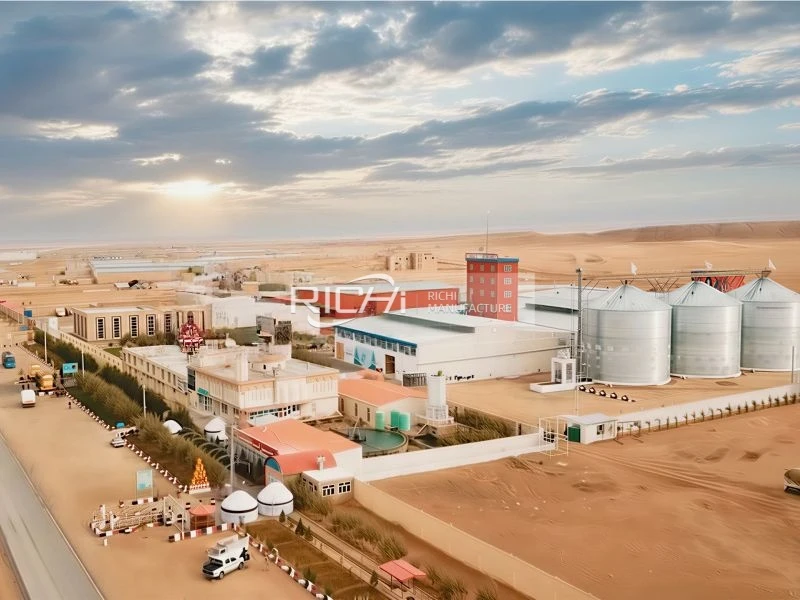

【10 T/H Fully Automatic Poultry Feed Plant for sale Afghanistan】This project was built for a growing commercial feed manufacturer focused on poultry pellet feed production. The customer required a highly automated system to reduce labor dependency while maintaining consistent pellet quality throughout long production shifts. The plant processes locally available grains and protein meals into poultry feed pellets of multiple specifications. Special attention was given to automation, batching accuracy, and future capacity expansion, allowing the customer to scale production as market demand increases.
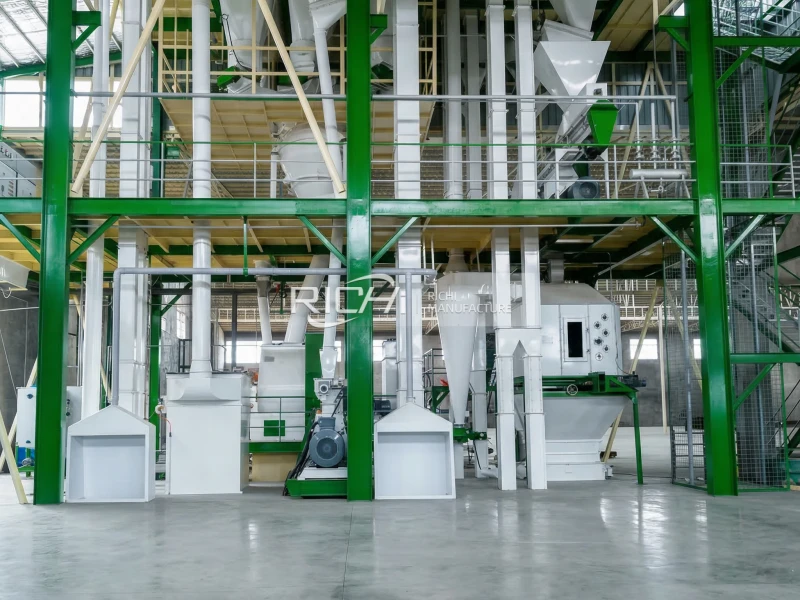
【10 T/H Cattle and Poultry Feed Plant for sale Uzbekistan】Unlike a single-purpose feed mill, this project was designed to manufacture both poultry feed pellets and cattle feed pellets within the same facility. The customer needed flexibility to switch between different formulas while maintaining stable output and minimizing downtime. The solution included dedicated process considerations for varying raw material characteristics, pellet sizes, and conditioning requirements. Today, the plant serves multiple livestock sectors from one centralized production facility.
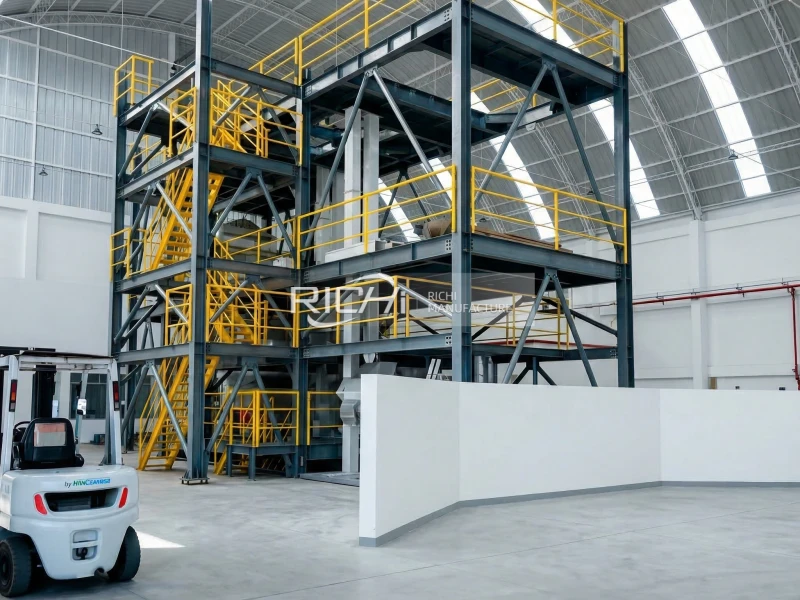
【5 T/H Poultry Feed Plant for sale Peru】Not every poultry producer needs pellet feed alone. This customer required the flexibility to manufacture both poultry pellet feed and poultry mash feed from the same production line. The system was designed with multiple discharge options, allowing rapid product changes while maintaining production efficiency. The project demonstrates how a properly engineered poultry feed plant can support diverse product portfolios without requiring separate manufacturing facilities.
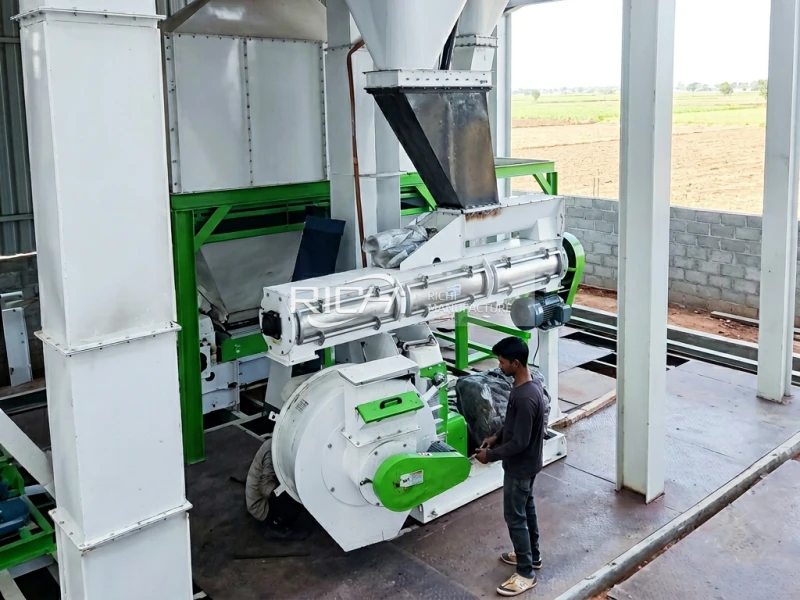
【15 T/H Poultry Feed Plant for sale Oman】This project was developed for a large-scale poultry operation seeking greater control over feed quality and production costs. Located in a region where reliable feed supply is critical, the customer required a robust production line capable of continuous operation under demanding environmental conditions. The plant produces high-quality poultry feed pellets for different growth stages and incorporates advanced process control systems to ensure formula consistency, production efficiency, and long-term operational reliability.
Custom Poultry Feed Plant Process Design & Engineering Solutions
A poultry feed plant is never designed around equipment alone. It starts with the feed itself. Different poultry species, feed formulas, raw materials, production capacities, and operating goals often require completely different process configurations. A broiler pellet feed project may require fine grinding, conditioning, pelleting, cooling, and crumbling systems. A mash feed facility may eliminate the pelleting section altogether. Feed mills processing unconventional ingredients often require specialized grinding, drying, or material handling solutions.
That is why every RICHI poultry feed plant begins with a detailed evaluation of the customer’s feed products, raw material characteristics, moisture levels, workshop dimensions, building height, automation requirements, and investment objectives before any equipment is selected.
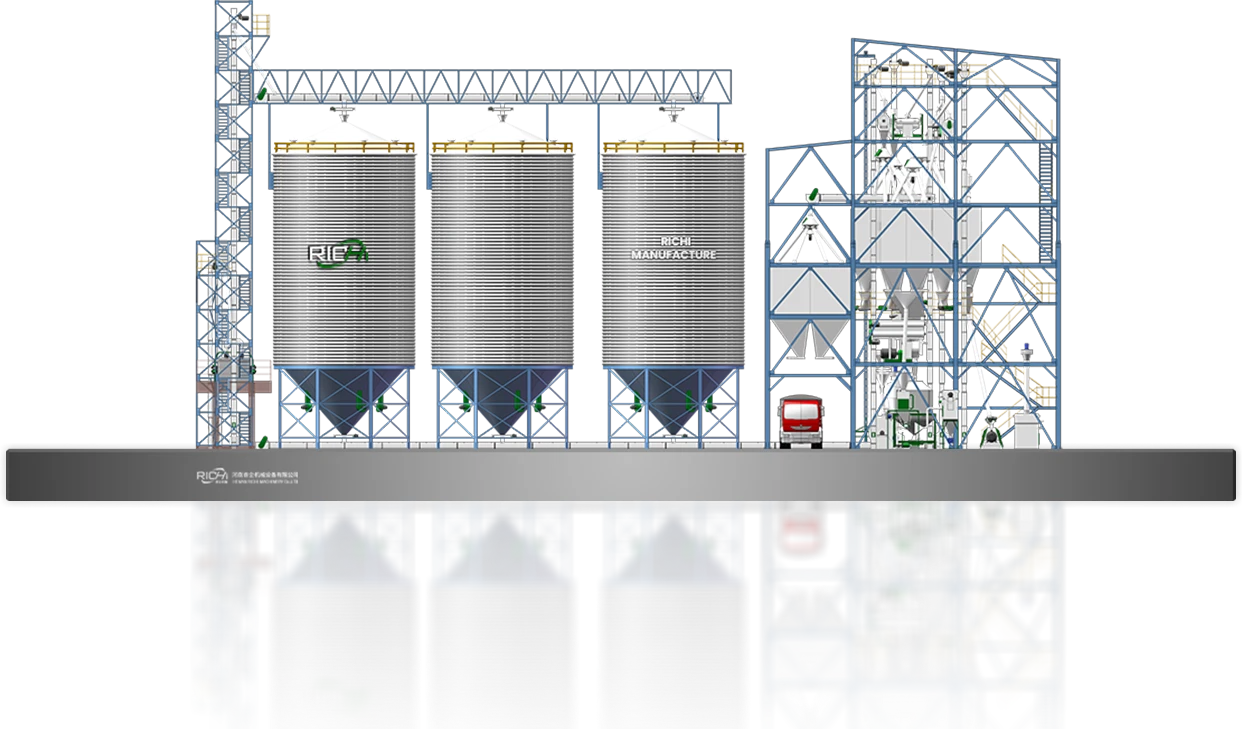
Rather than offering a fixed poultry feed production line, we build modular solutions around the way our customers actually produce feed. Depending on the project, a poultry feed plant may include raw material receiving, storage silos, cleaning systems, crushing equipment, batching and dosing systems, mixing systems, drying equipment, conditioning units, pelletizing systems, extrusion equipment, cooling systems, crumbling equipment, screening equipment, liquid addition systems, packing lines, palletizing systems, and intelligent control systems.
Some of these process sections are essential, while others are optional and determined by the feed type, raw material condition, and production targets. From initial consultation and process engineering to manufacturing, installation, commissioning, operator training, technical support, and spare parts supply, RICHI provides complete lifecycle services to help customers build a poultry feed plant that matches both today’s production needs and tomorrow’s expansion plans.
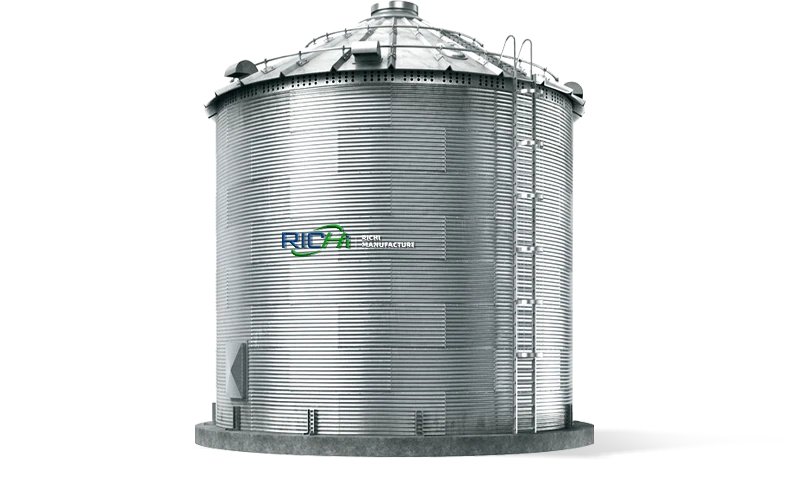
Silo system
01
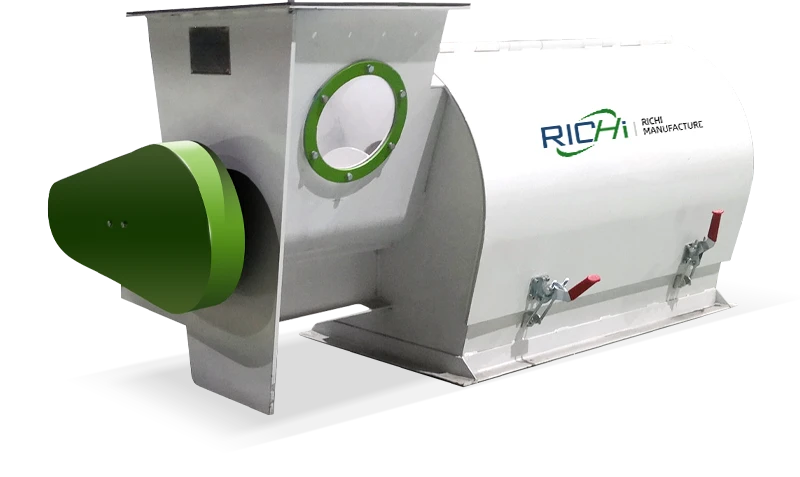
Cleaning system
02
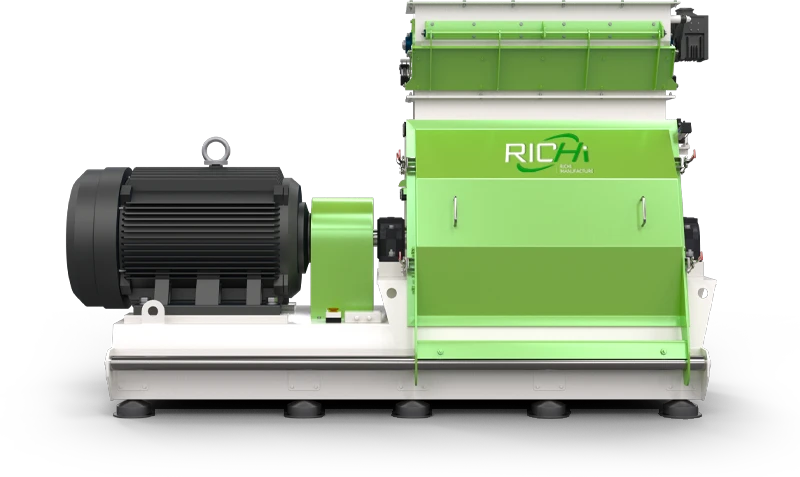
Grinding system
03
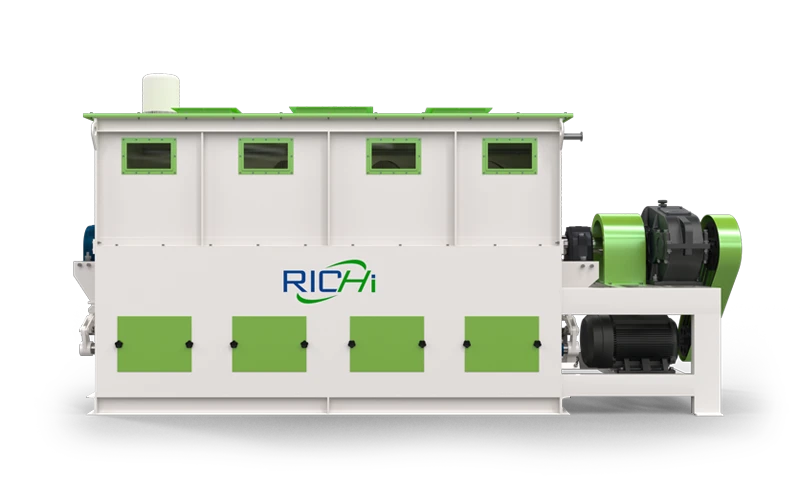
Mixing system
04
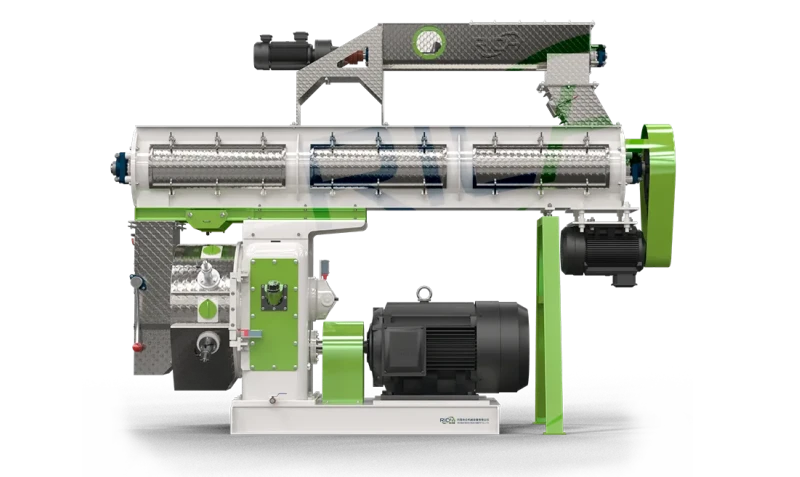
Pelleting system
05
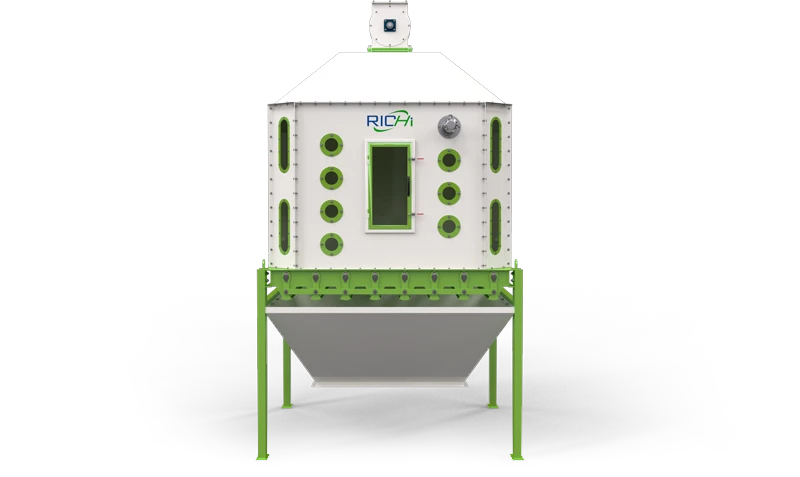
Cooling system
06
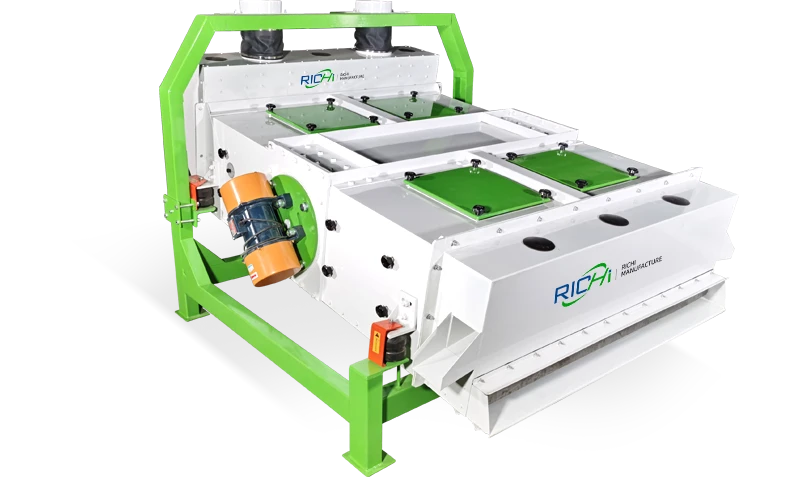
Screening system
07
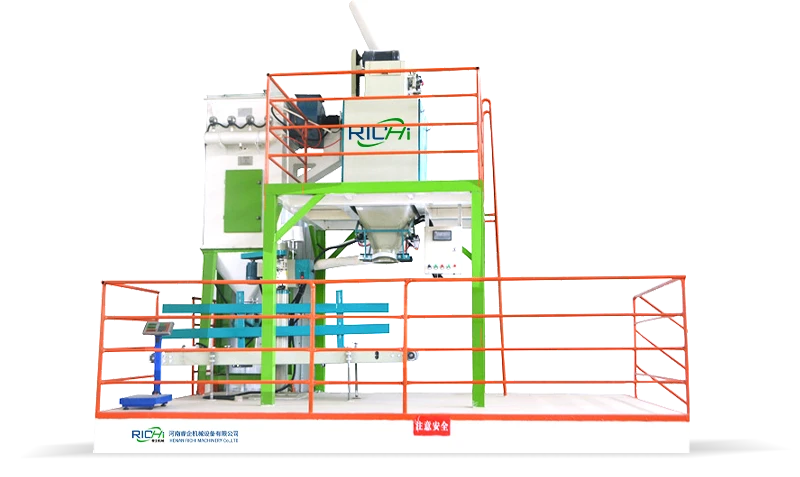
Packaging system
08
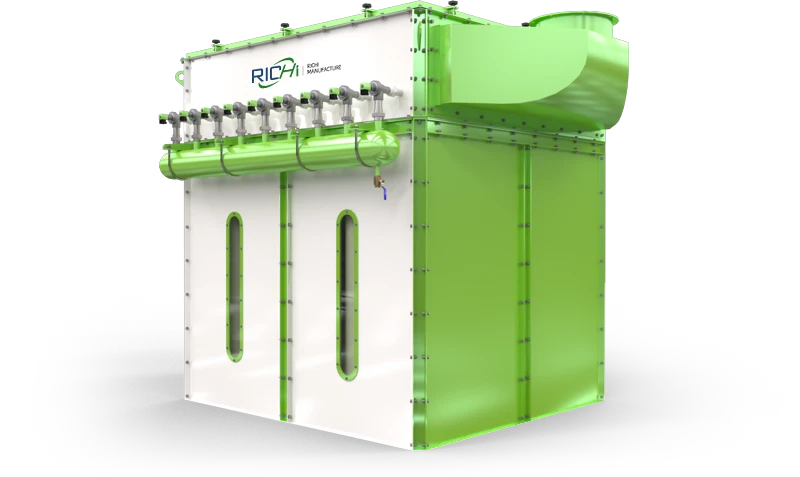
Dust removal system
09
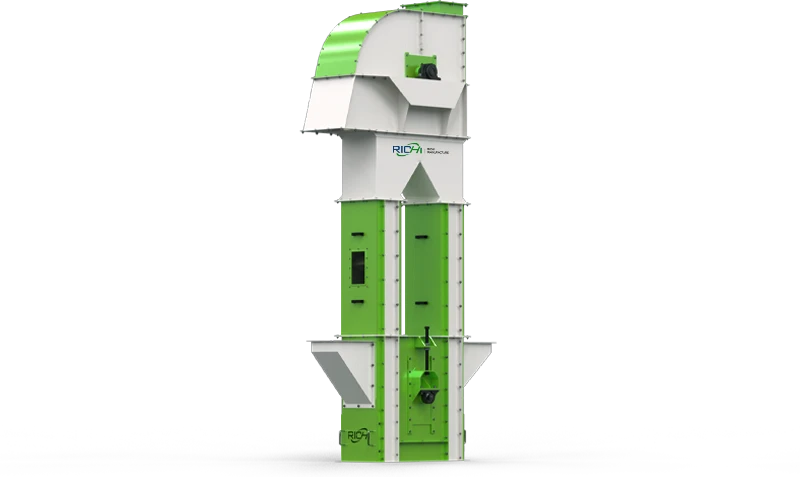
Conveying system
10
Proven Poultry Feed Plant Design for Different Capacities & Production Goals
Every successful poultry feed plant begins with the right process design. The production line process and layouts below are based on real engineering concepts developed by RICHI for different customer requirements, ranging from compact poultry feed mills to large-scale commercial feed factories. Some solutions are designed exclusively for poultry pellet feed production, while others combine poultry mash feed, poultry pellet feed, fish feed, or multiple livestock feed products within a single facility.
The process flow, equipment configuration, automation level, and plant layout vary significantly depending on production capacity, feed type, raw materials, available space, and investment budget. The following poultry feed plant flow diagrams illustrate how different process modules can be combined to create efficient, scalable, and cost-effective feed manufacturing solutions for a wide range of applications.
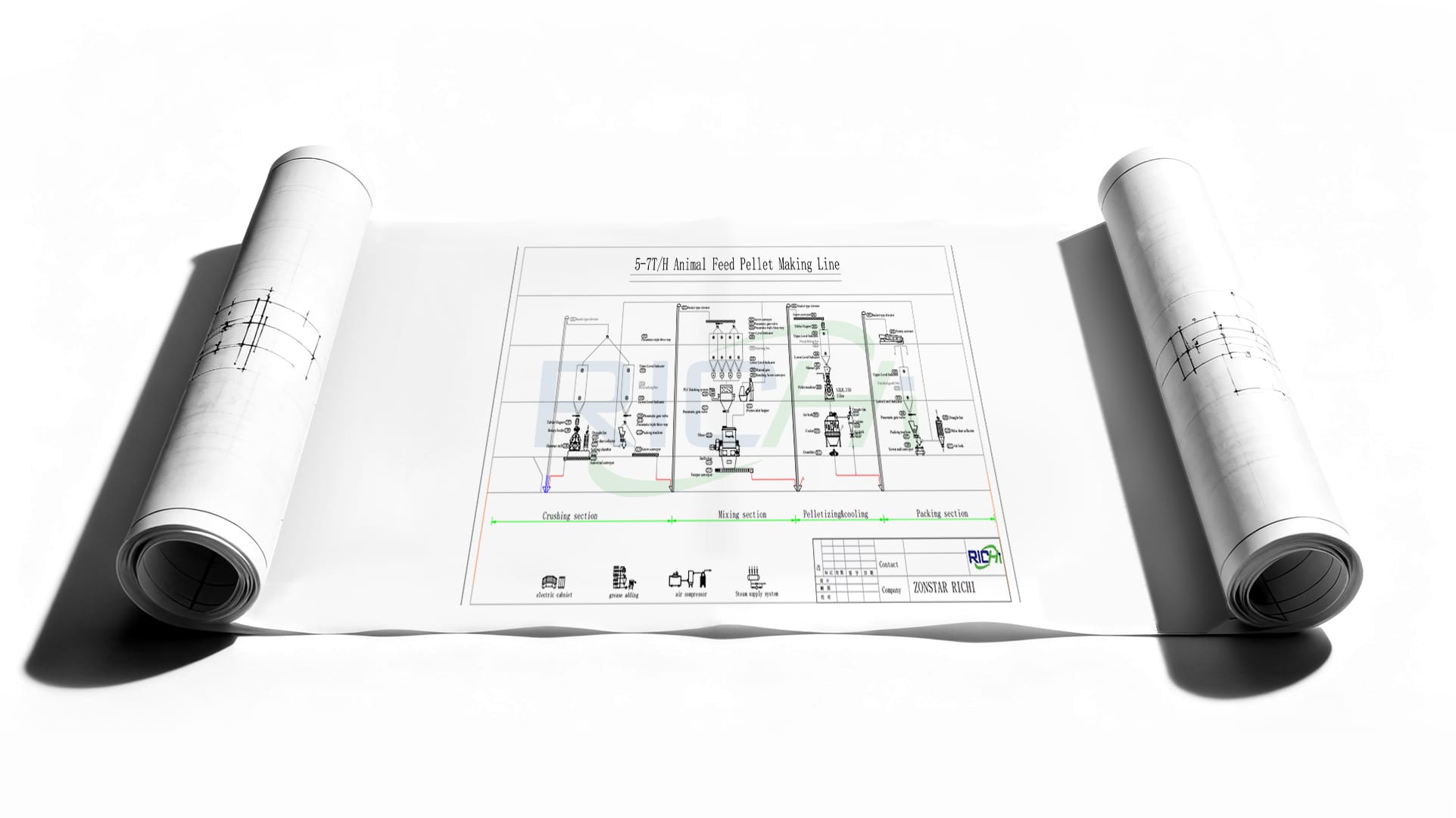
5-7T/H Poultry Feed Pellet Plant Design
This client’s raw material showed up already clean and pre-ground to powder — no clods, no foreign material, nothing that needed running through a separate cleaning section first. That let us skip straight from intake to crushing, which isn’t always possible at this capacity. From there: crushing, mixing (with manual addition for the smallest micro-ingredients, since dosing volumes that low don’t justify full automation at 5-7 t/h), pelleting, cooling, crumbling, screening, and automatic packing closing out the line.
A computerized batching system handles the bulk formula components, while the main conveying between stages runs on bucket elevators rather than pneumatic lines — quieter, less dust, lower power draw. The trade-off: manual small-ingredient dosing means an operator still needs to be present at that stage every batch.
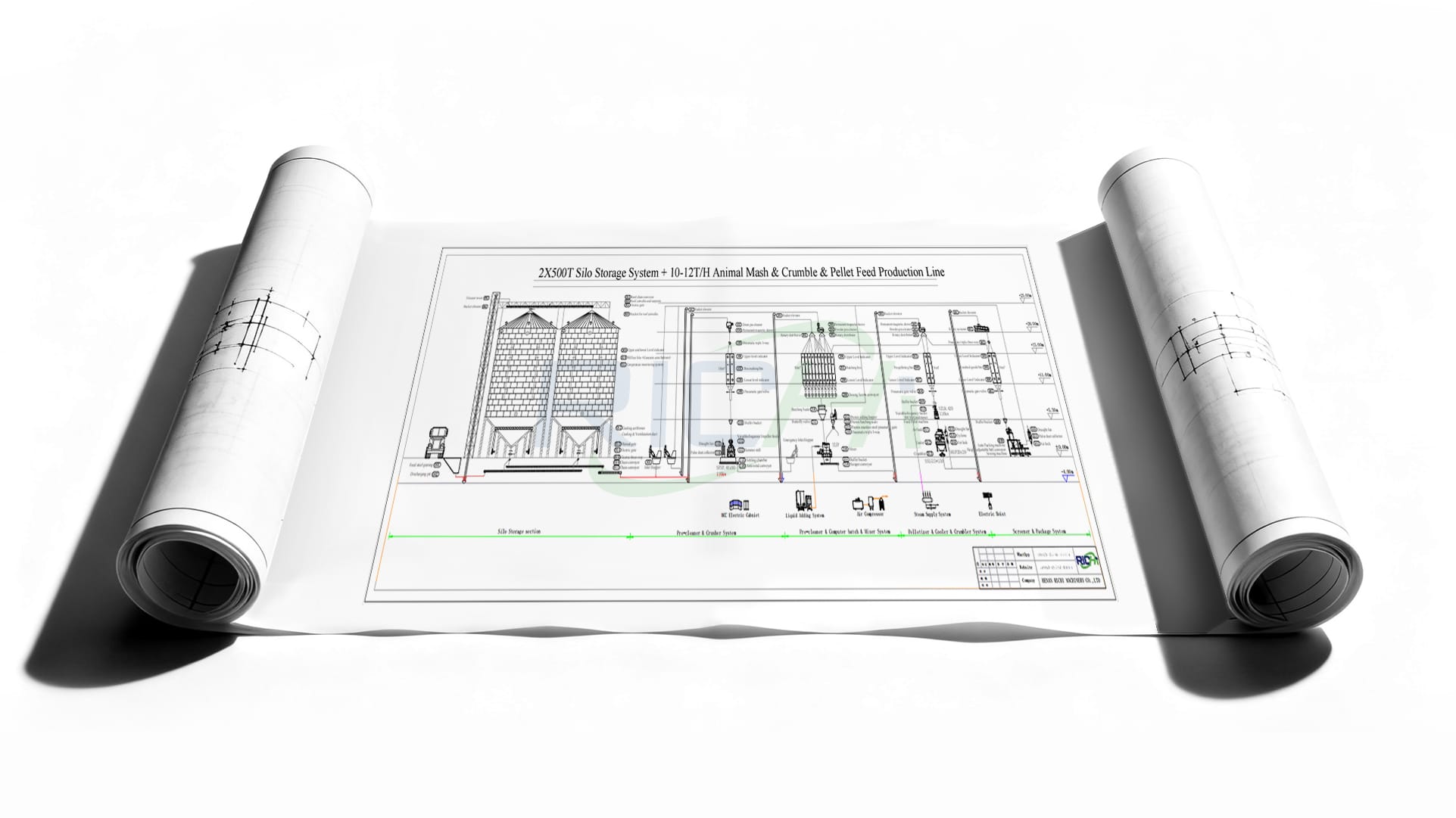
10-12T/H automatic poultry Feed Plant Design
Two 500-ton silos anchor this layout — a thousand tons of bulk storage before material even reaches the crusher. Intake still runs through two manual feeding ports despite everything downstream being automated, which catches some buyers off guard since “automatic” doesn’t mean hands-off at every stage.
After that: crushing, computerized batching, mixing, pelleting, cooling, crumbling, screening, and fully automatic packing. What sets this one apart is that it runs three feed formats off the same equipment — pellet, mash, and crumble — depending on which formula’s queued up that shift. Running three formats through one line does mean more changeover time between batches than a single-format plant would need.
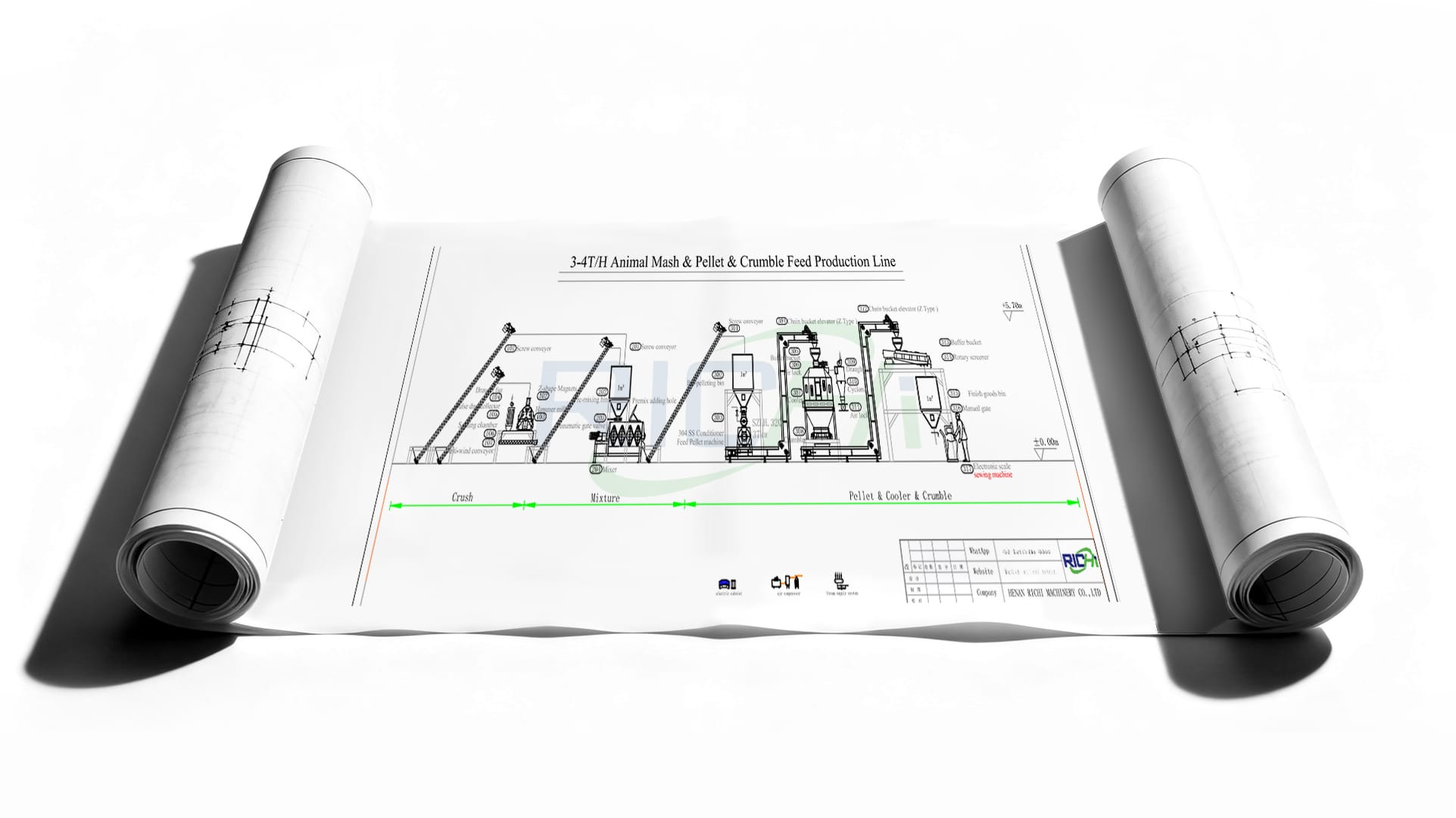
3-4 t/h poultry Feed processing plant Design
Ceiling height was the constraint here — the building topped out low enough that a standard bucket elevator layout wouldn’t fit. We went with screw conveyors paired with a Z-type bucket elevator instead, keeping the entire conveying system under 5.7 meters total height.
Feeding runs through two separate conveyors: one carries pelletized raw material into the crusher, the other routes powdered material straight into the mixer, bypassing crushing since it’s already fine enough. From there: crushing, mixing, pelleting, cooling, crumbling, screening, and manual packing. Smaller capacity, but the real engineering problem wasn’t tonnage — it was fitting a working poultry feed plant inside a building that wasn’t designed with feed milling in mind.
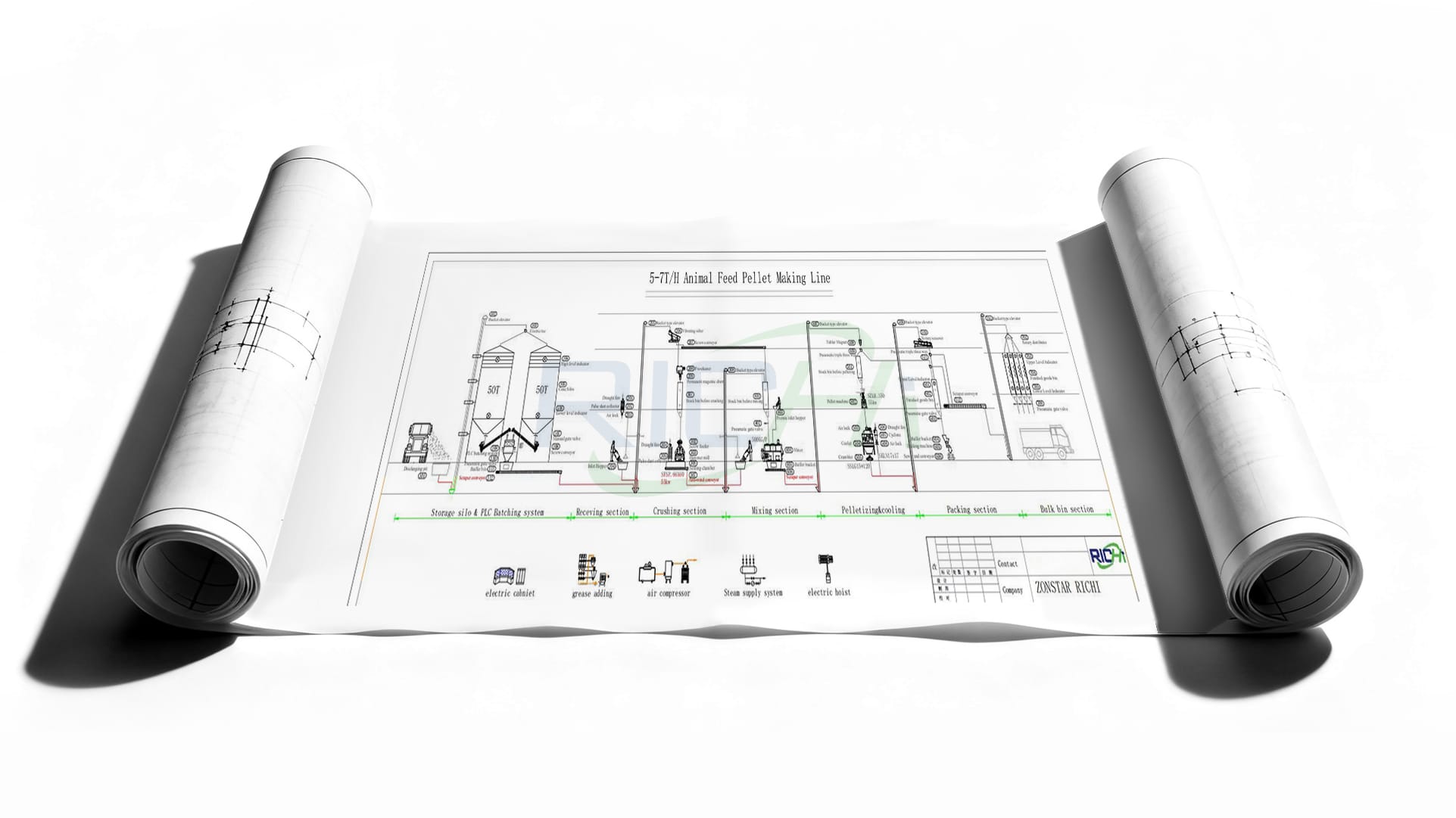
5-7T/H poultry Feed making plant Design
Same capacity bracket as our first design above, but almost nothing else matches. This client receives raw material by bulk truck, lifted via bucket elevator into two 50-ton holding silos rather than fed in by hand, with a PLC-based batching and weighing system handling formula accuracy from there.
The process runs crushing, mixing, pelleting, cooling, crumbling, and screening — standard enough — but packing splits two ways: an automatic packing scale for bagged product, and a separate bulk loadout line for customers buying by the truckload rather than the bag. That packing flexibility drove the equipment selection more than the tonnage figure did.
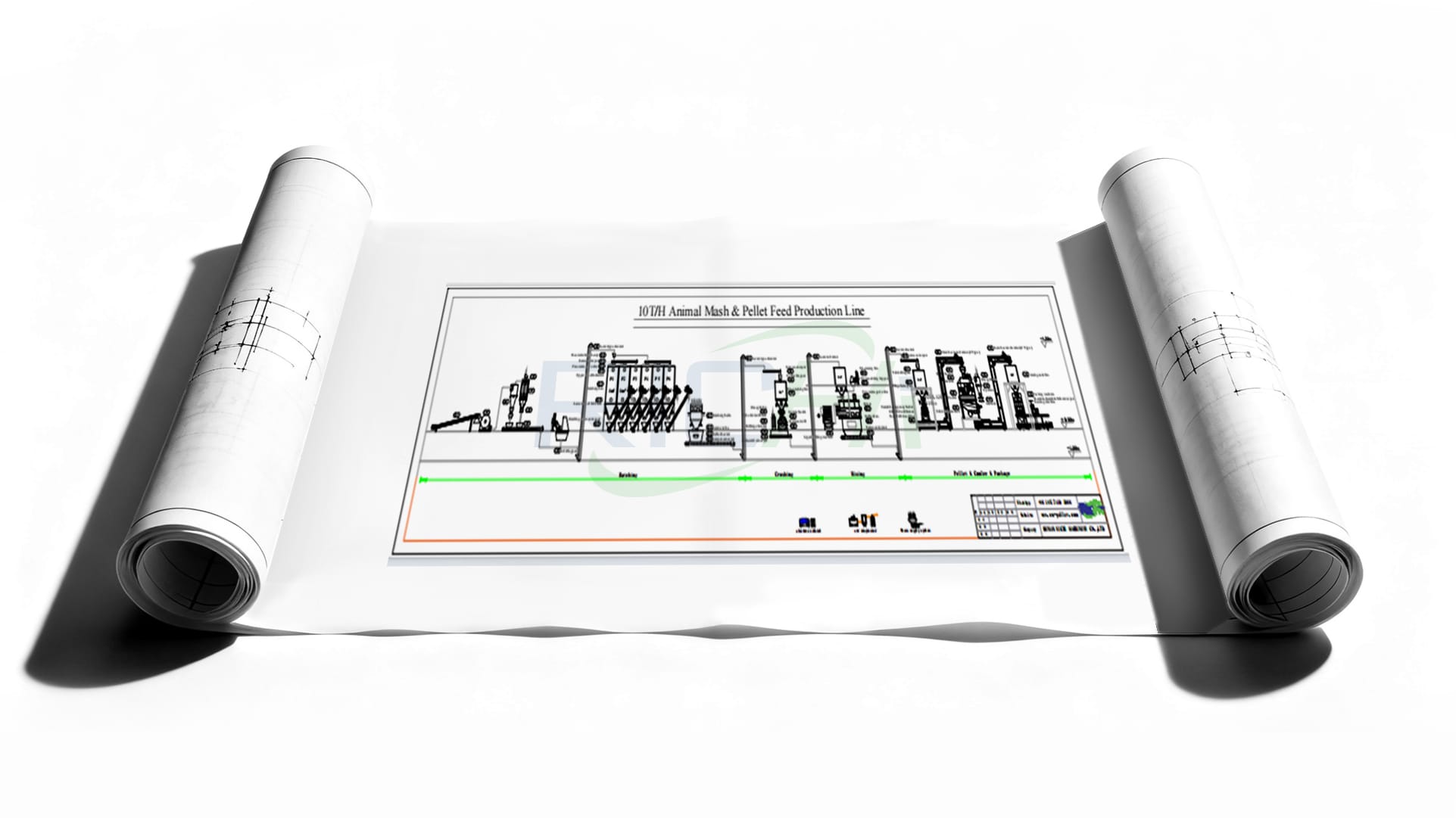
10T/H poultry pellet & mash feed plant Design
This one started as a different request entirely. The client, based in the US, originally asked for a straightforward 10 t/h mash feed plant — no pelleting at all. Partway through planning, the scope changed to a combined pellet-and-mash line, which meant reworking the layout to handle both finished formats.
Raw material needed very little crushing here — most of it arrived pre-ground, so that stage is almost a formality before batching, mixing, pelleting, cooling, screening, and packing. Both pellet and mash get automatically bagged at the end, no manual packing station anywhere in the line. Full automation on packing isn’t unusual for US-based operations, where labor cost tends to drive that decision more than raw material characteristics do.
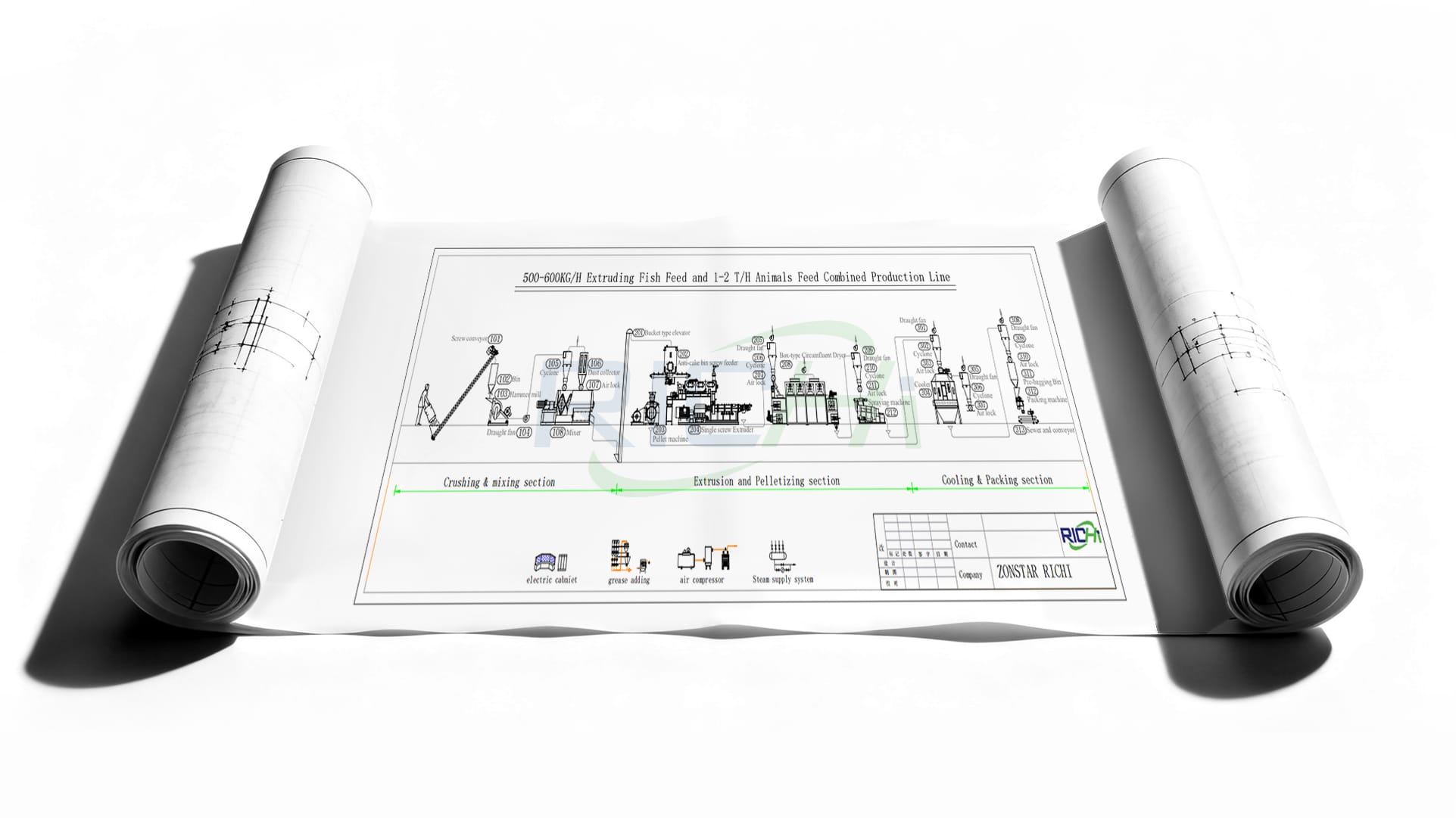
1-2 t/h poultry &fish Feed combined plant Design
Smallest capacity on this list, but the most equipment-dense per ton. The base is a standard poultry feed line running 1-2 t/h, with an additional 500-600 kg/h floating fish feed module added onto the same process. Floating feed needs equipment a poultry line normally doesn’t carry — a single-screw extruder, a belt dryer afterward, and a spraying unit to coat the pellets in oil once they’re dry.
That last step matters more than it sounds: extrusion cooks out a portion of the fat content, so spraying adds it back — otherwise the finished fish feed comes in under spec. Full sequence: crushing, mixing, pelleting or extrusion depending on format, drying, spray-coating, cooling, automatic packing.
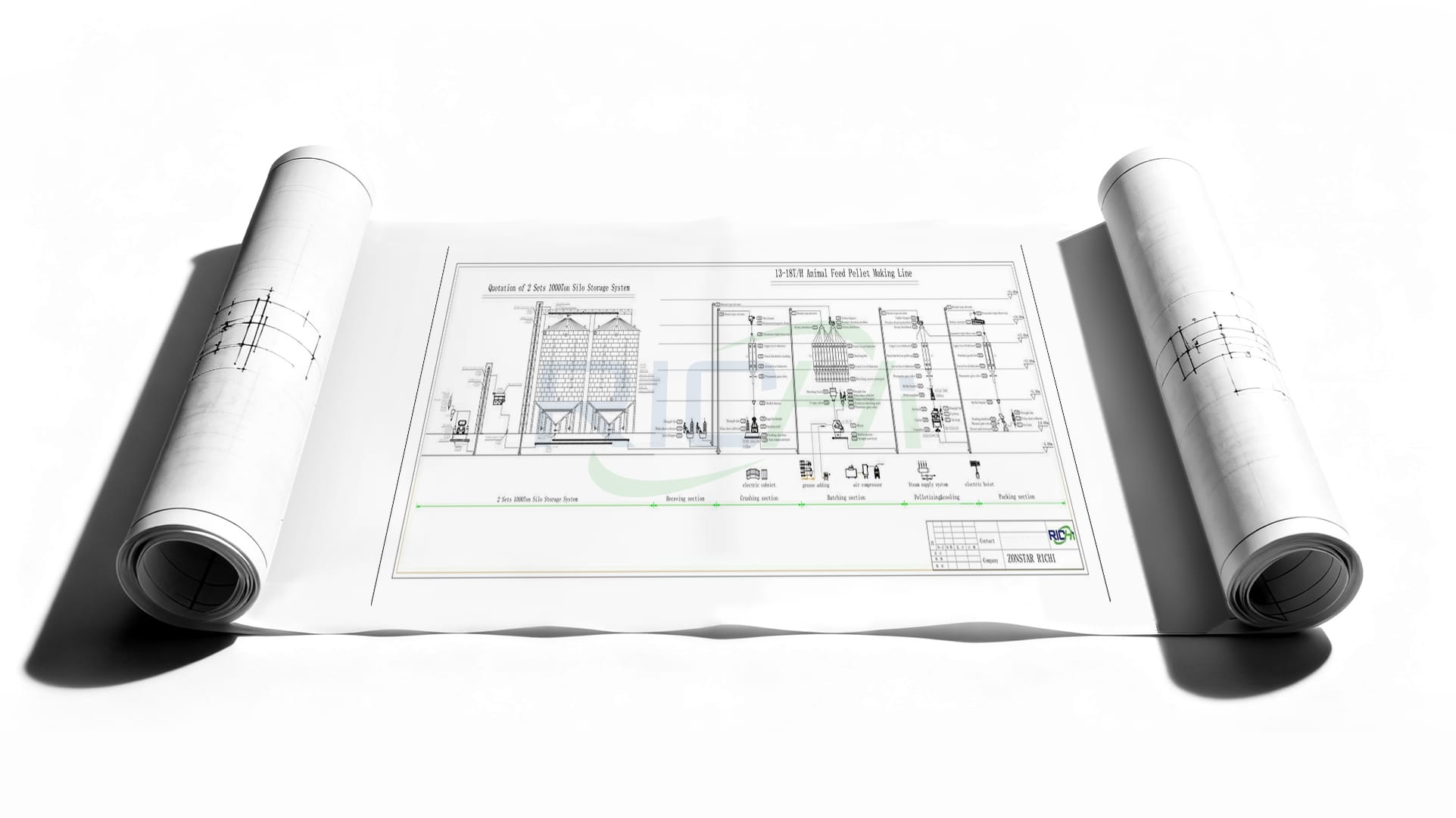
13-18T/H poultry Feed pelletizing Plant Design
Two 1,000-ton silos — 2,000 tons of storage ahead of the process, which tells you this client wasn’t planning on running short of raw material mid-shift. Outside of the storage capacity, this is close to the standard configuration we’d recommend for a large-volume poultry feed plant: crushing, fully automatic computerized batching, mixing, pelleting, cooling, crumbling, screening, and automatic packing.
No special raw material handling, no dual-format requirement, no building constraints worth mentioning. Sometimes the most useful design is the one without complications — this client wanted reliable big-volume output, not a list of custom features.
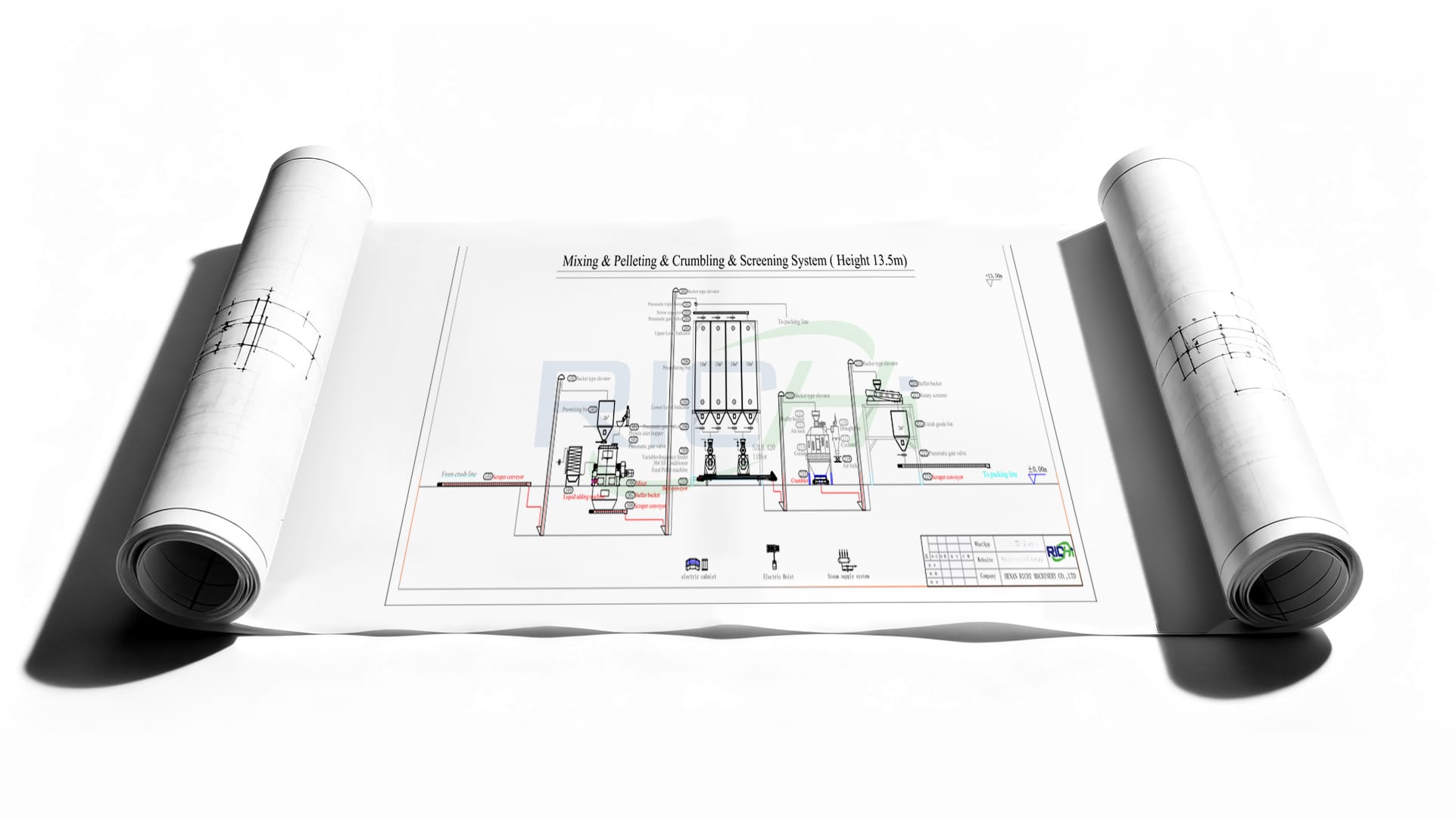
20 t/h poultry feed production plant design
This wasn’t a new plant — it was an existing feed mill that already had working crushing and packing sections and just needed everything in between upgraded. We supplied the modular systems for mixing, pelleting, crumbling, and screening, designed to slot into a building that wasn’t originally laid out for this kind of retrofit.
Floor space was tight, and the existing structure limited where new equipment could physically go, which made this more of a puzzle than a standard installation. Retrofitting around equipment that’s already running is a different exercise than building from a blank floor plan.
Different Poultry Feed Plant Projects
We’ve shipped poultry feed plant equipment to more countries than fit comfortably on one page — different companies, different industries, raw materials and formulas that shift by region, and production scales running anywhere from under 2 t/h to over 40 t/h. Most of these projects didn’t stop at a single pellet line, either.
We’ve built mash feed production lines, premix systems, and custom configurations that run two or three feed types at once — pellet, mash, crumble, sometimes poultry feed running alongside cattle or fish feed on the same equipment. Single-function or multi-function, depending on what the client actually needed. Every poultry feed plant for sale featured below started as a real project, not a spec sheet pulled from a catalog — sixteen of them, picked from very different parts of the world.
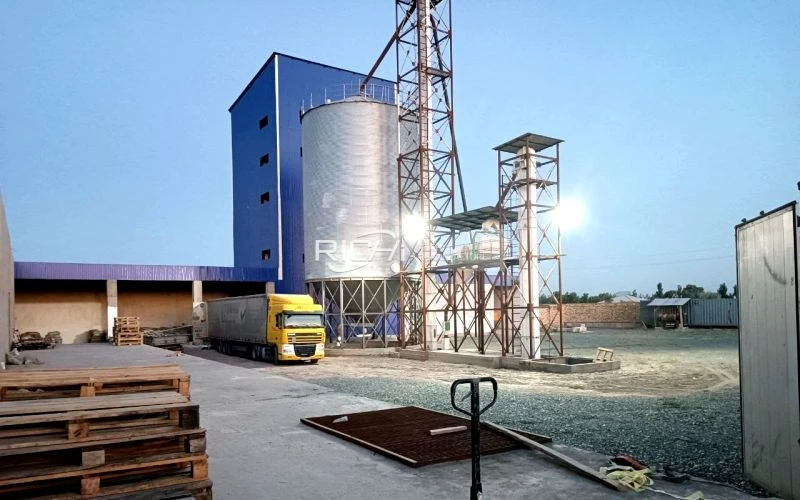
Broiler Poultry Feed Plant
South Africa
A regional broiler integrator running near capacity needed a 10 t/h pellet line to stop outsourcing feed production. Configuration covers crushing through automatic packing, with batching tight enough to hold formula consistency across daily runs feeding several contract grower houses.
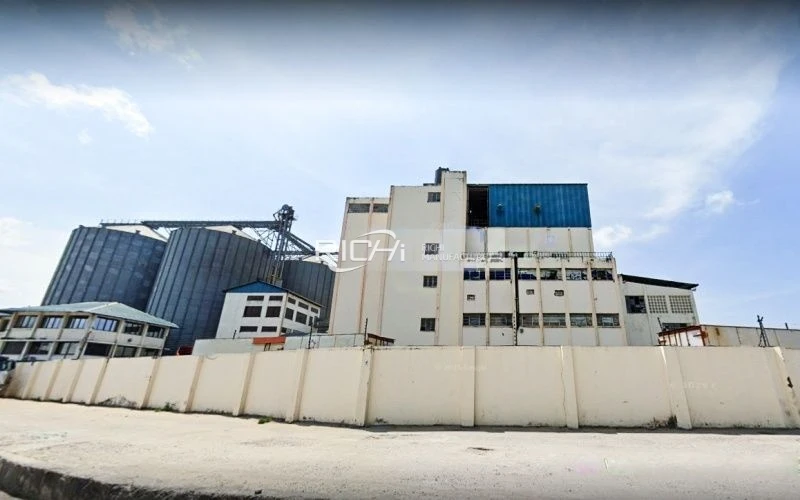
Poultry & Livestock Feed Plant
Oman
This client needed poultry and livestock feed from one facility rather than two separate buildings. The 10 t/h line handles formula and die changeovers between broiler pellets and coarser livestock rations without a full equipment teardown each switch.
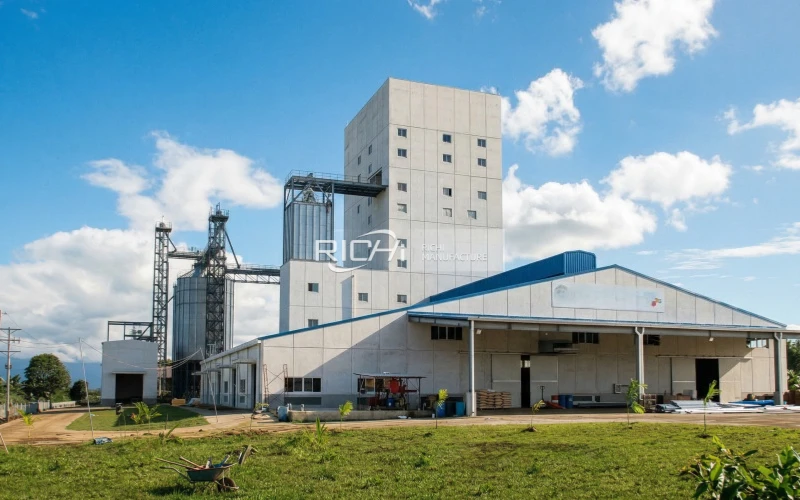
Broiler Poultry Feed Plant
Argentina
A large-scale broiler integrator running multiple grower contracts needed 15 t/h of standard pellet output built around regional corn-soy formulas, with computerized batching holding consistency across runs feeding several contract houses simultaneously.
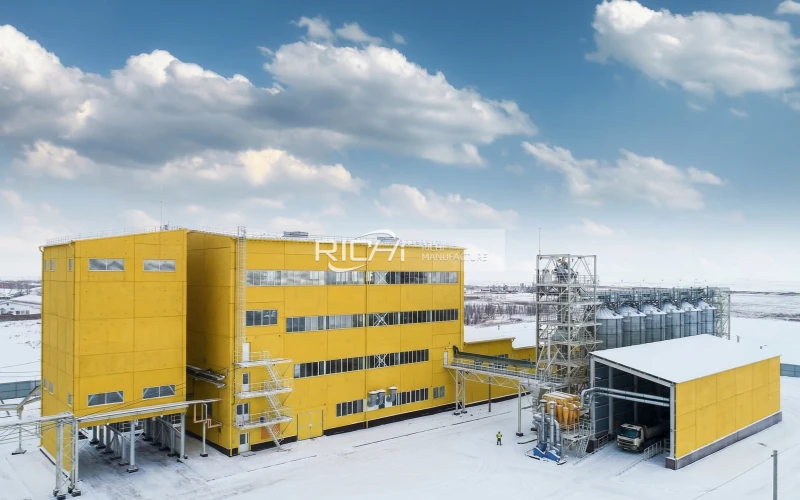
Poultry & Cattle Feed Plant
Kazakhstan
Poultry and cattle feed run from the same 15-20 t/h facility here, reflecting how common mixed livestock operations are across the region — formula switching between species was built into the design from day one.
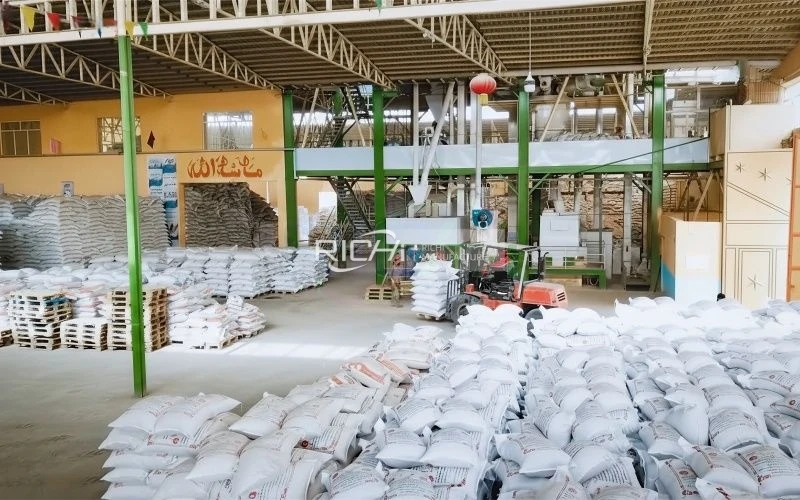
Broiler Poultry Feed Plant
Afghanistan
This 15 t/h plant runs both full pellet and crumble feed off the same line, switching formats depending on whether the week’s order is finisher broiler or starter chicks. Fully automated batching kept staffing requirements low for a site without deep technical labor pools nearby.
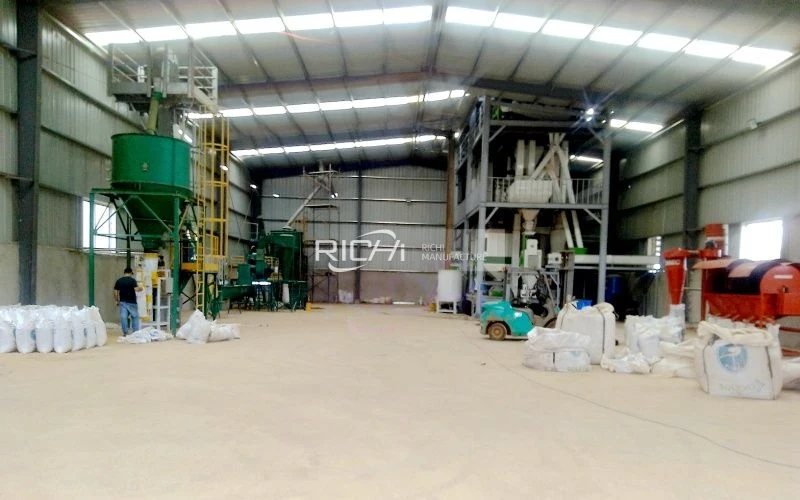
Chick Starter Poultry Feed Plant
Angola
Day-old chicks can’t handle a hard pellet, so this 5 t/h plant runs crumble as its primary output rather than full pellet feed, with pelleting capability kept available for finisher-stage formulas once the flock matures.
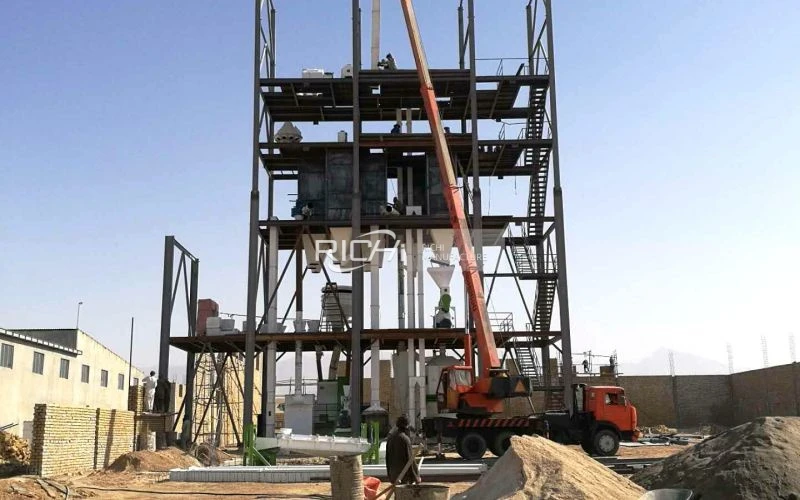
Multi-Format Poultry Feed Plant
Uganda
Different flock houses on this client’s operation needed different formats, so the 10 t/h line runs pellet feed one shift and mash the next, switched from the operator’s panel instead of manual valve changes.
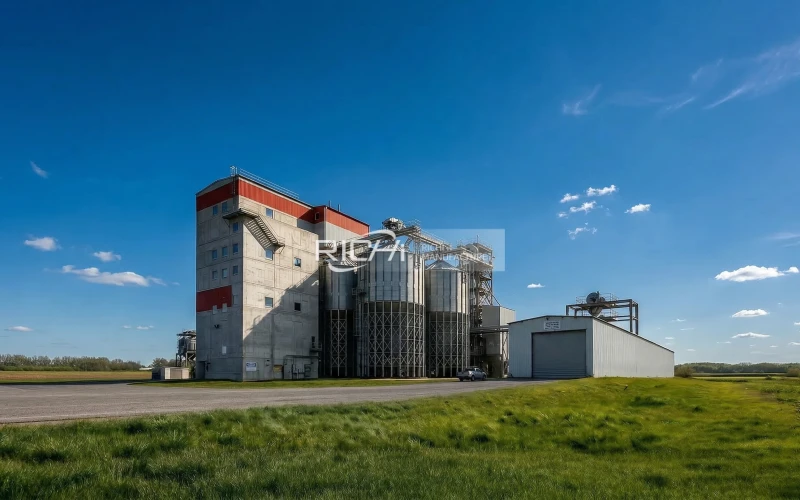
Layer Poultry Feed Plant
Australia
A commercial egg producer moved feed production in-house with a 10 t/h pellet line, prioritizing consistent calcium and mineral content across batches — something layer flocks are particularly sensitive to.
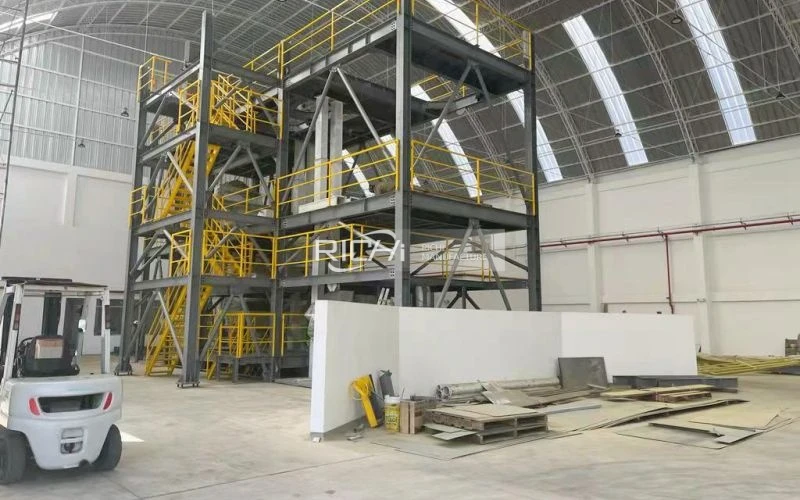
Layer Poultry Feed Plant
Brazil
A layer farm scaling past buying finished feed needed mash output only — no pelleting required for this flock’s diet. The 5 t/h line keeps particle size consistent through hammer mill screening, which mattered more here than throughput.
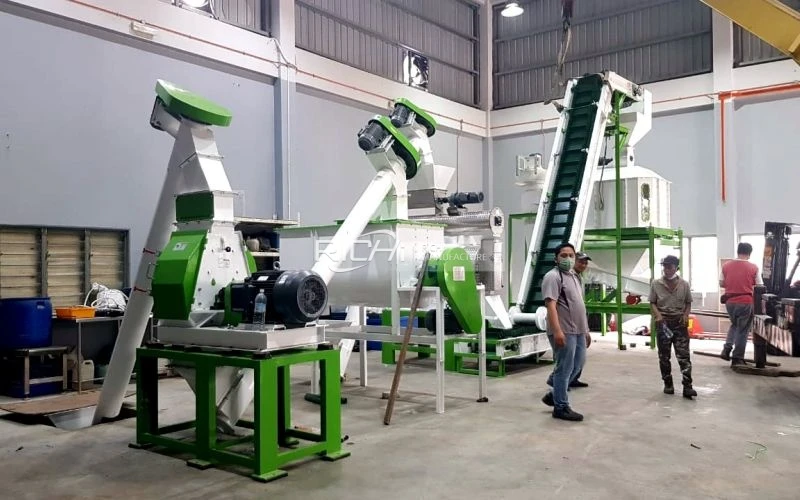
Poultry & Fish Feed Plant
Malaysia
Poultry and floating fish feed share equipment on this 3-4 t/h line, with extrusion added specifically for the aquaculture side — a pairing that made sense given how often backyard poultry and fish farming run side by side here.
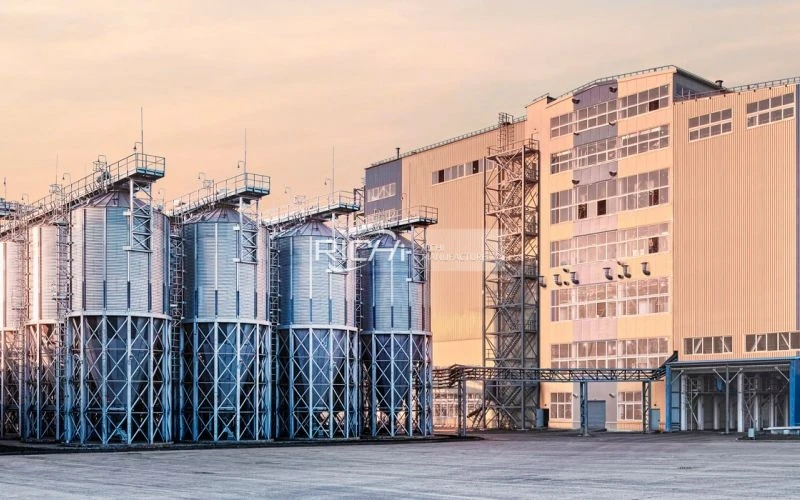
Automated Poultry Feed Plant
United States
A feed producer scaling output specified full automation end to end, from intake through bagging, at 20 t/h — labor cost drove that decision more than the formula or raw material characteristics did.
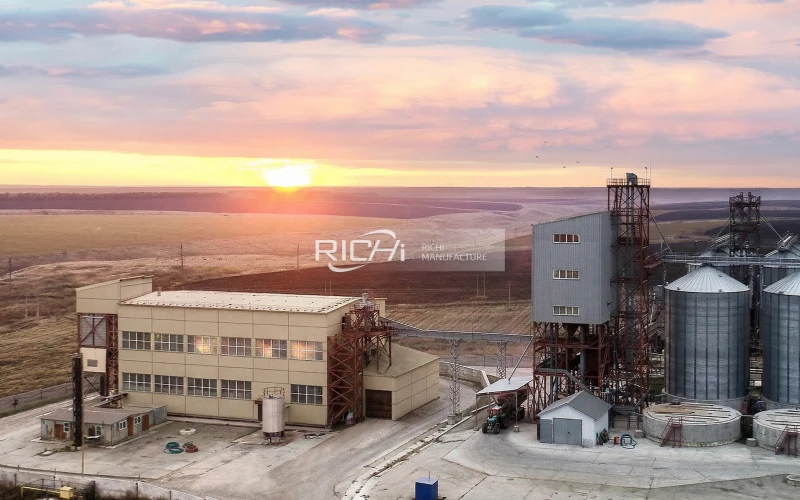
Poultry & Livestock Feed Plant
Kyrgyzstan
Poultry feed shares this 8-10 t/h facility with general livestock rations, a configuration that made sense given how many operations in the region run both poultry and grazing animals on the same property.
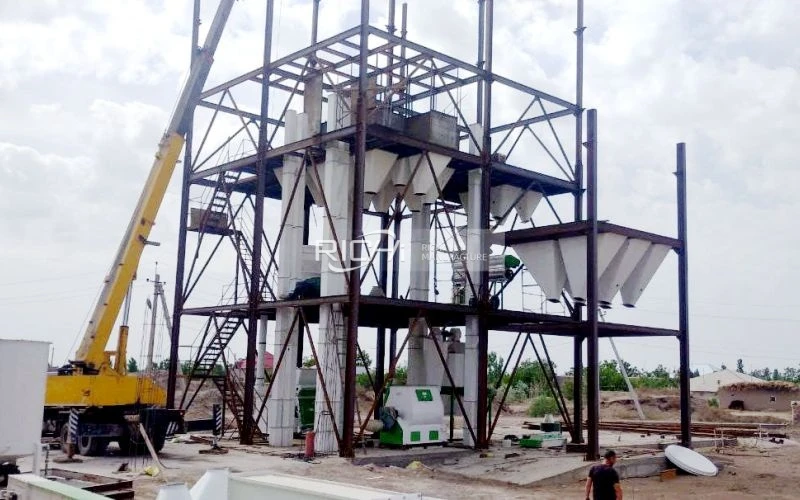
Commercial Poultry Feed Plant
Turkey
A commercial feed producer expanding beyond regional distribution ordered a 10 t/h pellet line built around corn-and-soybean-meal formulas common across local poultry operations, with automatic packing sized to match the distribution contracts already in place.
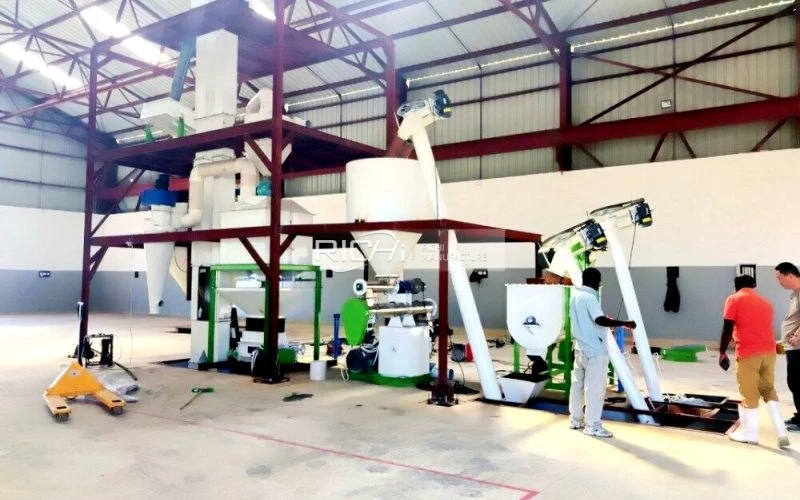
Layer Poultry Feed Plant
Tanzania
A growing layer flock outpacing what local feed suppliers could reliably provide switched to producing its own mash feed at 1-2 t/h, prioritizing consistent formula control over the volume a larger plant would have offered.
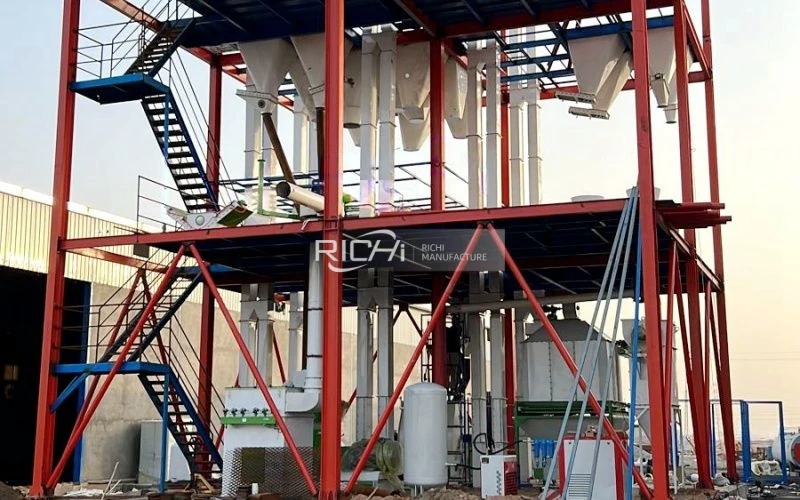
Broiler Poultry Feed Plant
Iraq
An existing operation needed more pellet capacity than its previous setup allowed, landing on an 8-10 t/h line sized for growing broiler contracts without requiring an entirely new building to house it.
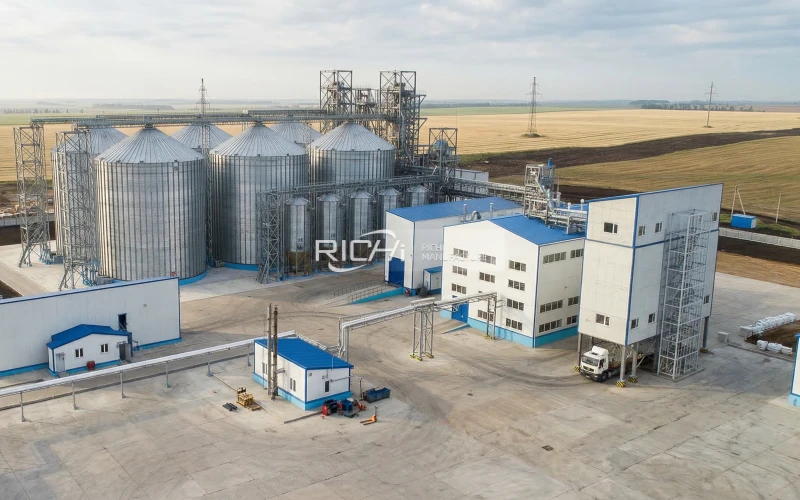
Industrial Poultry Feed Plant
Russia
The largest plant on this list, built for an industrial broiler producer running 30-40 t/h of standard pellet feed, with storage and batching systems sized to keep up with multiple production shifts running back to back.
Most of what we hear after a poultry feed plant goes live doesn’t come from us — it comes from the people actually running it months or years later, once the warranty period’s behind them and the equipment is just… working, day after day. Four of those conversations are below.

Running 20 Tons Without Adding a Single Shift
Operations Manager, Broiler Feed Producer
20 t/h Automated Poultry Feed Plant
“We went from three shifts of guys hand-batching micro-ingredients to one operator watching a screen most of the day. RICHI built our poultry feed plant around 20 t/h with full automation end to end, and honestly, what sold me wasn’t the capacity number on the spec sheet — it was that batching accuracy held up even after we changed our broiler formula twice in the first year.”

Built Around What Our Farmers Actually Grow
Feed Mill Owner
8 t/h Poultry Feed Plant, Barley-Based Formula
“Here in Algeria, our formula leans on barley and wheat bran more than the corn-soy mix you’d see elsewhere, and not every supplier wants to adjust crushing and mixing settings for that. RICHI didn’t have a problem with it. The poultry feed plant they built for us runs close to 8 tons an hour, and three years in, the die and screens are still holding up under our raw material.”

Equipment That Doesn’t Quit During Power Cuts
Plant Engineer
8-10 t/h Broiler Poultry Feed Plant
“Power here isn’t always reliable, and that was the first thing I told them when we started talking. What we got was a poultry feed plant that handles voltage drops without the control system resetting mid-batch — which mattered more to me than the 8-10 ton capacity on paper. We process mostly broiler pellet feed, and we haven’t lost a production day to equipment failure since startup.”

Fishmeal in the Mix, No Surprises
Production Supervisor
6 t/h Poultry Feed Plant with Fishmeal Inclusion
“Most outsiders don’t realize how much fishmeal goes into poultry feed formulas here, given how big our fishing industry is. That meant the mixing and conditioning stages had to handle a different moisture and fat profile than a standard corn-soy formula. The poultry feed plant we got runs around 6 tons an hour now, and pellet durability held up even with the oil content from the fishmeal — that part worried us going in.”

poultry feed plant solution, From 1 t/h to 120 t/h
Picking a capacity for a poultry feed plant isn’t really about picking a number — it’s about matching production scale to budget, building footprint, and how much feed you actually need to move in a day. The ten brackets below run from small commercial operations up to industrial-scale producers running multiple shifts, and the equipment investment attached to each one shifts by a factor of ten or more across the full list. None of these brackets belong to one type of buyer exclusively. Overlap is the rule here, not the exception — a cooperative and a private mill owner might land in the exact same bracket for completely different reasons. (The price quoted here is for the equipment only and does not include the silo.)
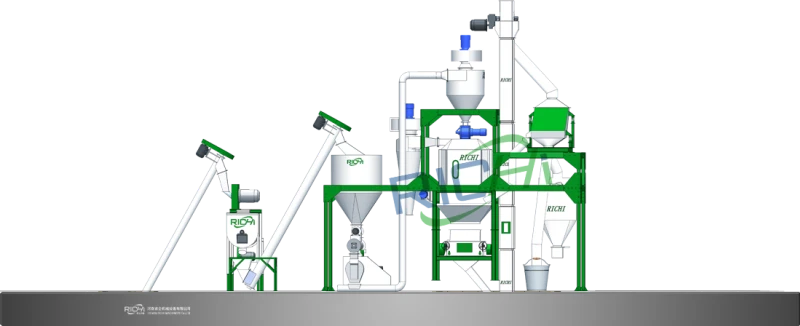
This is usually where first-time investors start, along with small commercial mills, cooperative farms, and producers running niche flocks — duck, quail, breeder stock — that don’t need volume. Footprint stays small enough to fit inside an existing building in most cases, and the lower end of that budget range covers fairly basic equipment without much automation.
Equipment Cost: $10,000-50,000**
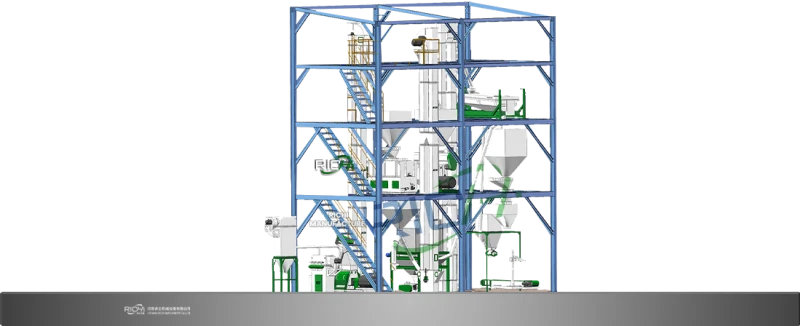
3-4 t/h animal feed production plant
A step up in both capacity and flexibility, this bracket fits regional farms supplementing their own feed supply, small distributors testing private-label production, and growers who’ve outpaced what they can buy locally at a reasonable price. Building constraints — low ceilings, narrow floor plans — show up more often at this size than people expect.
Equipment Cost: $50,000-120,000
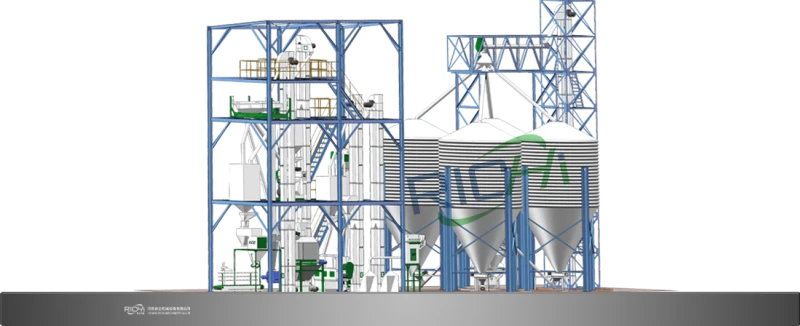
5-7 t/h animal feed pellet plant
This is the bracket we see the most volume in, honestly, across almost every type of buyer — small-to-mid commercial mills, regional integrators, cooperative operations splitting equipment costs across several farms. The wide budget range here reflects how differently two 5-7 t/h plants can be configured depending on automation level and raw material handling needs.
Equipment Cost: $70,000-250,000
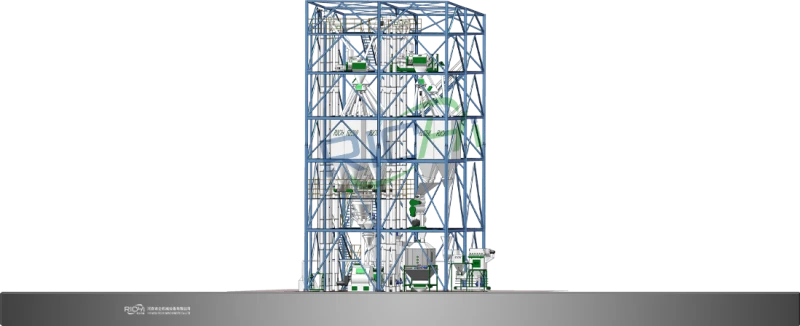
8-10 t/h animal feed processing plant
Mid-size feed mills land here, along with integrators managing several contract farms and distributors moving from reselling into producing their own formulas. Investment at this level usually assumes at least partial automation on batching, since manual dosing starts becoming a bottleneck once daily output crosses into double digits.
Equipment Cost: $150,000-300,000
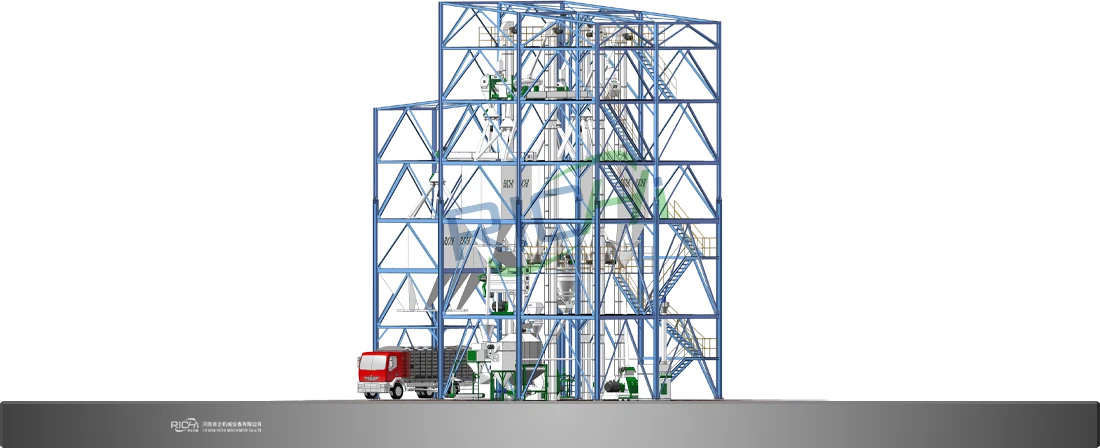
12-20 t/h feed preparation plant
Established regional mills scaling beyond a single market, and integrators supplying multiple grower contracts simultaneously, typically sit in this range. The jump in budget reflects more than just bigger equipment — storage capacity, conveying systems, and automation level all scale up together once you’re running 12+ tons an hour consistently.
Equipment Cost: $250,000-580,000
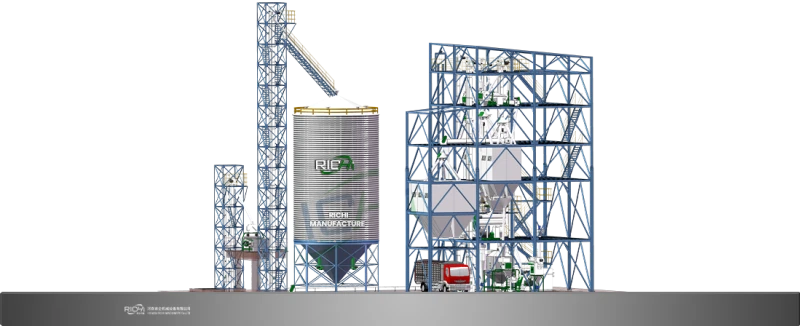
25-40 t/h feed pellet production line
Large-scale commercial producers running multi-shift operations fall here, often companies feeding sizable flock networks rather than a single farm. At this capacity, throughput planning matters as much as the equipment itself — bottlenecks at any single stage get expensive fast when you’re running this much volume daily.
Equipment Cost: $450,000-850,00
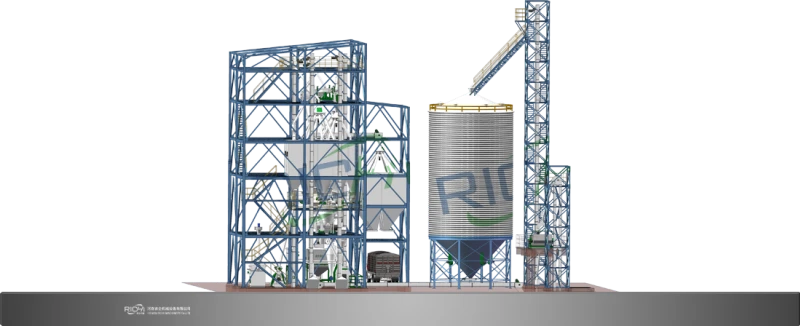
50-60 t/h commercial feed mill
This is industrial territory — large feed corporations and major regional producers with distribution networks that need this kind of consistent output. Budget here covers significant storage infrastructure and full automation as a baseline, not an upgrade option.
Equipment Cost: $900,000-1,400,000
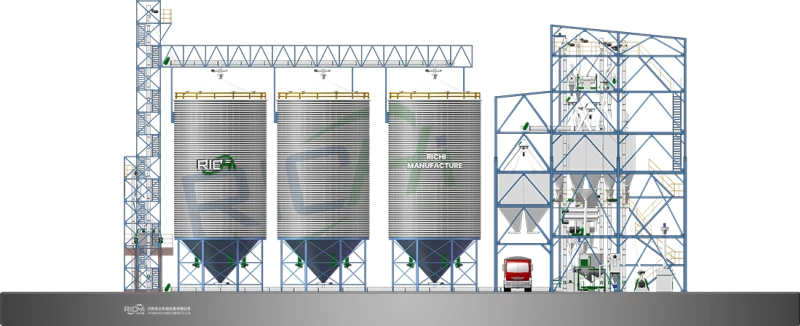
60-80t/h complete feed mill plant
Major poultry conglomerates and large industrial mills typically specify this range when they’re consolidating production across what used to be several smaller facilities. The investment jump from the previous bracket reflects redundancy requirements too — at this volume, equipment downtime isn’t a minor inconvenience.
Equipment Cost: $1,450,000-1,800,000
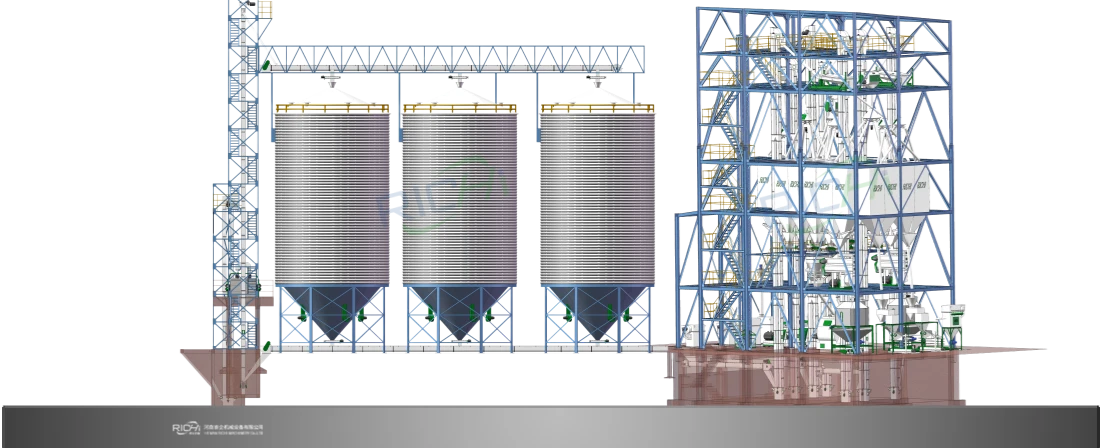
National-scale feed producers and export-oriented mills usually operate at this level, where the budget covers not just the production line but the storage and logistics infrastructure needed to keep raw material flowing in and finished feed moving out without interruption.
Equipment Cost: $2,000,000-3,000,000
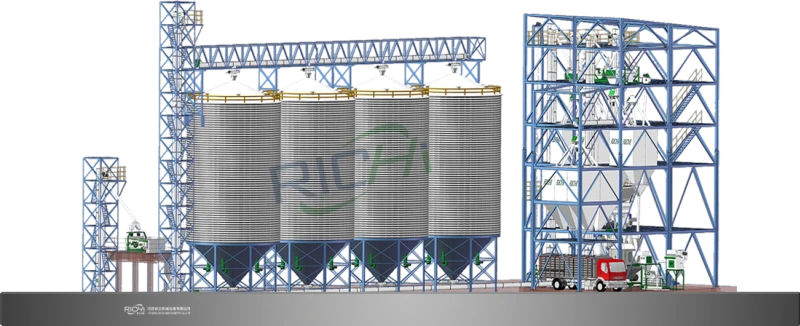
100-120 t/h feed mill engineering
The top of the range, generally reserved for multinational integrators and major exporters running plants that function more like industrial complexes than feed mills. Budget planning at this scale usually involves phased construction and equipment commissioning rather than a single installation event.
Equipment Cost: Over $2,500,000
What a Poultry Feed Plant Actually Costs
Every cost breakdown we put together starts the same way — separating what the equipment costs from everything else needed to actually get a poultry feed plant running. Buyers comparing quotes from different suppliers often look only at the line price and miss the rest of the bill entirely, and that gap is usually where budgets blow past what someone originally planned for.
Whole poultry feed plant set up investment : $80,000 – $40,000,000
Equipment Costs by Category :
Poultry feed plant grinder price :
$2,000-$20,000
Poultry feed plant mixer Price :
$1,500-$25,000
Poultry feed pellet machine Price :
$7,000-$95,000
Poultry feed plant cooler Price :
$2,000-$30,000
Crucrumbler & screener Price :
$2,000-$20,000
feed packaging machine Price :
$1,000-$40,000
Poultry feed plant conveyer Price :
$3,000-$60,000
cleaning equipment Price :
$1,500-$15,000
Dust removal equipment price :
$2,000-$30,000
Liquid or oil addition systems Price :
$1,500-$20,000
feed plant Storage silos Price :
$3,000-$200,000+
Control system & automation Price :
$5,000-$100,000
These ranges come from cross-referencing data across more than a thousand poultry feed plant projects we’ve quoted or built, not a single hypothetical scenario — which is exactly why the numbers above are ranges instead of fixed prices. Your actual cost depends on capacity, raw material, building condition, and local market factors that no general breakdown can account for. The more reliable way to get an actual number is to talk to us directly — we’ll put together a tailored equipment quote along with investment guidance and a business plan based on your specific situation, not a generic estimate.

What’s Actually Included When You Build With Us
Building a poultry feed plant usually involves more handoffs than people expect — a design firm, an equipment supplier, an installation contractor, sometimes three separate companies before the line ever runs.
We keep all of that under one roof instead. Design, manufacturing, installation, and after-sales support come from the same team throughout, which cuts down on the gaps where responsibility tends to get lost between vendors.
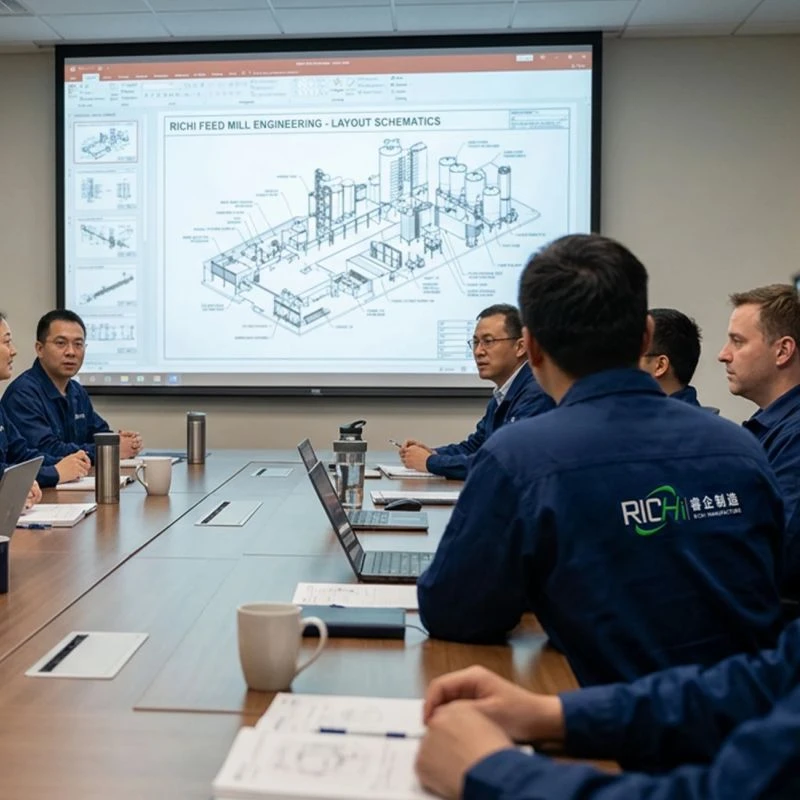
Design
Every project starts with civil drawings, not equipment drawings — building footprint, floor loading, ceiling height, and utility routing get worked out before a single machine goes on paper. Process flow is mapped against your actual raw material and formula rather than pulled from a generic template, and equipment layout gets built around your building instead of asking you to build around standard equipment dimensions. When a client needs something outside the standard catalog — a different equipment color, a modified die size, conveying designed around an unusual ceiling height.
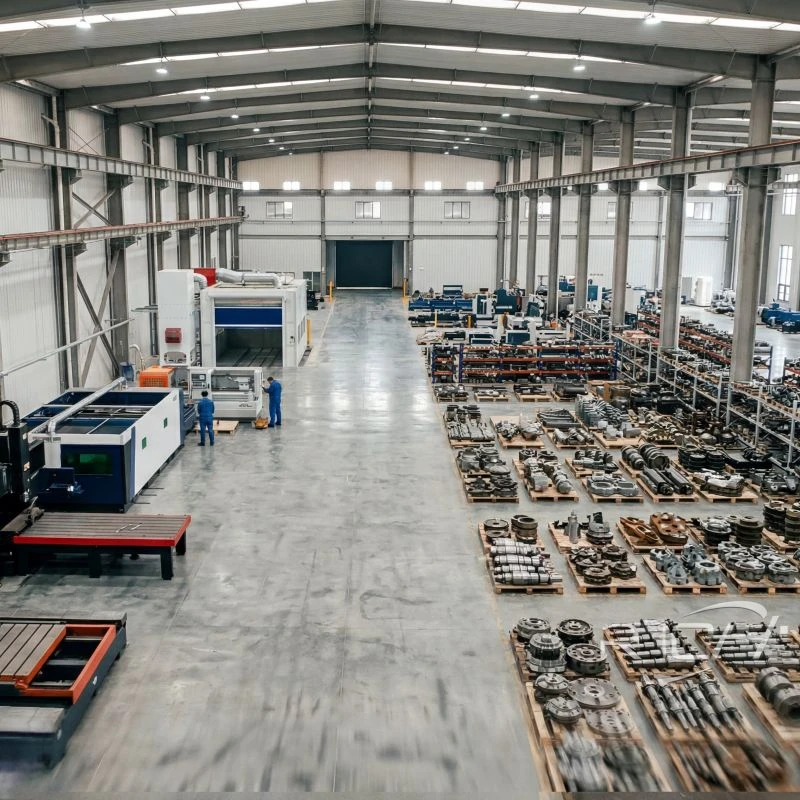
Manufacturing
Pellet mills, mixers, crushers, conveying systems — none of it gets outsourced to a third party and rebadged with our name on it. Manufacturing happens on our own production floor, holding patents on key equipment designs and carrying CE and ISO certification for international export. Production runs across a facility large enough to manufacture multiple complete plants at once, using CNC machining and automated welding lines for critical components rather than manual fabrication — part of why tolerance and consistency hold up across units shipped years apart.
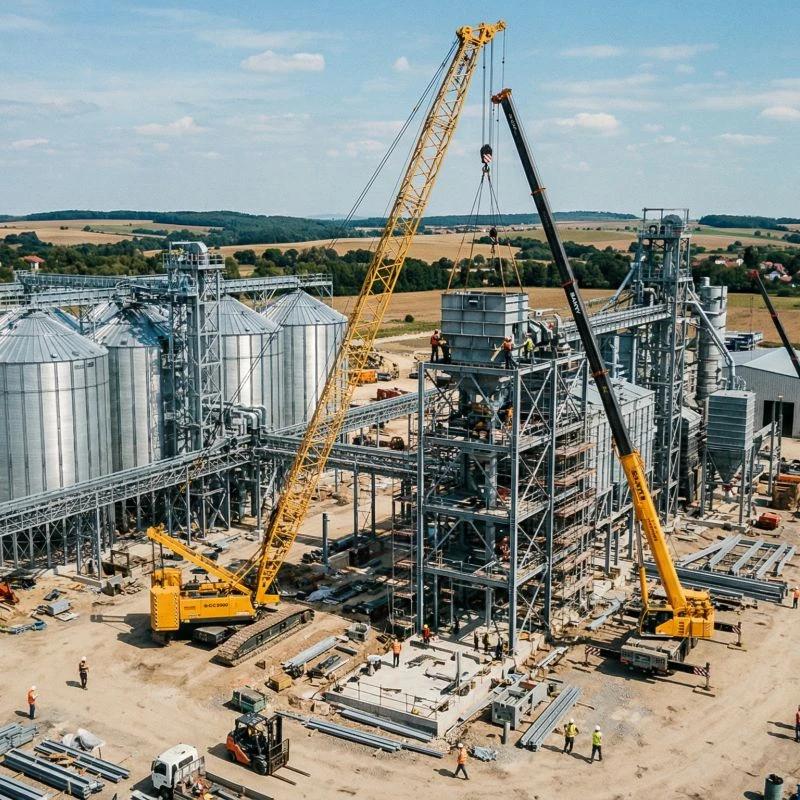
On Site, Not Remote
Installation supervision happens on site, with engineers present for equipment positioning, alignment, and electrical connection rather than running everything off a manual sent by email. Commissioning includes test runs using your actual raw material, not a generic sample, so formula-specific adjustments get caught before handover instead of after. Operator training covers daily operation, routine maintenance, and basic troubleshooting, usually conducted in the language the operating team actually speaks rather than relying on translated documentation alone.
After-Sales
Support doesn’t stop at handover. Spare parts stay available for the working life of the equipment, not just the first year or two, and technical support covers troubleshooting calls long after the warranty period closes. We’ve gone back to revisit plants years into operation — checking wear patterns, die condition, throughput against original spec — partly to catch what actually needs improving on the next design, not just as a courtesy call.
Free design Service
Most of the planning that goes into a poultry feed plant happens before any machine actually gets ordered, and none of that work gets billed separately. Cost estimates, technical drawings, layout planning — it’s all part of working out a proposal with us, and three of these don’t stop once the contract closes either.

Free Project Cost Estimate
Free Design Flow Chart
Free 3D Renderings & Drawing
Free Factory Area Planning
Free Circuit Diagram Design
Free Civil Engineering & Steel Structure Drawings
Free Remote Installation Guidance
Free Equipment Manual & Operation Guidance
The Equipment Behind Every Line We Build
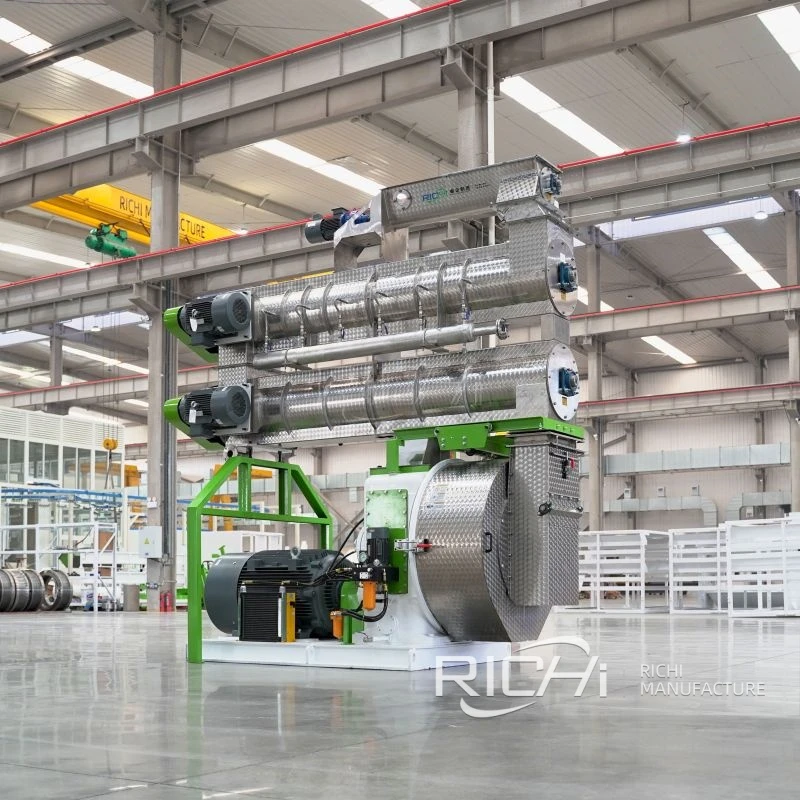
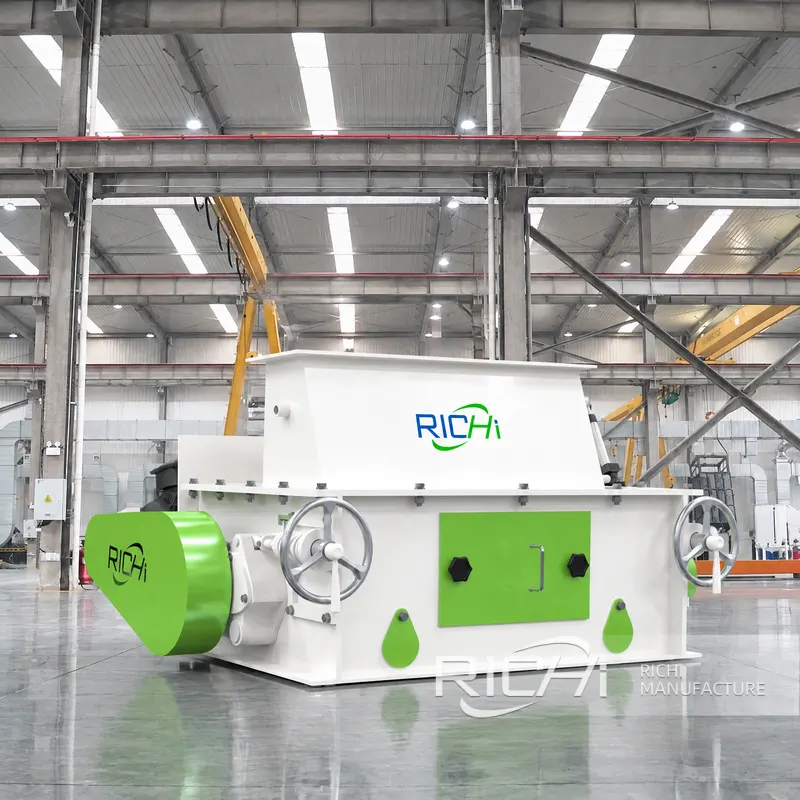
A complete poultry feed plant runs on more machinery than most buyers picture before they start specifying a line. Hammer mills handle the crushing, batching scales and mixers come next, and a ring die pellet mill sits at the center of the whole process.
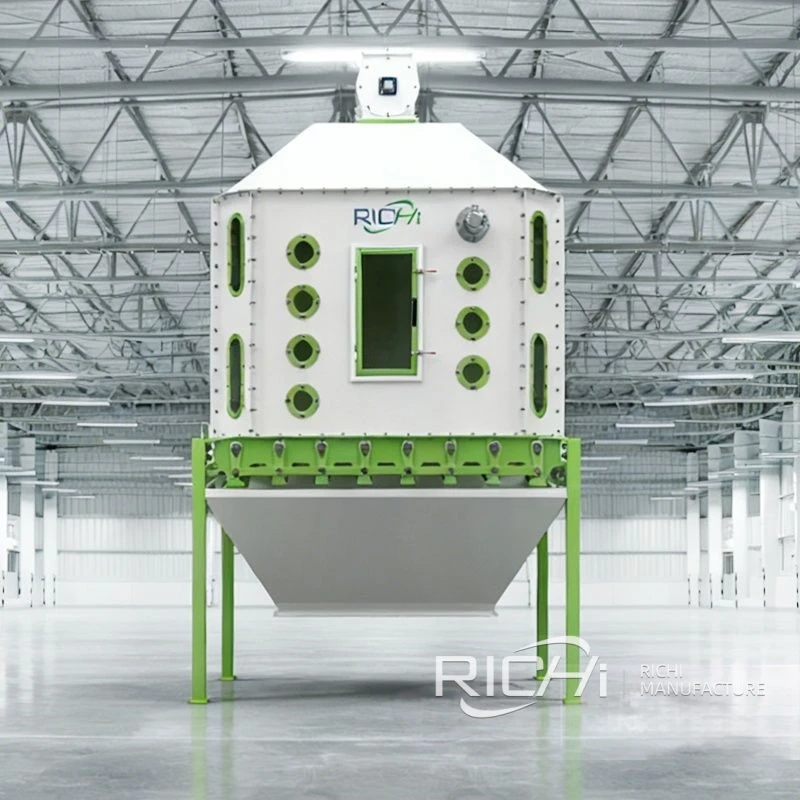
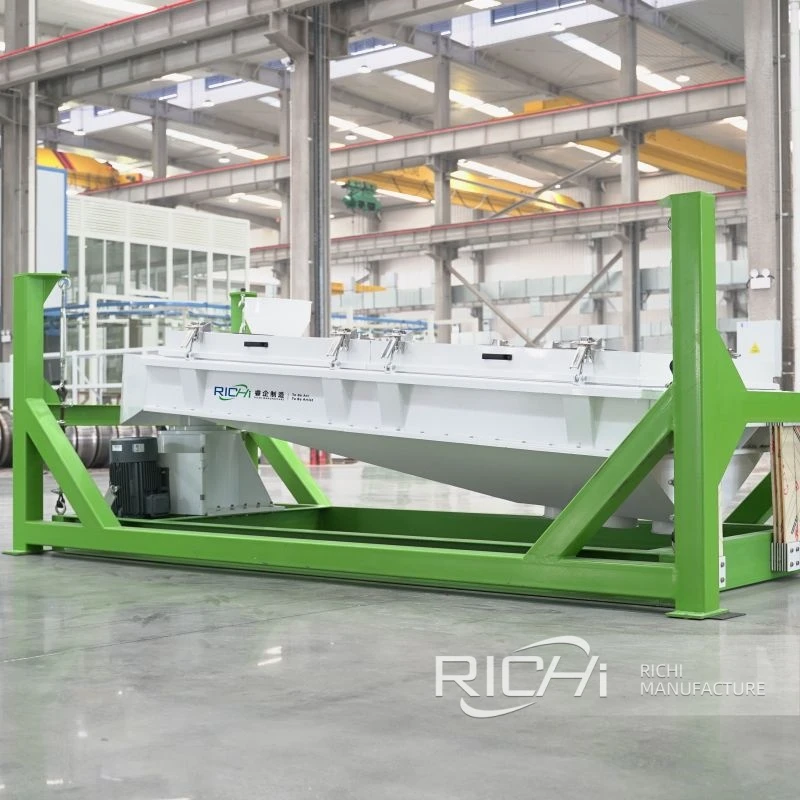
From there: counter-flow coolers, crumblers and vibrating screens for sizing, bagging scales or bulk loadout systems depending on how the finished feed leaves the plant.
Add in everything that actually moves material between stages — bucket elevators, screw and belt conveyors — plus cleaning sieves ahead of the crusher when raw material needs it, cyclone dust collectors, liquid spraying systems for oil or fat addition, steel storage silos, and the control cabinet running PLC automation behind all of it. Every piece on that list gets manufactured on our own production floor, not sourced from a third party and rebadged.
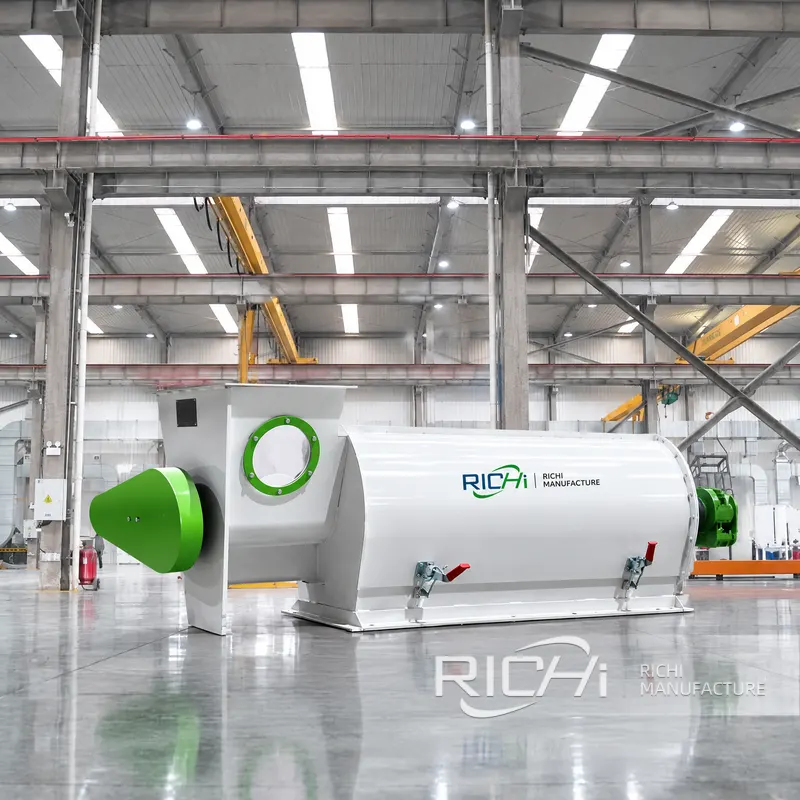
cleaning equipment
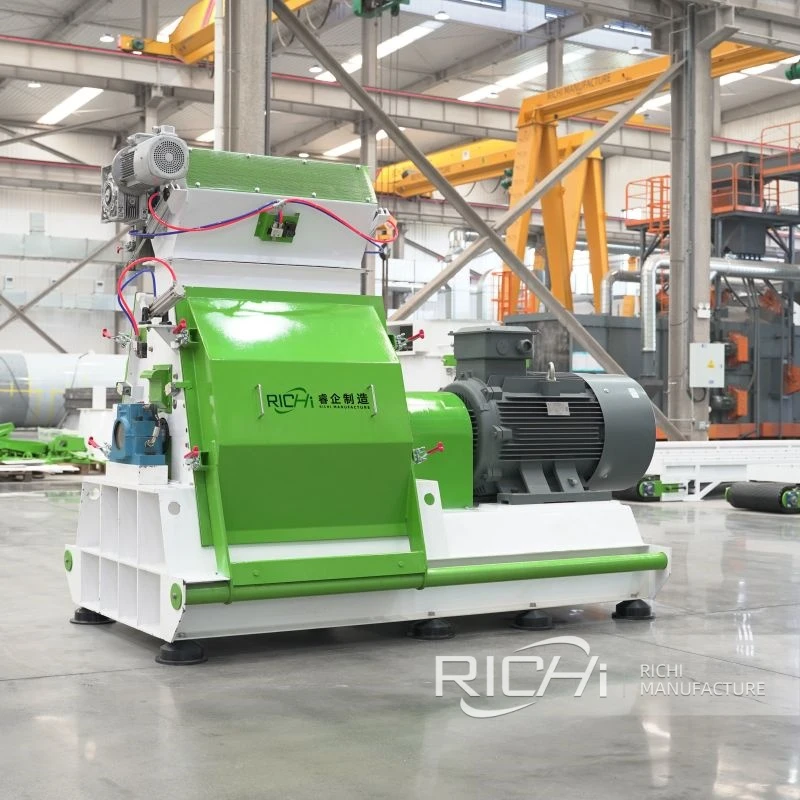
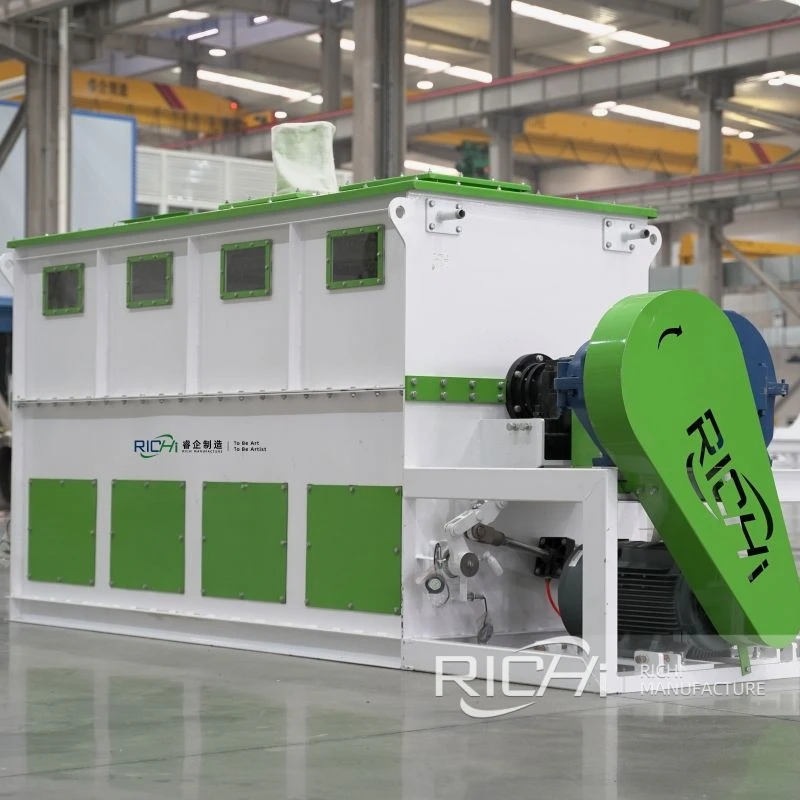
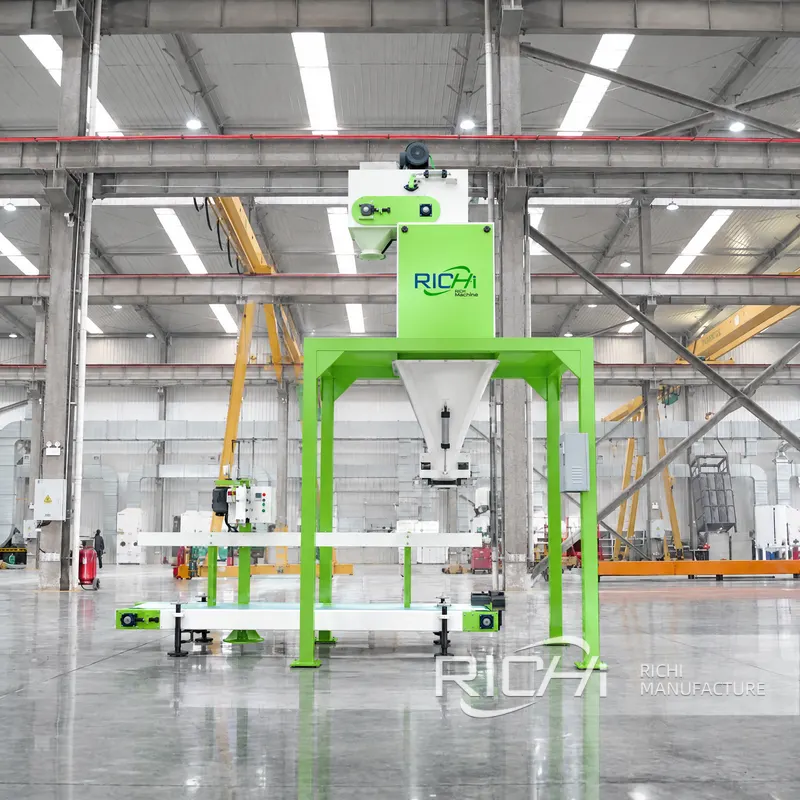
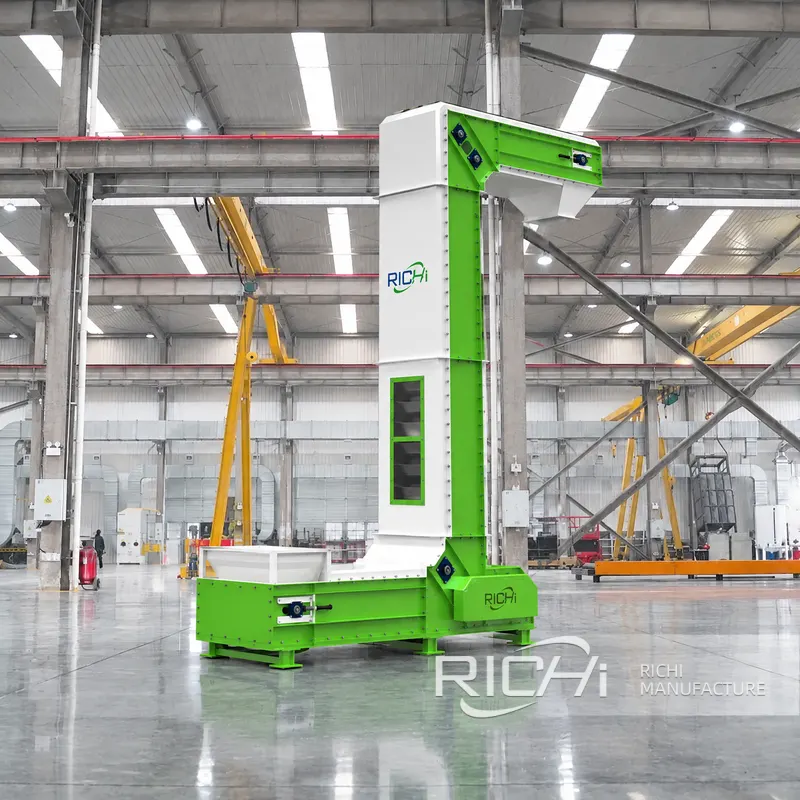
conveyor Machine
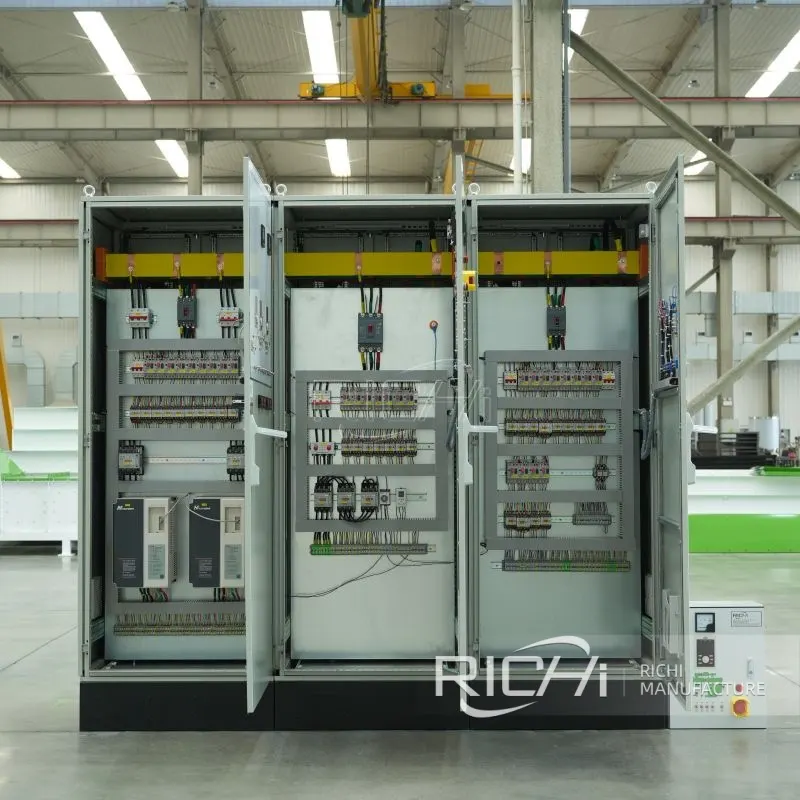
Electrical control cabinet
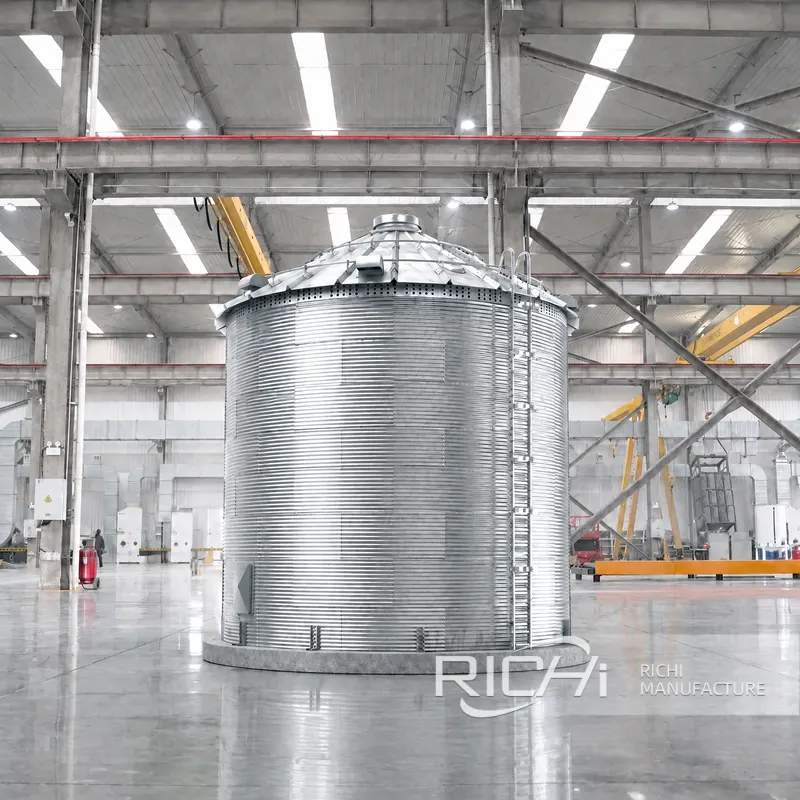
What’s shown above only covers part of the lineup — the full equipment list goes considerably deeper, with capacity ranges and configuration options for each machine.
Where the Real Margin Sits in Poultry Feed Production
Global protein demand keeps climbing, and chicken remains the cheapest animal protein to produce at scale — which is exactly why feed consumption keeps climbing right alongside it. Feed typically runs close to 70% of total broiler production cost, so operations still buying finished feed at retail markup are usually the first to feel pressure whenever grain prices move. Producing your own feed through a poultry feed plant isn’t just about trimming cost. It’s about controlling the one input that affects margin more than almost anything else in the operation.
Not every segment carries the same upside, either. Broiler feed moves the most volume, simply because turnover is faster than layers or breeders — but margins there run thinner, too, since every other producer in the region is chasing the same grower contracts. Layer feed demand moves slower but more predictably, tied to a regional flock size that doesn’t swing the way broiler placements do.
The segment with genuinely interesting margin per ton tends to be specialty feed — duck, quail, breeder rations — lower volume, but far fewer suppliers actually configure equipment for it. The angle most buyers miss, though, isn’t which segment to chase. It’s that a line locked into just one format competes against everyone else’s identical line. The same equipment configured to also run mash, crumble, or even a livestock or fish formula on the side picks up business a single-format plant simply can’t take on — which is usually worth working through before a design gets finalized, not after.
Talk to Us About Maximizing Your Production Line
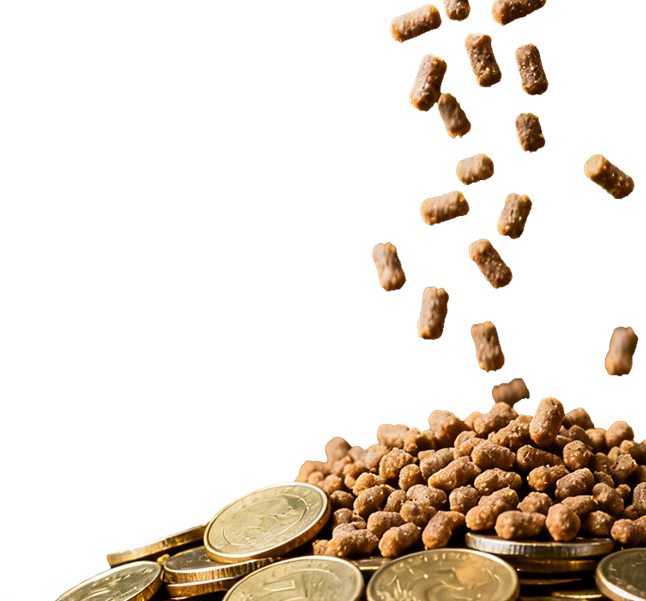
Poultry Feed Types & Customized Processing Solutions
Every poultry feed project starts with two critical factors: raw materials and feed formulation. Around the world, poultry feed is commonly produced from corn, wheat, soybean meal, rice bran, wheat bran, sunflower meal, rapeseed meal, DDGS, cassava meal, fish meal, meat and bone meal, limestone, dicalcium phosphate, salt, amino acids, vitamins, minerals, oils, and various feed additives. In some regions, we also encounter alternative ingredients such as sorghum, millet, palm kernel meal, copra meal, insect protein, brewery by-products, and agricultural processing residues.
As an experienced feed equipment manufacturer and turnkey engineering provider, RICHI does much more than supply machines. We design complete production processes based on each customer’s available raw materials, feed formulas, pellet specifications, capacity requirements, and market objectives. Whether you are producing conventional broiler feed, high-calcium layer feed, waterfowl feed, or specialty poultry diets using locally available ingredients, our engineering team can customize the most suitable poultry feed production solution to maximize efficiency, pellet quality, and production profitability.

Corn

Soybean Meal

Wheat
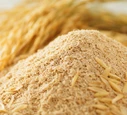
Rice Bran

Rapeseed Meal

Fish Meal

Limestone
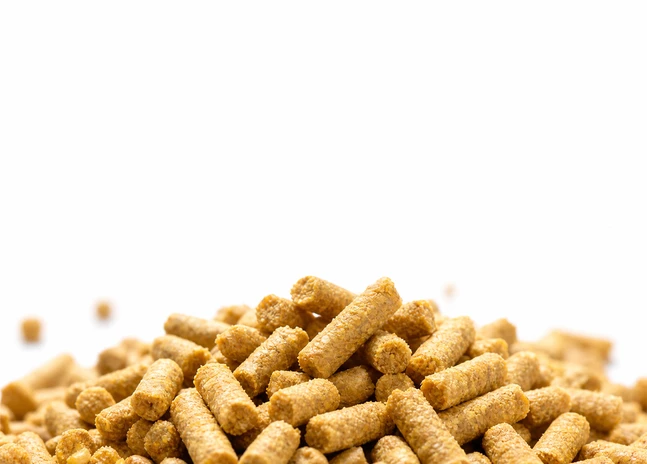
Broiler Feed
Broiler feed focuses on rapid growth, efficient feed conversion, and uniform pellet quality. Typical ingredients include corn, soybean meal, wheat, vegetable oil, limestone, vitamins, and amino acid supplements. Depending on bird age, pellet sizes generally range from 2 mm to 4 mm.
In projects across Asia, Africa, and Latin America, we have also processed broiler feeds containing cassava meal, sorghum, DDGS, and other cost-reducing ingredients. Our systems are designed to handle varying formulations while maintaining stable pellet durability and production efficiency.
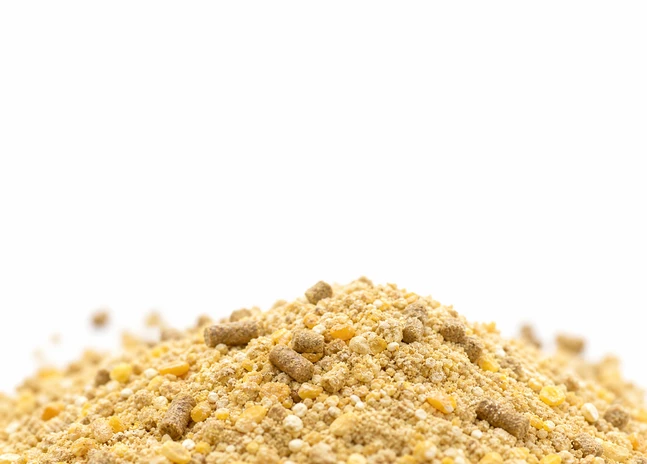
Layer Feed
Layer feed requires balanced nutrition to support egg production, eggshell strength, and bird health. Formulations typically contain higher levels of limestone and calcium sources, along with corn, soybean meal, wheat bran, and vitamin-mineral premixes.
Depending on market preferences, feed may be produced as mash, crumble, or pellets ranging from 2 mm to 4 mm. We frequently help customers optimize production processes for high-calcium formulations that can be challenging for standard feed equipment.
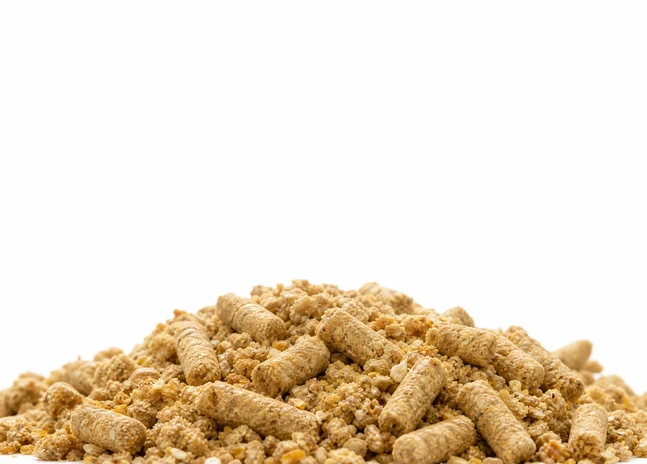
Duck Feed
Duck feed often contains higher energy levels and may incorporate ingredients such as rice bran, broken rice, corn, soybean meal, fish meal, and local agricultural by-products. Pellet sizes commonly range from 2 mm to 5 mm depending on growth stage.
In Southeast Asia and other duck-producing regions, we have worked with numerous feed formulas that utilize locally available raw materials while maintaining excellent pellet quality and feed performance.
Discover Duck Feed Systems
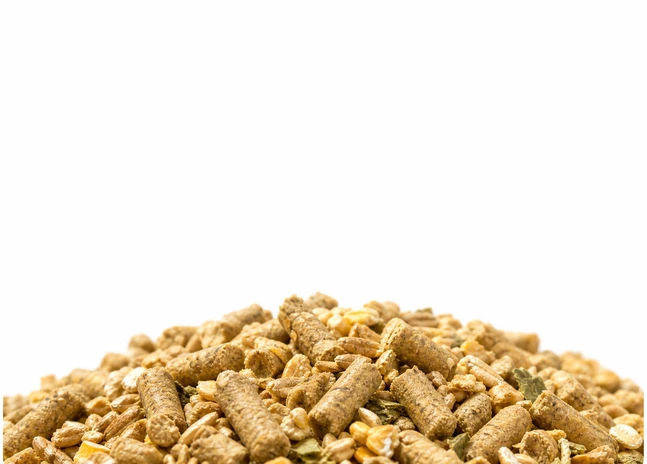
Goose Feed
Goose feed production frequently incorporates larger amounts of fiber-rich ingredients, including grass meal, alfalfa meal, wheat bran, and various forage materials alongside conventional grains and protein sources. Feed can be supplied as mash or pellets, typically between 3 mm and 6 mm.
Our engineering team has extensive experience designing systems capable of handling both traditional concentrate feeds and formulations containing significant forage components.
Learn About Goose Feed Processing
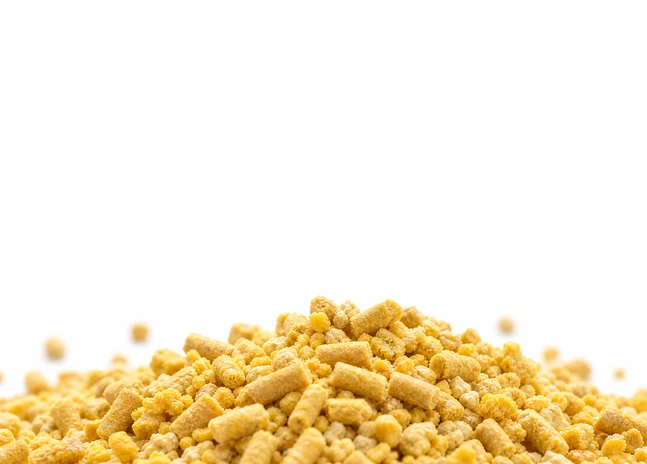
Turkey Feed
Turkey feed demands high nutritional density, especially during early growth stages. Common ingredients include corn, soybean meal, wheat, vegetable oil, amino acids, and specialized additives. Pellet sizes may vary from micro-pellets for poults to larger pellets for mature birds.
We have supplied turkey feed production systems capable of producing multiple pellet specifications within a single facility to meet changing nutritional requirements throughout the production cycle.
View Turkey Feed Solutions
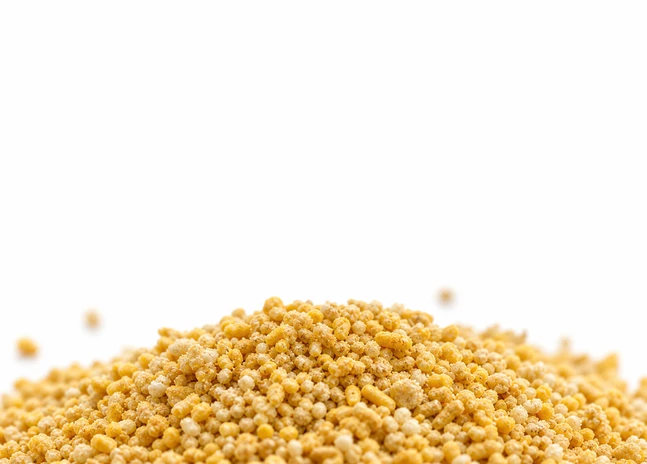
Quail Feed
Quail feed typically requires smaller pellet sizes and highly precise nutrient control. Formulations often include corn, soybean meal, fish meal, wheat, limestone, and specialized premixes. Pellet diameters commonly range from 1.5 mm to 3 mm.
Many quail feed producers also require the flexibility to manufacture both powder and pellet products, which is why our production lines are engineered to support multiple product formats with minimal changeover time.
Explore Quail Feed Production
Typical Poultry Feed Formulations Used Worldwide
Grower Broiler Feed Formula
Corn
58%
Soybean Meal
28%
Wheat Bran
5%
Vegetable Oil
4%
Limestone & Premix
5%
…
…
Layer Feed Formula
Corn
52%
Soybean Meal
20%
Wheat Bran
10%
Limestone
12%
Premix & Additives
6%
…
…
Duck Feed Formula
Corn
45%
Rice Bran
20%
Soybean Meal
18%
Fish Meal
8%
Premix & Minerals
9%
…
…
Goose Feed Formula
Corn
35%
Alfalfa Meal
20%
Wheat Bran
15%
Soybean Meal
18%
Premix & Minerals
12%
…
…
Turkey Feed Formula
Corn
55%
Soybean Meal
30%
Vegetable Oil
5%
Wheat
4%
Premix & Minerals
6%
…
…
Quail Feed Formula
Corn
50%
Soybean Meal
25%
Fish Meal
10%
Wheat Bran
7%
Premix & Minerals
8%
…
…
Feed formulas vary by species, age, production goals, raw material availability, and local market conditions. Over the years, RICHI has worked with customers processing a wide range of poultry feed formulations using both conventional and alternative ingredients. This practical experience allows us to design equipment and production processes that accommodate different ingredient characteristics, grinding requirements, conditioning parameters, and pellet quality standards.
Poultry Feed Plant FAQs
Can you design a poultry feed plant around my existing building instead of requiring a new workshop?
+
Yes. This is one of the most common requests from commercial feed producers. Before recommending any equipment, our engineers evaluate your building dimensions, column locations, floor loading capacity, material flow, and future expansion plans. In many cases, we can customize the poultry feed plant layout to fit an existing facility, significantly reducing construction costs and project timelines.
My workshop height is only 8-10 meters. Can a complete poultry feed plant still be installed?
+
Usually yes. While taller buildings provide more layout flexibility, many poultry feed plant projects are installed in facilities with height restrictions. We can optimize equipment arrangement, select suitable conveying systems, and redesign the process flow to maximize available space without sacrificing production efficiency.
Do I need to build pits or underground structures for the receiving section?
+
Not necessarily. Whether a pit is required depends on your raw material receiving method and site conditions. Many customers prefer pit-free designs to reduce civil engineering costs and avoid drainage issues. We can offer both traditional pit-type and above-ground receiving solutions for a poultry feed plant.
We produce several feed formulas every day. How do you prevent cross-contamination between batches?
+
For customers producing layer feed, broiler feed, breeder feed, or medicated feed, cross-contamination control is critical. We address this through optimized batching systems, low-residue mixers, proper conveying design, and intelligent sequencing. The solution depends on your production requirements and quality standards.
Can your poultry feed plant handle difficult raw materials with poor flowability?
+
Yes. Many customers use challenging ingredients such as DDGS, wheat bran, rice bran, cassava meal, sunflower meal, cottonseed meal, feather meal, or high-moisture by-products. We customize storage, feeding, grinding, mixing, and pelleting systems according to the physical characteristics of your raw materials to ensure stable operation.
Is it possible to upgrade an existing feed mill without replacing the entire production line?
+
Absolutely. Many of our projects involve modernization rather than complete replacement. Depending on the condition of your current equipment, we can upgrade individual sections such as grinding, batching, mixing, pelleting, cooling, or automation systems while retaining usable equipment to reduce investment costs.
How can I accurately estimate the return on investment for a new poultry feed plant?
+
ROI depends on production volume, raw material costs, labor savings, feed quality improvements, and local market demand. During the project planning stage, our engineers help customers evaluate production economics and select the most cost-effective configuration rather than simply recommending the largest system.
What level of automation do I really need for a modern poultry feed plant?
+
Not every project requires full automation. Some customers prioritize labor reduction, while others focus on formula accuracy or traceability. We offer solutions ranging from semi-automatic systems to fully automatic poultry feed plants with PLC control, automatic batching, production monitoring, and data management functions.
How do you ensure the poultry feed pellet mill can achieve the required capacity continuously?
+
The rated output of a pellet mill alone does not determine actual plant performance. We evaluate the entire production process, including grinding fineness, conditioning efficiency, raw material characteristics, die configuration, cooling capacity, and conveying systems. This ensures the poultry feed plant can maintain stable production over long operating periods.
If my business grows, can the poultry feed plant be expanded without major reconstruction?
+
Yes. Many successful feed producers begin with a moderate capacity and expand later. During the initial design phase, we can reserve space, electrical capacity, conveying routes, and control interfaces for future equipment additions. This allows capacity expansion with minimal disruption to ongoing production.
We are replacing European equipment. Can your machinery integrate with our existing systems?
+
In many cases, yes. We have experience upgrading and expanding feed mills that previously used equipment from European, Turkish, South American, and local manufacturers. Our engineers can evaluate compatibility requirements for conveyors, bins, batching systems, pellet mills, and control systems to develop a practical integration plan.
What information should I prepare before requesting a poultry feed plant quotation?
+
The more information available, the more accurate the solution will be. Ideally, customers provide:
- Target capacity (T/H)
- Feed types and formulas
- Raw material list
- Existing building drawings (if available)
- Automation requirements
- Local power supply information
- Future expansion plans
With these details, our engineering team can develop a customized poultry feed plant solution rather than a generic equipment quotation.
How much does a poultry feed plant cost?
+
The poultry feed plant price depends on capacity, automation level, feed type, and equipment configuration. A small farm-scale system and a large fully automatic poultry feed plant require very different investments. RICHI provides customized quotations based on your actual requirements, ensuring you only pay for the equipment you need while maintaining room for future expansion.
I only need 1-2 T/H. Is a complete chicken feed plant worth it?
+
Yes. Many customers start with 1-2 T/H and later expand production. A properly designed chicken feed plant can improve feed quality, reduce labor costs, and increase profitability from day one. We can also reserve expansion interfaces for future growth.
Can one poultry feed plant produce feed for both broilers and layers?
+
Absolutely. A modern poultry pellet feed plant can produce feed for broilers, layers, breeders, ducks, geese, quails, and other poultry species. Formula changes can be completed through the batching and mixing system without major equipment modifications.
Which raw materials can your poultry feed plant machinery handle?
+
Our poultry feed plant machinery can process corn, soybean meal, wheat, sorghum, rice bran, sunflower meal, cassava meal, DDGS, fish meal, meat and bone meal, premixes, vitamins, minerals, and many local agricultural by-products. We customize the process according to your available raw materials.
How many workers are needed to operate an automatic poultry feed plant?
+
A modern automatic poultry feed plant requires surprisingly few operators. Depending on capacity, most projects can be managed by only 2-6 workers per shift thanks to PLC automation, automatic batching, intelligent control systems, and centralized monitoring.
Can a poultry feed plant from RICHI handle different bird types and unusual raw materials, or just standard broiler formulas?
+
Broiler gets requested the most, but it’s far from the only thing our poultry feed plant designs get built around. Layer feed runs a completely different calcium load — limestone alone can sit at 8-10% of the formula instead of barely 1% in broiler feed — and that shifts mixing and storage requirements more than people expect going in. Duck and goose feed lean on fiber tolerance most chicken formulas can’t handle: rice bran, alfalfa meal, sometimes sugar beet pulp, depending on what’s locally available and cheap to source. Turkey starter feed needs protein up around 28%, the highest of the group, while quail feed needs particle sizes under 1.5mm simply because the birds are small enough that anything coarser ends up wasted on the feeder floor.
What actually makes the difference isn’t knowing these numbers exist — it’s adjusting the equipment around them, project by project. Our engineers reworked crushing and mixing settings for a client in Algeria running barley and wheat bran instead of the usual corn-soy base, since their local grain supply didn’t include much soybean to begin with. A duck feed line we built in Malaysia needed rice bran handled at a higher inclusion rate than we’d normally configure for, because that’s the regional byproduct actually available there. A combined poultry-cattle plant in Kazakhstan needed formula and die changeover engineered in from day one rather than retrofitted later, since mixed livestock operations are common across that market.
None of that comes off a catalog spec sheet. It comes from having engineered enough of these lines, across enough raw material situations, that an unusual formula request stops being unusual. If your raw material or bird type doesn’t fit a standard configuration, that’s exactly the kind of project worth bringing to us directly — working out the right crushing, mixing, and conditioning setup before committing to equipment is the part that actually matters.
What’s the actual difference between a poultry pellet line, a mash line, and a premix line?
+
All three process flows pull from the same family of equipment, but they diverge in ways that matter the moment you’re actually committing to a poultry feed plant order, not just reading a flowchart. A standard pellet line runs the full sequence — receiving, cleaning, crushing, batching, mixing, pelletizing, cooling, crumbling, sieving, packaging — and the finished product comes out dense and durable, built to hold together through transport and storage. Mash feed cuts that sequence short: receiving, cleaning, crushing, batching, mixing, straight to packaging, with no pelleting stage at all. Lower equipment cost, but the finished product handles and stores differently than pellets do, which matters more than people expect once it’s sitting in a warehouse for a few weeks.
Premix runs on a different track entirely — raw material pre-treatment, batching, mixing, then packing and storage — and even though that sequence looks almost identical to the mash process on paper, the equipment underneath isn’t interchangeable. Premix mixing typically runs on stainless steel rather than standard carbon steel, partly for hygiene and partly because micro-ingredient carryover between batches becomes a real problem on standard mixer surfaces at the inclusion rates premix actually runs at.
One detail that catches buyers off guard: a mash and pellet line can share most of the same equipment right up through mixing, with the powder simply diverted to packaging before it ever reaches the pelletizer — which is exactly how we configured a 10 t/h plant for a client in Uganda who needed both formats running off a single footprint instead of two separate lines. We’ve built dedicated stainless premix systems for export clients with stricter hygiene requirements too, since that’s not a stage most poultry feed plant buyers think to ask about until a food safety auditor brings it up. If you’re not sure which of these three process flows actually fits your output goals, that’s worth working through with our engineers before locking in equipment.
What’s the actual difference between a poultry pellet line, a mash line, and a premix line?
+
All three pull from the same family of equipment, but they diverge enough to matter once you’re actually committing to a poultry feed plant order — not just reading a flowchart.
| Process Type | Production Steps | Finished Product |
|---|---|---|
| Pellet Line | Receiving → Cleaning → Crushing → Batching → Mixing → Pelletizing → Cooling → Crumbling → Sieving → Packaging | Dense, durable pellets built to hold together through transport and storage |
| Mash Line | Receiving → Cleaning → Crushing → Batching → Mixing → Packaging | Loose powder feed, lower equipment cost, but handles and stores differently than pellets over time |
| Premix Line | Raw Material Pre-treatment → Batching → Mixing → Packing and Storage | Concentrated vitamin/mineral blend, mixed into a base ration at low inclusion rates |
A few things worth knowing before picking one:
- Premix mixing typically runs on stainless steel rather than standard carbon steel — partly for hygiene, partly because micro-ingredient carryover between batches becomes a real problem on standard mixer surfaces at the inclusion rates premix runs at.
- A mash and pellet line can actually share most of the same equipment right up through mixing, with the powder simply diverted to packaging before it reaches the pelletizer. That’s exactly how we configured a 10 t/h plant for a client in Uganda who needed both formats running off one footprint instead of two separate lines.
- We’ve also built dedicated stainless premix systems for export clients with stricter hygiene requirements — not a stage most poultry feed plant buyers think to ask about until a food safety auditor brings it up.
If you’re not sure which of these three process flows actually fits your output goals, that’s worth working through with our engineers before locking in equipment.
How many different configurations of poultry feed plant can RICHI actually build?
+
More than most buyers expect going in — configuration depends on far more than just tonnage. Equipment, layout, and automation level all get matched to what you’re actually trying to produce.
By Animal Type
| Category | Examples |
|---|---|
| Single-species poultry lines | Chicken feed plant, duck feed plant, goose feed plant, quail feed plant, turkey feed plant, pigeon feed plant |
| Compound (multi-species) lines | Poultry & cattle feed plant, poultry & fish feed plant, poultry & ruminant feed plant, poultry & shrimp feed plant |
| By processing method | Poultry feed pelleting plant, poultry extruded feed plant |
By Product Form
- Poultry pellet feed plant
- Poultry mash feed plant
- Poultry premix plant
- Poultry concentrate feed plant
By Automation Level
- Manual poultry feed plant
- Semi-automatic poultry feed plant
- Fully automatic poultry feed plant
- PLC-controlled poultry feed plant
Capacity, Cost, and Application Range
| Factor | Range |
|---|---|
| Capacity | 1-160 t/h |
| Investment Cost | $10,000-$5,000,000 USD |
| Application | One poultry feed type, multiple poultry feed formats, or combined poultry-and-livestock/aqua production |
What ties all of this together: we manufacture every piece of equipment ourselves — we’re not reselling someone else’s line under our name. Beyond that, our team functions as general contractor, engineer, steel fabricator, and construction millwright on a single project, covering transportation, installation, commissioning, training, and after-sales tracking from one source rather than coordinating across separate vendors.
Our business scope covers new poultry feed plant construction, expansion of an existing facility, and transformation of older lines into something closer to current production needs. If your project doesn’t fit neatly into one category above, that’s normal — most of what we build ends up being some combination of the categories rather than a single standard configuration, and that’s exactly the kind of project worth discussing directly with our engineering team.
What’s actually included in a poultry feed plant at different capacities, and what does each one cost?
+
Across more than a thousand client projects, it’s rare to deliver two identical configurations — capacity, finished product type, and raw material all push the design in a different direction each time. Five representative builds below give a sense of what changes and what stays consistent.
Investment Cost by Capacity
| Capacity | Investment Cost (USD) |
|---|---|
| 3-4 t/h | $100,000-$120,000 |
| 10 t/h | $300,000-$350,000 |
| 20 t/h | $580,000-$600,000 |
| 30 t/h | $700,000-$800,000 |
| 60 t/h | $1,400,000-$1,500,000 |
Core Systems Included
These run consistently across every capacity on this list:
- Raw material receiving and pre-cleaning system
- Crushing system
- Batching and mixing system
- Pelletizing, cooling, and screening system
- Packing and dust-collecting system
- MCC control center with mimic control panel
- Cables and cable bridge tube
From 10 t/h upward, the configuration typically adds:
- Bulk bin storage system
- Oil-adding system
- Computer-controlled batching system
From 20 t/h upward, it usually picks up two more:
- Auxiliary system
- CPP computer control system
Output by Feed Stage
| Feed Stage | Particle Size | 3-4 t/h | 10 t/h | 20 t/h | 30 t/h | 60 t/h |
|---|---|---|---|---|---|---|
| Chick starter (0-10 days) | 1.0-1.5mm | 1-1.5 t/h | 5-6 t/h | 10-12 t/h | 15-16 t/h | 40-42 t/h |
| Grower (10-30 days) | 2.5-3.0mm | 2-3 t/h | 8-10 t/h | 16-20 t/h | 28-30 t/h | 56-60 t/h |
| Finisher (30-45 days) | 3.5-4.0mm | 3-4 t/h | 10-12 t/h | 18-22 t/h | 30-32 t/h | 60-64 t/h |
| Layer / mash feed | Powder | 4-5 t/h | 12-15 t/h | 22-24 t/h | 30-35 t/h | 60-70 t/h |
Notice the output numbers shift depending on which product the line is running — a 10 t/h poultry feed plant isn’t actually producing 10 tons of every feed type equally; chick starter throughput runs lower than finisher throughput on the same equipment, since finer grinding and smaller pellet sizing simply take longer to process per ton. That’s the kind of detail that doesn’t show up on a basic spec sheet but matters once you’re planning daily output against flock size.
None of these five are templates meant to be used as-is — they’re starting references. If your raw material, building footprint, or product mix doesn’t match one of them exactly, that’s the normal case rather than the exception, and it’s worth running the numbers with our team directly before finalizing a configuration.
What do real poultry feed plant projects in different countries actually look like — capacity, cost, and build time?
+
Twenty snapshots from different markets, different feed sizes, and wildly different timelines — which is exactly the point. No two of these came out identical, even when the capacity numbers look close on paper.
| Project | Feed Size | Build Time | Cost (USD) | Completed |
|---|---|---|---|---|
| Russia — 5 t/h fish feed & 10 t/h poultry feed plant | 1-5mm pellets | 6 months | $1,350,600 | Sep 2022 |
| Russia — 7-8 t/h sunflower seed meal poultry feed plant | 2-4mm pellets | 2 months | $150,300 | Oct 2022 |
| Kazakhstan — 5-6 t/h poultry chicken feed plant | 2-4mm pellets | 2 months | $92,600 | Dec 2022 |
| Ethiopia — 5-6 t/h poultry feed plant | Powder feed | 3 weeks | $84,900 | Nov 2019 |
| Algeria — 6-10 t/h poultry feed plant | 2-6mm pellets | 8 months | $80,000-$400,000 | Sep 2015 |
| Uzbekistan — 10-15 t/h chicken poultry feed mill plant | 2-5mm pellets | 1 year | $150,000-$400,000 | Jul 2019 |
| Peru — 5 t/h poultry feed plant | 3-6mm pellets | 5 months | $220,000-$250,000 | Feb 2021 |
| Malaysia — 3-5 t/h poultry feed plant | 2-4mm pellets | 4 months | $60,000-$65,000 | Oct 2021 |
| El Salvador — 5 t/h poultry premix feed plant | Powder | 6 months | $480,000 | Sep 2022 |
| Thailand — 10 t/h poultry premix plant | Powder | 8 months | $120,000 | Jul 2021 |
| China — 30-40 t/h chicken feed plant | 2-6mm pellets & powder | 14 months | $960,000 | Jun 2019 |
| China — 35-40 t/h chicken, duck & goose feed plant | Powder & 1.5-8mm pellets | 9 months | $1,250,000 | Dec 2018 |
| Nigeria — 1-2 t/h livestock and poultry feed plant | 2-4mm pellets | 30 days | $25,000-$29,000 | Jun 2020 |
| Afghanistan — 16 t/h livestock and poultry feed plant | 2-8mm pellets | 11 months | $500,000 | Dec 2020 |
| Russia — 5-7 t/h cattle and poultry feed plant | 2-10mm pellets | 2 months | $97,160 | Jun 2022 |
| Uzbekistan — 10 t/h livestock, cattle & chicken feed plant | 2-8mm pellets | 7 months | $460,000 | Sep 2018 |
| Argentina — 5 t/h cow, goat & poultry feed plant | 2-10mm pellets | 6 months | $184,500 | Oct 2021 |
| New Zealand — 5-10 t/h aqua and poultry feed plant | 1.5-6mm pellets | 4 months | $131,820 | Oct 2022 |
| Uganda — 15 t/h chicken feed plant | 2-3mm pellets | 9 months | $159,070 | Jun 2022 |
| USA — 20 t/h ruminant and poultry feed plant | 2-10mm pellets | 10 months | $550,000 | May 2019 |
A few patterns worth noticing across that list: build time doesn’t track capacity in any straight line — Ethiopia’s 5-6 t/h plant went up in three weeks, while Uzbekistan’s 10-15 t/h project took a full year, mostly because building construction and import logistics added far more time than the equipment itself did.
Cost spreads the same way — two plants at nearly identical tonnage can land tens of thousands of dollars apart depending on automation level, feed size range, and how many species the line needs to handle on top of poultry.
RICHI has commissioned more than 200 complete design-build poultry feed plant projects over the past decade, engineered to multi-standard compliance including OSHA and NFPA, with a design and engineering team built from people who’ve spent decades in feed machinery specifically — not generalists who picked up feed equipment as one product line among many. If you want to see where your own project would land on a list like this, that’s worth running through with us directly rather than estimating from a table alone.
What are the capacity and power specs for the individual machines that go into a poultry feed plant?
+
A few specifics, machine by machine — these are the core building blocks behind any poultry feed plant we design, before they get sized and matched to your actual throughput target.
| Machine | Capacity | Main Power |
|---|---|---|
| Hammer mill grinder | 3-25 t/h | 30-160 kW |
| Feed mixer | 250-2,000 kg per batch | 4-55 kW |
| Poultry feed pellet making machine | 1-48 t/h | 22-315 kW |
| Poultry feed extruder | 1-12 t/h | 0.75-355 kW |
| Pellet cooler machine | 3-25 t/h | 30-160 kW |
| Crumbler machine | 3-8 t/h | 2-3 roller sets |
| Vibrating screening machine | 3-20 t/h | 1.5-5.5 kW |
| Automatic bagging machine | 6-12 bags/min | 1.1-5 kW |
The wide range on each line isn’t vagueness — it reflects different model sizes within the same machine type, picked based on what capacity the rest of your line is running at. A hammer mill spec’d for a 3 t/h plant and one spec’d for a 25 t/h plant share a category but not much else in terms of motor size or frame.
What doesn’t show up in a table like this is scale. A complete 1-160 t/h poultry feed plant typically needs anywhere from a few dozen to well over a hundred individual pieces of equipment and accessories once you count conveying systems, structural steel, wiring, and instrumentation alongside the core machines listed above.
We supply that full set directly — including storage silos, environmental protection equipment like dust collection systems, and laboratory instruments for ongoing quality control — rather than handing you a core equipment list and leaving the rest for you to source separately. If you want the complete equipment breakdown matched to your specific capacity, that’s worth working through with us directly.
What should I actually look for when selecting equipment for a poultry feed plant?
+
Machinery selection has more influence on long-term profitability than most first-time buyers expect — get it wrong and you’re either over-investing in capacity you’ll never use, or stuck with a bottleneck that caps output for years. A few principles worth following, grouped by where they matter most.
Capacity Planning
- Design capacity should run roughly 15-20% above your actual target output, with each downstream stage sized 5-10% larger than the stage feeding into it — a buffer that keeps a minor underperformance in one machine from becoming a bottleneck for the whole line.
- Production scale and product type should get decided first, based on market analysis, before locking in equipment. Process technology and machine selection follow from that decision, not the other way around.
Raw Material Handling and Crushing
- Grinder selection should match both your product’s particle size requirement and your target capacity together — picking based on one and ignoring the other is a common mistake.
- A secondary negative pressure suction system on the pulverizer recovers dusty material and can lift crushing output by more than 20%. Worth budgeting for, not an easy line item to skip.
- For layer feed and concentrate production specifically, anti-segregation measures in silo and discharge design matter, since different raw materials settle and discharge differently even from identical bin geometry.
Batching and Mixing
- Bin count should match formula complexity and raw material variety — too few bins forces compromises on formula accuracy that show up later in product consistency.
- Batching scale size and count should get sized against bin count, formula, and required batching speed together, not picked off a standard spec sheet.
Pelleting and Auxiliary Systems
- Gear-transmission pellet mills run higher production efficiency and suit livestock and poultry feed production specifically.
- Steam pipeline routing from boiler to pellet mill gets overlooked more often than it should be — pipe layout directly affects steam quality reaching the conditioner, which affects pellet durability downstream.
- Molasses and other liquid additives should go in through the conditioner rather than added separately further down the line.
- Air compressor displacement is one place where oversizing is the safer mistake — undersizing causes problems that are far more expensive to fix after installation than before.
Packing and Layout
- Packing scale pricing varies considerably based on precision and speed, so it’s worth choosing on quality and service support rather than price alone.
- Decide whether bagging runs elevated or at ground level before finalizing layout — both have tradeoffs, but retrofitting this decision later gets expensive.
- Keep the layout compact to reduce footprint, but not so tight that it limits operation and maintenance access.
- Standardizing equipment models where possible improves parts interchangeability and simplifies long-term maintenance.
Choosing a Manufacturer
- Installation quality varies significantly between poultry feed plant equipment manufacturers, so vetting the installation team matters as much as vetting the machines.
- Control system choice should match your team’s skill level — full computer control runs efficiently but needs more technically skilled maintenance staff, while a mimic panel system tends to suit small and medium operations better.
We treat ourselves as responsible for how well a customer’s poultry feed plant actually runs after handover, not just for shipping equipment that matches a spec sheet — which is why these selection principles come from projects we’ve engineered, not a generic checklist. If you want help working through which of these actually apply to your situation, that’s exactly the kind of conversation worth having with our team before equipment gets ordered.
What goes into a feasibility study before building a poultry feed plant?
+
A feasibility study isn’t a formality — skipping or rushing it is usually where over-budget, undersized, or poorly sited projects start. The full study generally breaks down into these areas:
- Market forecast and demand analysis — Sizing the regional market for finished feed before committing to a capacity, since building bigger than local demand supports just ties up capital.
- Construction scale and product scheme — Deciding what capacity and which feed formats (pellet, mash, premix, or some combination) the plant actually needs to produce.
- Site selection — Land access, transport routes for raw material delivery and feed distribution, and proximity to your target customer base.
- Equipment plan and civil works plan — Matching the equipment layout to a building design, not designing the building first and forcing equipment to fit afterward.
- Raw material and power/fuel supply — Confirming consistent access to your formula’s core ingredients and reliable power, especially in regions where grid stability isn’t guaranteed.
- Energy efficiency and environmental impact evaluation — Dust control, emissions, and energy consumption planning, which increasingly affects permitting in addition to operating cost.
- Health and safety assessment — Worker safety provisions built into the design itself, not added as an afterthought once equipment is already running.
- Organizational structure and staffing plan — How many people the operation actually needs, and what skill level each role requires.
- Project implementation timeline — Realistic phasing from groundbreaking through commissioning, since construction and equipment delivery rarely run on identical schedules.
- Investment estimate — A full cost breakdown covering equipment, construction, and the surrounding infrastructure together, not equipment cost alone.
- Financing plan — How the project gets funded and over what repayment structure, if financing is involved at all.
- Financial evaluation — Projected return on investment against realistic production and sales volume, not best-case assumptions.
- Social impact evaluation — Local employment and community impact, which matters for both permitting and reputation in the region.
- Investment risk analysis — What could go wrong — currency fluctuation, raw material price swings, regulatory change — and how exposed the project actually is to each.
Compressing or stretching these estimates to fit a number someone wants to hear is exactly how feasibility studies stop being useful. Local government regulations and actual market conditions should drive the numbers, not the other way around.
A fair number of these areas overlap directly with what we help clients work through before committing to a poultry feed plant order — equipment and civil layout planning, raw material and process compatibility, energy and safety considerations tied to standards like OSHA and NFPA.
That’s not incidental; it’s part of why our design team gets brought into feasibility conversations earlier than just the equipment-quoting stage on most projects. If you’re still in the planning phase and haven’t locked down capacity or layout yet, that’s a good point to start the conversation with us rather than after the feasibility study is finished.
How do you actually decide on the production process for a poultry pellet feed plant?
+
Four decision points drive the process design, and they get worked through in roughly this order on most projects.
1. Batching Before Crushing, or Crushing Before Batching
| Approach | Best Fit | Tradeoff |
|---|---|---|
| Batching first, then crushing | Small mills, single product type | Simpler, fewer batching bins needed, lower civil construction cost — but batching accuracy runs lower and cycle time stretches longer without dedicated batching bins and feeders |
| Crushing first, then batching | Large-scale mills, multiple product types | Distributors, multiple batching bins, feeders, and electronic scales give high automation and batching accuracy — bigger upfront investment, but the right call once output and product variety both scale up |
2. Single-Stage or Two-Stage Crushing
Crushing typically processes 50-80% of total raw material volume and accounts for 60-70% of total power draw in powder feed production — by far the most energy-intensive single stage in the whole line.
- Single-stage crushing: one pulverizer fitted with a standard classification screen. Straightforward setup, but energy-hungry relative to output, which is why it mostly fits smaller mills.
- Two-stage (secondary) crushing: two grinders at different specifications running in sequence, typically cutting energy consumption by 25-50% compared to single-stage — the standard choice once a plant is running at large-scale capacity.
3. Process Flow by Product Type
- Raw material receiving: transport, weighing, cleaning, drying, storage — exact sequence depends on whether the raw material arrives as grain, byproduct, or liquid additive.
- Powder finished product: crushing, batching, mixing.
- Pellet processing: granulation, oil or fat spraying, cooling, screening, and extrusion when the formula calls for it.
- Finished product handling: conveying, weighing, packaging, transport, storage.
4. Process Flow by Investment Level
Budget sets the ceiling on mechanization and automation for the entire plant — it’s the constraint everything else gets designed around, not an afterthought layered on once the process is already mapped out.
These four decisions interact more than they look like on paper — a large-scale poultry feed plant choosing crushing-first batching almost always pairs with secondary crushing too, since both decisions point toward higher throughput and tighter formula accuracy together.
We’ve engineered both ends of this spectrum, from single-pulverizer setups for small mills to dual-stage crushing lines feeding multi-bin batching systems at full industrial scale, which is part of why we’d rather work through your actual output target and product mix with you directly than hand over a generic process template.
What factors matter most when designing a poultry feed plant layout?
+
Layout decisions get locked in early, and reversing one after construction starts gets expensive fast. A few areas matter more than people expect going into the design phase.
Traffic and Material Flow
- Raw material trucks coming in and finished goods trucks going out should follow separate, non-crossing routes wherever the site allows — a single shared gate creates a bottleneck that slows both directions at once.
- Vehicle turning radius needs to account for firefighting vehicles, not just the standard delivery trucks used day to day.
- Parking should sit away from loading and unloading zones, so staff and visitor vehicles don’t block material flow during busy hours.
Utility and Infrastructure Placement
| Element | Placement Guideline |
|---|---|
| Weighbridge | Near the main gate and security checkpoint, with a straight, unobstructed approach, plus waiting and unloading space for trucks |
| Boiler | Chimney height and location set by local regulation; kept a safe distance from living quarters, offices, and flammable storage; fuel storage sized to the fuel type — wood, oil, and husk each have different density and footprint needs |
| Electrical transformer | Positioned near the main power line, ideally close to the security checkpoint for easier monitoring |
Machinery and Dust Control
- Equipment generating dust or noise should sit as far as practical from nearby residential areas, with blower duct outlets pointed away from those areas rather than toward them.
- Storage and frequently used equipment should follow the actual process sequence rather than whatever floor space happens to be open — walking distance between stages adds up across a full shift.
Pest Prevention
Rodents can’t crawl upside-down, so a platform extending roughly 0.6m (2 feet) beyond a 0.9m (3-foot) plinth wall creates an overhang they physically can’t climb past. Simple detail, but one of the more effective ways to keep rodents out of stored grain in a poultry feed plant.
A Few Things Often Left Off the Checklist
- Reserved space for future capacity expansion, so adding a second pellet mill or another silo later doesn’t mean demolishing something already built.
- A buffer zone around dust collection and ventilation outlets — separate from the residential buffer above — to manage noise alongside dust.
- Drainage and lighting planning around the building footprint, especially in regions with heavy seasonal rainfall.
- A dedicated quality control lab space, close enough to production for fast sampling but isolated enough to avoid contamination from dust or raw material handling.
Factory area planning is one of the things our design team does at no charge during the proposal stage, precisely because getting this wrong is one of the most expensive mistakes to fix later. If your site has constraints that don’t fit neatly into a standard layout — odd lot shape, height restrictions, an existing structure you’re building around — that’s exactly the kind of detail worth bringing to us before the layout gets finalized rather than after.
Does the raw material I’m processing change which type of mill I actually need for a poultry feed plant?
+
Yes, and getting this wrong is one of the more expensive mistakes to make early in a project — worth correcting a common misconception here too: it’s not that roller mills can’t handle flour. Roller mills are actually the standard choice for producing fine, uniform wheat flour. The real distinction runs the other way.
| Mill Type | Best Suited For | Limitation |
|---|---|---|
| Roller mill | Wheat and grain destined for fine, uniform flour-grade output | Limited versatility — not well suited to coarse, fibrous, or mixed feed ingredients |
| Hammer mill | Corn, grain, fibrous byproducts, and most standard poultry feed ingredients | Particle size distribution runs less uniform than a roller mill processing pure grain, though the right screen narrows that gap considerably |
That’s why almost every poultry feed plant we build defaults to hammer mills rather than roller mills — a typical formula mixes corn, soybean meal, and various byproducts together, and a roller mill simply isn’t built for that kind of mixed-material versatility. If your raw material stream really is narrow and grain-dominant, a roller mill setup might be worth discussing, but that’s the exception rather than the default for poultry feed production.
Raw material affects more than just mill type, though:
- Moisture content above roughly 14-16% usually means adding a dryer to the line before crushing even starts.
- High-fiber materials — rice hulls, sunflower husk, straw — often need a coarser screen or a secondary grinding pass to process efficiently.
- Harder grains wear down screens and hammers faster than soft grain does, which affects maintenance intervals and spare parts planning, not just the initial equipment spec.
We’ve reviewed raw material samples directly from clients more than a few times before finalizing a crushing equipment configuration, since a formula description on paper doesn’t always match what actually shows up at the mill. If you’re not sure whether your raw material mix needs a standard hammer mill setup or something more specialized, that’s worth confirming with us before equipment gets ordered rather than after.
How Do I Choose the Right Capacity for a Poultry Feed Plant?
+
The ideal poultry feed plant capacity depends on your production goals, future expansion plans, feed formulas, and operating schedule. Selecting a system that is too small can create bottlenecks, while an oversized plant may increase unnecessary investment costs.
When evaluating capacity requirements, consider the following factors:
| Key Factor | Why It Matters |
|---|---|
| Daily Feed Demand | Determines the minimum hourly output required. |
| Production Hours | Shorter operating hours require higher hourly capacity. |
| Future Expansion | Additional capacity reduces the need for future upgrades. |
| Feed Types | Different poultry feed formulations can affect throughput. |
| Automation Level | Automated systems typically achieve higher efficiency and stability. |
A common mistake is focusing only on current production needs. Many feed producers experience rapid growth after launching a new product line or expanding into new markets. Choosing a scalable solution from the beginning can significantly reduce future modification costs.
At RICHI, our engineers evaluate:
- Raw material characteristics
- Expected annual production volume
- Pellet size requirements
- Feed formulation complexity
- Future business development plans
Based on these factors, we design a customized poultry feed plant solution that delivers stable output without excessive heat buildup, unnecessary wear, or efficiency losses during continuous operation.
Whether you need a small farm-scale feed mill or a fully automated commercial poultry feed plant, our engineering team can recommend the most cost-effective capacity configuration to maximize productivity, equipment lifespan, and long-term return on investment.
Do Facility Space and Power Supply Affect Poultry Feed Plant Design?
+
Absolutely. Before investing in a poultry feed plant, it is essential to evaluate both your available installation space and local power conditions. These factors directly influence equipment selection, plant layout, operating efficiency, safety, and future expansion possibilities.
A professional feed mill design is not simply about fitting machines into a building. The goal is to create a production flow that maximizes efficiency while ensuring safe and convenient operation.
Key Site Factors We Evaluate
| Assessment Item | Why It Matters |
|---|---|
| Building Dimensions | Determines equipment arrangement and production flow. |
| Ceiling Height | Affects the installation of silos, elevators, and batching systems. |
| Power Supply Capacity | Ensures stable operation of pellet mills, grinders, mixers, and auxiliary equipment. |
| Material Flow Routes | Reduces unnecessary handling and improves productivity. |
| Employee Access Areas | Creates a safer and more efficient working environment. |
| Future Expansion Space | Allows additional production lines or storage systems to be added later. |
Common Challenges in Existing Facilities
Many customers already own workshops or warehouses before purchasing a poultry feed plant. In these situations, our engineering team often helps solve challenges such as:
- Limited floor space
- Insufficient electrical capacity
- Low building height
- Irregular building layouts
- Restricted truck loading and unloading areas
- Multi-floor production requirements
Rather than recommending a standard configuration, we adapt the production line to the actual site conditions.
How RICHI Optimizes Plant Layout
Our engineers perform a comprehensive evaluation before finalizing the design:
- Analyze the available workshop area and utility conditions.
- Calculate total equipment power requirements.
- Design efficient material transportation routes.
- Minimize dead space and unnecessary conveyor distances.
- Ensure smooth movement of operators, forklifts, and maintenance personnel.
- Reserve space for future capacity upgrades.
This customized approach helps customers achieve higher production efficiency, lower operating costs, and safer daily operations.
One Poultry Feed Plant Does Not Fit Every Facility
Whether you are building a compact farm feed mill, a commercial poultry feed plant, or a large integrated feed manufacturing facility, the most effective solution is always site-specific.
With hundreds of feed mill projects completed worldwide, RICHI’s engineering team can design a poultry feed plant that matches your available space, electrical infrastructure, production targets, and long-term business plans—ensuring every square meter of your facility delivers maximum value.
Why do customers choose RICHI over other poultry feed plant manufacturers?
+
RICHI is one of China’s leading poultry feed plant manufacturers, with hundreds of successful feed mill projects delivered across Asia, Africa, the Middle East, Europe, Oceania, and the Americas. We provide complete engineering services, customized solutions, strict quality control, professional installation support, operator training, and long-term after-sales service.
Do you provide turnkey chicken feed plants for overseas customers?
+
Yes. We supply complete chicken feed plants for sale on a turnkey basis, including process design, equipment manufacturing, plant layout, electrical control systems, installation guidance, commissioning, training, and ongoing technical support. From Nigeria to Saudi Arabia, from Indonesia to Peru, our project experience helps customers reduce risks and achieve faster returns on investment.