
 0086-138 3838 9622
CHICKEN FEED MILL PLANT
A chicken feed mill plant that actually performs — not just on commissioning day, but two years in when your flock size has doubled and your procurement team switched corn suppliers — requires more than a pellet press and a mixer bolted together. The specification decisions made at the front end of a project determine whether you’re troubleshooting bridging problems at 2 a.m. or running a stable 8 t/h through a grower pellet die without babysitting it.
RICHI has supplied complete poultry feed production lines across more than 130 countries — commercial broiler integrators in Southeast Asia, independent layer farms in East Africa, compound feed manufacturers in the Middle East, and everything in between.
Broiler starter crumble, layer mash, breeder pellets, duck and goose rations — the raw material handling, grinding fineness, conditioning parameters, and pellet geometry differ significantly across these formats, and we’ve built lines that handle all of them. If you’re processing locally sourced cassava alongside soybean meal in a 5 t/h operation or running a 30 t/h full-automatic line on corn-soy with liquid fat addition, the engineering decisions aren’t the same. We don’t treat them the same.
See What We’ve Built for Operations Like Yours
What Feed Types Can Your Line Actually Produce?
The answer depends on what you’re raising, at what growth stage, and how your distribution chain works. A broiler integrator running a centralized mill thinks differently about output format than a family-scale layer operation mixing on-farm. Our chicken feed mill plant configurations cover the full range — from micro-ingredient premix blending through finished crumble production — and the process engineering behind each format is genuinely different.
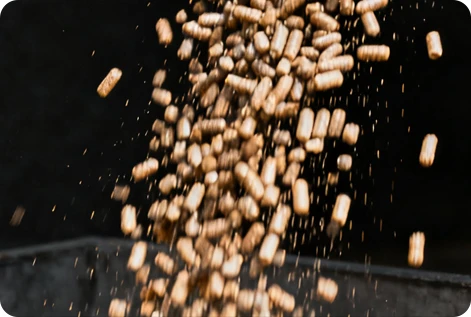
Chicken Pelleted Complete Feed
The workhorse of commercial poultry operations. Pellet diameter is matched to bird age and species — typically 1.5–2.0mm for early broiler grower, 3.5–4.0mm for finishing, up to 5.0–6.0mm for breeder stock. Our lines control conditioning temperature, retention time, and die compression ratio to hit the hardness and durability specs that survive bulk transport without fines buildup.
2.0mm to 6.0mm diameter
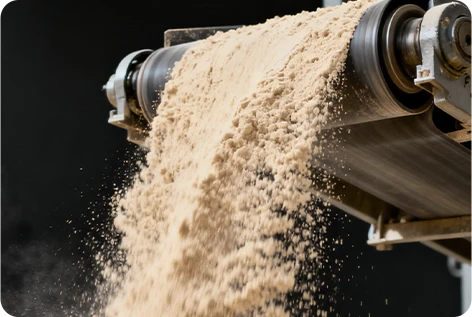
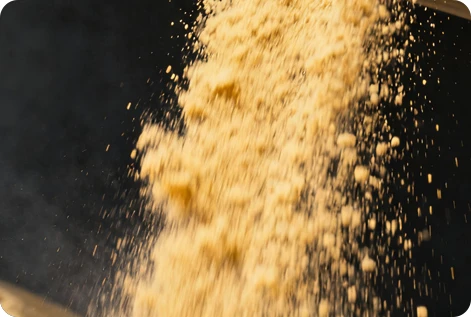
Chicken Mash Complete Feed
Powder-form full-nutrition ration, mixed but not pelleted. Preferred for cage-free layer systems, backyard flocks, and markets where pellet equipment investment isn’t justified at the production scale. Grinding uniformity matters more than most buyers expect — inconsistent particle size causes ingredient separation in storage bins, which shifts the actual nutrition reaching the bird.
0.5mm to 1.5mm grind fineness
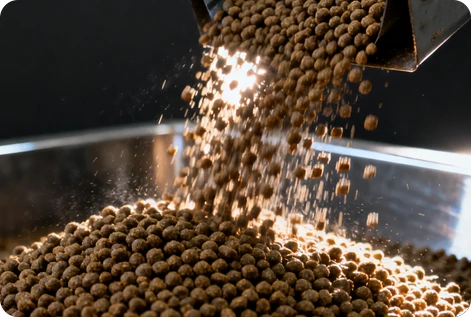
Chicken Crumble Feed
Pellets produced at 3.0–4.0mm then broken down through a crumbler unit. This is the standard format for chicks from day 0 to day 10, where whole pellets are physically too large to consume. The crumble unit is a separate post-pellet processing stage — if it’s not specified correctly at the design phase, you end up with too many fines or uneven particle distribution across the batch.
1.5mm to 2.5mm particle size
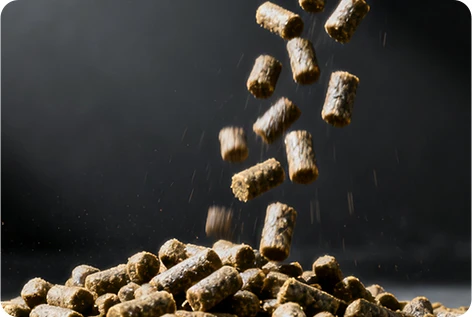
Chicken Concentrated Feed
Not a complete ration — designed to be diluted by the end user with locally sourced grain, typically corn at 50–70% inclusion. Common in smallholder poultry markets where farmers grow their own grain but can’t formulate micronutrient premixes. Our lines for this format emphasize mixing homogeneity, since the concentrated ingredients are present at low inclusion rates but high nutritional significance.
powder form, protein supplement
Chicken Premix Feed
Vitamins, minerals, amino acids, and additives combined at precise ratios — the fraction that determines whether the complete ration actually meets its nutritional targets. Premix lines operate at low throughput but demand high accuracy. Weighing system precision, dust containment, and cross-contamination prevention between batches are the engineering priorities here, not raw tonnage.
1–5% inclusion rate, micro-ingredient blend
We regularly configure lines that switch between pellet and mash production depending on season or order mix — same installation, different die and bypass settings. Beyond that, if your operation eventually expands into livestock feed, aquafeed, or ruminant TMR, we can design the line from the start to accommodate multi-species output without a full rebuild.
Discuss Your Feed Format Requirements With Our Team

Chicken Feed Mill Plant videos
We don’t just ship equipment. Every chicken feed mill plant we deliver goes through a full project cycle — process design, civil layout consultation, equipment manufacturing, factory acceptance testing, installation supervision, and operator training.
Over the years, that process has played out across dozens of countries and hundreds of production lines. Below are five projects pulled from our active case library.
Different countries, different feed types, different site conditions — but the same engineering standard across all of them.

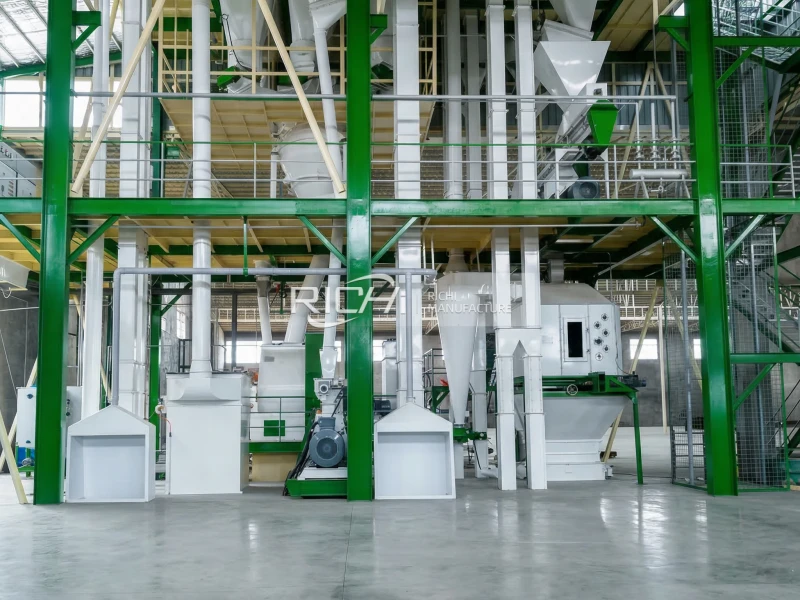
【Video 1 — 10 t/h Fully Automatic Chicken Feed Mill Plant | Afghanistan】The client runs a commercial broiler operation and needed a fully automated line — minimal manual intervention between batching and pellet discharge. Broiler pellet specs were 2.0mm grower and 3.5mm finisher, with conditioning temperature held at 75–82°C to hit the required PDI without over-processing the soy fraction. Automation scope covered batching, grinding, mixing, pelleting, cooling, and bagging — all tied into a centralized PLC panel. Dust control was a specific site concern given local operating conditions, so the filtration layout was adapted accordingly.
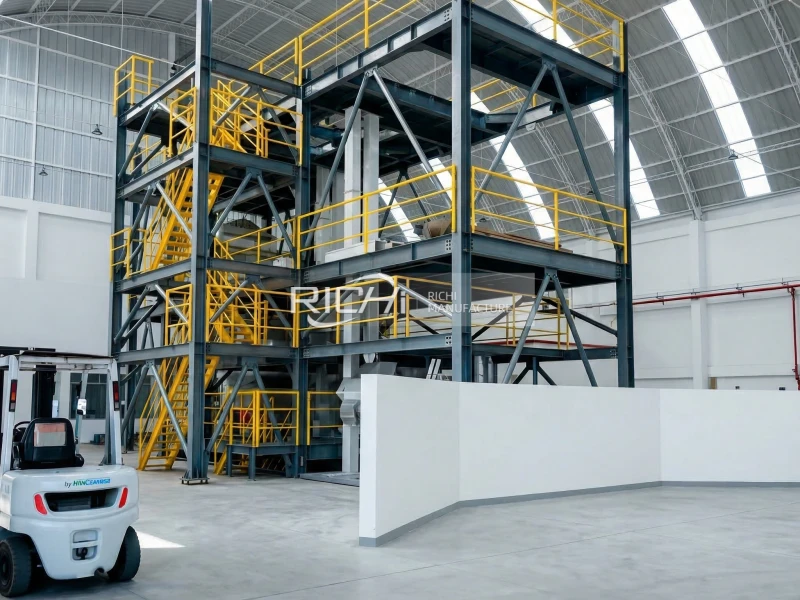
【Video 2 — 10 t/h Chicken & Cattle Feed Production Line | Uzbekistan】Dual-species line handling broiler pellets and cattle feed pellets on the same installation — which meant the grinding and mixing stages had to accommodate significantly different formulation structures. Broiler rations run finer grind with higher soy inclusion; cattle feed on this line used local roughage fractions that behave differently through the hammer mill. Die selection and conditioner retention time were configured separately for each product type. The client switches between species output based on seasonal demand, so the line was designed for fast changeover rather than dedicated parallel processing.
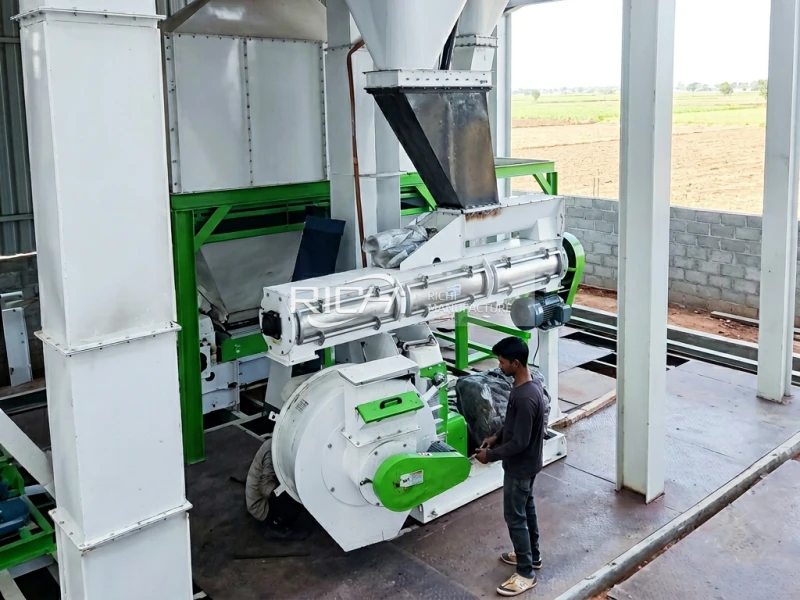
【Video 3 — 5 t/h Fully Automatic Chicken Feed Mill & Mash Line | Peru】This chicken feed plant was specified to handle both pelleted complete feed and powder mash — not as a compromise, but as a deliberate production strategy. The client supplies different customer segments: integrated broiler units that take pellets, and smaller backyard operations in the region that use mash. The line bypasses the pellet press and cooler for mash runs, with the grinding and mixing section doing the work. Full automation was a firm client requirement despite the 5 t/h scale — the labor cost calculation in this market made it the right decision, and the PLC scope reflects that.
【Video 4 — 15 t/h Broiler & Layer Chicken Feed Mill Plant | Oman】One of the more technically involved configurations in this region — the client produces both broiler complete pellets and layer pellets on the same line, which requires different pellet diameters (2.5mm broiler vs 3.5mm layer), different calcium-phosphorus ratios in the formula, and different conditioning parameters between the two rations. The Oman site also had specific layout constraints around the silo placement due to truck access requirements, which we resolved at the civil design stage before equipment manufacturing began. The line runs at 15 t/h across both product types with batch changeover managed through the control system.
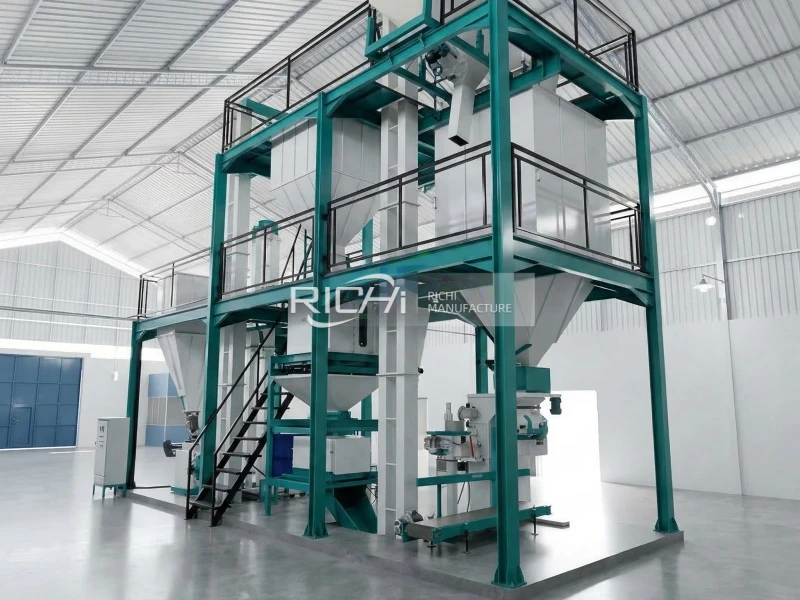
【Video 5 — 1–2 t/h Chicken Feed Pellet Line | Indonesia】Smaller capacity, but not a standard build. The client requested a full custom color scheme — abandoning RICHI’s standard white-green finish in favor of their own facility branding. That kind of request tells you something about how seriously a buyer takes their operation. Beyond aesthetics, the chicken feed mill on this project was configured for local raw material inputs that included higher-moisture ingredients than typical corn-soy formulations, which required adjustments to the conditioning and cooling stages. Compact footprint, single-operator design, fully functional at 1–2 t/h with room to expand the grinding section if throughput requirements increase.
Custom Process Engineering for Every Chicken Feed Mill Plant
Every chicken feed mill plant we design starts with a process audit, not a product catalog. What you’re producing matters — crumble for day-old chicks runs a fundamentally different process path than layer pellets or broiler finisher mash. Pelleted complete feed, expanded floating feed, premix blending, mash-only lines — each one demands a different equipment sequence, different conditioning parameters, and in some cases, entirely different core machinery.
The modular systems that make up a complete chicken feed mill cover raw material receiving and bulk storage, pre-cleaning and primary grinding, batching and weighing, mixing, conditioning and pelleting, crumbling, cooling, screening, liquid addition, packaging, and automation control. Not every project uses every stage. Which modules are mandatory and which are optional depends entirely on what you’re making and what you’re starting with.
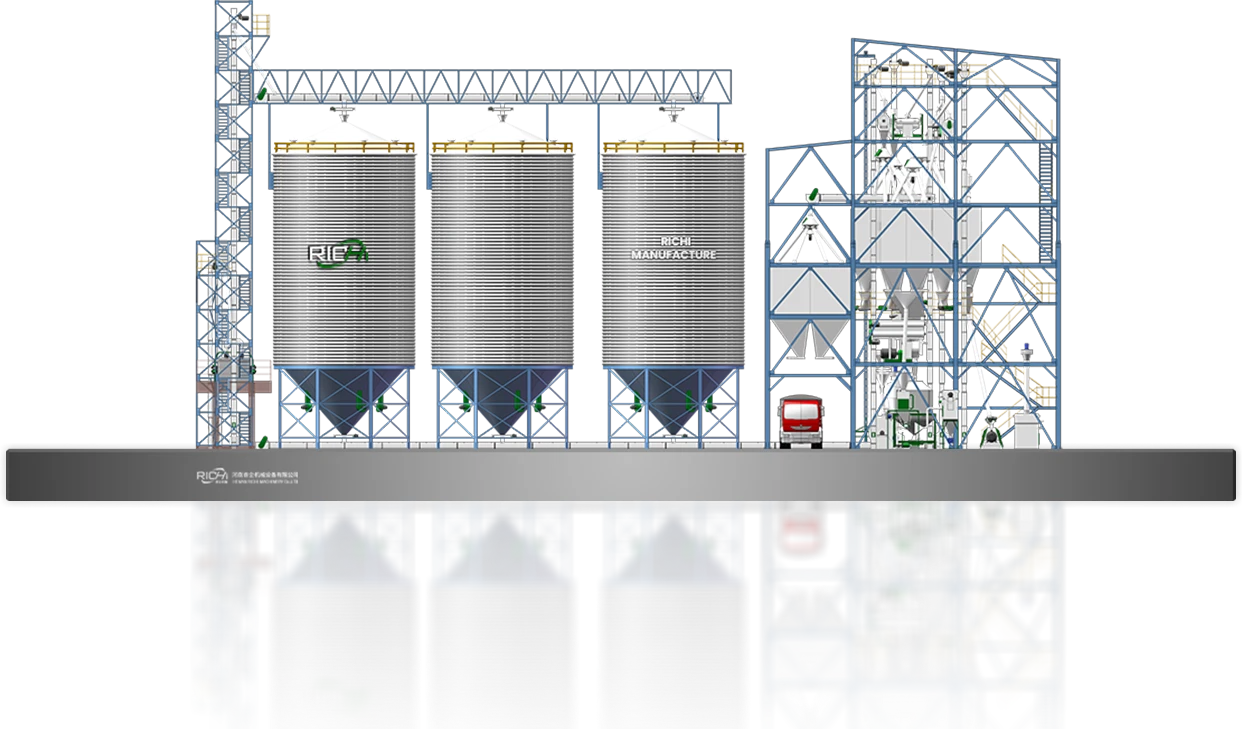
Raw material form is one of the bigger variables that buyers underestimate at the specification stage. Beyond raw materials, your building footprint, floor-to-ceiling height, truck access layout, and civil structure all factor into how we configure the process flow. Budget ceiling shapes the automation level and redundancy built into the line.
We work through all of it — from the first technical consultation through equipment manufacturing, installation supervision, commissioning, operator training, and long-term spare parts supply. That scope doesn’t end at handover. For a chicken feed mill running at commercial scale, the support relationship typically runs the full equipment lifecycle.
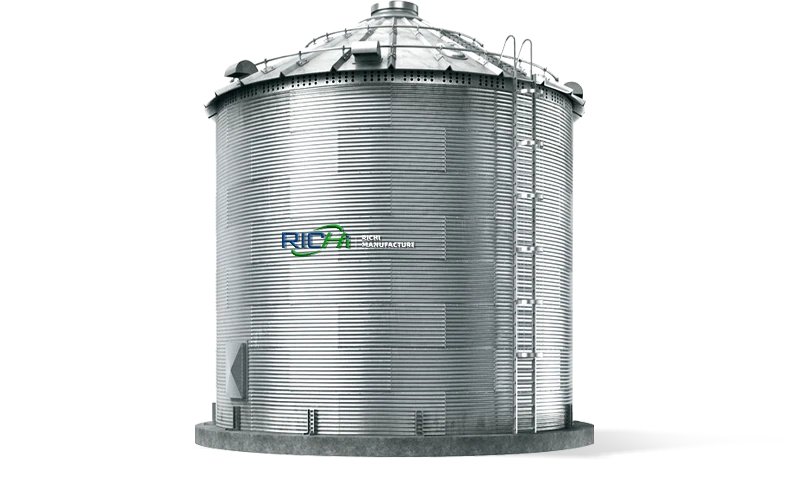
Silo system
01
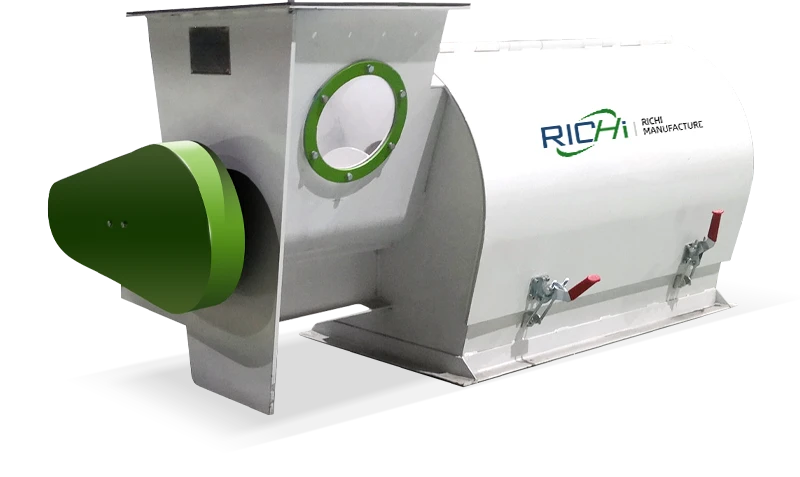
Cleaning system
02
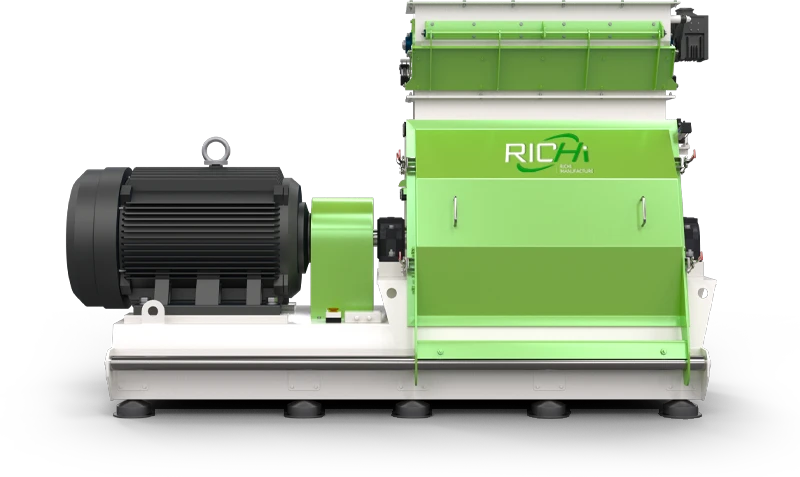
Grinding system
03
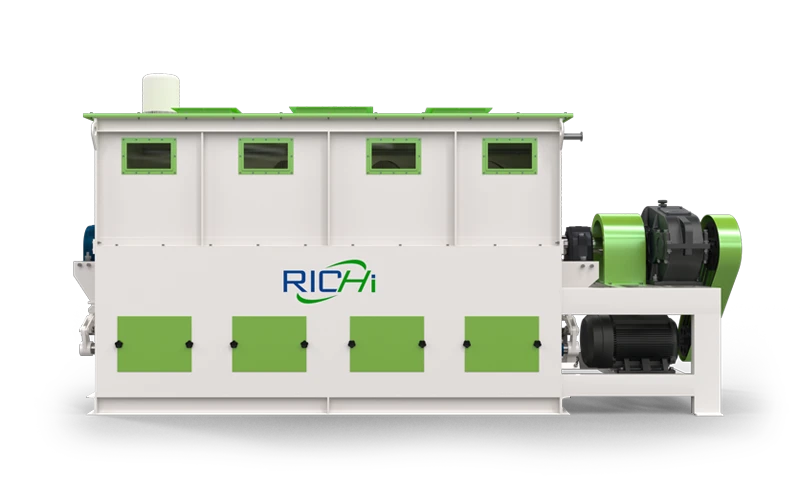
Mixing system
04
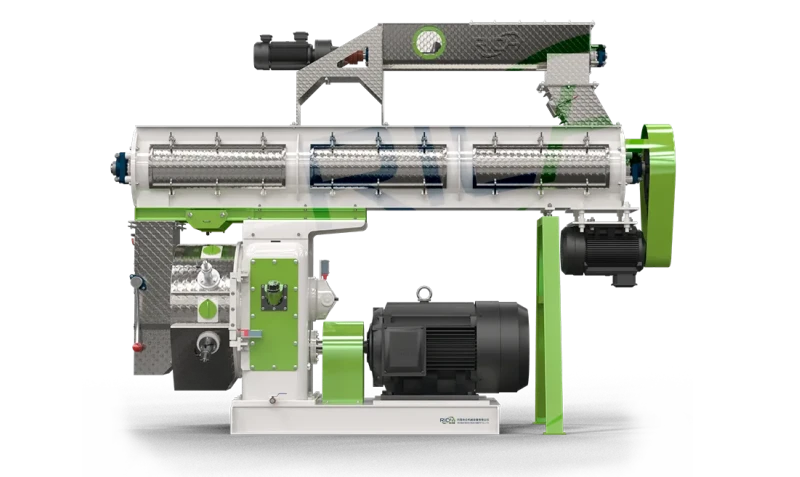
Pelleting system
05
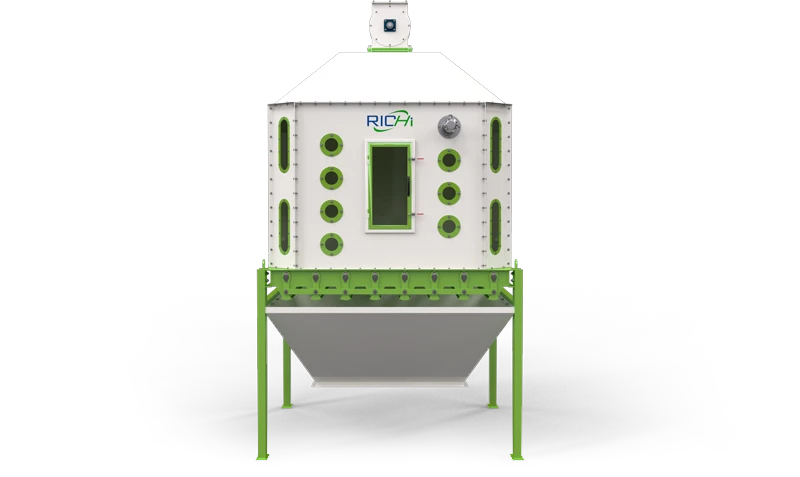
Cooling system
06
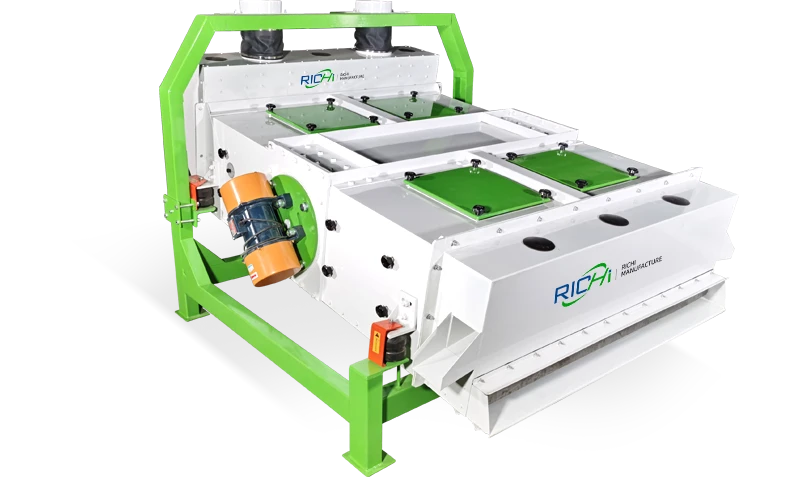
Screening system
07
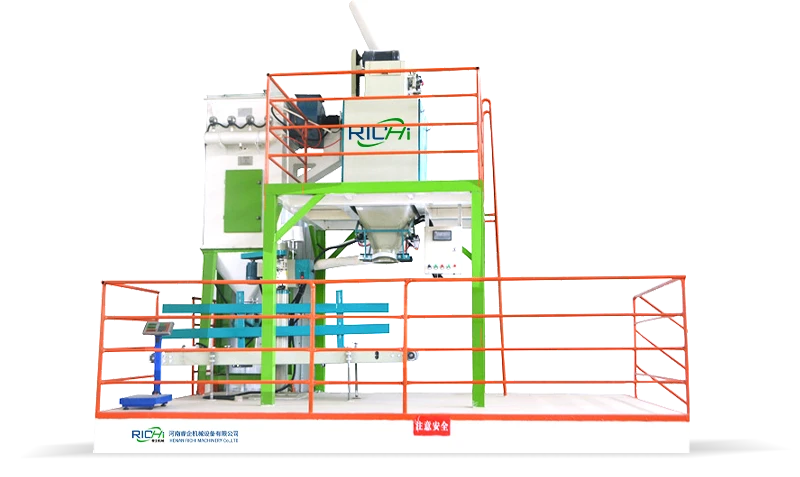
Packaging system
08
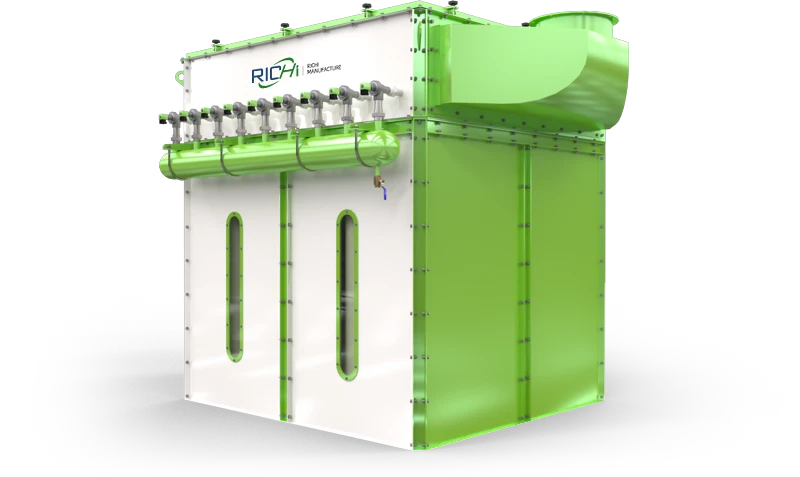
Dust removal system
09
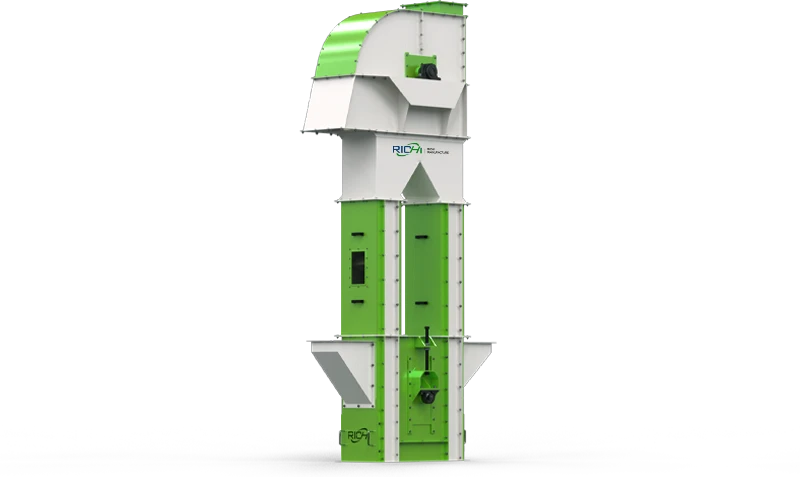
Conveying system
10
8 Configured Solutions Across Capacities and Feed Types
The eight chicken feed mill plant designs below come directly from real client projects. Capacity, feed type, building constraints, automation level, and budget all shift the configuration — none of these flowsheets are identical. Some are lean single-format lines; others handle multiple feed types or work around site limitations. Where a standard process sequence was extended or reduced, that’s noted.
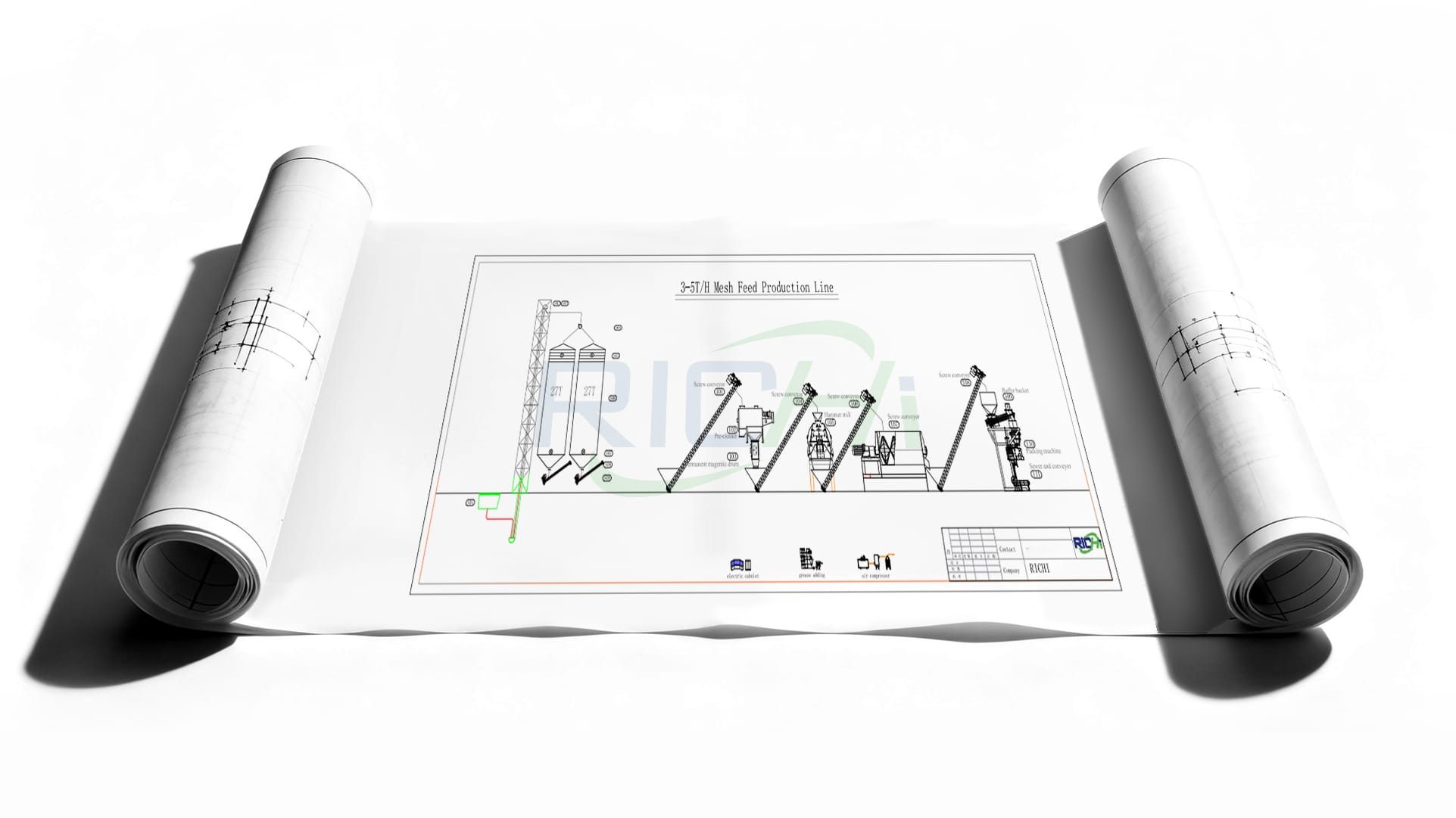
3–5 t/h Chicken Mash Feed Plant Design
A lean process for buyers entering mash production at farm or small commercial scale. Raw materials stage through holding silos, pass through a cleaning screen, then go to the hammer mill and mixer before bagging in 20–50 kg units. No pelleting stage — deliberately. The cleaning step gets dropped by cost-conscious buyers more often than it should; in a mash line, contamination shows up in the finished bag rather than getting caught at the pellet press.
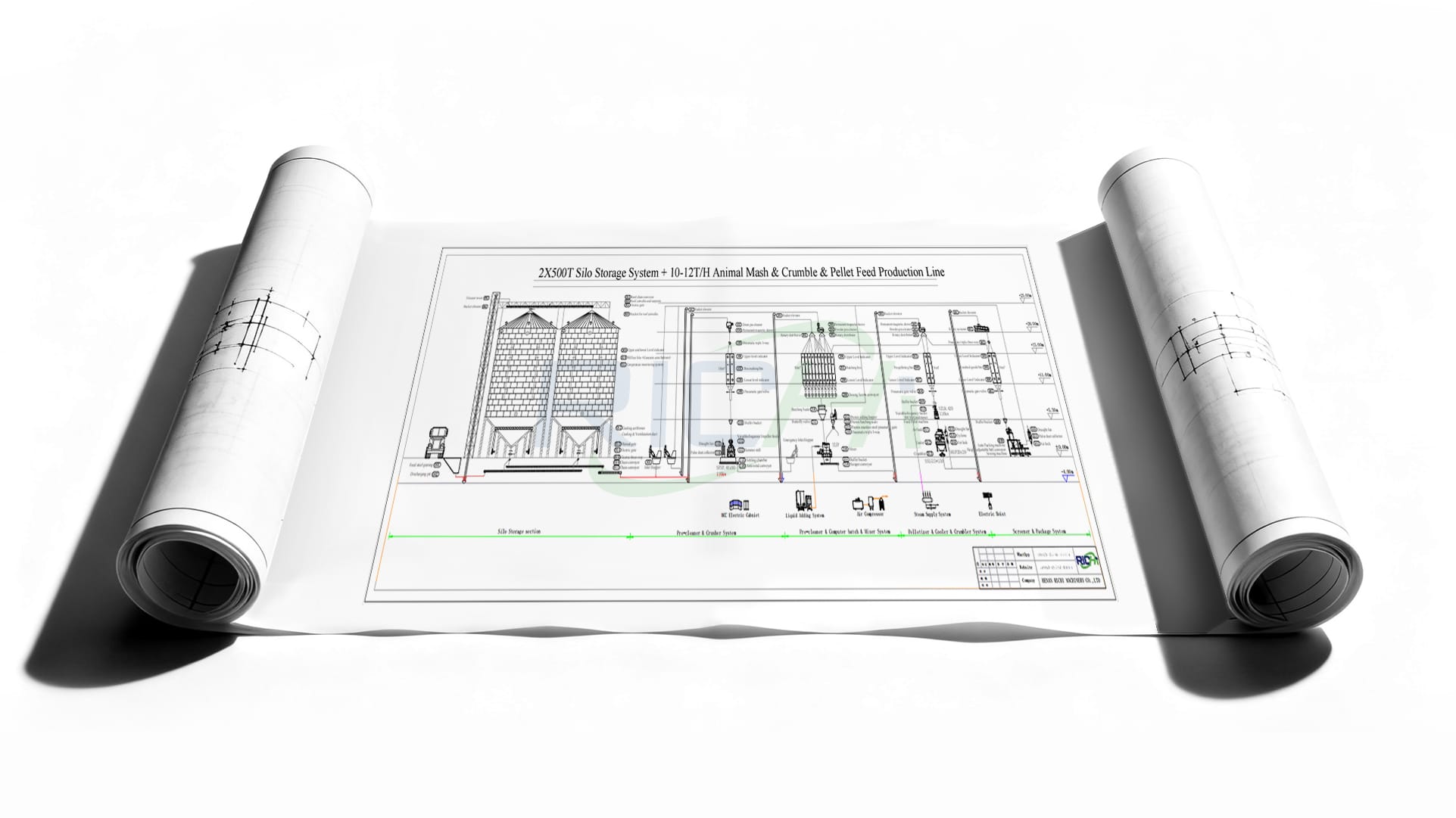
10–12 t/h Automatic Chicken Feed Mill Plant Design
Two 500-ton silos, dual manual intake hoppers, and a computer batching system anchoring the front end. This chicken feed mill plant produces pellets, mash, and crumble from one installation — format switching is handled through the control system. Process: intake → grinding → computer batching → mixing → pelleting → cooling → crumbling → screening → automatic bagging. At this capacity, full automation pays back in batch consistency and labor reduction within a realistic timeframe.
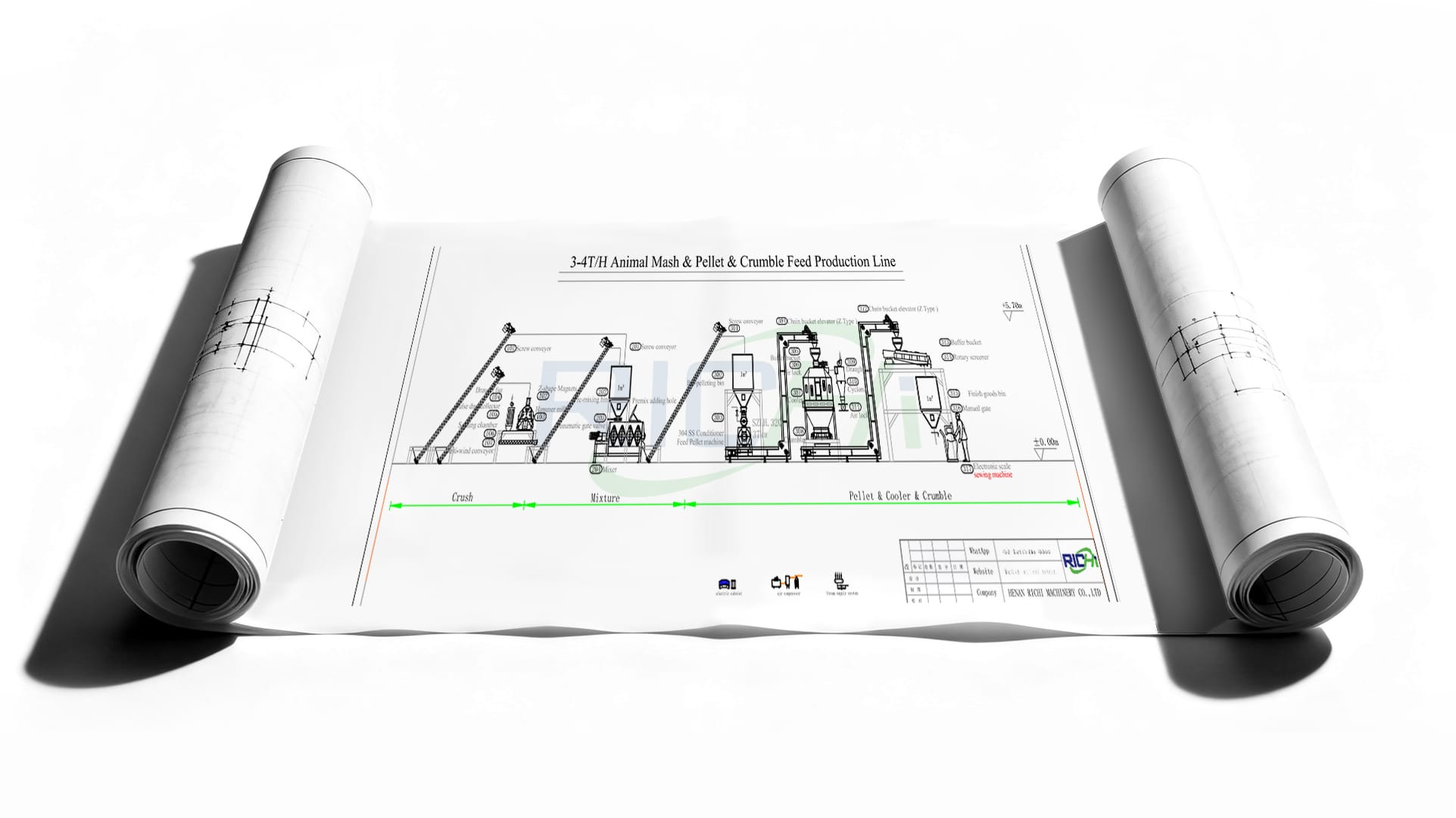
3–4 t/h Low-Headroom Chicken Feed Mill Design
The entire conveying layout was redesigned around a 5.7-meter height ceiling — screw conveyors and Z-type bucket elevators replacing a standard vertical system. Two intake conveyors feed the process: one for granular materials into the hammer mill, one bypassing directly to the mixer for pre-ground ingredients. Process continues through pelleting, cooling, crumbling, screening, and manual bagging. Throughput and feed quality weren’t compromised — only the conveying geometry changed.
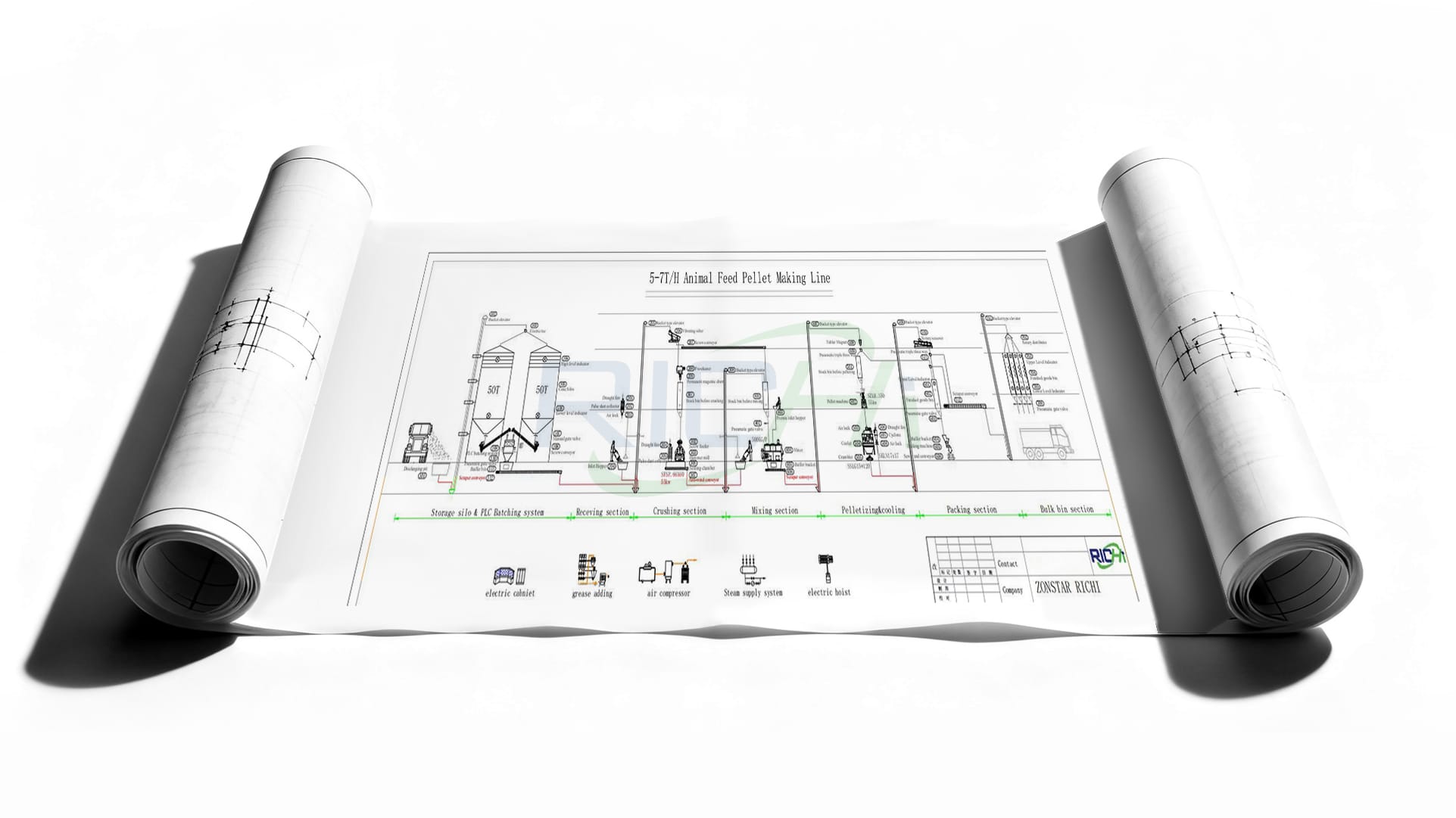
5–7 t/h Chicken Pellet Feed Mill Plant Design
Bulk truck intake into two 50-ton silos, PLC batching, and a dual output stage — automatic bagging for retail distribution and a bulk loadout point for direct truck filling. This configuration is common where the same client supplies both retail feed distributors and commercial broiler farms under supply contracts. The 5 t/h scale is the most frequently specified capacity in our chicken feed plant project history.
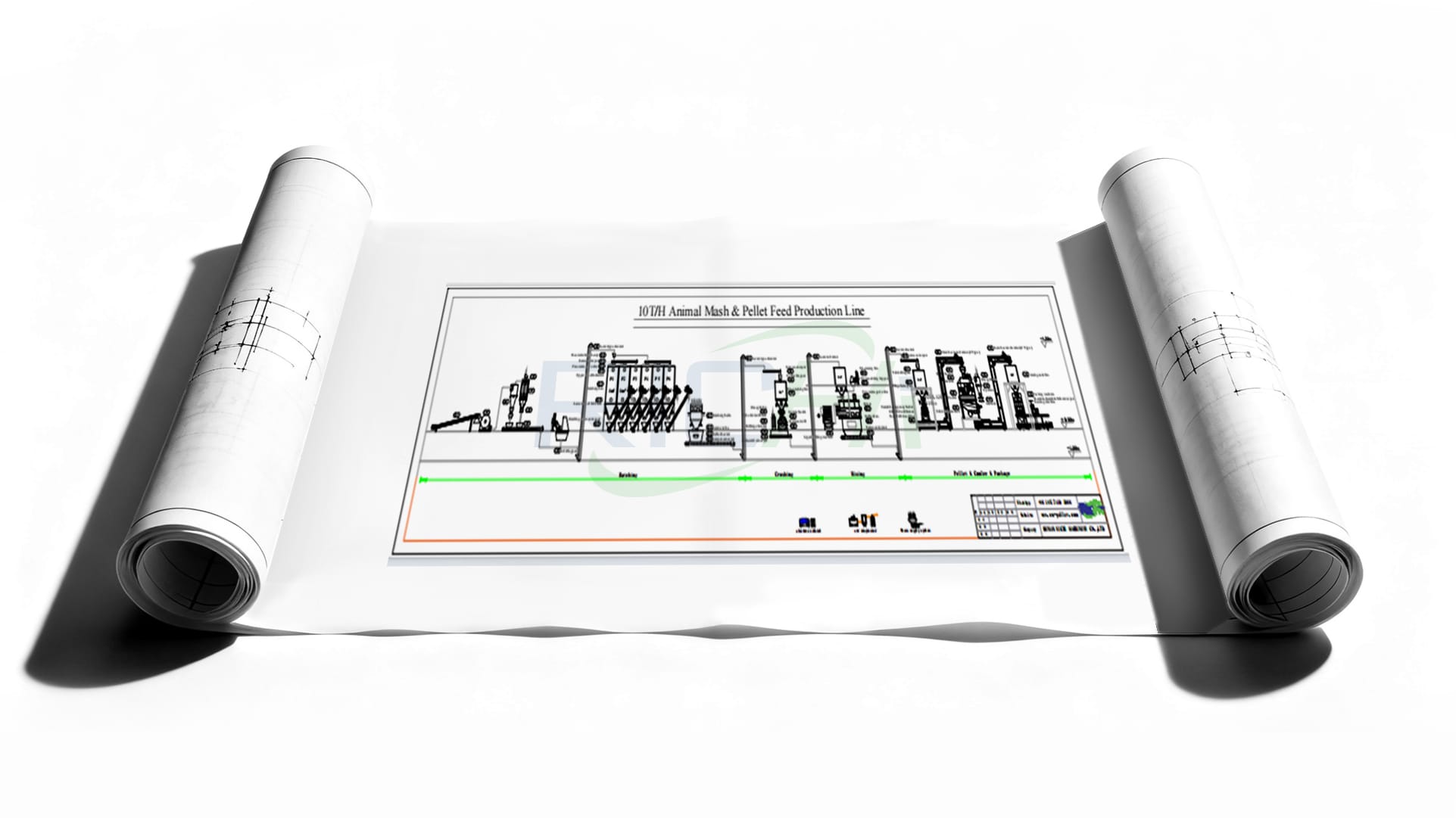
10 t/h Chicken Pellet & Mash Combined Line Design
Started as a mash-only inquiry from a U.S.-based client. Expanded to a combined pellet and mash chicken feed mill after process consultation. Key upstream detail: nearly all raw materials arrive pre-ground, so the grinding stage was sized accordingly rather than over-specified. Computer batching feeds into the mixer, then splits to either the pellet circuit or the mash bagging line. Both outputs run fully automatic bagging.
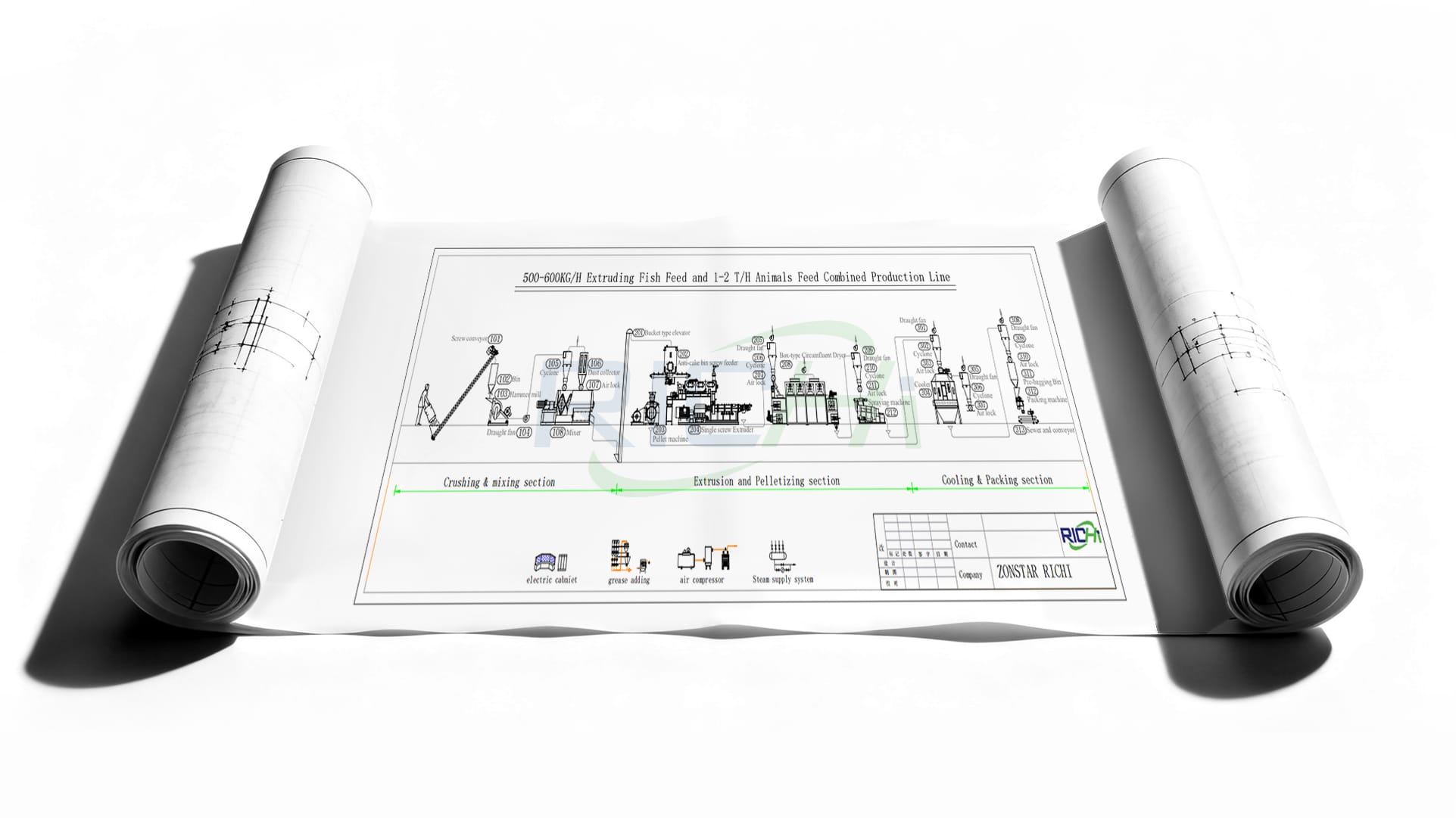
1–2 t/h Chicken & Fish Feed Combined Plant Design
One installation, two species. The base chicken feed mill runs 1–2 t/h of poultry pellets through a standard grind-mix-pellet sequence. A single-screw extruder added downstream handles 500–600 kg/h of floating fish feed — followed by a belt dryer, coating machine, and cooler specific to the aquafeed process. Full sequence: grinding → mixing → pelleting/extrusion → drying → coating → cooling → automatic bagging. This kind of combined line suits aquaculture-adjacent poultry operations where both feed types are consumed on the same farm.
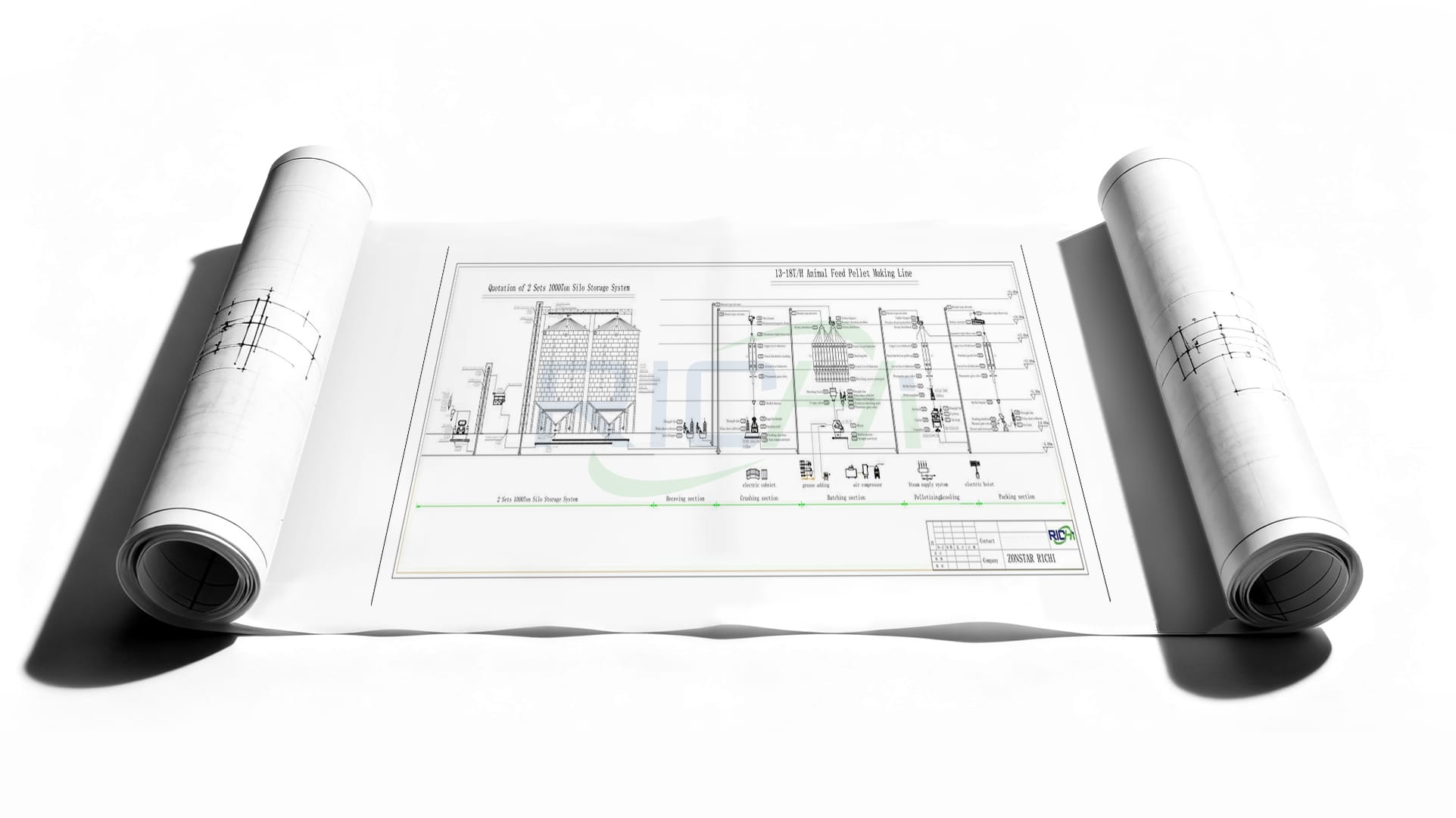
13–18 t/h Large-Scale Chicken Feed Mill Design
Two 1,000-ton silos anchor the raw material storage system on this large chicken feed mill plant. Standard high-capacity pellet line sequence: grinding → fully automatic computer batching → mixing → pelleting → cooling → crumbling → screening → automatic bagging. No process deviations from the core flowsheet — at this scale, the engineering focus shifts to throughput reliability, batching accuracy, and minimizing unplanned downtime rather than format flexibility.
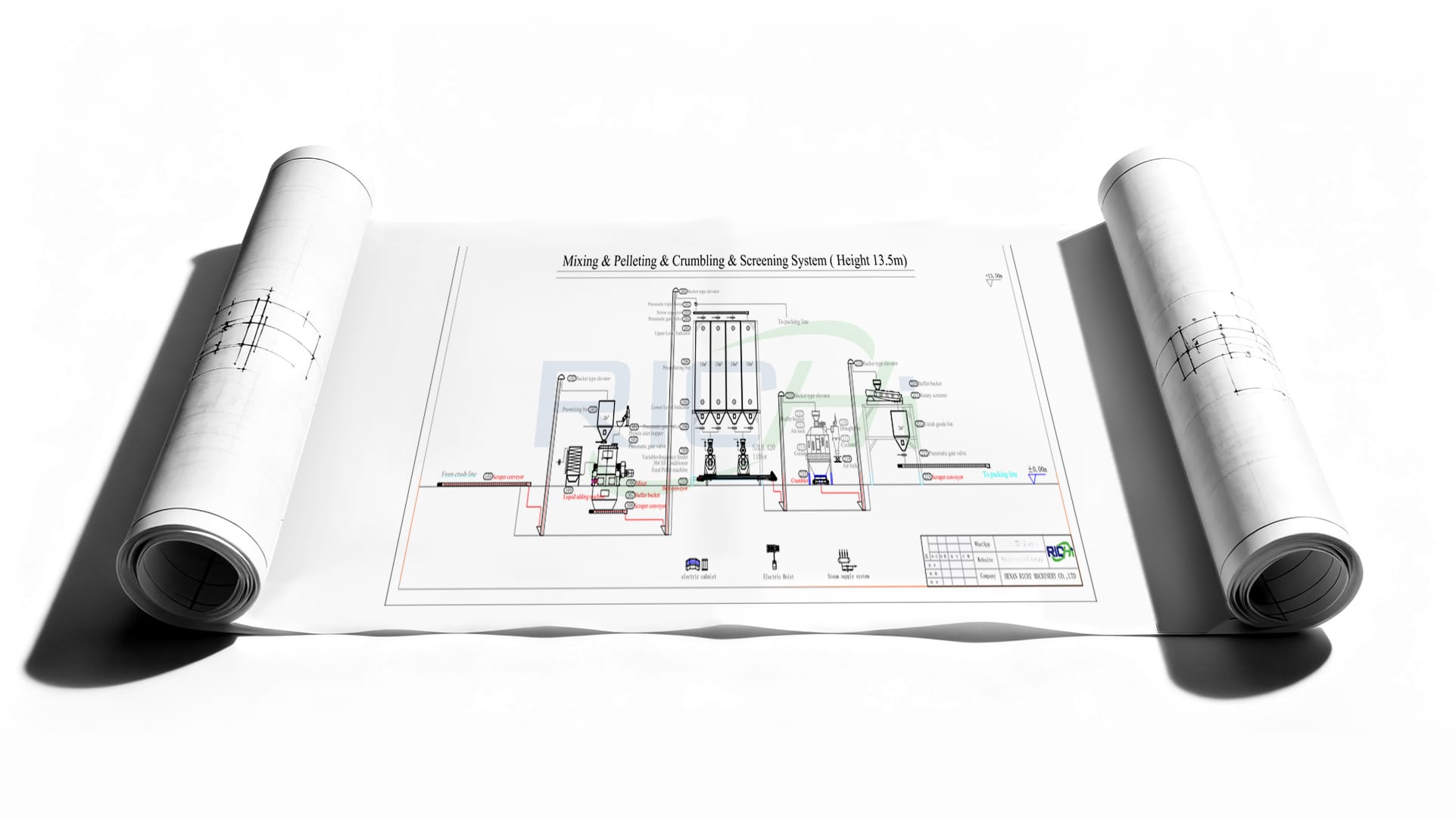
20 t/h Chicken Feed Mill Upgrade & Expansion Design
A retrofit project. The client’s existing facility already had functional grinding and bagging stages — what was missing was everything in between. RICHI engineered a modular insert covering mixing, pelleting, crumbling, and screening within the available footprint. Space was tight. The process layout went through multiple iterations before the equipment arrangement worked within the building constraints without requiring structural modification. Operational now — this project is a practical example of how modular system additions can upgrade a feed mill’s output without a full rebuild.
Chicken Feed Mill Plant Projects
The chicken feed mill plant projects below represent a cross-section of what we’ve delivered — not a highlight reel. Commercial feed manufacturers, integrated poultry operations, independent farms, and livestock cooperatives across Africa, Asia, the Americas, the Middle East, and beyond. Capacities range from 1 t/h starter lines to 40 t/h industrial installations.
Most of these chicken feed mill clients came in asking about a single feed type and ended up specifying a line that handles two or three — because once you’re running a chicken feed plant at commercial scale, the economics of adding a second species or a second output format usually make sense. Mash lines, pellet lines, premix systems, combined poultry-livestock configurations — the projects below cover all of it.
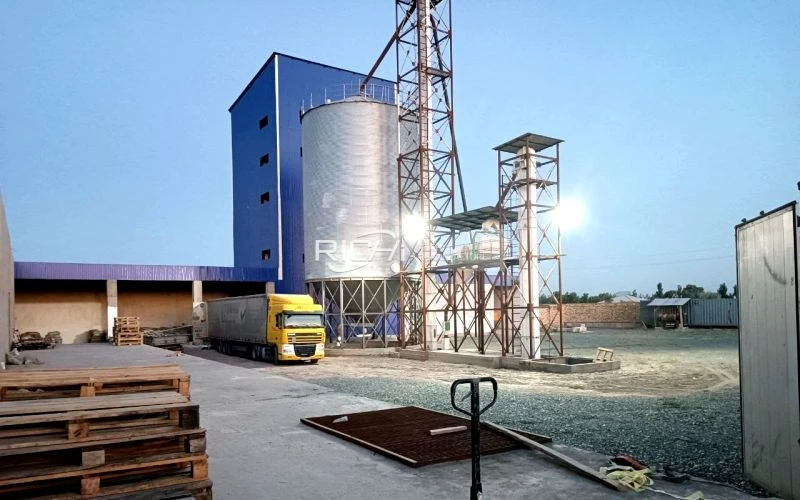
10 T/H Chicken & Cattle Feed Line
South Africa
A dual-species chicken feed mill plant serving a commercial operation producing both broiler pellets and cattle feed from one installation. Raw material intake was designed around locally sourced maize and sunflower cake — both common in southern African compound feed formulations. Pellet diameter: 3.5mm broiler, 6.0mm cattle. Die and conditioner settings switch between species runs without hardware changes.
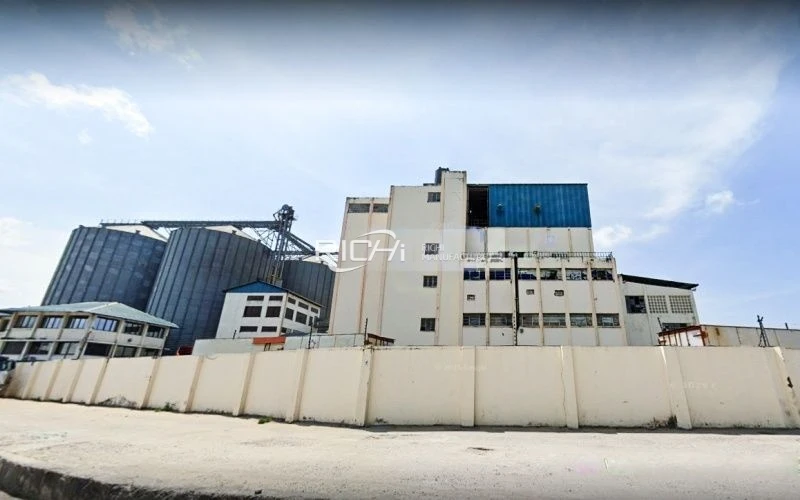
10T/H Dual Chicken Feed Plant
Oman
Layer and broiler pellet production on a single chicken feed mill line in the Gulf region. High ambient temperatures at the site required additional attention to the cooling stage — pellet temperature at cooler discharge needs to stay within 3–5°C of ambient regardless of season, which is harder to achieve in a 45°C summer environment. Pellet sizes: 3.5mm layer, 2.5–3.0mm broiler. Fully automatic bagging.
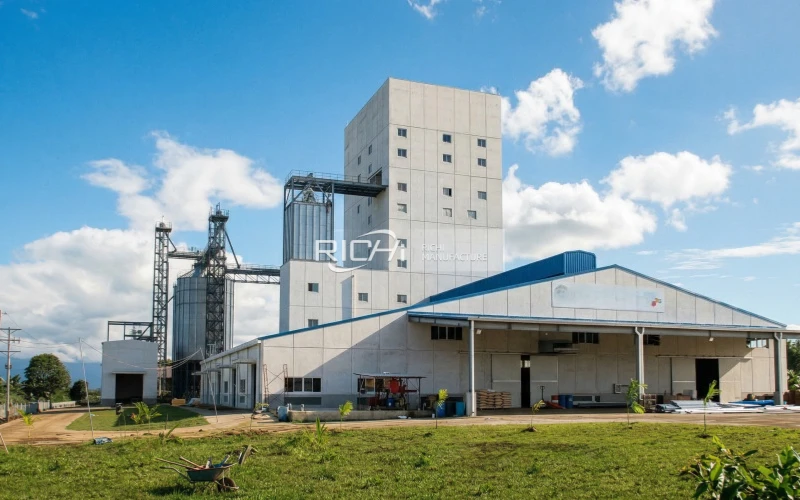
15T/H Chicken & Cattle Feed Mill
Argentina
A 15 t/h chicken and cattle feed mill plant for an Argentine agribusiness operating both poultry and beef production. Corn and soybean meal dominate Argentine feed formulations, and the line was configured accordingly — high-throughput grinding and a large-batch mixer suited to the high-volume, consistent-formula production pattern typical of South American integrated operations. Pellet sizes: 3.5mm broiler, 6.0mm–8.0mm cattle.
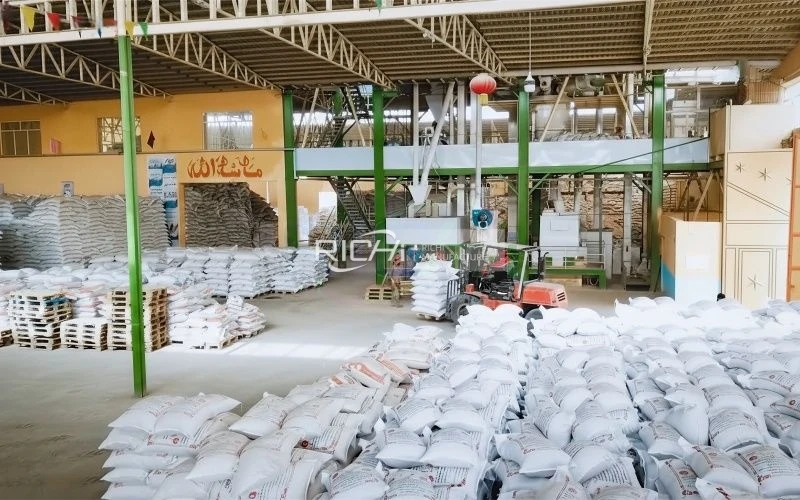
15-20T/H High-Capacity Poultry Line
Saudi Arabia
A large chicken feed mill plant for a Saudi commercial poultry producer operating in a hot, arid climate. Nearly all raw materials are imported, so consistent incoming specification is less of a variable here than in markets with local sourcing. Cooling system capacity was engineered to handle peak summer ambient temperatures. Output: layer and broiler pellets across three diameter sizes depending on bird age and stage.
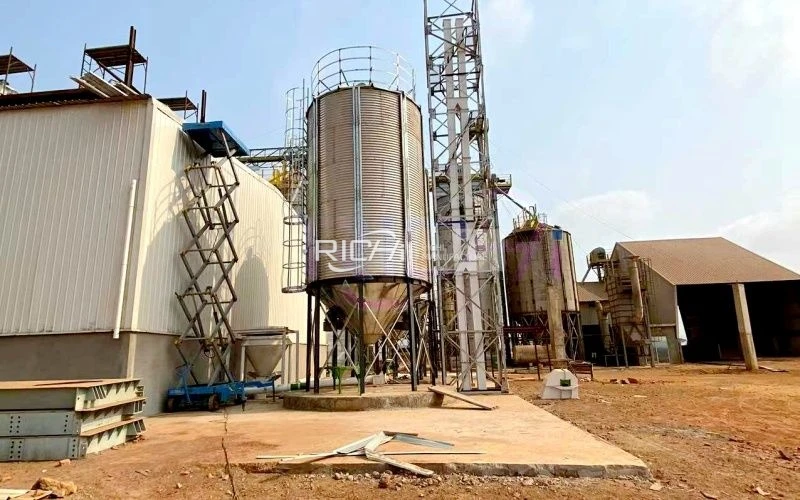
15T/H Five-Species Feed Mill
Nigeria
One of the more complex chicken feed mill configurations we’ve completed in West Africa — a single line producing layer pellets, broiler pellets, cattle feed, pig feed, and sheep feed. The Nigerian client operates a diversified livestock business and needed one plant to supply all species. Formulation management and cross-contamination prevention between species runs were the primary engineering focus during commissioning.
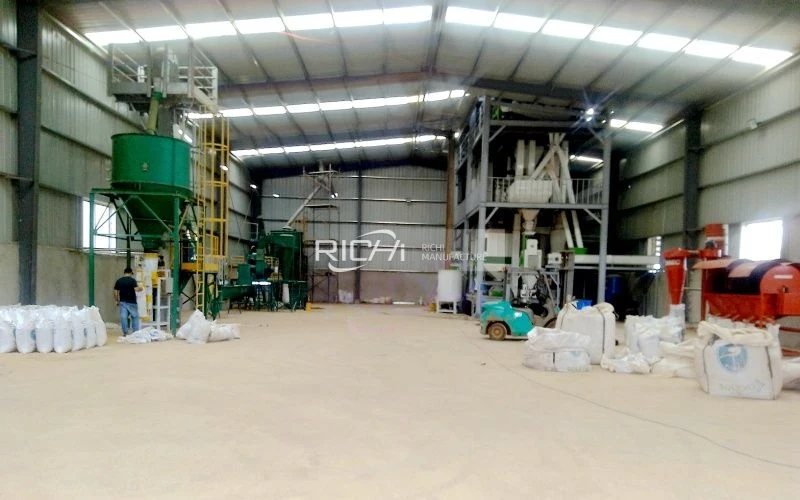
5T/H Layer & Broiler Feed Line
Mexico
A chicken feed plant built for a Mexican poultry operation producing layer mash and broiler pellets. The client’s existing building had usable floor space but limited headroom, so the conveying layout was adapted to work within the structural ceiling height. Both output formats — mash for layers, 3.0mm pellets for broilers — run from the same grinding and mixing section with a bypass around the pellet press for mash production days.
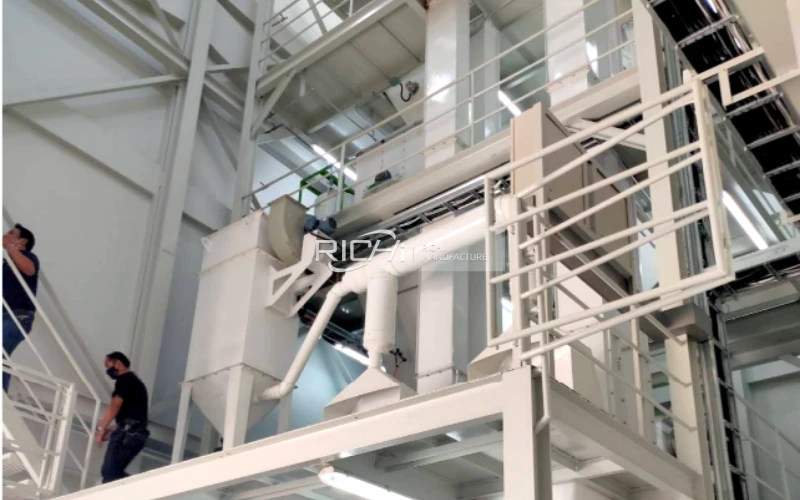
10T/H Layer Feed Specialist Line
Thailand
A dedicated layer chicken feed mill — single species, single output format, optimized entirely around layer pellet production at 3.5mm diameter. The Thai client’s operation supplies commercial egg farms in the central region and runs on a fixed formulation with rice bran, cassava meal, and fishmeal alongside the corn-soy base. Consistent pellet hardness and low fines rate were the key performance specs driving the die and conditioning selection.
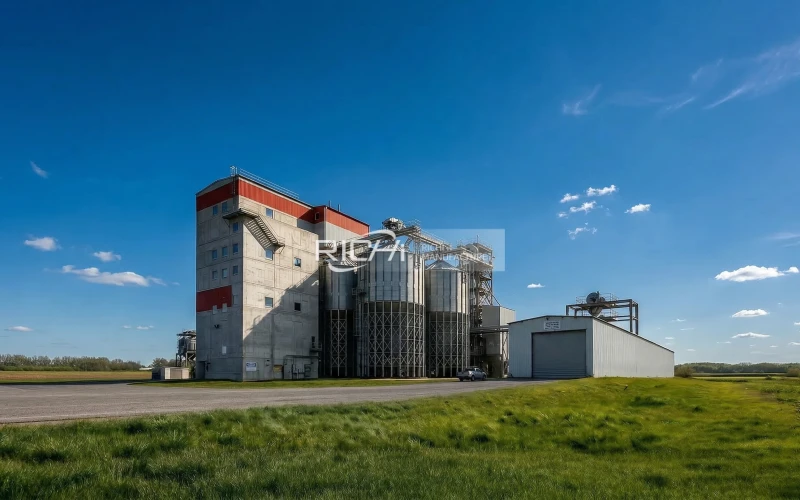
10T/H Dual-Format Poultry Mill
New Zealand
A chicken feed mill designed for a New Zealand operation producing both layer and broiler pellets under premium quality standards. New Zealand feed regulations and traceability requirements influenced the batching and record-keeping system specification. Formulations use locally grown wheat and barley alongside canola meal — a different grind profile than corn-soy lines, with adjustments made to screen sizing and conditioning temperature accordingly.
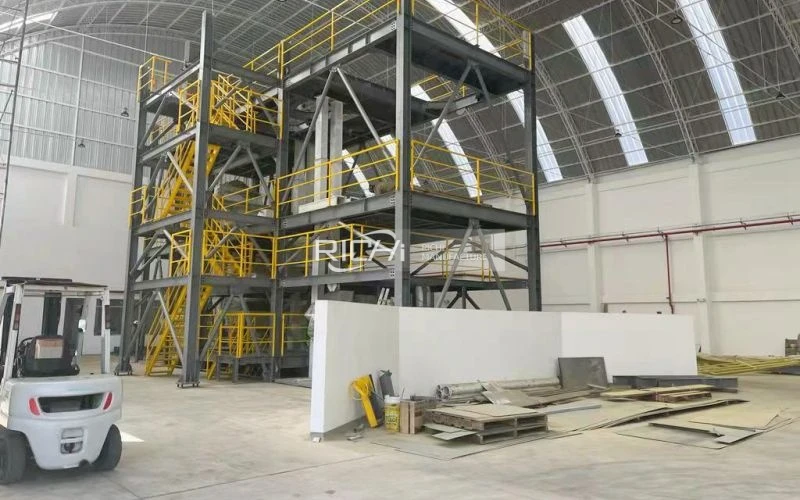
5T/H Layer & Broiler Pellet Plant
Brazil
A mid-scale chicken feed plant built for a Brazilian poultry integrator producing both layer and broiler complete pellets. Soybean meal dominates the formulation at this location — typical for Brazilian compound feed — and the hammer mill and conditioning parameters were set accordingly. Pellet sizes: 2.5mm broiler grower, 3.5mm layer. Automatic bagging in 25 kg and 40 kg formats.
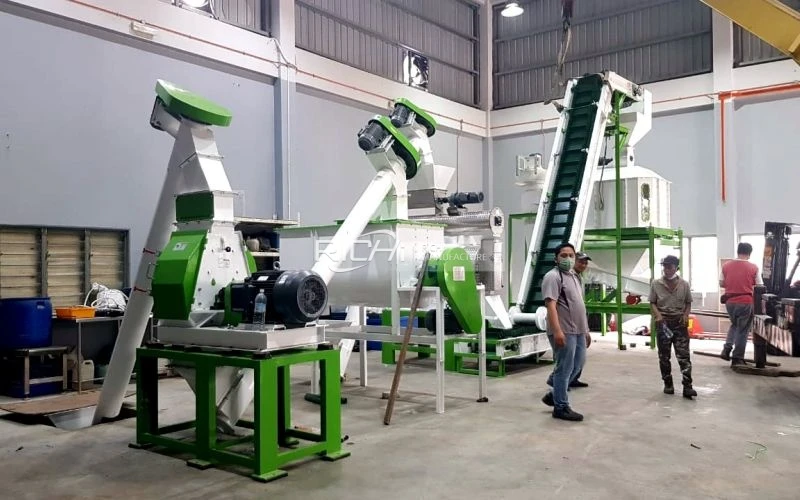
3-4T/H Compact Chicken Feed Mill
Malaysia
A compact chicken feed mill designed for a Malaysian poultry farm producing layer and broiler pellets on-site. Palm kernel cake is a locally available ingredient included in the formulation — it behaves differently through the hammer mill than corn-soy mixes and required specific screen sizing. Output: 2.5mm broiler, 3.5mm layer. The compact footprint fits within a standard agricultural building without structural modification.
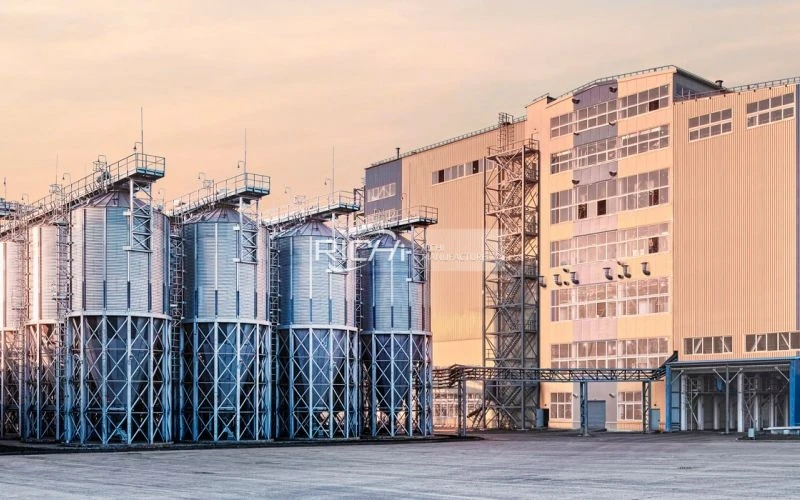
20T/H Large Broiler Feed Plant
United States
A 20 t/h broiler chicken feed mill for a U.S. commercial poultry operation — one of the larger single-species pellet lines we’ve completed in North America. The client’s raw materials arrive almost entirely pre-ground, shifting the design emphasis away from the grinding stage and toward batching accuracy and pellet consistency. Fully automatic throughout, with computer-controlled batching and automatic bagging in 50 lb format.
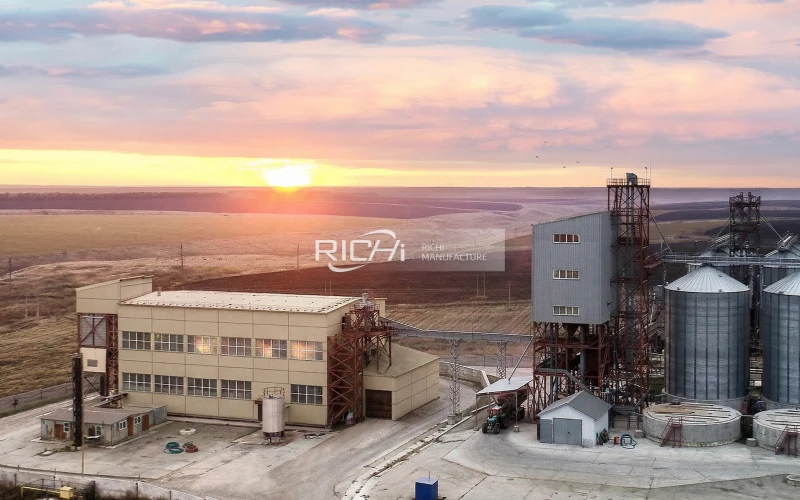
8-10T/H Chicken & Livestock Feed Plant
United Arab Emirates
A combined chicken and cattle feed plant for a UAE livestock operation producing poultry pellets and cattle feed blocks from imported raw materials. Dust containment was a specific engineering requirement given the indoor facility and proximity to animal housing. Process runs two separate product cycles — poultry in the morning shift, cattle feed in the afternoon — with the control system managing formulation switching between runs.both poultry and grazing animals on the same property.
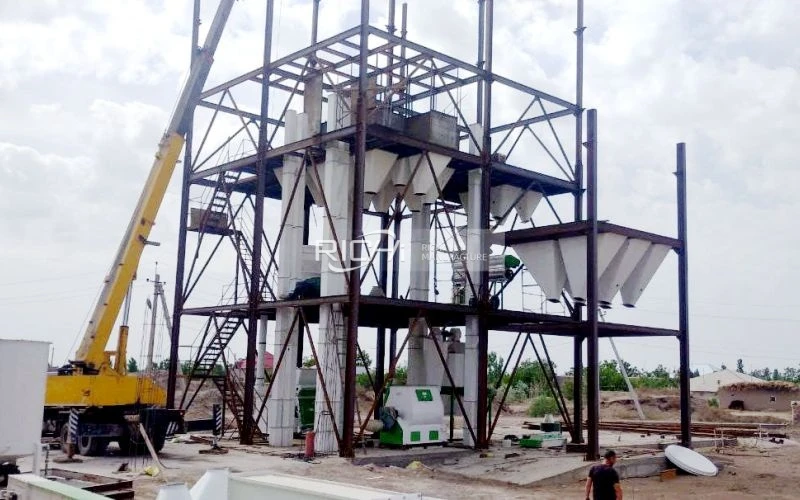
10T/H Broiler Pellet Feed Mill
Vietnam
A dedicated broiler chicken feed mill supplying a fast-growing commercial integrator in northern Vietnam. Rice bran and cassava are included in the local formulation alongside corn-soy, which required adjustment to the conditioning stage to manage the variable moisture behavior of cassava-inclusive mixes. Output: 2.0mm starter and 3.5mm finisher pellets. Line commissioned and running at full capacity.
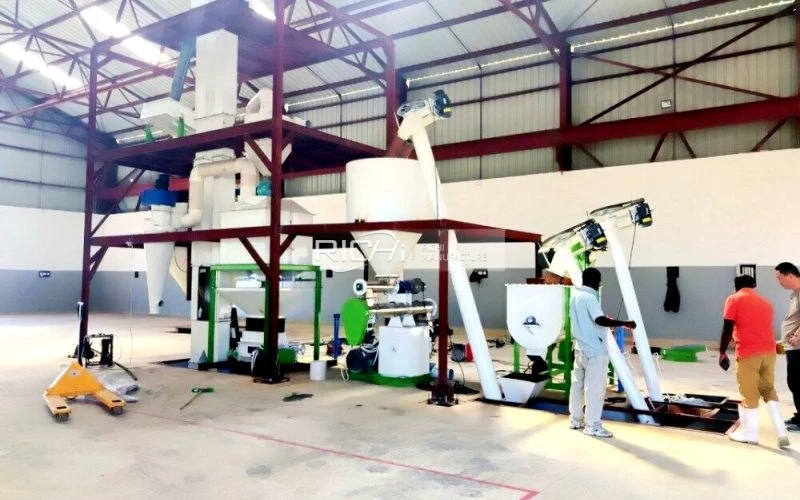
1-2T/H Entry-Scale Feed Plant
Ethiopia
A small-scale chicken feed plant for an Ethiopian poultry operation moving from purchased feed into self-manufacturing. Sorghum and locally sourced protein meals form the base formulation — both available regionally and lower cost than imported soybean meal. At 1–2 t/h, the line is sized for on-farm supply with modest surplus for local sale. Simple process: grinding, mixing, pelleting, manual bagging.
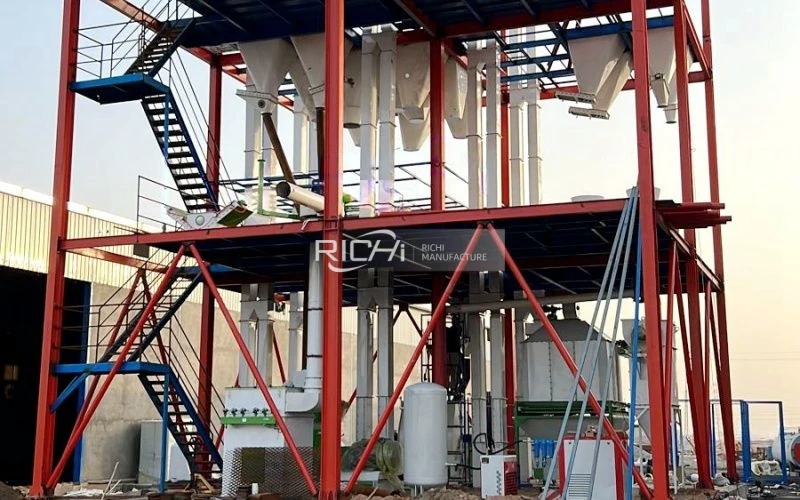
8-10T/H Layer & Broiler Feed Mill
Iraq
A chicken feed plant producing both layer and broiler pellets for an Iraqi poultry business operating in a region with significant raw material sourcing variability. The line was designed to handle ingredient substitutions without requiring process reconfiguration — practically important where corn availability fluctuates and barley or wheat substitution is common. Pellet sizes: 2.5mm broiler, 3.5mm layer.
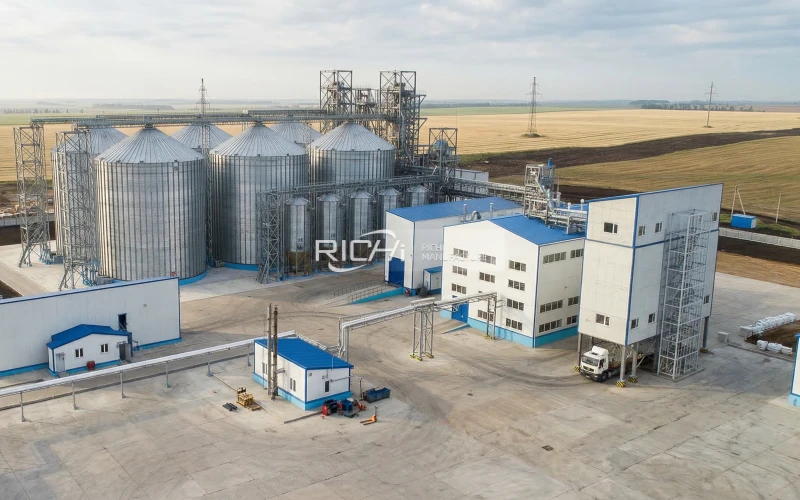
30-40T/H Multi-Species Industrial Mill
Russia
A 30–40 t/h chicken feed mill plant producing broiler pellets, pig feed, and cattle feed for a Russian agro-industrial group. Two large-capacity silos, fully automatic computer batching, high-throughput pelleting with multiple press units, and centralized PLC control across the entire process. At this scale, redundancy in the pelleting and cooling stages was built into the design to protect against unplanned downtime on a line running near-continuous production shifts.
Across every chicken feed mill plant project we complete, the relationship doesn’t end at handover. What we hear back from clients — months and sometimes years later — tends to focus less on the equipment specs and more on whether the line actually performs the way it was specified, and whether our team showed up when something needed sorting. Below are six unsolicited accounts from clients running RICHI-supplied feed production lines across four continents.

8 t/h Chicken Feed Mill Plant — France
- Pelleted Complete Feed | Layer & Broiler Production
Feed Production Manager, Integrated Poultry Operation, Normandy region
“We had precise technical expectations going in — wheat, barley, and sunflower meal behave differently through conditioning than corn-soy. RICHI’s engineers understood that without us explaining it twice. Pellet consistency across long runs has been exactly what we needed, and commissioning was far more straightforward than we anticipated.”

15 t/h Chicken Feed Mill — Algeria
- Broiler & Layer Pellets | Wheat Bran-Inclusive Formulation
Operations Director, Commercial Feed Manufacturer, Setif Province
“After-sales support from overseas suppliers usually disappears once payment clears. RICHI was different — spare parts arrived on time, and when we had a question about die selection for our durum wheat bran inclusion, someone answered it properly. The line has kept up without adjustment even as our flock size increased 30%.”

10 t/h Chicken Feed Plant — Iraq
- Dual Pellet Format Output | Formulation-Flexible Configuration
General Manager, Poultry Feed Business, Central Iraq
“Barley and wheat substitution is common here when corn prices move. RICHI designed the line to handle that variability without mid-run reconfiguration — a real operational consideration in this market. Changeover between 3.5mm layer and 2.5mm broiler pellets takes less time than we budgeted for.”

Fishmeal in the Mix, No Surprises
- Farm-Scale Broiler Feed Production | Tropical Raw Material Handling
Farm Owner, Integrated Broiler Operation, Visayas region
“We run rice bran, copra meal, and corn — ingredients not every supplier knows how to handle. RICHI specified conditioner parameters for our actual raw materials, not a generic formulation. The line was sized and priced for what we actually needed. Not oversold.”

Fishmeal in the Mix, No Surprises
- Layer Pellets & Broiler Crumble | 12 t/h Commercial Output
Technical Director, Feed Manufacturing Company, Greater Cairo
“RICHI flagged a silo layout issue before manufacturing started that would have created a bottleneck at peak throughput. We changed the design before installation. Small thing, but it saved us a significant problem. The line runs layer pellets and broiler crumble consistently.””

Fishmeal in the Mix, No Surprises
- Rice Bran-Dominant Formulation | Broiler Pellet Specialist Line
Managing Director, Agro-Processing Business, Dhaka Division
“We came from rice milling — completely different industry. RICHI configured the line for high rice bran inclusion rates that would cause problems on a standard setup. We started selling to neighboring farms within three months of commissioning.”

Chicken Feed Mill Plant Solutions by Capacity
A chicken feed mill plant at 1 t/h and one at 100 t/h are entirely different engineering and investment conversations. The capacity you need determines your equipment configuration, building footprint, automation level, staffing requirements, and capital outlay — and it should be driven by your actual flock size, supply contracts, or market coverage plan, not by what sounds reasonable on paper. Below are the ten capacity ranges we configure, with a realistic picture of who each scale suits and what it costs to build. (The price range shown here is for a complete set of chicken feed processing equipment only, excluding silos, civil engineering and other costs.)
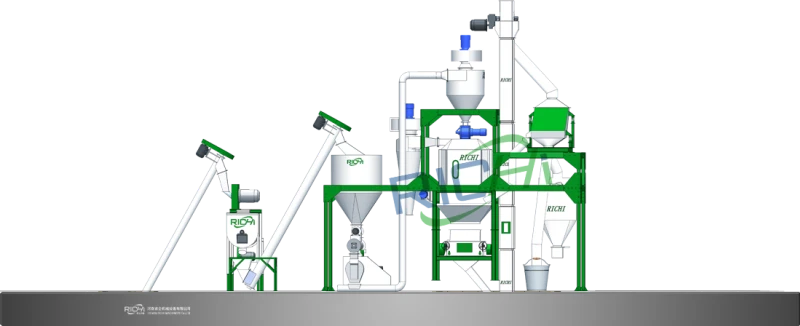
The entry point for on-farm feed manufacturing. At this scale, the typical buyer is a small poultry farmer producing feed exclusively for their own flock — 500 to 3,000 birds depending on species and production cycle. The investment threshold is low enough that the payback calculation against purchased feed costs is straightforward. Process is simple: grinding, mixing, pelleting, manual bagging. Automation is minimal.
Equipment Cost: $10,000-50,000**
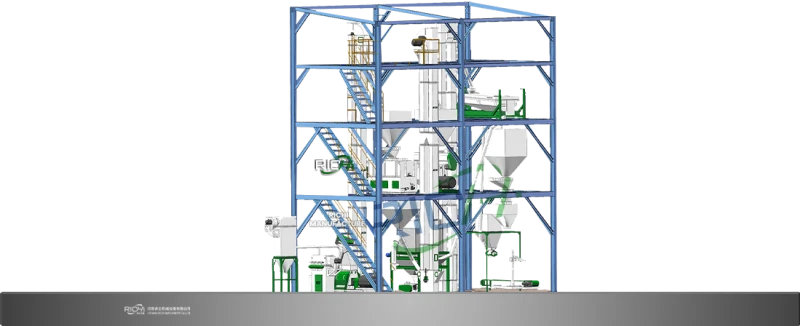
3-4 t/h animal feed production plant
A step up in both output and business intent. At 3–4 t/h, the operation typically serves a medium-scale poultry farm alongside limited external sales, or a small commercial feed supplier covering a local distribution area. This is a common configuration for buyers transitioning from feed purchasing into feed manufacturing as a primary revenue stream.
Equipment Cost: $50,000-120,000
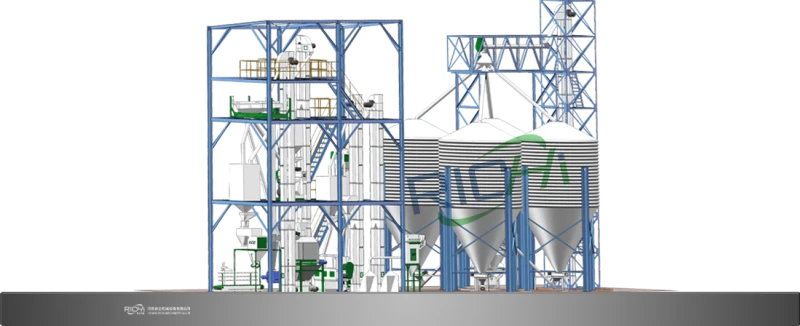
5-7 t/h animal feed pellet plant
The most frequently specified capacity range in our chicken feed mill project history. It sits at the crossroads of commercial viability and accessible capital — enough throughput to supply a meaningful distribution network or a large integrated poultry operation, without the infrastructure demands of a 10 t/h-plus installation. Buyers at this scale include commercial feed manufacturers entering regional markets, mid-size poultry integrators, and agricultural investors.
Equipment Cost: $70,000-250,000
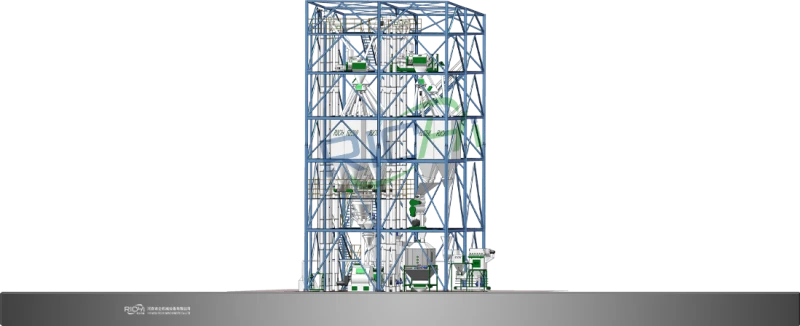
8-10 t/h animal feed processing plant
A serious commercial chicken feed mill operating at this capacity is typically supplying multiple poultry farms, running double shifts, or both. The buyer profile shifts here toward established agribusinesses, feed companies with existing distribution infrastructure, and poultry integrators with contracted flock volumes that justify the capital. At 8–10 t/h, full automation becomes the standard specification.
Equipment Cost: $150,000-300,000
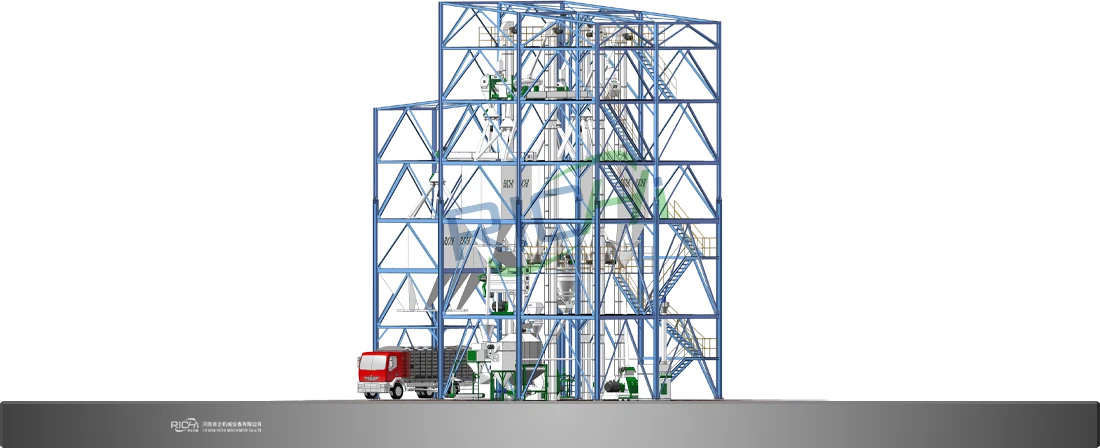
12-20 t/h feed preparation plant
Mid-to-large commercial scale. A 12–20 t/h chicken feed plant is typically the anchor production facility for a regional feed brand, a large vertically integrated poultry company, or an agricultural cooperative supplying feed to member farms. At the upper end of this range, the line is running near-continuous production cycles and the engineering emphasis shifts toward uptime reliability.
Equipment Cost: $250,000-580,000
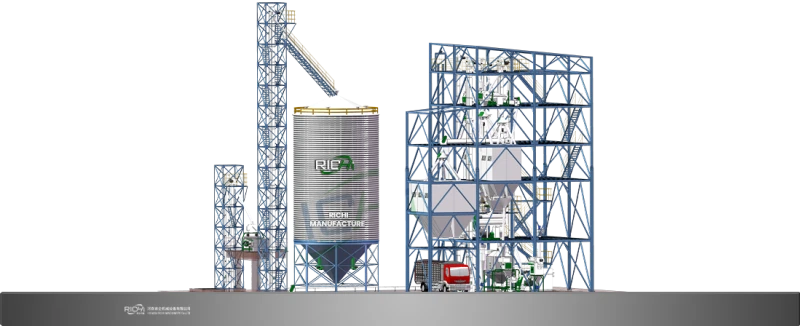
25-40 t/h feed pellet production line
Industrial-scale chicken feed mill territory. Buyers at this capacity are typically large commercial feed manufacturers, national poultry integrators, or export-oriented feed businesses. A 25–40 t/h chicken feed mill plant runs multiple pellet press units, large-batch mixing, automated raw material handling from bulk intake through to finished product dispatch, and centralized PLC control across the full process.
Equipment Cost: $450,000-850,00
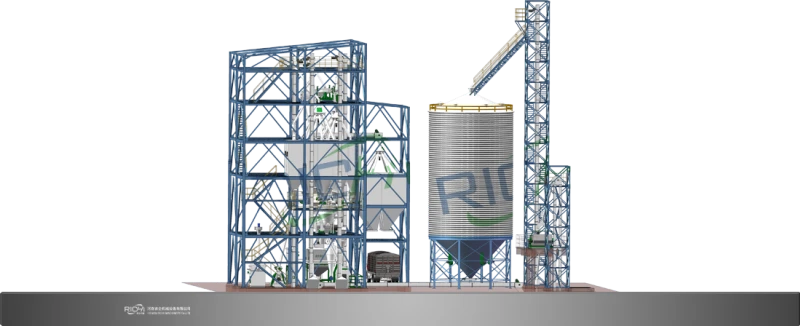
50-60 t/h commercial feed mill
At 50–60 t/h, the chicken feed mill is operating as a primary supply infrastructure asset for a large integrated poultry business or a commercial feed company with regional market coverage. Production runs around the clock, and downtime has direct financial consequences measured in tons per hour.
Equipment Cost: $900,000-1,400,000
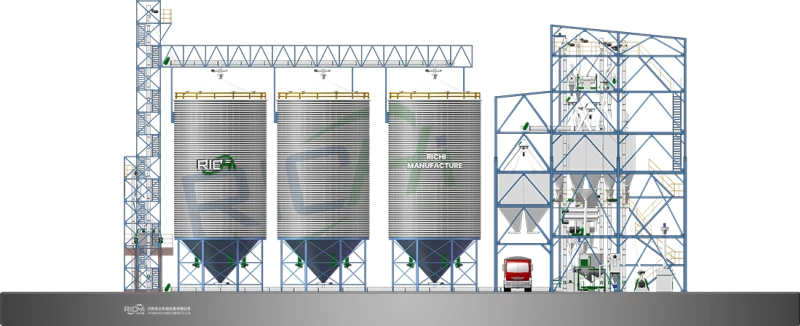
60-80t/h complete feed mill plant
A 60–80 t/h chicken feed plant represents a significant industrial asset — the kind of installation that anchors a national feed brand’s supply chain or forms the production backbone of a large vertically integrated agribusiness group. Multiple parallel process lines, high-capacity bulk storage, automated dispatch systems, and sophisticated quality control infrastructure are typical at this scale.
Equipment Cost: $1,450,000-1,800,000
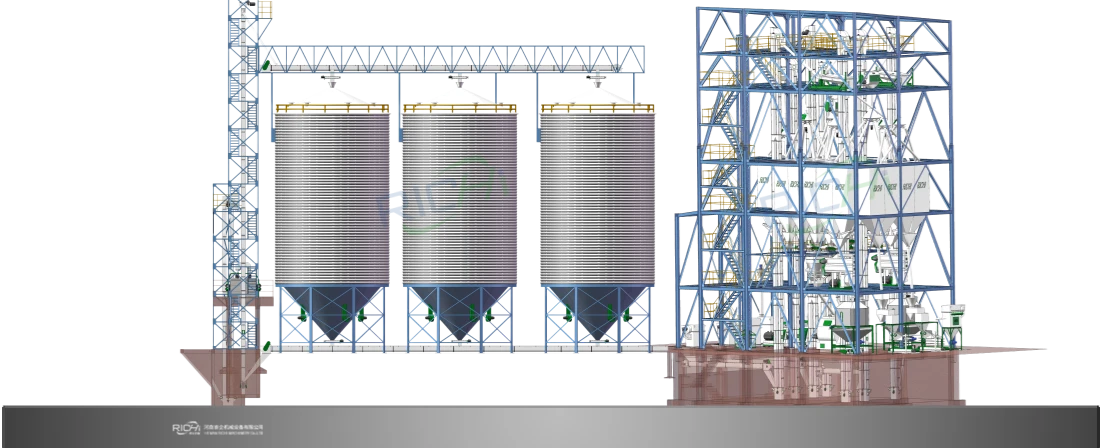
Large-scale industrial feed manufacturing at 80–100 t/h is the domain of major agro-industrial groups, national feed conglomerates, and government-backed food security projects. The engineering scope at this capacity is substantial — multiple grinding lines, large-capacity conditioning and pelleting systems, full automation with centralized SCADA control, and integrated quality monitoring.
Equipment Cost: $2,000,000-3,000,000
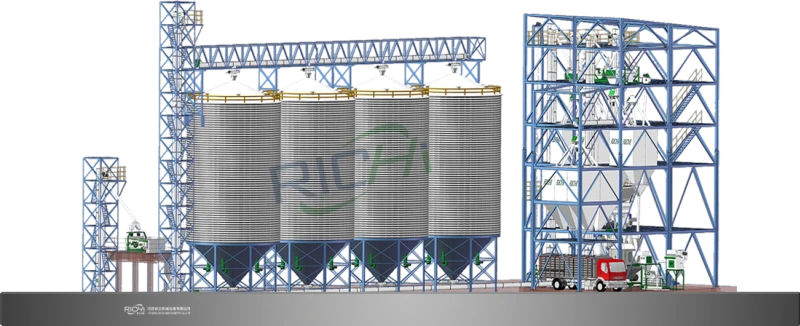
100-120 t/h feed mill engineering
The largest chicken feed mill plant configurations we engineer. At this scale, the installation is a strategic national or regional food production asset — typically serving a large integrated poultry conglomerate, a government feed security program, or an export-oriented feed manufacturing operation. The $2.5 million-plus investment reflects a complete industrial facility.
Equipment Cost: Over $2,500,000
Chicken Feed Mill Plant Investment Cost
One of the first questions any serious buyer asks is what this actually costs — and the honest answer is that it depends on more variables than most equipment suppliers will tell you upfront. Capacity, automation level, raw material handling scope, building conditions, country of installation, and local civil construction costs all move the number. What we’ve done below is break the investment into two parts: the equipment cost by system category, and the additional project costs that sit outside our equipment supply scope but are real budget items for anyone building a chicken feed mill plant from the ground up. The ranges reflect actual project data, not list price estimates.
Whole poultry feed plant set up investment : $80,000 – $40,000,000
Chicken Feed Mill Equipment Cost :
chicken feed plant grinder price :
$2,000-$20,000
chicken feed plant mixer Price :
$1,500-$25,000
chicken feed pellet machine Price :
$7,000-$95,000
chicken feed plant cooler Price :
$2,000-$30,000
Crucrumbler & screener Price :
$2,000-$20,000
feed packaging machine Price :
$1,000-$40,000
chicken feed plant conveyer Price :
$3,000-$60,000
cleaning equipment Price :
$1,500-$15,000
Dust removal equipment price :
$2,000-$30,000
Liquid or oil addition systems Price :
$1,500-$20,000
feed plant Storage silos Price :
$3,000-$200,000+
Control system & automation Price :
$5,000-$100,000
The ranges above are drawn from over a thousand chicken feed mill plant projects completed across more than 130 countries — from sub-$20,000 farm-scale installations in East Africa to multi-million-dollar industrial complexes in Russia and the Middle East. They are reference ranges, not quotations. Your actual number depends on what you’re building, where you’re building it, and what you’re starting with. The most efficient path to an accurate budget is a direct project consultation.
Send us your target capacity, feed type, raw material situation, and building conditions — we’ll produce a configured equipment quotation, a process flow recommendation, and a realistic breakdown of the full project investment. For buyers at the early planning stage, we also provide feed mill investment advisory and commercial feasibility input based on your specific market context. The equipment cost is only one part of the picture; we’ll help you see the whole thing.

What RICHI Delivers Beyond the Equipment
Building a chicken feed mill plant involves more decision points than most buyers anticipate before they start. Equipment selection is only one of them. Civil layout, process flow sequencing, installation sequencing, operator readiness, and what happens six months after commissioning when a wear part needs replacing — all of it matters, and all of it is part of what we manage. The four service areas below cover the full project lifecycle, from the first technical consultation through to long-term operational support.uns.
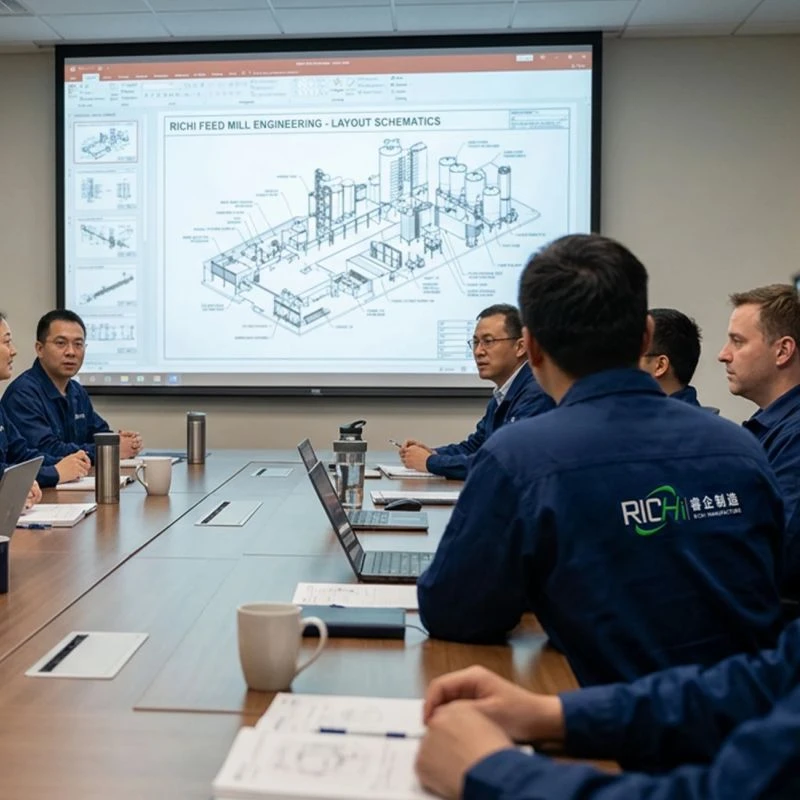
Process Design & Custom Engineering
Every project starts with a tailored process design based on your actual site conditions and production goals. We provide layout drawings, equipment arrangements, material flow plans, utility requirements, and electrical load schedules before manufacturing begins. Factors such as building size, height restrictions, and production requirements are addressed during engineering, not during installation. Feed formulation requirements, pellet specifications, and process parameters are integrated into the design, while custom equipment modifications and automation solutions are available for specialized applications.
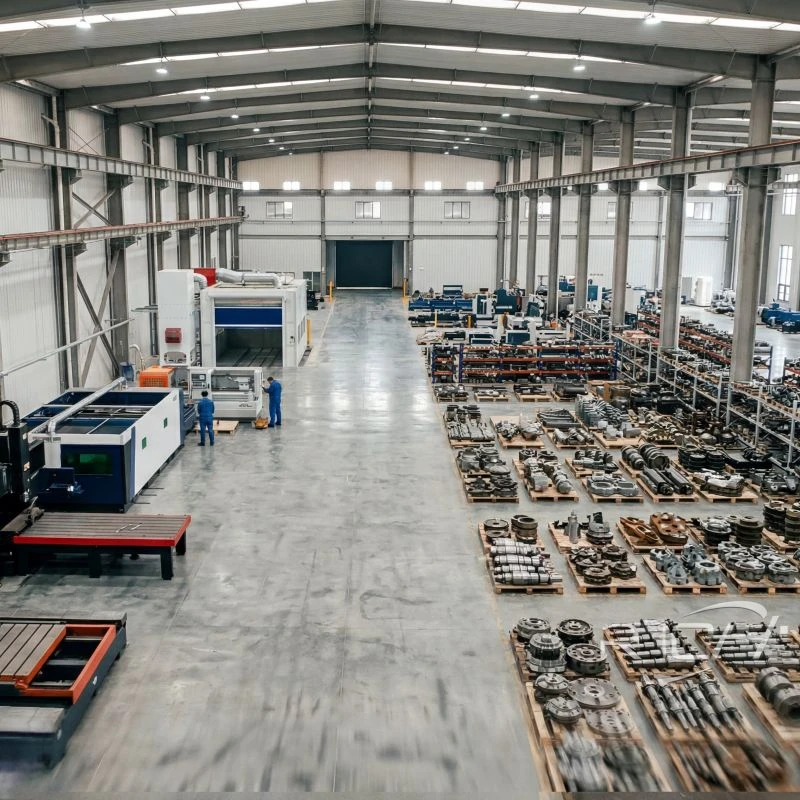
Equipment Manufacturing
All core equipment is manufactured in RICHI’s own production facilities, covering more than 300,000 m². Dedicated production lines ensure quality control for pellet mills, mixers, hammer mills, coolers, and conveying systems. ISO, CE, and SGS certifications support global export requirements. Critical components undergo strict inspection and testing, and factory acceptance testing is available before shipment to ensure reliable performance and consistent delivery schedules.
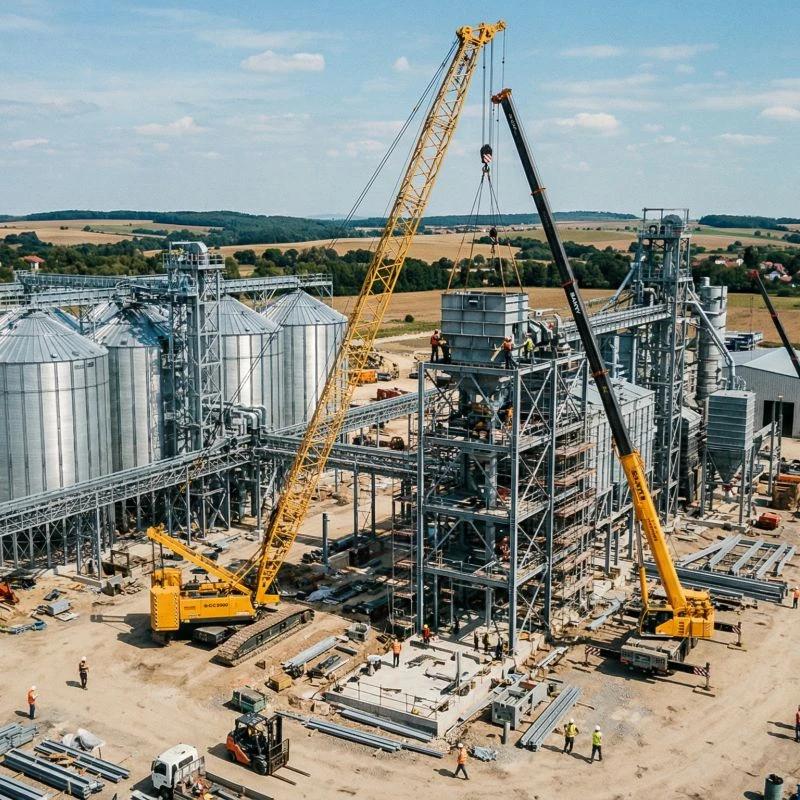
Installation, Commissioning & Operator Training
RICHI engineers provide on-site installation supervision, commissioning, and operator training. Equipment alignment, electrical connections, and system integration are verified before startup. Trial production is conducted using actual raw materials, with key indicators such as pellet quality, moisture, fines, and capacity adjusted to meet design targets. Training ensures operators can run the plant efficiently and handle routine troubleshooting independently.
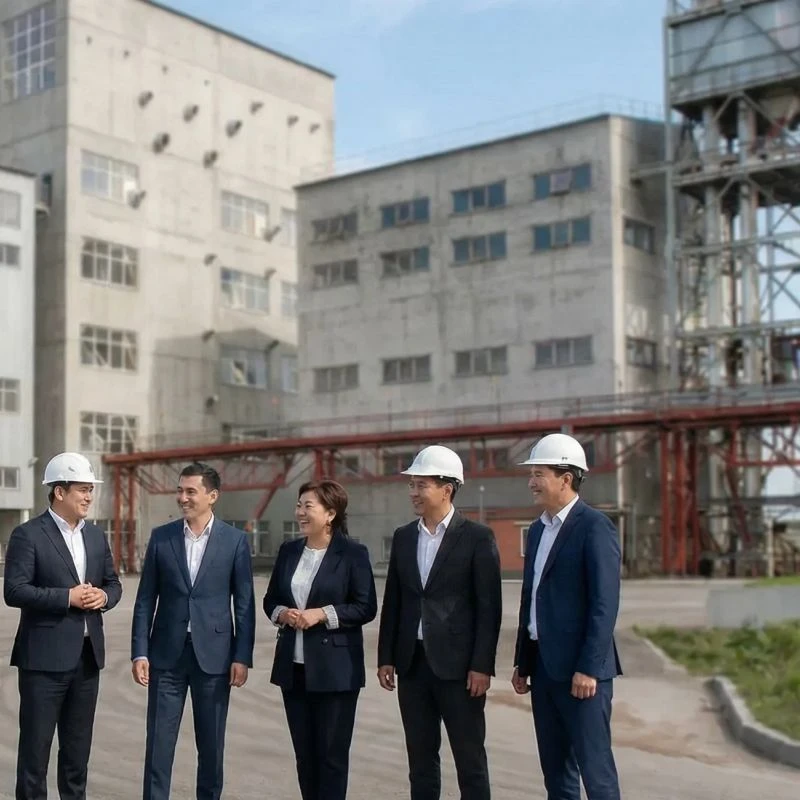
After-Sales Support & Lifecycle Service
Support continues long after project handover. We supply genuine spare parts for all equipment, including ring dies, rollers, screens, and other wear components. Technical assistance is available throughout the equipment lifecycle via remote support and on-site service when required. For future upgrades or capacity expansion, original project records and engineering data are retained, simplifying modifications and reducing downtime.
What RICHI Provides Free
Most equipment suppliers send you a price list. We send you a project. Before any purchase commitment, every chicken feed mill plant inquiry we handle gets a full technical response — not a sales deck, but actual engineering output you can take to your civil contractor, your bank, or your board. The eight categories below are provided at no charge as part of our standard pre-sales and ongoing support process. No retainer, no consulting fee, no obligation to buy.

Free Project Cost Estimate
Free Design Flow Chart
Free 3D Renderings & Drawing
Free Factory Area Planning
Free Circuit Diagram Design
Free Civil Engineering & Steel Structure Drawings
Free Remote Installation Guidance
Free Equipment Manual & Operation Guidance
Equipment That Goes Into Every Chicken Feed Mill Plant
A complete chicken feed mill plant draws from a wide equipment range — and every piece in the line affects what comes out the other end.
The core machinery covers: raw material receiving conveyors and intake hoppers, bulk storage silos, rotary cleaning screens and magnetic separators, hammer mills and roller mills for grinding, batching and weighing systems, single and double-shaft paddle mixers, ring die pellet mills, steam conditioners, counterflow coolers, crumblers, vibrating classification screens, liquid addition and fat coating systems, bucket elevators and screw conveyors throughout, pulse-jet dust collectors, automatic bagging scales, and PLC control systems tying the process together.
Not every line uses every piece — configuration depends on your feed type, raw material form, and automation requirements. What we manufacture covers the full range, and all of it is sourced from our own production facilities.
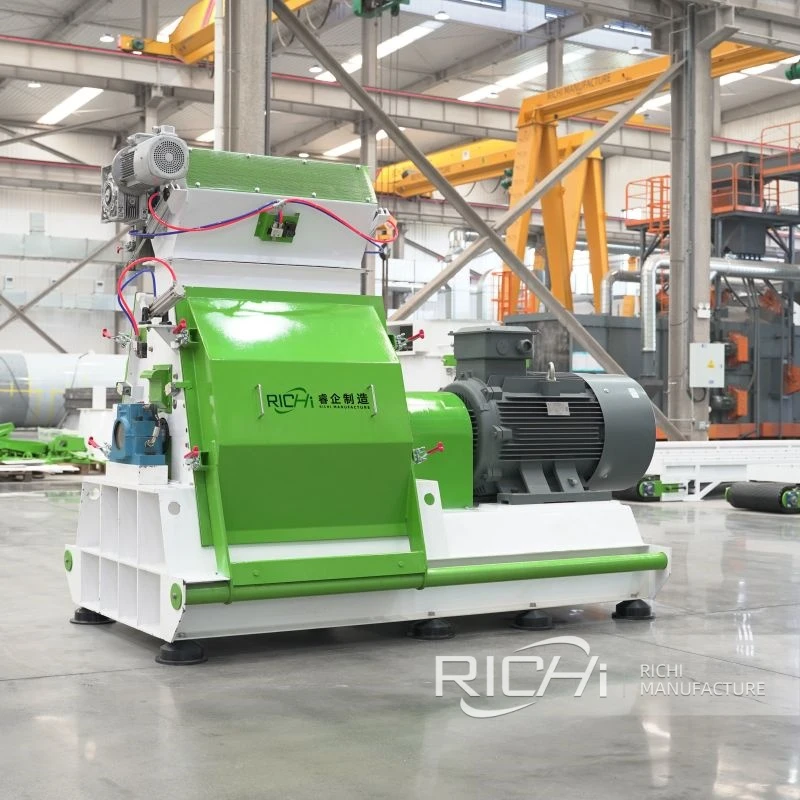
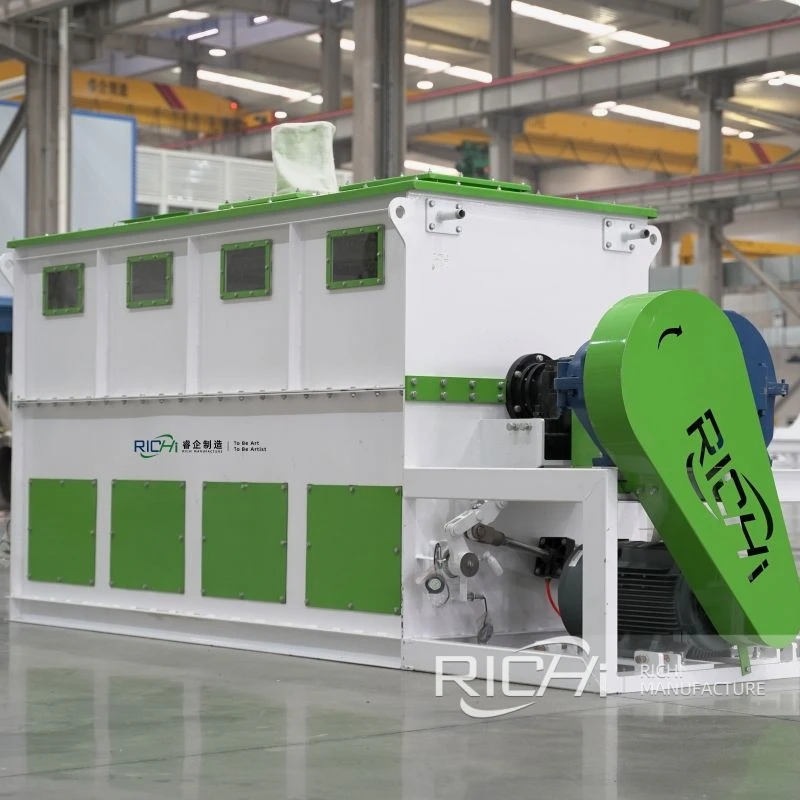
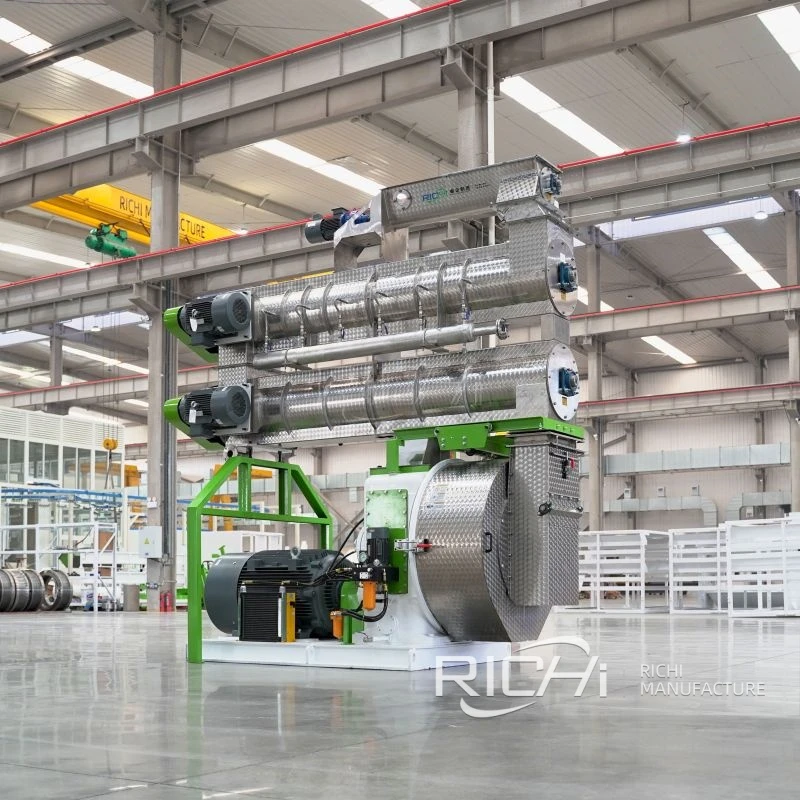
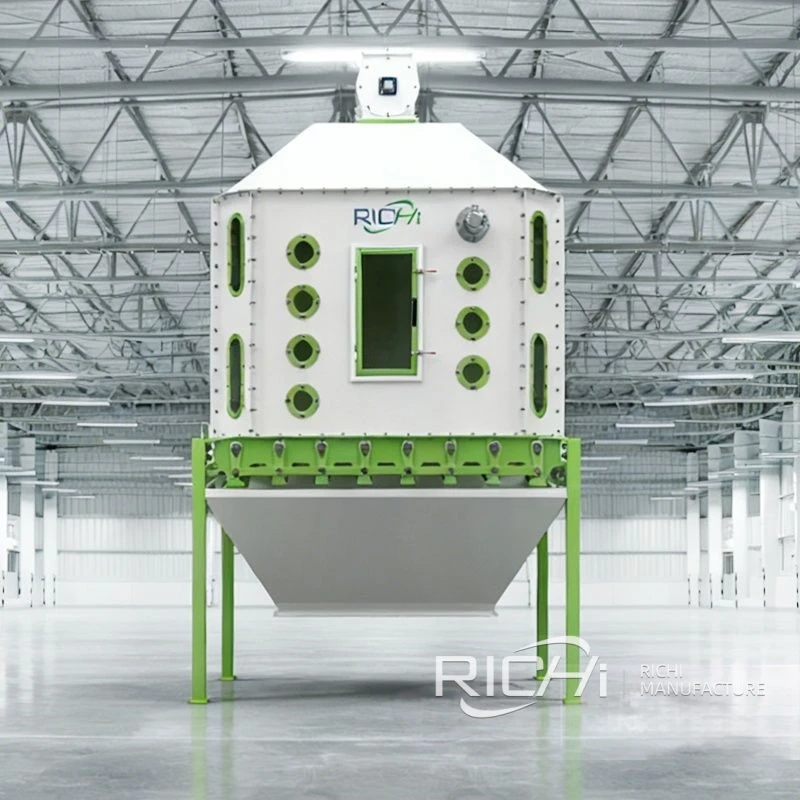
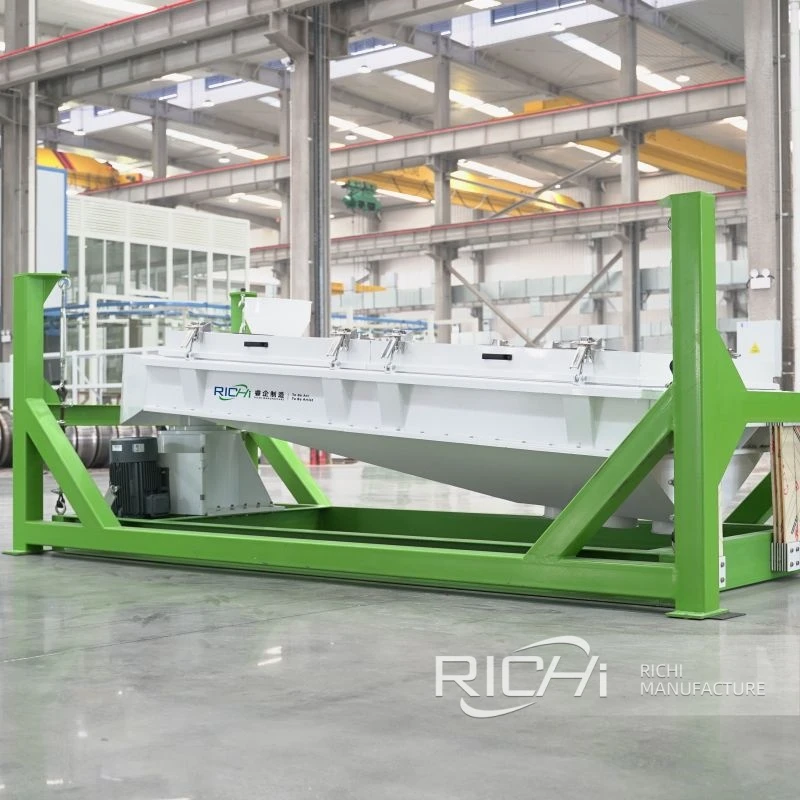
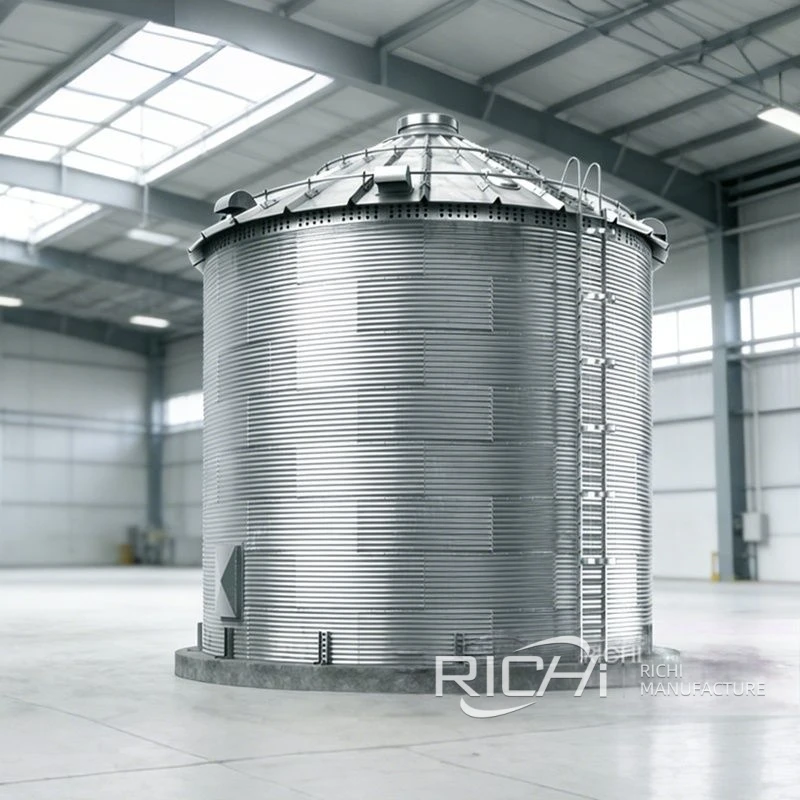
If you’re specifying a new line or replacing worn equipment on an existing installation, the full equipment catalogue covers specifications, capacity ranges, and power requirements across every category.
Why Chicken Feed Manufacturing Is Still One of the Safer Agribusiness Investments
Poultry is the most consumed meat protein globally — and that demand doesn’t move backward. Broiler cycles are short, flock turnover is high, and feed consumption is continuous. Every commercial chicken operation buys feed every week without exception. That’s the underlying logic that makes owning a chicken feed mill plant a fundamentally different investment from most agribusiness assets: your customer base doesn’t disappear between seasons.
The more interesting question for serious investors isn’t whether to enter feed manufacturing — it’s where the margin actually sits. Buying raw materials and selling finished feed at commodity pellet prices is one model. A more profitable version involves producing species-specific or stage-specific formulations — broiler starter crumble, layer high-calcium pellets, breeder rations — where the value-add justifies a price premium over generic compound feed.
Further up the margin curve: a single chicken feed mill configured to also run aquafeed, pig feed, or ruminant rations on the same installation. The capital cost increase is incremental; the revenue diversification is significant. Markets where commercial feed supply is inconsistent or expensive present the clearest entry opportunity — your competitors are logistics problems and imported product, not established local manufacturers.
Talk to Us About the Business Case for Your Market
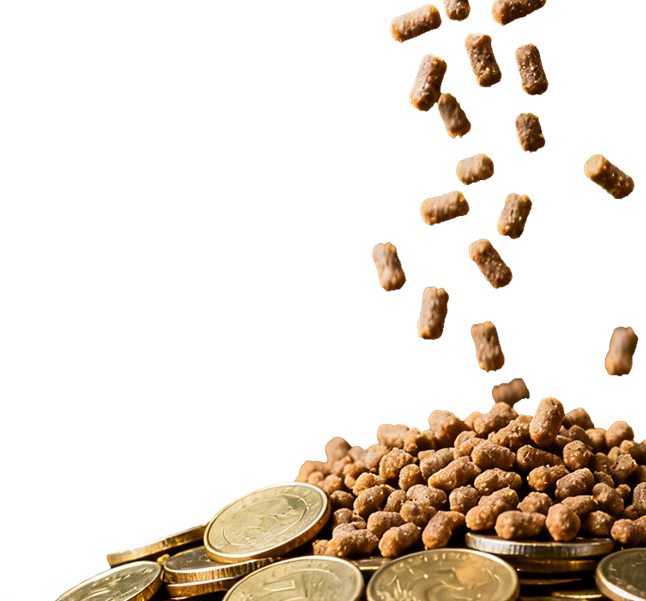
How We Engineer the plant Around What You’re Making
The raw materials going into a chicken feed mill plant determine almost everything about how the process needs to be configured. Corn, soybean meal, wheat bran, rice bran, fishmeal, meat and bone meal, cassava meal, sunflower cake, canola meal, palm kernel cake, sorghum, barley, limestone, dicalcium phosphate, salt, premix concentrates, synthetic amino acids, vegetable fat — these are the standard inputs. In practice, what we see across projects is considerably broader. Clients in West Africa substitute sorghum for corn when local prices shift.
Operations in Southeast Asia run high rice bran or copra meal inclusion rates that would cause bridging problems on a standard hammer mill configuration. Buyers in South America work with locally grown whole soybeans that need dehulling before grinding. We’ve configured lines around beet pulp, dried distillers grains, feather meal, and locally milled grain byproducts that don’t appear in any standard formulation reference. The point isn’t that these are exotic — it’s that raw material form, moisture content, bulk density, and fiber content all affect grinding behavior, mixing time, conditioning response, and pellet durability. We design the process around what you’re actually using, not around a reference formulation.

Corn
Soybean Meal

Wheat
Rice Bran

Rapeseed Meal

Fish Meal

Limestone
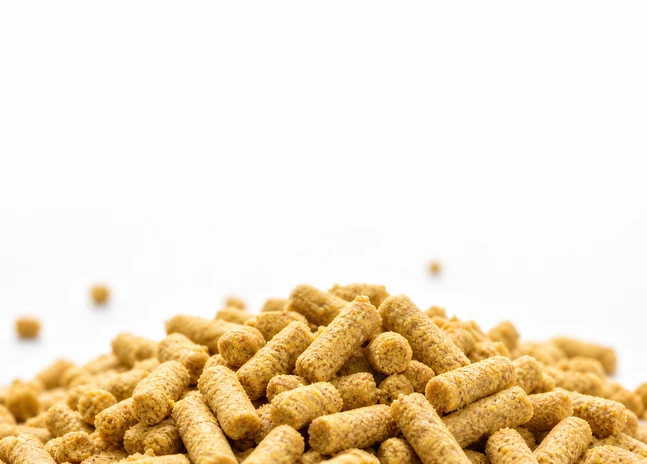
Broiler Feed
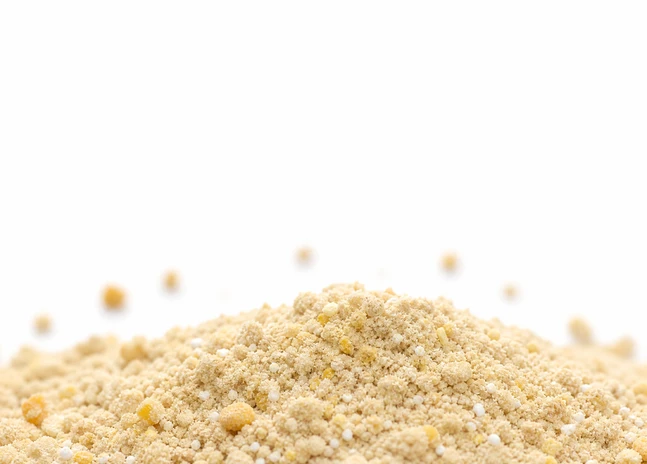
Broiler feed runs in three distinct phases, each with different pellet geometry and nutrient density. Starter feed: 1.5–2.0mm crumble or micro-pellet, high protein (22–24%), fine grind at 500–800 microns to maximize digestibility in young birds. Grower: 2.5–3.0mm pellet, protein steps down to 19–21%. Finisher: 3.5–4.0mm pellet, energy density increases as protein reduces to 17–19%.
The phase transitions matter to equipment configuration — a line producing all three formats needs a crumbler and screening deck, not just a pellet press.
Layer Feed
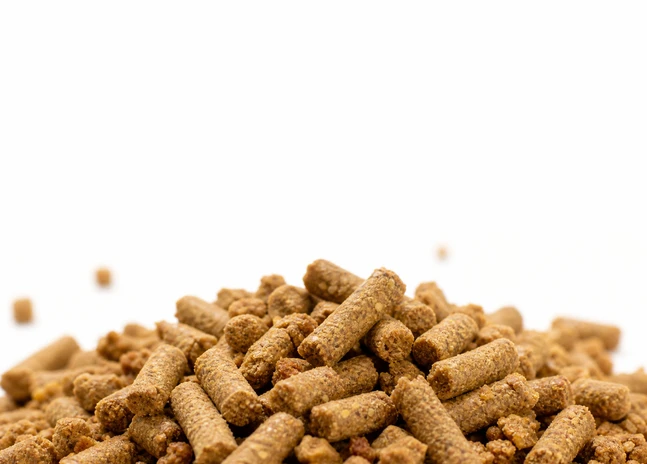
Layer feed is nutritionally distinct from broiler feed in one critical way: calcium requirement is substantially higher — typically 3.5–4.5% — to support shell quality across a 60–70 week laying cycle. That changes the raw material mix significantly; limestone inclusion rates of 8–10% are common, and the particle size of the limestone fraction matters for calcium absorption timing.
Layer feed is produced as either mash (0.5–1.5mm grind) or pellet (3.0–3.5mm), depending on the production system. Cage operations often run mash; free-range and barn systems increasingly prefer pellets for reduced feed wastage.
Breeder Chicken Feed
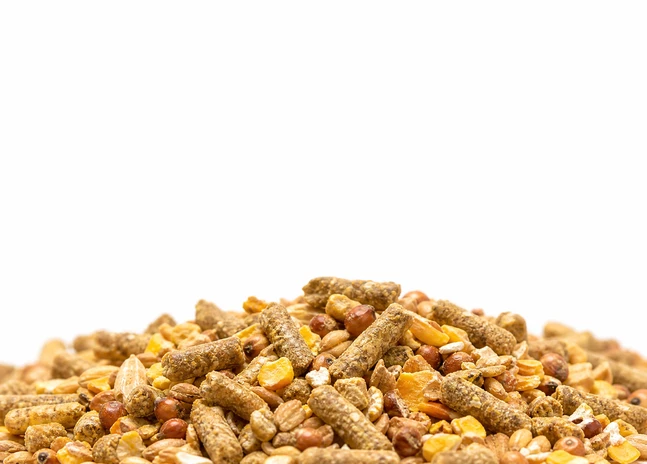
Breeder rations sit between layer and broiler specifications nutritionally, but the production context is different — breeder flocks are managed for reproductive performance rather than growth rate or egg volume, which means feed intake is often controlled by design.
Pellet size typically runs 3.5–4.5mm to slow consumption rate. Formulations emphasize vitamins E and D3, selenium, and specific amino acid ratios that affect hatchability rather than weight gain.
Ask About Breeder Feed Line Requirements
Native & Free-Range Chicken Feed
Native chicken and free-range poultry operations are a growing market segment, particularly across Asia, Africa, and Latin America, where traditional breeds are commercially farmed alongside or instead of commercial hybrids. Feed formulations for native breeds typically run lower protein and energy density than commercial broiler rations — these birds grow slower and forage partially, so the feed supplement role is different.
Raw material flexibility is higher in this segment: locally grown grains, agricultural byproducts, and unconventional protein sources appear more frequently.
Talk to Us About Native Breed Feed Production
Reference Formulations for Common Chicken Feed Types
Broiler Grower Pellet Feed — Reference Formulation (19% CP)
Corn (maize)
62%
Soybean meal (46% CP)
24%
Vegetable Oil
3%
Limestone
1.2%
Dicalcium phosphate
1.5%
…
…
Layer Complete Pellet Feed — Reference Formulation (16% CP)
Corn (maize)
58%
Soybean meal (46% CP)
18%
Limestone (coarse)
9.5%
Wheat bran
6%
Dicalcium phosphate
1.8%
…
…
Broiler Starter Crumble Feed — Reference Formulation (22% CP)
Corn (maize)
55%
Soybean meal (46% CP)
30%
Fishmeal (65% CP)
4%
Vegetable oil
2.5%
Dicalcium phosphate
1.8%
…
…
Breeder Chicken Pellet Feed — Reference Formulation (15% CP)
Corn (maize)
60%
Soybean meal (46% CP)
16%
Wheat Bran
8%
Limestone
7%
Sunflower meal
4%
…
…
Native Chicken Mash Feed — Reference Formulation (14% CP)
Broken rice / sorghum
50%
Rice bran
18%
Locally dried fishmeal
10%
Corn (maize)
10%
Cassava meal
6%
…
…
Layer Mash Feed — Reference Formulation (17% CP)
Corn (maize)
55%
Soybean meal (46% CP)
20%
Limestone (fine ground)
10%
Rice bran
7%
Dicalcium phosphate
1.5%
…
…
As a feed mill engineering company, we work with formulations daily — not to replace your nutritionist, but because understanding what’s going into the line is inseparable from designing the process correctly. The tables above show representative formulations for four chicken feed types.
These are illustrative references based on commonly used ingredient combinations globally; your actual formulation will depend on local raw material availability, pricing, and your specific nutritional targets. We use formulation data during process design to determine grinding fineness, mixer specification, conditioning parameters, and die selection — so sharing your formula early in the consultation process directly improves the accuracy of the equipment proposal.
Chicken Feed Mill Plant FAQs
What is a chicken feed mill plant and what does it produce?
+
A chicken feed mill plant is a complete production system that processes raw ingredients — grain, protein meals, minerals, additives — into finished poultry feed in pellet, mash, or crumble form. Depending on configuration, the same installation can produce broiler starter crumble, layer pellets, breeder rations, and concentrated or premix feed. It’s not a single machine — it’s a process line covering grinding, batching, mixing, pelleting, cooling, screening, and packaging as integrated stages.
How much does a chicken feed mill cost?
+
.How much is a chicken feed mill depends heavily on capacity and automation level. Equipment-only cost ranges from around $10,000 for a basic 1–2 t/h farm line to $2.5 million-plus for a 100 t/h industrial installation. A realistic full project budget — equipment, civil works, installation, utilities, initial raw material stock — typically runs 1.5 to 2.5 times the equipment cost alone. We provide itemized quotations based on your actual specification, not range estimates.
What is chicken feed mash and when is a mash line the right choice?
+
What is chicken feed mash: it’s a ground but unpelleted complete ration — mixed meal without the pelleting stage. Layer operations on cage-free or backyard systems often prefer mash because pellet binding agents can conflict with organic or natural certifications. It’s also the lower capital entry point — no pellet press, conditioner, or cooler required. The trade-off is higher feed wastage at the trough compared to pelleted formats.
What is chicken feed made of in commercial production?
+
What’s chicken feed made of varies by species and growth stage, but the base is typically corn or sorghum (energy), soybean meal (protein), a calcium source like limestone, dicalcium phosphate, salt, and a premix covering vitamins and trace minerals.
Layer feed runs significantly higher calcium — 9–10% limestone inclusion for shell quality. Broiler starter runs higher protein, finer grind. Regional raw material availability shifts the formula — rice bran and cassava are common in Southeast Asia; sunflower cake and barley appear frequently in Eastern Europe and Central Asia.
How is chicken feed made in a pellet production line?
+
How chicken feed is made in a pellet line: raw materials are received and stored, cleaned to remove foreign matter, ground to target particle size, weighed and batched by formula, mixed to homogeneity, conditioned with steam, pressed through a ring die to form pellets, cooled to near-ambient temperature, screened for fines, and bagged or bulk-loaded. Crumble production adds a post-pellet breaking stage. The full sequence from raw material intake to finished bag typically takes 20–35 minutes per batch on an automated line.
What capacity chicken feed mill plant do I actually need?
+
Start with your flock size and feed consumption rate, then work backward. A 10,000-bird broiler operation consuming 50g feed per bird per day needs roughly 500 kg/day — well within a 1 t/h line running a single shift. A commercial operation supplying multiple farms needs a different calculation. We run this sizing exercise with every client before recommending a capacity — oversizing wastes capital; undersizing creates a bottleneck within twelve months of commissioning.
Can one poultry feed mill plant handle both layers and broilers?
+
Yes — and most commercial operations we work with do exactly this. The process stages are shared; what changes between species runs is the formulation loaded into the batching system, the die specification on the pellet press, and sometimes the conditioning parameters. Changeover time between product types on a well-configured poultry feed mill plant runs 30–60 minutes. If you’re producing significantly different pellet diameters for different species, die inventory management is part of the operational planning.
How much floor space does a feed mill machine for poultry require?nt?
+
Feed mill machine for poultry at 5 t/h typically requires 200–400 m² of production floor space depending on silo integration and automation level. A 10–15 t/h line with bulk storage needs 600–1,000 m². Building height matters more than footprint for vertical conveying systems — standard configurations need 8–12 meters clearance. If your building has height restrictions, we redesign the conveying layout around your actual ceiling — we’ve installed functional lines in buildings as low as 5.7 meters.
Do I need to dig a pit for the equipment installation?
+
Not necessarily. Pit requirements depend on the equipment layout and building structure. Some configurations — particularly those with below-floor screw conveyors or flush-discharge mixers — do require shallow pits, typically 800mm to 1,200mm deep. Others are fully above-floor installations. We specify pit requirements in the civil engineering drawings we provide free of charge before any purchase commitment, so your civil contractor knows exactly what’s needed before ground is broken.
Can your chicken feed plant handle non-standard raw materials like cassava, sunflower husks, or beet pulp?
+
We’ve configured lines around all of these. Cassava affects conditioning behavior due to starch gelatinization characteristics. Sunflower husks and beet pulp introduce fiber fractions that behave differently through the hammer mill and affect pellet durability. Palm kernel cake has variable oil content that influences die selection. The process engineering response to each of these is specific — screen sizing, conditioner retention time, die compression ratio — and gets resolved at the design stage when you share your raw material composition with us.
What’s the difference between a local chicken feed mill and a commercial-scale installation?
+
A local chicken feed mill typically refers to a small on-farm or village-scale operation — 1–5 t/h, simple process, minimal automation, serving a defined local catchment. A commercial installation runs higher throughput, automated batching, quality control systems, and supplies a distribution network. The engineering logic is the same; what differs is the automation level, redundancy built into critical stages, and the civil infrastructure required. We supply both — the specification conversation is just different.
How long does it take to build and commission a chicken feed mill plant?
+
For a 5–10 t/h line: equipment manufacturing takes 30–45 days after order confirmation, shipping 15–35 days depending on destination, installation and commissioning 15–25 days on-site. Total timeline from order to first production run: typically 3–4 months. Larger lines — 20 t/h and above — run longer manufacturing schedules and more complex commissioning. Civil works run parallel to equipment manufacturing and are the most variable timeline factor.
We already have grinding and bagging equipment. Can we retrofit just the pelleting and mixing stages?
+
Yes. This is a fairly common project type — an existing feed operation that has functional raw material handling and packaging wants to add pelleting capability. We assess your existing equipment compatibility, design the connecting conveyors and control integration, and supply only the modules you’re missing. The 20 t/h upgrade project in our case library is exactly this scenario — the client retained their grinding and bagging sections and we engineered the middle of the process around what was already there.
What pellet sizes can your ring die pellet mill produce for poultry feed?
+
Standard poultry feed pellet diameters run 1.5mm, 2.0mm, 2.5mm, 3.0mm, 3.5mm, and 4.0mm. Die hole configuration is matched to bird type and age — 1.5–2.0mm for day-old chick crumble base, 3.5mm for layers, 2.5–3.5mm across broiler growth stages. Die changes on our pellet mills take 30–60 minutes with a two-person crew. If your operation runs multiple species or growth-stage rations, we factor die inventory and changeover frequency into the operational planning.
What automation level is standard on your chicken feed mill systems?
+
We supply three broad automation tiers. Basic: manual batching, operator-controlled process stages, suitable for 1–5 t/h farm-scale operations. Semi-automatic: PLC control of individual process stages with manual batching. Fully automatic: computer batching with recipe management, PLC-controlled process sequencing, automated bagging, production reporting, and remote monitoring. The right tier depends on your capacity, labor cost structure, and operator skill level — we don’t default to full automation as an upsell if it doesn’t make operational sense for your scale.
Can a chicken feed mill plant be configured to also produce fish or pig feed?
+
Yes — and this is a configuration we’ve done across multiple projects. Adding aquafeed capability to a chicken feed plant requires a single-screw or twin-screw extruder downstream of the mixer, plus a belt dryer and coating system for floating feed. Pig feed shares most of the same process stages as poultry feed with adjustments to formulation and pellet size. A combined line costs more upfront but substantially reduces the per-tonne capital cost of each feed type and gives the operation revenue flexibility across species.
What whole grain chicken feed options can your equipment handle?
+
Whole grain chicken feed recipes — used in some free-range and organic production systems — require roller mill or whole grain intake systems rather than hammer mill grinding, since the objective is to crack or coarsely reduce the grain rather than grind it to meal. We’ve configured lines for whole wheat and whole barley inclusion in layer and native breed rations. The process upstream of the mixer changes significantly; downstream stages remain largely standard.
Why do some producers feed chickens fermented feed, and can your line handle pre-fermented inputs?
+
Why feed chickens fermented feed: fermentation improves digestibility, reduces anti-nutritional factors in some ingredients, and can lower pathogen load in raw materials. It’s practiced primarily in small-scale and organic production systems, less common in commercial pellet manufacturing. Our lines can handle pre-fermented wet ingredients if the moisture management is addressed upstream — a drying stage before mixing is typically required to bring moisture content within the range the pellet press can handle without die blockage.
What after-sales support do you provide once the line is running?
+
Spare parts supply covering all wear components — ring dies, rollers, hammer mill screens, mixer paddles — with standard parts available for dispatch without extended lead times. Remote technical support throughout the equipment lifecycle, not just within warranty period. On-site follow-up visits where needed. We maintain full project documentation from original installation, so any modification or upgrade doesn’t require restarting the engineering process. Operator training is provided free of charge at commissioning and remains available as staff changes over time.
We’re planning a new chicken feed plant in Kenya — what local factors should we account for in the specification?
+
East African feed mill projects typically involve locally sourced maize, sunflower cake, and fishmeal alongside imported soybean meal — the hammer mill and die selection should reflect this mix. Power supply reliability varies significantly by region and often warrants generator backup specification. Construction costs in Kenya are moderate by global standards, which makes the civil works component manageable. Import duties on equipment vary; we’ve handled Kenyan customs documentation on previous projects and can advise on what to expect. Altitude at your site also marginally affects pellet press and motor performance — worth noting if you’re above 1,500 meters.
What types of chicken feed mill plant does RICHI supply, and what are the core specs?
+
A chicken feed mill plant is a complete production system engineered to process raw ingredients into finished poultry feed — broiler rations, layer rations, breeder feed, and everything in between. The output format depends on your operation: pelleted complete feed, mash, crumble, concentrated feed, or premix. RICHI supplies all of these configurations, from 1 t/h farm-scale installations to 160 t/h industrial complexes.
Core specification range:
| Parameter | Range |
|---|---|
| Capacity | 1–160 t/h |
| Equipment investment | $10,000–$5,000,000 USD |
| Output formats | Pellet, mash, crumble, premix, concentrated feed |
| Applicable bird types | Broilers, layers, breeders — all growth stages |
| Typical customers | Feed manufacturers, integrated poultry farms, agribusiness investors |
The three plant types we engineer:
Compound Feed Mill Plant
The most common configuration. Covers the full process sequence: raw material reception and cleaning → grinding → batching and weighing → mixing → conditioning and pelleting → cooling → screening → packaging. Liquid addition, steam, compressed air, and dust extraction systems are integrated depending on specification. Produces pellet, mash, and crumble formats from the same installation.
Premix Feed Mill Plant
A leaner process focused on micro-ingredient blending: raw material reception and cleaning → precise weighing → mixing → packaging. Premix is an intermediate product — vitamins, minerals, amino acids, and additives combined at low inclusion rates (1–5%) for addition to complete rations. The engineering emphasis here is weighing accuracy and cross-contamination prevention between batches, not throughput. Margins on premix production are typically stronger than compound feed on a per-tonne basis.
Concentrated Feed Mill Plant
Process mirrors compound feed powder production: reception and cleaning → grinding → batching → mixing → packaging. Concentrated feed is a high-protein, high-nutrient intermediate — the end user adds local energy grain (typically 50–70% corn) to produce a complete ration. Common in markets where smallholder farmers grow their own grain but can’t formulate or source micronutrient components independently.
What differentiates RICHI’s engineering approach across all three types: process design is built around your actual raw materials, not a reference formulation. Whether you’re running standard corn-soy or substituting sorghum, cassava, sunflower cake, rice bran, or locally sourced protein meals, the grinding configuration, conditioning parameters, and mixing specifications are set for what you’re actually processing — not adjusted after the fact during commissioning.
How is chicken feed made — what does the production process actually look like inside a feed mill?
+
Most buyers who’ve visited a chicken feed mill plant once have a rough picture of the process. What’s less obvious from the outside is how many of the quality and efficiency variables are set — or misset — at the equipment specification and process design stage, long before the first batch runs. Here’s how a complete pellet feed production sequence works, and where the engineering decisions that matter most are made.
Step-by-Step: Chicken Feed Production Process
01 — Raw Material Reception & Cleaning
Bulk ingredients — corn, soybean meal, wheat bran, and others — are received, inspector-verified, and directed into storage silos. Before storage, raw materials pass through:
- Primary cleaning screens (removes oversized foreign matter, stones, caking)
- Magnetic separation devices (permanent magnet drums or rollers — removes ferrous metal fragments)
- Conveying equipment connecting intake to silo allocation
This stage is skipped or underspecified more often than it should be. In a pellet line, metal contamination that reaches the ring die causes immediate and expensive damage. In a mash line, it ends up in the finished bag.
02 — Grinding
Raw materials requiring size reduction are drawn from the pre-grinding silo and fed into the hammer mill. Ground meal is conveyed to the pre-mixing silo.
Key engineering variables at this stage:
- Screen size selection determines particle fineness — broiler starter requires finer grind (500–800 microns) than layer pellet base meal
- Hammer mill sizing determines whether this stage is a bottleneck or keeps pace with downstream capacity
- This is typically the highest energy-consumption stage in the entire process
Monitoring points during operation: hammer wear condition, screen integrity, motor current draw, noise profile, and material flow through the grinding path. A worn screen that’s not caught early shifts your particle size distribution without triggering an obvious alarm.
03 — Batching & Weighing
Weighed quantities of each ingredient are drawn from individual batching bins according to the active formula. Small-volume inclusions — premix concentrates, amino acids, pharmaceutical additives — are typically hand-weighed and manually added to the batch.
Two system tiers:
- Manual batching: operator-controlled, suitable for simple formulas at small scale
- Computer batching: automated loss-in-weight or gain-in-weight systems with recipe management, batch logging, and formulation recall — standard on commercial chicken feed mill installations from 5 t/h upward
Batching accuracy directly determines finished feed nutritional consistency. A batching error in the premix fraction — even at 0.5% inclusion — compounds across every tonne produced until it’s caught.
04 — Mixing
Weighed ingredients discharge into the mixer. Liquid additions — vegetable oil, molasses, liquid amino acids — are introduced through the liquid addition system during the mix cycle.
The output of this stage is either:
- Finished mash → goes directly to packaging
- Pellet base meal → transferred to the pelleting silo for the next stage
Mixing uniformity coefficient (CV%) is the technical benchmark — commercial compound feed targets CV ≤ 5%. Mixer type, fill level, blade condition, and cycle time all affect this figure. A mixer running at incorrect fill level produces inconsistent results regardless of how well the rest of the line is set up.
05 — Conditioning, Pelleting, Cooling & Screening
This is the core of a chicken feed mill plant producing pelleted or crumble output — and where the most consequential process variables interact.
| Sub-stage | What happens | Key control variable |
|---|---|---|
| Magnetic separation | Final ferrous removal before press | Magnet condition and cleaning frequency |
| Conditioning | Steam injection raises temperature and moisture | Steam volume, retention time, temperature target (75–85°C typical for poultry) |
| Pelleting | Conditioned meal compressed through ring die | Die hole diameter, compression ratio, roller gap |
| Cooling | Counterflow air reduces pellet temp and moisture | Airflow rate, residence time, ambient conditions |
| Screening | Fines separated from finished pellets | Screen aperture matched to pellet diameter |
Ring die selection — hole diameter, compression ratio, die material — is matched to your specific formulation and target pellet hardness. A die specified for a corn-soy broiler ration will not perform the same way on a high-fiber layer formula. We specify dies based on your actual raw material composition, not a generic poultry standard.
06 — Finished Product Packaging
Finished pellets or mash are weighed from the finished product bin through a packaging scale, filled into bags, labeled, sealed, and palletized for warehouse storage or direct dispatch.
Packaging configurations across our chicken feed plant projects:
- Manual bagging: operator-controlled, suitable for 1–3 t/h scale
- Semi-automatic: automatic weigher with manual bag handling
- Fully automatic: net weigher with automatic bag clamping, filling, sealing, and conveyor discharge
- Bulk loadout: direct truck or container filling for operations supplying large commercial farms
The process description above covers a standard complete feed pellet line. Premix and concentrated feed lines follow a shorter sequence — grinding, batching, mixing, and packaging — without the pelleting stages. Combined lines that produce both pelleted poultry feed and extruded aquafeed add an extruder, belt dryer, and coating system downstream of the mixer.
Every chicken feed mill plant RICHI engineers is process-designed around the client’s specific raw material mix, feed type, building conditions, and output requirements. The sequence above is the framework; the specification decisions within each stage are what determine whether the line performs to target or spends its first year being adjusted.
What do real chicken feed mill plant projects actually cost — and what have other buyers paid?
+
Reference ranges are useful for budgeting. Actual project figures are more useful. Below is a breakdown of how chicken feed mill plant investment scales by capacity, followed by sixteen completed RICHI projects with real cost data — different countries, different feed types, different configurations.
Investment Range by Capacity Tier
| Scale | Capacity | Equipment Investment |
|---|---|---|
| Small | 1–4 t/h | $10,000–$120,000 |
| Medium | 5–20 t/h | $70,000–$580,000 |
| Large | 20–120 t/h | $250,000–$3,500,000 |
Investment varies significantly within each tier depending on automation level, silo system inclusion, feed type (pellet vs. premix vs. combined species), and site-specific engineering requirements. A 5 t/h broiler pellet line and a 5 t/h premix line are priced very differently — the premix configuration requires higher-precision weighing and stricter contamination control, which affects equipment cost.
16 Completed Chicken Feed Mill Plant Projects — Real Cost Data
| Project | Capacity | Feed Type | Cost (USD) | Year |
|---|---|---|---|---|
| Algeria | 6–10 t/h | Broiler & layer pellets | $80,000–$400,000 | 2015 |
| Uzbekistan | 10–15 t/h | Broiler & layer pellets | $150,000–$400,000 | 2019 |
| Peru | 5 t/h | Chicken pellet & mash | $220,000–$250,000 | 2021 |
| Malaysia | 3–5 t/h | Broiler pellet feed | $60,000–$65,000 | 2021 |
| Nigeria | 1–2 t/h | Layer pellet feed | $25,000–$29,000 | 2020 |
| Vietnam | 15–20 t/h | Chicken & pig feed | $500,000 | 2020 |
| Kyrgyzstan | 5–7 t/h | Chicken pellet feed | $97,160 | 2022 |
| Philippines | 10 t/h | Pig & chicken feed | $460,000 | 2018 |
| El Salvador | 5 t/h | Chicken premix feed | $480,000 | 2022 |
| Thailand | 10 t/h | Chicken premix feed | $120,000 | 2021 |
| Russia | 50 t/h | Chicken & ruminant feed | $960,000 | 2019 |
| Kazakhstan | 30 t/h | Chicken & livestock feed | $1,250,000 | 2018 |
| Argentina | 5 t/h | Chicken & cow feed | $184,500 | 2021 |
| New Zealand | 5–10 t/h | Layer & goat feed | $131,820 | 2022 |
| Uganda | 15 t/h | Chicken & aquafeed | $159,070 | 2022 |
| USA | 20 t/h | Chicken & cattle feed | $550,000 | 2019 |
What the numbers tell you:
A few patterns worth noting across this project set:
- Same capacity, different cost: The El Salvador and Thailand projects are both 5–10 t/h, both premix-related — but $480,000 vs. $120,000. Configuration scope, automation level, and what’s included in the supply package drive that gap, not arbitrary pricing.
- Multi-species lines cost more but cover more ground: Vietnam, Philippines, Uganda, Kazakhstan — all combined species lines. The incremental cost of adding a second species to an existing process design is lower than building a separate dedicated line later.
- Small-scale entry is genuinely accessible: Nigeria at $25,000–$29,000 for a 1–2 t/h layer line. Not every chicken feed mill plant project is a half-million-dollar commitment.
- Large-scale is a different conversation entirely: Russia and Kazakhstan are infrastructure-level investments — the engineering scope, silo system, civil works, and commissioning complexity are categorically different from a 5 t/h farm line.
The figures above are equipment supply costs. Full project investment — civil construction, utilities, installation, raw material initial stock, working capital — typically adds 50–150% on top depending on location and build scope. For an accurate budget specific to your capacity, feed type, and site conditions, the fastest path is a direct project consultation. We’ll provide a configured equipment quotation and a realistic full-project cost breakdown based on what you’re actually building.
What does a well-engineered chicken feed mill plant design actually look like?
+
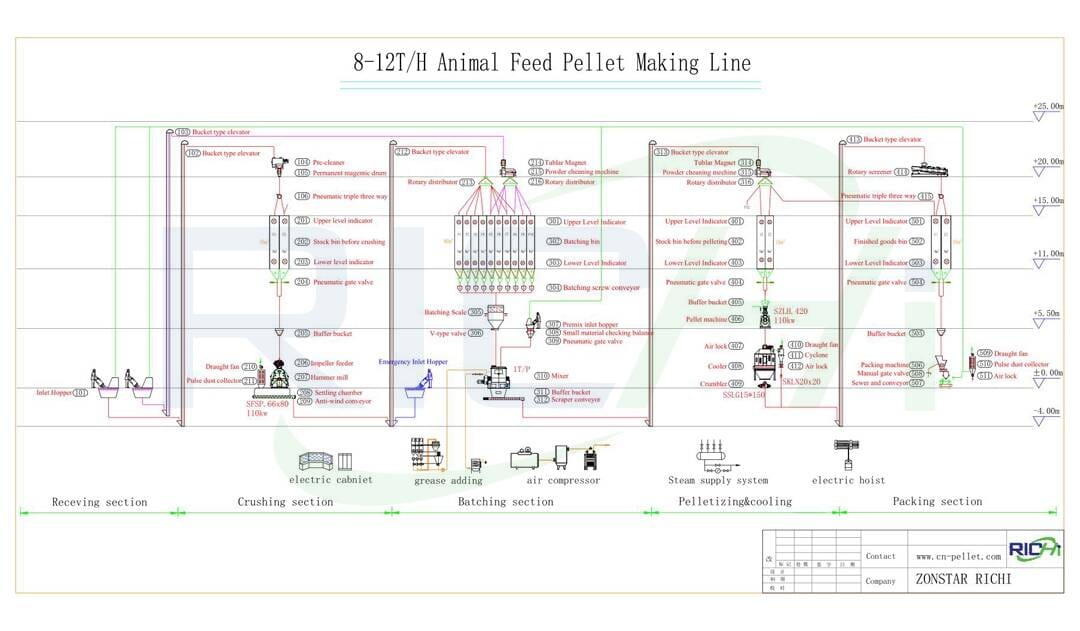
8-12 t/h chicken feed mill plant design
This 10 tons per hour complete chicken feed plant can be used for processing livestock, poultry and aquatic feed pellets, which is particularly suitable for medium feed factory, large breed farm or aquatic base. It is suitable for processing poultry feedstuff into premium chicken feed pellets.
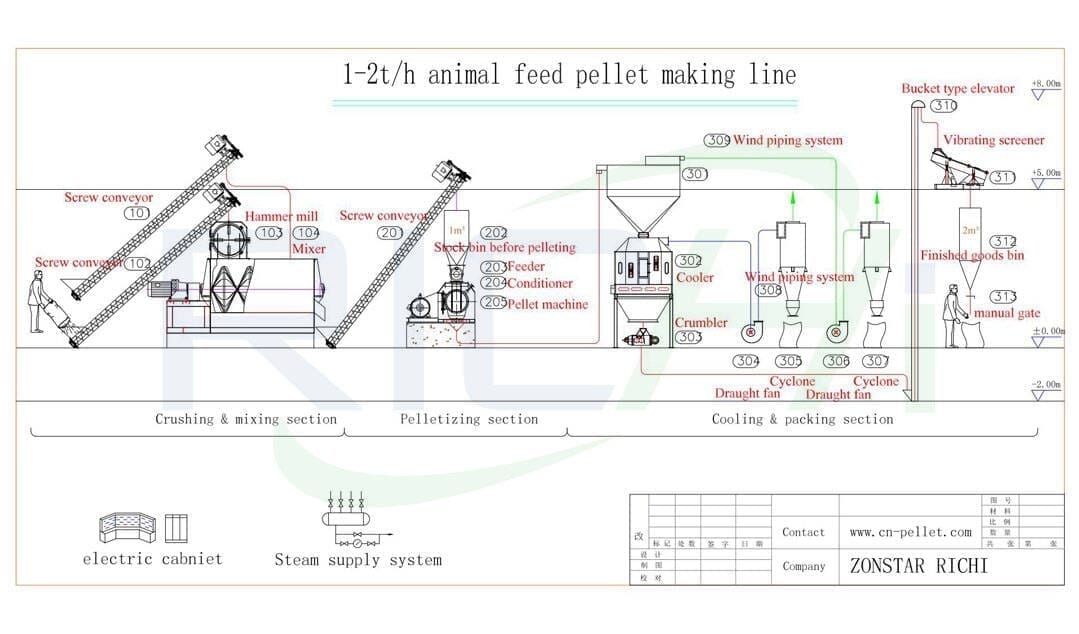
1-2 t/h chicken feed mill plant design
It is specially designed for the chicken farm owners, and the animal feed suppliers who first begins to enter the poultry feed production industry. This Line can used for all kinds of grain, such as maize, corn, wheat, soybean, barley etc. There are also other kinds of materials, like premix, vitamins, wheat bran, salt and others according to different formula.
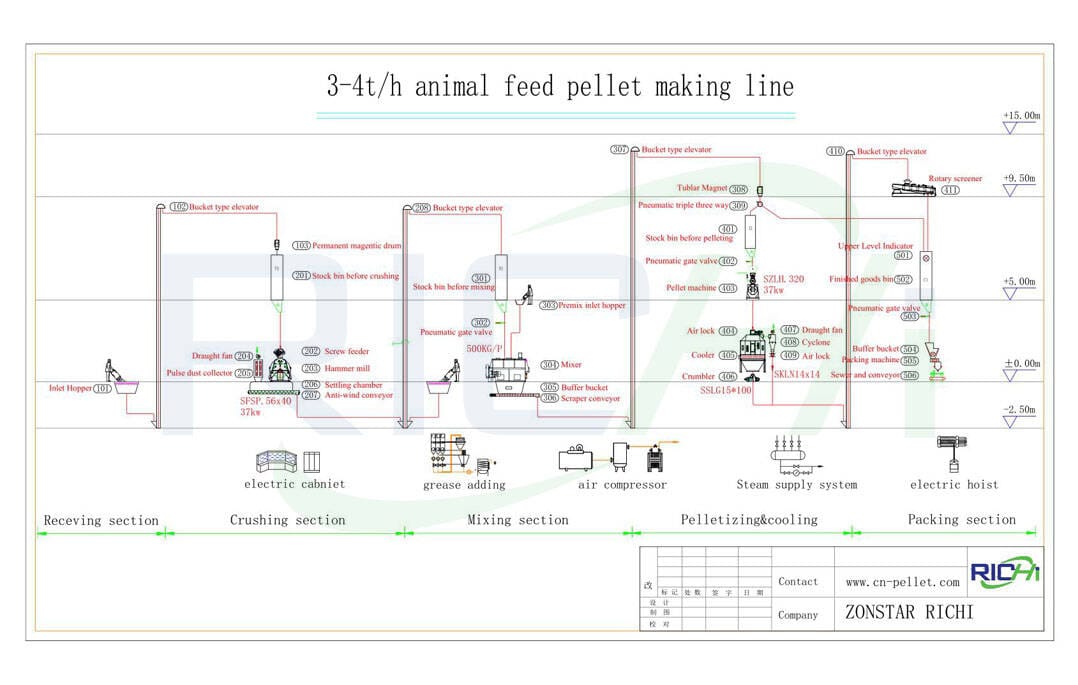
3-4 t/h chicken feed mill plant design
3-4T/H chicken feed mill is mainly suitable for processing poultry, livestock, ruminant feed for meat chicken, broilers, laying hens, small baby chicken, pig, cow, sheep, duck, goose, quail, rabbit, pet, camel, horse ,etc.It is also suitable for processing various pre-mixed feeds such as pig premix feed, chicken premix feed, duck premix feed, cattle premix feed, additive premix.
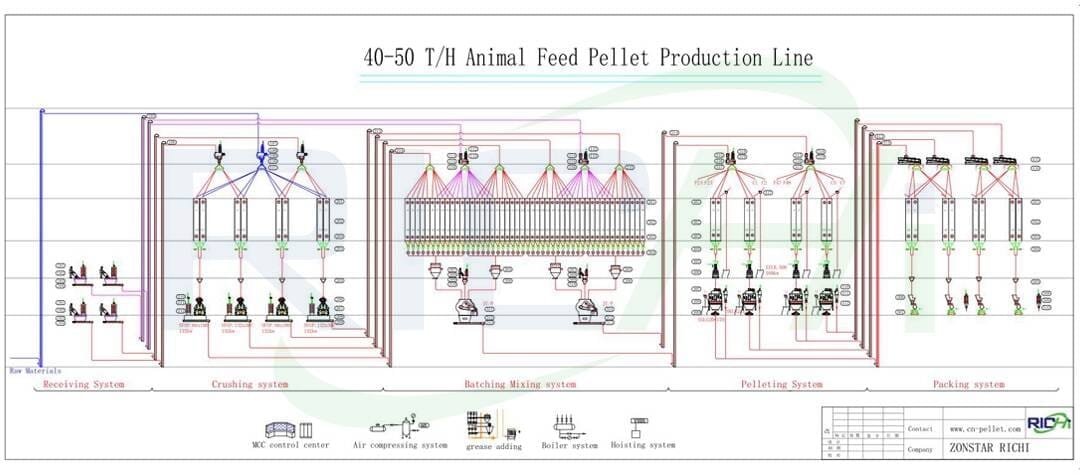
40-50 t/h chicken feed mill plant design
The automatic poultry feed plant adopts automatic batching system and computer control system, easy to adjust feed formulation and feed material mix proportion. We provide a turnkey project of our feed mill machine for poultry, including special design, installation, commissioning and training workers.
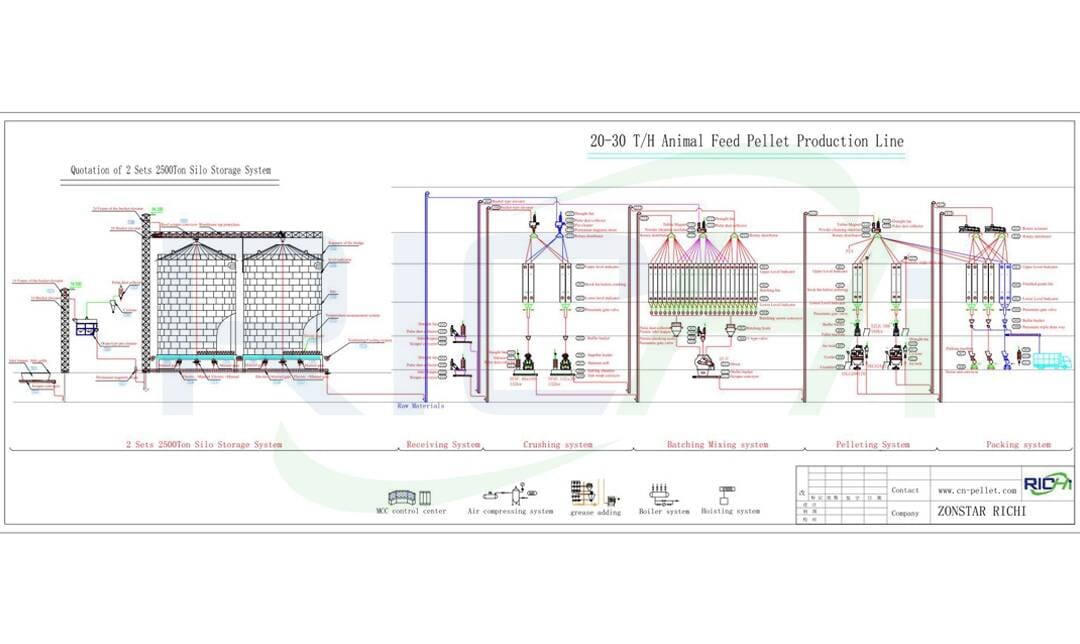
20-30 t/h chicken feed mill plant design
This type poultry feed mill plant can process all kinds of animal feed by using corn, soybean, wheat bran, crushed fish and other additives, etc. It is very suitable to produce feed pellets and premix/powder/mash feed for chicken, duck, rabbit, pig, fish, shrimp, cattle, cow, sheep, etc.
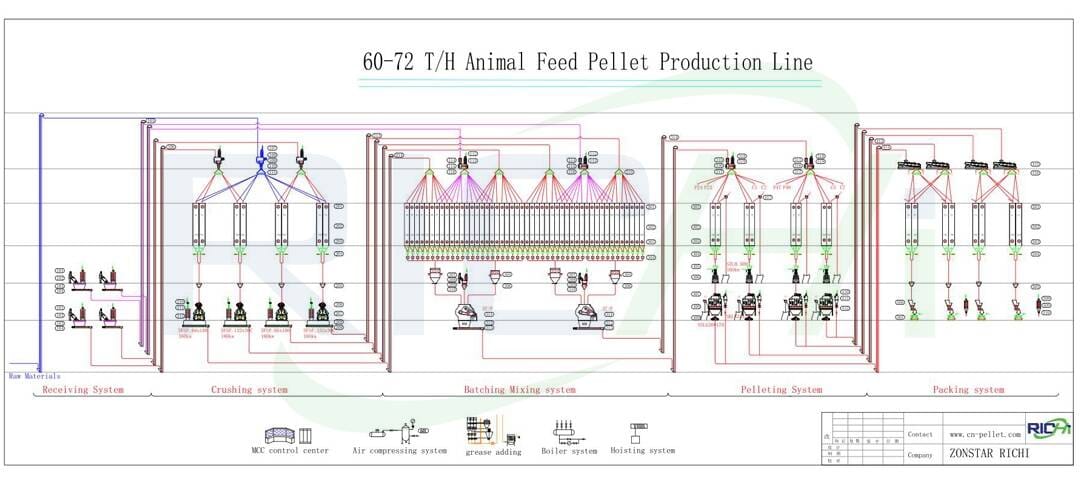
60-72 t/h chicken feed mill plant design
The 60-72 tons per hour chicken feed mill consists of several feed production machines. These machines perform their particular roles but have the mutual goal of producing small cylindrical pellets. The most basic equipment in a large scale poultry feed pellet manufacturing factory include crushing machine, feed mixing machine, chicken feed pellet mill, cooling machine, packing machine and etc.
If you are planning to set up your own chicken feed mill plant, but don’t know how to start the animal feed business plan, don’t hesitate to send us an inquiry and tell us your needs!
Our engineers will help you make the best chicken feed production project plan with detailed equipment list and factory layout according to your specific situation, requirements and cost budget!
What operational advantages does running a dedicated chicken feed mill plant give you over buying commercial feed?
+
The decision to build a chicken feed mill plant is ultimately a margin and control calculation. Buying finished feed is simple; manufacturing it gives you leverage over cost, quality, and formulation that purchased feed never will. Here’s where that advantage actually shows up in daily operations.
01 — Production Efficiency Across the Full Process
RICHI chicken feed mill plants are configured for either semi-automatic or fully automatic operation depending on budget and scale. The full production sequence — raw material cleaning, grinding, batching, mixing, conditioning, pelleting, cooling, screening, and packaging — runs as an integrated process rather than a series of disconnected manual operations.
- Fully automatic lines at 5 t/h and above run with minimal operator intervention between raw material intake and finished bag discharge
- Manual configuration options are available for smaller-scale or budget-constrained projects — automation level is a specification decision, not a fixed requirement
- Throughput consistency on an automated line is measurably higher than manual equivalents; batch-to-batch variation in cycle time drops significantly
02 — Formulation Control & Nutritional Consistency
This is where in-house feed manufacturing separates itself most clearly from purchasing finished feed.
| Factor | Purchased feed | Own chicken feed mill plant |
|---|---|---|
| Formula control | Supplier’s formulation | Your nutritionist’s specification |
| Ingredient substitution | No visibility | Full control |
| Batch traceability | Limited | Complete |
| Nutritional stability | Varies by supplier | Controlled at production stage |
Precise parameter control at the batching, conditioning, and pelleting stages means nutritional targets are hit consistently across production runs — not approximated. For operations where feed conversion ratio is a primary performance metric, this matters directly to the bottom line.
03 — Labor Efficiency
A correctly specified chicken feed plant requires fewer operators than most buyers expect. A 5–10 t/h fully automatic line typically runs on 2–3 operators per shift. At commercial scale, that labor cost reduction against the alternative — manual feed preparation or reliance on third-party supply logistics — compounds significantly over a one-to-two year period.
04 — Hygiene & Closed-Process Production
RICHI feed production lines operate as closed systems from raw material intake through to packaging discharge. This matters for two reasons:
- External contamination risk is substantially reduced compared to open mixing or manual preparation environments
- Cross-contamination between batches is managed through the process design — critical for operations producing both medicated and non-medicated rations, or multiple species feeds on the same line
Closed-process production also simplifies compliance with feed safety regulations in markets where certification or inspection is required for commercial feed sales.
05 — Product Range Flexibility
A single chicken feed mill plant can produce across multiple output formats and formulations without separate installations:
- Pellet, mash, and crumble from one line via bypass and crumbler configuration
- Multiple species rations (broiler, layer, breeder, livestock) through formulation switching
- Premix and concentrated feed on adapted configurations
That flexibility is a revenue consideration as much as an operational one — the ability to supply different customer segments from one installation changes the business model available to the operator.
The direction of travel in commercial feed manufacturing is clear: fully automatic and semi-automatic production lines are displacing manual methods across every scale of operation where the economics support it. The crossover point — where automation pays back against labor cost — is lower than most first-time investors expect, and it shifts further in favor of automation every year in most markets.
What are the critical decisions when building a chicken feed mill plant — and where do most projects go wrong?
+
Building a chicken feed mill plant isn’t complicated if the right decisions get made in the right order. Where projects run into trouble is usually traceable to one of five areas — and most of them are front-end decisions, not construction problems.
01 — Equipment Selection & Performance Specification
The equipment you specify determines your production ceiling, your operating cost per tonne, and how much unplanned downtime you absorb in the first two years. Reliable quality and stable performance across the core machinery — pellet mill, hammer mill, mixer, conditioner, cooler — isn’t a marketing claim you can verify from a brochure. What you can verify:
- Manufacturing certifications (ISO, CE, SGS)
- Whether the supplier manufacturers the equipment themselves or assembles third-party components
- Reference projects at similar capacity and feed type to yours
- Spare parts availability and lead times for wear components
RICHI manufactures all equipment in-house across 300,000+ m² of production facilities. Ring die and roller tolerances, shaft balancing on high-speed mills, weld quality on structural frames — these are production-stage quality controls, not commissioning adjustments.
02 — Process Design Around Your Actual Conditions
Generic process flowsheets don’t account for your raw material composition, your building footprint, your local power supply characteristics, or your operator skill level. A process designed around a standard corn-soy formulation will underperform if your actual inputs include high-fiber byproducts, variable-moisture ingredients, or locally sourced materials with different grinding behavior.
RICHI’s process design scope covers:
- Raw material-specific grinding and conditioning parameters
- Building layout adapted to your actual floor plan and ceiling height
- Civil engineering drawings provided free of charge before purchase commitment
- Equipment arrangement optimized for material flow efficiency, not just equipment fit
The process flowsheet is where production efficiency is determined — not during commissioning.
03 — Automation Level Matched to Your Operation
Higher automation doesn’t automatically mean better outcomes — it means better outcomes when the automation level matches your capacity, labor cost structure, and operator capability.
| Operation Scale | Recommended Automation | Rationale |
|---|---|---|
| 1–3 t/h farm line | Basic / manual | Labor cost savings don’t justify full automation investment |
| 5–10 t/h commercial | Semi to fully automatic | Batch consistency and labor reduction start paying back |
| 12 t/h and above | Fully automatic PLC | Continuous production makes manual control a reliability risk |
RICHI supplies PLC control systems with recipe management, production data logging, and remote monitoring capability on commercial-scale installations. The control system specification is part of the process design conversation, not an add-on decision made at the end.
04 — Safety & Environmental Integration
Two areas that get underweighted at the budgeting stage and become compliance problems later:
- Dust collection: pulse-jet filtration systems aren’t optional on commercial feed mill installations — they’re a regulatory requirement in most markets and a fire risk management necessity in any facility
- Electrical safety: proper panel specification, earthing, and motor protection — particularly relevant in markets with unstable grid supply where voltage fluctuation is common
RICHI equipment is designed and manufactured to meet international safety and environmental standards. For markets with specific regulatory requirements — EU CE marking, local environmental permits — documentation is available and has been used on export projects across 130+ countries.
05 — After-Sales Support Structure
A chicken feed mill plant is a long-cycle asset. The after-sales relationship matters more than most buyers factor into the supplier selection decision.
What a complete after-sales structure covers:
- Wear parts supply: ring dies, rollers, hammer mill screens, mixer paddles — available for dispatch without extended lead times
- Technical response: remote diagnostic support throughout the equipment lifecycle, not just within warranty period
- On-site support: commissioning engineers travel to site; follow-up visits available where needed
- Training: operator and maintenance training at commissioning; available again as staff changes over time
- Project documentation: full engineering records retained, so any future modification or expansion starts from an accurate baseline
The after-sales gap — where a supplier delivers equipment and then becomes unreachable — is the most common complaint we hear from buyers who’ve previously worked with other suppliers. It’s also the hardest thing to verify before you’ve signed a contract. Our project reference list across 130+ countries exists partly for this reason: buyers can speak to operations that have been running RICHI equipment for five or ten years, not just operations that commissioned last year.
What does a professional chicken feed mill plant layout design actually involve?
+
Layout design is where most first-time feed mill builders underestimate the complexity — and where experienced engineering teams earn their value.
A chicken feed mill plant layout isn’t just about fitting equipment into a building. It’s a multi-layer engineering document that determines how efficiently the facility operates for its entire service life.
What a Complete Feed Mill Layout Design Covers
01 — Zoning & Facility Relationship Planning
The factory area is divided into functional zones — raw material receiving and storage, production, finished product storage, utilities, waste handling, and staff facilities. Getting the zone relationships right at the design stage prevents operational conflicts that are expensive to fix after construction:
- Raw material intake and finished product dispatch should not share the same traffic routes
- Dust-generating zones (grinding, cleaning) need separation from mixing and packaging areas
- Utility infrastructure (boiler room, electrical room, compressed air) positioned for service access without interrupting production flow
- The layout must coordinate with local regional planning requirements and any existing site structures
02 — Internal & External Transport Routing
Material flow and personnel flow should never compete for the same path. A well-designed chicken feed plant separates:
| Flow Type | Design Priority |
|---|---|
| Bulk raw material intake (trucks) | Separate entry point, direct silo access |
| Finished product dispatch | Independent loading area, no crossing with intake |
| Internal material transfer | Gravity-assisted where possible, minimizing horizontal conveying runs |
| Operator movement | Separate walkways, access platforms at equipment service points |
| Maintenance access | Wide enough corridors for equipment removal without production shutdown |
Poor transport routing inside a feed mill shows up as bottlenecks during shift changeover, cross-contamination risk between incoming and outgoing product, and safety incidents at high-traffic intersections.
03 — Vertical Layout & Elevation Planning
Feed mill process design uses gravity where possible — raw material flows down through the process sequence, reducing conveying energy consumption and mechanical transfer points. Vertical layout decisions include:
- Indoor floor elevation relative to outdoor grade — affects drainage, flood risk, and truck access ramp design
- Equipment foundation depths and pit requirements for below-floor conveyors or discharge systems
- Building height allocation per process zone — grinding and pelleting sections typically need more vertical clearance than mixing or packaging
- Outdoor leveling elevation coordinated across the full site to manage surface drainage away from building foundations
Where building height is restricted — a common constraint on farm conversion projects — the vertical layout is redesigned around horizontal conveying alternatives, as we’ve done on multiple projects with ceiling heights as low as 5.7 meters.
04 — Pipeline & Utility Coordination
A chicken feed mill plant runs multiple utility systems simultaneously: steam lines to the conditioner, compressed air to pneumatic valves and bag filters, electrical cable runs to motors and control panels, water supply, drainage, and dust extraction ducting. Underground and above-ground pipelines need to be:
- Routed with defined parallel laying sequences and minimum separation distances
- Coordinated to avoid mutual interference at crossing points
- Separated from personnel walkways and primary material flow paths
- Documented with burial depth and erection height specifications for future maintenance reference
Utility coordination failures — steam lines running through high-traffic areas, electrical conduit buried without documentation, dust extraction ducting creating head-height obstructions — are common in layouts that weren’t fully engineered before construction started.
What RICHI Provides at No Charge Before Purchase
Layout design isn’t something we do after you’ve committed to buying equipment. The following are included in our pre-sales technical support for every chicken feed mill plant inquiry:
- Factory area planning drawings
- Equipment arrangement layout
- Civil engineering drawings
- Steel structure drawings
- 3D factory renderings
- Electrical and circuit diagrams
These documents are what your civil contractor, structural engineer, and local planning authority need before ground is broken. We provide them free of charge because a correctly designed layout from the start avoids costly site modifications during installation — which benefits both sides of the project.
Is the chicken feed production business still worth investing in — what does the market data actually show?
+
The short answer is yes — and the underlying demand drivers are structural, not cyclical. Here’s what the numbers look like and where the real opportunity sits for investors considering a chicken feed mill plant.
Global Market Snapshot
| Metric | Figure |
|---|---|
| Global poultry feed market revenue (2021) | $119.8 billion USD |
| Projected market revenue (2031) | $217.7 billion USD |
| Compound annual growth rate (2022–2031) | 6.3% |
Source: authoritative industry media reporting. The trajectory has been consistent across multiple independent forecasts — poultry feed is not a speculative growth sector, it’s a demand-driven one with a decade-long visibility window.
What’s Driving the Growth
Four demand drivers that aren’t going away:
- Population growth — more people means more protein consumption, and poultry is the most accessible animal protein globally across income levels
- White meat preference shift — consumer movement away from red meat toward chicken is a documented long-term trend across markets in Europe, North America, and increasingly urban Asia
- Rising protein intake in developing markets — as household income increases in Asia-Pacific, Sub-Saharan Africa, and the Middle East, daily protein consumption per capita rises, and poultry is typically the first animal protein that becomes affordable
- Rapid economic expansion in high-growth regions — Asia-Pacific and Middle East/Africa specifically are driving new poultry production capacity, which directly creates demand for feed manufacturing infrastructure
Where the Investment Opportunity Is Sharpest
Not every market presents the same opportunity. The clearest entry points for a chicken feed mill plant investment are:
- Markets where commercial feed supply is inconsistent or expensive — building your own supply removes dependency on third-party logistics and import pricing
- Regions with growing poultry integration — Southeast Asia, East Africa, Central Asia, and parts of Latin America are all seeing rapid expansion in commercial broiler and layer operations that need local feed supply
- Operations already raising poultry — the margin conversion from purchasing feed to manufacturing it is calculable and typically achieves payback within 2–4 years at commercial scale
- Investors looking for supply chain diversification — grain traders, agricultural cooperatives, and livestock businesses adding feed manufacturing as a downstream margin capture
The Practical Investment Case
The market data matters, but the business case for a specific investor comes down to local feed prices versus manufacturing cost, raw material availability, and what capacity is needed to achieve a viable margin. These vary significantly by country and region.
That’s exactly the calculation we work through with clients at the project consultation stage — not just equipment specification, but whether the investment makes commercial sense at your scale, in your market, with your available raw materials. A chicken feed mill plant is a long-cycle asset; the decision deserves a proper feasibility discussion, not just a quotation.