0086-138 3838 9622
Chicken Feed Mill Expansion in Nigeria
20 T/H poultry feed capacity added to an operating mill for broiler starter, grower and finisher feed production.
RICHI MACHINERY
20 T/H Expansion Built Around an Existing Poultry Feed Business
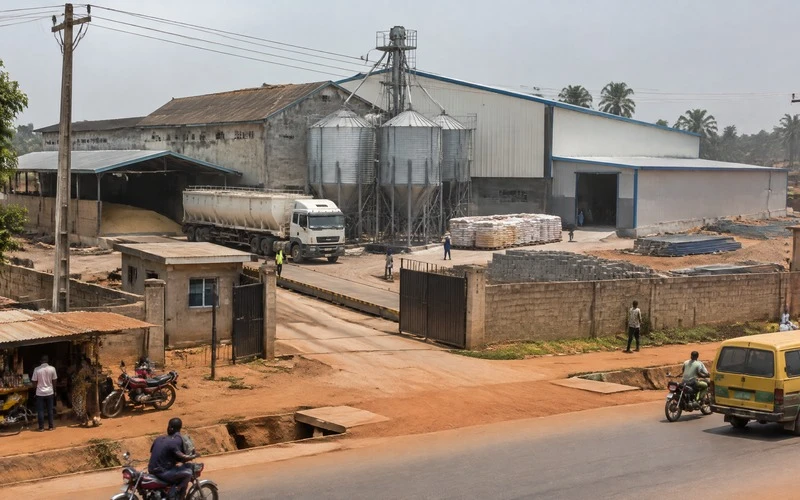
This chicken feed mill expansion in Nigeria was developed for an established agribusiness that already had feed-processing assets, grain procurement channels and poultry customers. Rather than replacing equipment that could continue to serve the business, the project added a 20 T/H processing route to increase peak production, improve scheduling flexibility and reduce the operational risk created when too much output depends on one processing route.
The added line was planned for approximately 35000 tons of production per year during its initial operating stage. This annual target leaves practical room for product changes, cleaning, preventive maintenance, ingredient interruptions and periods when sales do not require the full hourly rating. More production hours can be introduced as demand grows, allowing the client to use more of the installed 20 T/H capacity without immediately building another complete line.
- Project type: expansion of an operating poultry feed factory.
- Added production capacity: 20 T/H.
- Initial annual output from the expansion: approximately 35000 T/A.
- Products: broiler starter, grower and finisher feed in pellet and crumble formats.
- Project investment: approximately USD 500000.
- Initial workforce: approximately 20 people under the planned operating arrangement.
- Site area: approximately 1.35 acres within the existing factory property.
- Added buildings: approximately 900 m² for production and warehouse functions.
- Main ingredients: maize, soybean meal, selected cereal by-products, vegetable oil, premix and minerals.
The value of the project lies in more than adding nominal tonnage. Receiving, storage, grinding, batching, mixing, conditioning, pelleting, cooling, crumbling, screening and packing were considered as one connected system. The expansion also had to work around existing buildings and utilities, making interface design, vertical material movement and practical access for maintenance especially important.
20 T/H
capacity
USD 500000
investment
Nigeria
location
35000 T/A
initial output
RICHI MACHINERY
Expanding Capacity Without Rebuilding a Working Factory
The client already had the commercial foundation needed for a larger feed operation: established ingredient purchasing, an operating production site and access to poultry farms and feed distributors. The investment decision was therefore driven by throughput, reliability and production flexibility. Existing assets that could still perform useful work remained part of the factory, while new equipment was concentrated where additional capacity and better process control created the greatest operational value.
For an expansion of this type, simply installing another pellet mill would not solve the problem. The upstream grinding and batching sections must supply material at the required rate, the mixer must maintain batch accuracy, conditioning must provide stable feed to the pellet mills, and cooling and screening must accept the output without becoming downstream restrictions. The new poultry feed production line was therefore integrated as a complete processing route.
- Increase hourly production while continuing to use serviceable existing infrastructure.
- Create greater production flexibility for starter, grower and finisher feed.
- Reduce the impact of maintenance on total factory output.
- Provide an expansion route that can support longer operating hours as sales increase.
That approach also controls capital use. Instead of paying to duplicate every building, warehouse and utility already available on site, investment is directed toward equipment and interfaces that increase saleable feed output. For the customer, the chicken feed mill expansion in Nigeria therefore combines capacity growth with better use of the factory it already owns.
RICHI MACHINERY
Raw Materials and Finished Feed Strategy
The chicken feed mill plant is designed for conventional poultry-feed ingredients available through commercial supply channels in Nigeria. Maize is the principal cereal ingredient, while soybean meal provides an important protein source. Depending on formulation and purchasing conditions, suitable cereal by-products can be introduced alongside vegetable oil, premix, minerals and other controlled micro-ingredients.
For the initial annual production target of approximately 35000 tons, purchasing quantities are not locked into one fixed formula. Different broiler products use different ingredient ratios, and commercial formulations may be adjusted when maize, soybean meal or approved alternative ingredients change in price or quality. The receiving, storage and dosing system therefore provides enough segregation to support formula changes without treating every ingredient as interchangeable.
| Ingredient Group | Typical Handling Route | Design Consideration |
|---|---|---|
| Maize | Bulk receiving, cleaning, magnetic separation, storage and grinding | Moisture, impurities, seasonal procurement and grinding characteristics |
| Soybean Meal | Bulk or bag receiving and dedicated storage | Protein quality, storage condition and controlled batching |
| Cereal By-products | Separate receiving and ingredient bins | Used according to approved formulation and actual quality |
| Vegetable Oil | Liquid storage and metered addition | Accurate dosing and suitable addition point |
| Premix and Minerals | Controlled micro-ingredient handling | Traceability and dosing accuracy at low inclusion rates |
The poultry feed plant produces several physical feed formats from the same factory. Broiler starter can be supplied as crumble to give young birds a manageable and relatively uniform particle size, while grower and finisher products can be produced as larger pellets, commonly around 3–4 mm according to the customer’s product specification. Mash products can also bypass pelleting when the sales program requires them.
- Broiler starter feed: controlled fine crumble or other customer-specified starter format.
- Broiler grower feed: pellet or crumble format selected according to the feeding program.
- Broiler finisher feed: commonly larger pellets for the final feeding stage.
- Other poultry formulas: produced only after formula, raw-material and process requirements are confirmed.
This flexibility matters commercially because feed cost is heavily influenced by ingredient purchasing. The factory can manage seasonal procurement through planned storage and controlled formula changes instead of relying on one fixed raw-material combination throughout the year.
RICHI MACHINERY
Process Design for the 20 T/H Chicken Feed Line
The process is organized around two material streams before batching: bulk grain that requires cleaning and grinding, and meals or minor ingredients that can enter dedicated receiving and storage routes. They converge at the batching system before mixing and pellet processing. This arrangement prevents unnecessary grinding of ingredients that already have suitable particle characteristics and gives the operator better control over individual raw materials.
- Receiving and cleaning: maize is unloaded through the receiving system and passes through screening, aspiration and magnetic separation before storage or grinding. Separate intake arrangements are used for bagged meals and minor ingredients.
- Grinding: cleaned maize enters the hammer mill feed grinder. Screen specification and operating parameters are selected according to the required poultry-feed particle size rather than using one grinding setting for every formula.
- Batching and micro-dosing: ground grain, protein meals and other major ingredients are weighed from their respective bins. Premix, minerals and other low-inclusion ingredients are introduced through a controlled micro-ingredient route.
- Mixing and liquid addition: weighed ingredients enter the feed mixer machine, where vegetable oil and other approved liquids can be accurately metered. Mixing performance is verified to maintain formula uniformity.
- Conditioning and pelleting: mixed mash is conditioned with steam before entering the SZLH-series ring die pellet machine section. Multiple pelletizing units are used so the required 20 T/H system capacity does not depend on one undersized machine.
- Cooling: hot pellets enter counterflow coolers immediately after pelleting. Airflow and residence time are adjusted to production rate, pellet size and ambient conditions.
- Crumbling and screening: starter products can pass through a crumbler to create the required particle distribution. Screening separates acceptable product from fines, with clean recoverable fines managed through the designed return route.
- Weighing and packing: finished feed is weighed, bagged, lot identified and transferred to the warehouse for dispatch to farms, distributors or other customers.
The chicken feed pellet machine section is configured together with the cooler, crumbler and screener rather than selected in isolation. This is particularly important when the factory changes between starter crumble and larger grower or finisher pellets, because throughput, die specification, cooling load and downstream handling conditions all change with the product.
Local aspiration is provided at high-dust transfer points such as receiving, grinding, batching and packing. Equipment interlocks prevent downstream machines from being overloaded when a preceding section stops, while magnets and cleaning devices protect critical machinery from foreign material. These controls support both uptime and feed-quality consistency in the chicken feed mill expansion in Nigeria.
RICHI MACHINERY
Equipment Configuration Designed as a Balanced System
The expansion equipment is sized from the 20 T/H production requirement and the actual duty of each processing stage. The pelletizing section uses parallel units instead of relying on one small pellet mill, while grinding, mixing, cooling, screening and conveying are matched to the required hourly material flow. Final motor powers and equipment quantities are coordinated during detailed engineering so that one undersized section does not restrict the whole line.
| Process Stage | Main Equipment | Configuration Basis | Function |
|---|---|---|---|
| Receiving | Intake system and conveyors | Matched to truck unloading and storage turnover | Receives maize, meals and other ingredients through controlled routes |
| Cleaning | Pre-cleaner and magnetic separator | 1 complete route | Removes coarse impurities and ferrous contaminants |
| Grinding | Hammer mill system | Parallel or suitably sized grinding capacity | Produces controlled particle size for poultry feed |
| Batching | Ingredient bins and weighing system | Multiple bins by formula requirement | Provides accurate macro-ingredient dosing |
| Micro Dosing | Micro-ingredient station | 1 controlled system | Handles premix, minerals and low-inclusion materials |
| Mixing | Double-shaft paddle mixers | Matched to batch cycle and 20 T/H duty | Produces uniform mash before pelleting |
| Pelleting | SZLH-series pellet mills | Multiple units for combined 20 T/H duty | Produces poultry feed pellets at required diameter |
| Cooling | Counterflow coolers | Matched to pellet mill output | Reduces pellet temperature and stabilizes product |
| Crumbling | Feed crumbler | By starter-feed production requirement | Produces controlled crumble for young birds |
| Screening | Rotary screener | Matched to downstream product flow | Separates finished product and fines |
| Packing | Automatic weighing and bagging system | Matched to bag size and dispatch rate | Weighs and packs commercial feed |
| Dust Control | Pulse-jet filters and aspiration | Distributed by dust point | Controls airborne dust and maintains cleaner working areas |
Several conveyors, elevators and storage bins are distributed between these main machines. Their capacities are not selected independently: conveying rate, lift height, bin residence time, discharge characteristics and equipment start-up sequence are checked against the mass flow of the line. The same principle applies to the poultry feed pellet machine section and its downstream cooler and screening system.
For an expansion project, interface measurements are particularly important. Existing floor elevations, columns, access openings, electrical distribution and material-transfer heights are checked before fabrication so the new machines can be installed without creating avoidable structural work or difficult maintenance points.
RICHI MACHINERY
Compact Expansion Layout for an Existing Site
The approximately 1.35-acre site makes compact planning more valuable than simply increasing building area. Around 900 m² of additional production and warehouse space is used together with vertical equipment arrangement and outdoor bulk-storage positions. This allows the project to accommodate new processing capacity while preserving truck access, maintenance routes, finished-feed dispatch and safe movement around the existing operation.
- Receiving and bulk-storage zone: positioned so ingredient trucks can unload without repeatedly crossing finished-feed dispatch routes.
- Processing zone: uses vertical transfer between grinding, batching, mixing, pelleting and cooling equipment to reduce unnecessary horizontal conveying.
- Warehouse and dispatch zone: separates bagged raw materials and finished feed while keeping loading access practical.
Bulk maize storage is sized from actual procurement practice rather than from an oversized generic silo specification. The number of storage days must balance seasonal purchasing opportunities against the limited expansion footprint and the capital tied up in inventory. Separate bins are provided where ingredients need individual control, while low-volume materials remain in dedicated bagged or micro-ingredient storage.
The production area uses natural and mechanical ventilation appropriate to the local climate, with localized cooling where electrical control rooms or sensitive components require it. General production buildings do not depend on unnecessary whole-building air-conditioning. Roof drainage, yard grading and stormwater routes are also considered because heavy seasonal rainfall can affect receiving, outdoor traffic and raw-material protection if drainage is poorly planned.
These decisions keep the poultry feed mill project compact without making the plant difficult to operate. Access around pellet mills, hammer mills, mixers and coolers is retained for inspection and wear-part replacement, because a tightly packed layout that cannot be maintained efficiently would reduce the value of the expansion.
RICHI MACHINERY
Power Steam Water and Supporting Utilities
Utility planning follows the actual equipment load of the 20 T/H expansion. Electricity supplies the hammer mills, mixers, pellet mills, coolers, elevators, conveyors, screening equipment, bagging system, fans and auxiliary machinery. The electrical system is therefore sized from the final connected-load schedule and simultaneous operating demand, with starting characteristics of the larger motors considered when selecting distribution equipment.
| Utility | Project Application | Design Basis |
|---|---|---|
| Electricity | All main processing and auxiliary equipment | Final motor schedule, simultaneous load and starting demand |
| Steam | Conditioning before pelleting | Matched to pellet output, formula and conditioning requirement |
| Water | Steam-system make-up, sanitation and domestic use | Low direct process-water demand with separate sanitation requirements |
| Compressed Air | Pulse filters and pneumatic components | Matched to installed pneumatic equipment and cleaning cycles |
| Backup Power | Selected critical loads where required | Defined from local power reliability and safe shutdown requirements |
Steam is required for conditioning pelleted feed, but the heat source is selected according to the client’s available energy supply, operating cost and local compliance requirements. The project is not tied to coal or to a fuel that may be unavailable at the site. Boiler capacity, steam pressure, condensate arrangement and water treatment are confirmed together with the final pelletizing system.
Variable-frequency control is used where changing speed provides a process or energy benefit, such as selected feeders, fans and conveying equipment. It is not added indiscriminately to every motor. This keeps the utility design practical while giving operators control where production rate or airflow genuinely needs adjustment.
RICHI MACHINERY
A Lean Workforce for the Initial Operating Schedule
Approximately 20 employees support the initial operating arrangement. Because this is an expansion inside an existing business, the project does not need to duplicate every management and administrative position around the new line. Shared management, procurement and commercial functions can continue serving the wider factory, while the added workforce concentrates on production, raw-material handling, quality control, maintenance and dispatch.
- Production operators for receiving, grinding, batching, pelleting and packing.
- Warehouse and material-handling personnel for ingredients and finished feed.
- Maintenance personnel for mechanical and electrical routine work.
- Quality-control personnel for sampling, process checks and finished-feed verification.
- Shift supervision and essential support functions.
If the customer later extends daily operating hours, additional shift coverage can be added according to the actual operating plan rather than building an unnecessarily large permanent workforce at the first stage. Automation in batching, conveying and weighing reduces repetitive manual handling, but trained operators remain necessary for raw-material inspection, equipment monitoring, maintenance, cleaning and quality assurance.
RICHI Machinery provides commissioning and operational training around start-up and shutdown sequences, batching interlocks, pellet-mill adjustment, cooler operation, lubrication, inspection, routine maintenance and common fault handling. This helps the client move from equipment installation to stable commercial production with a team sized for the real operating schedule.
RICHI MACHINERY
Dust Control Feed Safety and Environmental Measures
Environmental measures are integrated into the process without turning the project into an unnecessarily complicated treatment system. Dust-producing points at receiving, grinding, batching and packing use enclosed transfer and local aspiration connected to suitable filters. Equipment foundations, isolation and routine maintenance help control mechanical noise, while production areas are cleaned to prevent accumulated feed dust and spilled ingredients from becoming hygiene or safety problems.
- Pulse-jet dust collection at major dust-generating process points.
- Magnetic separation and raw-material cleaning before critical equipment.
- Defined handling of clean process fines and rejection of contaminated material.
- Stormwater routing and dry storage for ingredients and finished feed.
- Controlled waste, used lubricant and maintenance-material handling.
The feed process itself has limited direct wastewater generation. Water management therefore focuses on sanitation, domestic use, steam-system requirements and preventing contaminated runoff around receiving and storage areas. The result is a practical environmental configuration that supports reliable feed production without adding systems unrelated to the actual operation.
RICHI MACHINERY
Why the Expansion Fits the Client’s Poultry Feed Business
A 20 T/H line is large enough to support commercial regional feed sales, yet the initial annual target of approximately 35000 tons prevents the business case from depending on immediate full utilization. This is particularly important for a feed manufacturer whose production schedule must follow customer orders, ingredient availability and changing feed formulas rather than simply operating continuously because machinery capacity exists.
- Procurement flexibility: additional storage and ingredient segregation give the customer more options when purchasing maize, soybean meal and other feed materials.
- Product flexibility: starter crumble and grower or finisher pellets can be produced through different downstream routes from the same core batching and mixing system.
- Maintenance flexibility: parallel processing capacity reduces dependence on a single production route and makes planned maintenance easier to schedule.
- Growth flexibility: longer operating hours can release additional output from installed equipment before another major expansion is required.
The commercial objective is therefore not to maximize tonnage on paper. It is to give the client enough capacity to serve existing customers, accept larger orders and develop new regional business while maintaining control over feed quality, ingredient inventory and production cost. That balance is central to the chicken feed mill expansion in Nigeria.
RICHI MACHINERY
RICHI Scope for the Feed Mill Expansion
Expansion engineering begins with the parts of the factory the customer intends to continue using. Machine elevations, conveying routes, available bins, electrical capacity, building dimensions and maintenance access determine where new equipment can connect efficiently. RICHI then develops the new processing sections around the required throughput and product range rather than treating the project as an isolated equipment purchase.
- Process engineering and capacity balance for the 20 T/H expansion.
- Equipment selection for receiving, grinding, batching, mixing, pelleting, cooling, crumbling, screening and packing.
- Integration of new machines with usable existing factory infrastructure.
- Equipment layout, material-flow design and utility interface planning.
- Manufacturing, inspection and preparation for shipment.
- Installation guidance, commissioning and operator training.
- Maintenance planning and wear-part recommendations for long-term operation.
The animal feed factory project shows why expansion work requires more interface engineering than a stand-alone machine order. Every new conveyor, bin and processing machine must connect to the rest of the factory at the correct capacity, elevation and control sequence. A high-capacity pellet mill provides little benefit if upstream batching cannot feed it consistently or downstream cooling cannot receive its output.
By treating the project as one operating system, RICHI helps the customer use existing assets where they still create value while directing new investment toward the sections that increase throughput, reliability and production flexibility.
RICHI MACHINERY
A Practical Route From Existing Capacity to the Next Stage of Growth
The completed chicken feed mill expansion in Nigeria gives the client a 20 T/H processing platform without requiring the entire existing factory to be discarded. Its initial annual production target of approximately 35000 tons leaves room for realistic utilization while providing sufficient hourly capacity for peak orders and future growth. The layout also allows the customer to increase operating hours as its poultry-feed market develops.
For customers planning a similar expansion, the most useful starting information is the existing poultry feed mill equipment list, building and equipment layout, current production capacity, formulas, ingredient forms, required pellet and crumble sizes, annual sales target, storage capacity, available electrical supply, steam conditions and packing specifications.
RICHI can then determine which existing systems can remain in service and where new animal feed production line equipment should connect. The objective is a balanced expansion in which receiving, storage, processing, utilities, labor and dispatch all support the same production target instead of creating hidden bottlenecks after installation.
● RICHI MACHINERY
RICHI Service

● Consulting
Customer Consultation
We review your raw materials, product range, capacity target, existing equipment, site conditions and operating plan before defining the feed-processing solution.

● Design
Animal Feed Plant Design
Process routes, equipment capacity, plant layout and utility interfaces are developed around the customer’s actual production conditions and future expansion requirements.

● Manufacturing
Equipment Manufacturing
Core machines and supporting equipment are manufactured and prepared according to the confirmed process design, capacity and project interface requirements.

● Testing
Quality Inspection & Testing
Equipment is inspected before shipment, with mechanical, assembly and operating checks carried out according to the applicable machine and project requirements.

● Delivery
Equipment Delivery
Equipment is packed according to machine size, transport conditions and installation sequence to protect components and simplify project-site handling.
● Installation
Installation & Commissioning
RICHI provides installation guidance and commissioning support so mechanical, electrical and process systems can be checked before stable production begins.

● Training
Staff Training
Operators receive practical training covering equipment operation, routine inspection, adjustment, maintenance points and production-system coordination.
● After-sales
Project Follow-Up
Technical support continues after commissioning, including operating questions, maintenance planning, spare parts and future capacity-expansion requirements.
Who we are
RICHI Machinery provides equipment, engineering and project services for animal feed, aqua feed, pet food, biomass pellets, fertilizer, cat litter and other pellet-processing applications.
Since 1995, we have focused on turning different raw materials, production targets and site conditions into practical processing systems for customers in international markets.
Our project capabilities cover animal feed mill equipment, aqua feed equipment, pet food equipment, biomass pellet equipment, fertilizer equipment, cat litter equipment and municipal solid waste pellet systems.

1995
RICHI Established

2000+
Serving More Than 2000 Customers

120+
RICHI Employees

140+
Exported To 140 Countries