0086-138 3838 9622
20 T/H Swine Feed Mill in the Philippines for Farm Supply
RICHI MACHINERY
The Feed Schedule Starts at the Farm
The next delivery needs to be the right ration, not simply the next batch leaving the press. This swine feed mill in the Philippines serves a regional farm group from Batangas through one 20 T/H RICHI pelleting line, shared ingredient preparation and scheduled bulk or bagged dispatch.
The regional farm group requires 180–240 tonnes per production day. One coordinated line limits machinery, staffing and stock commitments while serving several destinations.
Batangas places the project within reach of Luzon’s livestock operations and port-linked ingredient supply. Incoming grain traffic and finished-feed dispatch use separate working positions, with farm access treated as part of the biosecurity arrangement.
One SZLH678 animal feed pellet mill handles the main recipes, supported by matching preparation and dispatch equipment.
One control system links recipe execution with farm deliveries.
20 T/H
Capacity
One pellet line
Production layout
Philippines
Location
Farm-linked feed
Project type
RICHI MACHINERY
Ingredient Supply Meets the Luzon Delivery Network
Domestic grain and imported ingredients arrive on different schedules. Storage connects those receipts with daily farm demand and recipe-specific stock needs.
The operating priorities are:
| Priority | Operating response |
|---|---|
| Farm ration demand | Schedule by growth stage |
| Biosecurity | Separate vehicle and feed routes |
| Ingredient supply | Qualified local and imported stocks |
| Quality control | Batch records and release checks |
Identified batches connect formulation with farm delivery.
RICHI MACHINERY
Place the Buildings Around the Feed Route
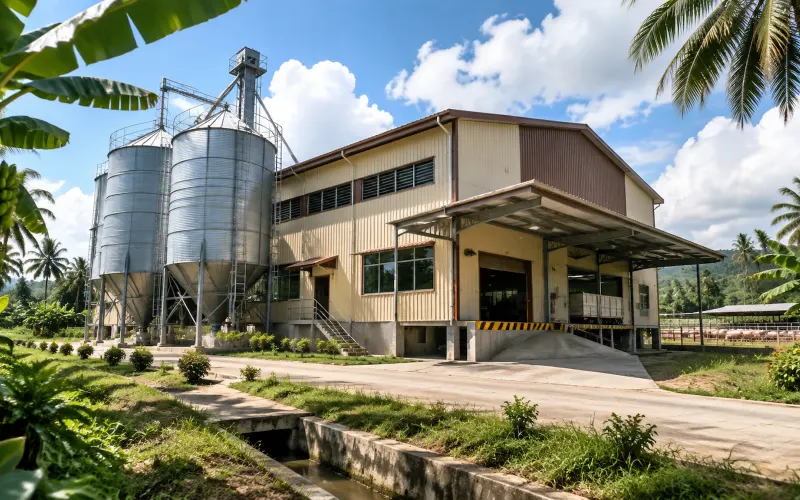
The 4800 m² site reuses industrial buildings and adds machinery foundations, platforms and utility connections. Receiving and finished-feed traffic occupy separate positions.
Each area has a specific role in the 20 T/H layout:
| Facility | Allocation | Arrangement | Operating purpose |
|---|---|---|---|
| Production building | 900 m² footprint | Existing structure adapted | Process and access |
| Ingredient warehouse | 200 m² | Separated lots | Bagged meals and additives |
| Finished-feed warehouse | 100 m² | Pallet and dispatch positions | Released feed |
| Silo area | 200 m² outdoors | Four silo positions | Bulk ingredient storage |
| Receiving shelter | 200 m² | Protected intake | Truck unloading |
| Boiler house | 80 m² | One boiler | Conditioning steam |
| Office and staff facilities | 150 m² | Shared support | Quality and administration |
| Gate control | 20 m² | Vehicle check | Separate entry and exit |
| Vehicle cleaning | 100 m² outdoors | Contained runoff | Farm biosecurity |
| Service area | 100 m² outdoors | Utility access | Maintenance and drainage |
Bulk ingredient storage serves two principal streams:
| Ingredient | Silos | Usable stock | Volume basis | Stock control |
|---|---|---|---|---|
| Corn | 2 | 800 tonnes combined | Measured density and safe fill | Approximately 5–6 production days |
| Soybean meal | 2 | 300 tonnes combined | Flow limits and measured density | Approximately 5 production days |
Usable stocks are 800 tonnes of corn and 300 tonnes of soybean meal. At 240 tonnes/day with 60% corn and 25% meal, these provide about five-and-a-half and five production days respectively. Supplier replenishment replaces the need to finance and store several weeks of ingredients onsite.
The process tower groups equipment by function:
| Process position | Function |
|---|---|
| Receiving level | Intake and heavy equipment access |
| Storage distribution | Assign cleaned ingredients |
| Batching zone | Bins and weighing |
| Mixing zone | Weighed recipe preparation |
| Pelleting zone | Conditioning and pressing |
| Below pellet discharge | Cooling and onward classification |
Gravity transfers reduce lifts without sacrificing service access.
RICHI MACHINERY
Different Rations from Controlled Ingredients
Starter, grower, finisher and sow feeds place different demands on formulation and physical product. The pig feed mill plant’s batching system keeps those recipes distinct while using common receiving and preparation equipment.
Ingredient roles determine the receiving and storage arrangement:
| Ingredient | Recipe role | Storage | Form | Acceptance |
|---|---|---|---|---|
| Corn | Energy | Bulk silo | Grain | Moisture and mycotoxins |
| Soybean meal | Protein | Suitable silo | Meal | Protein quality |
| Premix | Micronutrients | Controlled warehouse | Bagged | Identity and shelf life |
| Limestone | Calcium | Dry store | Powder | Feed-grade specification |
| Phosphate source | Phosphorus | Dry store | Powder | Approved formulation |
| Vegetable oil | Energy and processing | Suitable tank | Liquid | Quality and dosing |
| Amino acids and additives | Recipe-specific | Controlled store | Concentrate | Accurate small dosing |
| Complete recipe | Nutritionist-approved | Identified lots | Controlled batch | Mass reconciliation |
Concentrated additives use small-dose weighing linked to the approved formulation. The main ingredient groups use the following controls:
| Group | Weighing approach | Control |
|---|---|---|
| Grain | Main batch scale | Recipe quantity |
| Protein meal | Main scale | Ingredient identity |
| Premixes and additives | Dedicated small-dose system | Addition verification |
| Oil | Metered liquid system | Nozzle and quantity |
| Limestone | Appropriate scale | Feed-grade acceptance |
| Phosphate | Appropriate scale | Batch traceability |
| Complete mix | Batch reconciliation | Approved formulation |
Receiving brings together material condition and supplier information:
- Corn. Moisture, grain condition and the mycotoxin programme govern acceptance and storage.
- Soybean meal. Protein quality and supplier specification support formulation and purchasing.
- Premixes. Batch identity, shelf life and storage conditions remain visible through dosing.
Questioned deliveries remain in a separate hold position.
RICHI MACHINERY
RICHI Equipment for a 20 T/H Farm-Supply Mill
The main preparation and pelleting equipment comprises:
| Section | Equipment | Quantity | Duty basis | Function |
|---|---|---|---|---|
| Receiving | Intake pit | 1 | 30 T/H grain receiving | Unloading |
| Receiving | Magnets | 2 positions | Ingredient flow | Metal removal |
| Cleaning | Pre-cleaner | 1 | 30 T/H receiving route | Foreign-matter removal |
| Grinding | Hammer mills | 2 | 110 kW each | Grain preparation |
| Batching | Feeders and bins | 1 system | Recipe-specific | Controlled dosing |
| Weighing | Main batch scale | 1 | 2-tonne batch | Recipe weighing |
| Mixing | Batch mixer | 1 | 2-tonne working batch | Homogeneous mash |
| Conditioning | Steam conditioner | 1 | 20 T/H feed duty | Prepare mash |
| Pelleting | RICHI SZLH678 press | 1 | 250 kW | Nominal 20 T/H |
| Cooling | Counterflow cooler | 1 | At least 20 T/H | Cool pellets |
| Screening | Product screen | 1 | Product specification | Remove fines |
| Steam | Boiler package | 1 | 2 T/H steam | Conditioning supply |
| Extraction | Filters and ducts | Coordinated set | Airflow design | Dust capture |
Finishing, storage and dispatch complete the same line:
| Section | Equipment | Quantity | Duty basis | Function |
|---|---|---|---|---|
| Bulk stock | Corn silos | 2 | 800 tonnes usable combined | Energy ingredient storage |
| Bulk stock | Meal silos | 2 | 300 tonnes usable combined | Protein ingredient storage |
| Transfers | Elevators and conveyors | Coordinated set | Selected material routes | Controlled movement |
| Buffering | Prepared-feed bins | Assigned positions | Batch-to-continuous flow | Even press feeding |
| Small additions | Minor-dose station | 1 system | Recipe-specific accuracy | Additive control |
| Liquids | Oil dosing package | 1 | Formulation duty | Metered addition |
| Finished stock | Product bins | 4 | 15 tonnes usable each | Separate rations |
| Bagging | Weighing and closing route | 1 coordinated route | At least 8 × 50 kg bags/min | Bagged dispatch |
| Bulk loading | Vehicle loadout | 1 | 30 T/H | Fill bulk vehicles |
| Farm transfer | Covered short conveyor | 1 | 20 T/H; about 60 m | Adjacent destination |
| Controls | Batch and route management | 1 system | Complete line | Traceability |
| Services | Pneumatics and utility interfaces | 1 set | Working demand | Plant support |
The pig animal feed plant machinery amount and total capital allocation cover the following scope:
| Capital allocation | Amount or boundary |
|---|---|
| Equipment investment | USD 680,000 |
| Total project investment | USD 1,050,000 |
| Existing-site basis | Land purchase and operating inventory excluded |
Four engineering choices define the installation:
One production route. Receiving, batching and pelleting follow a single rated duty, with campaign buffers absorbing short interruptions between batch and continuous equipment.
Grain preparation. Two 110 kW hammer mills share the grinding duty. A recipe containing 60% grain requires about 12 T/H of grinding at full line output; suitable purchased meals bypass that stage.
Complete finishing. One 250 kW SZLH678 pig feed pellet machine discharges through its conditioner, cooler and product screen. Maintenance is scheduled between campaigns, with finished stock supporting deliveries during planned stops.
One 2 T/H boiler supplies the conditioner and distribution losses.
RICHI MACHINERY
Follow the Ration from Receiving to Farm Loadout
Recipe authorization governs ingredient routing, weighing and finished-bin selection.
Bulk Receiving and Bagged Addition
Receiving links the vehicle, accepted ingredient and destination silo in one sequence.
Bagged ingredients retain their identity through warehouse storage, tipping and small-dose weighing.
Pit access, vehicle positioning and conveying capacity work together during concentrated deliveries.
Cleaning Before the Sensitive Equipment
Screens and magnets intercept foreign matter before grinding and pressing.
Three duties work together:
Screening. The selected cleaner separates unsuitable oversized material from the ingredient flow.
Metal removal. Magnets protect downstream machinery at appropriate transfer points.
Aspiration. Light material and dust move into the designated collection system instead of escaping around unloading and preparation.
Grain Preparation for Swine Feed
Grain is prepared to the ration’s particle profile; supplied meals follow the route appropriate to their condition.
The grinding stage uses this operating basis:
| Item | Basis |
|---|---|
| Material | Qualified feed grain |
| Main drive | 110 kW per mill |
| Screen | Recipe-specific selection |
| Speed | Manufacturer operating range |
| Control | Load-regulated feed |
| Performance check | Sieve result and measured tonnes |
A 600–800 micrometre mean particle-size target provides the starting point for the main grower and finisher grain fraction. A sieve test checks the distribution; screen aperture alone does not establish particle size.
Matched aspiration and accessible screens support routine grinding service between campaigns.
Batch the Formula with the Correct Scale
Each batch record follows weighing, mixing and its assigned press train.
Bins and controlled feeders support an organized supply to the scales. The arrangement includes:
- High-level protection during filling
- Low-level information before a bin empties
- Discharge assistance suited to the ingredient
- Outlets linked to the selected material route
One 2-tonne main batch scale works with dedicated minor-ingredient dosing. The main hopper can prepare the next batch while the mixer completes its current cycle:
| Step | Control | Action |
|---|---|---|
| 1 | Route permission | Confirm destination |
| 2 | Scale readiness | Zero and tare |
| 3 | Main feed | Weigh bulk ingredients |
| 4 | Fine feed | Approach target accurately |
| 5 | Small additions | Verify identity and quantity |
| 6 | Discharge permission | Transfer complete batch |
| Complete cycle | Recorded batch | Reconcile recipe |
Different weighing duties receive appropriate verification:
| Weighing duty | Verification |
|---|---|
| Bulk ingredients | Suitable test weights and repeatability |
| Minor ingredients | Scale capacity matched to dose |
| Micro additions | Dedicated accurate dosing |
Complete hopper discharge limits carryover into the next batch.
Mix the Complete Recipe
The mixer handles a 2-tonne working batch, combining weighed ingredients and metered liquids before discharge to the pelleting buffer.
Mixing performance depends on:
- A working fill level suited to the recipe
- Uniform distribution of major and small additions
- Reliable discharge with limited retained material
A five-minute complete batch cycle corresponds to 24 T/H of mixing capacity. That leaves headroom above the 20 T/H pelleting duty, provided weighing overlaps mixing and the full cycle includes filling, liquid addition and discharge.
Homogeneity samples across discharge establish the mixing period and liquid-addition routine.
Deliver Steam in the Right Condition
Regulated steam heats and moistens mash before pressing.
Traps and drainage prevent accumulated condensate entering the conditioner.
The conditioner manages these variables:
| Variable | Operating basis | Check |
|---|---|---|
| Steam supply | Regulated dry steam | Traps and pressure |
| Mash temperature | Recipe-specific | Calibrated sensor |
| Steam addition | About 3–5% working range | Moisture balance |
| Residence | Validated recipe setting | Exposure distribution |
| Conditioned moisture | Recipe and incoming moisture | Sampling |
For conventional grower and finisher recipes, conditioning starts within a 75–85°C working window. Recipe validation sets the actual temperature, residence and moisture limits; a temperature reading alone is not a feed-hygiene guarantee.
Form the Pellet for the Scheduled Ration
One SZLH678 animal feed pellet press with a 250 kW motor serves the 20 T/H design duty on qualifying 4 mm grower and finisher recipes. Smaller pellets and higher-fibre formulations receive separate campaign settings and demonstrated throughput rates.
The press group is organized as follows:
| Press item | Configuration |
|---|---|
| Machine type | RICHI ring-die feed press |
| Main motor | 250 kW per train |
| Number of trains | 1 |
| Pellet diameter | Recipe-selected, typically 3–4 mm |
| Die geometry | Formulation trial |
| Feeding | Controlled by press load |
| Conditioning | Steam-assisted |
| Discharge | Direct to cooler |
| Nominal combined duty | 20 T/H |
Product properties follow the ration and delivery requirement:
| Property | Control | Release evidence |
|---|---|---|
| Diameter | Selected die | Sample measurement |
| Length | Cutter setting | Physical inspection |
| Moisture | Conditioning and cooling | Product test |
| Durability | Recipe and die | Mechanical test |
| Fines | Handling and screening | Sieve assessment |
Sow formulas and other higher-fibre rations use separate die and throughput settings. Starter orders needing crumbles require the corresponding finishing equipment; this scope supplies pellets and mash, without claiming a dedicated crumble route.
Cool Directly Below Pellet Discharge
Each press discharges directly into its own counterflow cooler.
Cooling combines:
- Even loading across the bed
- Controlled discharge suited to the pellet
- Airflow matched to product and ambient conditions
- Residence appropriate to the finished-feed condition
The cooler connects hot production with stable storage:
| Cooling item | Operating check |
|---|---|
| Incoming pellets | Even distribution |
| Discharge temperature | Close to ambient |
| Incoming moisture | Conditioning record |
| Final moisture | Storage specification |
| Residence | Adjusted to release condition |
Cooled grower and finisher feed targets 11–13% moisture and a discharge temperature within about 5°C of ambient. Dry enclosed transfers protect that condition before dispatch.
Separate the Finished Fraction
Product-specific screening removes clusters and excess fines.
| Screen route | Selection | Destination |
|---|---|---|
| Oversize | Product-specific aperture | Controlled rework |
| Fine fraction | Product-specific aperture | Compatible recipe return |
Finished-bin assignment preserves ration and destination identity.
Rework follows an assigned route:
- Oversize returns to an appropriate preparation point
- Clean fines return only to a compatible ration
Connect Loadout with the Farm’s Storage
Finished bins buffer continuous production against scheduled loadout.
Bulk farm orders use:
- Identified finished bins and controlled vehicle loading
Bagged farm orders use:
- A separate weighing, closing and pallet-handling route
Finished bins are assigned to the dispatch schedule so the required ration is available when the farm needs it.
Three delivery routes are available:
Bulk vehicles. These serve farms beyond the adjacent complex, with compartment identity retained during loading.
The short farm connection. A covered transfer of about 60 m serves an adjoining receiving point at up to 20 T/H. It is used when that destination has storage space; other farm orders leave by vehicle or in bags.
Bagged dispatch. A separate route supports orders requiring smaller handling units.
RICHI MACHINERY
Utilities Connected to the Full Installation
At 20 T/H, steam addition of 3–5% requires about 0.6–1.0 T/H before losses. The 2 T/H boiler covers this duty and warm-up. Treated-water provision allows up to 2 m³/h at the boiler, with separate domestic and cleaning allowances.
| Water use | Working allowance | Main equipment | Scope | Control |
|---|---|---|---|---|
| Boiler make-up | Up to 2 m³/h | Treatment and feed tank | Steam and blowdown | Make-up meter |
| Domestic use | About 1.5 m³/day | Staff facilities | 24-person total team | Separate drainage |
| Vehicle cleaning | About 1–2 m³/day | Controlled wash point | Demand-based service | Contained runoff |
| Process cleaning | Mainly dry cleaning | Vacuum and tools | Protect dry feed | Hygiene procedure |
| Supply provision | Boiler peak plus services | Site connection | Fire-water system separate | Water balance |
Wastewater is separated by its source:
| Wastewater | Source | Characteristic | Collection | Treatment basis |
|---|---|---|---|---|
| Domestic | Staff facilities | Sanitary | Separate system | Site treatment |
| Utility | Boiler and softener | Heat and salts | Controlled drainage | Compatibility assessment |
| Combined treatment interface | Defined streams | Measured load | Approved connection | Capacity and quality |
Utility and sanitary drainage follow separate collection routes.
A single boiler serves the selected operating duty:
| Steam item | Installed arrangement | Normal production | Control |
|---|---|---|---|
| Boiler capacity | One 2 T/H unit | Single conditioner | Demand regulation |
| Steam addition | 3–5% of feed flow | About 0.6–1.0 T/H | Recipe moisture balance |
| Fuel and water | Site-selected fuel | Treatment and blowdown | Metered consumption |
Boiler fuel handling remains separate from feed ingredients.
Main electrical duties are identified before auxiliary loads are added:
| Electrical item | Quantity basis | Connected rating | Operating role |
|---|---|---|---|
| Press motor | 1 × 250 kW | 250 kW | Pelleting |
| Grinding motors | 2 × 110 kW | 220 kW | Grain preparation |
| Auxiliary allowance | Complete line | 90 kW | Transfers, cooling and services |
| Connected total | Installed-load basis | 560 kW | Demand and starting study |
The press and two grinding motors total 470 kW. An allowance of 90 kW covers conditioning, conveying, cooling, extraction, packing and support, giving about 560 kW connected load. The three-phase 60 Hz connection is selected from the actual running and starting schedule.
RICHI MACHINERY
What the Integrated Layout Gives the Farm Operator
The design advantages appear in daily production decisions:
Controlled receiving. Grain and meals enter identified storage before weighing, preserving ingredient traceability through the single production line.
Purchasing follows the farm group’s recipe demand and five-day stock rotation.
Direct farm transfer. The adjacent connection provides a short route for a regular destination.
The conveyor includes weather protection and cleanout access.
Organized drainage. Utility streams have defined destinations and accessible service points.
Accessible utility connections simplify routine service.
Production visibility. The control system shows routing, weighing and machine status together.
Operators learn routing permissions, weighing checks and safe recovery after interruptions.
Cleanable feed handling. Hygiene is addressed throughout receiving, processing and dispatch.
The equipment arrangement includes:
- Accessible product-contact surfaces
- Metal separation before vulnerable machinery
- Controlled steam preparation
- Transfer points with cleanout access
- Housekeeping suited to dry feed production
Receiving, maintenance and dispatch have named operating responsibilities.
RICHI MACHINERY
Bringing the Process Sections into Working Balance
Steam and mash flow:
Loaded trials verify steam delivery as the press starts, reaches working duty and stops.
Operators monitor condensate removal and pressure regulation together.
Die and roller service:
Access and lifting provisions let the maintenance team install and service press components using the machine instructions.
Pellet appearance and motor current help identify process changes.
Batch records let maintenance compare symptoms with material changes.
Batch and loadout operation:
Commissioning exercises weighing, routing and loadout together.
Batch identity continues to the farm’s receiving point.
RICHI MACHINERY
Run the Mill to the Farms’ Weekly Needs
Ration planning:
Farm requirements establish campaign sizes and the order in which feeds enter production.
Two eight-hour shifts allow twelve net production hours. At 20 T/H this supports up to 240 tonnes/day, with routine dispatch of 180–240 tonnes according to the recipe mix.
Utility planning:
Production starts with steam, electricity and compressed air available for the selected recipe and dispatch route.
Team responsibilities:
Twenty-four staff cover the operation: eight production and handling positions per shift, plus eight people across quality, maintenance, planning and administration. Transport contractors are separate from the factory headcount.
Destination planning:
The direct conveyor and bulk vehicles are scheduled against receiving space at the farms.
Ingredient planning:
Domestic grain arrivals and imported supplies are translated into usable stock by recipe, giving the farm group a clearer basis for purchasing.
RICHI MACHINERY
Coordinate Production with the Delivery Day
| Operating choice | Production decision | Stock decision | Dispatch decision |
|---|---|---|---|
| Nominal duty | 20 T/H on main recipes | Match available ingredients | Up to 240 tonnes/day |
| Product assignment | One recipe campaign | Identify each batch | Confirm farm ration |
| Farm conveyor | Use when required | Check receiving capacity | 20 T/H transfer limit |
| Steam | Single 2 T/H boiler | Water-treatment readiness | Coordinate start-up |
| Ingredient controls | Traceable weighing | Five-day replenishment | Supplier schedule |
| Maintenance | Reserved stop windows | Finished-feed buffer | Delivery continuity |
| Automation | Route interlocks | Bin-level information | Batch records |
Campaign length follows farm orders, ingredient supply and finished-bin space. Cleaning and recipe changes remain inside the daily schedule.
RICHI MACHINERY
Swine Feed Mill in the Philippines: Equipment Scope
| Configuration | Selected arrangement | Working implication |
|---|---|---|
| Nominal line duty | 20 T/H | Main 4 mm recipes |
| Press arrangement | One SZLH678 | 250 kW main drive |
| Mixing | One 2-tonne mixer | 24 T/H at five-minute cycle |
| Grinding | Two 110 kW mills | Grain-specific preparation |
| Known main drives | 470 kW | 560 kW including auxiliary allowance |
| Products | Swine pellets and mash | Separate ration campaigns |
| Steam supply | One 2 T/H boiler | Conditioner and losses |
| Operating team | 24 staff total | Two shifts plus support |
| Site | 6,000 m² | Existing buildings adapted |
| Equipment investment | Complete defined package | USD 680,000 |
| Total project investment | Existing-site capital scope | USD 1,050,000 |
Four 15-tonne finished bins provide 60 tonnes of usable buffer, equivalent to three hours at nominal output. Bulk loadout is selected for 30 T/H; the bagging-and-closing route handles at least eight 50 kg bags/minute when the entire stream is bagged.
For a comparable integrated operation, the proposal begins with:
- Weekly demand by pig growth stage
- The number of working shifts and required service windows
- Ingredient and recipe requirements
- The operating and maintenance team
- Farm locations and dispatch methods
Equipment investment is budgeted at USD 680,000. Total project investment is budgeted at USD 1,050,000, including process and storage equipment, freight, import clearance, foundations, existing-building adaptation, utilities, installation, commissioning and contingency. Land acquisition and operating inventory are excluded.
Send RICHI the farm feed schedule, ingredient list and site plan. A pig feed production line proposal can then connect batch capacity, steam demand, finished storage and bulk feed mill dispatch in one equipment scope.
Discuss your swine feed mill in the Philippines with RICHI Machinery. The integrated feed mill layout and feed mill equipment selection start with the rations your farms need and the way those rations must reach them.
● RICHI MACHINERY
RICHI Service

● Consulting
Customer Consultation
We want to have a deep understanding of your industrial process, to know your exact needs of feed, wood, biomass, fertilizer or other pellet processing.

● Design
Feed Pellet Plant Design
Based on your unique situation and industrial process, we will tailor complete pellet plant you need, and inform you of every additional detail that could facilitate operation, minimize total cost.
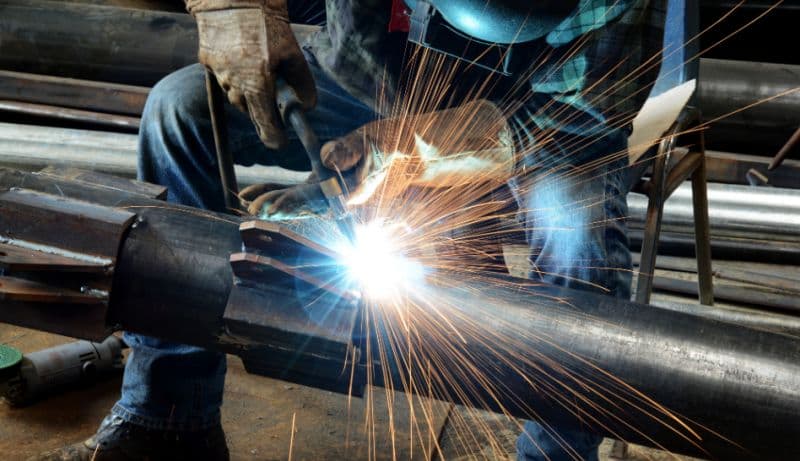
● Manufacturing
Equipment Manufacturing
The critical components of the of the complete pellet production line equipment are built in our own workshops in Asia. Additional equipment is manufactured by our worldwide network of reliable partners.
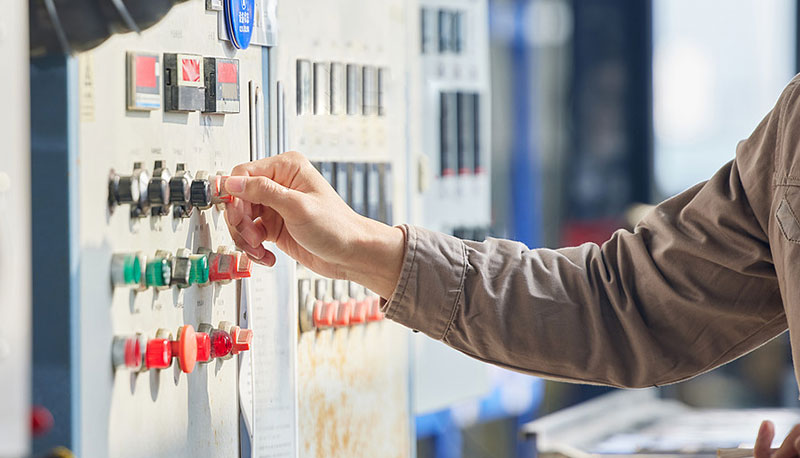
● Testing
Quality Inspection & Testing
Before leaving the factory, all equipment will be inspected by the quality inspection department. We can also provide customers with testing services from a single machine to a complete pellet plant system, and provide you with real actual data for “worry-free use.”

● Delivery
Equipment Delivery
In equipment boxing and packaging, we adopt professional packaging and modular solutions to ensure the safe and non-destructive delivery of pellet plant equipment.
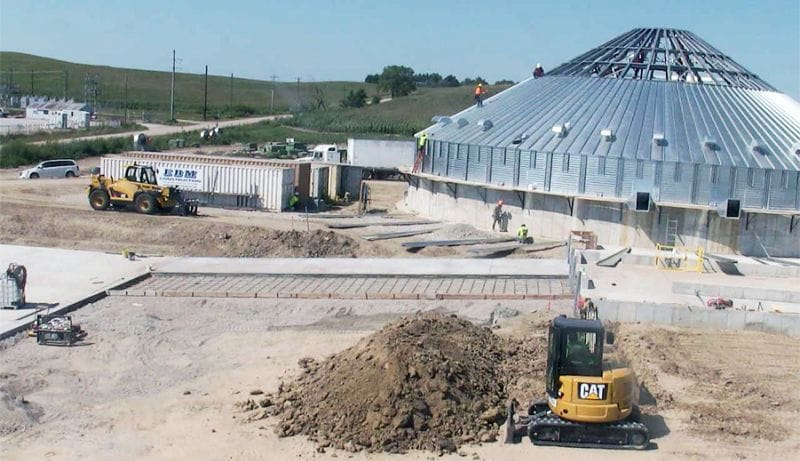
● Installation
Installation & Commissioning
Whether you choose your own subcontractor for the erection phase or you want to install everything together with us, a Richi supervisor will be around to make sure everything is mounted in a safe and thorough way.

● Training
Staff Training
We provide comprehensive training for the technicians of each project. We can also continue to provide support for the technicians during latter project operation.
● After-sales
Project Follow-Up
When everything is up and running our Richiers will help you further whenever needed. We are ready to answer your call 24/7.We’ll also visit you regularly to learn about your needs.
Who we are
RICHI Machinery is one of the world’s leading suppliers of technology and services for the animal feed, aqua feed and pet food industries, also the largest pellet production line manufacturer in China.
Since 1995, RICHI’s vision to build a first-class enterprise, to foster first-class employees, and to make first-class contributions to society has never wavered.
In the past three decades, we have expanded our business to a wide range of areas, including animal feed mill equipment, aqua feed equipment, pet feed equipment, biomass pellet equipment, fertilizer equipment, cat litter equipment, municipal solid waste pellets equipment, etc.

1995
RICHI Established

2000+
Serving More Than 2000 Customers

120+
RICHI Employees

140+
Exported To 140 Countries