 0086-138 3838 9622
Rice Straw Pellet Plant in Myanmar for Boiler Fuel
RICHI MACHINERY
The Harvest Determines the Factory Rhythm
The busiest weeks for collecting straw are not necessarily the busiest weeks for selling fuel. This rice straw pellet plant in Myanmar connects those two schedules through covered bale storage and a 4 T/H RICHI processing line. Located in the Bago rice-growing area, the project turns accepted dry straw into a more compact fuel for suitable industrial boilers.
The customer profile is a regional biomass processor working with farms and collection contractors. Its advantage begins close to the fields, where collection distances and bale handling determine how much usable material reaches the factory. The pellet line then adds density, a consistent physical form and a manageable dispatch route.
A 6,000 m² industrial plot contains a 2,100 m² existing workshop and 150 m² of office and staff facilities. Eighteen people cover two shifts, including receiving, preparation, presses, packing, supervision and maintenance; seasonal collection contractors are separate.
Equipment investment is budgeted at USD 110,000 and total project investment is budgeted at USD 180,000. The total covers the process package, freight and import clearance, installation, adaptation of the existing buildings, electrical distribution, dust protection, commissioning and contingency. Land acquisition, seasonal inventory and full-production standby generation are excluded.
4 T/H
Capacity
Straw handling
Process focus
Myanmar
Location
Industrial pellets
Project type
RICHI MACHINERY
Securing Usable Straw Close to Bago
Rice straw already has value on farms and in other local activities. A dependable collection business starts with the surplus farmers can release and the conditions under which it can be stored.
| Straw destination | Procurement implication | Plant response |
|---|---|---|
| Field retention | Supports farm soil management | Purchase only available surplus |
| Livestock use | Competing local demand | Respect committed volumes |
| Mushroom growing | Quality-dependent outlet | Use separate supply agreements |
| Fuel collection | Requires baling and transport | Record usable dry tonnes |
Drying before baling is especially important. A dense bale can retain moisture in its centre even when its surface feels dry. Supplier handling and receiving measurements work together to keep unsuitable material out of the covered stock.
Collection agreements therefore define material condition as well as tonnes. A clean dry load takes less handling and creates fewer problems in storage than a heavier load carrying soil and rainwater. Those differences eventually reach the cost of finished fuel.
Industrial sales are concentrated on users with a suitable combustion route:
| Potential buyer | Delivery area | Qualification | Commercial condition |
|---|---|---|---|
| Process steam users | Bago | Furnace and ash system | Successful fuel trial |
| Textile operations | Bago–Yangon route | Stable feeding | Agreed specification |
| Food processors | Accessible regional sites | Combustion compatibility | Regular order schedule |
| Central boiler operators | Industrial districts | Ash and emissions assessment | Verified receiving capacity |
Rice processors may already have their own husk supply. The stronger prospect is an industrial user that needs purchased fuel and has a furnace capable of handling agricultural biomass. This keeps sales effort focused on a customer’s actual operating need.
RICHI MACHINERY
Dry Bales, Clean Fibres and a Defined Feed Route
Rice straw forms the principal material for the Bago configuration. Its low bulk density and long fibres influence nearly every part of preparation, from the bale opener to the buffer discharge.
The supply arrangement distinguishes stored dry material from exposed stock:
| Check | Dry stored rice straw | Weather-exposed rice straw |
|---|---|---|
| Supply basis | Identified farm lots | Separate acceptance |
| Collection period | Linked to local harvest | Access-dependent |
| Moisture | Measured before use | Test bale core |
| Ash | Laboratory sample | Check soil contamination |
| Fibre condition | Dry and clean | Inspect for mould |
| Storage | Covered and ventilated | Hold outside accepted stock |
| Fuel value | Measured on declared basis | Do not infer from appearance |
Incoming straw must be dry enough for covered storage. Press feed is controlled around 10–14% moisture after preparation; the selected line has no thermal dryer. Wet or heating bales remain outside accepted stock until handled through a separate, suitable route.
Responsibilities are divided across collection and factory receiving:
| Source | Collection plan | Volume basis | Condition | Delivery control |
|---|---|---|---|---|
| Farm groups | Practical truck routes | Accepted dry tonnes | Covered bales | Supplier identification |
| Collection contractors | Agreed collection zones | Weighbridge receipts | Clean accepted bales | Moisture sample |
| Combined supply | Monthly delivery schedule | Supports planned production | Separate wet loads | Stock reconciliation |
Accepted straw has three essential characteristics:
The receiving team identifies:
- Moisture suitable for storage and preparation
- Clean fibres without mould or signs of heating
- Limited soil and no plastic wrapping, twine or metal
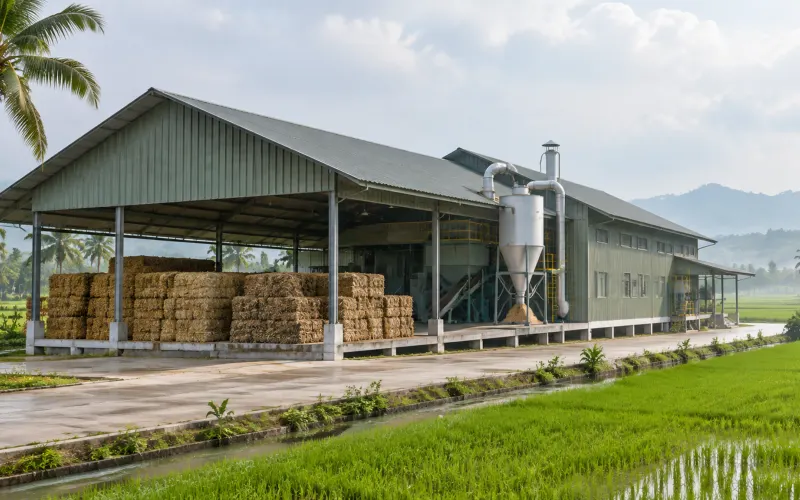
The 600 m² bale bay is a working buffer. At 60% stack coverage, 3 m stack height and 120 kg/m³ bale density, it holds about 130 tonnes. That is roughly two production days at full output; seasonal stocks remain in separately managed supplier stores.
RICHI MACHINERY
A Site Layout with Room for Bales and Trucks
Bales need space before they become a compact fuel. The site arrangement gives receiving vehicles, loaders and finished-product traffic separate working positions, with drainage around covered storage.
The main site functions are:
| Area | Size (m²) | Function |
|---|---|---|
| Production building | 2,100 | Includes processing and working stock |
| Bale buffer within building | 600 | Included in 2,100 m² |
| Finished stock within building | 500 | Included in 2,100 m² |
| Office building | 150 | Staff and administration |
| Weighbridge | Entrance allocation | Receipts and dispatch |
| Paved circulation | About 1,200 | Vehicle access |
| Remaining site | Within 6,000 m² total | Circulation, separation and utilities |
Inside the production building, space follows the material route:
The allocation keeps preparation, pressing and clean stock distinct:
| Zone | Area (m²) | Duty |
|---|---|---|
| Bale opening | 200 | Controlled primary feed |
| Grinding | 250 | Fine preparation |
| Pressing and cooling | 350 | Pellet formation and cooling |
| Packing and services | 200 | Weighing and access |
| Covered bale stock | 600 | Working buffer |
| Finished stock | 500 | Released bagged product |
The six indoor areas total 2,100 m². Raw stock and finished stock each have a single allocation, while the process sections retain access for machine service. The result is a layout the operator can use throughout the shift, not just fit onto a drawing.
RICHI MACHINERY
One Coordinated Line from Bale Opening to Packing
| Equipment | Quantity | Drive basis | Function |
|---|---|---|---|
| RICHI bale opener | 1 | Matched to feed duty | Open accepted bales |
| RICHI primary cutter | 1 | 55 kW | Shorten stems |
| RICHI straw hammer mill | 1 | 132 kW | Prepare fibre |
| RICHI MZLH678 biomass pellet mills | 2 | 200 kW each | 4 T/H combined design duty |
| Extraction system | 1 coordinated set | 22 kW drive allowance | Collect process dust |
| Weighing and closing stations | 2 | At least 200 × 25 kg bags/hour combined | 25 kg and 50 kg formats |
| Live-discharge buffer | 1 | Level-controlled | Even press feed |
| Conveyors, cooler and screen | 1 package | At least 5 T/H on qualified material | Transfer, cool and separate fines |
| Loader interface | 1 operating position | Local handling arrangement | Move bales and pallets |
The RICHI package connects bale opening, cutting, fine preparation and pelleting with continuous cooling and weighing. Buffers and conveyors are part of the material-handling design rather than accessories chosen after the major machines.
Two MZLH678 rice straw pellet making machines with 200 kW motors divide the nominal 4 T/H duty. Each works around 2 T/H on the selected dry rice-straw preparation, leaving more drive headroom than a single press carrying the entire line. The package’s throughput is established with representative straw, not by adding motor power.
Opening, cutting and fine grinding address different stages of fibre preparation.
RICHI MACHINERY
The Production Route, Starting with the Bale
Record the Delivery and Place the Stock
A weighbridge records incoming loads before the receiving team assigns each batch to covered storage. Supplier identity stays with the material, making changes in moisture or contamination easier to trace through production.
Bales are arranged in stable stacks with inspection access. Clear separation from heat sources and vehicle exhaust helps protect the stock, while a simple lot sequence keeps older accepted material moving toward processing.
Remove Wrapping and Open the Bale
Twine is removed while the bale is still identifiable. The opener loosens the compressed straw into a controllable feed instead of allowing large lumps to drop into the cutting chamber.
A metered infeed also gives the operator time to notice an unusual object. The aim is a continuous supply of loose straw that the cutter can shorten evenly.
Primary preparation provides:
- Controlled release of compressed fibres
- A feed rate aligned with the downstream line
- Short stems suitable for fine preparation
Low-density straw needs generous passages and live discharge to avoid bridging.
Extraction contains cutting dust; accessible panels support routine cleaning.
Fine Grinding for Even Press Loading
A 132 kW hammer mill receives precut straw through a controlled infeed. The preparation section is selected for at least 5 T/H on accepted material, with a live-bottom buffer between grinding and the two presses.
The grinding section is selected by these operating characteristics:
| Item | Selection basis | Check |
|---|---|---|
| Material | Precut rice straw | Clean fibres |
| Main drive | 132 kW | Motor loading |
| Screen | 4–6 mm starting screen; verify fibre profile | Sieve and visual check |
| Flow | Matched to press demand | Buffer level |
| Output | Uniform short fibre | Uniform fibre |
Operators check the discharged fibre as well as the screen aperture, because long strands can pass through a hole end-first.
The material leaving preparation has the following handling priorities:
| Feature | Desired condition | Operator response |
|---|---|---|
| Fine fraction | Controlled dust level | Review excessive regrinding |
| Short fibre | Consistent preparation | Maintain steady feed |
| Long fibre | Limited carryover | Check cutting and screen |
| Foreign matter | Excluded | Stop and investigate |
| Oversize | Separated | Return for preparation |
A defined return point recovers clean process fines. Dirt removed at receiving leaves the process separately, protecting the fuel from unnecessary mineral contamination and the equipment from abrasive material.
Keep Prepared Straw Moving
A suitable buffer discharge prevents light fibres from forming a stationary bridge above an empty feeder. Level information and controlled withdrawal help the press maintain a steady load while the upstream equipment handles normal variation in bale feeding.
Densify the Straw into Industrial Fuel
The die works with the prepared straw’s moisture and fibre condition. Consistency at that point reduces the need for repeated adjustments and gives the operator a more useful relationship between motor current and output.
Both presses form nominal 8 mm pellets through separate metered feeders. They discharge into a combined cooling and screening route sized above the 4 T/H finished-product duty.
The pelleting arrangement is:
| Parameter | Configuration | Purpose |
|---|---|---|
| Press type | Two MZLH678 ring-die presses | Agricultural residue duty |
| Die holes | Nominal 8 mm | Industrial fuel format |
| Main drive | 2 × 200 kW | About 2 T/H selected duty per press |
| Die geometry | Straw-trial selection | Stable formation |
| Moisture at preparation | About 10–14% | Control feeding and binding |
| Nominal line duty | 4 T/H | Qualified dry straw |
Finished-product characteristics are defined for the industrial customer:
| Property | Definition | Acceptance method |
|---|---|---|
| Diameter | Nominal 8 mm | Sample measurement |
| Length | 10–30 mm target | Cutter and screen checks |
| Moisture | 8–12% target after cooling | Cooled-product test |
| Particle integrity | Resists handling | Inspection and testing |
| Bulk density | 500–650 kg/m³ working target | Measured bulk sample |
| Durability | Product-specific limit | Mechanical test |
| Ash | Agricultural fuel chemistry | Laboratory analysis |
| Heating value | Declared test basis | Laboratory analysis |
Densification makes straw easier to store and convey, but the fuel retains the mineral character of the crop residue. Ash handling and combustion compatibility remain part of the product’s intended application.
Two eight-hour shifts allow fourteen net production hours, giving up to 56 tonnes/day at the nominal rate. At 12% incoming moisture, 10% product moisture and 3% dry-solids loss, accepted straw demand is about 59 tonnes/day. Collection plans therefore follow usable dry tonnes, not loose field volume.
Cool Continuously After the Press
Pellets pass into a counterflow cooler while the next material continues through the die. Continuous cooling frees the warehouse from the task of holding hot product on the floor.
The outlet is arranged for stable transfer to the screen and packing stations. In warm, humid conditions, cooling and storage protection work together to avoid delivering heat or condensation into a closed bag.
Removing loose fines after cooling improves the physical consistency of dispatches. It also reduces the amount of dusty material the customer handles at the receiving hopper.
Weigh, Close and Identify the Product
Two weighing-and-closing positions jointly handle at least 200 bags/hour in the 25 kg format. Production at 4 T/H requires 160 bags/hour, leaving handling margin for bag changes and pallet transfer.
Packing follows a clear sequence:
- Select the agreed 25 kg or 50 kg format
- Fill to the specified net weight
- Close and identify the production batch
- Move the bags into the released-stock area
Bulk supply is an alternative where customer access and unloading equipment suit it. Protected transport keeps the condition achieved at the factory from being lost on the delivery route.
RICHI MACHINERY
Electricity, Operating Hours and Restart
| Utility | Use | Design basis | Operating record |
|---|---|---|---|
| Electricity | Press and preparation | Demand and starting study | Production meter |
| Water | Staff and housekeeping | Separate clean supply | Metered use |
| Loader fuel | Bale and pallet handling | Vehicle hours | Daily log |
Connected electrical duties are assigned by process section:
| Group | Connected kW | Operating role | Sizing basis | Control |
|---|---|---|---|---|
| Primary cutting | 55 | Precut accepted stems | Bale opening and metered feed | Motor current |
| Fine grinding | 132 | Prepare fibre | At least 5 T/H on accepted straw | Sieve and buffer level |
| Two pellet mills | 400 | Shared pressing | 4 T/H combined line duty | Individual feeder control |
| Extraction | 22 | Capture process dust | Duct and pressure study | Filter monitoring |
| Opening, cooling, conveying and packing | 42 | Material handling | At least 5 T/H downstream duty | Level interlocks |
| Lighting and office | 5 | Support | Separate circuits | Section meter |
| Total | 656 | Connected-load basis | Demand and starting study | Measure actual consumption |
The two press motors total 400 kW; cutting and grinding add 187 kW. Extraction and downstream auxiliaries bring the connected-load basis to approximately 656 kW. The site needs a confirmed three-phase 50 Hz connection capable of the agreed running combination and controlled starts.
Routine water demand is about 1–2 m³/day for staff and housekeeping; fire-water provision is separate. Controls have short-duration continuity for an orderly stop. Production pauses during an extended supply failure unless a separately sized full-load generator is installed.
RICHI MACHINERY
Engineering for a Seasonal Raw Material
Four decisions make the straw route more manageable for the operating team:
Dry-stock continuity. Covered storage connects harvest collection with production between deliveries.
Supplier stores bridge the harvest calendar. Factory procurement starts with available surplus, bale density, measured moisture and a truck-access plan, before committing to year-round delivery quantities.
Fibre preparation. Removing twine, cutting stems and controlling the fine-grinding result reduce bridging before the material reaches the two press feeders.
The preparation package brings together:
- An opener for compressed bales
- A cutter for long stems
- Fine grinding suited to straw
- Controlled feeders for the two working presses
Complete product handling. Cooling and screening turn press discharge into material ready for commercial packing.
Cooling, classification and bag handling remain inside the machinery scope.
A clear division of work. Nine positions per shift cover the factory. Collection contractors and transport staff remain outside the eighteen-person operating team.
Instruction is tied to the equipment and material:
- Recognizing unsuitable bales and maintaining clear storage access
- Preparing fibres and servicing the press under isolation
- Responding to interrupted feeding, overload or loss of power
Recording wear by operating hours and material batches helps procurement and maintenance work together. More soil in the incoming straw can mean more abrasive material passing through the preparation and pressing equipment.
RICHI MACHINERY
Match the Pellet to the Combustion System
These are agricultural fuel pellets for suitable industrial equipment. Their sales specification addresses handling and fuel chemistry together, giving the buyer a clear basis for a combustion trial and subsequent deliveries.
| Test | Reason | Release basis |
|---|---|---|
| Diameter | Fuel feeder compatibility | Buyer agreement |
| Length | Avoid bridging | Measured samples |
| Bulk density | Loading consistency | Bulk test |
| Durability | Handling resistance | Agreed test method |
| Fines | Dust and feeding | Screened sample |
| Moisture | Storage stability | Moisture analysis |
| Ash | Ash-removal capacity | Laboratory result |
| Heating value | Useful heat assessment | Declared basis |
| Sulfur | Combustion chemistry | Laboratory result |
| Chlorine and ash fusion | Deposit and corrosion assessment | Customer qualification |
The choice between straw and wood fuel depends on the receiving equipment:
| Comparison | Rice straw pellets | Clean wood pellets |
|---|---|---|
| Ash behaviour | Agricultural minerals require assessment | Different feedstock chemistry |
| Fuel value | Measured for the straw batch | Measured for the wood batch |
| Handling | Densified fibrous fuel | Densified woody fuel |
| Application | Compatible industrial furnace | Buyer and appliance specification |
For an industrial boiler, ash quantity is only part of the discussion. Deposits, ash fusion and the cleaning arrangement also influence performance. A useful trial follows the fuel through feeding, firing and ash removal rather than stopping at a heating-value result.
RICHI MACHINERY
Turning Industrial Trials into Repeat Deliveries
The Bago–Yangon trading area gives the processor a route to industrial users, while incoming straw collection remains close to the farming districts. Pelleting improves outbound density; the economics of collecting loose residue still depend on a practical radius.
Commercial development follows four priorities:
- Available surplus. Farm collection is based on straw that can be released after other uses and soil-management needs are considered.
- Useful fuel value. Product comparisons account for moisture, ash and the customer’s combustion system as well as nominal heating value.
- A representative trial. The material offered to the customer should reflect the regular supply, not a specially selected sample unlike normal production.
- Repeatable handling. Consistent size and controlled fines make the delivered fuel easier to use in the customer’s feeding equipment.
Those priorities favour a dependable regional supplier relationship. The plant can build orders around what it can collect, process and deliver consistently, without relying on an uncertain export outlet to absorb every tonne.
The operating response to common constraints is:
| Constraint | Practical response |
|---|---|
| Ash and deposits | Trial the fuel in a suitable industrial furnace |
| Harvest concentration | Covered supplier stock and delivery scheduling |
| Bulky incoming straw | Baling and short collection routes |
| Buyer qualification | Representative samples followed by controlled firing trials |
Procurement, production and dispatch share one dry-stock and order schedule.
RICHI MACHINERY
Discuss a Rice Straw Pellet Plant in Myanmar
RICHI Machinery can translate your collection arrangement into a connected straw pellet production line, including the handling stages that are easy to overlook when comparing press quotations.
- Send representative bales or samples. Fibre length, contamination and moisture determine the preparation route.
- Identify the fuel buyer. Its furnace and ash system define the product’s intended use.
- Describe daily receiving. Bale size, truck loads and unloading equipment influence the opener and storage layout.
- Explain wet-season supply. Covered stock and access conditions help establish the operating calendar.
- Show the available space. RICHI can arrange receiving, preparation, pressing and packing around the usable workshop.
- Define the electrical service. Available power and the intended backup duty guide the drive and control arrangement.
Request the straw fuel pellet plant as a complete package. The rice straw pellet machine, preparation equipment and downstream handling can then be matched to one production duty.
For a biomass pellet plant cost enquiry, send monthly available tonnes, measured moisture, site dimensions and the desired dispatch format. RICHI can return a process route and equipment scope that make the investment discussion concrete.
For this rice straw pellet plant in Myanmar, a representative bale sample and a workable collection calendar are the quickest route to a useful equipment proposal.
● RICHI MACHINERY
RICHI Service

● Consulting
Customer Consultation
We want to have a deep understanding of your industrial process, to know your exact needs of feed, wood, biomass, fertilizer or other pellet processing.
● Design
biomass Pellet Plant Design
Based on your unique situation and industrial process, we will tailor complete pellet plant you need, and inform you of every additional detail that could facilitate operation, minimize total cost.
● Manufacturing
Equipment Manufacturing
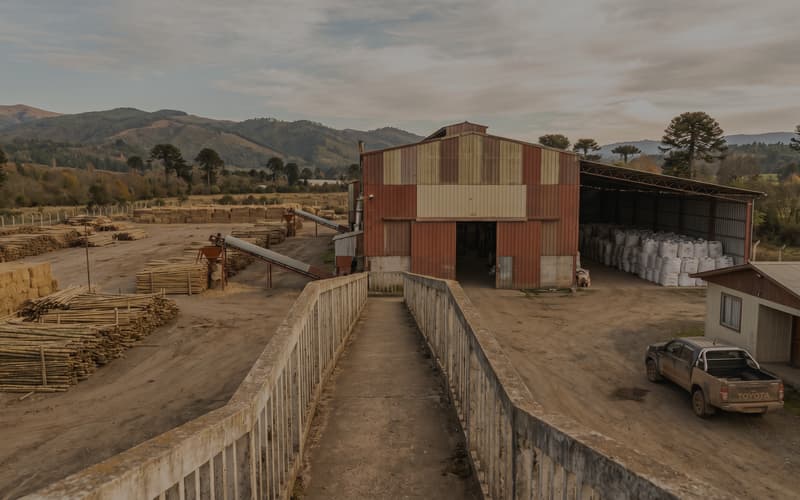
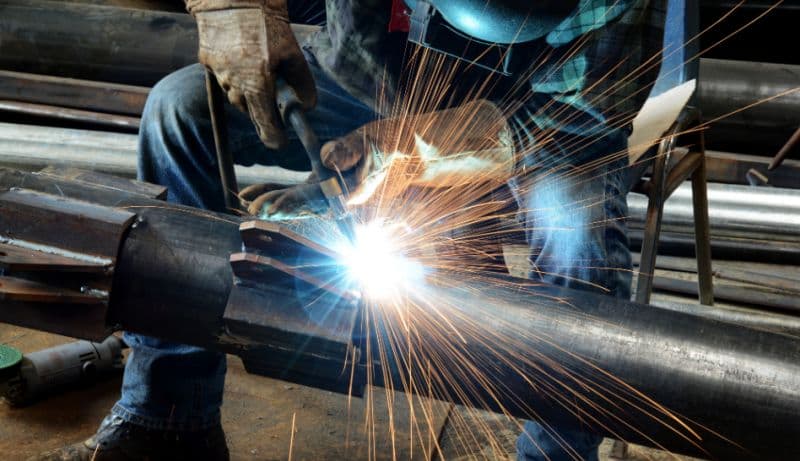
The critical components of the of the complete pellet production line equipment are built in our own workshops in Asia. Additional equipment is manufactured by our worldwide network of reliable partners.

● Testing
Quality Inspection & Testing
Before leaving the factory, all equipment will be inspected by the quality inspection department. We can also provide customers with testing services from a single machine to a complete pellet plant system, and provide you with real actual data for “worry-free use.”

● Delivery
Equipment Delivery
In equipment boxing and packaging, we adopt professional packaging and modular solutions to ensure the safe and non-destructive delivery of pellet plant equipment.
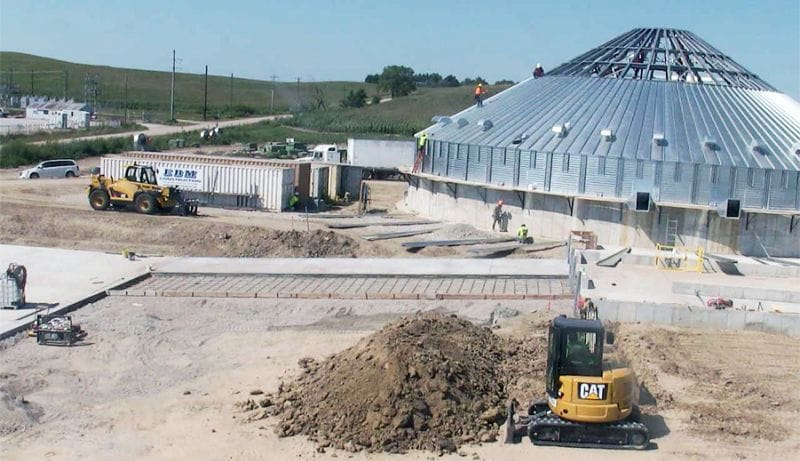
● Installation
Installation & Commissioning
Whether you choose your own subcontractor for the erection phase or you want to install everything together with us, a Richi supervisor will be around to make sure everything is mounted in a safe and thorough way.

● Training
Staff Training
We provide comprehensive training for the technicians of each project. We can also continue to provide support for the technicians during latter project operation.
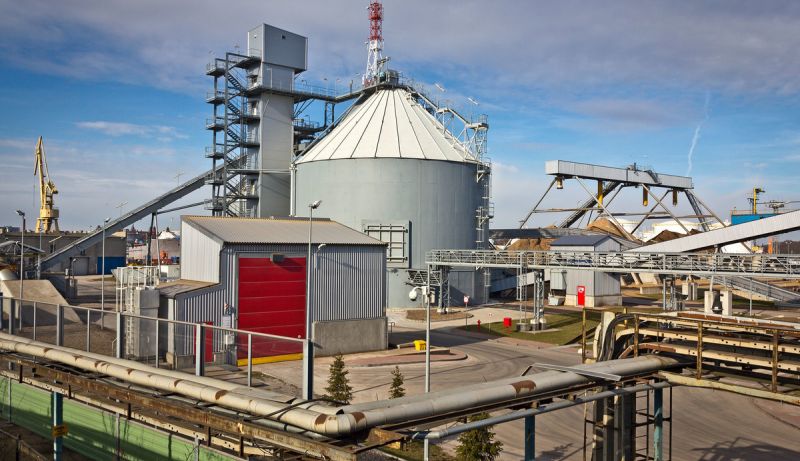
● After-sales
Project Follow-Up
When everything is up and running our Richiers will help you further whenever needed. We are ready to answer your call 24/7.We’ll also visit you regularly to learn about your needs.
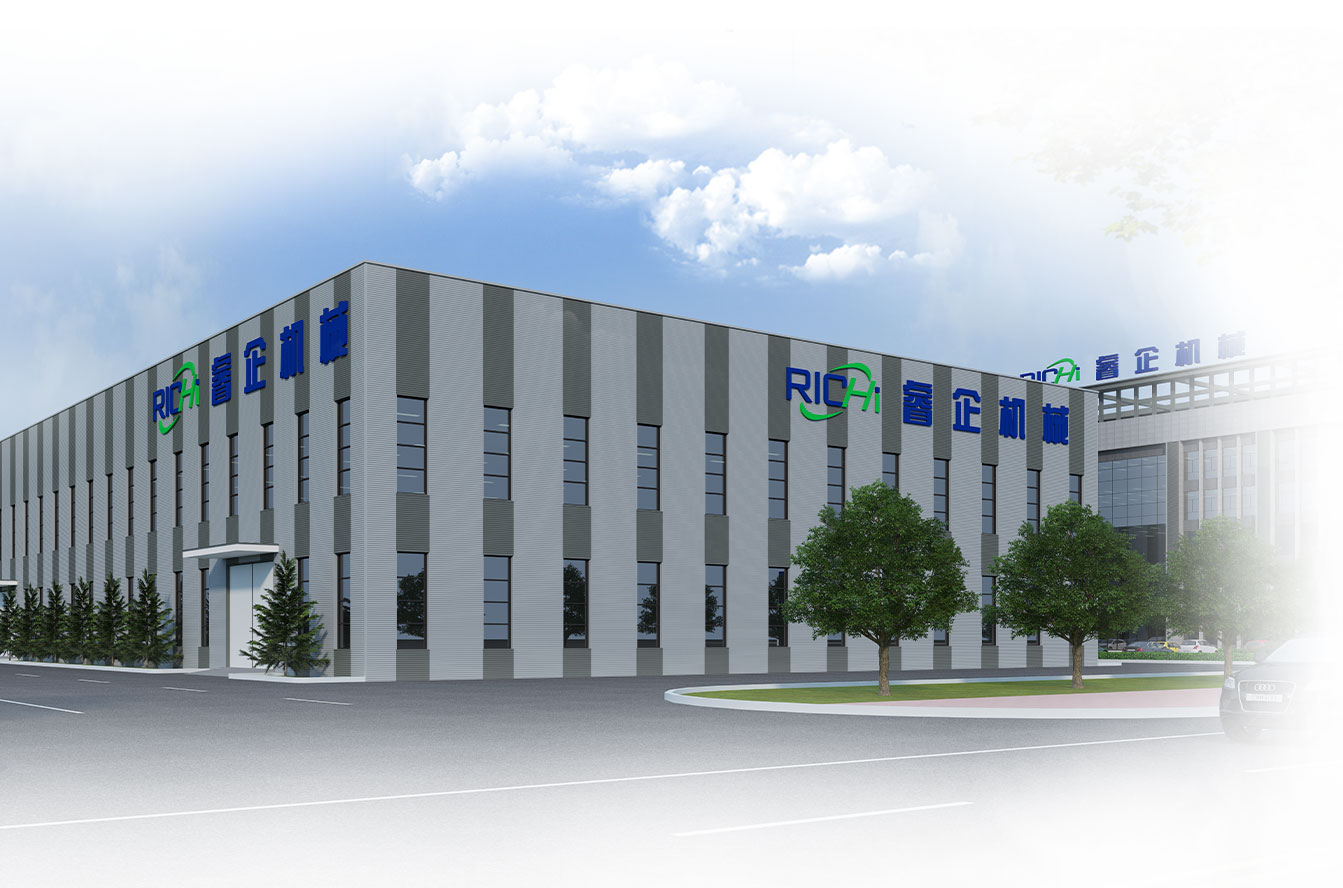
Who we are
RICHI Machinery is one of the world’s leading suppliers of technology and services for the animal feed, aqua feed and pet food industries, also the largest pellet production line manufacturer in China.
Since 1995, RICHI’s vision to build a first-class enterprise, to foster first-class employees, and to make first-class contributions to society has never wavered.
In the past three decades, we have expanded our business to a wide range of areas, including animal feed mill equipment, aqua feed equipment, pet feed equipment, biomass pellet equipment, fertilizer equipment, cat litter equipment, municipal solid waste pellets equipment, etc.

1995
RICHI Established

2000+
Serving More Than 2000 Customers

120+
RICHI Employees

140+
Exported To 140 Countries