 0086-138 3838 9622
Sugar Residue and Mushroom Waste Bio-Organic Fertilizer Plant in Mexico
RICHI MACHINERY
overview
This 10,000 T/A Sugar Residue and Mushroom Waste Bio-Organic Fertilizer Plant in Mexico was planned for a regional fertilizer manufacturer converting agro-industrial by-products into a standardized granulated product. The project combines sugar-processing residue, spent mushroom substrate and a controlled biomass-ash amendment, but it does not treat the three materials as interchangeable. Their moisture, bulk density, fibre content and storage behavior are handled separately before they are brought together in the fertilizer formula.
The mechanical finishing section is designed around a 4–5 T/H working range, 300 operating days per year and one principal 8-hour shift. One RICHI FZLH350 ring-die organic fertilizer pellet mill produces the main 4 mm granulated product after fermentation, maturation, crushing, screening and final mixing. The site uses approximately 7,000–9,000 m² because biological stabilization requires more floor area and residence time than the downstream pelletizing section.
The project keeps the machinery package proportional to the annual sales target. It does not install a second granulator, oversized drying equipment or a 24-hour finishing schedule before the customer has enough raw material and fertilizer demand to justify them. Space and interfaces are reserved for later expansion instead.
4T/H
capacity
$160,000
investment
Mexico
location
Fertilizer
project type
RICHI MACHINERY
A 10,000 T/A Plant Matches the Customer’s Raw-Material Network
This project is sized as a commercial fertilizer factory, not as a municipal waste-disposal facility. The customer needs enough annual volume to justify mechanized compost preparation, controlled fertilizer finishing and automatic bagging, while keeping the sourcing radius realistic for wet agro-industrial residues. At 10,000 T/A, the company can build supply agreements with several sugar-processing and mushroom-production businesses rather than depending on a national waste stream.
| Project Item | Design Basis |
|---|---|
| Project | Sugar residue and mushroom waste bio-organic fertilizer plant |
| Country | Mexico |
| Project nature | New-build commercial fertilizer project |
| Annual finished output | Approx. 10,000 T/A |
| Mechanical finishing capacity | Approx. 4–5 T/H |
| Operating days | Approx. 300 days/year |
| Production schedule | 1 × 8-hour principal shift |
| Main feedstock | Sugar-processing residue |
| Secondary feedstock | Spent mushroom substrate |
| Mineral amendment | Approved clean biomass ash |
| Main finished form | Granulated bio-organic / organic fertilizer |
| Main pellet diameter | 4 mm |
| Pelletizer | 1 × RICHI FZLH350 |
| FZLH350 reference output | 3–5 T/H |
| Finished-product moisture | Typically controlled to ≤12–15% |
| Main packaging | 25 kg / 40 kg bags |
| Site area | Approx. 7,000–9,000 m² |
| Staffing | Approx. 18–22 people |
| Destination port | Veracruz, Mexico |
| Expansion | Reserved interface for additional finishing capacity |
The 4–5 T/H mechanical finishing range also fits one FZLH350. The annual target is reached through the planned operating calendar rather than by forcing the pelletizer to run at maximum output every hour. This leaves operating margin for formula changes, cleaning, die inspection, maintenance and normal production interruptions.
RICHI MACHINERY
Mexico Gives the Project a Credible Supply Base
Mexico has a large sugarcane and sugar-processing sector, which gives the customer access to geographically concentrated agro-industrial by-products in suitable regions. Commercial mushroom production creates a second recoverable organic stream, especially where growers use straw, sawdust, bran or other lignocellulosic growing media. The project therefore links two existing agricultural-processing activities instead of inventing a raw-material chain around the fertilizer factory.
The sourcing model is regional. Wet sugar residue and spent mushroom substrate are expensive to haul over long distances because part of every truckload is water. The customer therefore prioritizes nearby suppliers and evaluates material on usable dry matter, contamination, transport cost and seasonal availability—not only on the purchase price per wet ton.
- sugar mills and sugar-processing businesses supplying approved organic residue;
- commercial mushroom growers supplying spent mushroom substrate;
- biomass users supplying traceable clean ash that meets the customer’s fertilizer specification;
- agricultural distributors and growers purchasing the finished fertilizer.
This combination also gives the plant some protection against seasonality. Sugar-industry residue can be strongly linked to the crushing season, while mushroom substrate may be generated on a different production cycle. The receiving and fermentation plan therefore includes enough buffer and staggered batches to keep the downstream finishing line supplied.
RICHI MACHINERY
Raw-Material Planning Starts with Dry Matter Not Wet Tonnage
The project keeps the original annual sourcing targets of approximately 7,500 tons of sugar-processing residue, 3,000 tons of spent mushroom substrate and 2,500 tons of clean biomass ash or a comparable approved mineral amendment. These numbers are procurement and process-planning quantities; they are not treated as a one-to-one mass balance in which every wet ton automatically becomes one ton of finished fertilizer.
| Material | Annual Planning Quantity | Typical Receiving Condition | Main Design Concern |
|---|---|---|---|
| Sugar-processing residue | Approx. 7,500 T/A | Moist, partially dewatered organic residue | Moisture variation, storage time, odor |
| Spent mushroom substrate | Approx. 3,000 T/A | Loose or broken fibrous substrate | High moisture, packaging contamination, fibre |
| Clean biomass ash | Approx. 2,500 T/A | Dry or low-moisture mineral-rich powder | Dust, alkalinity, segregation, contamination |
| Other approved dry formulation materials | Formula dependent | Dry organic/mineral ingredients | Nutrient balance and finished-product dry matter |
This distinction is essential because the two organic streams can contain substantial water, while a bagged fertilizer pellet normally needs much lower moisture for stable storage. Fermentation, maturation, dewatering or drying remove water, and some volatile organic matter is also lost during biological stabilization. Where the customer’s finished analysis requires additional dry organic or mineral ingredients, those materials are added according to formulation rather than hidden inside the wet-input figures.
For detailed engineering, RICHI requests representative samples and supplier data before fixing dryer duty, composting area or formula proportions. A realistic material balance is then built from measured moisture and dry matter. This prevents the common error of matching annual wet input directly to annual bagged output without accounting for evaporation, biological loss or added dry formulation material.
RICHI MACHINERY
Each Main Raw Material Needs a Different Receiving Standard
Sugar residue is the dominant organic feedstock, but the term can describe different materials generated at different stages of sugar processing. RICHI Machinery therefore does not select conveyors, mixers or storage geometry from the material name alone. The customer identifies the actual residue, its supplier, moisture range, fibre content, pH, organic matter, nutrient analysis, foreign material and expected storage age.
Spent mushroom substrate is handled as a fibrous biological material. It may arrive loose, in compressed blocks or still associated with bags, strings or other cultivation materials. Packaging and non-compostable contamination are removed before processing. The substrate is loosened where necessary, but it is not aggressively pulverized before fermentation because some remaining structure helps maintain porosity in the composting mixture.
The organic fertilizer production project also uses ash-based material only when its origin is traceable and suitable for the intended fertilizer. Ash from unknown mixed waste, treated wood or contaminated fuel is not treated as an interchangeable low-cost filler. The customer’s quality program checks source, moisture, pH, mineral profile, particle condition and relevant contaminant risks before regular use.
RICHI MACHINERY
Fermentation Is the Main Biological Process
The organic feedstocks are stabilized before they enter fine crushing and granulation. Sugar residue and mushroom substrate are blended according to actual moisture and structure, then moved into the aerobic fermentation area. The objective is not to force every batch through a fixed calendar period. Operators follow temperature, moisture, odor, pile structure and biological activity to decide when turning, moisture adjustment and maturation are required.
The mushroom substrate contributes useful structure, while the sugar residue provides a different organic fraction. If the mixture becomes too wet and compact, oxygen transfer falls and odor risk rises. If it becomes too dry, microbial activity slows. Turning equipment is therefore used to manage aeration and homogenization rather than simply following an arbitrary weekly routine.
- Receiving and pre-sorting: wet organic materials are inspected and non-compostable contamination is removed.
- Pre-blending: sugar residue and mushroom substrate are combined according to moisture and physical condition.
- Active fermentation: piles or windrows are turned as required to maintain aerobic decomposition.
- Secondary maturation: material is allowed to stabilize before the mechanical fertilizer section.
- Release to finishing: mature material is checked for moisture, odor, structure and suitability for crushing and formulation.
Multiple fermentation batches are kept at different stages so that the 4–5 T/H finishing line receives a steady supply of mature material. This is why the fermentation area occupies more space than the pelletizing workshop.
RICHI MACHINERY
Mechanical Preparation Begins Only after the Material Is Stable
Once the organic fraction is sufficiently mature, the process changes from biological control to physical product preparation. Lumps and fibrous agglomerates are reduced to a more uniform condition, while screening removes unsuitable oversize material and remaining foreign objects. The crusher is therefore not expected to process fresh, saturated waste directly from the receiving floor.
Prepared compost then enters the final formulation system. Controlled biomass ash and any approved dry ingredients are metered into the mixer according to the customer’s product specification. This mixing stage is particularly important because mineral powders can have a very different bulk density from fibrous compost. Poor distribution would create variation from bag to bag and can also cause unstable feeding to the pelletizer.
Before granulation, the plant controls four variables together: maturity + particle size + moisture + formula uniformity. Stable pelletizing depends on all four. Increasing motor power cannot compensate for poorly prepared feed material.
RICHI MACHINERY
One FZLH350 Fits the 10,000 T/A Finishing Target
The selected machine is one RICHI FZLH350 ring-die organic fertilizer granulator machine. Its 37 kW main motor and 3–5 T/H reference output match the project’s 4–5 T/H mechanical finishing requirement without moving to a substantially larger model.
| FZLH350 Item | Project Specification |
|---|---|
| Main motor | 37 kW |
| Arch-breaking feeder | 2.2 kW |
| Forced feeder | 0.75 kW |
| Ring-die inner diameter | 350 mm |
| Reference output | 3–5 T/H |
| Applicable fertilizer pellet diameter | 4–12 mm |
| Main project product | 4 mm |
| Quantity | 1 unit |
The fertilizer granulator equipment receives conditioned fertilizer from a buffer bin so feed rate can remain stable. The 4 mm die is used for the principal commercial grade, while other sizes within the FZLH application range can be produced later by changing the ring die when the customer has a defined market for them.
Using one FZLH350 also keeps spare-parts management and maintenance straightforward. The plant reserves an expansion interface rather than installing a second pelletizer that would sit idle during the first production stage.
RICHI MACHINERY
Drying Cooling and Screening Are Sized from the Finished Product
The organic fertilizer production line does not size its final dryer from the gross 13,000-ton wet receiving volume. Most moisture management occurs during fermentation, maturation and upstream preparation. The downstream drying system only needs to remove the water that remains above the finished-product target after pelletizing.
For stable bagged storage, finished moisture is normally controlled to approximately 12–15% or to the customer’s validated product specification. Warm product is cooled before packaging to reduce condensation and moisture redistribution in the bag. Final screening then separates qualified pellets from fines and broken material; suitable clean fines are returned to the appropriate upstream point.
If the customer’s registered bio-organic product requires viable beneficial microorganisms, heat sensitivity is considered separately. Sensitive cultures may need to be added after high-temperature treatment or through a controlled post-treatment step. The machinery does not create a microbiological claim by itself; viable count and product labeling must be supported by the customer’s formulation, testing and regulatory program.
RICHI MACHINERY
The Complete Process Has Eight Connected Stages
The factory is kept technically complete without adding unnecessary process steps. The normal route is:
- Raw-material receiving and segregation: sugar residue, spent mushroom substrate, ash and other ingredients remain in suitable dedicated areas.
- Organic pre-blending and fermentation: wet organic materials are mixed, aerated and biologically stabilized.
- Maturation and moisture control: compost is allowed to stabilize before mechanical finishing.
- Crushing and pre-screening: mature lumps and oversized fibrous material are controlled.
- Final formulation and mixing: compost, ash and approved dry ingredients are blended uniformly.
- FZLH350 pelletizing: prepared fertilizer is formed mainly into 4 mm cylindrical pellets.
- Drying cooling and final screening: product moisture and physical quality are stabilized and fines are separated.
- Automatic weighing and packing: qualified fertilizer is packed mainly in 25 kg or 40 kg bags for storage and dispatch.
This route gives the customer a clear separation between wet biological processing and dry finished-product handling. That separation is important for housekeeping, product quality and environmental control.
RICHI MACHINERY
Equipment Configuration Is Built around One 4–5 T/H Stream
Supporting equipment is selected to keep the FZLH350 supplied with prepared material and to prevent bottlenecks after granulation. The project does not combine unrelated disc, drum and ring-die granulation technologies. It uses the RICHI FZLH ring-die route required for this fertilizer project.
| Section | Main Equipment | Qty. | Function |
|---|---|---|---|
| Receiving | Covered wet-material receiving zones | 3 zones | Separate sugar residue, mushroom substrate and ash |
| Compost preparation | Heavy-duty organic-material mixer | 1 set | Pre-blending before fermentation |
| Fermentation | Compost turner | 1–2 | Aeration and pile management |
| Mature-material preparation | Organic fertilizer crusher | 1 | Break stabilized lumps and fibres |
| Pre-screening | Fertilizer screen | 1 | Remove oversize and foreign material |
| Formula mixing | Horizontal fertilizer mixer | 1 | Blend compost, ash and dry ingredients |
| Buffering | Pelletizer feed bin and feeder | 1 set | Maintain stable FZLH feed |
| Pelletizing | FZLH350 ring-die pelletizer | 1 | Main 4 mm fertilizer production |
| Moisture control | Drying system where required | 1 set | Reduce finished moisture |
| Cooling | Fertilizer cooler | 1 | Stabilize warm pellets |
| Final screening | Pellet screen | 1 | Separate qualified pellets and fines |
| Recycle | Fines return conveying | 1 set | Recover suitable clean return material |
| Packaging | Automatic weighing/bagging line | 1 | 25 kg / 40 kg bags |
| Dust control | Localized filters/collectors | Multiple | Control dry dust at crusher, screen and packing points |
| Control | PLC/electrical control system | 1 set | Coordinate mechanical finishing line |
Conveyor length, storage-bin volume, dryer duty and dust-collection airflow are finalized from the customer’s site layout and material tests. This keeps the equipment list realistic for the 10,000 T/A scale rather than copying a larger fertilizer complex.
RICHI MACHINERY
The 7,000–9,000 m² Site Is Dominated by Fermentation
A compact fertilizer factory cannot be planned like a compact feed mill. Mechanical equipment can process several tons per hour, but biological stabilization requires days or weeks of residence time. The site therefore saves space in the finishing workshop while preserving enough floor area for staggered fermentation and maturation inventory.
| Functional Area | Planning Area |
|---|---|
| Wet receiving and temporary storage | 1,000–1,300 m² |
| Fermentation and maturation | 2,500–3,200 m² |
| Mechanical fertilizer workshop | 900–1,100 m² |
| Finished-product warehouse | 700–900 m² |
| Dry ash/ingredient storage | 400–600 m² |
| Utilities and maintenance | 200–300 m² |
| Laboratory and office | 200–300 m² |
| Roads, loading, drainage, fire access and reserve | Balance of site |
| Total site | Approx. 7,000–9,000 m² |
Wet and clean traffic routes are separated where the plot allows. Incoming residue trucks move toward the receiving and fermentation side, while packed finished fertilizer leaves from the warehouse side. Impermeable floors and controlled drainage are used in wet areas so material-contact water does not simply mix with clean stormwater.
The finished-product warehouse remains dry and protected from rain and ground moisture. Pellets are stored on pallets or another suitable raised system, and truck loading is arranged so clean bags do not repeatedly cross the wet compost-handling yard.
RICHI MACHINERY
Utilities and Environmental Controls Follow the Actual Risk Points
Electrical demand is concentrated in crushing, mixing, FZLH pelletizing, conveying, cooling, screening, packing and dust extraction. For a plant of this scale, an annual electricity-planning range of approximately 220,000–320,000 kWh is reasonable for preliminary budgeting, but final transformer size is calculated from connected and simultaneous load after the selected dryer, turner and conveying distances are confirmed.
Fresh-water demand is comparatively modest because the incoming organic materials already contain water. Water is mainly required for staff use, cleaning and controlled compost-moisture adjustment when necessary. Process-water demand therefore changes with season and incoming moisture rather than remaining at one fixed daily number.
- Wet-area runoff: receiving and fermentation floors use controlled drainage and collection where required.
- Odor: residence time, aerobic turning, housekeeping and covered handling are used to prevent avoidable anaerobic conditions.
- Dry dust: ash handling, crushing, screening and packing points use enclosure and local collection.
- Noise: crushers, fans and the pelletizer are kept inside suitable production areas and maintained to control abnormal vibration.
- Solid rejects: plastics, strings, stones and other non-process material removed during receiving are segregated for appropriate disposal.
These measures are designed around the actual material route. The plant does not apply the same dust-control solution to a wet compost pile and a dry ash transfer point.
RICHI MACHINERY
A Single Shift and 18–22 Employees Fit the Project
The mechanical finishing line operates mainly on one 8-hour shift. That schedule is sufficient for the 10,000 T/A target and avoids building a three-shift labor structure before the market requires it. Fermentation piles may still need observation outside the principal machinery shift, but this does not mean the crusher, pelletizer and packing system must operate continuously.
- plant manager and production supervision;
- raw-material receiving and loader operators;
- fermentation/compost-turning operators;
- crusher, mixer and FZLH operators;
- drying, cooling and screening operator;
- packing and warehouse staff;
- laboratory/quality-control technician;
- mechanical and electrical maintenance;
- logistics, safety and administration support.
Approximately 18–22 employees is a practical planning range depending on the level of loader work, bag palletizing and automation. The workforce is deliberately larger than the number of people standing at the pelletizer because the business also has to manage fermentation, receiving, QC, warehousing and dispatch.
RICHI MACHINERY
Quality Control Protects the Product from Variable Raw Materials
The customer cannot create a repeatable fertilizer simply by mixing whatever material arrives that day. Incoming lots are identified and inspected before use. Sugar residue, mushroom substrate and ash each have their own acceptance criteria, and supplier variation is tracked over time.
A practical traceability chain is supplier lot → receiving record → fermentation batch → formulation batch → pellet production batch → finished bag lot. If a finished batch later shows unusual moisture, ash content or physical quality, the production team can trace the relevant raw-material and processing history instead of relying on memory.
Finished fertilizer is sold by a validated specification, which may include organic matter, declared nutrients, pH, moisture, pellet size and other parameters required by the customer’s market. Mexico’s organic-production framework also distinguishes between products made from organic-origin materials and inputs that are specifically approved for certified organic production. The customer therefore confirms registration, permitted ingredients and labeling requirements separately; the production line itself does not confer organic certification.
RICHI MACHINERY
RICHI’s Scope Covers the Process from Material Testing to Commissioning
For a project with three very different materials, engineering starts before equipment manufacturing. RICHI reviews available raw-material samples, annual quantities, moisture range, product specification, site dimensions, local power conditions and the required packaging format. The objective is to identify the real bottlenecks before the equipment list is frozen.
The organic fertilizer pellet making machine is only one part of that scope. RICHI also coordinates the crusher, mixer, screening, drying/cooling, conveying, electrical control and bagging interfaces so that the complete mechanical line has a consistent 4–5 T/H working capacity.
- Process confirmation: raw-material condition, moisture and finished specification are defined.
- Layout and civil interface: wet biological zones, mechanical workshop, warehouse and truck routes are coordinated.
- Equipment manufacturing and inspection: major machines and control components are checked before shipment.
- Export logistics: machinery is packed from China for shipment from Qingdao to Veracruz, with inland delivery arranged according to the project site.
- Installation and commissioning: equipment is installed in sequence and the line is started with prepared local material.
- Operator training: feeding, die/roller inspection, moisture response, screening, packing, cleaning and maintenance routines are established.
Local civil works, drainage, roads, simple warehouses and suitable structural fabrication can be completed in Mexico from project drawings where this is more economical than shipping low-value structural material across the ocean.
RICHI MACHINERY
USD 160,000 Is the Reference Equipment Investment
The project keeps the stated USD 160,000 investment as a reference for the RICHI machinery and core process package at this scale. That scope is centered on the fertilizer-processing equipment, controls and associated engineering rather than the purchase of land or every locally constructed building.
The final equipment quotation changes with fermentation-machine scope, dryer duty, conveying distance, dust and odor controls, bin volume, automation level and packing configuration. Civil works, site drainage, local utilities, freight, erection labor, raw-material inventory and working capital remain part of the customer’s wider development budget.
This separation is commercially important. A customer comparing two quotations should not treat a machinery package and a fully developed factory including land and civil construction as the same investment category.
RICHI MACHINERY
Expansion Is Based on the First Real Bottleneck
The plant reserves a practical expansion area but does not pre-install redundant machinery. If sales rise beyond 10,000 T/A, management first determines whether the constraint is raw-material supply, fermentation area, mature-compost inventory, FZLH capacity, drying, packaging or finished-product storage.
- If fermentation becomes the bottleneck, more biological-processing area or turning capacity is added first.
- If mature prepared fertilizer consistently exceeds the FZLH350 capacity, a second finishing module can be evaluated.
- If customers request powder fertilizer as well as pellets, screened mature material can be routed to a separate packing channel without forcing all product through the ring die.
- If viable microbial products become a larger business, a controlled post-cooling inoculation or coating section can be added according to the strain and product specification.
This modular approach protects the customer’s first-stage investment. Capacity is expanded where sales and operating records prove it is needed rather than by duplicating the complete factory in advance.
RICHI MACHINERY
Building a Sugar Residue and Mushroom Waste Bio-Organic Fertilizer Plant in Mexico
A Sugar Residue and Mushroom Waste Bio-Organic Fertilizer Plant in Mexico succeeds only when the raw-material system, biological process and mechanical finishing line are designed as one project. The wet organic feedstocks must be stabilized before fine processing, the mineral fraction must be controlled rather than treated as an unlimited drying aid, and the FZLH350 must receive material with suitable moisture, particle size and formula uniformity.
For this customer, the resulting production logic is clear: regional residue sourcing → controlled receiving → fermentation and maturation → crushing and screening → final formula mixing → FZLH350 pelletizing → moisture stabilization → cooling and screening → automatic bagging.
The 10,000 T/A annual target, 4–5 T/H finishing section, 7,000–9,000 m² site and 18–22-person organization support one another. The plant is large enough to operate as a commercial fertilizer business but small enough to source wet materials regionally, run primarily on one shift and expand only after the market justifies additional capacity.
For RICHI Machinery, the engineering priority is to make variable agricultural by-products predictable enough for commercial fertilizer production. Once the customer provides actual material samples, annual supply data, finished specification and site information, the equipment package can be finalized around those conditions rather than around a generic fertilizer-line template.
● RICHI MACHINERY
RICHI Service

● Consulting
Customer Consultation
We want to have a deep understanding of your industrial process, to know your exact needs of feed, wood, biomass, fertilizer or other pellet processing.
● Design
Fertilizer Pellet Plant Design
Based on your unique situation and industrial process, we will tailor complete pellet plant you need, and inform you of every additional detail that could facilitate operation, minimize total cost.

● Manufacturing
Equipment Manufacturing
The critical components of the of the complete pellet production line equipment are built in our own workshops in Asia. Additional equipment is manufactured by our worldwide network of reliable partners.

● Testing
Quality Inspection & Testing
Before leaving the factory, all equipment will be inspected by the quality inspection department. We can also provide customers with testing services from a single machine to a complete pellet plant system, and provide you with real actual data for “worry-free use.”

● Delivery
Equipment Delivery
In equipment boxing and packaging, we adopt professional packaging and modular solutions to ensure the safe and non-destructive delivery of pellet plant equipment.
● Installation
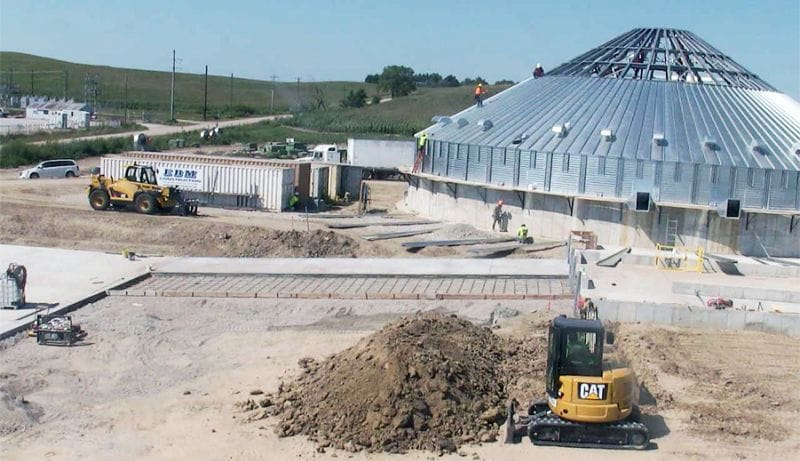
Installation & Commissioning
Whether you choose your own subcontractor for the erection phase or you want to install everything together with us, a Richi supervisor will be around to make sure everything is mounted in a safe and thorough way.

● Training
Staff Training
We provide comprehensive training for the technicians of each project. We can also continue to provide support for the technicians during latter project operation.
● After-sales
Project Follow-Up
When everything is up and running our Richiers will help you further whenever needed. We are ready to answer your call 24/7.We’ll also visit you regularly to learn about your needs.
Who we are
RICHI Machinery is one of the world’s leading suppliers of technology and services for the animal feed, aqua feed and pet food industries, also the largest pellet production line manufacturer in China.
Since 1995, RICHI’s vision to build a first-class enterprise, to foster first-class employees, and to make first-class contributions to society has never wavered.
In the past three decades, we have expanded our business to a wide range of areas, including animal feed mill equipment, aqua feed equipment, pet feed equipment, biomass pellet equipment, fertilizer equipment, cat litter equipment, municipal solid waste pellets equipment, etc.

1995
RICHI Established

2000+
Serving More Than 2000 Customers

120+
RICHI Employees

140+
Exported To 140 Countries