

 0086-138 3838 9622
Rice Husk and Wood Residue Pellet Plant in Philippines
RICHI MACHINERY
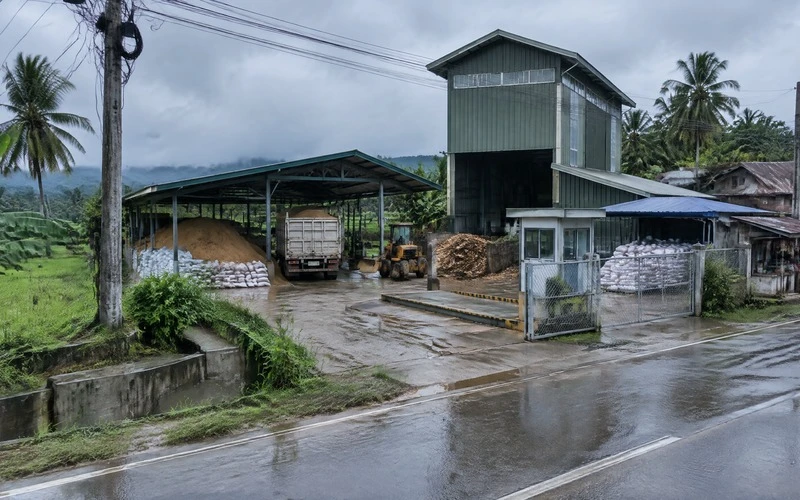
20000 T/A Biomass Fuel Project in Central Luzon
For this project in Pampanga, the customer’s opportunity was not simply access to one cheap biomass residue. The business was built around two established processing sectors in Central Luzon: rice milling, which generates large quantities of rice husk, and wood processing, which provides sawdust, shavings and clean offcuts with a different fuel and fiber profile. The 3–4 T/H rice husk and wood residue pellet plant in Philippines gives the customer one production system capable of preparing these materials through different front-end routes and then converting them into denser industrial fuel pellets for easier storage, controlled feeding and commercial transport.
The completed project has a total investment of USD 400,000, including USD 290,000 for the main pellet production equipment package. Its annual production target is 20000 tonnes based on 300 working days and a three-shift operating arrangement. The nominal line capacity provides operating margin above the annual average requirement, which is important because a mixed biomass factory does not run every hour at its nameplate rate. Wood moisture, rice husk proportion, dryer loading, die maintenance and feedstock changeovers all affect actual throughput. The project therefore combines commercial output with enough production margin for routine maintenance and material variation rather than forcing the line to operate continuously at maximum capacity.
3–4 T/H
capacity
$290,000
investment
Philippines
location
20000 T/A
annual output
RICHI MACHINERY
Raw Materials Define How This Factory Operates
Rice husk forms one of the main feedstock streams because Central Luzon has a strong rice-processing base and the material reaches the factory already in a relatively small, uniform form. Clean wood residues provide the second major stream and include sawdust, shavings and offcuts from suitable wood-processing operations. Bamboo residues can also be processed when clean material is available under a stable supply arrangement, but the commercial production plan does not depend on bamboo tonnage. This gives the customer greater purchasing flexibility without building the project around a feedstock whose volume may fluctuate from one supplier to another.
The important engineering difference is that these materials do not arrive in the same condition. Rice husk may be around 10–15% moisture and normally needs no chipping, while sawdust can vary substantially with storage and processing conditions. Larger wood offcuts require coarse size reduction, and wetter wood fractions create the main evaporation load. For this reason, the rice husk and wood residue pellet plant in Philippines uses separated receiving and preparation routes before the materials are brought together at the controlled blending stage. This avoids paying to chip or dry material that is already suitable for fine preparation and pelletizing.
| Feedstock | Typical Receiving Condition | Annual Planning Quantity | Preparation Requirement |
|---|---|---|---|
| Rice husk | Loose, approximately 10–15% moisture | 9000–11000 T/A | Cleaning and controlled feeding; normally bypasses chipping and drying when moisture is suitable |
| Sawdust and wood shavings | Loose, variable moisture and bulk density | 8000–10000 T/A | Screening, magnetic separation, moisture control and fine grinding as required |
| Clean wood offcuts | Irregular pieces, generally wetter than rice husk | 4000–5000 T/A | Chipping, grinding and selective drying before blending |
| Bamboo residues | Optional strips, offcuts or processing residues | Supplementary | Size reduction and drying according to incoming condition |
| Total feedstock | Mixed incoming moisture | About 23000–26000 T/A | Final consumption varies with incoming moisture and process losses |
Feedstock purchasing is managed on usable dry matter rather than truck weight alone. A tonne of wet wood does not contribute the same amount of pelletable solids as a tonne of relatively dry rice husk, while low-bulk-density residues can become uneconomic when transported too far. Covered storage is divided by material type and moisture condition, with higher inventory allowances for seasonal rice-milling periods. This also gives operators better control over blending, dryer demand and pellet quality instead of allowing several raw materials to become an uncontrolled mixture in the storage area.
RICHI MACHINERY
One Production Line With Different Material Routes
The processing route is designed around material condition rather than forcing rice husk, sawdust and larger woody residues through identical equipment. Incoming material is inspected and stored separately first. Rice husk with acceptable moisture can move through cleaning and controlled feeding without passing through a chipper or dryer. Sawdust is screened and, where necessary, ground to obtain a consistent feed size. Clean wood offcuts and larger bamboo residues enter the coarse size-reduction route before hammer milling. Magnetic separation is positioned ahead of critical machines to reduce the risk of metal entering the grinding and pelletizing system.
Wet woody material is routed to the drying section while sufficiently dry rice husk bypasses it. The drying system is sized from hourly water evaporation rather than the total 3–4 T/H line capacity, which prevents unnecessary thermal equipment from being installed for material that requires no drying. Prepared streams are buffered and blended after moisture adjustment, with pellet-mill feed generally controlled around 10–15% moisture during commissioning according to the actual rice husk-to-wood ratio. Fine grinding is normally controlled below about 6 mm, while the exact distribution is adjusted according to die specification and material behavior.
Conditioned material is then fed to one MZLH768 ring die pellet machine. Its 3–4 T/H biomass capacity range matches the project without requiring several smaller pellet mills. The finished pellets leave the die hot and are therefore cooled before screening. Reusable clean fines are returned to production, while finished 6 mm or 8 mm pellets move to storage and packing. The base sales format is suited to industrial users, with jumbo bags or other bulk-oriented handling preferred where buyer logistics allow it; 25–50 kg packing can be added for customers requiring smaller commercial units.
In practical operating order, the complete route is receiving and material separation → cleaning and magnetic separation → chipping where required → fine grinding → selective drying → moisture equalization and blending → pelletizing → cooling → screening and fines return → packing and finished-product storage. This split-route arrangement is one of the central design features of the rice husk and wood residue pellet plant in Philippines because it directly reduces unnecessary preprocessing while keeping the pellet mill supplied with a more stable material condition.
RICHI MACHINERY
Equipment Configuration for 3–4 T/H Production
The main equipment package has a value of USD 290,000 and is configured as an integrated system rather than as a collection of machines selected only by nominal capacity. One MZLH768 biomass pellet mill provides the pelletizing duty, while upstream equipment is sized according to the portion of material that actually passes through each route. The chipper, for example, only needs to handle oversized woody material; the dryer only handles feedstock above the target moisture window. Conveyors and buffer bins connect the separate routes so the operator can change the blend without repeatedly stopping the complete production line.
| Process Stage | Equipment | Configuration | Qty |
|---|---|---|---|
| Receiving and cleaning | Feed hoppers, screening and magnetic separation | Separate receiving routes for husk and woody residues | 1 set |
| Coarse size reduction | Drum Wood Chipper Machine | For wood offcuts and oversized fibrous material | 1 |
| Fine grinding | SFSP biomass hammer mill | 4–5 T/H system design margin | 1 |
| Selective drying | Rotary drying system | Duty based on wet woody feedstock and hourly evaporation load | 1 set |
| Buffering and blending | Bins, conveyors and controlled feeding system | For moisture equalization and feedstock ratio control | 1 set |
| Pelletizing | MZLH768 biomass pellet press | 3–4 T/H, 250–315 kW main motor range | 1 |
| Cooling and screening | Counter-flow cooler and vibrating screen | Matched to pelletizing capacity with operating margin | 1 set |
| Dust collection | Cyclones and pulse-jet filters | Applied at grinding, transfer and screening points | 1 set |
| Finished-product handling | Bins, conveyors and packing system | Industrial packing with optional smaller bags | 1 set |
The MZLH768 biomass granulator is selected with particular attention to the abrasive character of rice husk and the changing fiber characteristics of the wood fraction. Die compression ratio, roller setting and feed rate are finalized against actual material during commissioning rather than copied from a pure sawdust line. Wear monitoring is especially important when the rice husk ratio rises, so the operating plan includes scheduled inspection of the die, rollers, hammer-mill wear parts and conveying surfaces that receive the most abrasive material.
RICHI MACHINERY
Plant Layout Utilities and Daily Operation
A practical site requirement for the project is about 5000–8000 m², with the final figure determined mainly by feedstock inventory rather than by the footprint of the pellet machines themselves. The production building contains grinding, buffering, pelletizing, cooling, screening and packing, while receiving bays and covered raw-material storage are arranged to prevent dry rice husk from being mixed prematurely with wetter wood. The drying section and its hot-air equipment are separated from the main biomass storage area, and truck circulation is kept outside the principal operator route where the available site geometry allows it.
The factory is electrically driven for size reduction, conveying, pelletizing, cooling, dust extraction and packing. The MZLH768 is the largest single electrical load, while the total connected load also includes the hammer mill, chipper, fans, cooler, conveyors and auxiliary systems. Actual annual electricity consumption therefore follows operating hours and the percentage of material using each preprocessing route rather than a single fixed consumption figure. Thermal energy is required only for feedstock that needs drying. A biomass-fired hot-air system is suitable for the project because clean biomass fuel is available on site, while the final furnace specification and fuel choice are matched to local permitting and the actual evaporation requirement.
About 18–24 employees support three-shift production, including line operators, raw-material and finished-product handling personnel, maintenance, quality checks and basic production management. The number remains relatively lean because the line uses continuous conveying and automated pelletizing rather than manual transfer between each process. Staffing can be reduced further where loading, packing and warehouse movement are more automated. Domestic and sanitation water form the main routine water demand because pellet manufacturing itself does not require a continuous process-water stream; separate fire-water capacity and stormwater drainage are included in the site utility plan.
RICHI MACHINERY
Finished Pellets and the Customer Market
The factory produces 6 mm and 8 mm biomass fuel pellets, with the actual commercial specification agreed with the industrial customer before sustained production. Rice-husk-rich fuel cannot simply be marketed as equivalent to premium clean wood pellets because feedstock composition affects ash content, ash behavior and combustion characteristics. The customer’s sales strategy therefore focuses on industrial heat users whose fuel feeding, combustion and ash-removal systems are compatible with the contracted pellet specification. Moisture, pellet durability, dimensions, bulk density and ash-related requirements are checked by production lot so the plant can supply repeatable fuel rather than selling an undefined mixed-biomass pellet.
The rice husk pellet plant portion of the project creates particular value where loose husk would otherwise be costly to move and store because of its low bulk density. Adding suitable wood residues broadens the raw-material base and allows the customer to develop different blend specifications for different industrial users. Central Luzon also gives the project access to a substantial industrial market without making export a condition for commercial viability. Where sea transport is commercially justified, Manila-area logistics and Subic can be evaluated according to the final customer, shipping format and freight cost.
Finished pellets are kept in dry covered storage with separation by production lot and specification. This matters in a mixed-feedstock business because a customer buying a defined rice husk and wood blend should not receive pellets from an uncontrolled material changeover. Production records connect the finished lot to the principal feedstock ratio and operating conditions, helping the producer investigate changes in fines, durability or ash characteristics and giving repeat industrial buyers a more consistent basis for procurement.
RICHI MACHINERY
Environmental and Production Risk Control
The main controls for this dry biomass project are dust collection, fire prevention, noise reduction and clean material storage. Local extraction and pulse-jet filtration are applied around grinding, screening and transfer points, while magnetic separation and routine housekeeping reduce the accumulation of combustible dust and foreign metal. The drying heat system is physically separated from bulk biomass storage and managed with temperature monitoring and safe operating procedures. Equipment foundations, enclosure and appropriate isolation reduce mechanical noise, while clean collected process dust and fines can return to production when they meet feedstock quality requirements. Stormwater and domestic wastewater are managed separately from the dry production process.
RICHI MACHINERY
Where the USD 400000 Investment Goes
The completed rice husk and wood residue pellet plant in Philippines represents a total project investment of USD 400,000, of which USD 290,000 is allocated to the principal pellet production equipment package. The remaining capital covers the parts of the factory that determine whether the machines can operate as a commercial plant: site and warehouse adaptation, raw-material storage, drying and thermal equipment, electrical distribution, dust collection and safety systems, auxiliary facilities, installation, commissioning and other project implementation costs. This distinction is important for investors comparing a machinery quotation with the capital required to put a complete factory into operation.
The 3–4 T/H scale also leaves a practical route for later development. If annual demand grows beyond the utilization available from the first line, the customer can expand storage and preprocessing first and then evaluate additional pelletizing capacity according to the actual bottleneck. Space and conveying interfaces can therefore be considered during the initial layout instead of forcing a future expansion to rebuild the complete factory. For a mixed-material biomass pellet project, this is generally more useful than oversizing every machine at the beginning and carrying unused capital cost for several years.
RICHI MACHINERY
RICHI Engineering for Mixed Biomass Pellet Production
For this biomass pellet production line, RICHI engineering links feedstock preparation directly to the condition in which each material reaches the factory. The work covers material assessment, capacity and mass-balance calculation, drying-load determination, equipment sizing, process layout, conveying connections, dust collection, electrical requirements and expansion interfaces. The objective is to keep dry rice husk away from unnecessary thermal processing while still giving wet or oversized wood residues the preparation needed before they reach the pellet mill.
Commissioning focuses on the operating variables that determine whether mixed biomass can be produced consistently: feed moisture, rice husk-to-wood ratio, particle-size distribution, die specification, feeding stability, pellet-mill load, cooler performance and fines return. Operator training also covers routine wear inspection, cleaning, material changeover and fire-risk control. These details allow the same biomass pellet plant to work with meaningful feedstock variation without treating every incoming truckload as though it were identical dry sawdust.
If you are planning a biomass pellet factory in the Philippines, send RICHI Machinery the available tonnes of each raw material per month, incoming moisture, maximum material dimensions, required annual output, expected pellet specification, site dimensions and local electricity conditions. For wet materials, include the approximate moisture range and available heat source. These data allow the process route, dryer duty, pellet mill capacity, storage requirement and investment scope to be matched to the actual project before equipment manufacturing begins.


