

 0086-138 3838 9622

Pellet Machine for sale UK
We’ve shipped plenty of pellet machine for sale UK. Over the years, our ring-die pellet mills have gone into all sorts of projects across Britain — from wood and grass to alfalfa, organic fertiliser, livestock manure, straw, cattle and chicken feed, waste paper, even pet food and expanded fish feed. Also activated carbon pellets for air purifiers, rodent poison and snail baits, plus various agricultural and forestry residues, as well as municipal solid waste. If a material can be pelletised, someone in the UK has probably done it with our equipment.


215+
Pellet machines supplied
From small pilot mills to high-capacity production models.
80+
Complete pellet plants built
Each one custom-configured for specific materials and output targets.
160+
Total UK projects served
Ranging from one-man operations to large industrial facilities.
Real UK Projects
Not trying to sound flashy, but we’ve helped quite a few British producers get their pellet lines up and running. Below are some actual projects we delivered across England, Scotland, Wales, and Northern Ireland. Each one came with its own headache — weird moisture levels, tight factory spaces, odd raw materials — and somehow we made it work. If you’re searching for a pellet machine for sale UK, chances are one of these case studies looks a lot like what you’re trying to do.
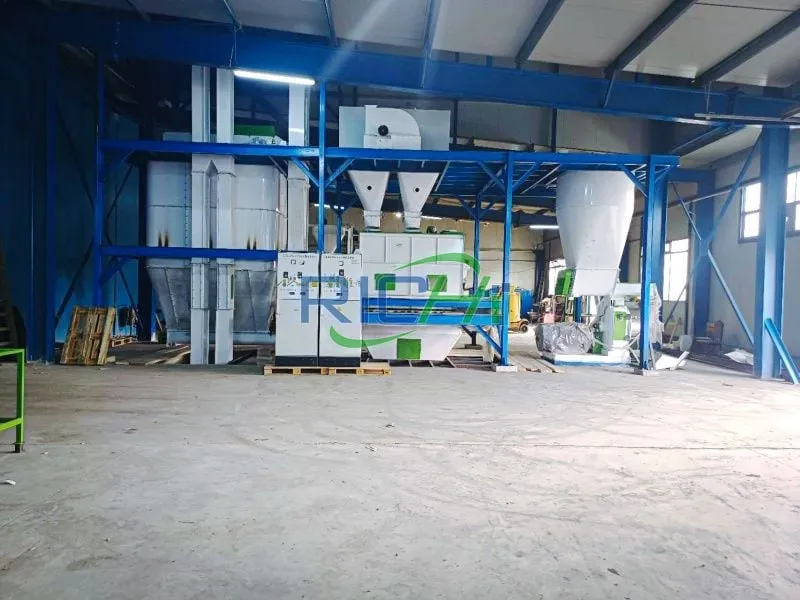
Cumbria, England
3-4T/H wood pellet making machine for sale uk
A family-run biomass fuel supplier, they’d been selling imported wood pellets but wanted to produce their own to cut costs and control quality. They planned to supply local households and small commercial boilers. The owner specifically looked for a wood pellet machine for sale UK that could run continuously without babysitting.
- Raw material: Single material — clean softwood sawdust from local sawmills. Particle size around 3-5mm, moisture content averaging 12-14%, which is pretty ideal.
- Pellet size: 6mm and 8mm diameter, for domestic biomass boilers.
- Complete line equipment: Besides the MZLH768, they bought a drum chipper, hammer mill, rotary dryer, counterflow cooler, vibrating screener, automatic bagging scale, and a dust collection system.
- Process we designed: Material reception → chipping → grinding → drying (if needed) → pelleting → cooling → screening → bagging. We also added a magnetic separator before the pellet mill for sale UK to catch stray metal bits.
- Investment: Around $280,000 USD for the whole line.
- What we provided: Full factory layout, civil works guidance, on-site installation supervision, training for three operators, and a 14-month warranty on main components.

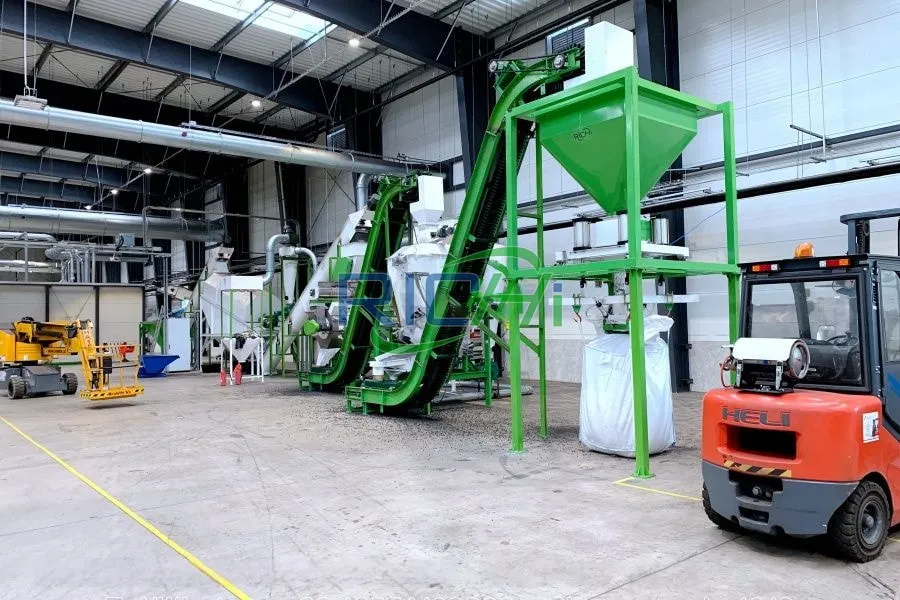
10 t/h cattle feed pellet mill in UK
A medium-sized dairy farm cooperative, they have around 1,200 cows and were tired of buying expensive commercial compound feed. So they want to produce their own high-protein cattle feed year-round. They didn’t just want any pellet mill for sale UK — they needed something robust enough for daily use with high moisture ingredients.
- Raw material: Mixed formulation — barley (40%), wheat middlings (25%), rapeseed meal (20%), molasses (10%), and mineral premix (5%). Incoming grain moisture around 14-15%, but the final mix before pelleting was about 13%.
- Pellet size: 4.5mm and 6mm, depending on whether it’s for calves or adult cows.
- Complete line equipment: SZLH420 pellet mill, two ribbon mixers (1-ton batch each), a hammer mill, a liquid addition system for molasses, a counterflow cooler, a crumbler for making smaller feed for young stock, and a bucket elevator chain.
- Process we designed: Grain receiving → cleaning → grinding → batching → mixing (dry then liquid) → pelleting → cooling → crumbling (optional) → screening → bagging or bulk loadout.
- Investment: Approximately $410,000 USD.
- What we provided: Process flow diagram, equipment layout, steel structure drawings, on-site electrical wiring guidance, and a 10-day training session covering die and roll adjustments.
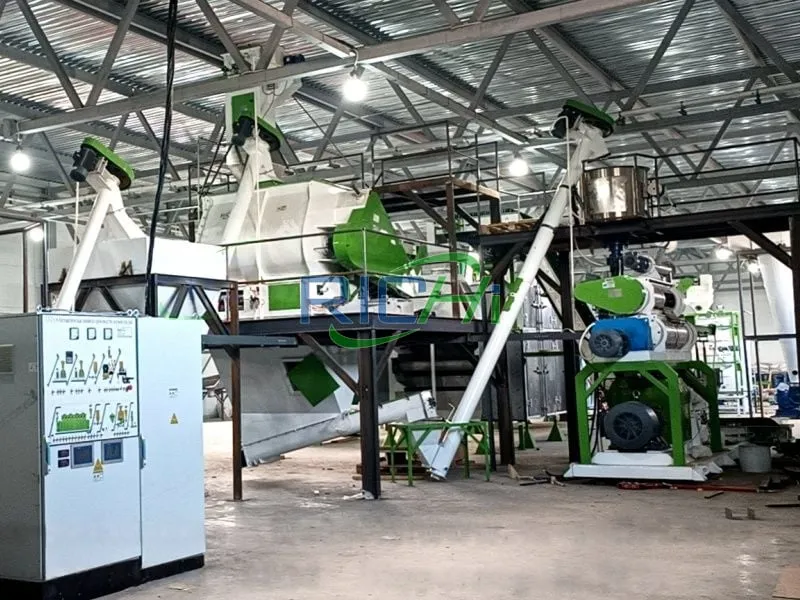
Aberdeenshire, Scotland
Norfolk, England
1.5-2 t h floating fish feed extruder in UK
A specialty aquafeed startup in Norfolk, East of England. They focus on high-end trout and ornamental fish feed. They want to produce floating pellets with good water stability. They’d been looking at used pellet mill for sale UK options but realized extruder technology was the right fit for floating feed.
- Raw material: Fishmeal (25%), soybean meal (20%), wheat flour (18%), corn gluten meal (15%), fish oil (8%), and vitamin premix. Moisture before extrusion around 22-24% (we add steam and water inside the extruder).
- Pellet size: 2mm, 3mm, and 4.5mm floating pellets with adjustable expansion.
- Complete line equipment: Twin-screw extruder SPHS120*2, pre-conditioner, air conveyor for drying, rotary dryer, oil sprayer, screener, and an automatic packing system.
- Process we designed: Raw material grinding → dry mixing → fine grinding → extrusion (with steam/water injection) → drying → oil coating → cooling → sizing → packaging.
- Investment: Around $485,000 USD.
- What we provided: Raw material testing at our lab, recipe optimization, extruder die selection advice, installation supervision, and production troubleshooting support for three months.
5 t/h grass pellet mill for sale UK
A livestock farmer in Pembrokeshire, Wales. They grow ryegrass on about 300 acres and wanted a way to preserve the nutritional value for winter feeding. They want to turn fresh-cut grass into stable pellets that don’t spoil. They needed a grass pellet mill for sale UK that could handle fibrous, slightly damp material without clogging.
- Raw material: Perennial ryegrass, cut and wilted for 24 hours. Particle size uneven — from 20mm to 80mm long pieces. Moisture around 18-20% after wilting.
- Pellet size: 8mm for easy handling and slow intake by cattle.
- Complete line equipment: CZLH678 pellet machine, a bale shredder, a hammer mill with 4mm screen, a rotary dryer (used occasionally when grass is too wet), a cooler, and a bulk storage silo with an auger discharge.
- Process we designed: Grass bale shredding → fine grinding → optional drying (if moisture >18%) → pelleting → cooling → storage. No bagging — they load directly into trailers.
- Investment: Approximately $155,000 USD.
- What we provided: Recommended a specific ring-die channel depth for grass, on-site commissioning, and a 6-month stock of spare rollers.
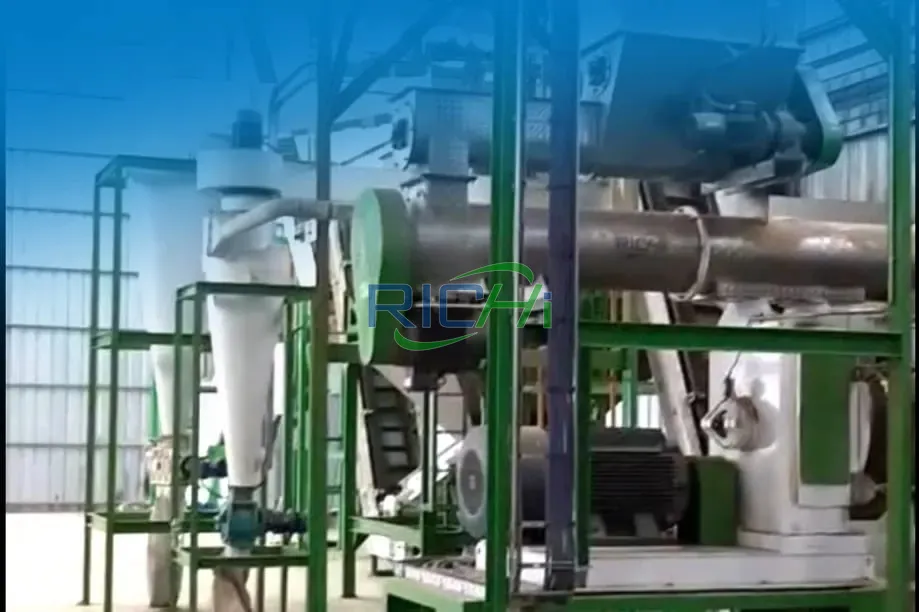
Pembrokeshire, Wales
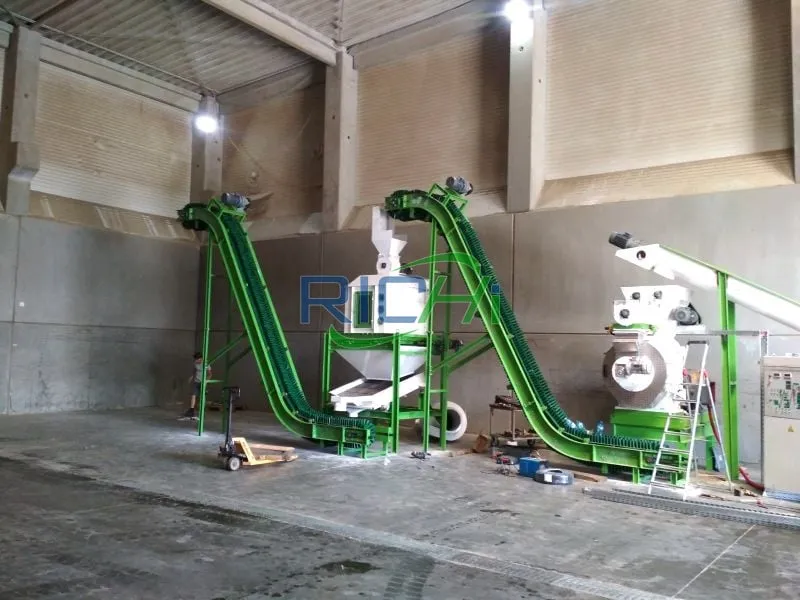
Gloucestershire, England
2 t/h oak pellet machine in UK
A joinery workshop and furniture maker in Gloucestershire, South West England. They generate tons of oak sawdust and shavings as waste. So they want to convert waste into sellable fuel pellets. They originally searched for a small pellet mill for sale UK but realized they needed more power for dense oak material.
- Raw material: Oak sawdust (70%) and planer shavings (30%). Shavings are longer — up to 15-20mm — so we added a regrind step. Moisture in fresh sawdust around 12%, which is fine, but some air-dried material dropped to 8% (too dry, so we added a little water).
- Pellet size: 6mm pellets for residential stoves.
- Complete line equipment: MZLH520 pellet machine, a secondary hammer mill for shavings, a paddle mixer for moisture adjustment (spray water), a cooler, a screener, and a manual bagging station.
- Process we designed: Waste collection → separate grinding for shavings → mixing with sawdust → moisture conditioning → pelleting → cooling → screening → bagging.
- Investment: Around $135,000 USD.
- What we provided: Layout design to fit their existing workshop space (tight fit), training on oak-specific die maintenance, and a follow-up video call two months after startup.
5 t/h pig feed pellet machine in UK
An independent pig finisher in East Yorkshire, England. They raise about 8,000 pigs annually. They want to produce customized grower and finisher pellets. They wanted a pellet making machine UK supplier who could help with steam conditioning because raw meal tends to be dusty.
- Raw material: Wheat (50%), barley (20%), soybean meal (22%), wheat midds (5%), and a custom mineral/vitamin premix (3%). Moisture around 13.5% before conditioning. Particle size ground to 2.5mm through a fine-screen hammer mill.
- Pellet size: 3.5mm for growers, 4.5mm for finishers.
- Complete line equipment: SZLH350 pellet mill, a steam boiler (150kg/h), a ribbon mixer, a hammer mill, a crumbler for some batches, a cooler, and a bagging scale with a sewing machine.
- Process we designed: Raw material intake → cleaning → grinding → batching → mixing → steam conditioning (85°C) → pelleting → cooling → crumbling (optional) → packing.
- Investment: Approximately $195,000 USD.
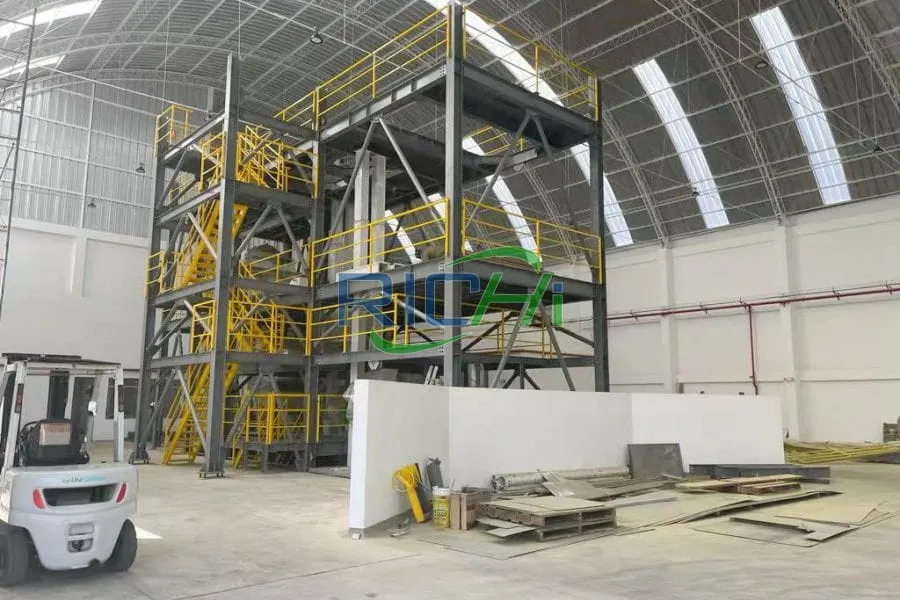
East Yorkshire, England
Somerset, England
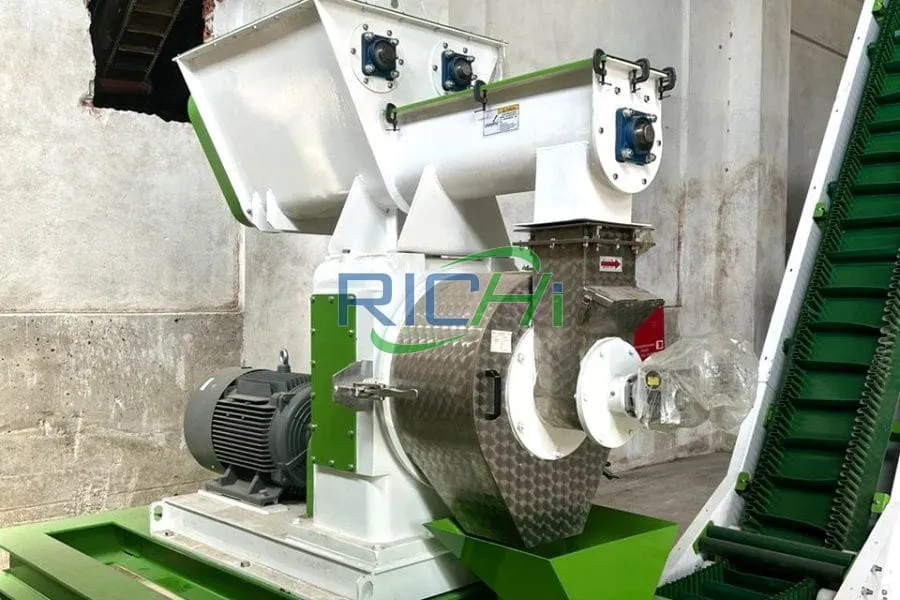
15 t/h cattle manure pellet press in UK
A large dairy operation in Somerset, South West England, with over 2,500 cows. They want to process fresh manure into organic fertilizer pellets for sale to local farms and gardens. They needed a pellet press for sale UK that could handle wet, sticky material without constant clogging.
- Raw material: Dairy cattle manure, collected from barns with some straw bedding mixed in (about 15% straw). As-received moisture around 70-75%. We added a solid-liquid separator and a rotary dryer to bring it down to 14-16% before pelleting.
- Pellet size: 6mm fertilizer pellets.
- Complete line equipment: FZLH520 pellet press, solid-liquid separator, rotary dryer, hammer mill for dried manure, mixer, cooler, screener, and a bulk bagging hopper.
- Process we designed: Manure collection → separation (liquid goes to lagoon, solids to drying) → drying (250°C inlet air) → grinding → pelleting → cooling → screening → bagging or bulk.
- Investment: Around $450,000 USD (the dryer was a big chunk).
- What we provided: Complete process engineering, odor control suggestions (enclosed conveyors), UK-sourced electrical panel compliance, and six months of remote technical support.
8 t/h hay pellet machine in UK
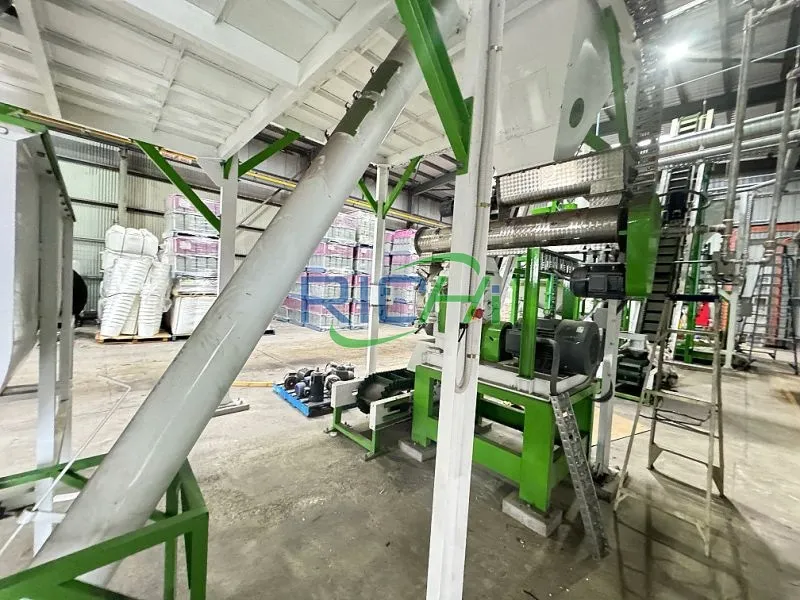
A mixed arable and livestock farm in North Yorkshire, England. They grow their own hay for sheep and wanted to reduce storage space and waste. They want to turn baled hay into dense pellets that are easier to store and feed. They looked at various wood pellet machine uk suppliers but needed something configured for long-fiber hay.
- Raw material: Timothy and clover hay, baled and stored for 4-6 months. Moisture around 12-14% — good for direct pelleting. Fiber length originally up to 100mm, so we added a coarse grinder.
- Pellet size: 10mm, mainly for sheep feeders.
- Complete line equipment: CZLH768 pellet machine, a bale de-baler, a coarse grinder, a hammer mill with 6mm screen, a cooler, and a screw conveyor feeding a bulk bin.
- Process we designed: Hay bales → de-baling → coarse grinding → fine hammer milling → pelleting → cooling → bulk storage.
- Investment: Approximately $260,000 USD.
- What we provided: Roll shell and die selection for fibrous hay, on-site startup assistance, and a detailed maintenance schedule.
North Yorkshire, England
West Midlands, England
2 t/h waste paper pellet press in UK
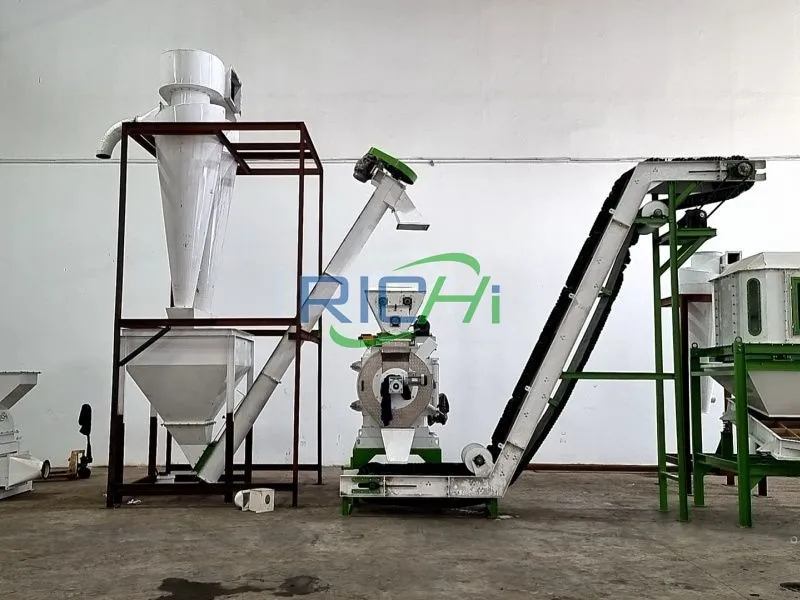
A commercial recycling company in West Midlands, England. They collect office paper and cardboard from local businesses. They want to turn waste paper into pellets for cat litters and industrial biomass boilers. They searched for a pellet making machine uk that could handle paper without burning or jamming.
- Raw material: Mixed office paper (70%) and corrugated cardboard (30%). Shredded to 20-30mm strips. Moisture around 8-10% — too dry actually, so we added water in a paddle mixer to reach 15% before pelleting.
- Pellet size: 3-8mm pellets.
- Complete line equipment: MZLH520 pellet press, a cross-cut shredder, a paddle mixer with water injection, a cooler (paper pellets come out hot), a screener, and an automatic bagger.
- Process we designed: Paper collection → shredding → moisture conditioning (spray water) → pelleting → cooling → screening → bagging.
- Investment: Around $155,000 USD.
500kg/h flax straw pellet machine in UK
A small-scale industrial hemp and flax grower in County Down, Northern Ireland. They want to process flax straw left after fiber extraction into animal bedding pellets. They needed a small pellet mill for sale UK that wouldn’t break the bank but could still handle tough, stringy straw.
- Raw material: Flax straw, chopped to 15-25mm, with some residual fiber. Moisture around 11% after field drying.
- Pellet size: 6mm pellets for poultry bedding.
- Complete line equipment: CZLH320 pellet machine, a hammer mill with 4mm screen, a small ribbon mixer (500kg/batch), a cooler, and a manual bagging frame.
- Process we designed: Straw bales → chopping → hammer milling → pelleting → cooling → bagging (25kg paper bags).
- Investment: Approximately $68,000 USD — one of our smaller but effective setups.
- What we provided:** Die recommendation (compression ratio 1:5 for flax), installation guidance via video call, and a basic spare parts kit.

County Down, Northern Ireland
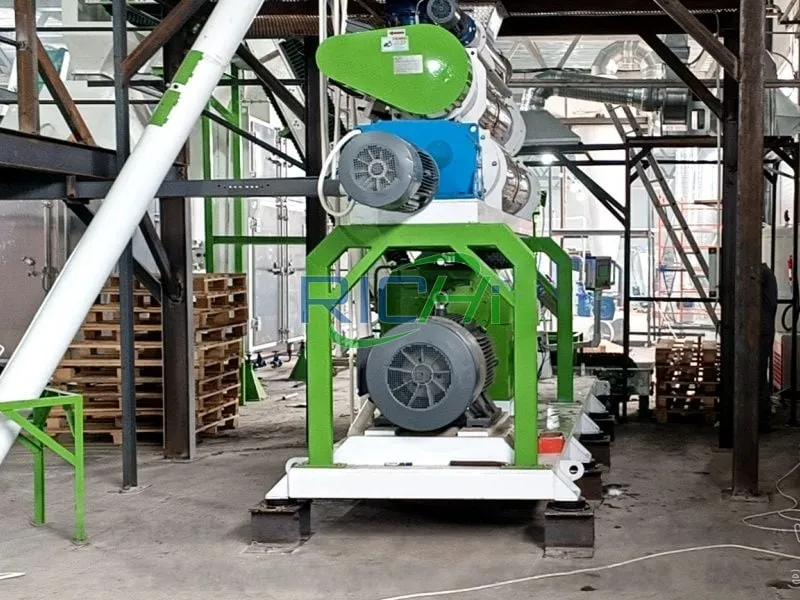
Leicestershire, England
1-2 t /h pet food extruder machine in UK
A mid-sized pet treat manufacturer in Leicestershire, East Midlands, England. They want to produce dry expanded dog and cat food kibble. They’d been using a contracted extruder but wanted in-house control over recipes and quality. They looked for a pellet machine for sale uk that could also handle extrusion — we explained the difference and sold them an extruder.
- Raw material: Chicken meal (22%), rice flour (20%), corn (15%), wheat gluten (10%), poultry fat (8%), beet pulp (5%), and vitamin premix. Moisture before extrusion around 20% after conditioning.
- Pellet size: Various — 5mm round kibble for cats, 8-12mm shapes for dogs (using different die plates).
- Complete line equipment: SPHS150*2 twin-screw extruder, preconditioner, belt dryer, oil spray drum, screener, and a seasoning applicator.
- Process we designed: Raw material grinding → dry mixing → extrusion (with steam/water injection) → drying (to 8% moisture) → oil coating → cooling → seasoning (optional) → packing.
- Investment: Around $320,000 USD.
- What we provided: Recipe consultation, screw and die configuration for different kibble sizes, on-site commissioning for two weeks, and operator manuals with troubleshooting sections.
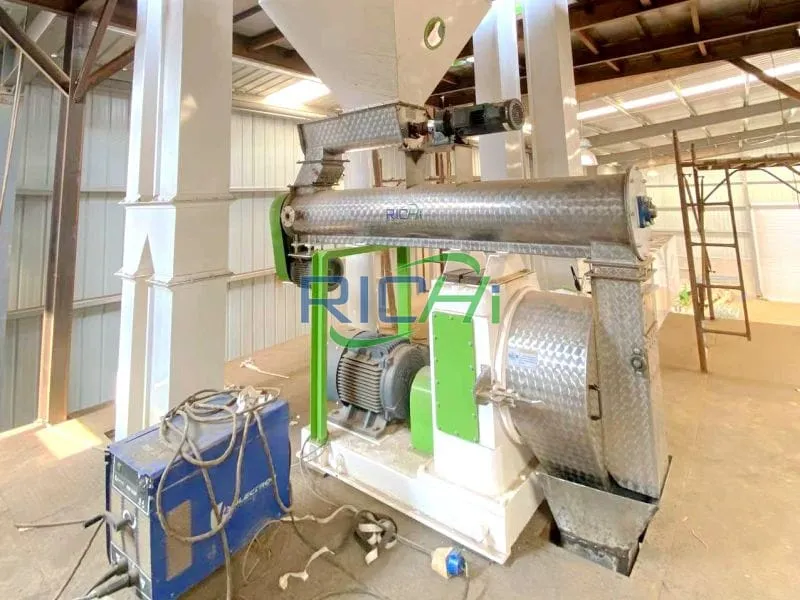
5-6 t/h bentonite cat litter pellet machine in UK
An industrial mineral processing company in Surrey, South East England. They want to produce clumping cat litter pellets from bentonite clay. They originally looked at a wood pellet machine for sale uk but needed a specialized mill for abrasive mineral material.
- Raw material: Sodium bentonite powder (100%), particle size 200 mesh (very fine). Moisture around 10% as received — we added a small amount of water in a mixer to reach 14% before pelleting for better binding.
- Pellet size: 2-4mm cylindrical pellets, then tumbled slightly to round edges.
- Complete line equipment: MSZLH350 pellet mill (heavy-duty mineral version with wear-resistant alloy die), a paddle mixer with water addition, a rotary dryer, a tumbler for edge rounding, a screener, and a bagging machine.
- Process we designed: Bentonite powder → moisture conditioning → pelleting (very gentle compression) → drying (to 8%) → tumbling → screening → bagging.
- Investment: Approximately $230,000 USD (higher due to abrasion-resistant materials).
- What we provided: Special alloy die and roll shells, lubrication schedule for mineral applications, on-site training for operators, and a dust control system recommendation.
Surrey, England
More UK Installations
Beyond the bigger named projects, we’ve quietly supplied a lot of other lines across Britain. Some are small farm-scale setups, others are proper industrial factories. The common thread? Each customer needed a reliable pellet machine for sale UK that actually works with their specific material — whether that’s poultry litter, clover, miscanthus, or even RDF. Here’s a look at the rest of our UK project list.
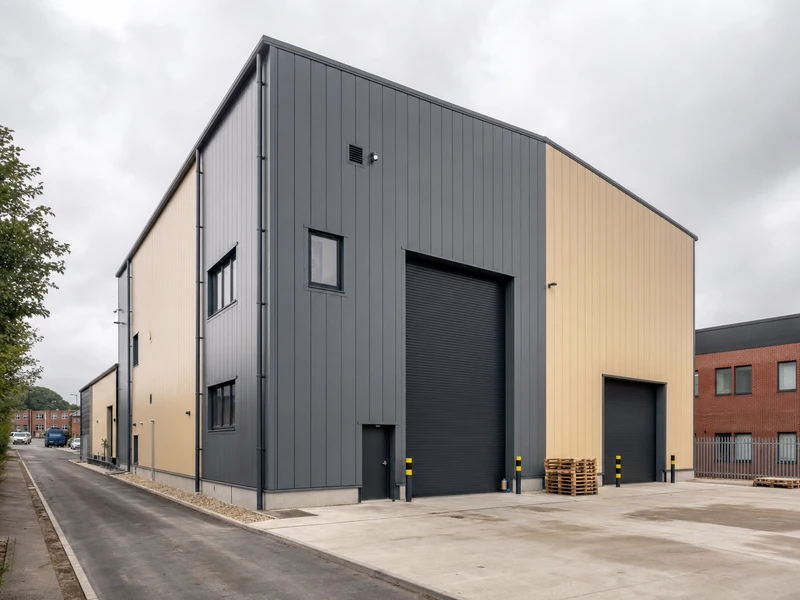
2-3 t/h complete pet food production line in UK
A small pet food brand in Kent wanted to stop outsourcing their kibble production. They approached us looking for a pellet machine for sale UK but quickly realized they needed an extruder-based line for proper expansion. The extruder here acts as the heart of the line, cooking and shaping the dough into uniform kibble. We supplied everything from the grinder to the coater.
Model
SPHS100*2
Pellet Size
5mm and 9mm
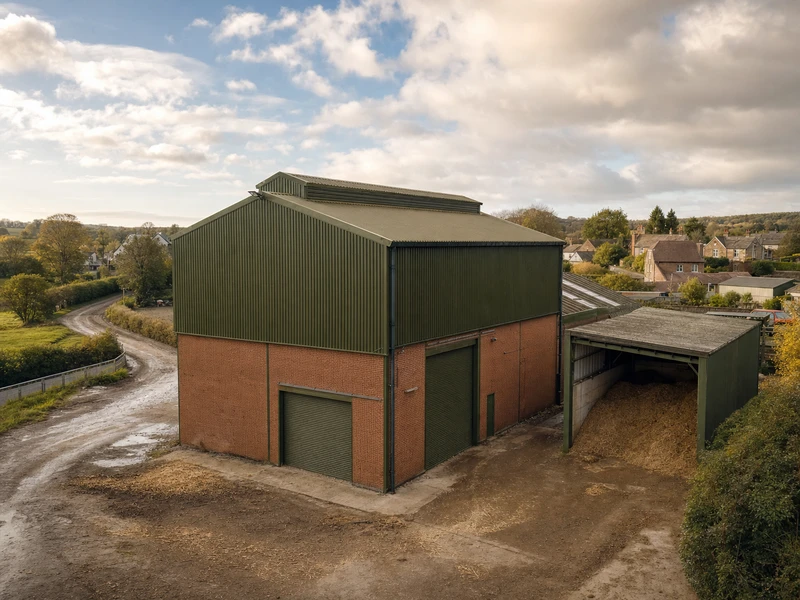
3-5 t/h chicken litter pellet plant in UK
A poultry farm in Norfolk with 200,000 birds faced a mounting waste problem. They needed a pellet machine for sale UK that could handle sticky, high-nitrogen litter without binding the die. We installed a complete plant where the pellet mill compresses dried litter into slow-release fertiliser pellets. The line includes a dryer, hammer mill, and cooler to manage the challenging raw material.
Model
FZLH420
Pellet Size
6mm
6-8 t/h complete cat litter production line in UK
An industrial mineral processor in Leicestershire wanted to enter the premium cat litter market. After searching for a pellet making machine uk that could handle bentonite clay, they chose our heavy-duty mineral mill. The pellet press compacts fine clay powder into durable, low-dust pellets that clump well. We added a tumbler to round off the sharp edges before bagging.
Model
MSZLH420
Pellet Size
2.5mm
3-5 t/h organic fertiliser pellet line in UK
An organic farm cooperative in Devon needed to turn composted green waste into saleable fertiliser. They found a used pellet mill for sale uk from another supplier but it failed within weeks. We replaced it with a new ring-die mill that handles fibrous compost smoothly. The pelletiser compresses the material at low temperature to preserve beneficial microbes. A cooler and screener complete the line.
Model
FZLH350
Pellet Size
5mm
12-15 t/h biomass pellet plant in UK
A renewable energy company in Yorkshire built a large plant to supply industrial boilers. They required a pellet machine for sale uk with serious throughput capacity for softwood sawdust. Our MZLH768 runs 24/7 with automated lubrication and a heavy-duty gearbox. The plant includes a 3-ton hammer mill, a rotary dryer, and four cooling towers to handle the volume.
Model
MZLH768
Pellet Size
8 mm
15-20 t/h dairy feed pellet factory in UK
A large dairy cooperative in Cheshire decided to produce their own compound feed for 5,000 cows. They wanted a pellet mill for sale uk that could handle high molasses inclusion without blocking the die. Our SZLH508 runs with steam conditioning and a special anti-blocking die design. The factory includes hammer mills, ribbon blenders, a liquid addition system, and bulk loadout bins.
Model
SZLH508
Pellet Size
5mm
8-12 t/h sheep feed pellet production line in UK
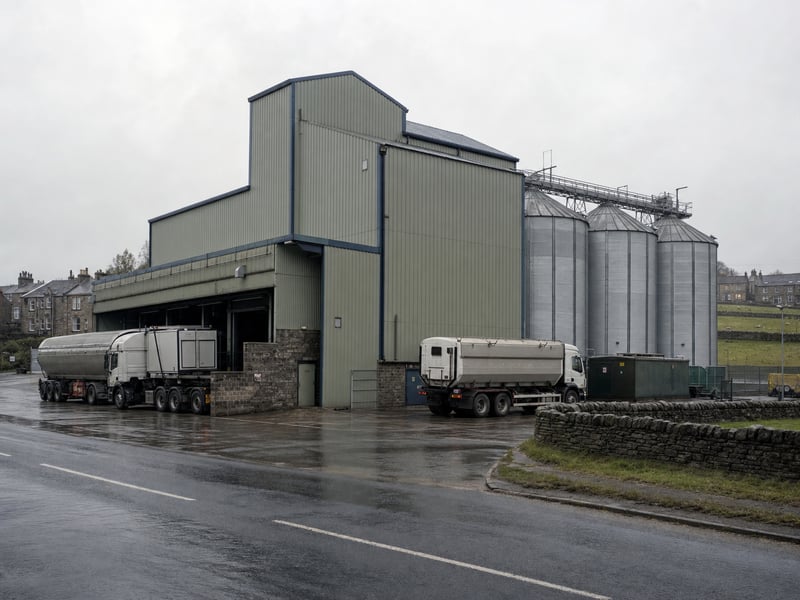
A sheep farming group in the Welsh borders needed a cost-effective way to pellet home-grown barley and beans. They searched for a pellet making machine uk that could handle fibrous straw inclusion up to 15%. Our CZLH768 runs with a heavier roll shell design for abrasive feeds. The line includes a grinder, mixer, and cooler, plus a crumbler for lamb feed.
Model
CZLH768
Pellet Size
4–6 mm
2-4 t/h clover pellet production line in UK
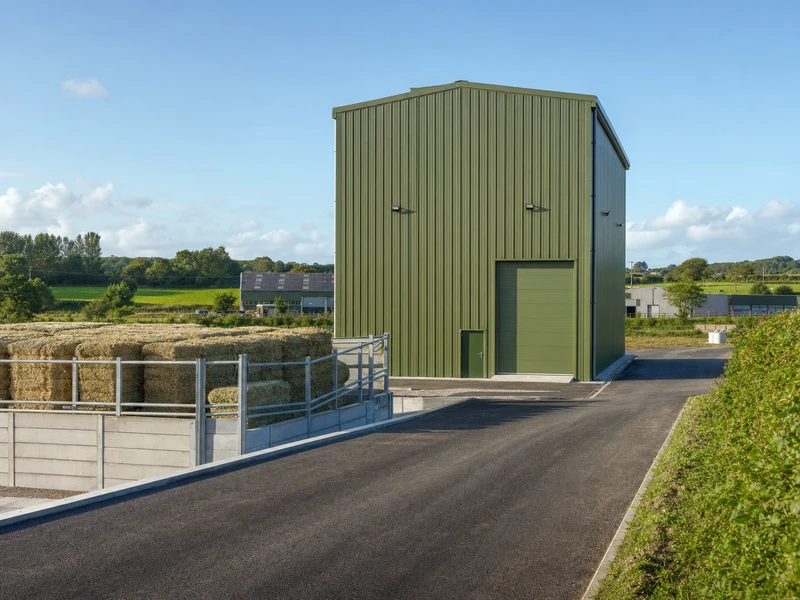
An organic livestock farmer in Shropshire grows red clover for soil improvement but wanted to sell the surplus as high-protein feed. He needed a small pellet mill for sale uk that could handle leafy, low-fibre clover. Our CZLH320 runs at lower speed to preserve leaf content. The system includes a bale shredder, hammer mill, and a small bagging station.
Model
CZLH320
Pellet Size
6mm
15-20 t/h industrial wood pellet factory in UK
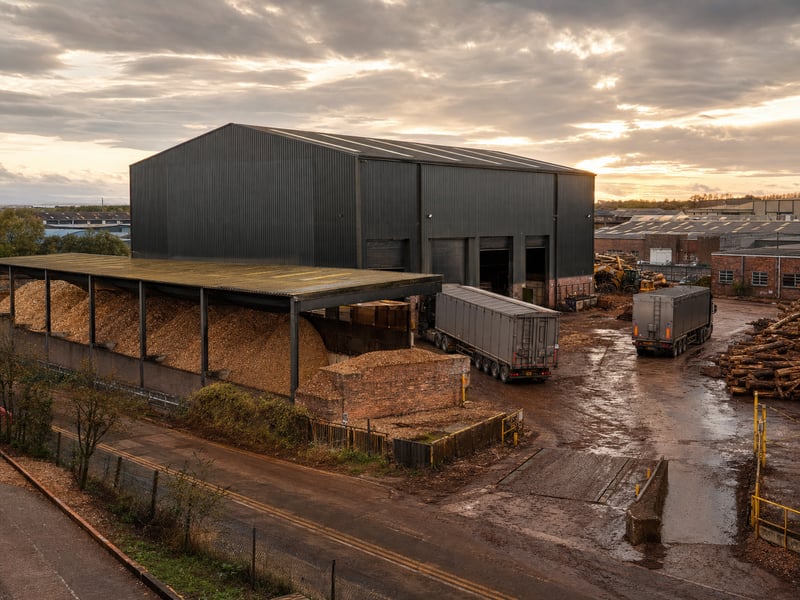
A forestry group in Scotland built a sawmill and wanted to pelletise the residual sawdust and shavings. They looked for a wood pellet machine for sale uk capable of processing mixed softwood species. Our MZLH768 runs with an intelligent feeder system that adjusts to moisture changes. The factory includes a drum chipper, hammer mill, rotary dryer, and a pellet silo for bulk loading.
Model
MZLH768
Pellet Size
6- 8mm
5-10 t/h turnkey pellet plant in UK
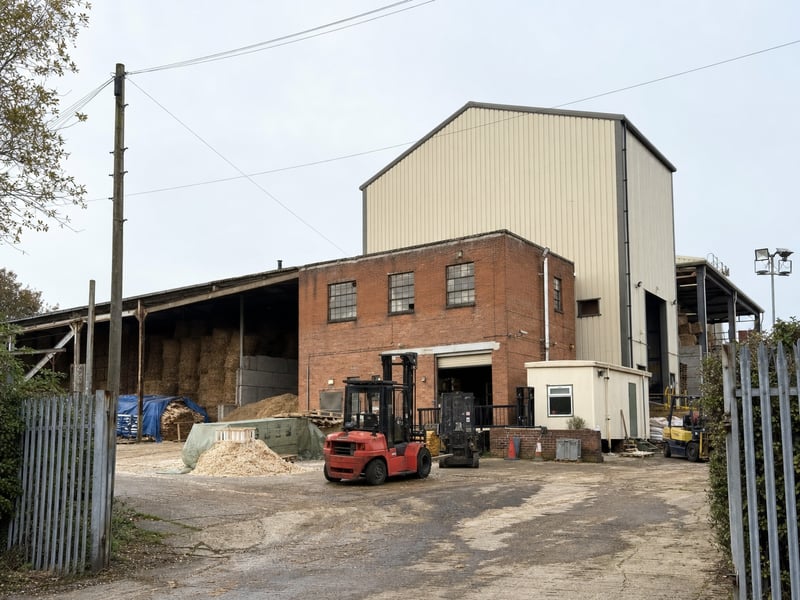
A waste management firm in the West Midlands wanted a flexible line to process various biomass streams. They purchased a pellet machine for sale uk as part of a turnkey plant we designed for multiple feedstocks. The pellet mill is mounted on a moveable frame to service different pre-processing lines. We supplied everything from the shredder to the automatic bagging scale.
Model
MZLH768
Pellet Size
6mm
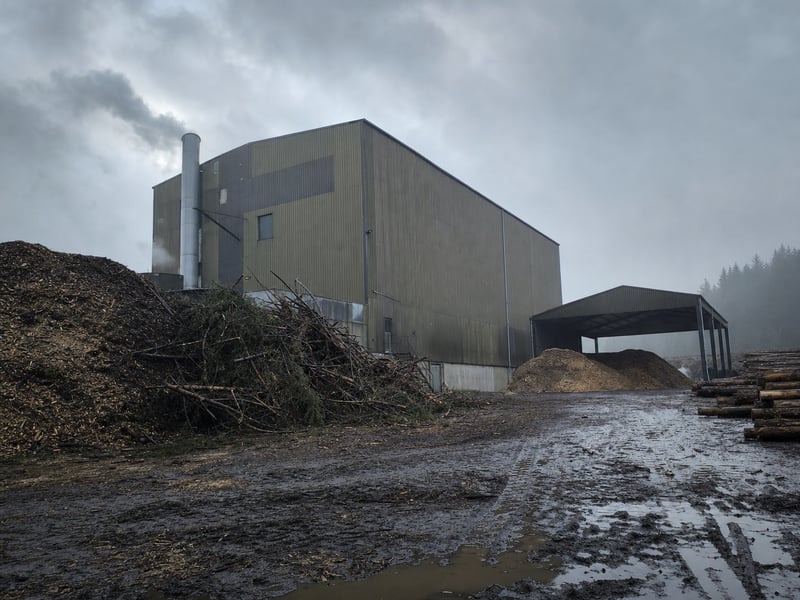
10-12 t/h forestry residue pellet plant in UK
A timber harvesting cooperative in Northumberland wanted to monetise branches, tops, and bark. They needed a wood pellet mill for sale uk that could handle higher ash content and occasional dirt. Our MZLH768 runs with a heavy-duty feeder and abrasion-resistant die. The plant includes a trommel screen to remove stones, a hammer mill, dryer, and a cooler.
Model
MZLH768
Pellet Size
8mm
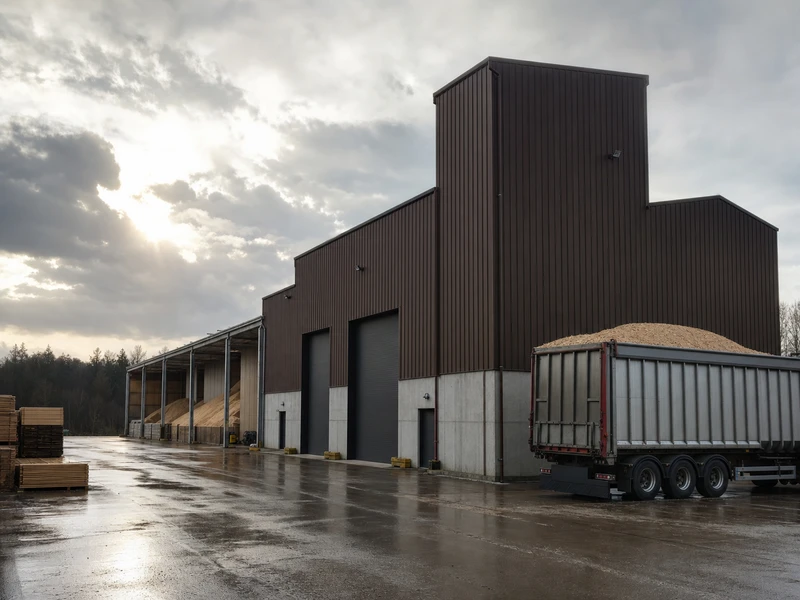
5-8 t/h sawdust pellet production line in UK
A furniture manufacturer in Lancashire generates hundreds of tonnes of fine sawdust annually. They searched for a pellet press for sale uk that could run on dust without pre-grinding. Our MZLH520 works efficiently with fine particles straight from their extraction system. The line includes a buffer bin, pellet mill, counterflow cooler, and a manual bagging station for 15kg bags.
Model
MZLH520
Pellet Size
6mm
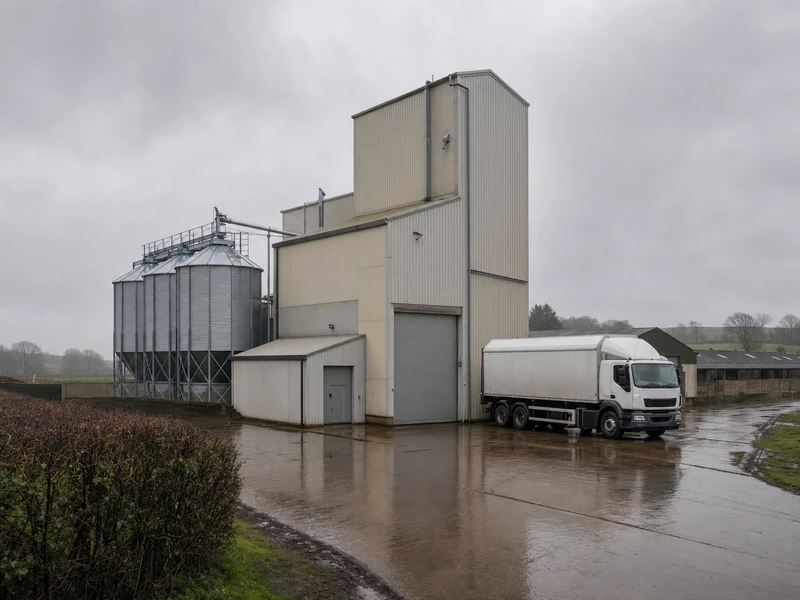
4-6 t/h hog feed pelleting line in UK
A family pig farm in Suffolk expanded to 3,000 finishers and needed better feed conversion. They wanted a pellet machine uk supplier who could integrate steam conditioning into a simple layout. Our SZLH350 runs with a 150kg/h boiler and a single ribbon mixer. The pelleting line includes a hammer mill, vertical cooler, and a small bagging hopper for farm use.
Model
SZLH350
Pellet Size
4.5mm
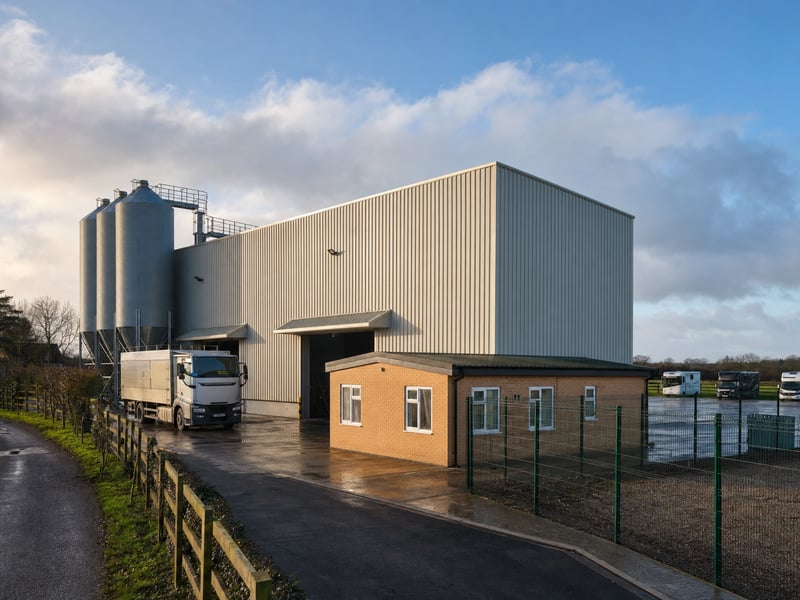
6-8 t/h equine feed pellet plant in UK
An equestrian feed brand in Gloucestershire wanted to produce molasses-free performance pellets for racehorses. They needed a pellet mill for sale uk that could handle oil-rich ingredients like linseed and soya. Our CZLH678 runs with a steam conditioner to bind oily meals without crumbling. The plant includes a fine grinder, paddle mixer, cooler, and a dust collection system.
Model
CZLH678
Pellet Size
5mm
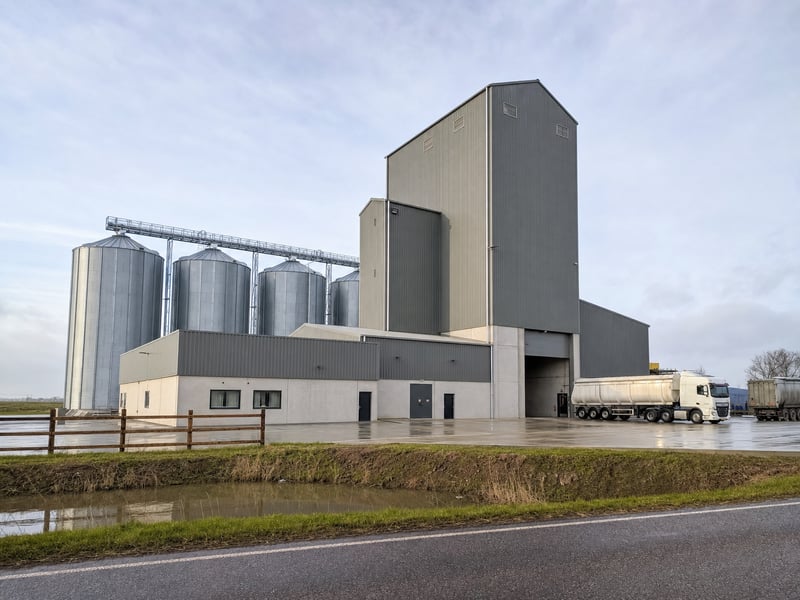
12-15 t/h goose feed pellet production system in UK
A waterfowl farm in Lincolnshire with 50,000 geese needed a high-volume feed line. They looked for a pellet making machine uk that could produce a floating pellet for pond feeding. Our SZLH420 with a special die creates pellets that stay afloat for 30 minutes. The system includes a hammer mill, ribbon mixer, steam boiler, cooler, and crumbler for goslings.
Model
SZLH420
Pellet Size
4mm
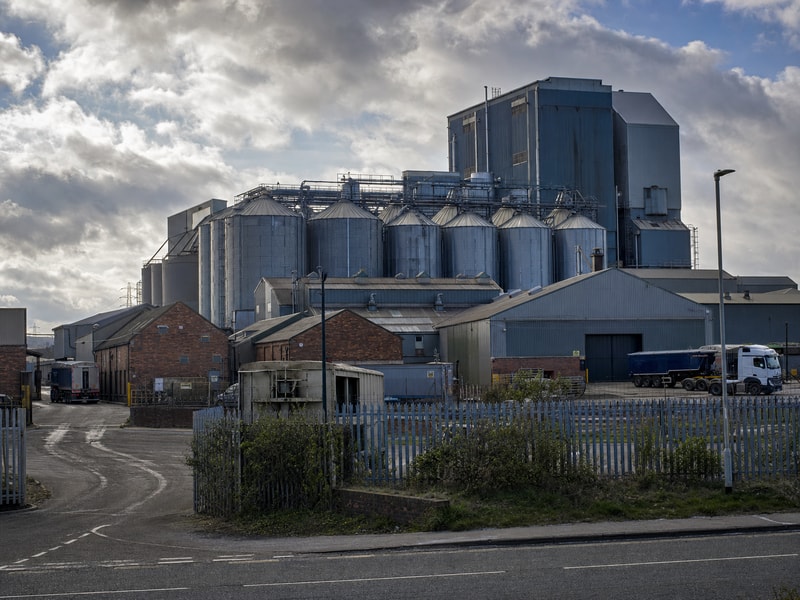
25-30 t/h ruminant feed pellet factory in UK
A major agricultural cooperative in East Anglia consolidated three old mills into one mega-factory. They required a pellet mill for sale uk with the highest available throughput for cattle and sheep feed. Our SZLH850 twin-drive mill runs at 250kW and includes automated die lubrication. The factory features two hammer mills, four ribbon mixers, a liquid addition system, and rail loadout.
Model
SZLH678
Pellet Size
5–6 mm
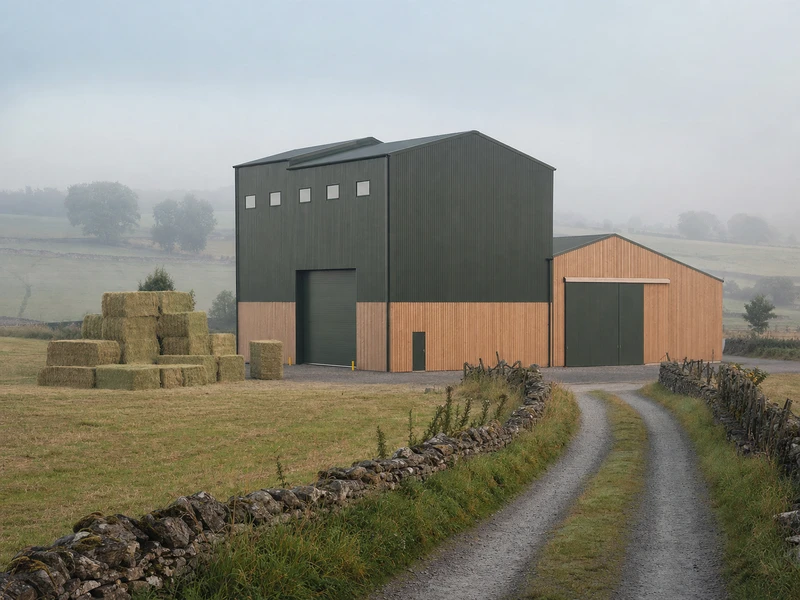
500 kg/h Timothy grass pellet plant in UK
A small horse hay producer in Herefordshire wanted to pelletise Timothy grass for a niche equine market. He searched for a small pellet mill for sale uk that could handle long-cut, dry grass without pre-grinding. Our CZLH320 runs with a special intake auger for fibrous forage. The plant includes a bale shredder, pellet mill, cooler, and a 25kg bagging frame.
Model
CZLH320
Pellet Size
8mm
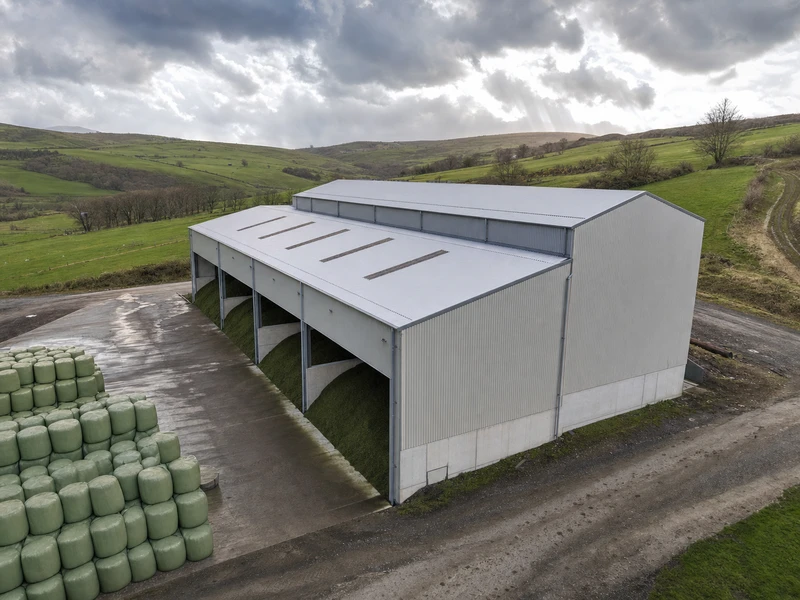
6-8 t/h ryegrass pellet system in UK
A forage company in Cornwall grows ryegrass for anaerobic digestion but wanted a secondary product line. They needed a pellet machine uk that could process high-moisture wilted grass. Our CZLH678 runs with a forced feeder to push sticky grass through the die. The system includes a mower-conditioner, bale shredder, low-temperature dryer, pellet mill, and cooler.
Model
CZLH678
Pellet Size
8mm
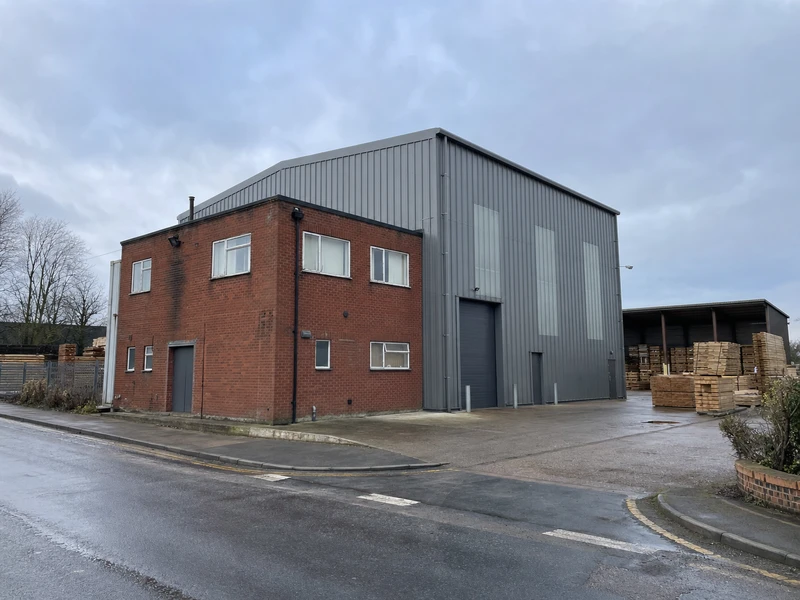
800 kg/h untreated timber pellet system in UK
A small joinery shop in Cumbria generates clean offcuts and shavings from untreated European oak and ash. They looked for a wood pellet making machine for sale uk sized for a small workshop. Our MZLH350 fits in a 20-foot container and runs on single-phase power. The system includes a small hammer mill, pellet mill, and a simple bucket elevator to a storage bin.
Model
MZLH350
Pellet Size
6mm
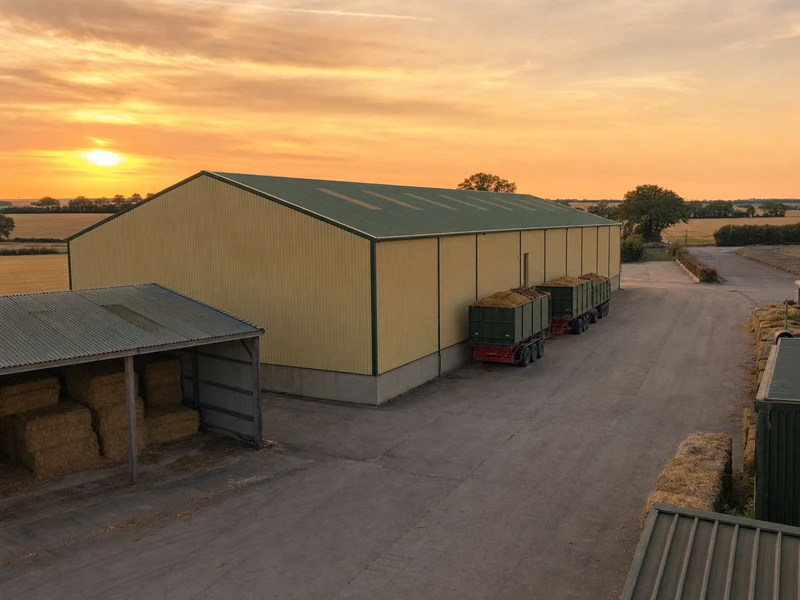
4-6 t/h barley straw pellet plant in UK
An arable farmer in East Lothian, Scotland, grows 500 acres of barley and wanted to pellet the straw. He needed a pellet press for sale uk that could handle the high silica content without wearing out dies every month. Our CZLH678 runs with a tungsten-carbide die that lasts three times longer. The plant includes a bale shredder, hammer mill, pellet press, and a bulk loader.
Model
CZLH678
Pellet Size
8mm
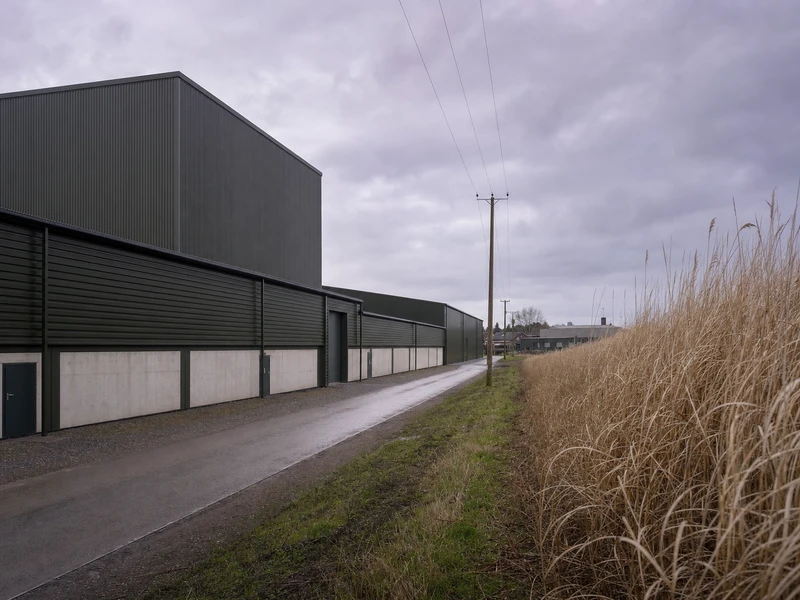
3-4 t/h miscanthus pellet production line in UK
A bioenergy crop grower in Yorkshire planted 200 acres of miscanthus and needed a way to densify it. They searched for a pellet making machine uk that could handle the long glass-like fibres without wrapping around the rolls. Our CZLH678 with a custom roll design and a cutter at the die face works perfectly. The line includes a tub grinder, pellet mill, cooler, and a bale press.
Model
CZLH678
Pellet Size
6mm
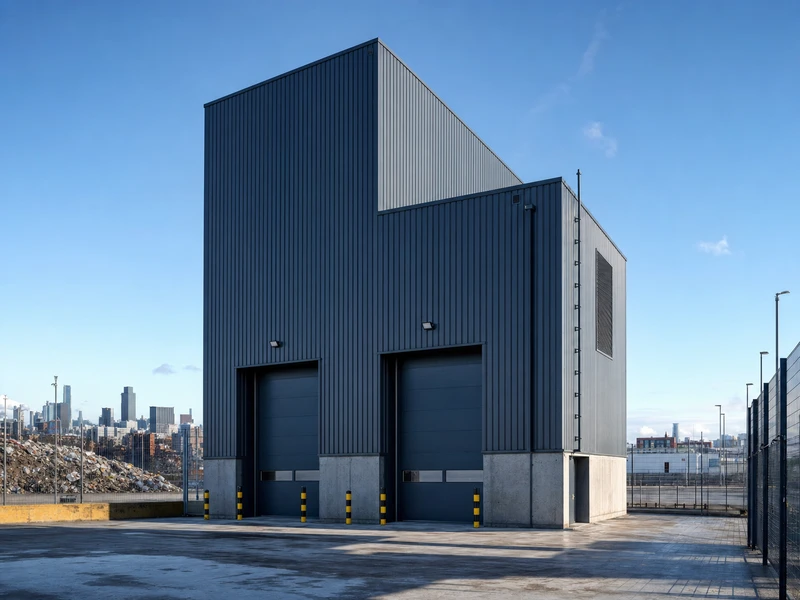
500 kg/h RDF pellet production line in UK
A waste processing start-up in Bristol wanted to turn household refuse into fuel pellets. They needed a pellet machine for sale uk that could handle mixed plastics, paper, and textiles. Our heavy-duty FZLH350 runs with a heated die to soften plastics for binding. The line includes a shredder, magnetic separator, air classifier, pellet mill, and a cooling conveyor.
Model
MZLH350
Pellet Size
10mm
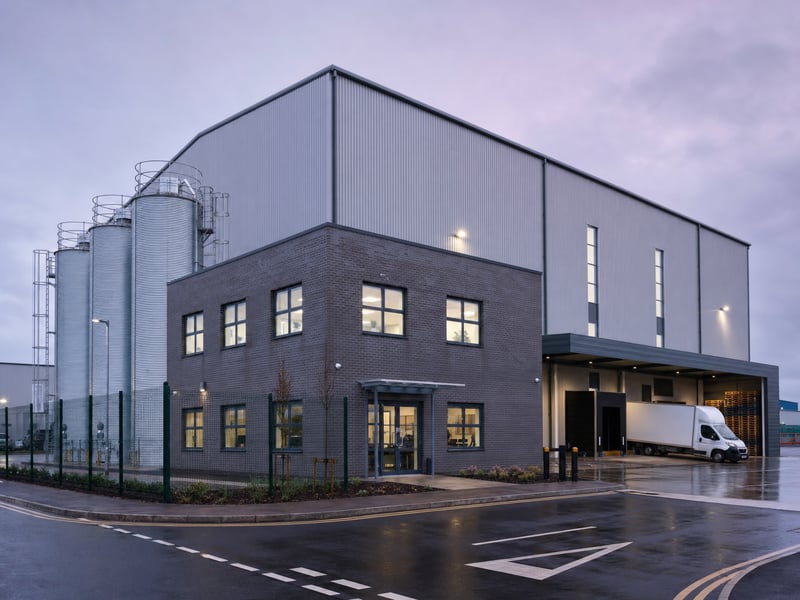
800-1000 kg/h dog food processing line in UK
A boutique dog treat company in Brighton wanted to produce small-batch air-dried kibble. They looked for a pellet machine for sale uk but learned they needed an extruder for proper cooking. Our SPHS90*2 twin-screw extruder cooks at 120°C and shapes the dough into bone-shaped pieces. The line includes a grinder, mixer, extruder, belt dryer, and a coating drum.
Model
SPHS75*2
Pellet Size
5-12mm
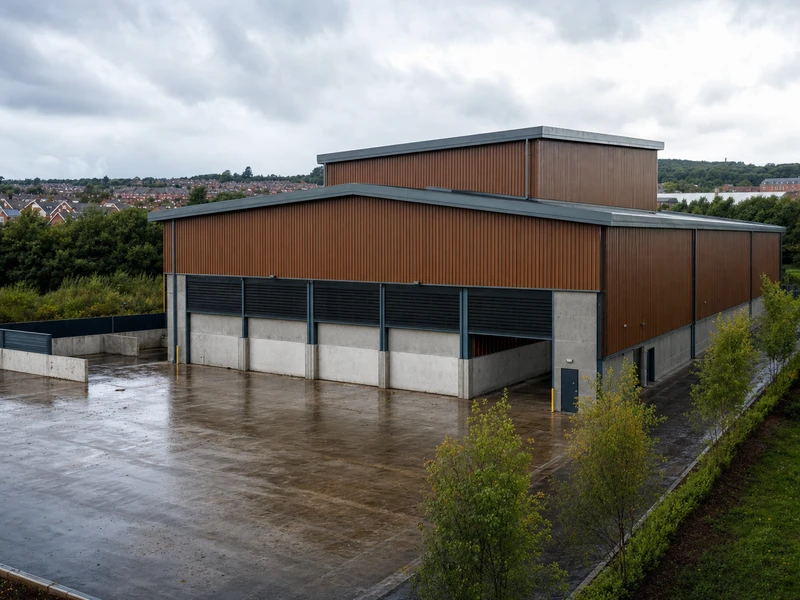
1-2 t/h compost pellet plant in UK
A municipal composting facility in Hampshire had too much fine compost and not enough market. They purchased a pellet machine for sale uk to turn screened compost into easy-to-spread lawn fertiliser pellets. The pellet mill compresses the material at low pressure to avoid killing beneficial fungi. The line includes a screener, paddle mixer, pellet mill, and a small bagging hopper.
Model
FZLH250
Pellet Size
5mm
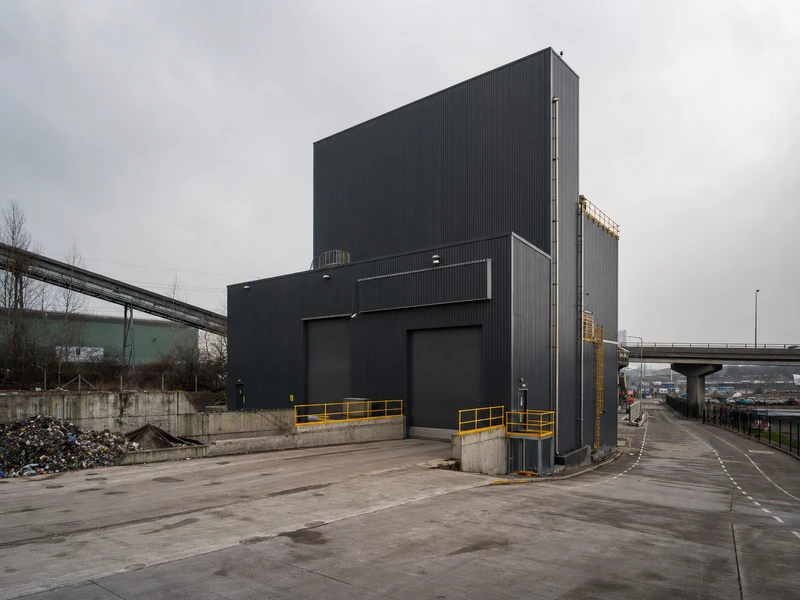
2-3 t/h refused derived fuel pellet plant in UK
A recycling centre in Merseyside wanted to upgrade from selling RDF fluff to producing densified fuel pellets. They needed a pellet press for sale uk that could handle inconsistent feedstock with high plastic content. Our MZLH678 runs with a hydraulic feeder that senses motor load and adjusts speed. The line includes a shredder, magnet, air separator, pellet press, and a long cooling conveyor.
Model
MZLH678
Pellet Size
12mm
See Our UK Project Videos
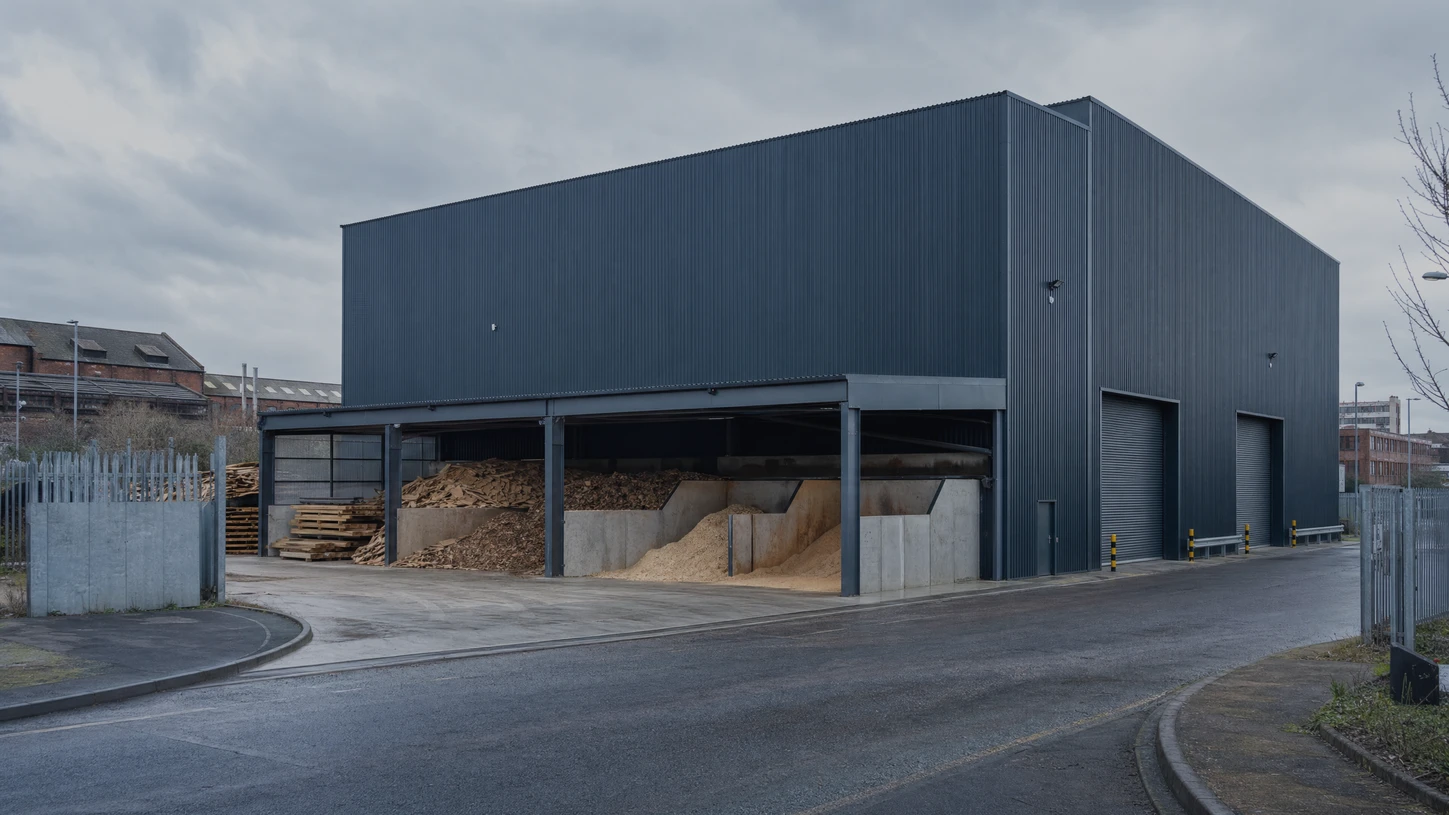
2-3T/H Wood Waste Pellet Line in UK
A joinery in Somerset was dumping pallet offcuts and MDF trims into a skip every week. We designed a compact line around our MZLH520 ring die pellet mill in UK configuration. The footage shows the hammer mill chewing up 30mm wood chunks, then the pellet press forming 6mm fuel pellets. Moisture runs around 12% straight from their dry storage. You’ll see the whole process from shredder to bagging hopper.
5T/H Alfalfa Pellet Plant in UK
A forage grower in Herefordshire needed to turn third-cut alfalfa into high-protein horse feed. This video follows our CZLH678 pellet machine for sale UK setup running at 4.8 tons per hour. The alfalfa enters at 14% moisture after field wilting, gets ground through a 4mm screen, then conditioned with steam before pelleting. Final pellets are 8mm and stable for 12 months. The cooler discharge is surprisingly dusty — that’s normal.
1T/H Tofu Cat Litter Pellet Plant in UK
A vegan cat litter startup in Bristol uses dried okara (tofu pulp) from a local tofu maker. The video highlights our MZLH350 pelletizing machine in UK operation with this unusual feedstock. The material comes in at 65% moisture — we run it through a paddle dryer first, then the pellet mill compresses the fibre into 3mm clumping pellets. Watch how the extruded pellets snap cleanly at the die face without crumbling.
5T/H Floating Fish Feed Plant in UK
A trout farm in North Yorkshire wanted to stop importing floating feed from Denmark. This video shows our SPHS120 twin-screw extruder as the core of a complete feed production line in UK. The extruder cooks the meal at 130°C, expands it, and cuts 4.5mm floating pellets that stay up for over an hour. You’ll see the post-extrusion drying step — pellets tumble through a rotary dryer before oil coating. The whole line fits in a 300sqm building.
2T/H Pet Food Production Plant in UK
A private-label pet food maker in Cambridgeshire runs small batches of grain-free kibble. The video focuses on our SPHS100 extruder and the downstream oil sprayer. Unlike a standard pellet mill for sale UK, this extruder uses steam and pressure to cook the dough — no external boiler needed. The line produces 8mm round kibble for adult dogs and 5mm triangles for cats. Watch the belt dryer’s variable speed adjustment in real time.
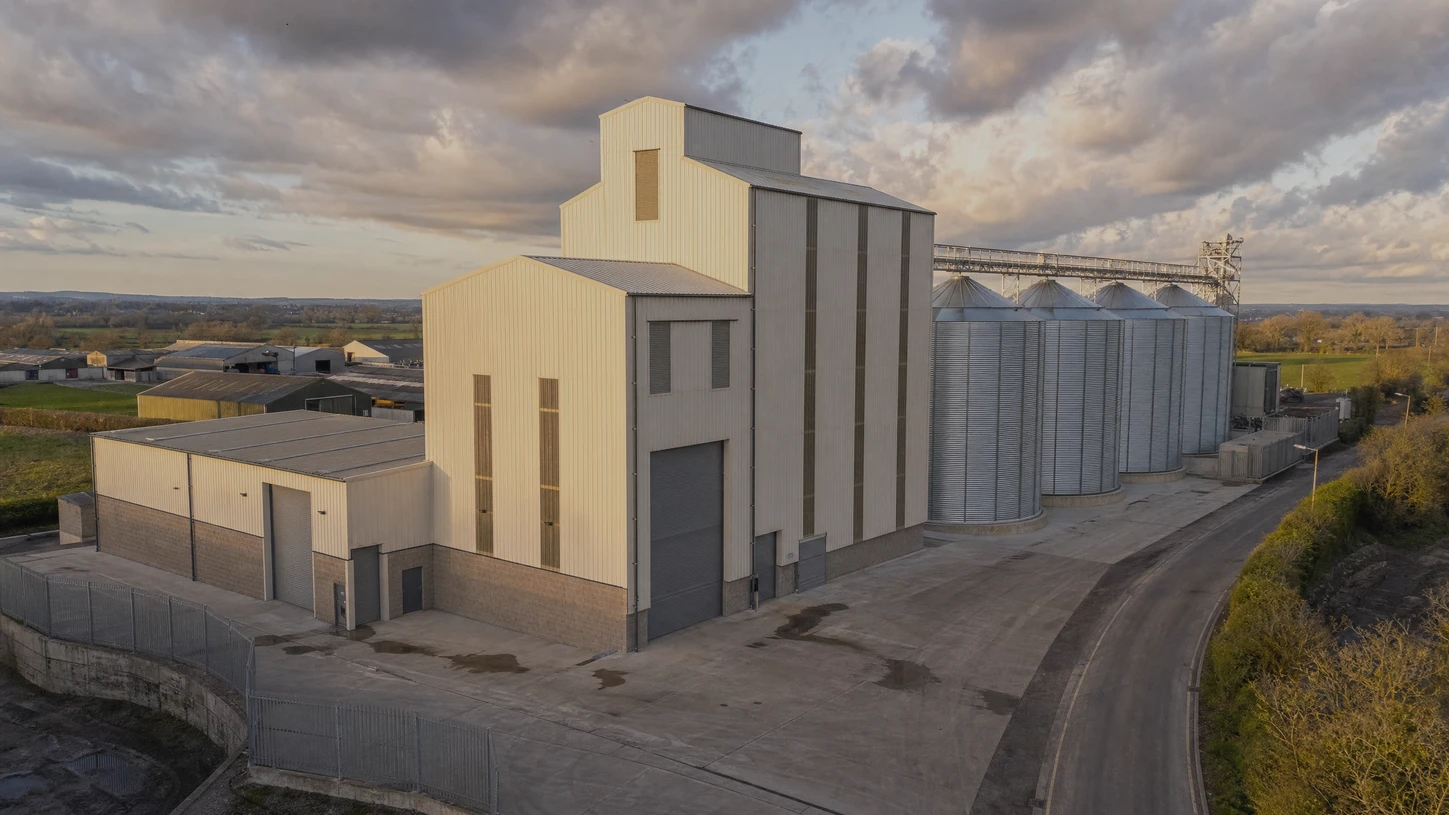
10-15T/H Poultry Feed Pellet Plant in UK
A broiler integrator in Lincolnshire built this feed factory to supply 200 farms. The video features our SZLH850 industrial pellet mill in UK running at 14 tons per hour on a maize-soy formula. Steam conditioning brings the meal to 85°C before it hits the die. You’ll see the pellet mill’s automatic grease system cycling every 8 minutes. The cooler below is a counterflow design — pellets come out at room temperature plus 5 degrees.
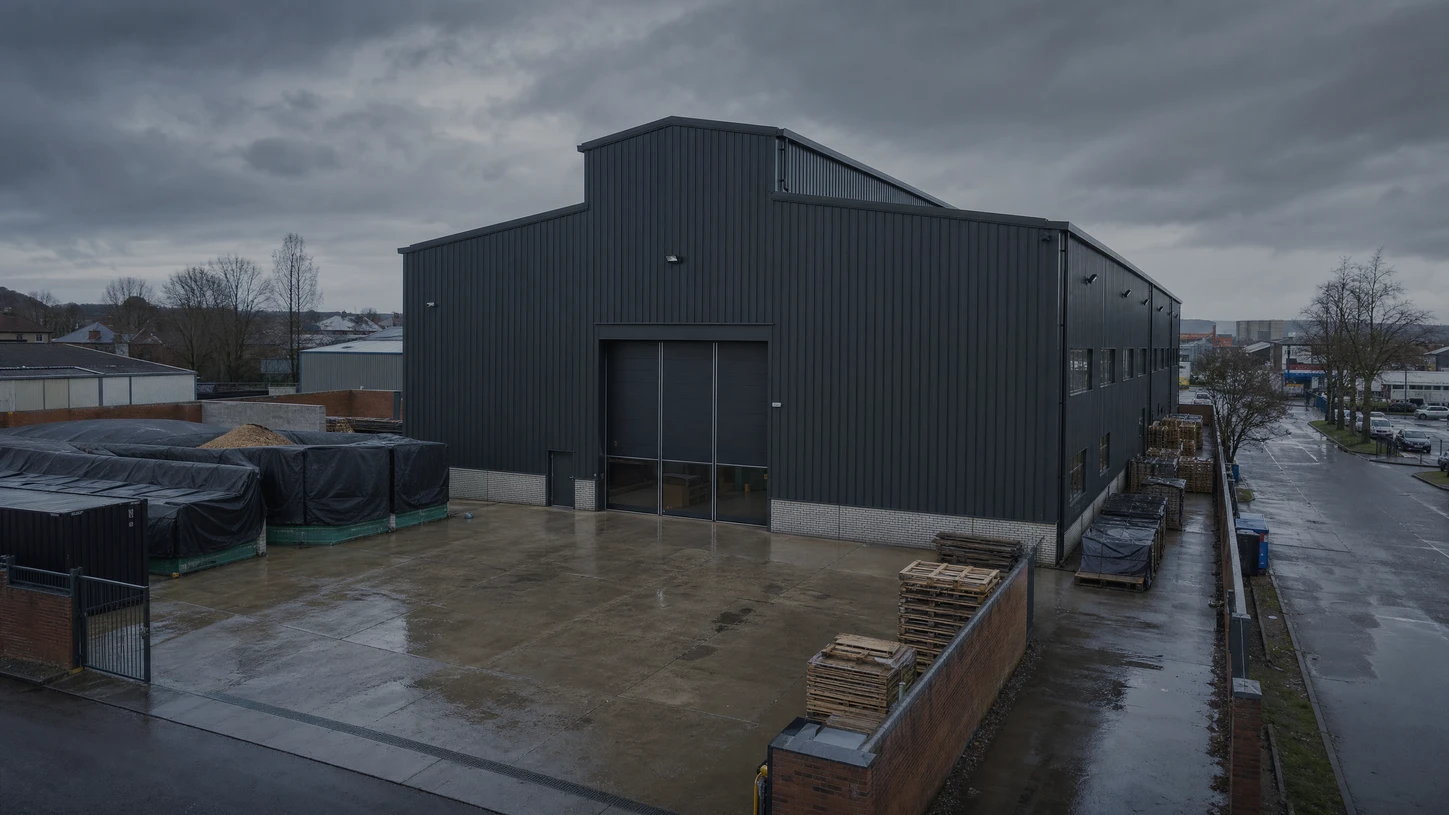
3-5T/H Biomass Rotary Drum Dryer in UK
Not every project needs a pellet machine for sale UK — sometimes the dryer is the bottleneck. This video from a wood pellet plant in Cumbria shows our 2.2m x 15m rotary drum dryer reducing wet sawdust from 45% moisture down to 12% before it hits the pellet mill. Watch the flame management system adjusting the burner automatically. The dried material then feeds into an MZLH768 pellet press. The whole thing is controlled from a single panel.
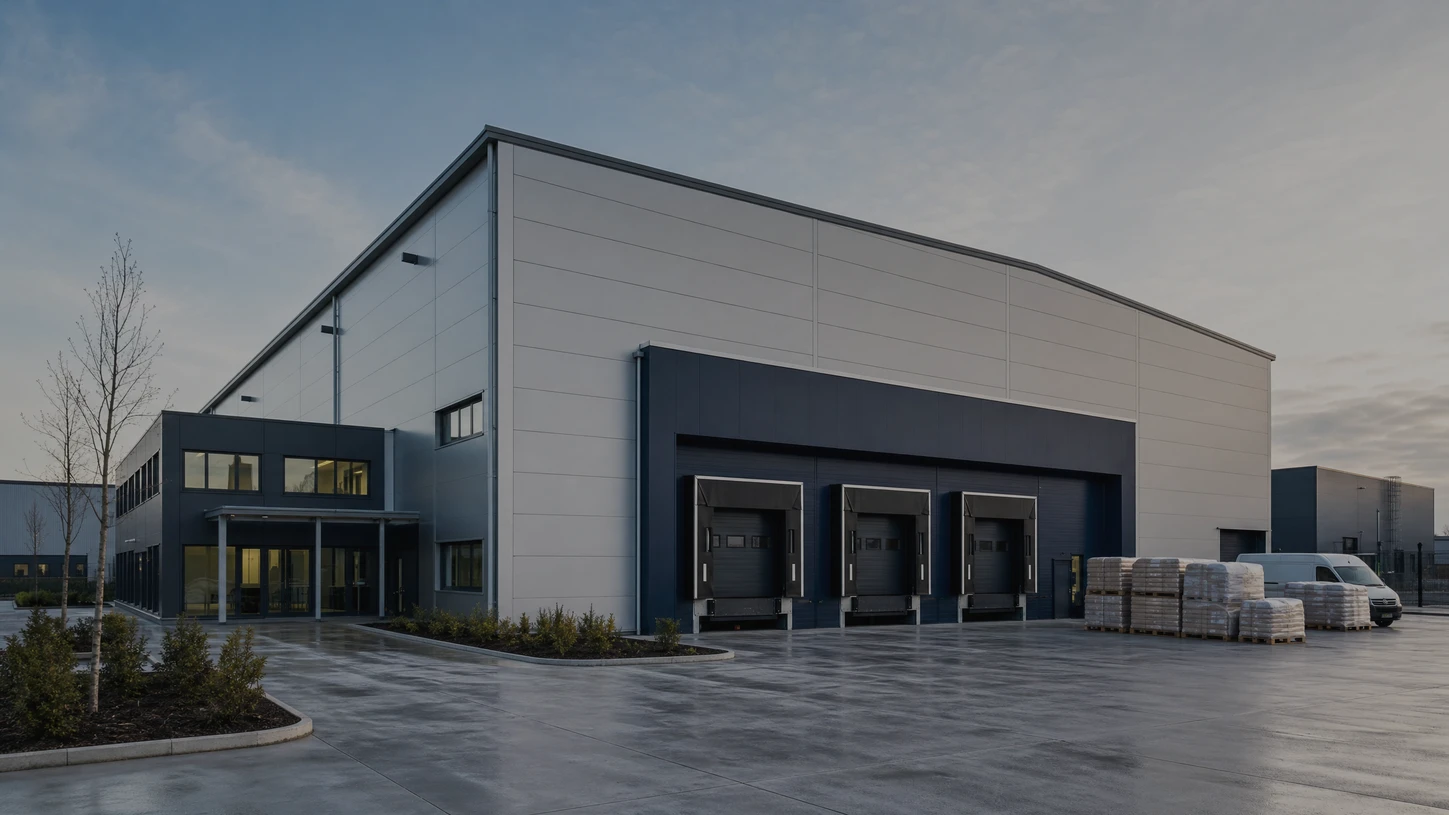
4000 KG/H Soybean Fibre Cat Litter Pellet Plant in UK
A pet product manufacturer in Nottinghamshire processes soybean hulls from a local oil crusher. The video shows our MSZLH420 heavy-duty pellet mill for sale UK with tungsten-carbide die. The fibre arrives at 10% moisture and 0.5mm particle size — almost too fine. We added a small amount of water in a paddle mixer before the pellet press to improve binding. The final pellets are 4mm, low-dust, and highly absorbent. Production runs two shifts daily.

What Our Customers Say

We switched to RICHI’s wood pellet machine after struggling with an unreliable local supplier. We’re a small sawmill in Tuscany, and we process our own pine and fir sawdust into 6mm fuel pellets for residential stoves across the region. What impressed us most wasn’t just the machine itself — it’s that they helped us redesign our drying stage because our incoming moisture was too high.
The pellet machine for sale UK we originally looked at was overpriced for what it offered. RICHI listened, adjusted the die specification, and even sent a technician to guide the first run. Now we run 2.5 tonnes per hour, eight hours a day, with almost no downtime. That’s reliability we didn’t think we’d get from a supplier so far away.
Marco Esposito
Production Manager, family-owned sawmill, Tuscany region

Promising Pellet Processing Opportunities Across the USA
Over the years supplying a pellet machine for sale UK to all sorts of operations, we’ve seen which sectors are growing and which are just hype. Below is our honest take on where the British market is heading across different pellet processing categories. Some of these we’ve already built plants for. Others are just opening up. If you’re considering a pellet machine UK investment, this should help you decide where to put your money.
WOOD PELLET PRODUCTION
WOOD PELLET SOLUTION
The UK biomass market isn’t what it was five years ago — subsidies have changed, but demand for industrial wood pellets remains strong, especially for converted coal plants and large district heating schemes. We’ve supplied ring die pellet mill in UK installations processing softwood sawdust, bark, and even construction offcuts. The real opportunity now is smaller-scale (2-5t/h) plants serving local heat networks and wood-burning schools. Richi Machinery can design lines from a single industrial pellet mill in UK up to full factories with drying, grinding, and bagging.

GRASS PELLET PRODUCTION
GRASS PELLET SOLUTION
British grass growers are sitting on an underused asset. Ryegrass, Timothy, and clover can be pelletised into high-value horse feed or biogas feedstock. We’ve helped farmers in Wales and the South West turn wilted ley grass into 8mm pellets that store for two years without spoiling. The UK imports tons of alfalfa pellets from Spain and the US — there’s a gap for domestic production. A ring die pellet mill in UK configuration running at 3-5t/h is usually the sweet spot for a grass co-op.


STRAW PELLET PRODUCTION
STRAW PELLET SOLUTION
Barley, wheat, and oat straw — Britain has plenty of it, but most gets chopped back into the field or sold for livestock bedding at low margins. Pelleting straw for biomass boilers or mushroom compost changes the numbers. We’ve installed biomass pellet mill in UK lines taking baled straw through shredders and hammer mills before pelleting. The challenge is silica wear, but our abrasion-resistant dies solve that. Several UK power stations still accept straw pellets. Worth a look if you’re arable-based.


RUMINANT FEED PELLET PRODUCTION
CATTLE FEED PELLET SOLUTION
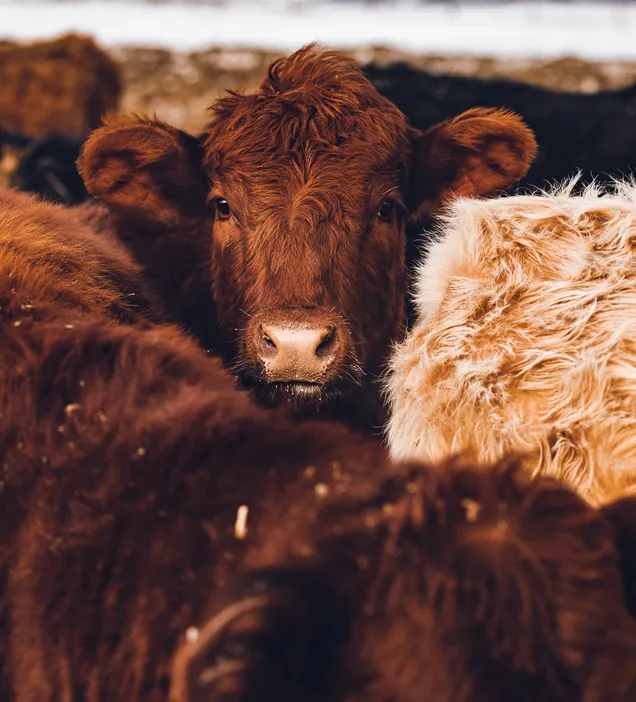
Dairy and beef farms across England and Scotland are under pressure to lower feed costs. Making your own compound pellets from home-grown barley, wheat, and protein crops like beans or lupins cuts out the merchant margin. We’ve built pellet production machine in UK lines for co-ops and individual farms, with steam conditioning to improve pellet durability. The trend is towards on-farm milling and pelleting — less reliance on imported soya. SZLH ring-die mills are our go-to here.

POULTRY FEED PELLET PRODUCTION
POULTRY FEED PELLET SOLUTION
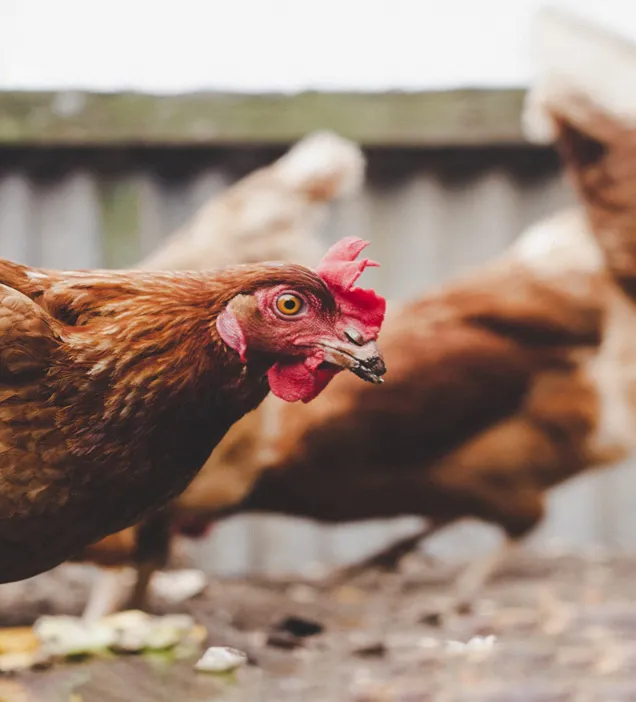
Broiler and layer farms in East Anglia and Lincolnshire operate at massive scale — some with over a million birds. They need consistent, durable pellets that don’t break apart in automatic feeding systems. We’ve supplied pellet manufacturing equipment in UK for poultry integrators, including hammer mills for maize, ribbon mixers for premix inclusion, and steam-conditioned pellet mills. The future is more precision — specific pellet sizes for different bird ages. Our dies can switch between 2.5mm and 4mm.

LIVESTOCK FEED PELLET PRODUCTION
LIVESTOCK FEED PELLET SOLUTION
Pork production in Yorkshire and the Humber drives demand for high-density grower pellets. Sheep feed is different — higher fibre, looser pellets. We’ve learned to adjust die compression ratios for each species. A pellet press machine in UK for pig feed needs more steam and tighter die holes; for sheep, you want a larger diameter and lower compression. We’ve done both. The UK still imports significant compound feed — domestic pelleting is a growing alternative for medium-sized farms.


FERTILIZER PELLET PRODUCTION
FERTILIZER PELLET SOLUTION
Organic fertiliser from poultry litter, cattle manure, and even green waste compost is gaining traction. British arable farmers are looking for alternatives to imported synthetic nitrogen. We’ve installed pellet plant equipment in UK for manure-based fertiliser, including drying steps because fresh litter is too wet. The pelletising machine in UK compresses the dried material into slow-release granules that spread easily. Also worked on NPK blending and pelleting for horticulture. The market is young but moving.

FISH FEED PELLET PRODUCTION
FISH FEED PELLET SOLUTION
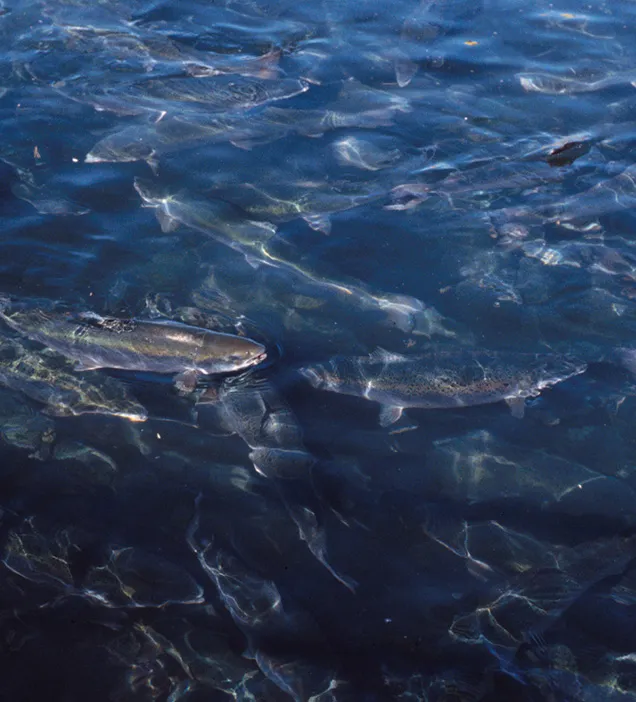
The UK has a significant aquaculture sector — trout in Yorkshire and Herefordshire, salmon in Scotland, plus growing interest in recirculating systems for barramundi and shrimp. Floating feed requires an extruder, not a standard pellet mill. We’ve supplied pelletizing machine in UK extruder lines with oil coating and drying. The opportunity is in species-specific formulations — diets for ornamental fish, halibut, or even insect-based protein. If you’re thinking of entering aquafeed, talk to us first.

PET FOOD PELLET PRODUCTION
PET FOOD PELLET SOLUTION
British pet owners spend more on premium kibble every year — grain-free, insect-based, or with novel proteins like venison. We’ve built pellet factory in UK lines using twin-screw extruders that cook and shape dough into custom pieces — bones, rings, stars. Unlike a standard pellet mill for sale UK, an extruder gives you control over expansion and texture. Small to medium lines (500kg/h to 2t/h) are perfect for regional brands. Several of our customers now supply farm shops and independent pet stores.

cat litter PELLET PRODUCTION
cat litter PELLET SOLUTION
This one surprised us. The UK cat litter market is huge, and most products are imported clay or synthetic crystals. We’ve helped two British companies produce biodegradable litter from okara (tofu pulp), soybean fibre, and waste paper. Our feed mill in UK? No — a heavy-duty mineral pellet mill with stainless steel dies for abrasive materials. The pellet size is 2-4mm, low dust, highly absorbent. If you have access to paper sludge, wood fibre, or agricultural byproducts, this is an underdeveloped niche.


paper PELLET PRODUCTION
paper PELLET SOLUTION
Paper and cardboard are everywhere in UK waste streams — offices, retail, packaging. Pelleting them for fuel or animal bedding is straightforward once you address moisture. Too dry (below 10%) and the pellets are brittle. We’ve installed feed plant in UK lines with water addition before the pellet mill to hit 14-15%. The resulting pellets burn cleanly in industrial biomass boilers or serve as absorbent bedding for horses and poultry. Several recycling centres have added this as a revenue stream.


ANIMAL BEDDING PELLET PRODUCTION
ANIMAL BEDDING PELLET SOLUTION
Not every bedding product needs to be shavings or straw. Pelletised wood fibre, paper, and even miscanthus make excellent horse bedding — highly absorbent, low dust, easy to muck out. We’ve supplied feed factory in UK? No, a bedding pellet line looks similar but without the steam conditioning. The pelletiser for sale UK in this application runs at lower compression to keep pellets soft enough to fluff up when wet. The equine market in the UK is massive. Many livery yards would switch if price was competitive.
RDF PELLET PRODUCTION
RDF PELLET SOLUTION
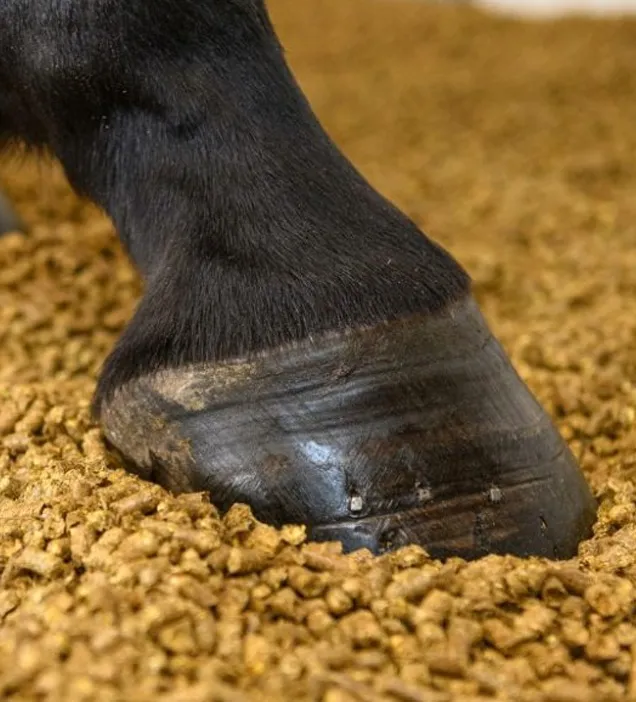
Refuse-derived fuel from household waste, commercial rubbish, and industrial offcuts. The UK generates millions of tonnes, but much still goes to landfill or incineration without densification. Pelleting RDF increases calorific value and makes transport cheaper. We’ve installed heavy-duty pelletizer for sale UK units with hydraulic feeders and abrasion-resistant dies for plastic-heavy feedstock. The challenge is inconsistent material — but our systems adapt with variable-speed conditioners. A growing sector as landfill taxes rise.

Raw grain puffing PRODUCTION
Raw grain puffing SOLUTION
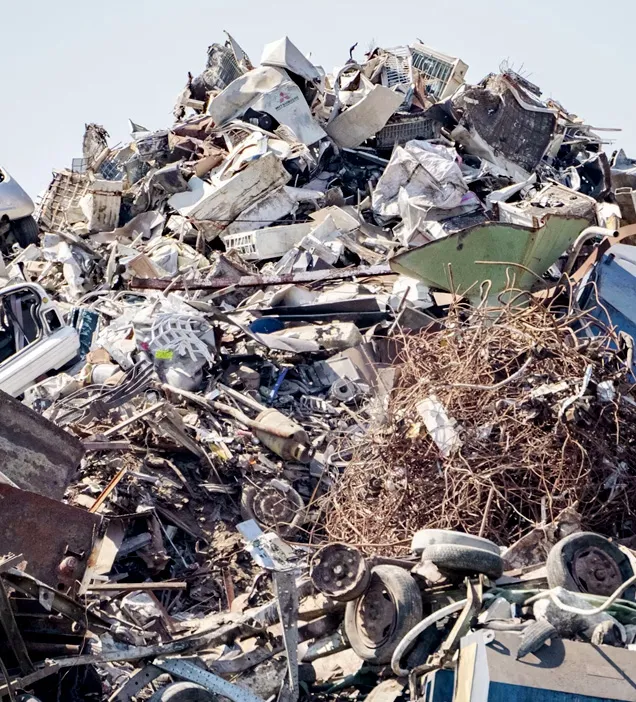
Not strictly pelleting — expansion is different. We’re talking about puffed wheat, expanded oats, or textured vegetable protein for meat alternatives. The UK plant-based food market is booming. Our twin-screw extruders puff grains at high temperature and pressure, creating light, crispy pieces for cereals, snacks, or meat substitutes. Unlike a pellet machine UK that compresses, an extruder expands. We’ve done lines for breakfast cereal makers and vegan ingredient suppliers. Low volume but high margin.


Pyrolytic carbon PELLET PRODUCTION
Pyrolytic carbon PELLET SOLUTION
Biochar has carbon credits, soil improvement benefits, and water filtration applications. But raw biochar is dusty and hard to handle. Pelleting solves that. We’ve worked with UK pyrolysis operators to install pellet mill in UK lines that compress char with small amounts of binder (starch or molasses). The pellets are 6-8mm, durable, and easy to bag. Government incentives for carbon removal are coming. This could be a serious opportunity within five years.


Rat poison PELLET PRODUCTION
Rat poison PELLET SOLUTION
Mouse and snail baits need to be palatable but weather-resistant. We’ve supplied a pellet production line in UK for a pest control manufacturer using cereal-based attractants mixed with active ingredients. The pellet mill compresses the blend into 3-5mm baits that hold together in damp conditions. Regulation is tight, but the market is steady — UK households and farms buy millions of pounds of rodenticides annually. We can help with closed-system designs for safety.


solid waste PELLET PRODUCTION
solid waste PELLET SOLUTION
Plastics, textiles, rubber, composites — the stuff that doesn’t easily recycle. Pelleting it into engineered fuel (EfW feedstock) is gaining acceptance at UK energy-from-waste plants. We’ve supplied pellet machine for sale UK units with heated dies and forced feeders to handle sticky synthetic materials. Not a clean business, but a necessary one. Several industrial parks now run their own waste-to-pellet lines to power on-site boilers. If you have consistent waste streams, we can design a system that pays back in under two years.


Our UK Best-Selling Equipment
Based on real orders and repeat customers across England, Scotland, Wales, and Northern Ireland, these are the machines British producers keep coming back for. Some are for complete pellet plant setups, others for upgrading existing lines. And yes, every time someone searches for a pellet machine for sale UK, these are the units they end up buying after comparing specs. We stock common wear parts for all of them in our UK-facing warehouse.
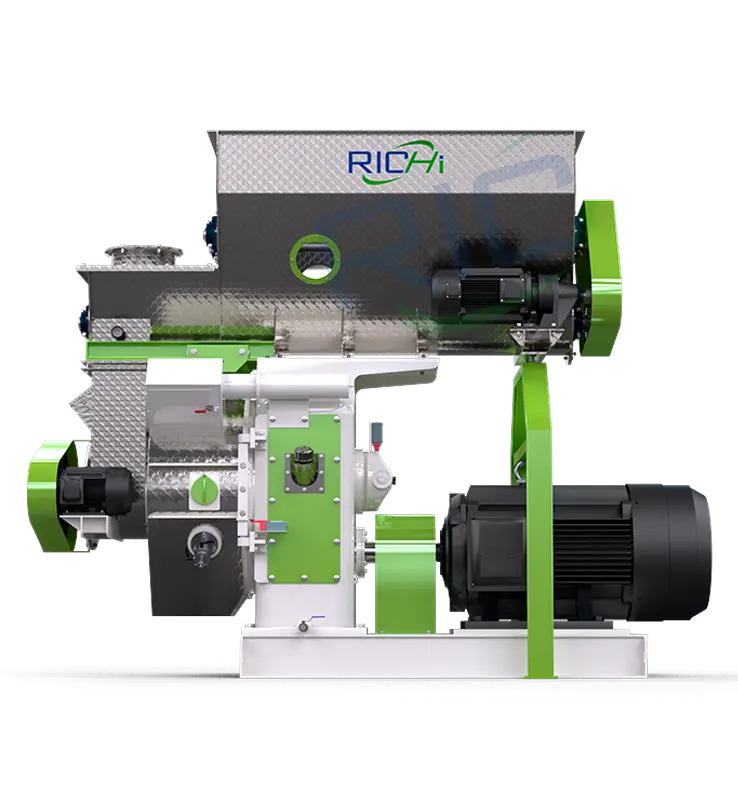
biomass pellet mill for sale
British wood processors and biomass fuel suppliers run our ring-die mills on softwood sawdust from Scottish pine plantations and English spruce. These biomass pellet mill in UK installations typically process material at 10-15% moisture into 6mm or 8mm fuel pellets for commercial boilers. One customer in Cumbria has clocked over 8,000 hours on his MZLH768 with only routine roller changes. We offer from 500kg/h to 15t/h single units.

grass pellet machine for sale
Welsh farmers and Herefordshire horse hay producers use our grass pellet machines to turn ryegrass and Timothy into high-protein feed pellets. The grass enters at 14% moisture after field wilting, then our CZLH series compresses it into 8mm pellets that store for over a year without mould. One Devon customer now supplies grass pellets to local riding schools as a complete feed. Works equally well on clover and lucerne.

feed mill pellet machine
Poultry integrators in Lincolnshire and pig farms in Yorkshire rely on our SZLH ring die feed mills for consistent, durable feed pellets. Steam conditioning at 80-85°C gelatinises starches and reduces fines. These pellet production machine in UK setups handle maize, wheat, barley, and soya blends with ease. A 10t/h unit can save a medium farm over £200 weekly compared to buying bagged feed. Dies available from 2mm to 10mm.
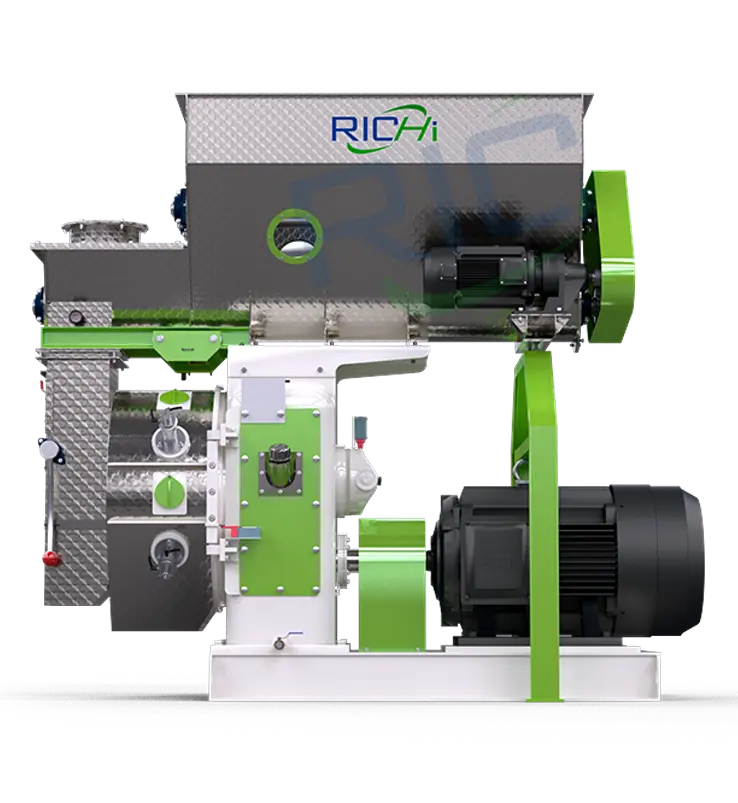
fertilizer granulator equipment
From cattle manure in Somerset to poultry litter in Norfolk, our FZLH fertiliser pellet mills convert wet, sticky waste into spreadable organic granules. The key is the forced feeder and abrasion-resistant die — standard pellet manufacturing equipment in UK won’t last six months on chicken litter. We add a dryer before the mill to bring moisture down from 70% to 15%. Several arable farms now use these pellets instead of imported urea.

twin screw extruder for sale
Scottish salmon feed producers and English pet food brands choose our SPHS twin-screw extruders for floating aquafeed and premium kibble. Unlike a standard pellet mill for sale UK, this machine cooks and expands the material. A trout farm in Yorkshire runs 1.5t/h of 4.5mm floating pellets that stay up for over an hour. Twin-screw design handles higher oil and fibre than single-screw models.
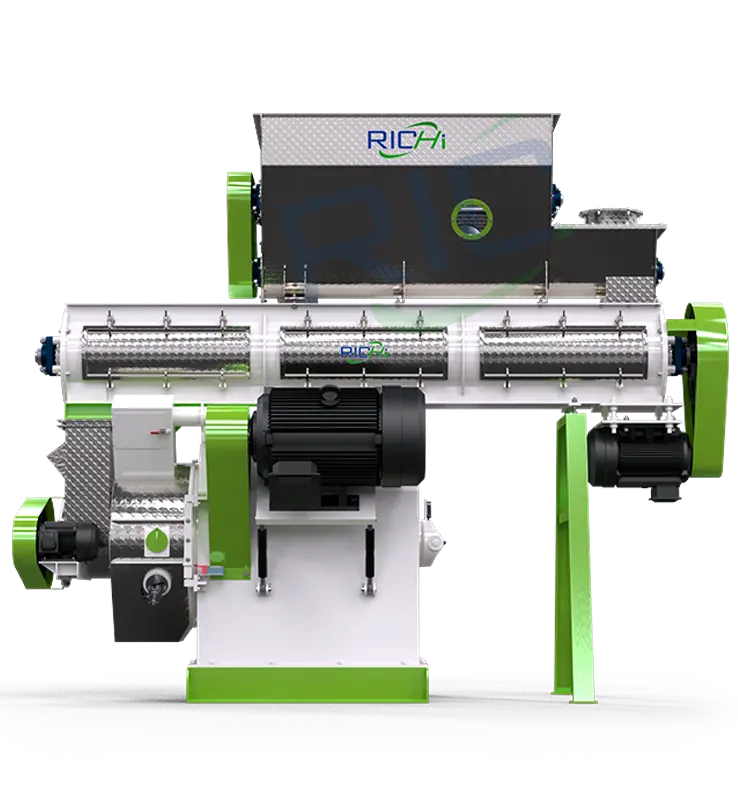
straw pellet machine for sale
Barley straw from East Anglia and wheat straw from the South East — our CZLH straw pellet mills compress these fibrous materials into biomass fuel or animal bedding. The challenge is silica wear, but our tungsten-carbide dies last three times longer than standard. We’ve supplied straw pellet manufacturing equipment in UK for farms wanting to monetise straw that used to be chopped back into the field. Output ranges 1-8t/h.

shrimp feed pellet machine
UK indoor shrimp farms are growing, especially in Yorkshire and the South West. Our small-die shrimp feed pellet mills produce 0.8mm to 2mm micro pellets that sink slowly. The pellet press machine in UK for this application needs very precise die holes and gentle compression. We’ve supplied three lines to recirculating aquaculture systems (RAS) farms. Material is typically high-protein meal with fish meal and squid meal.

cat litter pellet machine
Soybean fibre from a Nottinghamshire oil crusher and okara from a Bristol tofu maker — both go into our MSZLH cat litter pellet mills. This heavy-duty pellet plant equipment in UK setup uses stainless steel dies to handle abrasive plant fibres. The output is 2-4mm low-dust pellets that clump well. One customer now supplies Waitrose with biodegradable cat litter. Works on paper sludge and wood fibre too.
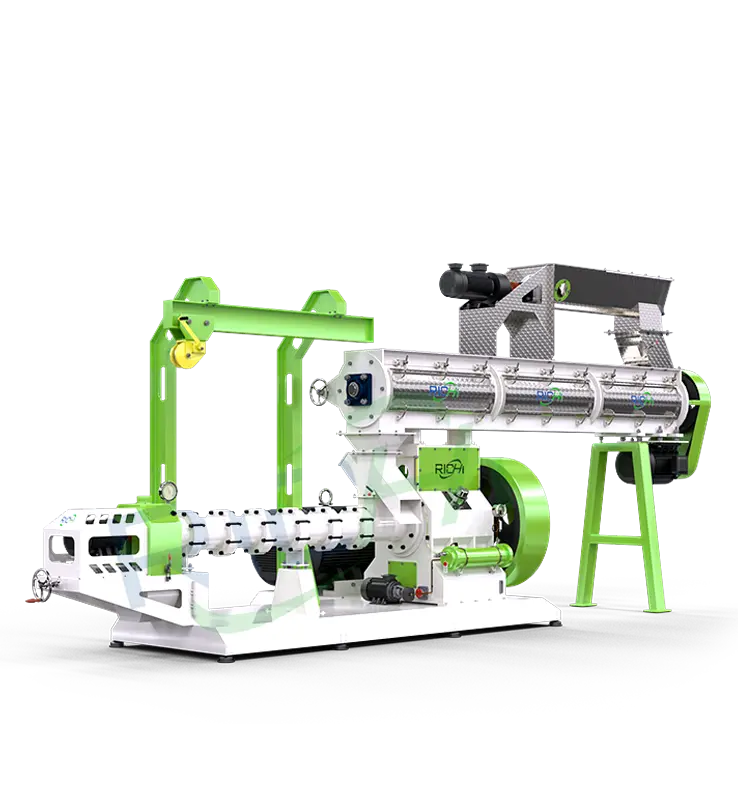
single screw extruder machine
For UK farmers wanting to expand grains for pig or calf feed, our single-screw extruder is a simpler, cheaper option than twin-screw. It puffs wheat, barley, and maize at high temperature, improving digestibility. We’ve installed pelletizing machine in UK extruders on mixed farms in Shropshire and Staffordshire. Output from 500kg/h to 3t/h. No complex die changes — just adjust the cutter for different length.

Grain extruder machine
The UK plant-based breakfast cereal market needs puffed wheat and expanded oat pieces. Our grain expander works like an extruder but with a shorter barrel and higher shear. Several pellet factory in UK lines we’ve supplied to cereal makers run 24/5 production. Unlike a pellet mill, this machine doesn’t compress — it explodes the starch structure. Output is light, crispy pieces used in muesli and snack bars.
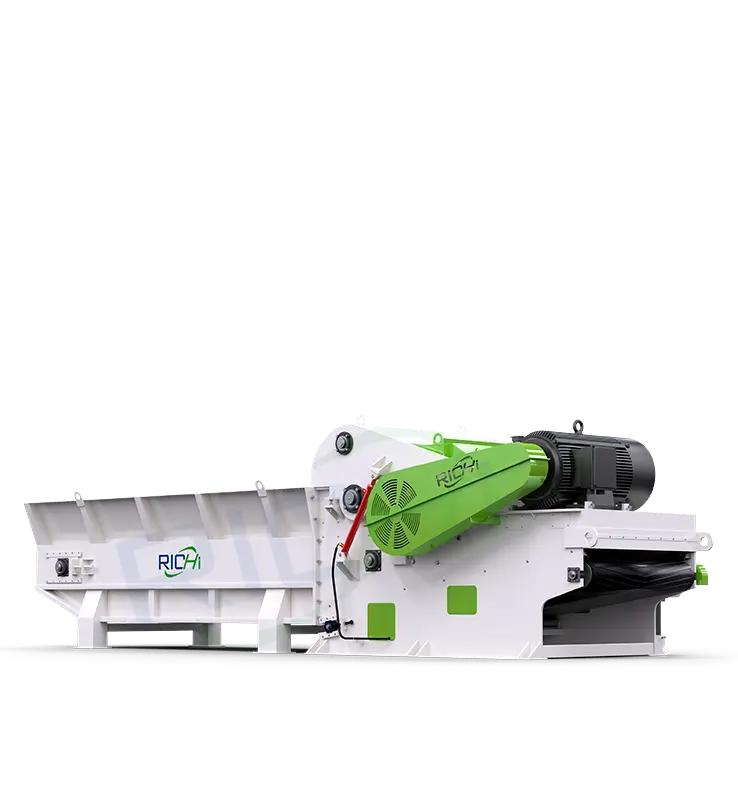
wood chipper machine
From Scottish forestry thinnings to English arboriculture waste, our disc and drum wood chippers reduce logs and branches to 20-50mm chips. These feed directly into hammer mills or pellet mills. A joinery in Gloucestershire chips all its offcuts before grinding and pelleting into 6mm fuel pellets. We’ve supplied feed mill in UK chipper units from 10hp to 300hp. The key is knife adjustment — we train your team on that.

shredder machine
Plastic pallets, carpet offcuts, textile waste, rubber — UK recycling centres use our twin-shaft shredders to reduce bulky waste to 50-100mm pieces before RDF pelleting. Unlike standard feed plant in UK grinders, these handle metal contamination without catastrophic failure. A facility in Merseyside shreds household waste at 8t/h feeding our RDF pellet line. Replaceable cutter teeth and hydraulic drive are standard.

Wood Chip Dryer
Wood pellet plants in Cumbria and Scotland use our rotary drum dryers to drop sawdust moisture from 45% down to 12% before the pellet mill. These 2m to 3m diameter drums run on waste wood heat or biomass burners. We’ve supplied feed factory in UK dryer setups with full cyclone and fan packages. One customer reduced his drying energy cost by 30% after we added a hot gas recirculation loop. Works on bark and shavings too.

bale crusher
Round or square bales — our bale shredders handle both. Welsh sheep farmers use them to break ryegrass bales before pelleting into 8mm feed pellets. The shredder cuts bales to 50-100mm pieces, then a hammer mill finishes the job. We’ve sold pelletiser for sale UK bale shredders to over a dozen forage-based pellet lines. Tip speed and rotor design matter more than horsepower for long-stem material like hay.

hammer mill
British feed mills grind maize, wheat, and barley through our SFSP drop-shaped hammer mills for consistent particle size before pelleting. The drop-shaped grinding chamber reduces recirculation and improves efficiency by 15% over round designs. Also used for wood chips and straw in biomass plants. A poultry feed line in Norfolk runs two units in parallel at 8t/h each. Screens available from 1mm to 10mm.

mesh belt dryer
Pet food kibble needs gentle drying after extrusion — our belt dryers use low-temperature air over multiple passes. A dog food maker in Cambridgeshire dries 2t/h of grain-free kibble from 25% moisture down to 8% without scorching. Also used for vegetable drying and fish feed. These feed production line in UK components have stainless steel belts and zone temperature control. Much lower product damage than rotary dryers.

Feed mixer machine
From pig feed premixes to wood pellet binder blending, our mixers handle it all. Ribbon mixers for dry powders (flour, minerals, wood dust), paddle mixers for sticky or high-moisture materials (molasses in cattle feed, water in wood pellets). We’ve supplied feed mill in UK mixing systems from 500kg to 5t per batch. One organic fertiliser plant mixes compost with minerals before pelleting. All contact parts are stainless upon request.

fertilizer crusher machine
Organic fertiliser pellets sometimes need crushing before rebinding — our vertical chain crusher breaks oversize lumps without over-grinding. Used by a Devon compost pelleting facility to recycle off-spec pellets back into the line. Also works on NPK fertiliser granules. Simple vertical design with hardened chains. Feed plant in UK locations with wet or sticky materials prefer this over hammer mills which would clog.

grass straw crusher machine
Long rye straw and clover hay choke standard hammer mills. Our 9FQ series crusher uses a combination of cutting and grinding to handle material up to 200mm long. A Hereford horse bedding plant uses it to reduce Timothy hay from bale shredder output before pelleting. Also works on corn stalks and miscanthus. We’ve supplied pellet production line in UK crushers as the pre-grind step before fine hammer milling.

vibrating screening machine
After cooling, pellets need screening for fines removal before bagging. Our rotary grading screens separate dust and broken pellets from finished product. Used in wood pellet plants, feed mills, and cat litter lines across the UK. A Lincolnshire poultry feed line recovers 3% more saleable product after installing our double-deck screener. Also used for raw material cleaning before grinding. Mesh sizes from 1mm to 12mm.

storage silos
From small 10-tonne hoppers to large 500-tonne bolted silos — we supply storage for wood chips, grains, finished pellets, and cat litter. A Scottish wood pellet plant stores 300 tonnes of dry sawdust in our silos with aeration floors to prevent bridging. Also flat-bottom and conical options. We can integrate with screw augers or chain conveyors. Part of any complete feed factory in UK solution we design.
FAQ-Sourcing a Pellet Machine for Sale UK
We manufacture pellet equipment in China and ship direct to British customers – no agents, no distributors. Below are the real questions UK buyers ask us before ordering. Answers are based on actual projects we’ve delivered across England, Scotland, Wales, and Northern Ireland, covering wood, grass, feed, fertiliser, cat litter, pet food, and waste processing.
What are the detailed technical specifications of the different pellet mills you supply to the UK market?
+
When someone starts looking for a pellet machine for sale UK, the first thing they realise is that one model doesn’t fit all. A poultry farmer in Lincolnshire needs something completely different from a wood pellet producer in Scotland or a cat litter manufacturer in Nottinghamshire.
Over the years, we’ve learned to match the right machine to the right material. Below are the actual specs of the pellet mill UK models we’ve shipped and installed across Britain.
Feed Pellet Mills (SZLH Series) – For poultry, pig, cattle, and sheep feed
These are our workhorses for British feed mills and on-farm mixing operations. The SZLH250 at 22kW handles 1-1.5 t/h, perfect for a small farm cooperative. Jump up to the SZLH420 with 110kW, and you’re doing 10-12 t/h for a medium feed plant.
The largest we’ve supplied to the UK is the SZLH768 – 315kW main motor, 762mm ring die inner diameter, pushing 38-40 t/h of finished pellets. All models come with a feeder (1.1 to 2.2kW) and a conditioner (1.5 to 11kW) for steam injection. Pellet diameter ranges from 2mm to 12mm, so you can do chick starter fines or coarse cattle pellets on the same machine with a die change.
| Model | Main Power (kW) | Feeder (kW) | Conditioner (kW) | Ring Die ID (mm) | Pellet Size (mm) | Capacity (t/h) |
|---|---|---|---|---|---|---|
| SZLH250 | 22 | 1.1 | 1.5 | 250 | 2-12 | 1.0-1.5 |
| SZLH320 | 37 | 1.5 | 4 | 320 | 2-12 | 3-4 |
| SZLH350 | 55 | 1.5 | 4 | 350 | 2-12 | 5-6 |
| SZLH420 | 110 | 1.5 | 7.5 | 420 | 2-12 | 10-12 |
| SZLH508 | 160 | 1.5 | 7.5 | 508 | 2-12 | 15-16 |
| SZLH558 | 185 | 1.5 | 11 | 558 | 2-12 | 20-22 |
| SZLH678 | 250 | 1.5 | 11 | 673 | 2-12 | 30-33 |
| SZLH768 | 315 | 2.2 | 11 | 762 | 2-12 | 38-40 |
Wood Pellet Mills (MZLH Series) – For sawdust, wood shavings, and bark
Wood is dense and abrasive. The MZLH320 starts at 22kW, doing 0.2-0.3 t/h of softwood pellets – suitable for a small joinery workshop in Gloucestershire. Most UK biomass plants we’ve worked with choose the MZLH520 (132kW, 1.5-2.0 t/h) or MZLH678 (185kW, 2.5-3.0 t/h).
The largest, MZLH768, runs 250kW and pushes 3.0-4.0 t/h of 6-8mm wood pellets. Notice the “breaking arch feeder” and “forced feeder” – wood doesn’t flow like grain, so these anti-bridging features are essential. We learned that the hard way on our first Scottish installation.
| Model | Main Power (kW) | Breaking Arch (kW) | Forced Feeder (kW) | Ring Die ID (mm) | Pellet Size (mm) | Capacity (t/h) |
|---|---|---|---|---|---|---|
| MZLH320 | 22 | 2.2 | 0.75 | 320 | 4-12 | 0.2-0.3 |
| MZLH350 | 37 | 2.2 | 0.75 | 350 | 4-12 | 0.3-0.5 |
| MZLH420 | 90 | 3 | 1.5 | 420 | 4-12 | 1.0-1.2 |
| MZLH520 | 132 | 3 | 1.5 | 520 | 4-12 | 1.5-2.0 |
| MZLH678 | 185 | 3 | 1.5 | 673 | 4-12 | 2.5-3.0 |
| MZLH768 | 250 | 4 | 1.5 | 762 | 4-12 | 3.0-4.0 |
Straw & Grass Pellet Mills (CZLH Series) – For ryegrass, Timothy, barley straw, miscanthus
Long fibres need special handling. The CZLH320 (22kW) produces 0.5-0.6 t/h – we’ve installed these for small horse hay producers in Herefordshire. At the top end, the CZLH768 (250kW) does 6-8 t/h of grass or straw pellets for larger forage operations in Wales and the South West.
Same anti-bridging and forced feeder setup as the wood series, but the die compression ratio is different. You cannot run grass through a wood die – it won’t form properly. These pellet mill UK models for fibre have larger die holes and deeper channels.
| Model | Main Power (kW) | Breaking Arch (kW) | Forced Feeder (kW) | Ring Die ID (mm) | Pellet Size (mm) | Capacity (t/h) |
|---|---|---|---|---|---|---|
| CZLH320 | 22 | 2.2 | 0.75 | 320 | 4-12 | 0.5-0.6 |
| CZLH350 | 37 | 2.2 | 0.75 | 350 | 4-12 | 1.0-1.2 |
| CZLH420 | 90 | 3 | 1.5 | 420 | 4-12 | 1.8-2.0 |
| CZLH520 | 132 | 3 | 1.5 | 520 | 4-12 | 2.8-3.0 |
| CZLH678 | 185 | 3 | 1.5 | 673 | 4-12 | 4-5 |
| CZLH768 | 250 | 4 | 1.5 | 762 | 4-12 | 6-8 |
Cat Litter Pellet Mills (MSZLH Series) – For bentonite, soybean fibre, paper sludge, okara
This series is basically our feed mill platform but upgraded with stainless steel or tungsten-carbide dies because cat litter materials are surprisingly abrasive. The MSZLH250 at 22kW does 1.0-1.5 t/h – a Nottinghamshire soybean fibre plant runs two of these.
The MSZLH768 at 315kW pushes 38-40 t/h, though most UK cat litter operations are smaller, typically choosing the MSZLH420 (110kW, 10-12 t/h) or MSZLH508 (160kW, 15-16 t/h). Same feeder and conditioner specs as the SZLH series, but the metallurgy is different. Standard ring dies would wear out in three months on bentonite.
| Model | Main Power (kW) | Feeder (kW) | Conditioner (kW) | Ring Die ID (mm) | Pellet Size (mm) | Capacity (t/h) |
|---|---|---|---|---|---|---|
| MSZLH250 | 22 | 1.1 | 1.5 | 250 | 2-12 | 1.0-1.5 |
| MSZLH320 | 37 | 1.5 | 4 | 320 | 2-12 | 3-4 |
| MSZLH350 | 55 | 1.5 | 4 | 350 | 2-12 | 5-6 |
| MSZLH420 | 110 | 1.5 | 7.5 | 420 | 2-12 | 10-12 |
| MSZLH508 | 160 | 1.5 | 7.5 | 508 | 2-12 | 15-16 |
| MSZLH558 | 185 | 1.5 | 11 | 558 | 2-12 | 20-22 |
| MSZLH678 | 250 | 1.5 | 11 | 673 | 2-12 | 30-33 |
| MSZLH768 | 315 | 2.2 | 11 | 762 | 2-12 | 38-40 |
Fertiliser Pellet Mills (FZLH Series) – For poultry litter, cattle manure, compost, NPK blends
Fertiliser materials are wet, sticky, and often corrosive. The FZLH250 small fertilizer pellet machine (22kW) does 1-1.5 t/h – a Somerset dairy farm uses one to process manure from 500 cows. The FZLH768 (250kW) pushes 22-26 t/h, but honestly, most UK organic fertiliser plants are smaller, typically the FZLH420 (90kW, 6-8 t/h) or FZLH520 (132kW, 9-12 t/h).
Notice the breaking arch and forced feeder – these are mandatory for sticky manure. Without them, the material bridges and the machine starves. We’ve supplied pellet machine for sale UK units in this series to over a dozen waste-to-fertiliser projects across England.
| Model | Main Power (kW) | Breaking Arch (kW) | Forced Feeder (kW) | Ring Die ID (mm) | Pellet Size (mm) | Capacity (t/h) |
|---|---|---|---|---|---|---|
| FZLH250 | 22 | 2.2 | 0.75 | 250 | 4-12 | 1-1.5 |
| FZLH320 | 22 | 2.2 | 0.75 | 320 | 4-12 | 2-3 |
| FZLH350 | 37 | 2.2 | 0.75 | 350 | 4-12 | 3-5 |
| FZLH420 | 90 | 3 | 1.5 | 420 | 4-12 | 6-8 |
| FZLH520 | 132 | 3 | 1.5 | 520 | 4-12 | 9-12 |
| FZLH678 | 185 | 3 | 1.5 | 673 | 4-12 | 18-22 |
| FZLH768 | 250 | 4 | 1.5 | 762 | 4-12 | 22-26 |
The tables above cover the main ring die pellet machine UK models we’ve been shipping to British customers over the past few years. But honestly, this isn’t everything. We also manufacture single-screw extruders, twin-screw extruders for aquafeed, small mobile pellet mills for farm use, and custom configurations for materials you wouldn’t normally think of pelletising – things like RDF, biochar, and even rodenticide baits.
If your material can be densified, we can build a pellet machine for sale UK that fits your exact raw material, moisture level, particle size, and output target. The specs above are starting points. Tell us what you’re processing, and we’ll recommend the right ring die diameter, compression ratio, and power configuration. No two projects are identical – and we don’t treat them that way.
What is the price range for a feed pellet machine for sale UK, and how much do your different models cost?
+
If you’ve been searching for a feed pellet machine for sale UK, you’ve probably noticed prices vary wildly online. Some suppliers quote very low, then hit you with hidden shipping or die costs. Others are simply overpriced. Below is real FOB pricing for our SZLH ring die feed pellet mills – the same models we’ve installed at poultry farms in Lincolnshire, dairy operations in Cheshire, and sheep farms in the Welsh borders. These prices are based on actual shipments to UK ports. Keep in mind, every chicken feed pellet machine for sale UK we sell can be configured for different species – more on that below.
SZLH250 (22KW) – 1-2 T/H
This small animal feed pellet machine is an entry-level model for small farms. Handles starter feeds for chicks, piglets, and lambs. Priced between approximately $6,500 and $8,500 USD FOB. We’ve sold several of these as chicken feed pellet machine for sale UK units to free-range egg producers in Norfolk. The 22KW motor is enough for most cereal-based recipes up to 15% fibre. Comes with a basic feeder and conditioner – no steam boiler needed unless you want one.
SZLH320 (37KW) – 3-4 T/H
This animal feed granulator is where commercial production starts. Price ranges from about $15,000 to $18,500 USD FOB. A popular choice for mixed farms running both pigs and poultry. Several customers bought this as a cattle feed pellet machine for sale UK after upgrading from smaller mills. The 37KW motor and 320mm ring die give you real durability. We’ve seen these run 12-hour shifts on barley-wheat blends without overheating. Conditioner adds steam for better pellet binding.
SZLH350 (55KW) – 5-6 T/H
Serious output for serious farms. Expect to pay between $26,000 and $32,000 USD FOB. One of our most popular animal feed pellet press models for British customers – enough capacity for a medium feed mill or a large cooperative. We’ve supplied this as a rabbit feed pellet mill for sale UK to several alfalfa processors in the South West. Rabbits need high fibre, and the 350’s die compression ratio can be adjusted for that. Also works for ducks, turkeys, and geese with the right die. The 55KW motor handles up to 6 t/h on standard grower rations.
SZLH420 (110KW) – 10 T/H
Industrial scale animal feed pellet mill. Price runs roughly $28,000 to $34,000 USD FOB. Don’t let the similar price to the 350 fool you – the 420 is a much heavier machine with a 110KW motor and 420mm die. A duck feed pelletizer in UK recently installed one for their 50,000-bird operation in Lincolnshire. The larger die surface area means less wear per ton produced. Comes with a 7.5KW conditioner for proper steam cooking. Can handle higher oil inclusion than smaller models.
SZLH508 (160KW) – 15 T/H
Major factory-level output. Priced between approximately $38,000 and $46,000 USD FOB. A turkey animal feed pellet making machine in UK installed this model for their integrated operation – turkeys need larger diameter pellets than chickens, and the 508 accepts dies up to 8mm easily. The 160KW motor and 508mm ring die run continuously with proper cooling. We recommend this for anyone processing over 500 tons per month. Also works well for mixed rations with molasses.
SZLH558 (185KW) – 20 T/H
Serious tonnage. Expect $45,000 to $55,000 USD FOB. A goose feed granulator machine in UK used this model for their 200,000-bird farm in East Yorkshire. Geese are messy feeders – they need durable pellets that don’t crumble in wet conditions. The 558’s higher compression ratio and 185KW motor produce extremely hard pellets. Also suitable for large-scale duck, turkey, and mixed poultry operations. The 11KW conditioner gives you excellent steam control.
SZLH678 (250KW) – 30 T/H
Large industrial plant territory. Price range $60,000 to $74,000 USD FOB. We’ve supplied this as a mixed ration feed pellet granulator in UK for a cooperative that blends cattle, sheep, and pig feeds on the same line. The 678mm die and 250KW motor allow die changes in under 30 minutes – you can switch between 4mm pig pellets and 8mm cattle pellets quickly. This is not a farm-scale machine. You’ll need a proper building, a boiler system, and trained operators.
SZLH768 (315KW) – 40 T/H
Our biggest standard commercial feed pellet mill. Priced between roughly $72,000 and $88,000 USD FOB. Only a few of these in the UK – typically at large integrators or commercial feed manufacturers. The 762mm ring die has over 40% more surface area than the 678. This machine can run 24/7 for weeks at a time. We’ve seen one at a Scottish feed plant producing salmon smolt feed on modified dies. Overkill for most farms, but if you’re supplying hundreds of thousands of birds or animals, this is the endgame.
The ring die feed pellet machine models above are our most common feed pellet mills for UK customers. But they’re not all we offer. Need a machine for ostrich feed? Goat minerals? Fermented ingredients? We can custom-build. The prices shown are FOB – shipping to UK ports adds ocean freight, but we can help arrange that too.
Want to see a customized quote? Tell us your target output, your main ingredients (maize, wheat, barley, soya, etc.), and whether you need steam. We’ll recommend the right size and die configuration, then send you a firm price. One more thing – prices change with steel costs and exchange rates. Contact us for today’s number on the specific model you’re looking at.
How much does a biomass wood pellet machine for sale UK typically cost across different capacities?
+
If you’ve been looking for a wood pellet machine for sale UK, you already know prices are all over the place. Some suppliers quote a low base price then add thousands for the feeder, the control panel, or basic shipping. The prices below are different.
Every MZLH series mill we sell includes the anti-bridging arch feeder, the forced feeder, the pelletizer unit itself, and the control cabinet. No hidden extras. These are FOB Qingdao prices based on actual shipments to British customers over the past two years – from a joinery in Gloucestershire running a MZLH320 small biomass pellet machine to a large wood pellet plant in Scotland using the MZLH768.
MZLH320 (22KW) – 0.2-0.3 T/H
Smallest in the range, but surprisingly capable. Price runs roughly $13,500 to $16,800 USD FOB. A softwood pellet machine in UK configuration like this works perfectly for a small workshop generating a few tons of sawdust per week. We sold one to a furniture maker in Cumbria who now pellets his own pine and spruce waste instead of paying for skip hire. The 22KW motor is gentle on power, and the unit fits in a standard container. For 0.2-0.3 t/h of 6mm pellets, this is your entry point.
MZLH350 (37KW) – 0.3-0.5 T/H
Stepping up. Expect to pay between approximately $18,500 and $22,800 USD FOB. A popular choice as a hardwood pellet press in UK for joiners working with oak, ash, and beech. Hardwood needs more torque than softwood – the 37KW motor provides that without straining. We’ve installed these at small biomass boiler servicing companies who want to produce their own fuel from arboriculture waste. The anti-bridging feeder is essential here because hardwood dust can clump. Capacity of this biomass pellet press depends on moisture – at 12% you’ll hit 0.5 t/h.
MZLH420 (90KW) – 1.0-1.2 T/H
This is where commercial production becomes viable. Price range roughly $26,500 to $32,800 USD FOB. A pine pellet mill in UK operation at this size can supply several schools or small factories with fuel. We’ve shipped the MZLH420 biomass granulator to a sawmill in Northumberland that processes Scottish pine. The 90KW motor and 420mm ring die give you genuine 24-hour capability. The forced feeder is larger than on the smaller models – 1.5KW instead of 0.75KW – because you’re moving more material. At 1.2 t/h, payback is usually under 18 months.
MZLH520 (132KW) – 1.5-2.0 T/H
Serious output for a serious operation. Price between roughly $40,000 and $50,000 USD FOB. A spruce pelletizer in UK system at this scale typically feeds a district heating scheme or a medium-sized wood pellet bagging business. One of our customers in Yorkshire runs two MZLH520 biomass fuel pellet machine units side by side, producing 3-4 t/h combined. The 132KW motor and 520mm die handle both softwood and hardwood mixes well. We recommend this for anyone processing over 500 tons of green material monthly. Comes with a 3KW breaking arch feeder – no bridging even with damp shavings.
MZLH678 (200KW) – 2.5-3.0 T/H
Industrial scale biomass pellet making machine. Expect to pay approximately $60,000 to $74,000 USD FOB. A wood shavings pellet press in UK at this capacity can supply an entire town’s biomass boilers. We’ve installed the MZLH678 at a large timber processing facility in the Scottish Highlands. The 200KW motor (some configurations use 185KW – we spec based on your material) and 673mm die run continuously with automated grease lubrication. The 3KW forced feeder and 3KW breaking arch handle wet shavings without issues. At 3 t/h of 8mm pellets, this is a serious revenue generator.
MZLH768 (315KW) – 3.0-4.0 T/H
Our largest standard biomass wood pellet machine. Price runs roughly $72,000 to $89,000 USD FOB. A virgin timber pellet mill in UK at this level is usually part of a complete factory producing tens of thousands of tons annually. Only a handful of these in Britain – typically at large forestry operations or major wood processing companies. The 315KW motor and 762mm die can run for weeks without stopping. We’ve supplied the MZLH768 to a facility in Cumbria processing construction waste timber into 6mm pellets for industrial boilers. This is not a machine for small operators. But if you have the feedstock volume, nothing else comes close.
Now, wood isn’t just for fuel. Some UK buyers use these machines for other applications entirely. A wood flour pellet machine in UK – same MZLH platform but with a different die – produces fine-ground wood dust pellets for industrial absorbents. A wood pellet cat litter machine in UK uses the same mill but with 3mm dies and a gentler compression ratio to keep pellets soft enough for cat paws.
A sawdust pellet press for sale UK can be configured for horse bedding – lower density pellets that fluff up when wet. A wood pellet machine for horse bedding in UK is a popular request from equestrian suppliers in Herefordshire and Gloucestershire.
Even a hedge trimming pellet machine in UK – yes, we’ve sold an MZLH350 to a landscaping company that pellets mixed hedge clippings (hawthorn, beech, leylandii) for biomass fuel. The machine doesn’t care what wood you feed it, as long as the moisture and particle size are right.
The models above are our standard biomass wood pellet mills. But we’re not limited to these.
Different ring die compression ratios, custom roll shells, special alloys for abrasive materials, or even mobile configurations – we can build what you need. Want to pellet wet bark? We’ll add a dryer ahead of the mill. Need to process construction waste with nails? We’ll add magnets and a heavy-duty feeder.
The prices shown are FOB Qingdao – shipping to UK ports is extra, but we can arrange competitive freight. For an exact quote on a specific wood pellet machine for sale UK, tell us three things: your raw material (softwood, hardwood, mixed, or something else), its typical moisture content, and your target output per hour. We’ll recommend the right MZLH model and send you a firm price. Prices shift with steel and exchange rates – contact us for today’s numbers.
We grow about 500 acres of ryegrass and clover in Wales for sheep feed. What size pellet line do we need to process round bales into 6mm pellets?
+
For 500 acres with two cuts per year, you’re looking at roughly 2,000-3,000 tonnes of dry matter annually. A 2-3 t/h line would process your bales comfortably during winter months.
We’d recommend a CZLH420 pellet machine for sale UK with a bale shredder upfront. The shredder breaks round bales (up to 1.2m diameter) into 50-100mm pieces, then a hammer mill with 4mm screen reduces it to powder. A steam conditioner helps bind the grass without artificial binders.
Your moisture target before pelleting is 12-14%. Too wet and the pellets won’t hold together; too dry and they’ll be brittle. We’ve installed similar lines for sheep farmers in Powys and Carmarthenshire.
We run a dairy with 800 cows in Somerset and want to pellet our own cattle feed from home-grown barley and bought-in soya. What size mill do we need for 8-10 t/h?
+
For 800 cows, assuming 15kg of concentrate per cow daily, you need about 12 tonnes per day – an 8-10 t/h line gives you a 1-2 hour production run daily.
The right pellet machine for sale UK for this application is the SZLH508 (160kW) which does 15-16 t/h on standard feed recipes, giving you headroom. Your main raw materials – barley (moisture around 14%), soya meal (11%), plus minerals – will need grinding through a hammer mill with 2.5-3mm screen. Steam conditioning at 85°C is essential for gelatinising the barley starch.
The line includes a hammer mill, ribbon mixer, pellet mill, counterflow cooler, and a crumbler if you need smaller pellets for calves. We have an in-house animal nutritionist who can help formulate your barley/soya blend.
We’re a recycling centre in the West Midlands handling 5,000 tonnes of cardboard and paper waste annually. Can we pellet this for fuel?
+
Yes, cardboard and paper pellet well once you get the moisture right. Fresh cardboard is usually 8-10% moisture – too dry, actually. You’ll need to add about 5% water in a paddle mixer before the pellet mill.
A MZLH520 paper pellet machine for sale UK is what we’d recommend for 2-3 t/h of paper pellets. Your annual 5,000 tonnes works out to about 2.5 t/h over 2,000 operating hours.
The line includes a shredder (to reduce cardboard to 30-50mm strips), a paddle mixer with water injection, the MZLH520, a cooler, and a bagging scale.
The key challenge with paper is heat – paper pellets can smoulder in the cooler if you don’t cool them sufficiently. We add an extra-long counterflow cooler for paper applications. One of our customers in Birmingham runs this exact setup producing 6mm fuel pellets.
We have a tofu factory in Bristol and generate 300 tonnes per month of okara (soybean fibre). Can we make cat litter from this?
+
Okara makes excellent cat litter – highly absorbent, biodegradable, and clumps well. We’ve done this before for a customer in Nottinghamshire. The okara comes out of your production at about 75% moisture, so you’ll need a dryer first (a rotary dryer or a belt dryer).
Once dried to 12-15% moisture, the material is ready for pelleting. For 300 tonnes per month (about 1.5 t/h running 8 hours daily), a cat litter pellet making machine in UK like the MSZLH320 or MSZLH350 works well. The MSZLH320 (37kW) does 3-4 t/h on soybean fibre.
You’ll need a forced feeder because dried okara is fluffy and doesn’t gravity-feed well. After pelleting, we add a tumbler to round off sharp edges and a screener to remove fines. The complete line includes dryer, pellet mill, tumbler, screener, and bagging.
We’re looking into making wood pellets for horse bedding instead of fuel. Is the same machine used?
+
Different. Horse bedding pellets need to be softer and more absorbent than fuel pellets. They should break apart when wet, not stay hard. For bedding, we recommend a MZLH420 or MZLH520 pellet machine for sale UK but with a lower compression ratio die (1:3.5 instead of 1:5.5 for fuel).
Your raw material – clean softwood shavings or sawdust – should be 12-14% moisture. Too dry and the pellets will be too hard; too wet and they won’t form. The line includes a hammer mill (to reduce shavings to uniform size), the pellet mill, a cooler, and a screener to remove fines.
The bedding market in the UK is substantial – equestrian centres prefer wood pellets over shavings because they’re lower dust and easier to muck out. We’ve supplied bedding lines to customers in Gloucestershire and Herefordshire using forestry residues and sawmill waste.
We want to start a dog food business making extruded kibble. What’s a realistic starting capacity?
+
Many dog food brands start small. A 500-800 kg/h line is a good entry point – enough to supply local pet shops and farm stores. The core is a twin screw pet food extruder in UK. We recommend the SPHS100 twin-screw extruder (90kW) with a preconditioner.
The complete dog food processing line in UK includes: a hammer mill for grinding grains, a ribbon mixer (500kg batch), the twin-screw extruder, a multi-belt dryer, an oil coating drum, and a manual bagging frame.
At 500-800 kg/h, you’re producing about 1,000-1,600 tonnes annually running one shift. The extruder cooks the dough at 120-130°C, expanding it into kibble. Different die plates give you different shapes – rounds, triangles, bones. We’ve supplied this size to a start-up in Brighton making grain-free kibble.
Can you make cat litter from corn cobs? We have a maize farm in Lincolnshire and tonnes of cobs left after harvest.
+
Yes, corn cobs make excellent cat litter – lightweight, highly absorbent, and compostable. A corn cob cat litter pelletizer in UK would use a MZLH420 ring die mill (90kW) with a forced feeder.
Your cobs need to be dried first (fresh cobs are 30-40% moisture) to around 12%. Then hammer-milled through a 2mm screen to break the cobs into fine particles. The pellet mill compresses the powder into 2-4mm pellets. After pelleting, we add a tumbler to round off sharp edges – cats prefer rounded pellets.
The complete line includes dryer, hammer mill, pellet mill, tumbler, screener, and bagging. One of our customers in East Anglia runs this exact line using maize cobs and also mixes in a small percentage of wheat straw for better clumping.
We process about 500 tonnes per month of mixed paper – shredded office paper, cardboard, magazines. Can we pellet this for cat litter or fuel?
+
Both are possible, but the approach is different. For fuel, use a MZLH520 wood pellet mill – it’s the same as wood but with a slightly larger die hole (8-10mm). For cat litter, you need a finer grind and a gentler process.
A recycled paper cat litter pellet mill in UK like the MSZLH350 with a 3mm die works well. Your paper mix: office paper (80%) and cardboard (20%) is a good ratio.
For shredded office paper pelletizer in UK applications, moisture adjustment is critical – paper is often too dry at 8-10%, so add water to reach 14% in a paddle mixer before the pellet mill.
For 500 tonnes per month (about 2.5 t/h), the cat litter version requires a tumbler for edge rounding and a dust removal system. The fuel version is simpler – just pellet, cool, and bag. We’ve done both for customers in the South East.
We have access to waste cardboard from supermarkets – about 200 tonnes per week. What’s the best way to pellet this?
+
200 tonnes per week is about 5 t/h running two shifts. A cardboard pellet mill for sale UK at this scale would be the MZLH678 (200kW, 2.5-3.0 t/h on paper) – you’d need two units running in parallel, or step up to the MZLH768 (315kW, 3.0-4.0 t/h) and run longer hours. Supermarket cardboard often has plastic tape, labels, and occasional wax coating.
You’ll need a shredder first, then a magnetic separator to remove staples, then a hammer mill. A paddle mixer with water injection is essential because cardboard is dry.
The pellets can be 8-10mm for industrial biomass boilers. We’ve installed similar lines for waste management companies in Merseyside and the West Midlands. The key is consistent moisture – aim for 13-14% before pelleting.
We want to pellet textile waste – mainly cotton and polyester blend from a clothing manufacturer. Is this possible?
+
Yes, but it’s challenging. A textile waste pellet press in UK needs a heavy-duty machine with a forced feeder. For cotton/polyester blends (say 70% cotton, 30% polyester), we recommend an FZLH420 or FZLH520 with hardened dies. The cotton fibres need to be pre-shredded to under 20mm.
Polyester melts at high temperatures, so you must keep the die temperature below 150°C – we add temperature sensors and can water-cool the die if needed. The resulting pellets can be used as industrial fuel (calorific value similar to wood).
A carpet fibre pellet mill in UK is a similar application – nylon and wool fibres also pellet, but they need even more care with temperature. We’ve done one textile waste line in the UK for a recycling facility in Manchester processing offcuts from clothing production.
Can you make pellets from used tyres or rubber crumb?
+
Used tyres are a different material entirely. A used tyre pellet machine in UK doesn’t exist in the same way as a wood pellet extruder machine – rubber doesn’t “pellet” under compression; it needs to be granulated or extruded.
What we can supply is a rubber crumb pellet mill for sale UK – that’s a different machine. If you have rubber crumb (typically 1-5mm particles from tyre shredding), we can compress it into briquettes or pellets using a specialized hydraulic press, not a ring die pellet mill.
The application is typically rubber matting or playground surfaces, not fuel. Honestly, for most UK tyre recycling operations, a standard ring die mill is not the right solution. We’d need to discuss your specific output requirements and final product use before recommending anything.
We have a poultry farm with 50,000 layers in Norfolk. Can we pellet the chicken manure into fertiliser?
+
Absolutely. Poultry manure is high in nitrogen and makes excellent organic fertiliser. A pellet machine for sale UK for this application would be the FZLH420 (90kW) poultry manure pellet machine with a forced feeder and an anti-bridging arch.
Your fresh manure will be about 70% moisture – you’ll need a dryer first to bring it down to 15% before pelleting. We recommend a rotary dryer running at 250-300°C inlet, which also pasteurises the manure.
The dried material goes through a hammer mill (4mm screen), then into the pellet mill. The finished pellets (6mm diameter) are slow-release and easy to spread.
The complete line includes dryer, hammer mill, manure pellet mill, cooler, screener, and bagging. We’ve installed similar lines for poultry farms in Lincolnshire and Somerset.
We want to make floating fish feed for our trout farm in Yorkshire. What extruder do we need for 1.5 t/h?
+
For 1.5 t/h of floating trout feed (typically 3-4.5mm pellets), we recommend the SPHS120 twin-screw extruder. This is not a standard pellet machine for sale UK – it’s a wet extruder with a preconditioner.
Your recipe (fish meal, wheat flour, soya, fish oil) needs to be ground to under 0.5mm. The preconditioner adds steam and water, heating the mix to 90-95°C before it enters the extruder barrel.
The floating fish feed extruder machine cooks at 120-130°C under pressure; when the dough exits the die, it expands instantly into floating pellets. After extrusion, you need a belt dryer to bring moisture down from 25% to 8%.
The complete floating fish feed production line includes a super-fine grinder, ribbon mixer, twin-screw extruder, belt dryer, oil sprayer, and cooler. We’ve supplied this exact size to a trout farm in North Yorkshire.
What is the price range for a grass or hay pellet machine for sale UK across different output capacities?
+
If you’ve been pricing out a hay pellet machine for sale UK, you already know that grass and forage pelleting is different from wood. Fibre length matters more. Moisture tolerance is different. And the machine needs a proper conditioner to bind the material without overheating.
Below are real FOB Qingdao prices for our CZLH series – the same grass pellet mills we’ve shipped to livestock farmers in Wales, horse hay producers in Herefordshire, and forage companies in Devon. Every price includes the anti-bridging arch feeder, conditioner, forced feeder, the pelletizer unit itself, and the control cabinet. No hidden line items.
CZLH250 (22KW) – 0.3-2 T/H
The smallest in the grass pellet range, but surprisingly versatile. Price runs roughly $7,000 to $8,800 USD FOB. A lucerne alfalfa pellet machine in UK at this size is perfect for a small horse farm or a mixed sheep operation. We sold one to a farmer in Pembrokeshire who pellets his own ryegrass for winter feeding. The 22KW motor and 250mm die handle up to 2 t/h on easy materials like clover, but expect closer to 0.5-1 t/h on tougher grasses. The conditioner is essential here – without steam or water, dry grass won’t bind properly.
CZLH320 (22KW) – 0.5-4 T/H
Same motor power as the 250 but larger die and better throughput. Expect to pay approximately $17,500 to $21,500 USD FOB. A silage pellet press in UK configuration like this works well for farmers who want to pellet leftover silage that would otherwise spoil. The 320mm die gives you more surface area, so you get higher output with the same 22KW motor. We’ve installed these at dairy farms in Somerset that make grass pellets for dry cow feed. The forced feeder (0.75KW) handles chopped material up to 50mm without clogging. At 2-3 t/h on meadow grass, this is a solid mid-range option.
CZLH350 (37KW) – 1-6 T/H
This is where commercial grass pelleting becomes viable. Price range roughly $22,000 to $27,500 USD FOB. A ley grass pelletizer in UK at this capacity can supply several equestrian centres or a small feed mill. The 37KW motor and 350mm die give you genuine all-day running capability. One of our customers in Cornwall runs a CZLH350 on mixed rye and clover, producing 4-5 t/h of 8mm pellets for local horse owners. The conditioner (4KW) adds just enough steam to gelatinise the surface starches without cooking the protein. Works brilliantly on perennial ryegrass.
CZLH420 (90KW) – 2-10 T/H
Serious output for serious forage operations. Price between roughly $27,500 and $34,000 USD FOB. A meadow grass pellet mill in UK at this scale typically supplies multiple farms or a regional feed cooperative. We’ve shipped the CZLH420 to a large hay processing facility in Shropshire that pellets Timothy grass for export to the equine market. The 90KW motor and 420mm die handle up to 10 t/h on dry material. The 7.5KW conditioner gives you excellent steam control – critical for high-fibre grasses that need more binding help. This machine runs two shifts daily in many of our UK installations.
CZLH520 (132KW) – 3-12 T/H
Industrial-scale grass pelleting. Expect to pay approximately $46,000 to $57,000 USD FOB. A 3-5 t/h straw pellet mill in UK is a common search, and the CZLH520 fits that perfectly – but it also does grass, hay, and clover. The 132KW motor and 520mm die give you flexibility across multiple forage types. One of our Scottish customers uses this for barley straw in summer and ryegrass in autumn. The 3KW breaking arch feeder and 1.5KW forced feeder handle long material without bridging. At 8-10 t/h on wheat straw, this pays for itself quickly if you have consistent feedstock.
CZLH678 (200KW) – 4-20 T/H
Large commercial or cooperative scale. Price runs roughly $66,000 to $82,000 USD FOB. A wheat straw pellet machine in UK at this capacity can supply biomass power stations or large animal feed manufacturers. We’ve installed the CZLH678 at a facility in East Anglia processing oilseed rape straw after harvest. The 200KW motor (185KW in some configurations) and 673mm die run continuously with automated lubrication. The 3KW forced feeder and 3KW breaking arch handle sticky, damp material well. Also works on reed canary grass – a reed canary grass pellet press in UK at this scale is rare but we’ve done one for a bioenergy project in the Fens.
CZLH768 (315KW) – 6-30 T/H
Our largest grass pellet mill. Price range approximately $78,000 to $97,000 USD FOB. A 2-3 t/h oilseed rape straw pelletizer is a smaller machine – this is for operations that need ten times that. We’ve only sold a handful of CZLH768 units in the UK, typically to large agricultural cooperatives or industrial biomass processors. The 315KW motor and 762mm die can run 24/7 for weeks. One customer uses this for hemp stalks – a hemp stalk pelletizer in UK at this scale is unusual, but the machine handles the long, tough fibres surprisingly well. Also works as an industrial hemp pellet mill in UK for CBD waste or hurd. The 11KW conditioner gives you all the steam you could need.
Now, grass and straw come in many forms. A 1-2 t/h corn stalk pellet mill in UK is just a CZLH350 with a different die compression ratio – corn stalks are hollow and need more pressure. A 1-3 t/h oat straw pellet press in UK uses the same CZLH420 but with a coarser screen ahead of the mill. A hemp pellet press in UK – whether for bedding, fuel, or animal feed – works best on our CZLH520 or CZLH678 depending on volume. The machine doesn’t care if it’s alfalfa, clover, miscanthus, or reed canary grass. What matters is moisture (12-15% is ideal), particle size (under 30mm before the mill), and fibre type. We adjust the die compression ratio and roll shell design for each material.
The CZLH models above are our standard grass and forage pellet mills. But we’re not limited to these. Need a machine for marsh hay? Wet silage? Green chop straight from the field (with a dryer ahead of the mill)? We can custom-build. The prices shown are FOB Qingdao – shipping to UK ports adds ocean freight, but we can arrange that too.
For an exact quote on a specific pellet machine for sale UK, tell us your material (ryegrass, Timothy, alfalfa, straw type, etc.), its typical moisture content, and your target output per hour. We’ll recommend the right CZLH model, the correct die compression ratio, and send you a firm price. Prices change with material costs and exchange rates – contact us for today’s numbers on the model you need.
We have a horse stable with 200 horses and want to make our own hay pellets. What machine do we need?
+
For 200 horses, assuming 5kg of hay replacement pellets daily, you need about 1 tonne per day. A small line at 0.5-0.8 t/h would be more than enough. A CZLH320 hay pellet machine for sale UK (22kW, 0.5-1.2 t/h on grass/hay) is the right size.
Your hay – Timothy or ryegrass – needs to be baled, then shredded through a bale shredder, then hammer-milled with a 5mm screen. Hay moisture should be 12-14% for good pellet binding. If your hay is too dry (under 10%), add a small amount of water in a paddle mixer.
The pellet mill compresses the hay into 8-10mm pellets. After pelleting, a small cooler drops the temperature. You’ll also need a bagging frame for 20kg bags. The complete line is compact – it fits in a 10m x 5m area. We’ve supplied similar lines to equestrian centres in Gloucestershire and Surrey.
We run a mushroom farm and need to pasteurise and pellet our spent mushroom substrate. Can you help?
+
Yes. Spent mushroom substrate (SMS) is a mix of straw, gypsum, poultry manure, and mycelium. It has good calorific value for biomass fuel, or can be pelleted into soil conditioner.
A pellet machine for sale UK for SMS would be the FZLH420 with a forced feeder and stainless steel contact parts (the material is slightly corrosive). Your SMS comes out of the growing rooms at about 65-70% moisture. You’ll need a dryer first to bring it down to 15-18%. Because SMS is fibrous, a hammer mill with 6mm screen works well.
The pellet mill compresses it into 8mm fuel pellets. The finished pellets can be burned in biomass boilers or sold as garden fertiliser. We’ve installed a line for a mushroom farm in Somerset. The key is managing the gypsum content – too much gypsum wears dies faster, so we recommend tungsten-carbide dies.
We have access to barley straw from our arable farm in East Lothian. Can we pellet it for animal bedding?
+
Yes, barley straw pellets make excellent animal bedding for horses and cattle. A grain husk pellet machine in UK (using biomass pellet mill) like the MZLH520 is suitable.
Your straw needs to be baled, then shredded through a bale shredder, then hammer-milled with a 5-8mm screen (straw pellets for bedding should be slightly coarser than feed pellets). Moisture should be 12-14%.
The pellet mill compresses the straw into 8-10mm pellets. For bedding, you want the pellets to break apart when wet, so we use a lower die compression ratio (1:3.5 instead of 1:5). After pelleting, a cooler and a screener remove fines.
The complete line includes bale shredder, hammer mill, pellet mill, cooler, screener, and bagging. Bedding pellets sell well to equestrian customers – they’re lower dust than loose straw and easier to store. We’ve supplied this to a farm in East Lothian.
What is the investment cost for a complete straw or grass-based cattle feed pellet plant in the UK?
+
If you’re planning a ruminant feed pellet factory in UK using grass, hay, or straw, the total cost depends heavily on your raw material form – round bales, square bales, chopped material, or powder – and your target output.
Below are FOB price ranges for complete grass and straw feed pellet lines we’ve shipped to British farms and feed manufacturers. These lines process everything from alfalfa and clover to Timothy hay, ryegrass, barley straw, and wheat straw. They handle round bales, square bales, long-cut material (up to 200mm), or pre-ground powder.
The core of each line is a pellet machine for sale UK configured specifically for fibrous forage – with anti-bridging feeders and forced feeders. Prices vary based on automation level, material handling equipment, and whether you need a bale shredder upfront.
0.3-2 t/h complete grass/straw feed pellet line – Approximately $37,000 to $62,000 USD FOB
Entry-level commercial line. Perfect for a small farm processing their own round bales of ryegrass or clover into cattle feed. Includes a bale shredder (handles round or square bales), a hammer mill with 4mm screen, a ribbon mixer (500kg batch), a CZLH320 grass pellet mill (22kW), and a small cooler. A sheep feed pellet production line in UK at this size typically processes Timothy hay or lucerne into 6mm pellets for ewes. We’ve installed several of these in Wales and the Scottish Borders.
0.5-4 t/h complete grass/straw feed pellet line – Approximately $80,000 to $200,000 USD FOB
Commercial scale for mixed farms or small feed co-ops. Handles square bales of alfalfa, meadow grass, or oat straw. Includes a heavier bale shredder (10-15 bales per hour), a larger hammer mill (55kW), a 1-tonne paddle mixer, a CZLH350 or CZLH420 pellet mill (37-90kW), a counterflow cooler, and a manual bagging frame. At the lower price, you get basic controls and mild steel. At the higher price, you get PLC automation, a steam conditioner (for better pellet binding), and stainless steel contact parts. Works equally well on dry hay or slightly damp silage (with a small dryer added).
1-6 t/h complete grass/straw feed pellet line – Approximately $99,000 to $220,000 USD FOB
Serious commercial operation. A ruminant feed pellet factory in UK at this capacity can supply hundreds of farms. Handles all grass types – lucerne (alfalfa), red clover, white clover, Timothy, fescue, and rye grass – as well as cereal straws (barley, wheat, oat). Includes a heavy-duty bale shredder (20-30 bales/hour), a 75kW hammer mill, a 2-tonne double-ribbon mixer, a CZLH520 pellet mill (132kW), a 3-pass belt cooler, and an automatic bagging scale. We’ve supplied this size to a cooperative in East Anglia processing wheat straw into cattle feed pellets.
2-10 t/h complete grass/straw feed pellet line – Approximately $190,000 to $400,000 USD FOB
Industrial scale. At this level, you’re processing round bales by the truckload. Handles long-cut material up to 300mm before shredding. Includes a high-capacity bale shredder (50+ bales/hour), a 110kW hammer mill with magnetic separator, a 5-tonne paddle mixer with liquid addition (for molasses or fats), a CZLH678 pellet mill (200kW), a 5-pass belt cooler, and a bulk loadout system for tanker trucks. A sheep feed pellet production line in UK at 10 t/h can supply most of a county’s winter feed needs. The higher price includes full automation and a central control room.
3-12 t/h complete grass/straw feed pellet line – Approximately $220,000 to $450,000 USD FOB
Large industrial. Handles square bales, round bales, or loose chopped material. Includes twin bale shredders (for redundancy), a 160kW hammer mill, a 10-tonne paddle mixer, two pellet mills in parallel (CZLH678 units), a dual-belt cooler system, and automated bagging with palletising. We’ve built these for large dairy regions in South West England. The line can switch between grass species in under an hour – from lucerne pellets for cattle to Timothy pellets for horses.
4-20 t/h complete grass/straw feed pellet line – Approximately $300,000 to $620,000 USD FOB
Major facility scale. At this capacity, you’re processing thousands of tonnes of baled forage annually. Includes a bale de-baling system with shredder and pre-grinder, a 220kW hammer mill, a 15-tonne ribbon mixer, three CZLH768 pellet mills (each 250kW), a multi-belt dryer for damp material, and a rail loadout system. The higher price includes a separate line for making coarse 10mm pellets for beef cattle and fine 4mm pellets for calves and sheep. Only a handful of these exist in the UK.
Higher capacities – Custom quoted
Above 20 t/h, every line is custom-engineered. We’ve quoted up to 50 t/h for overseas projects. For the UK market, 20 t/h is typically the maximum before you need multiple parallel lines for operational flexibility. Call us to discuss.
A few important notes:
- First, raw material form matters greatly. Round bales need a different shredder than square bales.
- Second, grass type affects die choice – lucerne is easier to pellet than coarse straw.
- Third, moisture is critical. Ideally 12-15% for direct pelleting. Damp material needs a dryer (adds $50,000-200,000).
- Fourth, the prices above are for complete lines FOB Qingdao. Shipping to a UK port adds $15,000-50,000 depending on container count. Installation and commissioning are extra – we can supervise your team or send our engineers.
The grass and straw feed pellet lines above are our standard configurations. But all biomass pellet plants are customised. Need a line for haylage (higher moisture)? A line for horse bedding pellets (lower density)? A line for rabbit or guinea pig feed (smaller pellets, 3mm)? We can build it.
The prices shown are ranges based on actual UK shipments. For an exact quote on a straw or grass-based cattle feed pellet plant in the UK, tell us your raw material (grass type, straw type, bale form), your target output per hour, and your pellet size preference. We’ll design the line and send you a firm price. Prices shift with steel costs and exchange rates – contact us for today’s numbers.
We have a fruit farm in Kent and want to pellet apple pomace from our cider press for animal feed. What’s the process?
+
Apple pomace is wet (about 75-80% moisture) and sticky. You’ll need a dryer first – a belt dryer works better than a rotary dryer for sticky fruit waste. Once dried to 12-14% moisture, the pomace becomes fibrous and can be pelleted.
A pellet machine for sale UK for fruit waste would be the MZLH420 with a forced feeder. The dried pomace should be hammer-milled through a 3mm screen. The pellet mill compresses it into 6mm pellets for cattle or sheep feed. Apple pomace pellets are high in pectin and sugar – animals love them. After pelleting, a cooler is essential because the pellets come out hot and soft.
The complete line includes dryer, hammer mill, pellet mill, cooler, screener, and bagging. We’ve supplied a similar line to a farm in Herefordshire processing pear and apple waste.
We’re a local council considering a municipal waste pellet plant for RDF. What equipment do we need for 5-8 t/h?
+
Municipal solid waste (MSW) is challenging because of contamination. A pellet machine for sale UK for RDF needs to be heavy-duty.
The line starts with a primary shredder (twin-shaft, low speed, high torque) to reduce MSW to under 100mm. Then a magnetic separator removes ferrous metal. An air classifier separates heavy materials (glass, stones) from light materials (paper, plastic, textiles).
The light fraction then goes to a secondary shredder (20-30mm), then a dryer (MSW is usually 25-35% moisture, needs to drop to 12-15%), then an FZLH520 or FZLH678 pellet mill with a hydraulic feeder and wear-resistant dies.
The finished RDF pellets (10-12mm) can be used in cement kilns or dedicated biomass power plants. For 5-8 t/h, you’re looking at a significant investment. We’ve supplied RDF lines to facilities in Merseyside and the West Midlands.
Does the UK’s 230V / 50Hz electrical standard cause any issues with your equipment?
+
No issues at all. We manufacture all our equipment for export, including full compliance with UK electrical standards – 400V / 50Hz three-phase power (standard for industrial equipment) and 230V / 50Hz for control circuits.
We supply the correct motors, contactors, and control panels for UK voltage. We also offer CE marking on request, which covers UK requirements. Many of our customers have requested explosion-proof motors for wood pellet plants (ATEX rated) – we can supply those too. We’ve shipped hundreds of machines to the UK over the years; electrical compatibility has never been a problem.
One thing to note: you’ll need a qualified electrician on-site for final connection, but we provide full wiring diagrams and remote support. We don’t have agents in the UK – everything is shipped direct from our factory in China, and we support you remotely or can send our engineers for on-site commissioning.
What is the price of a complete floating fish feed production line in the UK? Not just the extruder alone, but the whole system?
+
Most people searching for a fish feed extruder in UK only look at the extruder price. That’s a mistake. A floating fish feed machine in UK needs a whole system – grinder, mixer, extruder, dryer, oil coater, and cooler. Below are real FOB prices for complete lines we’ve shipped to British trout farms, salmon hatcheries, and ornamental fish food producers.
These are not just extruder prices. Each line includes everything from raw material intake to finished pellet bagging. And yes, every customer who bought one started by looking for a pellet machine for sale UK before realising they needed an extrusion system.
Single Screw Fish Feed Lines (Dry Extruder – Lower Cost, Simpler Operation)
Single screw is the entry point for floating feed. A dry type fish feed extruder in UK doesn’t need a pre-conditioner or boiler – just add water. The trade-off? Lower fat content and slightly lower expansion. Works fine for trout, carp, and ornamental fish.
- 200-400 kg/h complete line – Approximately $60,000 to $80,000 USD FOB. Includes a hammer mill (15kW), ribbon mixer (500kg batch), single screw extruder (22kW), vertical dryer (7.5kW), oil sprayer (1.5kW), and a manual bagging frame. A trout farmer in Yorkshire runs this exact setup producing 3mm floating pellets.
- 500-600 kg/h complete line – Approximately $70,000 to $100,000 USD FOB. Upgraded with a larger extruder (37kW), a belt dryer instead of vertical, and an automatic oil coating drum. Perfect for a small commercial fish farm. One of our Scottish customers uses this for salmon smolt feed at 4.5mm.
- 800-1000 kg/h complete line – Approximately $130,000 to $170,000 USD FOB. Industrial single screw with 75kW extruder motor, a preconditioner (adds steam), a multi-pass belt dryer, and a full control panel. A pet fish food manufacturer in Cambridgeshire runs this line producing coloured floating pellets for koi and goldfish. At 1 t/h, payback is usually 18-24 months.
Twin Screw Fish Feed Lines (Wet Extruder – Higher Quality, Better Expansion)
Twin screw is the professional’s choice. Higher fat inclusion, better expansion control, longer floating time. A wet extrusion system needs steam, so you’ll need a boiler. Most serious fish feed producers in the UK eventually upgrade to twin screw.
- 0.5-1.0 t/h complete line – Approximately $150,000 to $200,000 USD FOB. Includes a fine grinder (30kW), double ribbon mixer (1t batch), twin screw extruder (55kW with 11kW preconditioner), multi-belt dryer (75kW), oil vacuum coater (5.5kW), counterflow cooler, and an automatic bagging scale. A trout farm in North Yorkshire bought this line for 4.5mm floating pellets that stay up for over an hour. The extruder alone is about 40% of the total cost.
- 1.5-2.0 t/h complete line – Approximately $440,000 to $560,000 USD FOB. Serious industrial scale. Extruder is 110kW with a 15kW preconditioner. Dryer is 110kW with five belts. Includes a magnet separator, a micro-dosing system for vitamins, and a bulk bagging hopper. We supplied this to a salmon feed producer in Scotland. The line runs 24/5 with two operators per shift.
- 3.0-4.0 t/h complete line – Approximately $530,000 to $650,000 USD FOB. Jumping up again. Extruder is 200kW with a 22kW preconditioner. Dryer is 160kW with seven belts and waste heat recovery. Includes an upstream super-fine grinder (90kW) and a downstream crumbler for making smaller pellets. One of our largest UK installations – a major aquafeed company producing feed for both freshwater and marine species. Die changes take about 20 minutes.
- 5.0-6.0 t/h complete line – Approximately $670,000 to $840,000 USD FOB. This is big factory territory. Extruder is 315kW with twin preconditioners. Dryer is 220kW with nine belts and a closed-loop air system. Includes a raw material silo system (three 50-tonne silos), a 5-tonne ribbon mixer, and a fully automated bagging line with palletising. Only two of these in the UK – both supplying export markets.
- 8.0-10.0 t/h complete line – Approximately $880,000 to $1,200,000 USD FOB. Mega-scale. Extruder is 450kW with a dual-shaft preconditioner. Dryer is 350kW with eleven belts and solvent recovery if you’re using alcohol-based coatings. Includes a full laboratory for quality control, a central control room with SCADA system, and robotic bagging. At this scale, we custom-engineer every component to your specific fish species and target market. You’re not just buying equipment – you’re buying a turnkey factory.
- To bigger capacity – Anything above 10 t/h is custom-quoted. We’ve designed lines up to 25 t/h for overseas markets. For the UK, 10 t/h is typically the maximum before you need multiple parallel lines for redundancy.
A few things people don’t realise until they price out a full line.
- First, the dryer is often more expensive than the extruder – especially on twin screw lines above 2 t/h.
- Second, you need a steam boiler for wet extrusion; budget another $20,000 to $80,000 depending on size.
- Third, stainless steel contact parts cost more but are mandatory for aquafeed – fish feed is acidic and will corrode mild steel.
- Fourth, shipping a complete line costs $15,000 to $40,000 to a UK port depending on container count. Fifth, installation and commissioning is extra, but we can supervise your local team or send our engineers.
The lines above are our standard configurations. But we’re not limited to these. Need a line for shrimp feed (micro pellets below 1mm)? A line for eels (paste extrusion)? A line using insect protein or single-cell protein? We can custom-build. The prices shown are FOB Qingdao – ocean freight to UK ports is additional.
For an exact quote on a complete floating fish feed line in the UK, tell us your target species (trout, salmon, carp, tilapia, ornamental, etc.), your desired output per hour, and your raw materials (fish meal percentage, oil content, etc.). We’ll design the line, recommend single or twin screw, and send you a firm price. Prices shift with stainless steel costs and exchange rates – contact us for today’s numbers on the capacity you need.
How much does an organic fertiliser pellet machine for sale UK typically cost across different capacity ranges?
+
If you’re searching for an organic fertiliser pellet machine for sale UK, you’ve probably noticed that manure and waste pelleting is a different challenge than wood or feed. The material is wetter, stickier, and often corrosive. Standard pellet mills struggle.
Our FZLH series is built specifically for this – with larger anti-bridging feeders, forced feeders, and abrasion-resistant dies. Below are real FOB Qingdao prices based on actual shipments to British farms and waste processing facilities. Each price includes the anti-bridging arch feeder, forced feeder, the pelletizer unit, and the control cabinet. Nothing hidden.
FZLH320 (22KW) – 2-3 T/H
Entry-level for small to medium manure processing. Price runs roughly $13,500 to $16,800 USD FOB. A cow muck pellet mill in UK at this size works well for a dairy farm with 200-300 cattle. We sold one to a farm in Somerset that processes separated cow manure into bagged fertiliser for local gardeners. The 22KW motor and 320mm die handle up to 3 t/h on drier material (under 18% moisture). The forced feeder is essential here – cow muck likes to bridge. If your moisture is higher, you’ll need a dryer ahead of the mill.
FZLH350 (37KW) – 3-5 T/H
Stepping up to serious on-farm production. Expect to pay approximately $18,500 to $22,800 USD FOB. A poultry muck pellet machine in UK at this capacity is popular among broiler farms in Lincolnshire and Norfolk. The 37KW motor and 350mm die produce 3-5 t/h of 6mm fertiliser pellets from dried chicken litter. The anti-bridging feeder (2.2KW) handles the sticky texture better than standard units. One customer runs his FZLH350 compost pellet making machine six hours daily during spreading season, then stocks pellets for the rest of the year.
FZLH420 (90KW) – 6-8 T/H
Commercial-scale fertiliser production. Price range of this organic fertilizer pellet mill roughly $26,500 to $32,800 USD FOB. A horse muck pelletizer in UK at this size can serve a large equestrian centre or a regional waste recycling facility. The 90KW motor and 420mm die give you genuine all-day capacity. We’ve installed these at riding schools in Gloucestershire that turn stable waste into saleable fertiliser pellets.
FZLH520 (132KW) – 9-12 T/H
Industrial scale for large waste processors. Price between roughly $40,000 and $50,000 USD FOB. A pig slurry pellet machine in UK at this capacity is usually part of a complete waste-to-fertiliser facility. The 132KW motor and 520mm die run continuously with automated lubrication. One of our customers in Yorkshire processes separated pig slurry from 5,000 sows into 10 t/h of fertiliser pellets. The forced feeder (1.5KW) and breaking arch (3KW) handle the wet, sticky material surprisingly well. A rotary dryer ahead of the mill is mandatory at this scale.
FZLH678 (185KW) – 18-22 T/H
Large industrial facility scale. Expect to pay approximately $60,000 to $74,000 USD FOB. A duck muck pellet mill for sale UK at this size is rare – we’ve only supplied a couple, both to large poultry integrators. The 185KW motor and 673mm die produce 18-22 t/h of dried manure pellets. The 3KW forced feeder and 3KW breaking arch handle wet, sticky duck litter without clogging. These machines run 24/5 with scheduled maintenance. You’ll need a serious drying system ahead of the mill – rotary drum or belt dryer depending on your moisture levels.
FZLH768 (250KW) – 22-26 T/H
Our largest fertiliser pellet mill. Price runs roughly $72,000 to $89,000 USD FOB. Only a handful of these in the UK – typically at mega-dairies or large municipal waste facilities. The 250KW motor and 762mm die push 22-26 t/h of organic fertiliser pellets. The breaking arch is 4KW, forced feeder is 1.5KW – both oversized for sticky materials. One facility in the West Midlands uses this to pellet digested fibre from an anaerobic digestion plant. The material is challenging (high moisture, variable fibre), but the FZLH768 organic manure making machine handles it with the right die configuration. This is endgame scale for organic fertiliser pelleting in Britain.
Now, organic fertiliser comes in many forms. Some customers search for an organic chicken feed pellet machine in UK – but that’s a different application (feed vs fertiliser). For actual manure pelleting, the same FZLH platform works across species.
Cow muck is wetter and needs more drying ahead of the mill. Poultry litter is drier but more abrasive – you’ll want tungsten-carbide dies. Horse manure often has straw mixed in, which means longer fibre – the breaking arch feeder is critical.
Pig slurry is the wettest; you’ll need a solid-liquid separator plus a dryer before pelleting. Duck muck falls somewhere between poultry and pig – sticky but manageable with the forced feeder. We adjust die compression ratios, roll shell metallurgy, and feeder configurations for each manure type.
The FZLH fertilizer granulator equipment models above are our standard organic fertiliser pellet mills. But we’re not limited to these. Need a machine for green waste compost? Digested fibre from AD plants? Municipal sewage sludge (dried)? We can custom-build.
The prices shown are FOB Qingdao – shipping to UK ports is extra, but we can arrange competitive freight. For an exact quote on a specific organic fertiliser pellet machine for sale UK, tell us your material (cow, pig, poultry, horse, duck, or mixed), its typical moisture content as-received, and whether you already have drying equipment.
We’ll recommend the right FZLH model, the correct die metallurgy, and send you a firm price. Prices shift with material costs and exchange rates – contact us for today’s numbers on the model you need.
What is the price range for a drop-shaped hammer mill in the UK for grinding grain, wood, and forage?
+
If you’re looking for a wood hammer mill for sale UK or a feed hammer mill in UK, you’ve probably noticed that not all hammer mills are built the same. Our SFSP series is what we call a “drop-shaped” hammer mill – the grinding chamber is shaped to reduce recirculation and improve efficiency by about 15% compared to round designs.
Below are FOB price ranges for the models we’ve shipped to British farms, feed mills, and biomass plants. These machines take material up to 5cm (about 2 inches) and grind it down to anything from 0.5mm powder (for aquafeed) up to 20mm coarse grinds (for animal bedding or fuel). Just change the screen. Prices vary by power and configuration – your final cost depends on motor size and optional features like magnetic separators or vibration monitoring.
SFSP56*40 (37kW) – Grain: 3-5 t/h | Wood chips: 0.5-0.6 t/h
Smallest in the range. Price approximately $5,000 to $7,500 USD FOB. Rotor diameter 560mm, chamber width 400mm, speed 2980 rpm, hammer tip speed 88 m/s. A farm feed grinder mill in UK at this size is perfect for a small mixed farm grinding barley, wheat, or maize for their own animals. Also handles wood chips at 0.5-0.6 t/h through a 6mm screen. We sold one to a smallholding in Devon that grinds both grain for pigs and wood for bedding. Good entry-level machine.
SFSP66*60 (55kW / 75kW) – Grain: 5-7 t/h | Wood chips: 1.0-1.2 t/h
Stepping up. Price approximately $7,500 to $12,000 USD FOB. Rotor diameter 660mm, chamber width 600mm, hammer tip speed 103 m/s – faster than the 56 series. Available with 55kW or 75kW motor. A wood hammer mill for sale UK at this size works well for a small wood pellet plant or a medium-sized feed mill. One of our customers in Cumbria uses the 75kW version to grind pine shavings for horse bedding. Grain output on wheat through a 3mm screen is 5-7 t/h.
SFSP66*80 (75kW / 90kW / 110kW) – Grain: 8-12 t/h | Wood chips: 2.0-2.5 t/h
Serious commercial output. Price approximately $10,000 to $18,000 USD FOB. Chamber width 800mm. Power options: 75kW, 90kW, or 110kW. A feed hammer mill in UK at this capacity is common in medium-sized poultry feed plants. We’ve installed the 90kW version at a broiler farm in Norfolk – they grind 10 t/h of maize through a 2.5mm screen. On wood chips, expect 2.0-2.5 t/h through a 6mm screen. The drop-shaped chamber really shines here – less recirculation means fewer fines and better efficiency.
SFSP66*100 (110kW / 132kW / 160kW) – Grain: 15-22 t/h | Wood chips: 3.0-4.0 t/h
Industrial scale. Price approximately $15,000 to $25,000 USD FOB. Chamber width 1000mm. Power options from 110kW up to 160kW. A farm feed grinder mill in UK at this size is usually part of a large commercial feed mill or a major biomass plant. One of our Scottish customers uses the 132kW version to grind barley for a whisky distillery’s animal feed co-product. On wood chips (pine, spruce), output is 3.0-4.0 t/h through a 4mm screen. The machine comes with a magnetic separator to catch stray nails and staples – essential for wood recycling.
SFSP66*120 (160kW / 185kW / 220kW) – Grain: 25-32 t/h | Wood chips: 4.0-6.0 t/h
Large industrial. Price approximately $20,000 to $30,000 USD FOB. Chamber width 1200mm. Power options: 160kW, 185kW, or 220kW. A wood hammer mill for sale UK at this capacity is serious kit – we’ve supplied the 185kW version to a wood pellet plant in North Yorkshire processing construction waste timber. Output on clean wood chips is 5-6 t/h through a 5mm screen. On grain (wheat, barley), you’ll get 25-32 t/h through a 3mm screen. Hydraulic lid opening for screen changes – a 10-minute job instead of an hour.
SFSP66*150 (220kW) – Grain: 40-50 t/h | Wood chips: 7.0-8.0 t/h
Our largest standard hammer mill. Price approximately $25,000 to $35,000 USD FOB. Chamber width 1500mm, 220kW motor. A feed hammer mill in UK at this scale is for major industrial facilities only – large feed mills, large wood pellet factories, or big biomass plants. We’ve only sold a couple of these in Britain. Output on wheat is 40-50 t/h through a 3mm screen. On wood chips, 7-8 t/h through a 5mm screen. Comes with vibration monitoring, automatic bearing lubrication, and a 500mm diameter inlet auger to keep it fed. Not for small operations.
The SFSP series above is our standard drop-shaped hammer mill range. We also make larger custom mills for special applications. The prices shown are FOB Qingdao – shipping to UK ports adds ocean freight, typically $2,000 to $8,000 depending on container size.
For an exact quote on a hammer mill for your UK operation, tell us your material (grain type, wood type, or forage), your target output, and your desired final particle size. We’ll recommend the right model and send you a firm price. Prices shift with motor costs and exchange rates – contact us for today’s numbers.
What is the price range for different livestock and poultry feed production lines you supply to the UK, from small farm-scale to large industrial plants?
+
When someone starts searching for a pellet machine for sale UK, they often don’t realise how much the rest of the line costs. A complete feed mill in UK needs grinders, mixers, conveyors, coolers, and often a boiler.
Below are real FOB price ranges for complete feed production lines we’ve shipped to British customers – from a small sheep farm in Wales to a large ruminant feed pellet factory in East Anglia. These prices are for complete lines, not just the pellet mill. And every line is custom-configured for the customer’s specific species and raw materials.
Small Capacity Lines – Flat Die Systems (Farm Scale)
These are entry-level lines for mixed farms wanting to produce their own mash and pellets. The flat die pelletiser is simple, affordable, and runs on single-phase power in some cases. Each line includes a hammer mill (for grinding grain), a horizontal mixer (for blending ingredients), and a flat die pellet machine. You can produce both mash feed (just grind and mix) or pellet feed (run through the flat die).
- 1 t/h mash feed + 0.2-0.3 t/h pellet feed – Approximately $12,000 to $15,000 USD FOB. The smallest practical line for a farm with 100-200 pigs or 500-1000 chickens. The flat die pellet mill produces about 200-300 kg/h of 4-6mm pellets. A sheep farmer in Powys uses this line to pellet barley and beans for winter feeding.
- 1 t/h mash feed + 0.5-0.6 t/h pellet feed – Approximately $13,500 to $16,500 USD FOB. Same grinder and mixer size, but a larger flat die pellet mill (22kW instead of 15kW). Output jumps to 500-600 kg/h of pellets. Perfect for a mixed farm with both poultry and cattle. One of our customers in Devon runs this line for chicken layers and beef finishers – he switches dies between 3.5mm and 6mm.
- 1 t/h mash feed + 0.8-1.0 t/h pellet feed – Approximately $14,500 to $17,800 USD FOB. Maximum flat die output before you need to move to ring die. The flat die machine runs at 30kW and produces up to 1 t/h of pellets on easy-to-pellet materials like wheat and barley. A small equine feed pellet plant in UK started with this line, producing horse nuts for local livery yards. They upgraded to ring die after two years, but the flat die line still runs as a backup.
Large Capacity Lines – Ring Die Systems (Commercial Scale)
Once you exceed 1 t/h of pellets, flat die becomes inefficient. Ring die lines include weighing systems, larger hammer mills (up to 90kW), ribbon or paddle mixers (1-5 tonnes per batch), a ring die pellet mill, a counterflow cooler, and often a crumbler. Same capacity, different designs lead to different prices – automation level, stainless steel contact parts, and boiler inclusion all affect the final number.
- 1-2 t/h complete ring die line – Approximately $30,000 to $60,000 USD FOB. Entry-level commercial. A small poultry farm with 20,000 birds could use this. Includes a 37kW hammer mill, a 1-tonne ribbon mixer, an SZLH320 pellet mill, and a small cooler. We’ve supplied these as complete feed mill in UK setups for free-range egg producers in Norfolk. Price varies depending on whether you want a steam boiler (adds $8,000-12,000).
- 3-4 t/h complete ring die line – Approximately $60,000 to $200,000 USD FOB. Big jump in price range because of automation options. Basic line at $60k has manual controls and mild steel contact parts. A $200k line includes PLC automation, stainless steel mixer and conditioner, and a fully enclosed dust collection system. A ruminant feed pellet factory in UK at this scale typically processes barley, wheat, and beans for 500-1000 cattle.
- 5-6 t/h complete ring die line – Approximately $80,000 to $250,000 USD FOB. Similar price spread. The lower end is basic Chinese components with manual bagging. The upper end includes European motors, automated weighing, a crumbler for making smaller pellets for young animals, and a bulk loadout system. An equine feed pellet plant in UK at 5-6 t/h can supply a large region. One of our customers in Gloucestershire runs a mid-range $150k line producing horse feed for 50+ riding schools.
- 10 t/h complete ring die line – Approximately $170,000 to $320,000 USD FOB. Industrial scale. The lower end is a functional line with local UK controls. The upper end includes a full SCADA system, recipe storage for 200+ formulas, automated die lubrication, and a 250kW boiler with heat recovery. A poultry feed mill at this capacity supplies about 500,000 birds. We’ve installed several of these in Lincolnshire and Yorkshire.
- 15 t/h complete ring die line – Approximately $240,000 to $400,000 USD FOB. At this scale, you need dedicated operators. The lower end gets you a basic line with manual control. The upper end includes a second pelleting line (two smaller mills instead of one large one for redundancy), a 3-tonne paddle mixer, and robotic bagging. A ruminant feed pellet factory in UK at 15 t/h is a serious business – typically supplying 2,000-3,000 dairy cows or 10,000+ beef cattle.
- 20 t/h complete ring die line – Approximately $440,000 to $600,000 USD FOB. Large industrial. Lower end is single pelleting line with basic automation. Upper end includes twin pelleting lines (two SZLH508 or SZLH558 mills), a 5-tonne ribbon mixer, a liquid addition system for molasses (up to 8% inclusion), and a bulk truck loadout system. We’ve supplied this size to a major pig feed producer in East Yorkshire.
- 30 t/h complete ring die line – Approximately $600,000 to $700,000 USD FOB. At this point, you’re building a proper feed factory. Includes three main grinding bins (100 tonnes each), a 10-tonne mixer, two pellet mills running in parallel (typically SZLH678 units), a 3-ton/hour cooler, and a fully automated bagging line with palletising. A complete feed mill in UK at 30 t/h supplies about 1.5 million broilers or 30,000 pigs.
- 40 t/h complete ring die line – Approximately $700,000 to $800,000 USD FOB. Major facility scale. Includes four raw material silos (200 tonnes each), a 15-tonne double-ribbon mixer, two SZLH768 pellet mills (each 315kW), a 5-ton/hour counterflow cooler, and a rail loadout system for bulk deliveries. We’ve only supplied a couple of these in the UK – both to large agricultural cooperatives serving hundreds of farms.
- 60 t/h complete ring die line – Approximately $1,100,000+ USD FOB. Mega-factory scale. At this level, everything is custom-engineered. Includes multiple hammer mills (three 200kW units), a 20-tonne paddle mixer, three or four pellet mills in parallel, and a central control room with 24/7 monitoring. A ruminant feed pellet factory in UK at 60 t/h supplies tens of thousands of cattle across multiple counties. Only a handful of these exist in Britain.
- Higher capacity up to 120 t/h – Custom quoted. At 120 t/h, you’re talking about one of the largest feed mills in the country. We’d need to do a site visit, analyse your raw material supply chain, and design a multi-line system with redundancy. Expect pricing above $2 million USD FOB. But at that scale, you’re not buying off-the-shelf anyway.
The lines above are our standard configurations. But we’re not limited to these. Need a line for organic feed (extra cleaning steps)? A line for waterfowl (duck and goose feed needs different pellet durability)? A line for turkey feed (larger diameter pellets, often 6-8mm)? We can custom-build. The prices shown are FOB Qingdao – shipping to UK ports is additional, typically $15,000 to $60,000 depending on container count.
For an exact quote on a complete feed mill in UK, tell us your target species (poultry, pigs, cattle, sheep, equine, or mixed), your desired output per hour, your main raw materials (maize, wheat, barley, soya, etc.), and your automation preference. We’ll design the line and send you a firm price. Prices shift with steel costs, motor prices, and exchange rates – contact us for today’s numbers on the capacity you need.
What is the price of a drum wood chipper suitable for a pellet plant in the UK?
+
If you’re running a pellet operation, you know that chipping is the first critical step. A wood chipper for pellet plant in UK needs to produce consistent chips (20-40mm) that feed smoothly into your hammer mill.
Below are FOB price ranges for our XPJ series rotary drum chippers – the same machines we’ve shipped to biomass facilities in Scotland, Wales, and across England. These are drum chippers, not disc chippers. Drum chippers handle crooked branches and small diameter logs better than disc designs.
Each machine takes logs, branches, or wood strips and turns them into uniform chips. The screen size can be customised. Prices shown are ranges based on actual shipments – your final cost depends on configuration and optional hydraulic systems.
XPJ500x230 – Infeed opening 500x230mm, max log diameter φ230mm
Price approximately $16,000 to $22,000 USD FOB. Smallest in the range but surprisingly capable. Feed motor 4+3kW, main motor 75kW, hydraulic pump 0.75kW, discharge belt 1.5kW. Two fly knives, one bed knife. A wood chipper in UK at this size works well for a small joinery or tree surgery business. We sold one to an arborist in Kent who chips his own pruning waste for a biomass boiler. Output on softwood branches is about 3-5 tons per hour depending on material.
XPJ680x300 – Infeed 680x300mm, max log φ300mm
Price approximately $20,000 to $28,000 USD FOB. Feed motor 4+3kW, main motor 90kW, hydraulic 1.1kW, discharge belt 1.5kW. Two fly knives, one bed knife. A rotary drum chipper for sale UK at this size is popular with medium-sized landscaping companies and small sawmills. One of our customers in the Lake District uses this to chip windblown spruce and pine for a local biomass plant. Output on clean logs is 6-8 t/h.
XPJ500x500 – Infeed 500x500mm, max log φ500mm
Price approximately $25,000 to $35,000 USD FOB. Notice the square infeed – 500x500mm. Feed motor 4+3kW, main motor 110kW, hydraulic 1.5kW, discharge belt 2.2kW. Six fly knives, two bed knives. A drum chipper in UK at this capacity handles larger diameter logs. We’ve supplied this to a forestry contractor in Northumberland who chips roadside thinnings. The square infeed is better for processing short, thick logs. Output on mixed hardwood/softwood is 10-15 t/h.
XPJ850x500 – Infeed 850x500mm, max log φ500mm
Price approximately $35,000 to $50,000 USD FOB. Serious commercial machine. Feed motor 4+3kW, main motor 132kW, hydraulic 1.5kW, discharge belt 2.2kW. Ten fly knives, three bed knives. A wood chippers for sale uk at this size is common at large sawmills and wood processing yards. One of our Scottish customers uses this to chip slabwood and edgings from a pine sawmill. Output on clean mill waste is 15-25 t/h. The ten-knife rotor gives you very consistent chip size – no oversize pieces.
XPJ1200x500 – Infeed 1200x500mm, max log φ500mm
Price approximately $50,000 to $70,000 USD FOB. Large industrial. Feed motor 5.5+4kW, main motor 200kW, hydraulic 1.5kW, discharge belt 2.2kW. Fourteen fly knives, three bed knives. A wood crusher in UK at this scale feeds a large pellet plant or a panel board factory. We’ve installed this at a wood recycling facility in the West Midlands processing construction waste timber (pallets, crates, offcuts). Output on clean material is 25-40 t/h. The hydraulic system is beefed up to handle occasional nails and metal – the chipper keeps running while the metal detector trips an alarm.
XPJ850x600 – Infeed 850x600mm, max log φ600mm
Price approximately $65,000 to $100,000 USD FOB. Our largest standard drum chipper. Feed motor 7.5+7.5kW (twin drives), main motor 200kW, hydraulic pump 3kW, discharge belt 2.2kW. Fourteen fly knives, three bed knives. An industrial wood shredder in UK at this capacity is for major operations only. Handles logs up to 600mm diameter – that’s a serious tree. We’ve only sold a couple of these in Britain. One to a large forestry company in the Highlands, one to a biomass power station in England. Output on whole logs is 40-60 t/h. Twin feed motors give you the torque to pull in crooked, knotty material that would stall smaller machines.
The XPJ series above is our standard drum chipper range. Need a disc chipper instead? We make those too. Need a wood shredder for pallets (with nails)? That’s a different machine – we have twin-shaft shredders for that application.
For an exact quote on a wood chipper for your UK pellet plant, tell us your raw material (logs, branches, sawmill waste, or construction timber), your target chip size, and your desired output per hour. We’ll recommend the right model and send you a firm price. Prices shift with steel and motor costs – contact us for today’s numbers.
What is the cost of a grass and straw crusher (hammer mill) suitable for UK farms and biomass operations?
+
If you’re running a grass pellet line or a straw processing plant, you already know that grinding is half the battle. A grass hammer mill for sale UK needs to handle fibrous, sometimes damp material without clogging.
Below are FOB price ranges for our SFSP series drop-shaped hammer mills – the same models we’ve shipped to forage processors in Wales, straw pellet plants in East Anglia, and biomass operations across Britain. These machines take material up to 5cm (about 2 inches) and reduce it to powder.
By changing the screen, you can get anything from 0.5mm flour up to 20mm coarse grinds. Prices shown are ranges based on actual shipments – your final cost depends on power configuration and optional features.
SFSP56*40 (37kW) – 0.8-1.0 t/h on grass/straw
Smallest in the range but still a serious machine. Price approximately $5,000 to $7,500 USD FOB. Rotor diameter 560mm, crushing chamber width 400mm, rotor speed 2980 rpm, hammer tip speed 88 m/s. A straw hammer mill in UK at this size is perfect for a small farm making their own animal feed or bedding. We sold one to a sheep farm in Powys that grinds barley straw for winter supplement. Output on dry straw is about 0.8-1.0 t/h through a 4mm screen. Good for smaller grass pellet lines up to 500 kg/h.
SFSP66*60 (55kW / 75kW) – 1.0-1.5 t/h on grass/straw
Stepping up. Price approximately $7,500 to $12,000 USD FOB. Rotor diameter 660mm (larger than the 56 series), chamber width 600mm, hammer tip speed 103 m/s – faster grinding. Available with 55kW or 75kW motor. A hammer mill for biomass in UK at this capacity handles ryegrass, wheat straw, and even miscanthus. One of our customers in Herefordshire uses the 75kW version to grind hay for horse bedding pellets. Output runs 1.0-1.5 t/h depending on screen size and material moisture. Popular choice for 1-2 t/h pellet lines.
SFSP66*80 (75kW / 90kW / 110kW) – 2.0-2.5 t/h on grass/straw
Serious output for commercial operations. Price approximately $10,000 to $18,000 USD FOB. Chamber width 800mm, same 660mm rotor diameter. Available with 75kW, 90kW, or 110kW motors. A grass hammer mill for sale UK at this scale typically feeds a 2-3 t/h pellet line. We’ve installed the 90kW version at a ryegrass pelleting facility in Devon – they grind 2.0-2.5 t/h through a 3mm screen. The faster tip speed (103 m/s) means cleaner cutting of fibrous material. Heavy-duty housing handles stray stones better than smaller models.
SFSP66*100 (110kW / 132kW / 160kW) – 3.0-4.0 t/h on grass/straw
Industrial scale. Price approximately $15,000 to $25,000 USD FOB. Chamber width 1000mm, same 660mm rotor. Power options from 110kW up to 160kW. A straw hammer mill in UK at this capacity is usually part of a large biomass pellet plant or a major animal feed operation. One of our Scottish customers uses the 132kW version to grind oat straw for a 4 t/h pellet line. Output on dry material is 3.0-4.0 t/h through a 4mm screen. The machine weighs over 3 tonnes – you’ll need a solid concrete base. Comes with a magnetic separator to catch stray metal.
SFSP66*120 (160kW / 185kW / 220kW) – 5.0-6.0 t/h on grass/straw
Large industrial. Price approximately $20,000 to $30,000 USD FOB. Chamber width 1200mm. Power options: 160kW, 185kW, or 220kW. A hammer mill for biomass in UK at this size is serious kit. We’ve supplied the 185kW version to a wheat straw pellet plant in Lincolnshire that runs 24/5. Output on baled straw (pre-shredded to under 5cm) is 5.0-6.0 t/h. The machine has a hydraulic lid opening for screen changes – a 10-minute job instead of an hour. Heavy-duty bearings and a main shaft diameter of 140mm.
SFSP66*150 (220kW) – 7.0-8.0 t/h on grass/straw
Our largest standard hammer mill. Price approximately $25,000 to $35,000 USD FOB. Chamber width 1500mm, 660mm rotor diameter, 220kW motor. A grass hammer mill for sale UK at this capacity is for major industrial plants only. We’ve only sold two of these in Britain – one to a large miscanthus pellet plant, one to a dedicated straw-to-energy facility. Output on dry cereal straw is 7.0-8.0 t/h through a 5mm screen. The machine requires a 500mm diameter inlet auger to keep it fed. Comes with vibration monitoring and automatic bearing lubrication.
A few practical notes.
- First, all these mills can grind grain (wheat, barley, maize) at higher capacities – roughly double the grass/straw numbers.
- Second, moisture matters. Above 18% moisture, output drops significantly.
- Third, screen size changes everything. A 0.5mm screen produces flour for aquafeed but cuts capacity by 60-70%. A 20mm screen produces coarse grinds for bedding but runs much faster.
- Fourth, we offer customisations – stainless steel contact parts for corrosive materials, heavier hammers for abrasive biomass, and different inlet configurations for bale shredders upstream.
The SFSP series above is our standard range. We also make larger custom mills for special applications. The prices shown are FOB Qingdao – shipping to UK ports adds ocean freight, typically $2,000 to $6,000 depending on container size.
For an exact quote on a grass or straw crusher for your UK operation, tell us your material (ryegrass, wheat straw, barley straw, miscanthus, etc.), your target output, and your desired final particle size. We’ll recommend the right model and send you a firm price. Prices shift with motor costs and exchange rates – contact us for today’s numbers.
What is the price range for a rotary drum dryer suitable for biomass, feed, and waste processing in the UK?
+
If you’re running a pellet plant, you know that drying is often the bottleneck. A 1-3 t/h rotary dryer for wood chips in UK needs to handle wet material reliably without burning it or leaving it too damp.
Below are FOB price ranges for our rotary drum dryers – single-pass and three-pass designs. We’ve shipped these to wood pellet plants in Scotland, feed mills in England, and waste processing facilities across Wales. Inlet temperature runs 400-500°C, outlet around 70-80°C. Speed is adjustable from 3-12 rpm.
Prices vary by diameter, length, and number of passes. Your final cost depends on material, moisture content, and whether you need a complete system with cyclone and fan.
φ0.6*6 – Single pass, 0.6m diameter x 6m length
Price approximately $15,000 to $22,000 USD FOB. Smallest in the range. A 500 kg/h food waste dryer for pellets in UK at this size works for a small operation. One of our customers in Bristol uses this to dry fruit and vegetable waste from a juice factory before pelleting into animal feed. Also suitable for small wood chip drying. Inlet 400-500°C, outlet 70-80°C. About 50-100 kg/h evaporation capacity depending on material.
φ0.8*8 – Single pass, 0.8m x 8m
Price approximately $18,000 to $28,000 USD FOB. A 1-2 t/h sawdust drying system in UK often starts here. We sold one to a furniture maker in Gloucestershire who dries wet sawdust from 45% moisture down to 12% before pelleting. Output on sawdust is about 1 t/h of dried material. The 0.8m diameter gives you better heat transfer than the 0.6m. Comes with a cyclone and a small induced draft fan.
φ1.2*12 – Single pass, 1.2m x 12m
Price approximately $28,000 to $45,000 USD FOB. This is a popular size for small to medium biomass plants. A 2-3 t/h alfalfa dehydrator for pellet plant in UK at this capacity works well for forage drying. We’ve installed this at a farm in Herefordshire that dries fresh-cut ryegrass from 70% moisture down to 14% before pelleting for horse feed. The 1.2m drum gives you serious throughput – about 2-3 t/h of dried product on grass, 1.5-2 t/h on wood chips. The extra length (12m) provides more residence time for wetter materials.
φ1.5*15 – Single pass, 1.5m x 15m
Price approximately $40,000 to $65,000 USD FOB. Stepping up to commercial scale. A 1-3 t/h rotary dryer for wood chips in UK at this size runs comfortably at 3 t/h on softwood chips from 40% down to 10% moisture. We’ve supplied this to a wood pellet plant in Cumbria. The 1.5m diameter and 15m length give you a large drying zone. Heat transfer is excellent. Also works for bark, shavings, and miscanthus. Includes a heavy-duty gearbox and a chain drive system.
φ1.8*18 – Single pass, 1.8m x 18m
Price approximately $55,000 to $85,000 USD FOB. Industrial scale. A 1-2 t/h sawdust drying system in UK at this size is overkill – this dryer does 4-6 t/h on sawdust, 6-8 t/h on wood chips. We’ve installed this at a large pellet factory in Scotland processing spruce and pine. The 1.8m diameter is where rotary dryers really become efficient. The 18m length gives you plenty of residence time for difficult materials like green wood chips at 50% moisture. Comes with a heavy-duty discharge cyclone and a rotary airlock.
φ1.8*20 – Single pass, 1.8m x 20m
Price approximately $65,000 to $100,000 USD FOB. Same diameter, longer drum. A 2-3 t/h alfalfa dehydrator for pellet plant in UK at this length gives you extra residence time for high-moisture forage. We sold one to a large dairy cooperative in Somerset that dries 8 t/h of grass silage press cake for their own feed. The extra 2 meters over the 18m model adds about 15% more drying capacity. Output on grass: 8-10 t/h dried. On wood chips: 6-8 t/h.
φ1.8*36 – Single pass, 1.8m x 36m
Price approximately $100,000 to $150,000 USD FOB. Longest single-pass drum we make. A 1-3 t/h rotary dryer for wood chips in UK would never need this length – this is for very wet, difficult materials. We’ve only sold one of these in the UK, to a facility drying digested fibre from an anaerobic digestion plant (moisture 70% down to 15%). The 36m length gives you a very long retention time – about 45-60 minutes depending on speed. Not common in the UK market. Most customers prefer three-pass designs at this capacity.
φ1.8*12*3C – Three-pass, 1.8m outer diameter x 12m length
Price approximately $80,000 to $130,000 USD FOB. This is a three-pass dryer – material passes through three concentric drums before exiting. Much more compact than a single-pass of equivalent capacity. A 1-2 t/h sawdust drying system in UK with three-pass design takes up half the floor space. We’ve supplied this to a wood pellet plant in North Yorkshire. Output on sawdust: 3-4 t/h dried. On wood chips: 5-6 t/h. The three-pass design is more efficient (better heat transfer) but harder to clean if you process sticky materials. Great for clean wood and dry grass.
φ1.8*24*3C – Three-pass, 1.8m outer diameter x 24m length
Price approximately $120,000 to $180,000 USD FOB. Our largest three-pass dryer. A 2-3 t/h alfalfa dehydrator for pellet plant in UK at this scale does 10-12 t/h on fresh alfalfa (70% to 12% moisture). We’ve installed one of these at a large lucerne pellet facility in the South East.
- First, rotary dryers need a burner – we can supply gas, oil, or biomass burners. Add $10,000-40,000 depending on fuel type and size.
- Second, you need a cyclone and a fan – included in our complete systems.
- Third, three-pass dryers are more efficient but harder to maintain if you process sticky materials like green wood chips with high resin content.
- Fourth, all prices are FOB Qingdao. Shipping to a UK port adds $5,000 to $15,000 depending on machine size and if it’s a single-pass or three-pass unit (three-pass units are shorter but wider, so they sometimes need a flat rack container).The rotary dryers above are our standard range. Need a dryer for poultry litter? Food waste? Digestate from an AD plant? We can custom-build with different internal flights and materials. For an exact quote on a dryer for your UK operation, tell us your material (wood chips, sawdust, grass, alfalfa, food waste, etc.), your input moisture, your target output moisture, and your desired throughput. We’ll recommend the right model and send you a firm price. Prices shift with steel costs – contact us for today’s numbers.
The 24m length gives you more residence time than the 12m three-pass unit. The three-pass design means the total flight length is actually 3 x 24m = 72m of drum surface in a compact footprint. Output on grass: 12-15 t/h. On wood chips: 8-10 t/h. This is serious industrial equipment.
A few practical notes for UK buyers.
What is the price range for a belt dryer machine suitable for fish feed, vegetables, and fruits in the UK?
+
If you’re producing extruded fish feed or pet food, you already know that a rotary dryer will damage the product. A belt dryer is gentler.
Below are FOB price ranges for our DHG (electric heating) and QHG (steam heating) belt dryers – the same machines we’ve shipped to aquafeed plants in Scotland, vegetable processing facilities in East Anglia, and pet food manufacturers across England.
These dryers use multiple belt layers (typically 5 layers) with dehumidification fans that remove moist air and pull in fresh dry air. Gentle airflow at lower temperatures (typically 80-120°C) preserves nutrients and prevents scorching. Prices vary by heating type, belt width, and drying area. Your final cost depends on material and required throughput.
DHG-400 – Electric heating, belt width 0.8m, drying area 13㎡
Price approximately $13,000 to $22,000 USD FOB. Smallest in the range. Total power 40kW + four small fans at 0.55kW each + one exhaust fan at 0.55kW. A 500-1000 kg/h belt dryer for fish feed in UK at this size works for a small trout farm or a boutique pet food maker. We sold one to a salmon smolt producer in Scotland who dries 3mm floating pellets from 25% moisture down to 8%. Output on fish feed is about 500-800 kg/h. Also works for herbs and small vegetable pieces.
DHG-500 – Electric heating, belt width 1.0m, drying area 21㎡
Price approximately $18,000 to $32,000 USD FOB. Power: 50kW + two 2.2kW circulation fans + one 0.75kW exhaust fan. A 2-4 t/h vegetable dryer for pellet line in UK at this capacity is common for drying carrot, beet, and potato pieces before pelleting into animal feed. One of our customers in Norfolk uses this to dry carrot waste from a juice factory, then pellets it for horse feed. Output on diced vegetables (10mm pieces) is 2-3 t/h. Also suitable for fish feed at 800-1200 kg/h. The 1.0m belt gives you good coverage without taking up too much floor space.
DHG-1000 – Electric heating, belt width 1.2m, drying area 43㎡
Price approximately $28,000 to $48,000 USD FOB. Power: 70kW + three 2.2kW circulation fans + one 1.5kW exhaust fan. A 800 kg/h fruit dryer for chicken feed in UK at this size works well for drying apple pomace, berry press cake, or overripe fruit for poultry feed. We’ve installed this at a farm in Kent that dries apple pulp from a local cider maker, then pellets it for chicken feed. Output on fruit waste is 800-1200 kg/h depending on initial moisture (typically 70% down to 12%). Also works for fish feed at 1.5-2 t/h. Five belt layers give you plenty of residence time – about 20-40 minutes depending on belt speed.
DHG-2000 – Electric heating, belt width 1.6m, drying area 58㎡
Price approximately $45,000 to $75,000 USD FOB. Largest electric model. Power: 132kW + three 2.2kW circulation fans + one 1.5kW exhaust fan. A 500-1000 kg/h belt dryer for fish feed in UK at this size is overkill – this does 2-3 t/h on fish feed. Better suited for large vegetable or fruit drying operations. One of our customers in Lincolnshire uses this to dry 5 t/h of potato peelings for a biogas digester (they dry it first to improve storage). The 1.6m wide belt gives you very high throughput. Also used for drying spent grains from breweries for animal feed. Electric heating is clean but expensive to run at this scale. Most UK customers at this capacity switch to steam heating.
QHG-500 – Steam heating, belt width 1.0m, drying area 21㎡
Price approximately $35,000 to $65,000 USD FOB. Same dimensions as DHG-500 but steam heated instead of electric. Power: only the fans – two 2.2kW circulation fans + one 0.75kW exhaust fan. The heating comes from steam coils (you need a boiler). A 2-4 t/h vegetable dryer for pellet line in UK at this size is very efficient with steam. We’ve supplied this to a frozen vegetable processor in East Yorkshire who dries off-spec peas and sweetcorn for animal feed. Output 3-4 t/h. Steam heating is cheaper than electric for continuous operation. But you need a steam boiler (add $20,000-50,000).
QHG-1000 – Steam heating, belt width 1.2m, drying area 43㎡
Price approximately $55,000 to $95,000 USD FOB. Same drying area as DHG-1000 but steam heated. Power: three 2.2kW circulation fans + one 1.5kW exhaust fan. A 800 kg/h fruit dryer for chicken feed in UK at this size is perfect for a medium fruit processing facility. We installed one of these at a farm in Herefordshire that dries apple and pear waste for poultry feed. The steam coils give you very even temperature control – no hot spots that burn the product. Output on fruit waste is 1.5-2 t/h. On fish feed, 2-3 t/h. The steam version is more expensive upfront but cheaper to run if you already have a boiler.
QHG-2000 – Steam heating, belt width 1.6m, drying area 58㎡
Price approximately $85,000 to $250,000 USD FOB. Our largest belt dryer. Same dimensions as DHG-2000 but steam heated. Power: three 2.2kW circulation fans + one 1.5kW exhaust fan. A 500-1000 kg/h belt dryer for fish feed in UK at this size is way too big – this does 5-7 t/h on fish feed, 8-10 t/h on vegetables, 4-6 t/h on fruit waste. The wide price range reflects automation level. Basic model at $85k has manual controls and simple temperature regulation. Top-end at $250k includes PLC automation, humidity sensors on each belt layer, recipe storage, and remote monitoring. We’ve only sold a couple of these in the UK – both to large pet food manufacturers. One in Cambridgeshire dries 6 t/h of kibble after extrusion. The steam version is the right choice at this scale.
A few practical notes for UK buyers.
- First, belt dryers are gentle but slower than rotary dryers. Residence time is typically 20-60 minutes.
- Second, electric heating is fine for small units (under 50㎡ drying area). Above that, steam is much cheaper to run.
- Third, you’ll need a steam boiler for the QHG series – budget $30,000-80,000 for a 200-500 kg/h boiler depending on size.
- Fourth, all models include dehumidification fans that automatically exhaust humid air and pull in fresh dry air – this is essential for consistent drying.
- Fifth, we can build belt dryers with more than 5 layers (up to 8 layers) for special applications – just ask.
- Sixth, prices are FOB Qingdao. Shipping to a UK port adds $5,000 to $15,000 depending on machine size. The larger units ship in multiple containers.
The belt dryers above are our standard range. Need a dryer for herbs? Spent grains? Coffee grounds? Edible insects for pet food? We can custom-build with different belt materials (stainless steel mesh or plastic) and different heating configurations.
For an exact quote on a belt dryer for your UK operation, tell us your material (fish feed, vegetables, fruit, pet food kibble, etc.), your input moisture, your target output moisture, and your desired throughput. Also tell us if you have a steam boiler or need electric heating. We’ll recommend the right model and send you a firm price. Prices shift with stainless steel costs and control system options – contact us for today’s numbers.
What is the price range for an automatic weighing and packing machine suitable for pellets and powders in the UK?
+
If you’re running a feed mill or a pellet plant, you know that packing is the last step but a critical one. A feed bagging machine for sale UK needs to be accurate, fast, and handle your specific material – whether it’s free-flowing wood pellets, sticky poultry feed, or fine powders.
Below are FOB price ranges for our DCS series automatic packing scales. We’ve shipped these to wood pellet plants in Scotland, feed mills in England, and fertiliser bagging operations across Wales.
Each machine includes a weighing hopper, a bag clamp, and a control panel. Sealing options: thermoplastic (heat seal), seam sewing (stitch), or a combination of both. Prices vary by feed mechanism and speed. Your final cost depends on whether you need a single unit or a twin-unit system.
DCS-50W – Gravity feed, for pellets, 2-3 bags/min
Price approximately $5,000 to $7,500 USD FOB. Basic gravity-fed unit. Uses a two-stage gate (large and small feed) for accuracy. A wood pellet packing line in UK often starts with this model. We sold one to a small wood pellet producer in Cumbria who bags 15kg and 20kg sacks for local stove shops. The 2-3 bags per minute speed is fine for small operations (about 1.5 tons per hour on 20kg bags). Static accuracy ±0.1%, dynamic ±0.2%. Power: 0.55kW + 0.37kW. Works best on free-flowing pellets – wood, feed, fertiliser.
DCS-50K – Gravity feed, for pellets, 5-6 bags/min
Price approximately $6,000 to $9,000 USD FOB. Same gravity feed as the 50W but faster. The mechanism is optimised for speed. A feed packaging machine in UK at 5-6 bags per minute does about 4-5 tons per hour on 20kg bags. We’ve installed this at a poultry feed mill in Norfolk. The 50K is popular for medium-sized operations. Same accuracy (±0.1% static, ±0.2% dynamic). Power: 0.55kW + 0.37kW. Requires 0.4-0.6MPa air at 1.5m³/h. Works well on dry, free-flowing pellets and grains.
DCS-50F – Auger feed, for powders, 6-8 bags/min
Price approximately $7,000 to $11,000 USD FOB. This model uses an auger (screw feeder) instead of gravity. Auger feed is necessary for powders that don’t flow well on their own – things like flour, fine wood dust, mineral premixes, or ground feed. A feed packaging machine in UK at 6-8 bags per minute does about 5-6 tons per hour on 20kg bags. Power: 1.5kW (auger) + 0.55kW + 0.37kW. We’ve supplied the 50F to a flour mill in the East Midlands and to a mineral supplement company in the South West. The auger gives you precise control over powder flow. Accuracy remains ±0.1% static.
DCS-50P – Belt feed, for pellets and powders, 6-8 bags/min
Price approximately $8,000 to $13,000 USD FOB. Belt feed is the most versatile option. The belt feeder handles both pellets and powders without changing parts. An automatic bagging machine in UK at this speed is very common. We’ve sold many of these to feed mills producing both pelleted and mash feed. The belt gives you better control than gravity, especially when the product density varies. Power: 1.5kW (belt) + 0.55kW + 0.37kW. The 50P is our best-selling model for mixed operations. If you run both pellets and powders, this is the one to get.
DCS-50P*2 – Twin belt feed, for pellets and powders, 10-12 bags/min
Price approximately $12,000 to $20,000 USD FOB. This is two DCS-50P units combined into one frame with a common control system. A pellet packing line in UK at 10-12 bags per minute does about 8-10 tons per hour on 20kg bags. Twin units are perfect for large feed mills or wood pellet factories. One unit can run while you service the other. We’ve installed these at a large ruminant feed plant in Cheshire and at a wood pellet factory in North Yorkshire. Power: 1.5kW x 2 (two belts) + 0.55kW + 0.37kW. Accuracy is maintained on each head independently. The twin configuration gives you redundancy and higher throughput.
DCS-50FB (Stainless Steel) – Auger feed, for premixes and corrosive materials, 6-8 bags/min
Price approximately $10,000 to $18,000 USD FOB. Same as the 50F but with stainless steel contact parts. A feed bagging machine for sale UK in stainless steel is essential for wet or corrosive materials – things like mineral premixes (which are acidic), salt, fertilisers, or wet fish feed ingredients. The stainless construction prevents rust and contamination. We’ve supplied this to a vitamin premix plant in the Midlands and to an organic fertiliser producer in Devon. Power: 1.5kW + 0.55kW + 0.37kW. The stainless version costs more upfront but lasts much longer in aggressive environments. Accuracy ±0.1% static.
The DCS series above is our standard range. Need a machine for 50kg bulk bags (jumbo bags)? We have a separate model for that – the DCS-1000 for 500-1000kg sacks. Need a complete packing line with a bag conveyor and palletiser?
We can design that too. For an exact quote on a bagging machine for your UK operation, tell us your material (wood pellets, feed pellets, powder, premix, etc.), your target bag weight (typically 15kg, 20kg, 25kg, or 50kg), and your desired throughput per hour.
We’ll recommend the right DCS model and send you a firm price. Prices shift with stainless steel costs and control system options – contact us for today’s numbers.
60000 +
Backed by a 60,000 m² advanced production complex
140 +
Global footprint extends across 140+ international markets
2000 +
Over 2,000 successful pellet production system installations
2013
RICHI MANUFACTURE
Established in 1995, RICHI MACHINERY has grown from a medium-sized enterprise to become China’s largest pellet production line manufacturer. With two major manufacturing bases spanning hundreds of thousands of square meters, we specialize in custom pellet machines and complete plant solutions, handling every production stage in-house—from R&D to delivery.
Our vertically integrated facilities (including dedicated sections for production, testing, and logistics) ensure premium quality, environmental responsibility, and operational reliability for feed, biomass, and fertilizer industries worldwide. For nearly three decades, we’ve partnered with clients to enhance productivity, minimize risks, and achieve sustainable outcomes through innovative engineering.
Zhengzhou Headquarters
R&D, global operations and strategic management converge

Jiaozuo New Production Base (2025)
Featuring automated production lines and Industry 4.0 technologies

Kaifeng Original Complex (Since 1995)
Our manufacturing legacy began and quality traditions endure
Certifications & Patents
As a world-leading pellet equipment manufacturer, RICHI Machinery demonstrates its engineering prowess through internationally recognized certifications and proprietary innovations.
Our ISO quality management system, CE compliance, BV-certified production processes, GOST-R for Russian compliance, ATEX explosion-proof certification for EU safety standards, FDA registration for U.S. market access, and EHEDG hygienic design certification validate our commitment to global standards, while 50+ patented technologies in pellet mills, extruders and automation systems deliver unmatched performance.

When you choose RICHI, you’re selecting globally validated, future-proof pelletizing solutions backed by the industry’s most comprehensive certification portfolio.

01
Consultation
Our experts provide professional advice to understand your specific feed production requirements.

02
Design
We develop customized solutions with optimized layouts and equipment configurations for your project.

03
Manufacturing
All pelletizing equipment is precision-built using quality materials in our ISO-certified factories.
04
Shipping
We handle secure packaging and global logistics with reliable delivery timelines.

05
Installation
Our engineers supervise on-site assembly and commissioning for smooth operation.

06
Training
Comprehensive operator instruction ensures proper use and maintenance of equipment.

07
After-sales
Dedicated support team provides troubleshooting and technical assistance.
08
Spare Parts
Genuine components are available worldwide with fast delivery service.


