 0086-138 3838 9622
Cattle Manure and Coffee Husk Fertilizer Plant in Colombia
RICHI MACHINERY
The Plant Is Sized Backward from Mature Compost Supply
The defining problem in this cattle manure and coffee husk fertilizer plant in Colombia is not how fast one machine can make pellets. It is how to keep a mechanical finishing line supplied with mature compost every production day when the two main raw materials arrive with very different moisture, density and seasonal behavior.
The customer is a regional agricultural-input company that buys and collects material from several livestock and coffee-processing businesses rather than relying on one farm or one coffee mill.
The finished target is 20,000 T/A. Instead of forcing that number into a rigid eight-hour shift, the project is planned around roughly 3,000 effective mechanical hours per year. At that utilization, the finishing section needs to average about 6.7 T/H, which fits a 6–8 T/H project design basis for one FZLH420 organic fertilizer pellet mill. A normal day uses one primary production shift with scheduled extension when mature-compost inventory and orders justify it.
The biological side runs on a different clock. Compost piles continue to heat, aerate, lose moisture and stabilize when the pellet line is stopped. Three operating zones therefore hold material at different stages so a batch can move toward mechanical finishing while newer material is still in active decomposition. This staggered inventory is what connects a slow biological process to a much faster mechanical line without installing unnecessary pellet mills.
The RICHI machinery and engineering supply is USD 350,000. Land, local civil construction and owner-side site works are not presented as part of that figure because the source project data does not provide a verified all-in local construction cost. Keeping those two scopes separate avoids turning an equipment-package value into a false total-project claim.
6–8 T/H
mechanical line
USD 350,000
RICHI scope
Colombia
location
20,000 T/A
finished output
RICHI MACHINERY
The Capacity Calculation Starts after Fermentation
Capacity is controlled by the mature-compost buffer, not by the wet-tonnage entering the gate. A truck of high-moisture manure contains much less usable dry matter than the same truckload of cured compost, and active fermentation also reduces mass through water loss and organic decomposition. For that reason, the plant does not define annual manure purchasing with a simple one-to-one ratio against 20,000 tonnes of finished pellets.
Procurement is managed by dry-matter balance, incoming moisture and the actual conversion yield measured during operation.
| Capacity Layer | Project Basis | Why It Matters |
|---|---|---|
| Finished product | 20,000 T/A | Commercial sales target |
| Mechanical finishing | 6–8 T/H design basis | Crushing, formulation, pelletizing, cooling and packing |
| Effective mechanical time | About 3,000 h/year | Keeps average required output near 6.7 T/H |
| Biological operation | Three staggered zones | Maintains mature-compost supply ahead of the pellet line |
| Active composting reference | About 20 days before further maturity checks | Planning reference, not an automatic release date |
| Main pellet size | 6 mm | Standard commercial product; other dies remain possible |
This is also why the project does not add a second cattle dung pellet making machine simply because manure spends weeks in fermentation. Slow residence time is solved with fermentation area and inventory. Fast finishing is solved with hourly mechanical capacity. Treating those as separate design problems avoids both an oversized pellet room and an undersized compost yard.
RICHI MACHINERY
Two Raw Material Streams Enter under Different Rules
The raw-material network has two lanes. Cattle manure arrives from livestock operations as the nitrogen-rich, high-moisture base. Coffee husk arrives as a more fibrous carbonaceous residue from coffee processing. The project does not use “coffee waste” as a catch-all label because dry husk, wet pulp and parchment behave differently. Each supplier is accepted by actual material condition, not by the name written on the delivery ticket.
| Material | Typical Project Role | Receiving Check | Storage Decision |
|---|---|---|---|
| Cattle manure | Main organic and nutrient-rich base | Moisture, bedding, visible contamination, loading condition | Impermeable wet receiving area |
| Coffee husk | Dryer structural carbon source and porosity support | Moisture, fiber condition, foreign matter | Roofed dry storage |
| Coffee pulp or other wet coffee residue | Optional co-composting material only after evaluation | High moisture, decomposition behavior, contamination | Separate controlled holding |
| Approved mineral or formulation inputs | Product formulation after compost maturity | Specification, lot identity, compatibility | Dry dedicated storage |
Cattle manure can arrive with bedding, soil or variable moisture, while coffee husk may change by season and processor. Supplier contracts therefore specify minimum handling and contamination requirements. The plant rejects loads containing plastics, wire, stones, chemical residues or other material that would compromise composting, pelletizing or the final fertilizer registration. This makes receiving control part of the organic fertilizer production project, not a warehouse formality.
Coffee pulp is treated more cautiously than husk. Cenicafé has long recommended controlled handling and decomposition of coffee pulp rather than allowing wet material to saturate storage or enter the environment untreated. More recent work also notes that raw coffee pulp can contain compounds that make proper stabilization important before agronomic use.
In this project, a wet coffee fraction can therefore be co-composted only after its moisture and behavior are understood; it is not assumed to substitute one-for-one for dry husk.
RICHI MACHINERY
From Wet Residues to Pellet Ready Compost
The process begins by building a compost mix that can breathe. Fresh cattle manure is usually too wet and dense to be the whole pile by itself, so coffee husk and other approved structural material are used to increase porosity and dry matter. A practical starting target is around 50–60% moisture, with the initial carbon-to-nitrogen ratio generally adjusted toward roughly 25:1–30:1. Those are operating targets, not a fixed manure-to-husk recipe, because the incoming materials change from supplier to supplier.
- Receive manure and coffee residues separately, inspect each lot and keep wet and dry streams from being mixed before the operator knows their condition.
- Build the compost recipe from measured moisture, structure and dry-matter balance; add coffee husk or another approved structural material when the manure mix is too wet or compact.
- Move the prepared mixture through active aerobic fermentation with turning, temperature observation and moisture management, then hold it through stabilization and maturity checks.
- Release only mature material to crushing and screening; adjust moisture and formulation before the mechanical line rather than asking the pellet mill to correct an unstable compost.
- Pelletize, cool, screen, recycle clean fines and pack the finished fertilizer by traceable production lot.
The nominal 20-day period is used as an active-composting planning reference, not as a promise that every batch becomes finished compost on day 20. Release depends on the pile’s temperature trend, odor, structure, moisture and stability. A batch that is still biologically active stays in the maturation area. This protects the organic fertilizer production line from receiving material that can continue heating, shrinking or changing after bagging.
Before pelletizing, mature compost is crushed only enough to remove compacted lumps and long fibrous pieces, then screened. The target is a free-flowing, reasonably uniform feed rather than ultrafine powder. Formula ingredients are added after biological stabilization, because the customer wants a registered commercial fertilizer product rather than pellets made from anonymous mixed compost.
If the mature mix is above the acceptable feed-moisture window, covered curing, additional turning or dedicated moisture-control equipment is used before the FZLH section.
RICHI MACHINERY
Equipment Is Split between the Biological Yard and Dry Workshop
The equipment list follows material transitions. The compost yard handles wet, biologically active material with loaders, mixers and turners. The workshop handles stable material with controlled crushing, screening, formulation and pelletizing. This division keeps abrasive wet manure away from machines that are designed for consistent mechanical finishing and makes maintenance easier to plan.
| Where the Material Is | Main Equipment | Qty. | Design Function |
|---|---|---|---|
| Wet receiving | Manure receiving and loader handling | 1 set | Separate wet feedstock and inspect incoming loads |
| Recipe preparation | Organic-material mixer | 1–2 | Blend manure with coffee husk and approved structural materials |
| Fermentation zones | Compost turners | 2 | Aeration, heat redistribution and moisture control |
| Mature-compost preparation | Fertilizer crusher and pre-screen | 1 set | Break lumps and remove unsuitable oversize material |
| Commercial formulation | Horizontal mixer | 1 | Blend mature compost with approved formulation inputs |
| Pelletizing | FZLH420 | 1 | Project design basis 6–8 T/H; 90 kW main motor |
| Product stabilization | Cooler and final screen | 1 set | Reduce pellet temperature and remove fines |
| Packing | Automatic weighing and bagging | 1–2 | 25 kg and 40 kg commercial formats |
| Transfer and controls | Conveyors, bins, electrical/PLC | As required | Connect dry mechanical sections and maintain stable feed |
One FZLH420 organic fertilizer pellet making machine is used because the project does not need several parallel pelletizers to reach the annual target. The project design basis is 6–8 T/H with a 90 kW main motor, while the arch breaker and forced feeder help handle organic fertilizer material that does not flow like grain. The line is commissioned first around the 6 mm product instead of changing dies repeatedly during startup.
The same FZLH platform can use dies for other diameters within the project range, generally 4–12 mm. For this customer, 6 mm is the commercial anchor because it balances handling, bagging and field application. Changing pellet diameter later is a sales decision, not a reason to overcomplicate the first-phase organic fertilizer granulator machine configuration.
RICHI MACHINERY
The Site Moves Material from Wet to Dry
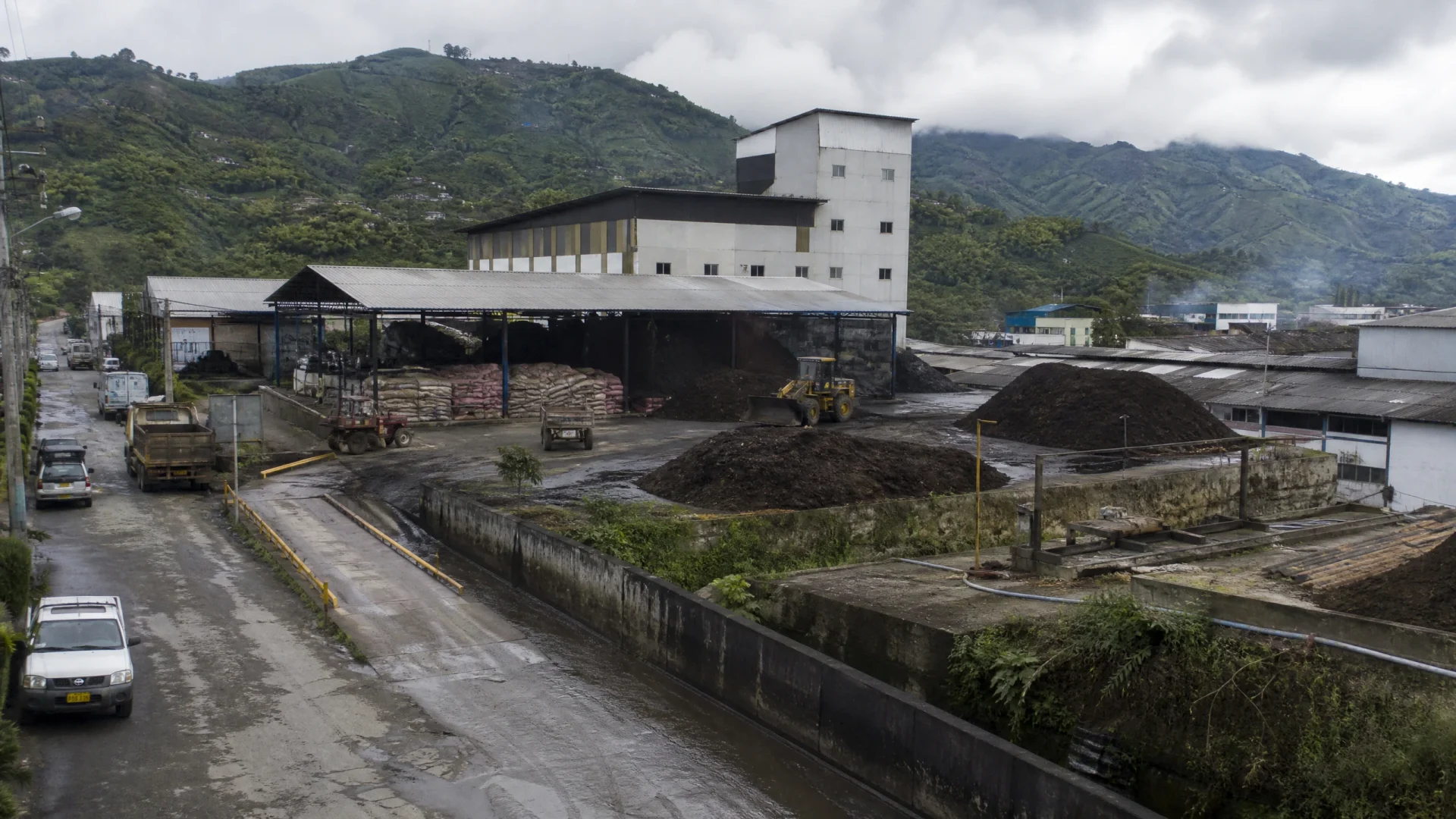
The site is organized from wet to dry rather than simply following the order of machines on a brochure. Trucks carrying manure remain near the wet-receiving side. Coffee husk and other dry structural materials enter covered storage. Fermentation occupies the largest land block because residence time, turning lanes and pile separation need space. Only mature compost crosses into the mechanical workshop, after which material moves toward cooling, bagging and a dry finished-product warehouse.
| Functional Zone | Planning Area | Layout Reason |
|---|---|---|
| Wet manure receiving | 800–1,000 m² | Impermeable floor, loader access and runoff control |
| Covered coffee-husk storage | 500–700 m² | Preserves the value of a relatively dry structural material |
| Fermentation and maturation | 3,500–4,500 m² | Three staggered zones plus turning and service lanes |
| Mechanical fertilizer workshop | 1,000–1,300 m² | Crushing, screening, mixing, pelletizing, cooling and packing |
| Finished-product warehouse | 900–1,200 m² | Dry storage for bagged commercial fertilizer |
| Utilities, maintenance and QC | 300–500 m² | Electrical, spare parts, testing and staff support |
| Roads and loading circulation | Balance of site | Truck turning, fire access and separation of wet/dry traffic |
A total land allowance of roughly 9,000–11,000 m² is practical for this arrangement. The project does not need a huge industrial estate, but it also cannot squeeze fermentation into whatever space remains after the workshop is built. Colombia’s rainfall pattern varies strongly by region and elevation, so roof coverage and drainage are finalized for the actual site.
The constant principle is to keep dry coffee husk and finished fertilizer protected from unnecessary rain while collecting contaminated wet-area runoff separately from clean stormwater.
RICHI MACHINERY
Product Control Comes before Market Claims
The plant sells a controlled fertilizer product, not simply “recycled manure in pellet form.” The main physical specification is a 6 mm organic fertilizer pellet, commonly cut to about 5–30 mm length depending on the die and cutter arrangement. Feed moisture is controlled before pelletizing, and finished moisture is normally brought to about 12–15% or below the registered product limit before long-term storage.
Formation rate, fines and breakage are checked during commissioning instead of being published as guaranteed numbers before the customer’s real formula is tested.
| Product Item | Project Basis | Commercial Control |
|---|---|---|
| Main diameter | 6 mm | Standard first-phase product |
| Optional diameters | 4–12 mm | Introduced only for confirmed buyer requirements |
| Typical pellet length | 5–30 mm | Adjusted by cutter and customer specification |
| Finished moisture | Normally ≤12–15% | Verified before storage and dispatch |
| Packaging | 25 kg and 40 kg | Dealer and commercial-farm channels |
| Formula declaration | Product-specific | Based on laboratory analysis and registration |
Colombian commercialization also changes what the factory has to document. A company that manufactures, formulates, packs or repacks fertilizers or soil conditioners for sale must register with ICA, and product composition, labeling and conformity requirements are governed through the fertilizer and soil-conditioner framework.
The customer therefore builds quality control around traceable raw-material lots, compost batches, formulation records and finished-product testing rather than treating registration as paperwork added after the factory is finished.
Coffee farms are a logical downstream customer, but the plant does not label every product as a coffee fertilizer. Crop positioning has to follow nutrient analysis, soil conditions and agronomic recommendations. The same mechanical platform can therefore supply products for coffee, fruit, vegetables, horticulture and other commercial crops without claiming that one cattle-manure-and-coffee-husk formula is universally appropriate.
RICHI MACHINERY
Pelletizing Extends the Sales Radius of the Compost
The customer’s commercial decision is to move part of the business beyond loose compost. Loose mature compost can still be sold locally, but its low bulk density and irregular physical form make longer-distance distribution less attractive. Pelletizing creates a denser, cleaner and more uniform product that can be weighed into repeatable bags, stacked in warehouses and sold through agricultural-input channels.
The value increase comes from product control and distribution reach, not from pretending that pelleting creates nutrients that were not already in the compost.
- 25 kg bags suit dealers, horticultural customers and higher-value formulated products.
- 40 kg bags reduce packaging cost per tonne for larger agricultural buyers.
- Bulk or big-bag supply can be added when a nearby commercial farm has the unloading system and order volume to justify it.
- Lot-based quality records let distributors compare repeat deliveries by actual specification instead of appearance alone.
This also gives the customer a way to manage seasonality. Coffee residues do not arrive evenly through the year, and manure supply can change with farm management and rainfall. The plant can carry mature compost and dry structural material as controlled inventory, then schedule formulation and bagging against sales rather than forcing every incoming tonne through the mechanical line immediately.
RICHI MACHINERY
Utilities Labor and Environmental Control Follow Different Duty Cycles
The FZLH420 main motor is 90 kW, but plant utility sizing must include the crusher, mixers, screens, cooler, conveyors, packing, dust extraction and workshop services. The mechanical plant is therefore treated as an electrical system in the roughly 180–260 kW installed-load class, depending on the final turner drives, conveying routes and packing level.
Annual electricity use is calculated from real duty cycles rather than multiplying every motor by the full operating calendar. Colombia’s current electrical installation work also has to comply with the applicable RETIE requirements and the local utility connection conditions.
Fresh water is used selectively for compost moisture correction, cleaning and staff facilities. The project does not add a large thermal dryer as the default response to wet manure. First, operators balance the compost recipe with dry structural material, aeration and controlled turning. If mature fertilizer still reaches the mechanical workshop above the feed-moisture target, the customer can use additional curing or a dedicated moisture-control step. This keeps purchased energy focused on a real process need.
Around 16–20 direct employees is a practical project basis. The roster covers receiving, loader and turner operation, compost monitoring, mechanical production, packing, quality control, maintenance and warehouse/logistics. The pellet line itself does not need all employees at once; biological monitoring, raw-material handling and warehouse work continue on a different schedule from the one primary mechanical production shift.
Environmental control begins in the wet yard. Manure receiving uses an impermeable surface and controlled drainage; covered coffee-husk storage avoids rain saturation; aerobic operation and correct porosity reduce odor risk; and dust extraction is concentrated around crushing, screening, pelletizing and packing. Clean stormwater is kept separate from contaminated runoff where the site layout permits.
The project does not publish invented odor or discharge limits—the final environmental controls follow the actual site permit and local authority requirements.
RICHI MACHINERY
RICHI Scope Delivery and Commissioning
The USD 350,000 figure represents the confirmed RICHI machinery and engineering scope for the project, including compost-preparation equipment, mature-compost crushing and screening, formulation mixing, one FZLH420 pellet mill, cooling, final screening, conveying, packing, dust-control interfaces and electrical/PLC integration. It is not presented as a fabricated all-in Colombia land-and-building cost.
Owner-side civil works, land, local utility connection and working capital remain separate where the available project record does not establish those amounts.
Execution is staged around the biological area rather than waiting until all machines arrive. First, the customer confirms supplier routes, drainage, fermentation-zone dimensions and wet/dry traffic. RICHI then freezes the equipment layout, manufactures the mechanical package and completes factory checks. Ocean freight leaves from Qingdao, while the Colombian entry port and inland route are selected according to the final project location and freight plan rather than guessed in the case copy.
On site, installation proceeds from receiving and compost-handling equipment toward the dry finishing workshop. No-load checks come before material commissioning. The first production trials use the customer’s own mature cattle-manure and coffee-residue compost so feeder behavior, crusher output, FZLH motor load, 6 mm pellet formation, cooling, fines and bagging accuracy can be tuned on the material the factory will actually sell.
Operator training follows the same logic. The compost team learns moisture, pile condition, turning and maturity release. The mechanical team learns crushing, screening, formulation, FZLH operation, die inspection, cooling and packing. Quality staff connect the two sections through lot records and laboratory checks. That division makes the fertilizer granulator equipment part of a controlled fertilizer system rather than an isolated machine.
RICHI MACHINERY
Expansion Follows the First Real Bottleneck
Future expansion starts with a question: which inventory is running out first? If mature compost accumulates while the FZLH420 is continuously loaded, the next constraint may be pelletizing, cooling or packing. If the pellet mill waits for material, adding another machine would create more idle capacity and the customer should expand fermentation or supplier intake first. If finished bags block the workshop, warehouse and dispatch become the priority.
The project therefore reserves expansion interfaces without buying equipment before the bottleneck exists.
This is the main lesson from the cattle manure and coffee husk fertilizer plant in Colombia. Coffee husk is valuable because it changes the physical behavior of a wet manure compost mix; three biological zones are valuable because they convert residence time into predictable inventory; and one properly supplied FZLH420 is valuable because it turns mature material into a saleable form at the rate the annual plan actually needs.
A customer evaluating a similar plant should begin with raw-material moisture, annual dry matter, coffee-residue type, composting area, climate exposure, required product registration, mechanical operating hours and buyer packaging—not with a list of machines. With those inputs, RICHI Machinery can size the fermentation inventory, dry finishing line and expansion interfaces around a production target the business can support.
● RICHI MACHINERY
RICHI Service

● Consulting
Customer Consultation
We want to have a deep understanding of your industrial process, to know your exact needs of feed, wood, biomass, fertilizer or other pellet processing.
● Design
fertilizer Pellet Plant Design
Based on your unique situation and industrial process, we will tailor complete pellet plant you need, and inform you of every additional detail that could facilitate operation, minimize total cost.

● Manufacturing
Equipment Manufacturing
The critical components of the of the complete pellet production line equipment are built in our own workshops in Asia. Additional equipment is manufactured by our worldwide network of reliable partners.

● Testing
Quality Inspection & Testing
Before leaving the factory, all equipment will be inspected by the quality inspection department. We can also provide customers with testing services from a single machine to a complete pellet plant system, and provide you with real actual data for “worry-free use.”

● Delivery
Equipment Delivery
In equipment boxing and packaging, we adopt professional packaging and modular solutions to ensure the safe and non-destructive delivery of pellet plant equipment.
● Installation
Installation & Commissioning
Whether you choose your own subcontractor for the erection phase or you want to install everything together with us, a Richi supervisor will be around to make sure everything is mounted in a safe and thorough way.

● Training
Staff Training
We provide comprehensive training for the technicians of each project. We can also continue to provide support for the technicians during latter project operation.
● After-sales
Project Follow-Up
When everything is up and running our Richiers will help you further whenever needed. We are ready to answer your call 24/7.We’ll also visit you regularly to learn about your needs.
Who we are
RICHI Machinery is one of the world’s leading suppliers of technology and services for the animal feed, aqua feed and pet food industries, also the largest pellet production line manufacturer in China.
Since 1995, RICHI’s vision to build a first-class enterprise, to foster first-class employees, and to make first-class contributions to society has never wavered.
In the past three decades, we have expanded our business to a wide range of areas, including animal feed mill equipment, aqua feed equipment, pet feed equipment, biomass pellet equipment, fertilizer equipment, cat litter equipment, municipal solid waste pellets equipment, etc.

1995
RICHI Established

2000+
Serving More Than 2000 Customers

120+
RICHI Employees

140+
Exported To 140 Countries