 0086-138 3838 9622
Twin Screw Extruded Fish Feed Mill Plant in Egypt
RICHI MACHINERY
Project Overview
A major aquaculture feed manufacturer reached out to RICHI Machinery about building a 6t/h twin screw extruded fish feed mill plant in Egypt with an annual capacity of 25,000 tons of extruded fish feed (running 20 hours per day, 2 shifts, 200 days per year). The facility produces high-quality floating and sinking pellets for tilapia, catfish, and other aquaculture species, serving fish farms across the Nile Delta and Upper Egypt regions.
The client is located in the Sharqia Governorate, about 80km northeast of Cairo, in an industrial zone near the Nile Delta. Egypt has one of the largest aquaculture industries in Africa, producing over 1.5 million tons of fish annually — mostly tilapia (70%), mullet, catfish, and carp. However, the country still imports significant volumes of extruded feed, creating an opportunity for local production.
The client already operated a 120,000 tons/year poultry livestock feed production line and a 15,000 tons/year shrimp feed line. This new 25,000 tons/year extruded fish feed production line is an expansion, located in an existing 5-story shrimp feed building. The client invested heavily in environmental controls, including:
- Pulse bag filters at all dust points
- Spray towers for particulate scrubbing
- Biofilter + activated carbon + catalytic oxidation for odor control (from drying and extrusion)
- A 40m stack for the main exhaust (higher than surrounding buildings to avoid odor complaints)
Total investment was about $ 1.25 million USD.
6T/H
capacity
$ 1.25 million
investment
Egypt
location
Feed
project type
RICHI MACHINERY
Why Egypt?
Egypt’s aquaculture sector is the largest in Africa and the 7th largest in the world. Key indicators:
| Parameter | Value |
|---|---|
| Total fish production | 1.5-1.8 million tons/year |
| Tilapia production | 1.0-1.2 million tons/year (70% of total) |
| Catfish, mullet, carp | 300,000-500,000 tons/year |
| Aquaculture farms | 15,000+ (mostly in Nile Delta) |
| Feed demand (extruded) | 500,000+ tons/year |
| Current local production (extruded) | 200,000-250,000 tons/year |
| Import volume | 250,000+ tons/year |
The opportunity: Extruded feed is superior to pelleted feed for fish because:
- Extruded pellets float (tilapia feed) or sink slowly (catfish feed)
- Extrusion gelatinizes starch (improves digestibility by 15-20%)
- Extrusion kills pathogens (Salmonella, E. coli)
- Extruded pellets have better water stability (don’t disintegrate in water)
The client’s target market:
| Customer segment | Annual demand (tons) | Client’s target |
|---|---|---|
| Tilapia farms (Nile Delta) | 300,000 | 15,000 |
| Catfish farms | 50,000 | 5,000 |
| Other species (mullet, carp) | 150,000 | 5,000 |
| Total | 500,000 | 25,000 |
The client’s breakeven point is 15,000 tons/year (60% capacity). Their existing distribution network to 1,500+ fish farms guarantees 10,000 tons, so they need only 5,000 additional tons to break even.
RICHI MACHINERY
Raw Materials: 50+ Ingredients for High-Quality Fish Feed
The client uses an extensive list of ingredients. Key ingredients include:
| Ingredient Category | Examples | Annual (tons) | Function |
|---|---|---|---|
| Grains | Barley (726t), corn (0.55t), low/high gluten flour (3,095t), rice bran (1,599t) | ~5,500 | Energy, structure |
| Plant proteins | 43-46% soybean meal (5,825t), cottonseed meal (1,560t), rapeseed meal (1,858t), peanut meal (952t), corn gluten meal (467t) | ~10,900 | Protein |
| Animal proteins | Fish meal (multiple grades, 2,600t), shrimp meal (246t), chicken meal (1,056t), pork meal (636t), blood meal (12t) | ~4,600 | Protein, palatability |
| Oils & fats | Soybean oil (825t), phospholipid oil (164t), fish oil (86t) | ~1,075 | Energy, EPA/DHA |
| Premixes & additives | 20+ custom premixes for specific species (tilapia, catfish, yellow catfish, crab, etc.) | ~500 | Vitamins, minerals |
| Binders & minerals | Bentonite (235t), zeolite (not in this line?), calcium phosphate (443t), limestone (556t), squid paste (293t) | ~1,600 | Binding, calcium, phosphorus |
| Total input | ~25,000 | — |
Note on fish meal grades: The client uses fish meal from multiple sources — Japanese grade (1,422t), Taiwanese grade (234t), Thai grade (89t), Mauritania (243t), Danish (53t), US red (102t), Vietnamese (32t), domestic grades B and D (244t). This ensures consistent protein (65-70%) and amino acid profile.
Raw material storage:
- Bulk grains: in silos
- Bagged ingredients: 2,000m² raw material warehouse (25kg, 50kg, 70kg, 100kg, 200kg bags)
- Liquids (oils, squid paste): 2 × 50m³ tanks for soybean phospholipid oil
RICHI MACHINERY
Site and Building Layout (Existing 5-Story Building)
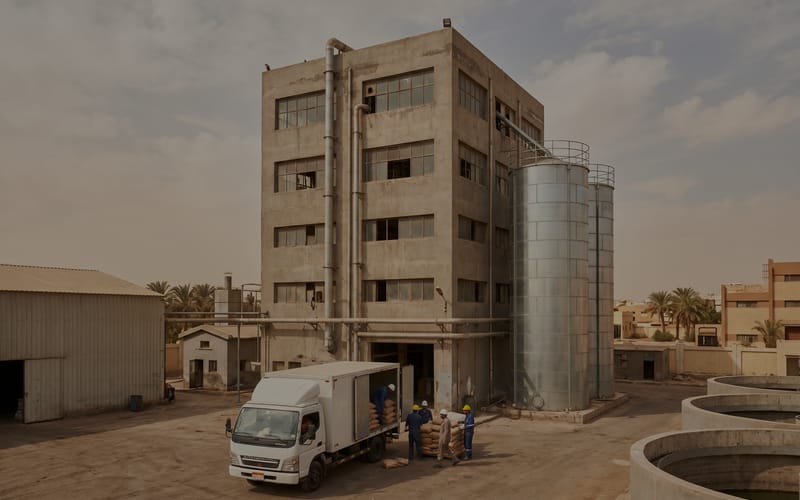
The client’s Twin Screw Extruded Fish Feed Mill Plant in Egypt is in Sharqia Governorate, about 80km northeast of Cairo. The site has:
| Building | Function | Size |
|---|---|---|
| 5-story main building (existing) | Shrimp feed + this new extruded feed line | ~1,500m² footprint |
| Raw material warehouse | Storage for bagged ingredients | 2,000m² |
| Finished goods warehouse | Bagged extruded feed | 1,000m² |
| Office, lab, cafeteria | Admin and QC | Existing |
| Boiler house | Steam supply | — |
| Wastewater treatment | 3 × 10m³ septic tanks + 10m³ settling pond | — |
The extruded aqua feed production line is on the 5th and 4th floors of the shrimp feed building (the shrimp feed line uses other floors). The client added new equipment on the upper floors, with gravity flow to lower floors for packaging.
Floor plan (extruded feed line only):
| Floor | Function | Equipment |
|---|---|---|
| 5th floor (top) | Raw material intake, cleaning, batching | Pulse filters, bucket elevators, cleaners, magnets, 23 ingredient bins |
| 4th floor | First mixing, grinding | Mixers, hammer mill, ultra-fine mills (2) |
| 3rd floor | Second batching, second mixing | 3 ingredient bins, mixer |
| 2nd floor | Extrusion, drying, oil coating | Twin-screw extruder, dryer, coater |
| 1st floor (ground) | Cooling, screening, packaging | Cooler, screener, bagging scale, robot palletizer |
RICHI MACHINERY
Equipment Configuration
The client chose a complete twin-screw extruded floating fish feed production line from RICHI.
Equipment by section:
| Section | Equipment | Quantity | Power (each) | Notes |
| Receiving & cleaning | Pulse bag filter | 2 | 7.5 kW | Dust control |
| Drag chain conveyor | 2 | 5.5 kW | Transport | |
| Bucket elevator | 2 | 11-15 kW | Vertical lift | |
| Cleaner | 2 | 4 kW | Removes stones, debris | |
| Magnetic separator | 2 | — | Removes ferrous metal | |
| Rotary distributor | 2 | 1.5 kW | Distributes to bins | |
| First batching | Ingredient bins | 23 | — | 12-15m³ each |
| Screw feeders | 23 | 1.5-3 kW | For each bin | |
| Batching scales | 3 | — | 1,000kg + 250kg | |
| Feed mixer machine | 2 | 30 kW | Twin-shaft, 2m³ | |
| First grinding | Hammer mill feed grinder | 1 | 160 kW | 66mm rotor × 125mm width |
| Second grinding (ultra-fine) | Ultra-fine micro pulverizer | 2 | 132 kW each | For fish feed (100-200 microns) |
| Cyclone | 2 | — | Primary dust separation | |
| Pulse bag filter | 2 | 15 kW | Dust collection | |
| High-pressure fan | 2 | 37 kW | Airflow | |
| High-frequency screener | 2 | 5.5 kW | Particle size control | |
| Second batching | Ingredient bins | 3 | — | For micro-ingredients |
| Screw feeders | 3 | 1.5 kW | ||
| Batching scale | 1 | — | ||
| Mixer | 1 | 11 kW | ||
| Extrusion | Twin screw extruder | 1 | 250-315 kW | 166mm twin screws |
| Single-shaft conditioner | 1 | 15 kW | Steam conditioning | |
| Twin-shaft differential conditioner | 1 | 22 kW | High-shear conditioning | |
| Drying | Fish feed dryer machine | 1 | 150 kW (heaters) + 30 kW fans | Belt dryer, multi-pass |
| Cyclone | 1 | — | Dust/fines recovery | |
| Oil coating | Oil sprayer | 1 | 11 kW | Vacuum coating |
| Cooling & packaging | Counterflow cooler | 1 | 15 kW fan | Grading |
| Screener | 2 | 5.5 kW each | ||
| Bagging scale | 2 | 3 kW | 25kg bags | |
| Robot palletizer | 1 | — | Shared with shrimp line | |
| Dust & odor control | Pulse bag filter | Multiple | — | For all dust points |
| Spray tower | 1 | — | For dryer exhaust | |
| Biofilter + activated carbon + catalytic oxidation | 1 set | 75 kW fans | For odor (extruder + dryer) |
RICHI MACHINERY
Process Flow
This is a sophisticated Twin Screw Extruded Fish Feed Mill Plant in Egypt for high-quality extruded fish feed. Key differences from pelleted feed: two-stage grinding (hammer mill + ultra-fine), two-stage batching, twin-screw extrusion, drying, and oil coating.
Step 1: Raw Material Receiving and Cleaning
Bagged ingredients: Forklifts unload pallets into the raw material warehouse (2,000m²). Operators manually dump bags into the intake hopper (with dust collection). The material is lifted to the 5th floor by bucket elevator.
Bulk grains (barley, corn): Pneumatic tankers unload into receiving pits, then bucket elevators lift to cleaning.
Cleaning equipment on 5th floor (per line):
- Drum pre-cleaner (SCQZ90×80×110) — removes stones, twine, debris
- Magnetic separator (TCXT25) — removes ferrous metal
After cleaning, material is distributed to 23 ingredient bins by rotary distributor.
Step 2: First Batching and Mixing
Fish feed requires precise batching of 20+ ingredients. The client uses 3 scales: 1,000kg for major ingredients, 250kg for minors, and 50kg for micros.
Batching sequence (automated by PLC):
- Major ingredients (grains, protein meals) feed from bins via screw feeders (TLSUW20)
- Scale fills to target (accuracy ±0.1%)
- Discharge to mixer (SLHSJ2A, 30 kW)
First mixer parameters:
- Type: Twin-shaft paddle
- Capacity: 2m³ (≈ 1,200-1,500 kg per batch)
- Mix time: 90-120 seconds
- Coefficient of variation (CV): <5%
Step 3: First Grinding (Hammer Mill)
After first mixing, the material goes to the hammer mill for coarse grinding.
Hammer mill parameters:
- Rotor width: 125mm
- Screen size: 1.5mm (for fish feed — finer than livestock feed)
- Throughput: 5-6 t/h
Step 4: Second Grinding (Ultra-Fine — Critical for Fish Feed)
Fish require very fine particles (100-200 microns) for optimal digestibility. Pelleted feed for chickens is 800-1,200 microns — 4-6x coarser.
The pre-ground material is conveyed to two ultra-fine mills (SWFL017C, 132 kW each).
Ultra-fine mill parameters (each):
- Type: High-speed hammer mill with built-in classifier
- Particle size: 100-200 microns (0.1-0.2mm)
- Screen size: 0.8-1.0mm
- Rotor speed: 4,500+ RPM
Step 5: Second Batching and Mixing (Micro-Ingredients)
The ultra-fine ground material is lifted to 3 ingredient bins on the 3rd floor. Micro-ingredients (premix, minerals, small-quantity proteins) are added at this stage.
Second mixer (SLHSJ0.5A, 11 kW):
- Capacity: 0.5m³ (≈ 300-400 kg per batch)
- Mix time: 60-90 seconds
Step 6: Extrusion (Twin-Screw)
This is the heart of the aqua feed plant. Twin-screw extrusion is superior to single-screw for fish feed because it provides better mixing, higher shear, and more uniform cooking.
The final mix is conveyed to the twin-screw floating fish feed extruder machine on the 2nd floor.
Conditioning system (steam injection):
- Single-shaft conditioner — low-shear preconditioning
- Twin-shaft differential conditioner — high-shear, high-temperature
Conditioning parameters:
| Parameter | Value |
|---|---|
| Steam temperature | 150-160°C |
| Material temperature after conditioner | 90-110°C |
| Steam addition | 5-10% of feed mass |
| Retention time | 30-90 seconds |
Twin-screw extruder parameters (SJPS166×2):
| Parameter | Value |
|---|---|
| Screw diameter | 166 mm |
| Number of screws | 2 (co-rotating) |
| Screw L/D ratio | 16:1 to 20:1 (adjustable) |
| Die hole diameter | 2-8 mm (depending on species) |
| Throughput | 5-6 t/h |
Production capabilities:
| Product | Die size | Characteristics |
|---|---|---|
| Tilapia floating feed | 3-4 mm | Floating pellets, 30-40% protein |
| Catfish sinking feed | 4-6 mm | Slow-sinking, 28-32% protein |
| Starter feed (fry) | 0.5-1 mm (crumbles) | After crumbler |
Step 7: Drying
Wet pellets (20-25% moisture) from the extruder drop onto the belt dryer.
Dryer parameters:
- Type: Multi-pass belt dryer
- Temperature: 80-100°C
- Retention time: 20-40 minutes
- Outlet moisture: 8-10%
Energy source: Steam from district heating. The client uses 9,132 tons of steam annually. No coal or gas boiler on site — the client connects to the industrial park’s central steam system.
Odor control at dryer: The mesh belt dryer exhaust (containing volatile organic compounds from fish meal) is captured and sent to:
- Spray tower — removes particulate
- Biofilter — breaks down organic odors
- Activated carbon — polishes residual odors
- Catalytic oxidation — final treatment
- 40m stack (higher than surrounding buildings to avoid complaints)
Step 8: Oil Coating (Vacuum)
Dried pellets (8-10% moisture) are conveyed to the vacuum oil sprayer.
Oil coating parameters:
- Type: Vacuum coating
- Oil addition: 5-10% of pellet mass (fish oil, soybean oil, phospholipid oil)
- Vacuum pressure: -0.6 to -0.8 bar
- Oil penetration: Deep into pellet (not just surface)
Why vacuum coating? Standard spray coating only coats the surface. Vacuum coating pulls air out of the pellets, then oil is sucked deep into the pores. This improves:
- Oil retention (less dust during handling)
- Palatability (oil throughout the pellet)
- Shelf life (oil is protected from oxidation)
Step 9: Cooling and Screening
Oil-coated pellets (still warm, 50-60°C) go to the counterflow cooler.
Cooler parameters:
- Retention time: 10-15 minutes
- Outlet temperature: ambient + 5-8°C (25-30°C in Cairo)
Screening: Cooled pellets pass through two screeners:
- Primary screener — removes oversized pellets (return to extruder)
- Secondary screener — removes fines (return to start)
Step 10: Packaging
Finished pellets are stored in 5 finished bins on the 1st floor.
Packaging line:
- Two bagging scales — 25kg bags
- Conveyor and bag sealer
- Robot palletizer (shared with shrimp feed line)
Packaging speed: 8-10 bags/minute per scale × 2 = 16-20 bags/minute (about 24-30 tons/hour, well above line capacity).
RICHI MACHINERY
Utilities and Consumption
| Utility | Annual consumption | Source | Cost (EGP) | Cost (USD at 50 EGP/USD) |
|---|---|---|---|---|
| Electricity | 7,550,000 kWh | Grid | 15.1 million | $302,000 |
| Steam (district heating) | 20,000 tons | Power plant | 10 million | $200,000 |
| Water | 640 m³ | Municipal + deep well | 32,000 | $640 |
Electricity breakdown (annual, 200 days, 20 hours/day = 4,000 hours):
| Equipment | kW average | Hours/day | kWh/day | kWh/year |
|---|---|---|---|---|
| Receiving & cleaning | 30 | 10 | 300 | 60,000 |
| Bucket elevators (multiple) | 40 | 20 | 800 | 160,000 |
| Hammer mill | 120 | 10 | 1,200 | 240,000 |
| Ultra-fine mills (2) | 200 (100 each avg) | 20 | 4,000 | 800,000 |
| Cyclones, fans, bag filters | 60 | 20 | 1,200 | 240,000 |
| Batching & mixing (multiple) | 40 | 20 | 800 | 160,000 |
| Extruder | 200 | 20 | 4,000 | 800,000 |
| Dryer fans & heaters | 100 | 20 | 2,000 | 400,000 |
| Oil coater | 8 | 20 | 160 | 32,000 |
| Cooler fan | 12 | 20 | 240 | 48,000 |
| Screeners, conveyors | 20 | 20 | 400 | 80,000 |
| Bagging scales & robot | 15 | 16 | 240 | 48,000 |
| Odor control (blowers, etc.) | 50 | 20 | 1,000 | 200,000 |
| Lighting, office, lab | 20 | 20 | 400 | 80,000 |
| Total | ~915 | — | 16,740 | 3,348,000 kWh |
RICHI MACHINERY
How RICHI Customized This Line for Fish Feed
The client had specific requirements that shaped the equipment design:
Requirement 1: The client needed both floating (tilapia) and sinking (catfish) pellets from the same line. Floating pellets require lower density (by adding air during extrusion), sinking pellets require higher density.
RICHI solution: The twin-screw extruder (SJPS166×2) has adjustable screw configuration and die design. For floating pellets:
- Higher screw speed (400-500 RPM)
- More shear sections in the screw
- Die hole size 3-4mm
For sinking pellets:
- Lower screw speed (250-350 RPM)
- Less shear
- Die hole size 4-6mm
The client can switch between floating and sinking in about 2 hours (change screw configuration and die).
Requirement 2: The client had strict odor control requirements because the facility is near residential areas (the Nile Delta is densely populated). Fish meal odors are strong, and the drying process releases volatile organic compounds.
RICHI solution: Multi-stage odor control:
- Enclosed equipment at all odor points (extruder, dryer)
- Spray tower — removes particulate
- Biofilter — breaks down organic odors
- Activated carbon — polishes residual odors
- Catalytic oxidation — final treatment for VOCs
- 40m stack (higher than surrounding buildings)
Requirement 3: The client has limited qualified operators in Egypt. They needed a system that is easy to operate and maintain.
RICHI solution:
- Centralized PLC control system with touchscreen interface (in Arabic and English)
- Automatic startup/shutdown sequences
- Alarm system for abnormal conditions (bearing temperature, motor overload, vibration)
- Provided a 5-week on-site training program:
- Week 1-2: Basic safety, machine operation, daily checks
- Week 3: Extruder screw configuration, die changes
- Week 4-5: Troubleshooting and maintenance
Requirement 4: The client has no on-site boiler (uses district heating from a steam system). The client needed a line that could use steam from an external source.
RICHI solution: The conditioner and dryer use steam at 5-6 bar. The client installed a steam pressure reducing station and flow meters to monitor consumption.
RICHI MACHINERY
Product Specifications
The client’s extruded fish feed meets Egyptian standards (ES: 4920/2005 for fish feed).
Tilapia floating feed (3mm, 32% protein):
| Parameter | Value |
|---|---|
| Pellet diameter | 3-3.5 mm |
| Length | 4-6 mm |
| Bulk density (floating) | 450-550 g/L |
| Water stability | >2 hours |
| Protein | 32-35% |
| Lipid (oil) | 5-7% |
| Moisture | 8-10% |
| Floating time | >30 minutes |
Catfish sinking feed (5mm, 28% protein):
| Parameter | Value |
|---|---|
| Pellet diameter | 5-5.5 mm |
| Length | 6-8 mm |
| Bulk density (sinking) | 650-700 g/L |
| Water stability | >3 hours |
| Protein | 28-30% |
| Lipid | 4-6% |
| Moisture | 8-10% |
Pricing (as of October 2025):
| Product | Price (EGP/ton) | Price (USD/ton at 50 EGP/USD) |
|---|---|---|
| Tilapia floating (25kg bags) | 25,000 | $500 |
| Catfish sinking (25kg bags) | 22,000 | $440 |
| Bulk (30-ton truckload) | 20,000-22,000 | $400-440 |
Comparison with imported feed:
| Source | Price (USD/ton) | Delivery time |
|---|---|---|
| Client’s product | $400-500 | 1-2 days |
| Imported (China) | $550-650 | 30-45 days |
| Imported (Europe) | $700-800 | 45-60 days |
RICHI MACHINERY
Market Outlook for Extruded Fish Feed in Egypt
Egypt’s aquaculture sector is growing at 5-8% annually. Key drivers:
1. Government support for aquaculture. The government’s “1.5 Million Feddan” project (land reclamation in the desert) includes fish farming in new agricultural areas.
2. Protein demand. Egypt’s population of 110+ million is growing. Fish is a primary protein source (cheaper than beef or chicken).
3. Import substitution. Imported extruded feed is expensive and often delayed. The client’s local production is 15-25% cheaper.
4. Technology upgrade. Many Egyptian fish farms still use pelleted feed or even raw ingredients (maize, soybean meal). Extruded feed improves feed conversion ratio (FCR) from 1.8:1 to 1.4:1 — 30% less feed for the same fish growth.
Competition: There are 15-20 extruded feed producers in Egypt (10,000-50,000 tons/year). The client’s 25,000 tons/year puts them in the top tier.
Challenges the client is managing:
| Challenge | Mitigation |
|---|---|
| Imported ingredients (fish meal) | Lock in 6-month contracts with importers; maintain 60-day inventory |
| Raw material price volatility | Diversify fish meal sources (8 countries) |
| Electricity load shedding | 500 kVA diesel generator for critical equipment (extruder, dryer) |
| Competition from cheap pelleted feed | Educate farmers on FCR benefits; offer floating feed for tilapia (pelleted feed sinks into mud, wasted) |
The client’s breakeven point is 15,000 tons/year (60% capacity). At full capacity (25,000 tons/year), operating margin is about 20-25%. Payback on equipment ($1.85 million) is about 3 years.
RICHI MACHINERY
Why a Twin-Screw Extruded Fish Feed Line Makes Sense in Egypt
Egypt has a large aquaculture sector, growing fish consumption, and government support. Here’s why you should consider this market:
The Nile Delta is the ideal location. Raw materials (soybean meal, corn, wheat) arrive at Alexandria port. Fish farms are in the Delta. The client’s facility is centrally located.
Imported fish meal is available. Alexandria port handles fish meal from Peru, Chile, Denmark, and Vietnam. The client uses 2,600+ tons of fish meal annually.
Steam is available (district heating). The client doesn’t need an on-site boiler — they connect to the industrial park’s steam system. This reduces capital cost and eliminates boiler emissions.
The market is growing. Egyptians are eating more fish. Extruded feed is the future.
If you’re considering an extruded fish feed line in Egypt (or any country with aquaculture), RICHI can help. We’ve designed twin-screw extruder lines for tilapia, catfish, shrimp, and other species. We understand the challenges (fine grinding, odor control, steam conditioning, oil coating) and can recommend the right equipment.
Contact us to discuss your fish feed mill project. Tell us about your target species (tilapia, catfish, shrimp), raw materials, site conditions, and budget. We’ll prepare a customized process flow, equipment list, and budget estimate — no obligation.
● RICHI MACHINERY
RICHI Service

● Consulting
Customer Consultation
We want to have a deep understanding of your industrial process, to know your exact needs of feed, wood, biomass, fertilizer or other pellet processing.

● Design
aqua feed Plant Design
Based on your unique situation and industrial process, we will tailor complete pellet plant you need, and inform you of every additional detail that could facilitate operation, minimize total cost.
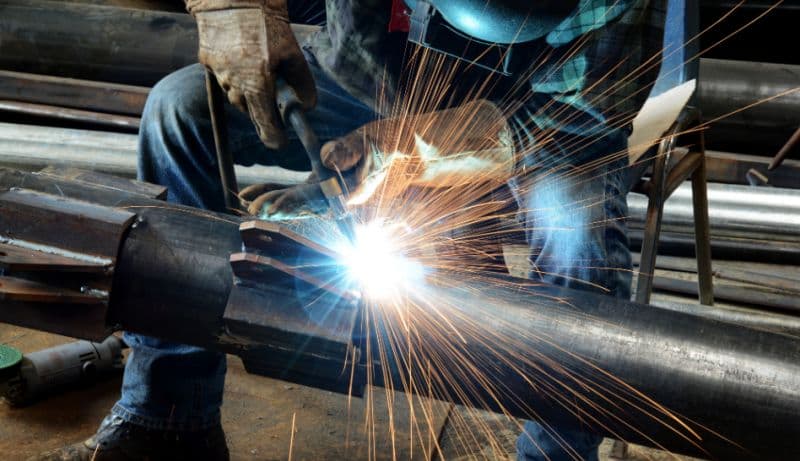
● Manufacturing
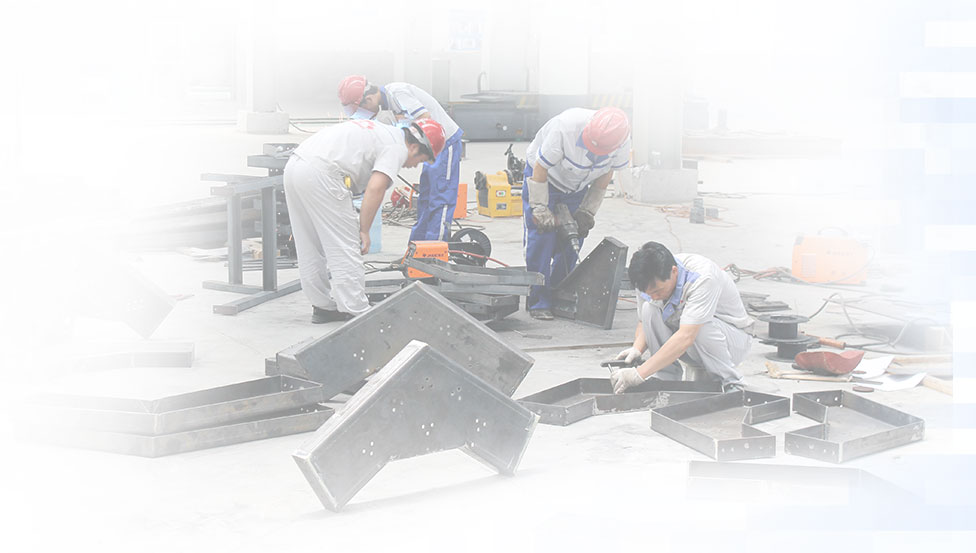
Equipment Manufacturing
The critical components of the of the complete pellet production line equipment are built in our own workshops in Asia. Additional equipment is manufactured by our worldwide network of reliable partners.
● Testing
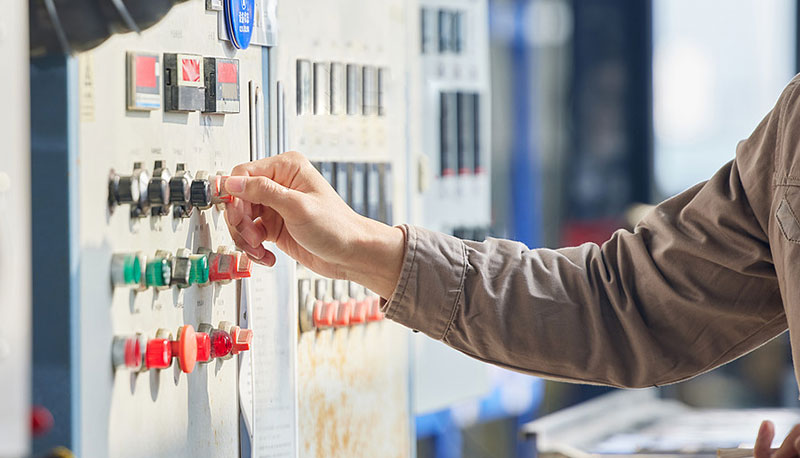
Quality Inspection & Testing
Before leaving the factory, all equipment will be inspected by the quality inspection department. We can also provide customers with testing services from a single machine to a complete pellet plant system, and provide you with real actual data for “worry-free use.”

● Delivery
Equipment Delivery
In equipment boxing and packaging, we adopt professional packaging and modular solutions to ensure the safe and non-destructive delivery of pellet plant equipment.
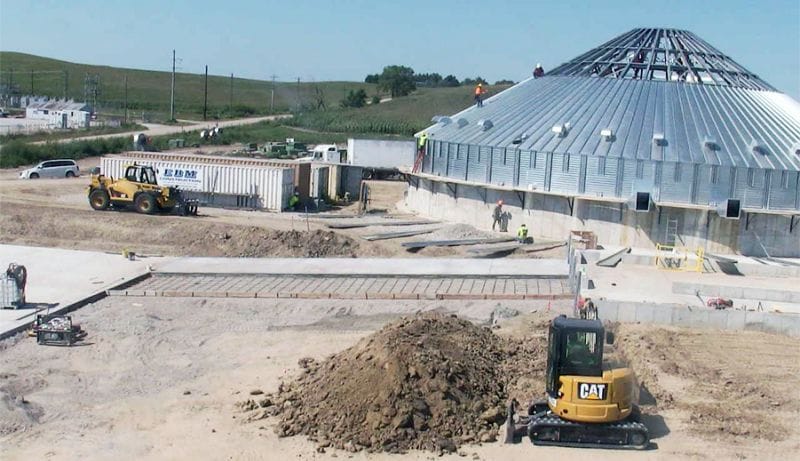
● Installation
Installation & Commissioning
Whether you choose your own subcontractor for the erection phase or you want to install everything together with us, a Richi supervisor will be around to make sure everything is mounted in a safe and thorough way.

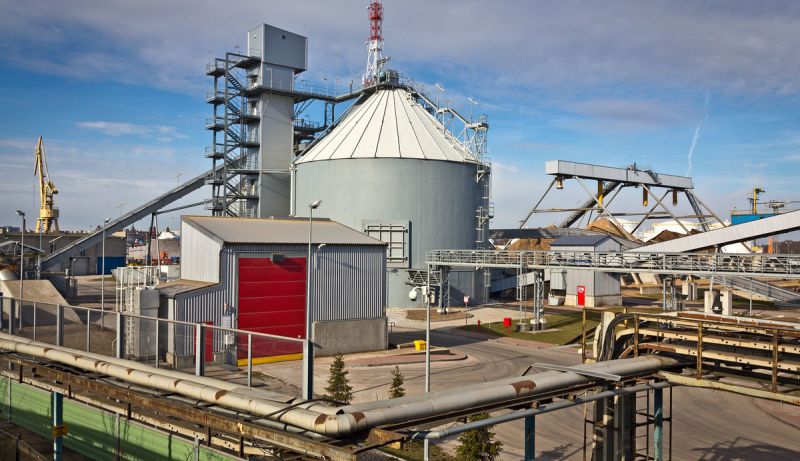
● Training
Staff Training
We provide comprehensive training for the technicians of each project. We can also continue to provide support for the technicians during latter project operation.
● After-sales
Project Follow-Up
When everything is up and running our Richiers will help you further whenever needed. We are ready to answer your call 24/7.We’ll also visit you regularly to learn about your needs.
Who we are
RICHI Machinery is one of the world’s leading suppliers of technology and services for the animal feed, aqua feed and pet food industries, also the largest pellet production line manufacturer in China.
Since 1995, RICHI’s vision to build a first-class enterprise, to foster first-class employees, and to make first-class contributions to society has never wavered.
In the past three decades, we have expanded our business to a wide range of areas, including animal feed mill equipment, aqua feed equipment, pet feed equipment, biomass pellet equipment, fertilizer equipment, cat litter equipment, municipal solid waste pellets equipment, etc.

1995
RICHI Established

2000+
Serving More Than 2000 Customers

120+
RICHI Employees

140+
Exported To 140 Countries