 0086-138 3838 9622
Biochar Fuel Pellet Production Line in Croatia
RICHI MACHINERY
Project Overview
A biomass processing company reached out to RICHI Machinery about building a 4t/h biochar fuel pellet production line in Croatia with an annual capacity of 10,000 tons of products (4,000 tons of fuel pellets + 6,000 tons of biochar) when operating at full capacity (two phases, Phase 1 and Phase 2 each 5,000 tons/year).
The facility produces both standard biomass fuel pellets and high-value biochar pellets from agricultural residues (sawdust, peanut hulls, rice husks, straw, cotton stalks, vegetable waste) using a two-stage process: first drying and pelletizing, then high-temperature carbonization (350-450°C) to produce biochar with 27-33 MJ/kg calorific value.
The client is located in the Osijek-Baranja County of eastern Croatia, about 250km east of Zagreb. This region is Croatia’s agricultural heartland — the “Granary of Croatia” — producing vast amounts of wheat, corn, sunflowers, and soybeans. The area generates hundreds of thousands of tons of crop residues annually, most of which are currently burned in the fields or left to rot. The client saw an opportunity to convert this waste into premium fuel products for the Croatian and wider EU market.
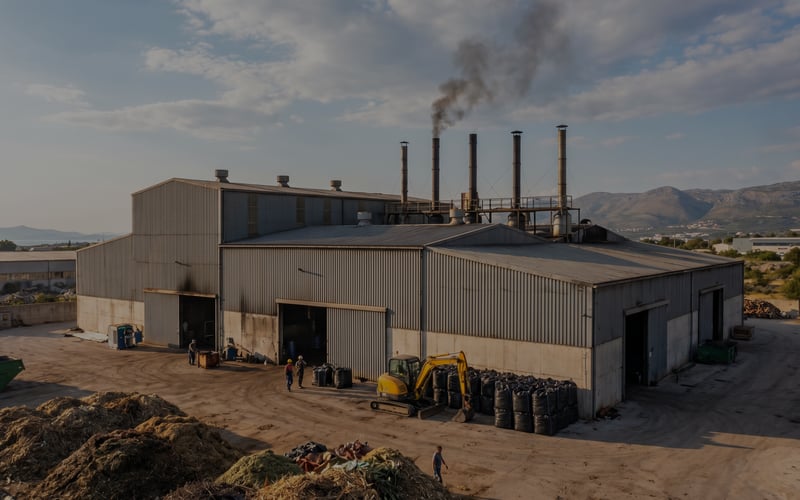
The client use a 3,000m² production building on the site. The site includes raw material storage, processing areas, and finished product storage.
4T/H
capacity
$285,000
investment
Croatia
location
Biofuel
project type
RICHI MACHINERY
Why Croatia?
Croatia is a newer EU member with growing biomass markets:
| Parameter | Value |
|---|---|
| Agricultural land | 1.5+ million hectares |
| Corn production | 2+ million tons/year → 2+ million tons stalks |
| Wheat production | 800,000+ tons/year → 800,000+ tons straw |
| Sunflower production | 500,000+ tons/year → husks and stalks |
| Forest cover | 44% of land area |
| Current pellet production | 100,000-150,000 tons/year |
| EU renewable energy target for Croatia | 36% by 2030 |
The opportunity: Biochar pellets have higher calorific value (27-33 MJ/kg) than standard wood pellets (16-18 MJ/kg) and are increasingly used in steel production, industrial boilers, and as a coal substitute. The client can sell biochar pellets for €300-400/ton — double the price of standard pellets.
Target customers:
| Customer segment | Location | Annual demand (tons) | Price (EUR/ton) |
|---|---|---|---|
| Steel industry (as reducing agent) | Sisak, Croatia | 50,000+ | 350-450 |
| Industrial boilers (co-firing) | Croatia, Hungary | 30,000+ | 250-300 |
| Soil amendment (agriculture) | Croatia | 20,000+ | 200-250 |
| Export to Austria/Italy | EU | 100,000+ | 300-400 |
RICHI MACHINERY
Raw Materials: Agricultural and Wood Processing Waste
The client’s raw material comes from local farms and wood processors:
| Raw Material | Annual (tons) | Moisture (%) | Source | Cost (EUR/ton) | USD/ton (1.05 EUR/USD) |
|---|---|---|---|---|---|
| Sawdust | 8,000 | 35% | Local sawmills | 15 | $15.75 |
| Peanut hulls | 4,000 | 35% | Local farms | 10 | $10.50 |
| Rice husks | 4,000 | 35% | Rice mills | 12 | $12.60 |
| Straw | 4,000 | 35% | Wheat farms | 8 | $8.40 |
| Cotton stalks | 4,000 | 35% | Cotton farms | 8 | $8.40 |
| Vegetable waste | 4,000 | 35% | Farms | 5 | $5.25 |
| Total input (Phases 1+2 combined) | 30,466 | — | — | — | — |
The client’s raw material processing:
- Materials that need crushing: straw, cotton stalks, vegetable waste
- Materials that do not need crushing: sawdust, peanut hulls, rice husks
Raw material moisture: All raw materials enter at 35% moisture. The client uses:
- Electric low-temperature dryer (60°C) to reduce moisture to 10% for pelletizing
- High-temperature carbonization (350-450°C) partially dries further during pyrolysis
RICHI MACHINERY
The Site and Building
The client’s site is in an industrial zone in Osijek-Baranja County. The building is a single-story steel-framed structure with a concrete floor and 8m ceiling height.
Building layout (3,000m²):
| Zone | Size (approx.) | Equipment |
|---|---|---|
| Raw material storage | ~500m² (northwest) | Stacked agricultural residues |
| Crushing area | ~300m² | Crusher (1 unit) |
| Low-temperature drying | ~300m² | Electric dryer (60°C) |
| Pelletizing area | ~500m² | 5 briquette presses, 0.3 t/h each |
| High-temperature carbonization | ~600m² | 10 carbonization furnaces, 1.5 t/day each |
| Cooling/separation | ~300m² | Gas condensation and separation system |
| Finished product storage | ~300m² (south side) | Bagged pellets and biochar |
| Hazardous waste storage | ~50m² | Wood tar storage |
| Office | — | Management (off-site) |
RICHI MACHINERY
Equipment Configuration
The client chose a two-stage biomass pellet production line with Phase 1 (5 units) and Phase 2 (additional 5 units):
| Equipment | Quantity | Power (each) | Function |
|---|---|---|---|
| Crusher | 1 | 22-30 kW | Crushing straw/cotton stalks to 2-3cm |
| Low-temperature dryer | 1 | 45 kW (heating) + 15 kW fan | 60°C, reduces moisture to 10% |
| Biomass pellet mill | 1 | 90 kW | Producing pellets |
| Biomass pellet press | 1 | 90 kW | Additional capacity |
| Carbonization furnace | 1 | 7.5 kW fan | High-temperature pyrolysis (60-450°C) |
| Carbonization furnace | 1 | 7.5 kW fan | Additional capacity |
| Gas collection system | 1 set | — | Collecting pyrolysis gases |
| Electrostatic precipitato | 1 set | 30 kW | Treating carbonization exhaust |
| Bag filter | 1 set | 30 kW fan | Treating crushing/drying/pelletizing dust |
| Material conveyors | 4 sets | 3-5 kW each | Transport |
Equipment cost (FOB Qingdao): $285,000 USD
Why this configuration for biochar pellets (4 t/h, 10,000 tons/year products):
1. Two-stage drying. Low-temperature dryer (60°C, electric) removes moisture before pelletizing. High-temperature carbonization (350-450°C) further processes the pellets into biochar.
2. 2 biomass granulators (2 t/h each). Combined capacity is 3 t/h. The client runs for 4 t/h of pellets, then carbonizes them.
3. 10 carbonization furnaces (1.5 t/day each). Each furnace processes 1.5 tons of pellets per day (0.0625 t/h). With 10 furnaces, capacity is 0.625 t/h of biochar (15 t/day). The yield is about 33% (from 30,466 tons of raw material → 10,000 tons of product after drying and carbonization losses).
4. Byproduct recovery. The carbonization process produces:
- Wood gas — 8,700 tons/year — burned in the furnaces for heat
- Wood vinegar — 960 tons/year — sold as a byproduct (agricultural use)
- Wood tar — 240 tons/year — hazardous waste, sent to licensed disposal
RICHI MACHINERY
Process Flow
Stage 1: Raw Material Preparation (Pellets)
Step 1: Raw Material Receiving
Trucks deliver sawdust, peanut hulls, rice husks, straw, cotton stalks, and vegetable waste. Raw material is stored in the 500m² raw material storage area (northwest).
Step 2: Crushing (for straw, cotton stalks, vegetable waste only)
Large material (straw, cotton stalks, vegetable waste) is fed into the crusher.
Crusher parameters:
- Output size: 2-3cm pieces
- Throughput: 0.5 t/h
Step 3: Low-Temperature Drying
All material (crushed + fine material) is fed into the electric low-temperature dryer.
Dryer parameters:
- Type: Electric heating
- Temperature: 60°C
- Moisture in: 35%
- Moisture out: 10%
- Heat source: Electricity
Step 4: Pelletizing (Briquetting)
Dried material (10% moisture) is fed into biomass fuel pellet machines (2 t/h each, 1 in Phase 1 + 1 in Phase 2).
Briquette press parameters (each):
- Capacity: 2 t/h
- Output: Pelleted fuel
- Moisture: 10%
Step 5: Product Split
- 40% of pellets (4,000 tons/year across Phases 1+2) are sold directly as fuel pellets
- 60% of pellets (6,000 tons/year across Phases 1+2) go to Stage 2 for carbonization
Stage 2: Carbonization (Biochar Production)
Step 6: High-Temperature Carbonization
Pellets are fed into 2 carbonization furnaces (1 in Phase 1 + 1 in Phase 2).
Carbonization parameters:
| Stage | Temperature | Duration | What happens |
|---|---|---|---|
| Initial drying | 60-150°C | 0.4-1.2 hours | Remaining moisture evaporates |
| Pyrolysis start | 200-350°C | 2-4 hours | Gases begin to form |
| Full carbonization | 350-450°C | 2-4 hours | Maximum gas production, biochar forms |
Carbonization yields (per batch):
| Product | Percentage | Annual (Phases 1+2 combined) | Use |
|---|---|---|---|
| Biochar | 33.333% | 6,000 tons | Primary product — sold |
| Wood gas | 48.333% | 8,700 tons | Burned for process heat |
| Wood vinegar | 5.333% | 960 tons | Sold as byproduct |
| Wood tar | 1.333% | 240 tons | Hazardous waste |
| Water vapor | 10% | 1,800 tons | Vent to atmosphere |
| Particulate/dust | 0.035% | 6.3 tons | Captured by electrostatic precipitator |
| Ash | 1.633% | 294 tons | Sold to farmers as fertilizer |
Heat source for carbonization:
- Startup: LPG (1800 m³/year total for Phases 1+2)
- Once running: Wood gas (8,700 tons/year) from the carbonization process itself — closed-loop system
Step 7: Cooling and Gas Separation
The hot pyrolysis gases pass through a cooling system.
Separation process:
- Gases enter a water-cooled condenser
- Wood vinegar and wood tar condense into liquid
- Liquids collect in a storage tank where wood tar (heavier, 1080 kg/m³) settles to the bottom
- Wood vinegar (lighter, pH 1.5-3.7) floats on top
- Separated:
- Wood vinegar → byproduct, sold in 400kg barrels
- Wood tar → hazardous waste, stored in barrels, sent to licensed disposal
- Uncondensed wood gas is piped back to the carbonization furnaces for heat
Step 8: Biochar Cooling and Packaging
Carbonized biochar is cooled in the furnaces, then removed and packaged.
Packaging:
- Bulk (30-ton truckloads) — industrial customers
- 25kg bags — retail/agricultural customers
RICHI MACHINERY
Utilities and Consumption
| Utility | Annual consumption (Phases 1+2) | Cost (EUR) | Cost (USD at 1.05 EUR/USD) |
|---|---|---|---|
| Electricity | 90,000 kWh | 10,800 | $11,340 |
| Water (cooling, makeup) | 2,450 m³ | 4,900 | $5,145 |
| LPG (startup only) | 1,800 m³ | 1,080 | $1,134 |
Electricity breakdown (annual, 300 days, 24 hours/day = 7,200 hours for carbonization; 12 hours/day for drying/pelletizing):
| Equipment | kW average | Hours/day | kWh/day | kWh/year |
|---|---|---|---|---|
| Crusher | 15 | 6 | 90 | 27,000 |
| Low-temperature dryer | 40 | 6 | 240 | 72,000 |
| Briquette presses (10) | 40 (20 each avg) | 6 | 240 | 75,000 |
| Carbonization furnaces (10 fans) | 30 | 24 | 720 | 216,000 |
| Gas condenser pump | 5 | 24 | 120 | 36,000 |
| Bag filter fan | 20 | 12 | 240 | 72,000 |
| Electrostatic precipitator | 15 | 24 | 360 | 108,000 |
| Conveyors | 15 | 12 | 180 | 54,000 |
| Lighting | 5 | 12 | 60 | 18,000 |
RICHI MACHINERY
Byproducts and Their Value
The carbonization process produces valuable byproducts:
| Byproduct | Annual (tons) | Price (EUR/ton) | Revenue (EUR) | Use |
|---|---|---|---|---|
| Wood vinegar | 960 | 200 | 192,000 | Agricultural (soil conditioner, pesticide) |
| Wood gas | 8,700 | — | — | Used as fuel (no revenue, but saves LPG cost) |
| Wood tar (hazardous waste) | 240 | — | — | Disposal cost (30 EUR/ton = 7,200 EUR/year) |
Wood vinegar specifications:
| Parameter | Value |
|---|---|
| pH | 1.5-3.7 |
| Specific gravity | >1.005 |
| Acidity | 2-12% |
| Color | Yellow to light brown, transparent |
RICHI MACHINERY
How RICHI Customized This Line for Biochar Production
The client had specific requirements that shaped the equipment design:
Requirement 1: The client wanted to produce both standard fuel pellets and high-value biochar pellets. Biochar has higher margin but requires a second processing stage.
RICHI solution: Two-stage line:
- Stage 1: Dryer + pellet presses → standard fuel pellets
- Stage 2: Carbonization furnaces → biochar
The client can sell both products or process all pellets into biochar.
Requirement 2: The raw material is wet (35% moisture). The client needed efficient drying without natural gas.
RICHI solution: Electric low-temperature dryer (60°C). Croatia’s electricity rate is 0.12 EUR/kWh — more expensive than gas, but the client has no gas pipeline at the site.
Requirement 3: The carbonization process produces valuable byproducts (wood vinegar, wood gas). The client wanted to recover them.
RICHI solution: Gas collection and condensation system. Wood gas is burned for heat. Wood vinegar is sold. Wood tar is hazardous waste (disposal required).
Requirement 4: The client needed to meet strict EU/Croatian emissions standards (NOx <100 mg/m³, particulate <10 mg/m³).
RICHI solution:
- Low-NOx burner for carbonization furnaces (25% NOx reduction)
- Electrostatic precipitator for carbonization exhaust (85% particulate removal)
- Bag filter for drying/pelletizing dust (95% removal)
Requirement 5: The client has 10 staff, no prior biochar experience. Croatia has a skilled workforce, but biochar production is specialized.
RICHI solution: Provided a 3-week on-site training program:
- Week 1: Basic safety, dryer/press operation, dust collection
- Week 2: Carbonization furnace operation, temperature control
- Week 3: Byproduct separation, quality control, emissions monitoring
RICHI MACHINERY
Product Specifications
Fuel pellets (40% of production, 4,000 tons/year across Phases 1+2):
| Parameter | Value |
|---|---|
| Diameter | 8-10 mm |
| Length | 20-40 mm |
| Moisture | 10% |
| Density | >1,000 kg/m³ |
| Ash content | <5% |
| Calorific value | 16-18 MJ/kg |
Biochar pellets (60% of production, 6,000 tons/year across Phases 1+2):
| Parameter | Value | Notes |
|---|---|---|
| Diameter | 8-10 mm | After carbonization |
| Length | 15-30 mm | Slightly shorter after processing |
| Moisture | <5% | Very dry |
| Density | 1.3-1.4 g/cm³ | High density |
| Ash content | <6% | |
| Sulfur content | 0.07% | Very low |
| Calorific value | 27-33 MJ/kg | (8,000 kcal/kg) — double standard pellets |
| Porosity | >7% | |
| Specific surface area | High | Good for adsorption |
Wood vinegar (byproduct, 960 tons/year across Phases 1+2):
| Parameter | Value |
|---|---|
| pH | 1.5-3.7 |
| Acidity | 2-12% |
| Appearance | Yellow to light brown, transparent |
Pricing (as of August 2025, Phases 1+2 combined):
| Product | Price (EUR/ton) | Price (USD/ton at 1.05 EUR/USD) | Customers |
|---|---|---|---|
| Fuel pellets (bulk) | 150 | $158 | Industrial boilers |
| Biochar pellets (bulk) | 350 | $368 | Steel industry, soil amendment |
| Wood vinegar | 200 | $210 | Agriculture |
RICHI MACHINERY
Market Outlook for Biochar Pellets in Croatia
Croatia’s biomass pellet market is growing. Biochar is a niche but rapidly expanding segment. Key drivers:
1. EU coal phase-down. Croatia has committed to reduce coal use. Steel plants (Sisak) are looking for reducing agents. Biochar can replace coal.
2. Agricultural demand for biochar. Croatian farmers are discovering biochar as a soil amendment. The EU Common Agricultural Policy (CAP) supports carbon farming.
3. Carbon capture (biochar is carbon negative). Biochar production sequesters carbon. The client can potentially earn carbon credits.
4. Export to Austria and Italy. Both countries import biochar. Croatia’s location (land borders with both) gives a logistics advantage.
Competition: There are 20-30 pellet producers in Croatia (1,000-10,000 tons/year). Only 3-4 produce biochar. The client’s 6,000 tons/year makes them one of the largest biochar producers.
Challenges the client is managing:
| Challenge | Mitigation |
|---|---|
| Raw material has high moisture (35%) | Electric dryer — more expensive than gas, but no gas pipeline available |
| Wood tar is hazardous waste (240 t/year) | Storage in 50m² hazardous waste area; disposal cost 30 EUR/ton (7,200 EUR/year) |
| Carbonization requires skilled operators | 3-week training program |
| Market awareness of biochar | The client provides free samples to farmers; participates in agricultural fairs |
The client’s breakeven point is 6,000 tons/year of product (60% capacity across both phases). At full capacity (10,000 tons/year), operating margin is about 20-25%. Payback on equipment ($285,000) is about 2 years.
RICHI MACHINERY
Why a Biochar Pellet Line Makes Sense in Croatia
Croatia has abundant agricultural waste, EU market access, and growing demand for premium fuels. Here’s why you should consider this market:
Raw material is cheap. Sawdust is 15 EUR/ton ($16). Straw is 8 EUR/ton ($8.40). The client collects crop residues from local farms at very low cost.
Croatia is in the EU. No customs barriers for export to Austria, Italy, Hungary, or Slovenia — all of which are major biomass consumers.
The EU supports biomass. Renewable Energy Directive (RED II) incentivizes biomass use for industrial heat. Carbon credits are available for biochar.
Croatia has competitive energy costs. Electricity is 0.12 EUR/kWh — similar to other European countries. Labor costs are lower than in Western Europe.
If you’re considering a biochar pellet line in Croatia (or any agricultural country), RICHI can help. We’ve designed lines for sawdust, straw, cotton stalks, peanut hulls, and other crop residues. We understand the challenges (drying, carbonization, byproduct recovery, emissions control) and can recommend the right equipment for your budget.
Contact us to discuss your biomass pellet project. Tell us about your raw material (type, moisture, volume), target products (pellets, biochar, or both), site conditions, and budget. We’ll prepare a customized process flow, equipment list, and budget estimate — no obligation.
● RICHI MACHINERY
RICHI Service

● Consulting
Customer Consultation
We want to have a deep understanding of your industrial process, to know your exact needs of feed, wood, biomass, fertilizer or other pellet processing.
● Design
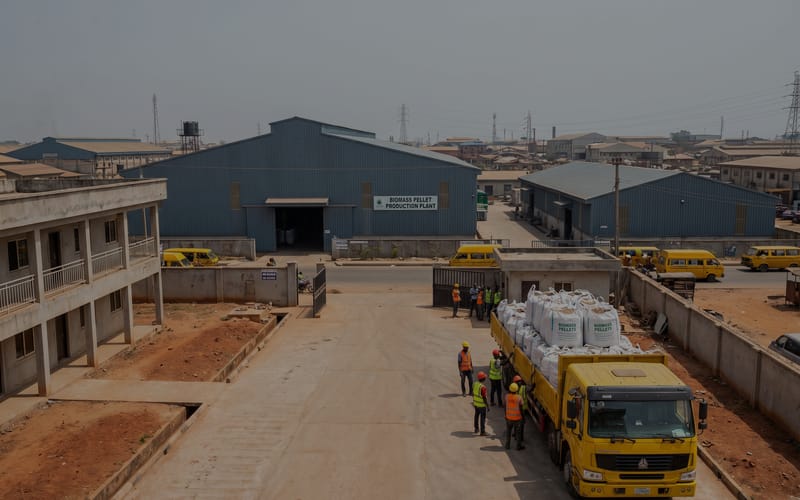
biomass Pellet Plant Design
Based on your unique situation and industrial process, we will tailor complete pellet plant you need, and inform you of every additional detail that could facilitate operation, minimize total cost.
● Manufacturing
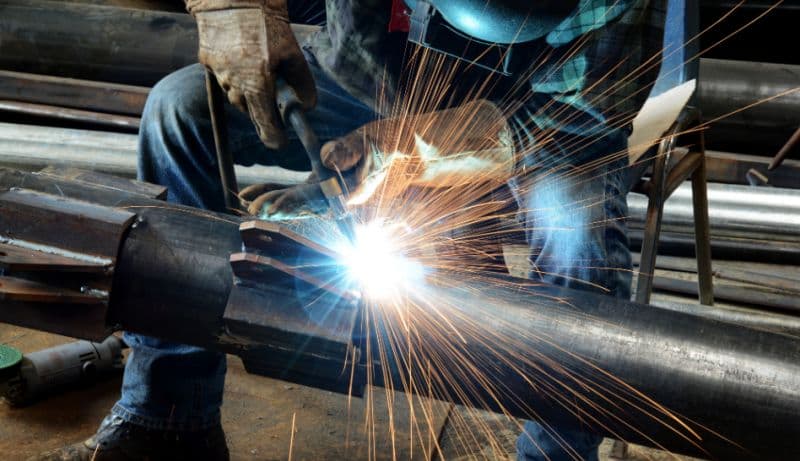
Equipment Manufacturing
The critical components of the of the complete pellet production line equipment are built in our own workshops in Asia. Additional equipment is manufactured by our worldwide network of reliable partners.
● Testing
Quality Inspection & Testing
Before leaving the factory, all equipment will be inspected by the quality inspection department. We can also provide customers with testing services from a single machine to a complete pellet plant system, and provide you with real actual data for “worry-free use.”
● Delivery
Equipment Delivery
In equipment boxing and packaging, we adopt professional packaging and modular solutions to ensure the safe and non-destructive delivery of pellet plant equipment.
● Installation
Installation & Commissioning
Whether you choose your own subcontractor for the erection phase or you want to install everything together with us, a Richi supervisor will be around to make sure everything is mounted in a safe and thorough way.

● Training
Staff Training
We provide comprehensive training for the technicians of each project. We can also continue to provide support for the technicians during latter project operation.
● After-sales
Project Follow-Up
When everything is up and running our Richiers will help you further whenever needed. We are ready to answer your call 24/7.We’ll also visit you regularly to learn about your needs.
Who we are
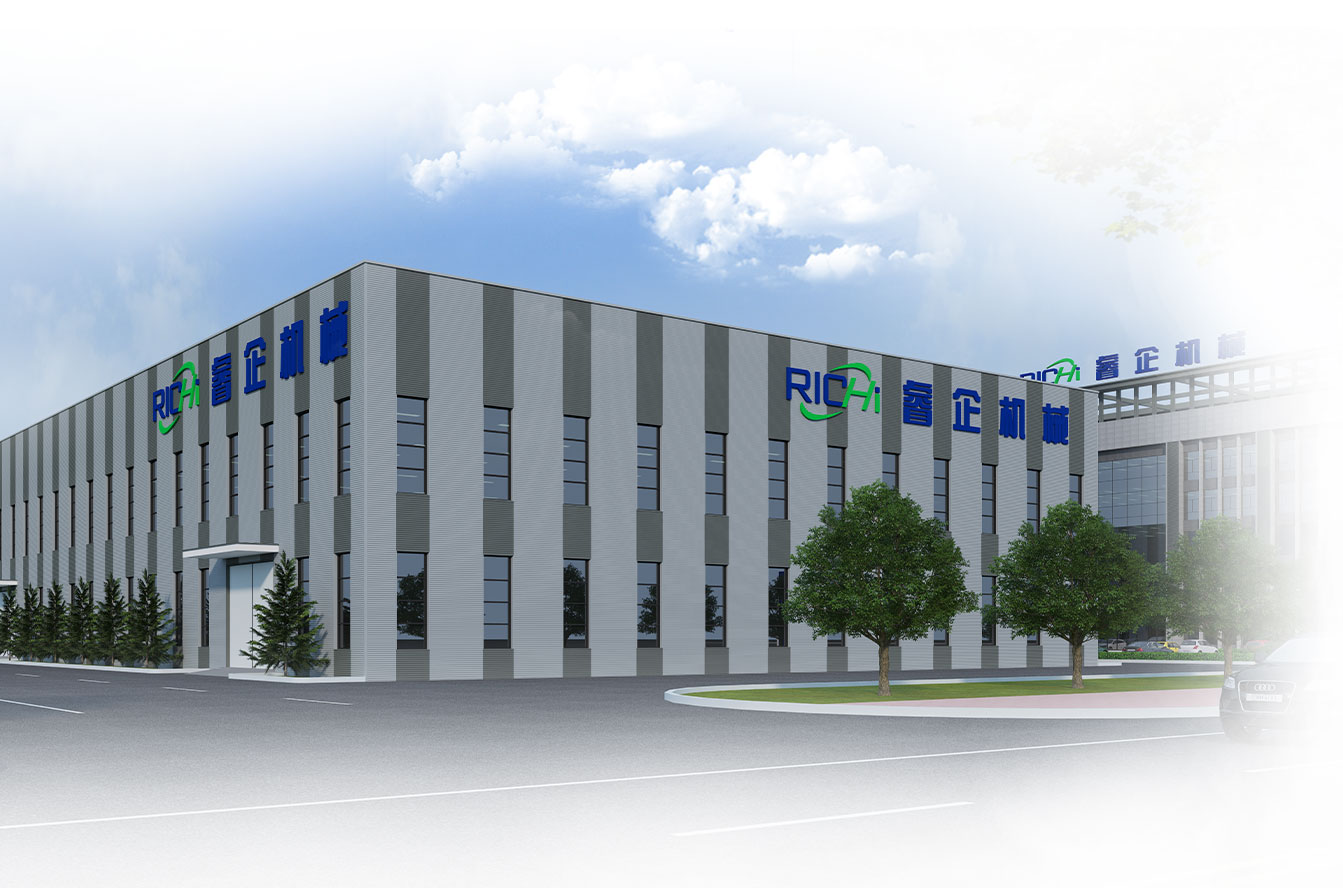
RICHI Machinery is one of the world’s leading suppliers of technology and services for the animal feed, aqua feed and pet food industries, also the largest pellet production line manufacturer in China.
Since 1995, RICHI’s vision to build a first-class enterprise, to foster first-class employees, and to make first-class contributions to society has never wavered.
In the past three decades, we have expanded our business to a wide range of areas, including animal feed mill equipment, aqua feed equipment, pet feed equipment, biomass pellet equipment, fertilizer equipment, cat litter equipment, municipal solid waste pellets equipment, etc.

1995
RICHI Established

2000+
Serving More Than 2000 Customers

120+
RICHI Employees

140+
Exported To 140 Countries