 0086-138 3838 9622
Sheep Cow Dung Granule and Powder Fertilizer Production Line in Kazakhstan
RICHI MACHINERY
Project Overview
An agricultural entrepreneur in Kazakhstan reached out to RICHI Machinery about building a 10t/h sheep cow dung granule and powder fertilizer production line in Kazakhstan with an annual capacity of 50,000 tons of bio-organic fertilizer (running 8 hours per day, 2 shifts, 300 days per year). The facility produces both powder fertilizer (20,000 tons/year) and granular fertilizer (30,000 tons/year) from sheep and cattle manure, serving wheat, sunflower, and vegetable farms across northern Kazakhstan.
The client is located in the North Kazakhstan Region, about 300km west of Petropavlovsk. Kazakhstan has one of the largest livestock populations in Central Asia — 8+ million cattle, 20+ million sheep, and 3+ million horses. The North Kazakhstan Region is a major grain-producing area (wheat, barley, sunflowers) where soil degradation from conventional farming (low organic matter, wind erosion) is a serious concern.
The client previously worked in agricultural logistics and saw that most livestock manure was simply stockpiled or dumped, creating environmental problems (ammonia emissions, groundwater contamination). He saw an opportunity to convert this waste into a valuable product.
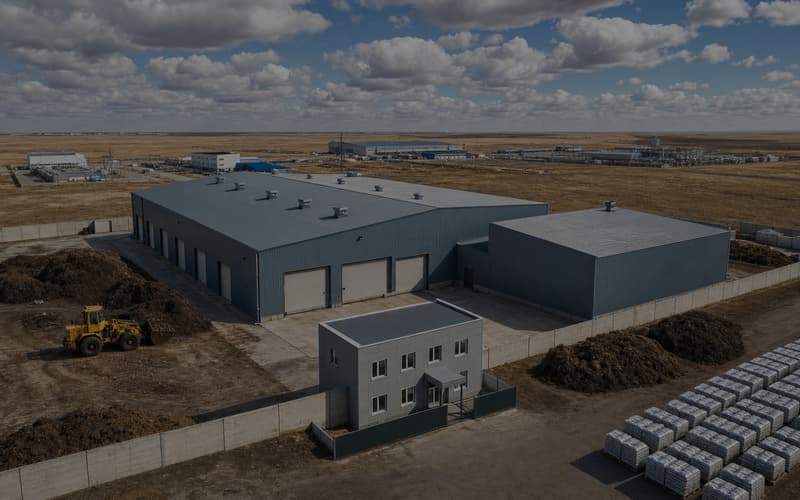
The facility is built on a 5,742m² site (about 1.4 acres) with a 3,870m² production building (steel frame, 8m ceiling height) and a 1,440m² enclosed fermentation building . The site also includes a 150m² office, 80m² staff rest area, and 30m² parts storage.
Total equipment investment was $385,000.
10T/H
capacity
$385,000
investment
Kazakhstan
location
Fertilizer
project type
RICHI MACHINERY
Why Kazakhstan?
Kazakhstan has a massive livestock sector but underdeveloped organic fertilizer production:
| Parameter | Value |
|---|---|
| Cattle population | 8+ million head |
| Sheep population | 20+ million head |
| Horse population | 3+ million head |
| Annual manure generated | 70-90 million tons |
| Current manure utilization | <10% (mostly stockpiled or dumped) |
| Arable land | 20+ million hectares |
| Soil organic matter | 2-3% (down from 5-6% historically) |
The problem: Decades of intensive grain farming (wheat, barley, sunflowers) have degraded Kazakhstan’s soils. Wind erosion (“black storms”) is a serious problem. Farmers need to rebuild soil organic matter.
Target customers:
| Customer segment | Location | Annual demand (tons) | Notes |
|---|---|---|---|
| Wheat farms | North Kazakhstan, Kostanay | 50,000+ | Large volume, price-sensitive |
| Sunflower farms | East Kazakhstan | 20,000+ | Premium market |
| Vegetable farms | Almaty, Shymkent | 15,000+ | High-value crops |
| Export to Russia/China | Border areas | 10,000+ | Higher margin |
The client’s price is 30-50% cheaper than imported organic fertilizers.
RICHI MACHINERY
Raw Materials: Sheep and Cattle Manure
The client’s raw material is exclusively sheep and cattle manure — no pig or chicken manure (which have higher nitrogen and can be too “hot” for some applications).
| Raw Material | Annual (tons) | Moisture (%) | Source | Cost (KZT/ton) | USD/ton (480 KZT/USD) |
|---|---|---|---|---|---|
| Cattle manure (pre-composted) | 32,000 | 50-55% | Local farms | 1,000 | $2.08 |
| Sheep manure (pre-composted) | 22,000 | 50-55% | Local farms | 1,000 | $2.08 |
| Fermentation starter | 0.8 | — | Imported (China) | 5,000,000 | $10,417 |
| Bio-fermentation bacteria | 10 | — | Imported | 1,000,000 | $2,083 |
| Trace elements | 1.5 | — | Imported | 1,500,000 | $3,125 |
| Total input (manure only) | 54,000 | — | — | — | — |
Wait, 54,000 tons manure input for 50,000 tons fertilizer output? Yes. The difference (4,000 tons) is:
- Water evaporated during fermentation and drying (manure is 50-55% moisture → fertilizer is 30% moisture for powder, 10% for granules)
- Loss of organic matter as CO₂ during aerobic fermentation
- Dust collected in filters (returned to product)
The client’s raw material quality advantage: The manure is pre-composted (partially dried) by farmers before delivery — approximately 50-55% moisture, no free liquid. This avoids the leachate problems associated with fresh manure (70-80% moisture).
RICHI MACHINERY
The Site and Building
The client’s site is on former agricultural land (reclassified as industrial use) in the North Kazakhstan Region, about 300km west of Petropavlovsk.
Building layout:
| Building | Size (m²) | Construction | Use |
|---|---|---|---|
| Production building | 3,870 | Steel frame, 8m high | Crushing, granulation, drying, cooling, screening, packaging |
| Fermentation building | 1,440 | Steel frame, enclosed | Aerobic composting (7 days + 10 days aging) |
| Office | 150 | Brick/concrete | Admin, lab, control room |
| Staff rest area | 80 | Brick/concrete | Break room |
| Parts storage | 30 | Brick/concrete | Spare parts |
| Total | 5,570 | — | — |
Fermentation building layout (1,440m², enclosed):
- Two-stage fermentation: active fermentation (20-25 days) + aging/curing (10 days)
- The building is enclosed with negative pressure ventilation to capture odors
- Air is pulled through UV photolysis + biofilter before exhausting (15m stack P1)
Production building layout (3,870m², 8m ceiling):
The client chose a single-story layout with multiple processing zones:
| Zone | Size (approx.) | Equipment |
|---|---|---|
| Raw material receiving | ~400m² | 6 receiving hoppers, conveyors |
| Powder fertilizer line | ~600m² | Crushers (2), screener, bagging scale |
| Granule line | ~1,500m² | Disc granulators (4), dryers (2), coolers (2), screener, bagging scale |
| Natural gas heating area | ~200m² | 2 gas-fired hot air furnaces |
| Packaging area | ~300m² | 2 bagging scales, conveyor |
RICHI MACHINERY
Equipment Configuration
The client chose a dual-line configuration: one line for powder fertilizer (20,000 tons/year), one line for granular fertilizer (30,000 tons/year), with a common fermentation stage.
| Equipment | Quantity | Power (each) | Function |
| Receiving | |||
| Receiving hoppers | 6 | — | Raw material intake |
| Fermentation | |||
| Compost turner | 1 | 15 kW | Turning material in fermentation bays |
| Powder fertilizer line | |||
| Horizontal crusher | 2 | 30 kW each | Grinding to <5mm |
| Screener | 1 | 5.5 kW | Particle separation |
| Bagging scale | 1 | 3 kW | 40kg bags |
| Granular fertilizer line | |||
| Fertilizer granulator equipment | 4 | 45 kW each | Producing 2-5mm granules |
| Primary dryer | 1 | 45 kW + 150 kW heat | 160-180°C, 10-30 min |
| Primary cooler | 1 | 30 kW | Air cooling |
| Secondary dryer | 1 | 37 kW + 120 kW heat | 200°C, ~10 min |
| Secondary cooler | 1 | 22 kW | Air cooling |
| Screener | 2 | 5.5 kW each | Particle separation |
| Bacteria addition tank | 1 | 3 kW | Adding bio-bacteria to granules |
| Bagging scale | 1 | 3 kW | 40kg bags |
| Utility | |||
| Gas-fired hot air furnace | 2 | — | 2.4 million kcal/h each, natural gas |
| Belt conveyors | 10 | 2.2-3 kW each | Material transport |
| Front-end loader | 1 | — | Raw material handling |
| Sweeper | 1 | — | Floor cleaning |
| Dust collector + UV + biofilter | 1 set | 50 kW fans | P2 exhaust (production building) |
| UV + biofilter | 1 set | 30 kW fans | P1 exhaust (fermentation building) |
Equipment cost (FOB Qingdao): $385,000 USD
RICHI MACHINERY
Process Flow
This 10t/h Sheep Cow Dung Granule and Powder Fertilizer Production Line in Kazakhstan produces both powder and granular fertilizer from the same fermentation batch. The split happens after the initial crushing. Powder fertilizer bypasses the granulation, drying, cooling stages.
Step 1: Raw Material Receiving
Sheep and cattle manure (50-55% moisture, pre-composted) arrives in sealed trucks (to prevent odor). The driver unloads directly into the fermentation building — no outdoor storage.
The client’s receiving system: 6 receiving hoppers (4m×1.5m) inside the fermentation building. Manure is dumped into the hoppers, then conveyed to the fermentation bays.
Vehicle washing: Manure trucks are washed at the entrance; wash water (containing manure residue) flows to a settling pond, then is reused in the disc granulators.
Step 2: Fermentation (Aerobic Composting)
Fermentation is the most critical step. It determines the final product’s organic matter content, pathogen kill, and odor.
The manure is stacked in long rows (Windrow Aerobic Composting) inside the enclosed fermentation building. A compost turner turns the material daily.
Fermentation parameters:
| Stage | Duration | Temperature | Activity |
|---|---|---|---|
| Active fermentation | 20-25 days | 60-65°C | Pathogen kill, rapid decomposition |
| Aging/curing | 10 days | 40-50°C | Moisture reduction, stabilization |
Fermentation starter addition: The client sprays diluted fermentation starter onto the manure at a rate of 25L of diluted starter per ton of manure. The starter promotes rapid heating (60-65°C) which kills pathogens (E. coli, Salmonella) and weed seeds.
Turning frequency: Once or twice daily when temperature reaches 60-65°C.
Moisture reduction: During fermentation, moisture drops from 50-55% to 30-35%.
Step 3: Post-Fermentation Handling
After 30-35 days of fermentation + aging, the material is moved to the production building.
The split (powder vs granular):
- 40% of material (about 20,000 tons/year) → powder fertilizer line
- 60% of material (about 30,000 tons/year) → granular fertilizer line
Step 4: Powder Fertilizer Production (powder fertilizer, 20,000 t/year)
4a. Crushing: The fermented material is fed into two horizontal crushers (30 kW each).
Crusher parameters:
- Output size: <5mm
- Throughput: 4-5 t/h each (8-10 t/h total)
4b. Screening: Crushed material passes through a screener to remove oversize particles (>5mm), which are returned to the crusher.
4c. Bagging: Powder fertilizer is conveyed to a bagging scale and packaged in 40kg bags.
Powder fertilizer specifications:
| Parameter | Target | Standard (China NY/T 525-2012) |
|---|---|---|
| Organic matter | ≥45% | ≥45% |
| N+P₂O₅+K₂O | ≥5.0% | ≥5.0% |
| Moisture | ≤30% | ≤30% |
| pH | 6.0-7.5 | 5.5-8.5 |
| Particle size | <5mm | — |
Step 5: Granular Fertilizer Production (granular fertilizer, 30,000 t/year)
5a. Crushing (same as powder line): Fermented material is crushed to <5mm.
5b. Ring Die Granulation (4 units):
Granulator parameters (each):
- Diameter: 3,50mm
- Angle: 40-50° (adjustable)
- Speed: 15-25 RPM
- Capacity per unit: 2-2.5 t/h (8-10 t/h total)
Water addition: The client sprays water (2160 m³/year, 7.2 m³/day) into the granulators. The water helps form spherical granules (2-5mm diameter).
5c. Primary Drying (2.2m×20m rotary dryer):
- Temperature: 160-180°C
- Residence time: 10-30 minutes
- Moisture reduction: 35% → 25%
- Heat source: Natural gas-fired hot air furnace (2.4 million kcal/h)
5d. Primary Cooling (2.0m×20m cooler):
- Method: Ambient air (forced air)
- Outlet temperature: 30-40°C
5e. Secondary Drying (2.0m×20m rotary dryer):
- Temperature: 200°C
- Residence time: ~10 minutes
- Moisture reduction: 25% → 10%
5f. Secondary Cooling ( 1.8m×18m cooler):
- Outlet temperature: ambient + 5-10°C (25-30°C in Kazakhstan summer)
5g. Screening: Dried and cooled granules pass through a screener:
- Acceptable: 2-5mm diameter → packaging
- Oversize (>5mm) → return to crusher
- Fines (<2mm) → return to granulator
5h. Bacteria Addition (optional): For premium products, the client adds bio-bacteria to the granules. This enhances the fertilizer’s soil health benefits.
5i. Bagging: Granular fertilizer is packaged in 40kg bags.
Granular fertilizer specifications:
| Parameter | Target | Standard |
|---|---|---|
| Organic matter | ≥45% | ≥40% |
| N+P₂O₅+K₂O | ≥5.0% | ≥5.0% |
| Moisture | ≤10% | ≤30% (much lower than powder) |
| pH | 6.0-7.5 | 5.5-8.5 |
| Granule size | 2-5mm | — |
| Bio-bacteria count | ≥20 million per gram | ≥20 million per gram |
RICHI MACHINERY
Utilities and Consumption
| Utility | Annual consumption | Source | Cost (KZT) | Cost (USD at 480 KZT/USD) |
|---|---|---|---|---|
| Electricity | 1,000,000 kWh | Grid | 20 million | $41,667 |
| Natural gas | 1,080,000 m³ | CNG tanker (no pipeline) | 108 million | $225,000 |
| Water | 2,376 m³ | Municipal | 1.2 million | $2,500 |
Natural gas usage detail: 1,080,000 m³/year. At 108 m³/ton of product, gas cost is about $4.50/ton — significantly less than coal or diesel. Kazakhstan has abundant natural gas reserves, and CNG is delivered to the site by tanker.
Electricity breakdown (annual, 300 days, 16 hours/day = 4,800 hours):
| Equipment | kW average | Hours/day | kWh/day | kWh/year |
|---|---|---|---|---|
| Receiving hoppers & conveyors | 15 | 16 | 240 | 72,000 |
| Compost turner | 10 | 4 (intermittent) | 40 | 12,000 |
| Crushers (2) | 40 (20 each avg) | 16 | 640 | 192,000 |
| Organic fertilizer pellet machine (4) | 120 (30 each avg) | 16 | 1,920 | 576,000 |
| Primary dryer fan | 30 | 16 | 480 | 144,000 |
| Primary cooler fan | 20 | 16 | 320 | 96,000 |
| Secondary dryer fan | 25 | 16 | 400 | 120,000 |
| Secondary cooler fan | 15 | 16 | 240 | 72,000 |
| Screeners (3) | 10 | 16 | 160 | 48,000 |
| Bagging scales (2) | 6 | 16 | 96 | 28,800 |
| P1 exhaust fan (UV+biofilter) | 20 | 24 | 480 | 144,000 |
| P2 exhaust fan (baghouse+UV+biofilter) | 30 | 24 | 720 | 216,000 |
| Lighting, office | 10 | 16 | 160 | 48,000 |
| Total | ~351 | — | 5,896 | 1,768,800 kWh |
RICHI MACHINERY
How RICHI Customized This Line for Sheep/Cattle Manure
The client had specific requirements that shaped the equipment design:
Requirement 1: Raw material is sheep and cattle manure (50-55% moisture, pre-composted). The client didn’t want to handle fresh manure (70-80% moisture) because of leachate issues.
RICHI solution: The client sources manure from farms that pre-compost it for 2-4 weeks before delivery. This reduces moisture to 50-55% (no free liquid). The manure is delivered in sealed trucks and unloaded directly into the enclosed fermentation building — no outdoor storage.
Requirement 2: The client wanted to produce both powder and granular fertilizer from the same line. Powder fertilizer is cheaper to produce (skip granulation, drying, cooling), but granular fertilizer has higher value (easier to spread with machinery).
RICHI solution: Designed the organic fertilizer production line with a split after the initial crushing:
- 40% of material → powder line (crusher → screener → bagging)
- 60% of material → granule line (granulator → primary dryer → primary cooler → secondary dryer → secondary cooler → screener → bacteria addition → bagging)
Requirement 3: The client’s facility has natural gas available (via CNG tanker). They wanted to use gas for drying (cheaper than electricity or diesel).
RICHI solution: Two gas-fired hot air furnaces. Natural gas contains 60mg/m³ of sulfur, but at 1.08 million m³/year, the SO₂ emissions are negligible.
Requirement 4: Odor control is critical. The facility is near agricultural villages (about 500m away).
RICHI solution: Two-stage odor control:
- Fermentation building: enclosed with UV photolysis + biofilter (P1 stack)
- Production building: enclosed with baghouse + UV + biofilter (P2 stack)
Requirement 5: The client has 8 staff (very few for a 10 t/h line). They needed a highly automated line.
RICHI solution: Centralized PLC control. The line runs with only 2 operators per shift:
- 1 operator monitoring the fermentation turner and receiving hoppers
- 1 operator monitoring the production line (granulators, dryers, coolers, bagging)
The client has 2 shifts (16 hours/day), plus 1 maintenance person.
RICHI MACHINERY
Product Specifications
Powder fertilizer, 20,000 t/year:
| Parameter | Standard | Client’s product |
|---|---|---|
| Organic matter (dry basis) | ≥45% | 48-52% |
| N+P₂O₅+K₂O | ≥5.0% | 5.5-6.5% |
| Moisture | ≤30% | 25-28% |
| pH | 5.5-8.5 | 6.5-7.5 |
| Particle size | — | <5mm |
Granular fertilizer, 30,000 t/year:
| Parameter | Standard | Client’s product |
|---|---|---|
| Organic matter (dry basis) | ≥45% | 48-52% |
| N+P₂O₅+K₂O | ≥5.0% | 5.5-6.5% |
| Moisture | ≤30% | 8-10% (much dryer) |
| pH | 5.5-8.5 | 6.5-7.5 |
| Granule size | — | 2-5mm |
| Bio-bacteria (optional) | ≥20 million CFU/g | 20–30 million CFU/g |
Pricing (as of August 2025):
| Product | Price (KZT/ton) | Price (USD/ton at 480 KZT/USD) |
|---|---|---|
| Powder (40kg bags) | 72,000 | $150 |
| Granular (40kg bags) | 96,000 | $200 |
| Granular with bio-bacteria | 120,000 | $250 |
Comparison with imported organic fertilizer:
| Source | Price (USD/ton) | Delivery time |
|---|---|---|
| Client’s product | $150-250 | 1-3 days |
| Imported (Russia) | $300-350 | 1-2 weeks |
| Imported (China) | $350-400 | 3-4 weeks |
RICHI MACHINERY
Market Outlook for Organic Fertilizer in Kazakhstan
Kazakhstan’s organic fertilizer market is growing at about 10-15% annually. Key drivers:
1. Soil degradation. Kazakhstan’s wheat soils have lost 50-60% of their organic matter over 50 years. Wind erosion (“black storms”) is a serious problem. Farmers need to rebuild soil health.
2. Export requirements for organic grain. The EU requires organic certification for imported grain. Fertilizer is part of that certification.
3. Government support for organic agriculture. Kazakhstan’s “Green Economy” concept paper targets organic farming on 1 million hectares by 2030.
4. Cost savings. Organic fertilizer improves soil structure, reducing the need for expensive irrigation and chemical fertilizers.
Competition: There are 10-15 organic fertilizer producers in Kazakhstan (5,000-20,000 tons/year). The client’s 50,000 tons/year makes them one of the largest.
Challenges the client is managing:
| Challenge | Mitigation |
|---|---|
| Raw material seasonality (manure availability is lower in winter) | Build 3-4 month inventory during summer months (June-September) |
| Natural gas supply (no pipeline—uses CNG tankers) | Contract with CNG supplier for year-round delivery |
| Customer education (farmers are used to chemical fertilizers) | Free 1-ton samples to wheat farms; yield comparisons |
| Export logistics (landlocked country) | Transport to China/Russia by rail; client has 2 railcars |
RICHI MACHINERY
Why a Sheep/Cattle Manure Fertilizer Line Makes Sense in Kazakhstan
Kazakhstan has 28+ million cattle and sheep, abundant natural gas, and degraded soils requiring organic matter. Here’s why you should consider this market:
Manure is abundant and cheap. The client pays 1,000 KZT/ton ($2.08) for cattle manure — farmers are happy to get paid for something they used to have to dispose of.
Natural gas is available. Kazakhstan has the 12th largest natural gas reserves in the world. The client uses CNG tankers for drying (no pipeline needed).
The government supports value-added processing. Kazakhstan wants to export finished goods (fertilizer), not raw materials (manure).
Kazakhstan is close to large markets. Russia and China are both significant importers of organic fertilizer. Rail transport is economical.
If you’re considering an organic fertilizer line in Kazakhstan (or any country with cattle/sheep farming), RICHI can help. We’ve designed lines for cattle manure, sheep manure, horse manure, and other livestock wastes. We understand the challenges (odor control, fermentation management, two-stage drying) and can recommend the right equipment.
Contact us to discuss your organic fertilizer production project. Tell us about your raw material (type, moisture, volume), target products (powder, granules, or both), site conditions, and budget. We’ll prepare a customized process flow, equipment list, and budget estimate — no obligation.
RICHI Machinery – Organic fertilizer plants from 1 t/h to 60 t/h, designed for livestock manure. Shipping from Qingdao to Aktau port (Kazakhstan): 25-30 days. Installation support available in Kazakhstan within 2 weeks.
● RICHI MACHINERY
RICHI Service

● Consulting
Customer Consultation
We want to have a deep understanding of your industrial process, to know your exact needs of feed, wood, biomass, fertilizer or other pellet processing.
● Design
organic fertilizer Plant Design
Based on your unique situation and industrial process, we will tailor complete pellet plant you need, and inform you of every additional detail that could facilitate operation, minimize total cost.
● Manufacturing
Equipment Manufacturing
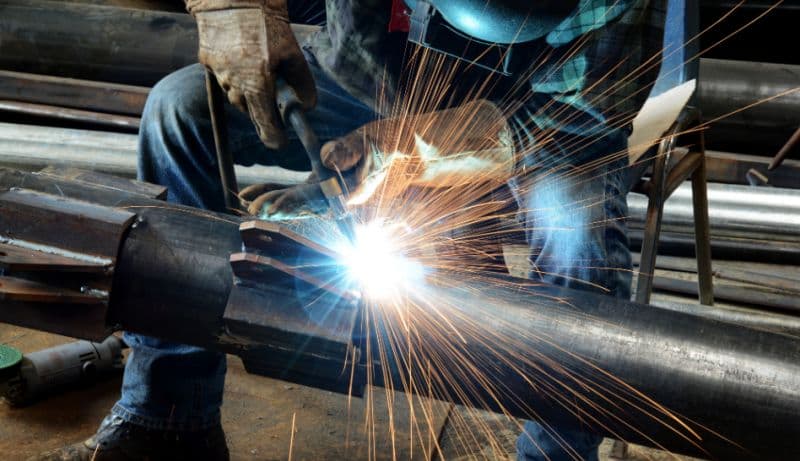
The critical components of the of the complete pellet production line equipment are built in our own workshops in Asia. Additional equipment is manufactured by our worldwide network of reliable partners.
● Testing
Quality Inspection & Testing
Before leaving the factory, all equipment will be inspected by the quality inspection department. We can also provide customers with testing services from a single machine to a complete pellet plant system, and provide you with real actual data for “worry-free use.”
● Delivery
Equipment Delivery
In equipment boxing and packaging, we adopt professional packaging and modular solutions to ensure the safe and non-destructive delivery of pellet plant equipment.
● Installation
Installation & Commissioning
Whether you choose your own subcontractor for the erection phase or you want to install everything together with us, a Richi supervisor will be around to make sure everything is mounted in a safe and thorough way.

● Training
Staff Training
We provide comprehensive training for the technicians of each project. We can also continue to provide support for the technicians during latter project operation.
● After-sales
Project Follow-Up
When everything is up and running our Richiers will help you further whenever needed. We are ready to answer your call 24/7.We’ll also visit you regularly to learn about your needs.
Who we are
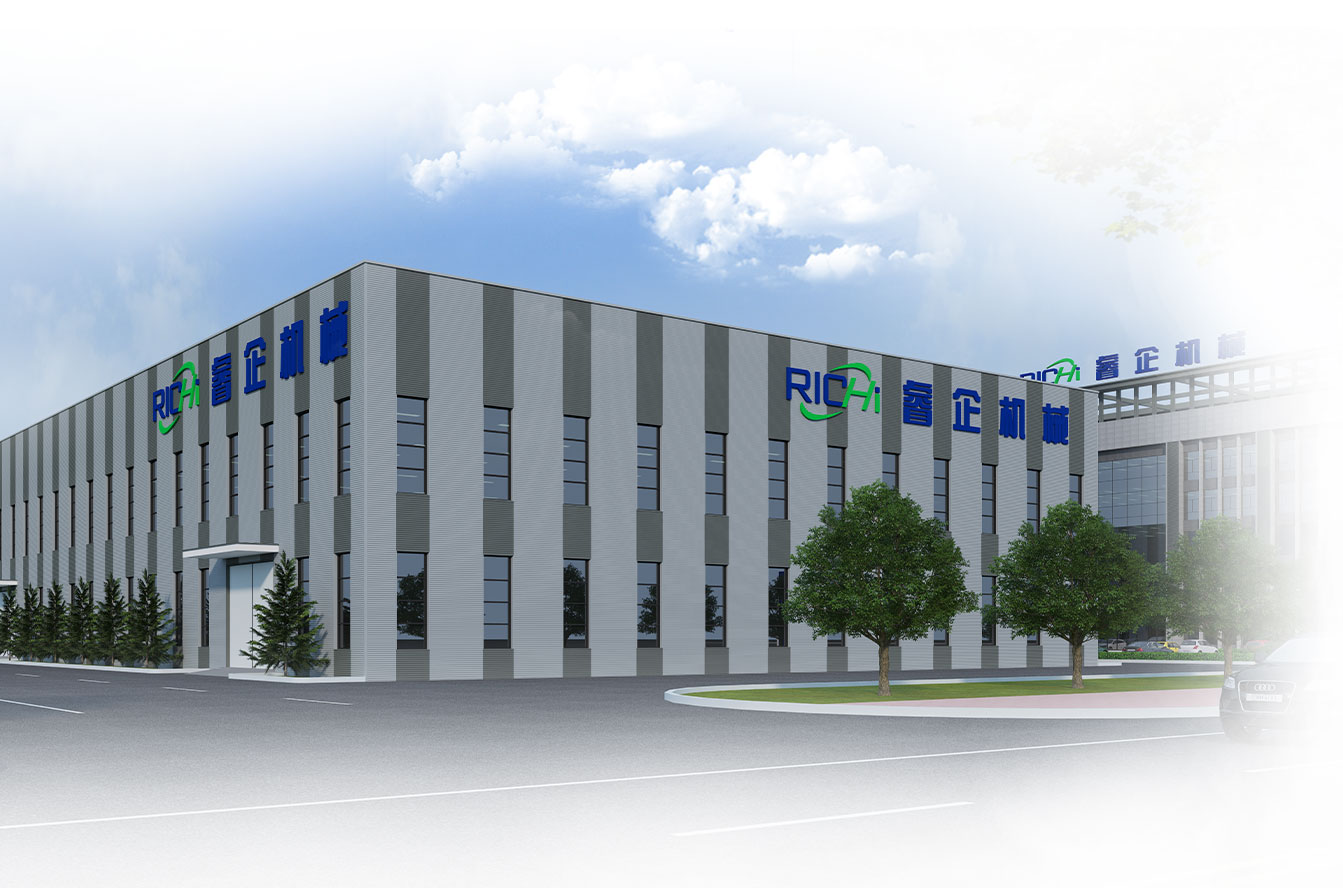
RICHI Machinery is one of the world’s leading suppliers of technology and services for the animal feed, aqua feed and pet food industries, also the largest pellet production line manufacturer in China.
Since 1995, RICHI’s vision to build a first-class enterprise, to foster first-class employees, and to make first-class contributions to society has never wavered.
In the past three decades, we have expanded our business to a wide range of areas, including animal feed mill equipment, aqua feed equipment, pet feed equipment, biomass pellet equipment, fertilizer equipment, cat litter equipment, municipal solid waste pellets equipment, etc.

1995
RICHI Established

2000+
Serving More Than 2000 Customers

120+
RICHI Employees

140+
Exported To 140 Countries