 0086-138 3838 9622
Wood Bedding Pellet Production Line in Brazil
RICHI MACHINERY
Project Overview
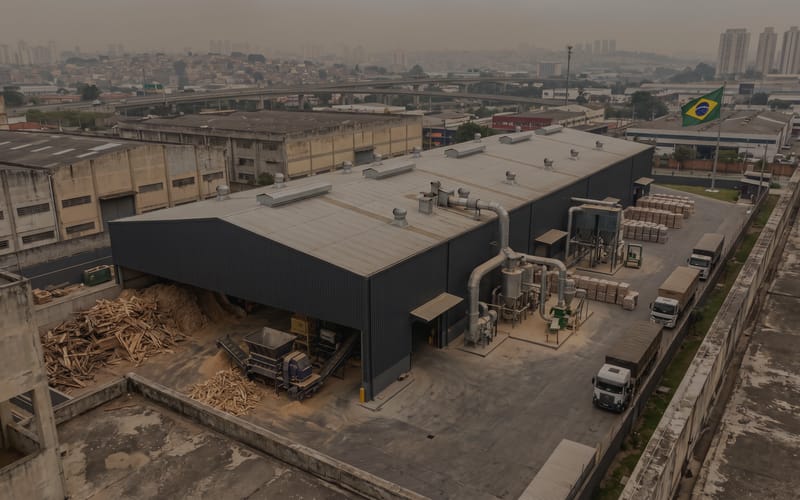
15-20T/H wood bedding pellet production line in Brazil was developed around a very practical need—turning mixed wood residues and agricultural by-products into stable, dust-controlled bedding pellets for livestock use. The wood pellet production line for bedding was designed not just for output, but for flexibility, because the raw material supply was never perfectly consistent.
At full operation, this pellet plant runs close to 15–20 tons per hour in peak conditions, with an annual output designed around 80,000 tons of biomass pellets and crushed material.
The project makes use of an existing 6,000 m² facility, where production, storage, and handling are all arranged in a fairly compact but efficient layout. What stands out is not just the capacity—but how the system handles different material sizes, moisture variations, and storage logistics without relying on drying systems.
15-20T/H
capacity
$620,000
investment
Brazil
location
Bedding
project type
RICHI MACHINERY
How This Project Actually Started
The first inquiry came in March 2024. Not a detailed RFQ—just a short message:
“We have wood waste and straw. Can it be pelletized for animal bedding without drying?”
That question shaped the entire animal bedding production project.
The client operates a medium-scale agricultural and forestry business in southern Brazil. They had access to:
- Wood offcuts from local sawmills
- Tree branches and forestry residues
- Seasonal straw materials
But they were facing two issues:
- Loose material was difficult to transport and store
- Dust levels were high when used as bedding
They weren’t originally planning a complete wood pellet line. They were simply looking for a way to “make the material more usable.” The idea of a pelletizing line came later, after a few rounds of discussion.
RICHI MACHINERY
Key Project Milestones
| Item | Details |
|---|---|
| Initial Inquiry | March 2024 |
| Raw Material Testing | April 2024 |
| Process Design Finalized | June 2024 |
| Contract Signed | July 2024 |
| Equipment Delivery | October 2024 |
| Installation & Commissioning | December 2024 |
| Trial Production | January 2025 |
RICHI MACHINERY
Production Capacity and Positioning
This is not a fuel pellet plant.
That was clarified early.
The output is designed for animal bedding pellets, which means:
- Larger diameter than fuel pellets
- Lower density requirement
- Better water absorption
- Less concern about calorific value
Typical finished product size:
- Diameter: 6–10 mm
- Length: 10–20 mm
This is important. Several early test batches failed because the compression ratio was initially set for fuel pellets. The first few tons were either too hard or too dusty.
RICHI MACHINERY
Raw Materials
In Brazil, the material mix is never stable month to month. That had to be built into the design.
The client sources materials locally within a 50–80 km radius. Moisture is naturally reduced through air drying before processing, usually below 10%, so no dryer was included.
Raw Material Composition
| Material | Annual Usage (t) | Storage | Size Range | Notes |
|---|---|---|---|---|
| Waste wood | 43,000 | 11 days | 9×10 cm – 9×25 cm | Main structural material |
| Sawdust | 12,000 | 7 days | Powder | Helps binding |
| Branches | 21,000 | 7 days | 8×20 cm – 10×30 cm | Variable density |
| Forestry residues | 2,100 | 7 days | Mixed bark/leaves | Lower bulk density |
| Straw | 2,100 | 7 days | ≤20 cm | Seasonal input |
There was a discussion early on whether to exclude straw. In the end, it stayed—but at a controlled ratio.
RICHI MACHINERY
Main Equipment Configuration
The animal bedding pellet line is arranged as a single pellet mill line, but internally it behaves more like two parallel preparation routes feeding into pelleting.
Equipment List
| No. | Equipment | Quantity | Capacity |
|---|---|---|---|
| 1 | Wood pellet mill | 8 | 2 t/h each |
| 2 | Dust-proof shredders | 2 | 30 t/h + 5 t/h |
| 3 | Hammer mills | 2 | 8 t/h each |
| 4 | Packing machine | 1 | — |
| 5 | Bale clamp | 1 | — |
| 6 | Loaders | 2 | — |
| 7 | Belt conveyors | Several | — |
| 8 | Screw conveyors | 9 | — |
| 9 | Fans | 2 | — |
| 10 | Forklifts | 2 | — |
One thing that often gets overlooked—those two shredders are not redundant. They serve different roles. The 30 t/h unit handles bulk wood waste, while the smaller one is used when material consistency drops.
RICHI MACHINERY
Plant Layout Observations
The workshop is about 4,500 m², and space was tight.
Instead of spreading equipment out, the layout follows a linear flow:
- West side → pelletizing zone
- Middle → grinding
- East → shredding and raw material storage
Storage areas are split:
- 1,000 m² for raw materials
- 600 m² for crushed material
- 400 m² for finished pellets
The entrance is positioned on the south side, which reduces internal traffic overlap. This was adjusted during design—initially, trucks were crossing the production line path.
RICHI MACHINERY
Process Flow (Real Operation Logic)
The process is simple on paper, but the actual operation required tuning.
Step-by-step flow:
- Raw Material Storage
- Materials stored in enclosed yard
- Sawdust kept in bags
- Larger materials stacked with barriers
- Primary Shredding
- Input size reduced to 5–20 cm
- Fully enclosed to reduce dust
- Intermediate Transfer
- Belt conveyors + screw conveyors
- Temporary buffer storage
- Fine Grinding
- Hammer mills reduce material to uniform size
- Output directly into storage bags or pellet feed
- Pelletizing
- No additives
- Compression only
- Adjustable die ratio for bedding pellets
- Cooling & Packing
- Natural cooling (no dedicated cooler)
- Packed into ton bags
RICHI MACHINERY
Capacity Matching (Actual Engineering Check)
This part was discussed quite a bit during design.
- Shredding capacity: 84,000 t/year
- Grinding capacity: 38,400 t/year
- Pelletizing capacity: 38,400 t/year
The numbers don’t perfectly match—and that’s intentional.
The Wood Bedding Pellet Production Line in Brazil produces both:
- Pellets: 35,000 t/year
- Crushed material: 45,000 t/year
So not all material goes through pelletizing. That reduces bottlenecks.
RICHI MACHINERY
Utilities and Consumption
| Item | Annual Usage |
|---|---|
| Water | 270 m³ |
| Electricity | 3,000,000 kWh |
No drying system means energy consumption stays reasonable.
RICHI MACHINERY
Equipment Cost & Investment
- Total equipment cost: approx. $620,000
- Civil works: existing facility used
- Installation & commissioning included
For a 15-20t/h Wood Bedding Pellet Production Line in Brazil, this sits in a reasonable range.
RICHI MACHINERY
Shipping Information
- Port of departure: Qingdao Port, China
- Destination port: Port of Santos, Brazil
RICHI MACHINERY
Why This Type of Pellet Plant Works in Brazil
Brazil has a steady supply of:
- Forestry residues
- Agricultural by-products
- Wood processing waste
Transport distances are often long, which makes loose biomass inefficient.
Bedding pellets solve several problems:
- Easier transport
- Cleaner storage
- Higher product value
There’s also growing demand from:
- Poultry farms
- Horse farms
- Livestock operations
RICHI MACHINERY
Final Thoughts from an Engineering Perspective
Projects like this don’t fail because of equipment—they fail because the raw material and process don’t match.
This one worked because:
- The process was adjusted to the material
- The capacity wasn’t over-designed
- The client understood that not everything needs to be pelletized
A wood bedding pellet production line like this is not complicated, but it needs to be realistic.
For anyone considering a similar pellet machine line, the first step isn’t choosing machines—it’s understanding your material. That’s where most of the real decisions are made.
● RICHI MACHINERY
RICHI Service

● Consulting
Customer Consultation
We want to have a deep understanding of your industrial process, to know your exact needs of feed, wood, biomass, fertilizer or other pellet processing.
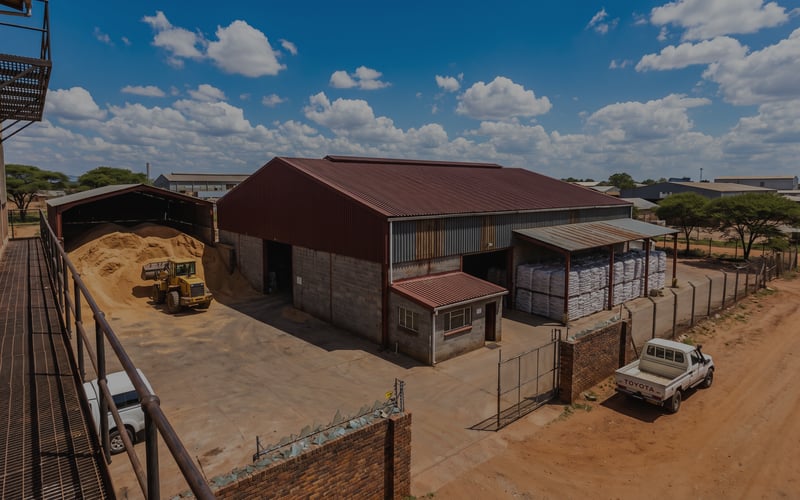
● Design
bedding Pellet Plant Design
Based on your unique situation and industrial process, we will tailor complete pellet plant you need, and inform you of every additional detail that could facilitate operation, minimize total cost.
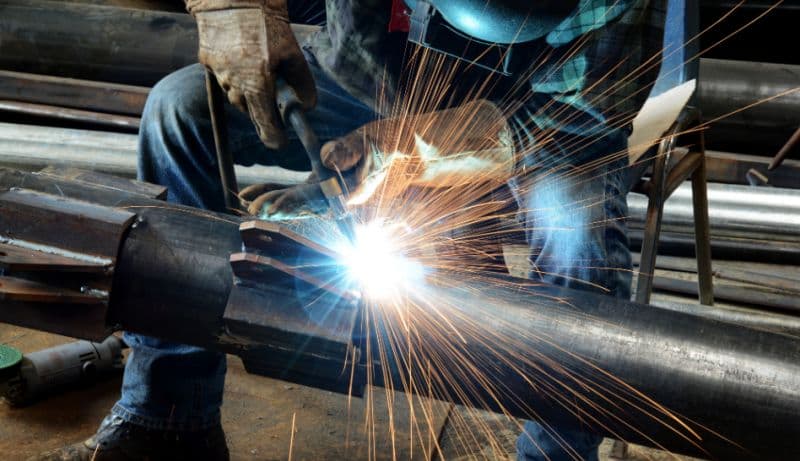
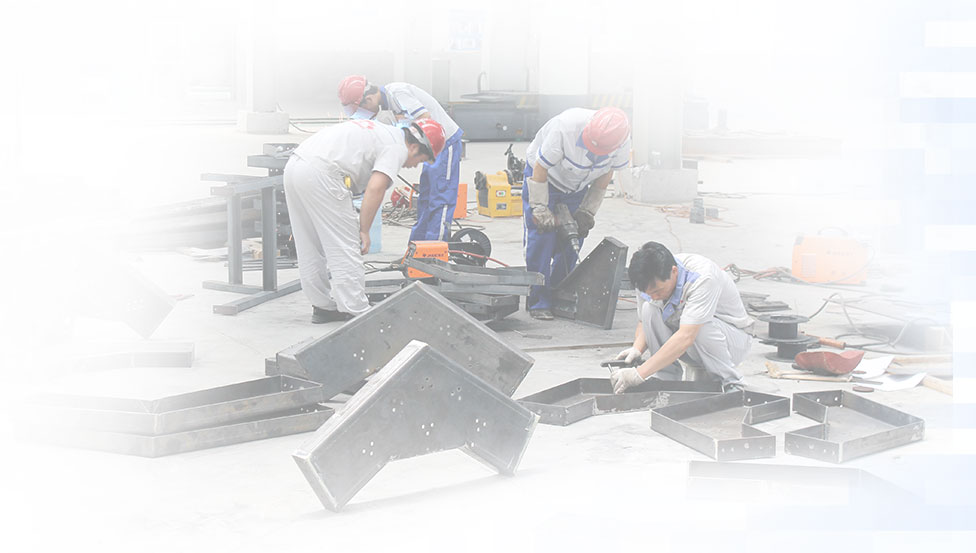
● Manufacturing
Equipment Manufacturing
The critical components of the of the complete pellet production line equipment are built in our own workshops in Asia. Additional equipment is manufactured by our worldwide network of reliable partners.
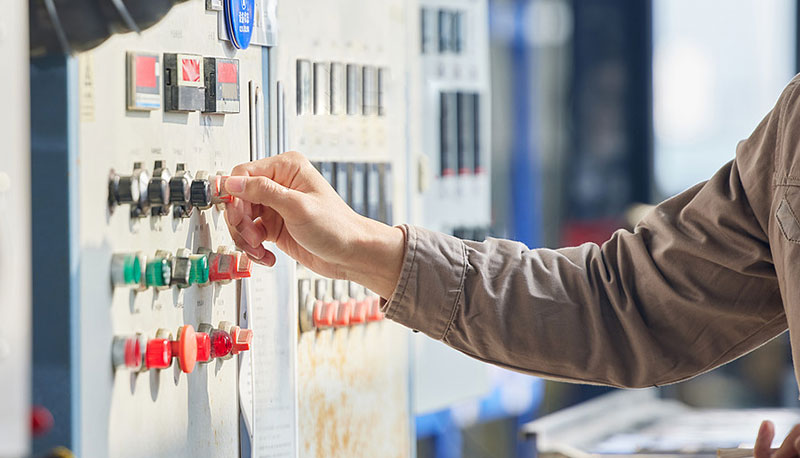
● Testing
Quality Inspection & Testing
Before leaving the factory, all equipment will be inspected by the quality inspection department. We can also provide customers with testing services from a single machine to a complete pellet plant system, and provide you with real actual data for “worry-free use.”

● Delivery
Equipment Delivery
In equipment boxing and packaging, we adopt professional packaging and modular solutions to ensure the safe and non-destructive delivery of pellet plant equipment.
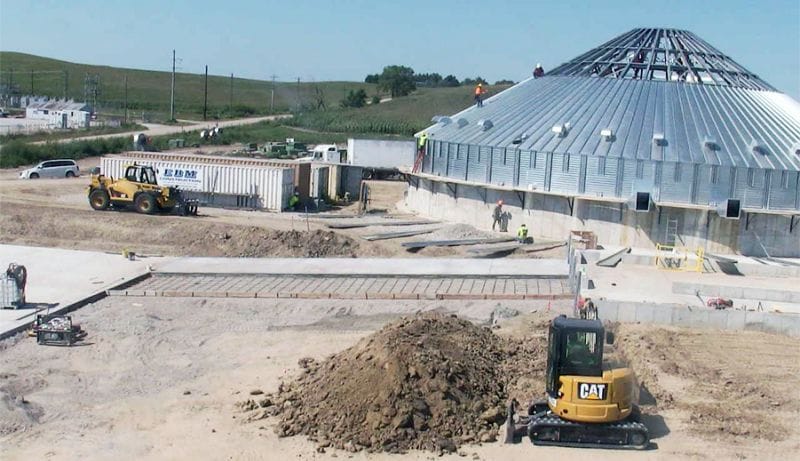
● Installation
Installation & Commissioning
Whether you choose your own subcontractor for the erection phase or you want to install everything together with us, a Richi supervisor will be around to make sure everything is mounted in a safe and thorough way.

● Training
Staff Training
We provide comprehensive training for the technicians of each project. We can also continue to provide support for the technicians during latter project operation.
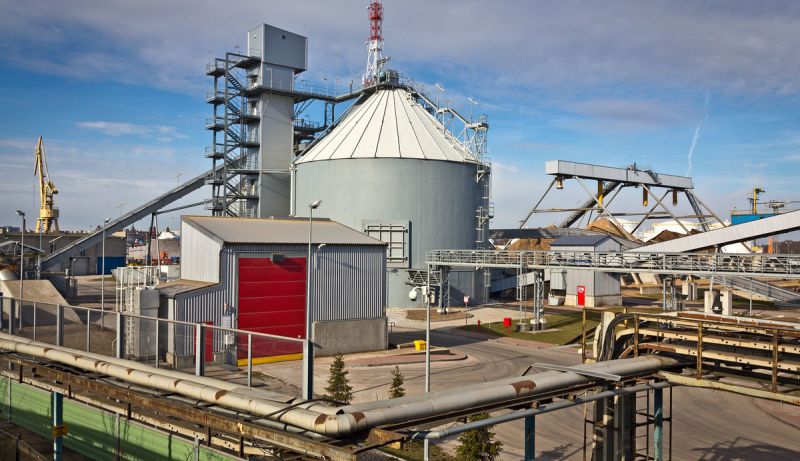
● After-sales
Project Follow-Up
When everything is up and running our Richiers will help you further whenever needed. We are ready to answer your call 24/7.We’ll also visit you regularly to learn about your needs.
Who we are
RICHI Machinery is one of the world’s leading suppliers of technology and services for the animal feed, aqua feed and pet food industries, also the largest pellet production line manufacturer in China.
Since 1995, RICHI’s vision to build a first-class enterprise, to foster first-class employees, and to make first-class contributions to society has never wavered.
In the past three decades, we have expanded our business to a wide range of areas, including animal feed mill equipment, aqua feed equipment, pet feed equipment, biomass pellet equipment, fertilizer equipment, cat litter equipment, municipal solid waste pellets equipment, etc.

1995
RICHI Established

2000+
Serving More Than 2000 Customers

120+
RICHI Employees

140+
Exported To 140 Countries