 0086-138 3838 9622
Straw Pellet Manufacturing Plant in Uganda
RICHI MACHINERY
Project Overview
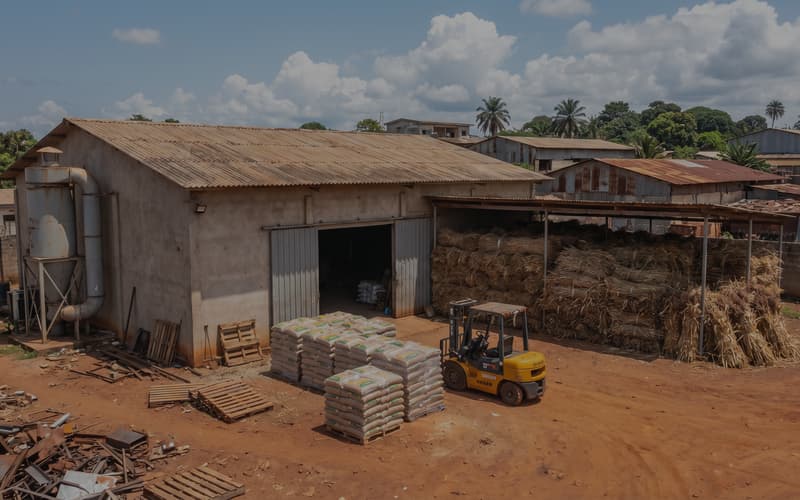
A 0.8t/h straw pellet manufacturing plant in Uganda was commissioned in late 2023 for a client in the Mpigi District, about 35km west of Kampala. The facility processes 2,020 tons of agricultural residues annually into 2,000 tons of biomass pellets for local institutions, small factories, and households.
The straw pellet plant operates three shifts per day, 8 hours per shift, 300 days per year (7,200 total operating hours), with 6 employees. Total investment was $78,000 USD.
What makes this 0.8t/h straw pellet manufacturing plant in Uganda unusual is the feedstock diversity. The client uses four different agricultural residues: cereal straw – 500 t/yr, ginger plant residue – 620 t/yr, tree branches and twigs – 400 t/yr, and corn stalks and husks – 500 t/yr. Most pellet plants in East Africa run on sawdust. This client built his business entirely on crop residues that other farmers were burning.
0.8T/H
capacity
$78,000 USD
investment
Uganda
location
Biofuel
project type
RICHI MACHINERY
The First Call – “I Have Access to Free Crop Residues”
The client called us in May 2023. He was a former agricultural extension officer who had worked with smallholder farmers in Mpigi for over a decade. Every year, he watched farmers burn ginger stalks, corn stover, and straw after harvest. The smoke was terrible. The soil lost organic matter. And the farmers got nothing.
He had a building (900 m² Workshop + 300 m² Office Area) on a small plot of land he owned. He had saved about $80,000 over fifteen years. He had no experience with pellet production but knew the market for cooking fuel in Kampala was desperate – charcoal prices had tripled in five years.
His question: “Can I make pellets from mixed crop residues without drying them first?”
We asked about moisture content. He sent samples. Ginger stalks were 12-15% moisture – dry enough. Corn stalks were 14-18% – acceptable. Straw was 10-12% – perfect. The key was that all his residues came from the dry season harvest (December-February) and were stored under cover. No drying needed.
We told him yes. A 0.8t/h straw pellet manufacturing plant in Uganda could work with his feedstock if he maintained covered storage and rejected wet material.
RICHI MACHINERY
Raw Materials – Four Feedstocks, One Source
The client set up collection agreements with 200 smallholder farmers within a 30km radius.
| Raw Material | Annual Input (tons) | As-Received Moisture | Cost (USD/ton) | Source |
|---|---|---|---|---|
| Cereal straw | 500 | 10-12% | $15 | Farmers in Mpigi |
| Ginger plant residue | 620 | 12-15% | $12 | Ginger growers |
| Tree branches/twigs | 400 | 15-18% | $18 | Local tree pruning |
| Corn stalks/husks | 500 | 14-17% | $14 | Maize farmers |
| Total | 2,020 | Avg 13-14% | $15 avg |
The client pays farmers per kilogram delivered. For ginger residue, he pays 600 Ugandan shillings per kg (about $0.16 USD) – which is 3x what farmers would get for selling it as animal bedding. For straw and corn stalks, he pays less because they’re more abundant.
Total input 2,020 tons, output 2,000 tons. The 20-ton difference accounts for dust collected (about 18 tons) and packaging waste (2 tons).
The client also generates about 1.5 tons of ash annually from his own cooking (he uses pellets for his household stove) – but that’s not part of the straw biomass pellet production line.
RICHI MACHINERY
Why No Dryer? (And Why That Matters)
Most agricultural residues are too wet for direct pelleting. Fresh corn stalks can be 40-60% moisture. Fresh straw from the rainy season can be 25-35%. A dryer would cost $15,000-25,000 and consume significant energy.
The client avoided this by doing two things:
First: He only collects during the dry season (December to February). Farmers store their residues under simple tarpaulins after harvest. By March, moisture is down to 12-15%.
Second: He built covered storage (200m² Raw Materials Area) at his facility. Any material that arrives above 18% moisture goes into a separate bay and air-dries for 2-3 weeks before processing.
This 0.8t/h straw pellet manufacturing plant in Uganda has no straw dryer and no hot air furnace. The client saved $20,000 upfront and avoids ongoing fuel costs.
The trade-off: he can only produce pellets for 8 months per year. During the rainy season (April-November), he either shuts down or buys dry material from farmers who stored properly. He chose to shut down for 4 months and do maintenance. His customers understand the seasonal supply.
RICHI MACHINERY
Equipment List – Simple and Reliable
| Equipment | Quantity | Power | Function |
|---|---|---|---|
| Crusher/Shredder | 2 | 22kW each | Size reduction of crop residues |
| Straw pellet machine | 2 | 37kW each | Main compaction (0.4-0.45 t/h each) |
| Automatic Bagging Machine | 2 | 1.5kW each | Finished product packaging |
| Belt conveyor | 2 sets | 1.1kW each | Material transfer |
| Baghouse filter | 1 | 3.7kW | Dust collection, 3,000 m³/hr |
| Exhaust stack | 15m | — | Treated air discharge |
Equipment price (EXW Qingdao port): $52,000 USD
The client bought the two production lines as a package – each line has one crusher, one press, one bagger, and one conveyor. He runs both lines simultaneously during the 8-month production season.
Shipping: Two 40-foot containers. Departed Qingdao August 15, 2023. Arrived Mombasa Port, Kenya on September 28, 2023 (Uganda is landlocked). Sea freight: $4,200 USD. Rail freight from Mombasa to Kampala (about 1,200km) via the Standard Gauge Railway added $2,800 USD and 10 days. Inland trucking from the rail terminal to Mpigi added $400 USD.
RICHI MACHINERY
Facility Layout – 1,200m² Total Space
The client already had a 900m² workshop and 300m² office on his property. We helped him reorganize the space.
| Area | Size (m²) | Function |
|---|---|---|
| Production Workshop | 900 | Two production lines (crushers, presses, baggers) |
| Raw Materials Area | 200 | Covered storage for crop residues |
| Finished Goods Area | 150 | Bagged pellets awaiting shipment |
| Office | 300 | Admin, sales, records |
| General waste storage | 10 | Collected dust, packaging waste |
The Raw Materials Area is at the north end of the Production Workshop. Raw material flows south through the crushers, then to the presses, then to the baggers, and finally to the Finished Goods Area at the south end. Straight line. No backtracking.
The baghouse filter sits outside the workshop to save floor space. The 15m exhaust stack is mounted on the exterior wall.
RICHI MACHINERY
Process Flow – Three Steps, Agricultural Residues
Here’s how the 0.8t/h straw pellet manufacturing plant in Uganda actually runs.
Step 1 – Crushing/Shredding
Farmers deliver crop residues in baled or loose form. The client’s workers feed material into the two crushers. The crushers reduce straw, corn stalks, ginger residue, and branches to 5-10mm particles. This is the only size reduction step – no secondary hammer mill.
The crushing process generates dust. A collection hood above each crusher captures about 90% of the dust and sends it to the baghouse filter.
Step 2 – Pelleting/Briquetting
Crushed material drops onto belt conveyors (enclosed) and feeds into the two biomass pellet mills. Each press produces 0.4-0.45 t/h of 8mm diameter pellets. The presses use friction heat (100-120°C) to soften the lignin in the plant material, which acts as a natural binder. No added binders or glues.
The client runs both presses simultaneously during the 8-month production season. Daily output: 6.4-7.2 tons.
Step 3 – Bagging
Pellets drop directly from each press into a bagging machine. The baggers fill 25kg woven polypropylene bags. Workers stack bags on pallets (40 bags per pallet, 1 ton per pallet). The pellets cool naturally during storage – no forced-air cooler needed because the production rate is low and the workshop is well-ventilated.
The bagging process generates waste packaging material (torn bags, strapping). The client collects this and sells it to a recycler.
RICHI MACHINERY
Operating Costs – After Six Months of Production
The plant has been operating for 8 months (December 2023 to July 2024, with a 4-month rainy season shutdown). Here are the numbers for the production months.
| Cost Category | Monthly (USD) | Annual (USD) | Notes |
|---|---|---|---|
| Crop residues | $2,525 | $20,200 | 168 tons at $15/ton average |
| Electricity | $280 | $2,240 | 2,000 kWh/month at $0.14/kWh |
| Labor (6 people) | $360 | $2,880 | $60/month per person (Uganda) |
| Maintenance & spares | $200 | $1,600 | Dies, bearings, belts |
| Building (owned) | $0 | $0 | Client owns the land |
| Total monthly | $3,365 | $26,920 |
Revenue (8 production months only):
| Product | Monthly Output (tons) | Price (USD/ton) | Monthly Revenue |
|---|---|---|---|
| Biomass pellets | 167 | $145 | $24,215 |
Monthly net profit: $20,850 USD. Annual net profit (8 months): $166,800 USD.
The client’s total investment was $78,000 (equipment $52,000 + shipping $7,400 + local installation $5,000 + working capital $13,600). Payback period: 5 production months.
RICHI MACHINERY
The Ugandan Market for Crop Residue Pellets
Uganda has a severe cooking fuel problem. Over 90% of households rely on charcoal or firewood. Deforestation is estimated at 122,000 hectares per year. Charcoal prices in Kampala have increased from 20,000 UGX per sack in 2018 to 65,000 UGX ($17.50) in 2024.
The client’s target customers are:
- Schools in Mpigi and Kampala (institutional kitchens) – 60 tons/month
- Small bakeries and food processors – 40 tons/month
- Households in peri-urban areas (switching from charcoal) – 40 tons/month
- Poultry farms (using pellets for brooder heaters) – 27 tons/month
He can’t keep up with demand. During the 8-month production season, he sells everything he makes. During the 4-month rainy season shutdown, his customers buy charcoal or switch to other fuels.
The client is already planning to expand. He wants to add a drying system so he can process rainy-season material. A simple solar dryer (polytunnel with fans) would cost about $8,000 and extend his production season to 10-11 months.
RICHI MACHINERY
What the Client Learned
The first month of operation (December 2023) had problems. Here are three.
Problem 1 – The ginger residue was stringy.
Ginger stalks have long fibers that wrapped around the crusher rotor. The machine would jam every 2 hours.
Fix: The client added a pre-shredder (a simple rotary knife cutter) before the crusher. He bought a used unit from a feed mill in Kampala for $500. Now the ginger stalks are cut to 50mm length before crushing. No more jams.
Problem 2 – Pellet quality varied by feedstock.
Pellets made from 100% straw were soft (PDI 86%). Pellets made from 100% corn stalks were hard but dusty. Pellets made from the standard blend (25% each) were inconsistent.
Fix: The client experimented with different blends. He found that 40% corn stalks + 30% straw + 20% ginger + 10% branches produced pellets with PDI 93%. He now follows this blend ratio strictly.
Problem 3 – The baghouse filter clogged.
Crop residue dust is finer than wood dust. The filter bags blinded within 3 days of operation.
Fix: We upgraded the pulse-jet cleaning frequency (from every 4 hours to every 2 hours) and added a cyclone pre-separator ($1,200). The cyclone removes 70% of the dust before it reaches the baghouse. Now the system runs for 2 weeks between cleanings.
RICHI MACHINERY
The Agricultural Residue Opportunity
This 0.8t/h straw pellet manufacturing plant in Uganda demonstrates a model that could work across East Africa.
What makes it work:
- Seasonal production matches dry season harvest
- Covered storage keeps material dry
- Multiple feedstocks provide supply security
- Local demand for cooking fuel is strong and growing
What makes it challenging:
- Inconsistent feedstock quality (moisture varies by farmer)
- Seasonal shutdown (4 months with no revenue)
- Labor-intensive collection from many small farmers
The client solved the seasonal shutdown problem by using the rainy season for maintenance and sales. He visits schools and bakeries during the rainy months, takes orders for the next dry season, and collects deposits. This gives him working capital for the next production cycle.
RICHI MACHINERY
What We Provided
For this 0.8t/h straw pellet manufacturing plant in Uganda, we delivered:
- Process design – Including the blending recommendation and pre-shredder integration.
- Equipment package – Two complete lines (crushers, presses, baggers, conveyors).
- Dust collection design – Cyclone + baghouse with pulse-jet cleaning.
- Installation supervision – Our engineer spent 12 days in Mpigi.
- Operator training – Three days on feedstock blending, press adjustments, and filter cleaning.
- Spare parts kit – Two spare dies, belts, bearings, and a box of filter bags.
We also provided the client with a list of local suppliers for consumables (dies, belts, lubricants) in Kampala.
RICHI MACHINERY
Thinking About Agricultural Residue Pellets?
If you’re looking at a 0.8t/h straw pellet manufacturing plant in Uganda – or anywhere in East Africa – here’s what we’ve learned:
- Seasonal production works if you plan for it. The client shuts down for 4 months and survives on deposits and savings.
- Covered storage is critical. Wet crop residues will ruin your production. Spend money on a good roof.
- Blending improves pellet quality. Don’t rely on one feedstock. Mix different residues to get the right fiber length and lignin content.
- Start with institutional customers. Schools and bakeries buy consistently and pay on time.
The client in Mpigi is already profitable. He’s expanding. If you have access to crop residues and a market for cooking fuel, this model works.
Contact us for a site assessment or equipment quote. We can provide references from this biomass pellet project upon request.
● RICHI MACHINERY
RICHI Service

● Consulting
Customer Consultation
We want to have a deep understanding of your industrial process, to know your exact needs of feed, wood, biomass, fertilizer or other pellet processing.
● Design
straw Pellet Plant Design
Based on your unique situation and industrial process, we will tailor complete pellet plant you need, and inform you of every additional detail that could facilitate operation, minimize total cost.

● Manufacturing
Equipment Manufacturing
The critical components of the of the complete pellet production line equipment are built in our own workshops in Asia. Additional equipment is manufactured by our worldwide network of reliable partners.

● Testing
Quality Inspection & Testing
Before leaving the factory, all equipment will be inspected by the quality inspection department. We can also provide customers with testing services from a single machine to a complete pellet plant system, and provide you with real actual data for “worry-free use.”

● Delivery
Equipment Delivery
In equipment boxing and packaging, we adopt professional packaging and modular solutions to ensure the safe and non-destructive delivery of pellet plant equipment.
● Installation
Installation & Commissioning
Whether you choose your own subcontractor for the erection phase or you want to install everything together with us, a Richi supervisor will be around to make sure everything is mounted in a safe and thorough way.

● Training
Staff Training
We provide comprehensive training for the technicians of each project. We can also continue to provide support for the technicians during latter project operation.
● After-sales
Project Follow-Up
When everything is up and running our Richiers will help you further whenever needed. We are ready to answer your call 24/7.We’ll also visit you regularly to learn about your needs.
Who we are
RICHI Machinery is one of the world’s leading suppliers of technology and services for the animal feed, aqua feed and pet food industries, also the largest pellet production line manufacturer in China.
Since 1995, RICHI’s vision to build a first-class enterprise, to foster first-class employees, and to make first-class contributions to society has never wavered.
In the past three decades, we have expanded our business to a wide range of areas, including animal feed mill equipment, aqua feed equipment, pet feed equipment, biomass pellet equipment, fertilizer equipment, cat litter equipment, municipal solid waste pellets equipment, etc.

1995
RICHI Established

2000+
Serving More Than 2000 Customers

120+
RICHI Employees

140+
Exported To 140 Countries