
 0086-138 3838 9622
Poultry Feed Factory Setup in Philippines
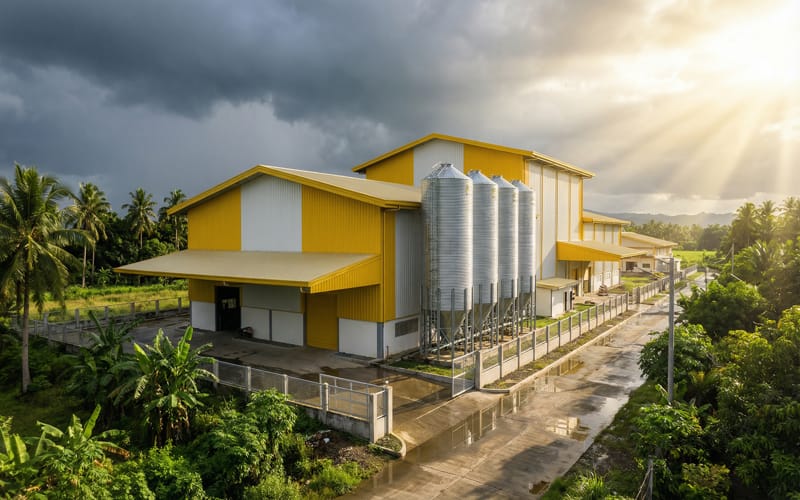
RICHI MACHINERY
Overview
In early 2026, RICHI Machinery completed the engineering design, equipment manufacturing, and technical commissioning support for a complete poultry feed factory setup in Philippines, located in an industrial zone with excellent access to raw material supply routes and major poultry-producing regions.
This project represents a strategic investment in the Philippines’ growing livestock sector, designed to produce 120,000 tons annually of high-quality poultry feed—comprising 48,000 tons of mash feed and 72,000 tons of pelleted feed.
The poultry feed factory setup in Philippines was developed by an established Filipino agribusiness company that recognized the significant opportunities in the country’s expanding poultry market. With the Philippines animal feed market reaching approximately 13.79 million tons in 2025 and projected to grow at a CAGR of 2.00% through 2035, the investor identified a compelling need for modern, efficient feed production capacity to serve the rapidly growing broiler and layer sectors.
Located in a leased industrial facility with strategic access to major agricultural supply routes, this poultry feed factory setup in Philippines occupies a 1,000 m² production building plus supporting facilities, with a newly constructed five-story equipment tower housing the main processing line.
The facility processes approximately 123,500 tons of raw materials annually—including 95,000 tons of corn, 10,000 tons of soybean meal, 10,000 tons of vegetable oil, and various other ingredients—to produce nutritionally optimized feed formulations for poultry operations throughout the region.
The total equipment investment for this poultry feed factory setup in Philippines reached USD 520,000, representing a complete processing solution from raw material intake to automated packaging. The client’s total project investment, including building modifications, installation, and working capital, amounted to approximately USD 780,000. Financial modeling indicates a projected payback period of 3.2 years based on conservative margin assumptions, with internal rates of return exceeding 22% over a seven-year operating horizon.
40T/H
capacity
USD 520,000
investment
Philippines
location
FEED
project type
RICHI MACHINERY
Project Background
The Investor Profile
The client behind this poultry feed factory setup in Philippines represents the second generation of a family deeply rooted in the Philippine agricultural sector. Originally established as a small-scale grain trading operation in the 1990s, the family business gradually expanded into commodity supply to local livestock and poultry farms throughout the Luzon region. By 2020, they had built a reliable network of supplier relationships with corn farmers and importers, while simultaneously developing strong connections with poultry integrators and independent growers.
The decision to vertically integrate into feed manufacturing reflects both opportunity and necessity. According to industry analysis, feed represents approximately 60% of the total cost to produce poultry meat and eggs in the Philippines, making it the single most critical factor in production economics. With the Philippine poultry sector continuing to expand—chicken production reached 1.81 million tons in 2026, up 7.1% from the previous year—the demand for consistent, high-quality feed has never been stronger.
The investor recognized that while they had successfully built a trading business, the real value in the agricultural supply chain lay in processing and value addition. By establishing their own poultry feed factory setup in Philippines, they could capture the processing margin while ensuring consistent quality for their customers.
The Philippine Poultry Market Opportunity
The Philippines presents one of Southeast Asia’s most attractive markets for poultry feed manufacturing. Several factors make this poultry feed factory setup in Philippines particularly well-timed:
Market Size and Growth: The Philippines animal feed market reached approximately 13.79 million tons in 2025, with the poultry sector accounting for a substantial market share due to consistent demand, short production cycles, and predictable feed planning. Chicken is a highly popular meat in the Philippines due to its cost-effectiveness and adaptability in a wide range of culinary dishes.
Production Trends: Poultry production continues to expand robustly. In 2022, the country produced 454.38 metric tonnes of chickens, a 6.7% rise from the previous year, while egg production grew by 6.1% during the same period. This growth trajectory has continued, with recent data showing broiler and layer industries driving strong feed demand.
Export Opportunities: The Philippines exports a significant share of poultry products to Japan, where geographical proximity provides a competitive advantage. Japan’s increasing demand for poultry imports, combined with the Philippines’ ability to supply fresh products, creates additional market pull for domestic production.
Feed Ingredient Dynamics: Corn remains the cornerstone of poultry nutrition in the Philippines, with feedmillers preferring locally produced yellow corn when available. However, they remain flexible in incorporating imported corn or wheat when global prices are favorable. This flexibility allows processors to optimize formulations based on market conditions.
Why Invest in Feed Manufacturing?
The decision to proceed with this poultry feed factory setup in Philippines reflects several strategic considerations:
Cost Control: By producing their own feed, the investor can capture margins that would otherwise flow to commercial suppliers. At 120,000 tons annual production, even modest per-ton savings translate to significant bottom-line impact.
Quality Assurance: Direct control over ingredient selection, processing parameters, and quality testing ensures consistent nutrition aligned with poultry performance goals. Recent research demonstrates that precise control over factors like particle size and pellet quality can significantly improve feed efficiency.
Supply Security: The Philippine feed industry occasionally faces raw material supply challenges due to typhoon-related crop losses or import disruptions. A 2025 USDA report noted that typhoons in Q3 2025 caused corn losses exceeding 71,000 tons, with Cagayan Valley—the country’s leading corn-producing region—hit hardest. In-house manufacturing provides insulation from such market volatility.
Formulation Flexibility: Independent control enables rapid adjustment of formulations based on ingredient prices, poultry performance data, and nutritional research without the lead times required by commercial suppliers.
Facility Scale and Throughput
This poultry feed factory setup in Philippines operates at a scale appropriate for serving regional poultry operations within a 150-kilometer radius. The 120,000-ton annual capacity represents approximately 0.9% of the total Philippine animal feed market, making it a significant regional supplier.
Key Operational Parameters
| Parameter | Value |
|---|---|
| Operating Days per Year | 300 |
| Production Shifts | 1 Shift (10 hours) |
| Processing Rate (Design) | 40 Tons/Hour |
| Raw Material Consumption | ~123,500 Tons/Year |
| Finished Product Output | 120,000 Tons/Year (48k Mash + 72k Pellets) |
| Steam Generation Capacity | 1.5 t/h Biomass Boiler |
| Biomass Fuel Consumption | 195 Tons/Year |
| Power Consumption | 38,000 kWh/Day (Estimated) |
| Water Consumption | 5,418 m³/Year |
| Staffing | 50 Total (25 On-Site, 25 Sales/External) |
RICHI MACHINERY
Site Selection and Facility Layout
Site Location and Context
The poultry feed factory setup in Philippines is situated in an established industrial area with excellent access to both raw material supply routes and major poultry-producing regions. Rather than constructing a new facility from scratch, the investor strategically chose to lease an existing industrial building from a local steel structure company, significantly reducing capital requirements and accelerating the project timeline.
The location was selected based on several strategic criteria:
- Raw Material Access: Proximity to corn-producing areas and major transportation routes ensures reliable inbound logistics for the 95,000 tons of corn consumed annually.
- Customer Proximity: Location within reasonable distance of major poultry-producing regions minimizes finished product transportation costs.
- Utility Availability: Access to municipal water and grid electricity with adequate capacity for industrial operations.
- Existing Infrastructure: The leased building provided a solid foundation for the new processing line, requiring only modifications rather than complete new construction.
Facility Layout and Building Configuration
The facility comprises multiple interconnected areas designed for efficient material flow:
Main Production Building: A five-story equipment tower (approximately 1500 m² total floor area) housing the complete processing line. The vertical arrangement allows gravity flow between processing stages, reducing conveying requirements and energy consumption:
- 1st Floor: Crushing, mixing, packaging, and cooling operations
- 2nd Floor: Animal Feed Pellet mill, control room, batching equipment
- 3rd Floor: batching bins
- 4th Floor: batching bins, fans
- 5th Floor: Bucket elevators, head pulleys, screens
Support Buildings:
- Raw Material Warehouse: 2,768 m² steel structure building for ingredient storage
- Finished Product Warehouse: 400 m² storage area within main complex
- Bag Storage: 100 m² dedicated area for packaging materials
- Administration Building: 480 m² four-story structure housing offices, laboratory, and staff accommodations
- Steam Generator Room: 95 m² adjacent to main production building
- Oil Storage Tanks: Two 10 m³ tanks for vegetable oil storage
- Gate House & Disinfection Station: 14 m² combined facility
Facility Area Breakdown
| Area | Square Meters | Notes |
|---|---|---|
| Main Production Building | 1,500 | 5-Story Equipment Tower |
| Raw Material Warehouse | 2,768 | Steel Structure |
| Finished Product Warehouse | 400 | Within Main Complex |
| Bag Storage | 100 | Dedicated Packaging Area |
| Administration Building | 480 | 4-Story with Lab & Accommodation |
| Steam Generator Room | 95 | Biomass Boiler |
| Support Facilities | Various | Gate House, Disinfection, etc. |
| Total Leased Area | ~5,000 | Approximate Total |
RICHI MACHINERY
Raw Materials and Formulation Strategy
Ingredient Sourcing in the Philippine Context
For this poultry feed factory setup in Philippines, raw material sourcing reflects the reality of the Philippine agricultural economy. The country produces significant quantities of corn—projected at 8.27 million tons in marketing year 2025/26—but also relies on imports to meet total demand of approximately 10.15 million tons.
Primary Ingredient Sources
| Ingredient | Annual Consumption (tons) | Primary Source | Typical Formulation Rate |
|---|---|---|---|
| Corn | 95,000 | Local Farmers (Luzon) / Imports | 60-70% |
| Soybean Meal | 10,000 | Imported / Local Crushers | 15-20% |
| Vegetable Oil | 10,000 | Imported / Local Processors | 5-8% |
| Wheat Bran | 2,500 | Local Flour Mills | 2-4% |
| Rice Bran | 2,000 | Local Rice Mills | 1-3% |
| Mineral Powders | 2,000 | Imported / Local Suppliers | 1-2% |
| Additives & Premixes | 2,000 | Various Suppliers | 1-2% |
Corn Sourcing and Quality
Corn represents the largest ingredient volume in poultry diets, and sourcing high-quality corn is essential for this poultry feed factory setup in Philippines. The facility’s location provides access to production from Luzon’s corn-growing areas, supplemented by imports when local supplies are tight or pricing favors foreign origin.
Corn Specification Requirements
| Parameter | Target | Acceptable Range |
|---|---|---|
| Moisture | 14.0% | <14.5% |
| Test Weight | >58 kg/hL | >56 kg/hL |
| Broken Kernels | <3% | <5% |
| Foreign Material | <1% | <2% |
| Aflatoxin | <20 ppb | — |
The facility’s quality control program includes rapid moisture testing for each incoming truckload, with regular sampling for mycotoxin analysis.
Soybean Meal and Protein Ingredients
Soybean meal serves as the primary protein source, typically imported from major soybean-producing countries. Specifications include:
- Protein Content: 44-46%
- Fiber Content: <7%
- Urease Activity: 0.05-0.20 pH rise
Additive and Premix Ingredients
Modern poultry nutrition requires precise inclusion of micro-ingredients. This poultry feed factory setup in Philippines incorporates a comprehensive range of additives:
- Enzymes: Phytase, xylanase for improved nutrient utilization
- Vitamins: A, D, E, B-complex
- Minerals: Calcium, phosphorus, trace minerals
- Amino Acids: Lysine, methionine, threonine
- Other Additives: Antioxidants, mold inhibitors, flavoring agents
Raw Material Consumption Summary
| Item | Annual Consumption | Unit | Packaging | Storage Method |
|---|---|---|---|---|
| Corn | 95,000 | t/a | Bulk (bags) | Ton Bags / Warehouse |
| Soybean Meal | 10,000 | t/a | Bags | Ton Bags / Warehouse |
| Vegetable Oil | 10,000 | t/a | Bulk Liquid | 10 m³ Tanks (2) |
| Wheat Bran | 2,500 | t/a | Bags | Warehouse Stacking |
| Rice Bran | 2,000 | t/a | Bags | Warehouse Stacking |
| Mineral Powders | 2,000 | t/a | Bags | Warehouse Stacking |
| Additives & Premixes | 2,000 | t/a | Bags | Warehouse Stacking |
RICHI MACHINERY
Processing Equipment and Technology
Complete Equipment Inventory
The poultry feed factory setup in Philippines incorporates a comprehensive range of processing equipment designed for efficient, reliable operation.
Major Equipment Summary by Process Section
| Section | Equipment Type | Model | Quantity | Function |
| Receiving & Cleaning | Fan | 4-72-3.2A | 2 | Air movement |
| Receiving Pit | — | 2 | Raw material intake | |
| Pulse Dust Collector (Explosion-proof) | TBLMa.12 | 2 | Dust control | |
| Self-Cleaning Bucket Elevator | TDTG36/28 | 2 | Vertical transport | |
| Permanent Magnet | TCXT25 | 2 | Ferrous metal removal | |
| Rotary Drum Screen | SCY63 | 1 | Coarse impurity removal | |
| Pneumatic Three-Way Valve | QZMQ30*30 | 1 | Flow direction | |
| Powder Cleaning Screen | SCQZ60*50*80 | 1 | Fine screening | |
| Drag Conveyor (Explosion-proof) | TGSS25 | 1 | Horizontal transport | |
| Self-Cleaning Bucket Elevator | TDTGU40/28 | 1 | Vertical transport | |
| Cone Powder Cleaner | SCQZ90×80×110 | 1 | Final cleaning | |
| Rotary Distributor | TTFPX10 | 1 | Material distribution | |
| Grinding Section | High Level Indicator | KF1500 | 2 | Bin level monitoring |
| Grinding Bin | 10 m³ | 2 | Surge capacity | |
| Low Level Indicator | KF1500 | 2 | Bin level monitoring | |
| Pneumatic Gate | TZMQ30*30 | 2 | Flow control | |
| Surge Hopper | — | 1 | Feed regulation | |
| Rotary Feeder | TWLY20*100 | 1 | Controlled feeding | |
| Hammer Mill Feed Grinder | SWSP66*100 | 1 | Particle size reduction | |
| Settling Chamber | — | 1 | Dust separation | |
| Closed Screw Conveyor | TLSS25 | 1 | Material transfer | |
| Fan | 4-72-6A | 1 | Air movement | |
| Pulse Dust Collector | TBLMa.48 | 1 | Dust collection | |
| Bucket Elevator | TDTG36/28 | 1 | Vertical transport | |
| Rotary Distributor | TFPX10 | 1 | Material distribution | |
| Batching & Mixing | High Level Indicator | KF1500 | 16 | Bin level monitoring |
| Batching Bins | 160 m³ Total | 1 Set | Ingredient storage | |
| Low Level Indicator | KF1500 | 16 | Bin level monitoring | |
| Bin Discharge | TLSS/25/20 | 16 | Metered discharge | |
| Batching Scale | 1T | 2 | Accurate weighing | |
| Pneumatic Gate | TZMQ40*2 | 2 | Flow control | |
| Pulse Dust Collector | TBLMa.4 | 1 | Dust control | |
| Discharge Hopper | — | 1 | Material collection | |
| Micro-ingredient Check Scale | 200 kg | 1 | Small ingredient weighing | |
| Pneumatic Gate | — | 1 | Flow control | |
| Double-Shaft Paddle Mixer | SJHLS4A | 1 | Homogeneous blending | |
| Surge Bin | — | 1 | Post-mix surge | |
| Drag Conveyor | TGSS25 | 1 | Horizontal transfer | |
| Bucket Elevator | TDTG50/28 | 1 | Vertical transport | |
| Permanent Magnet | TCXT25 | 1 | Final metal removal | |
| Finished Product Screen | SCQZ60*50*80 | 1 | Quality screening | |
| Rotary Distributor | TFPX4-300 | 1 | Material distribution | |
| Pellet Mill & Cooling | High Level Indicator | KF1500 | 2 | Bin level monitoring |
| Pellet Mill Feed Bin | 10 m³ | 2 | Surge capacity | |
| Low Level Indicator | KF1500 | 2 | Bin level monitoring | |
| Pneumatic Gate | TZMQ40 | 2 | Flow control | |
| Poultry Feed Pellet Machine | SZLH420 | 4 | Pellet production | |
| Conditioner | TZ38*250 | 4 | Steam conditioning | |
| Rotary Airlock | GLF.40 | 1 | Material feeding | |
| Counterflow Cooler | SKLN20x20 | 1 | Pellet cooling | |
| Crumblizer | SSLG15*150 | 1 | Pellet size reduction | |
| Fan | 4-72-6C | 1 | Air movement | |
| Cyclone | SK150 | 1 | Dust recovery | |
| Rotary Airlock | GFY.9 | 1 | Material discharge | |
| Bucket Elevator | TDTG36/28 | 2 | Vertical transport | |
| Pneumatic Three-Way Valve | TBDQY25*25 | 2 | Flow direction | |
| Drag Conveyor | TGSS25 | 1 | Horizontal transfer | |
| Rotary Grading Screen | SFJH125*2 | 1 | Particle size classification | |
| Pneumatic Three-Way Valve | TBDQY25*25 | 1 | Flow direction | |
| Packaging Section | High Level Indicator | KF1500 | 2 | Bin level monitoring |
| Finished Product Bin | 10 m³ | 2 | Product storage | |
| Low Level Indicator | KF1500 | 2 | Bin level monitoring | |
| Discharge Indicator | SR2L-10F-200L | 1 | Flow monitoring | |
| Pneumatic Gate | TZMQ30*30 | 2 | Flow control | |
| Surge Hopper | — | 1 | Packaging feed | |
| Packaging Scale | DSC-50 | 1 | Weight-controlled filling | |
| Sewing Conveyor | — | 1 | Bag closing | |
| Pulse Dust Collector (Explosion-proof) | TBLMa.6 | 1 | Dust control | |
| Fan | 4-72-2.4A | 1 | Air movement | |
| Rotary Airlock | GFY.9 | 1 | Dust discharge | |
| Support Equipment | Rotary Airlock | GFY7L | 1 | General service |
| Electric Hoist | 2T | 1 | Maintenance | |
| Weighed Oil Addition System | SYTZ100 | 1 | Liquid fat addition | |
| Air Compressor | — | 1 | Pneumatic power | |
| Air Receiver | 2 m³ | 1 | Compressed air storage | |
| Refrigerated Air Dryer | — | 1 | Moisture removal | |
| Filter | — | 1 | Air quality | |
| Steam Generator | 1.5 t/h Biomass | 1 | Process steam | |
| Truck Scale | — | 1 | Weight verification | |
| Total Major Equipment | Approx. 100 |
Biomass Steam Generation
An important feature of this poultry feed factory setup in Philippines is the biomass-fired steam generation system. With steam required for conditioning in the pellet mill, the facility installed a 1.5 t/h biomass steam generator using locally available agricultural residues as fuel.
Steam System Specifications
| Parameter | Value |
|---|---|
| Boiler Type | Biomass-Fired Steam Generator |
| Capacity | 1.5 t/h |
| Operating Pressure | Suitable for feed conditioning |
| Fuel | Biomass Pellets (195 t/a) |
| Operating Hours | 10 hours/day (matched to production) |
| Emissions Control | Water Curtain Scrubber + 18m Stack |
The boiler consumes approximately 195 tons of biomass fuel annually, sourced from local agricultural processing residues. Emissions are controlled through a water curtain scrubber before discharge through an 18-meter stack.
Dust Collection System
The Philippine regulatory environment increasingly emphasizes occupational health and environmental compliance. This poultry feed factory setup in Philippines incorporates comprehensive dust collection:
| Emission Point | Control Equipment | Discharge Point |
|---|---|---|
| Receiving (2 points) | Pulse Dust Collectors (2) | In-plant return |
| Grinding | Pulse Dust Collector | 15m Stack (DA001) |
| Pellet Mill | Pulse Dust Collector | 15m Stack (DA002) |
| Packaging | Pulse Dust Collector | 15m Stack (DA003) |
| Batching Bins | Pulse Dust Collector | In-plant return |
All collected dust is returned to the process stream at appropriate points, achieving zero particulate waste while recovering valuable feed material.
RICHI MACHINERY
Production Process and Quality Control
Process Flow Description
The poultry feed mill project setup in Philippines employs a comprehensive manufacturing process designed to produce consistent, high-quality poultry feed meeting the nutritional requirements of broilers and layers at all production stages.
Process Flow Summary
Raw Material Receiving → Cleaning/Magnetic Separation → Grinding →Batching → Mixing → (Pellet Mill → Cooling → Crumbling → Screening) → Packaging → Storage
Detailed Process Steps
Step 1: Raw Material Receiving and Laboratory Testing
All incoming raw materials are sampled and tested before acceptance. The laboratory analyzes:
- Corn: Moisture, protein, aflatoxin screening
- Soybean Meal: Protein, moisture, urease activity
- Other Ingredients: Conformance to specifications
Step 2: Cleaning and Magnetic Separation
Corn and other grains pass through the rotary drum screen to remove:
- Oversize Material: Stems, cobs, stones, and other field debris
- Undersize Material: Fine particles, broken kernels, weed seeds
After screening, material passes through permanent magnets to remove ferrous contaminants that could damage downstream equipment—particularly important for protecting hammer mill screens and pellet mill dies.
Step 3: Grinding
Cleaned corn is conveyed to the grinding bin, then metered to the 75 kW hammer mill through a controlled feeder. The mill operates with screen perforations optimized for poultry feed:
- Screen Size: 3-6 mm depending on target particle size
- Rotor Speed: 1,480 RPM
- Grinding Mode: Under-sieve discharge with pneumatic assist
Proper particle size is critical for poultry performance—too fine and feed becomes dusty and unpalatable; too coarse and digestibility suffers.
Step 4:Batching
The batching system operates under computer control, with each ingredient drawn from its storage bin according to the formulation stored in the system database. Key features:
- Major Ingredients: Corn, soybean meal, bran—batched into 1,000 kg scales
- Liquid Ingredients: Vegetable oil—metered directly into mixer
- Micro-Ingredients: Vitamins, minerals, additives—weighed on 200 kg check scale
The batching system accommodates multiple formulations, allowing rapid changeovers between different feed types (starter, grower, finisher, layer).
Step 5: Mixing
Batched ingredients discharge into the double-shaft paddle mixer. During the mixing cycle:
- Mixing Time: 3-4 minutes
- Liquid Addition: Oil sprayed during mixing
- Uniformity: Coefficient of variation <5%
For mash feed production, mixed material proceeds directly to packaging after quality testing.
Step 6: Conditioning and Pellet Mill
For pelleted feed production, mash is conveyed to the poultry chicken feed pellet machine feed bin. From there, it enters the conditioner where steam injection raises temperature to 60-70°C. This conditioning step:
- Gelatinizes starches for improved digestibility
- Softens particles for better die compaction
- Adds moisture to facilitate pellet formation
Conditioned mash then passes through the pellet mill die, emerging as cylindrical pellets at 85-90°C.
Step 7: Cooling
Hot pellets enter the counterflow cooler where ambient air is drawn upward through the product bed. Cooling reduces pellet temperature to within 5°C of ambient while removing 3-4% moisture added during conditioning.
Step 8: Crumbling and Screening
For applications requiring smaller particles, pellets pass through the crumbler before screening. The rotary grading screen separates:
- Oversize: Returned to crumbler
- Target Size: Product to packaging
- Fines: Returned to pellet mill
Step 9: Packaging
Finished feed transfers to packaging bins, where the automated scale system fills 40 kg or 50 kg bags (adjustable) at rates up to 10 tons per hour. Bags are manually palletized for warehouse storage or direct truck loading.
Laboratory and Quality Control
The poultry feed factory setup in Philippines includes a fully equipped laboratory for comprehensive quality testing:
Incoming Material Testing
| Ingredient | Tests Performed | Frequency |
|---|---|---|
| Corn | Moisture, protein, aflatoxin | Every truck |
| Soybean Meal | Protein, moisture, urease | Every lot |
| Bran | Moisture, fiber | Every lot |
| Oil | Peroxide value, free fatty acids | Every delivery |
| Additives | Certificate of Analysis review | Every lot |
In-Process Testing
| Sample Point | Tests Performed | Frequency |
|---|---|---|
| Ground Corn | Particle size | Every shift |
| Mash (Pre-Pellet) | Moisture, uniformity | Every batch |
| Pellet Mill Discharge | Temperature, durability | Hourly |
Finished Product Specifications
| Parameter | Broiler Starter | Broiler Finisher | Layer Mash |
|---|---|---|---|
| Crude Protein (%) | 21-23 | 19-21 | 16-18 |
| Crude Fat (%) | 5-7 | 4-6 | 3-4 |
| Crude Fiber (%) | <4 | <5 | <6 |
| Calcium (%) | 0.9-1.1 | 0.8-1.0 | 3.5-4.0 |
| Available Phosphorus (%) | 0.45-0.50 | 0.40-0.45 | 0.35-0.40 |
| Moisture (%) | <12.5 | <12.5 | <12.5 |
RICHI MACHINERY
Environmental Management and Sustainability
Philippine Environmental Regulatory Framework
This poultry feed factory setup in Philippines operates under the regulatory framework established by the Department of Environment and Natural Resources (DENR) and local government units. Key requirements include:
- Environmental Compliance Certificate (ECC): Secured prior to construction
- Air Quality Standards: DENR Administrative Order 2021-19 (Revised Implementing Rules and Standards for Air Quality)
- Water Quality Standards: DENR Administrative Order 2021-19 (Water Quality Guidelines)
- Waste Management: RA 9003 (Ecological Solid Waste Management Act)
Air Quality Management
The primary environmental impact of feed manufacturing is particulate emissions. This poultry feed plant setup in Philippines controls emissions through:
- Pulse dust collectors on all major process exhausts
- Cyclone on pellet cooler
- Enclosed conveying throughout the facility
- Water curtain scrubber on biomass boiler
Emissions Control Summary
| Emission Point | Control Device | Stack Height | Discharge |
|---|---|---|---|
| Grinding | Pulse Dust Collector | 15 m (DA001) | Atmosphere |
| Pellet Mill | Pulse Dust Collector | 15 m (DA002) | Atmosphere |
| Packaging | Pulse Dust Collector | 15 m (DA003) | Atmosphere |
| Biomass Boiler | Water Curtain Scrubber | 18 m (DA004) | Atmosphere |
Water and Wastewater Management
Water management for this poultry feed factory setup in Philippines addresses multiple streams:
Water Consumption Summary
| Use | Daily Consumption (m³) | Source |
|---|---|---|
| Boiler Feed (Softened) | 15.17 | Municipal |
| Boiler Blowdown | 0.0009 | — |
| Scrubber Makeup | 1.0 | Recycled |
| Dust Suppression/Green Space | 0.78 | Recycled |
| Laboratory | 0.0073 | Municipal |
| Domestic (Staff) | 2.13 | Municipal |
| Total | 17.31 |
Wastewater Treatment
- Softener Reject Water: Collected in 10 m³ sedimentation tank, reused for scrubber and dust suppression
- Boiler Blowdown: To sedimentation tank
- Kitchen Wastewater: 1 m³ grease trap pretreatment
- Sanitary Wastewater: 15 m³ septic tank,定期 hauled to municipal treatment facility
Total wastewater generation: 2.59 m³/day (777 m³/year)
Solid Waste Management
| Waste Type | Source | Annual Quantity | Management Method |
|---|---|---|---|
| Packaging Waste | Raw material bags | Significant | Sold to recyclers |
| Cleaning Impurities | Screens/magnets | Moderate | Municipal collection |
| Boiler Ash | Biomass combustion | 30-40 tons | Sold for fertilizer |
| Dust Collector Fines | All collectors | Process-dependent | Returned to production |
| Laboratory Waste | Testing | Minimal | Hazardous waste contractor |
| Used Oil | Maintenance | Minimal | Hazardous waste contractor |
| General Waste | Offices, lunchroom | 5-10 tons | Municipal collection |
Hazardous Waste Management
The facility includes a dedicated 10 m² hazardous waste storage area for:
- Laboratory Waste: Chemical residues from testing
- Used Oil and Filters: From maintenance activities
- Contaminated Containers: From chemical supplies
These materials are periodically collected by DENR-accredited hazardous waste transporters for proper disposal.
RICHI MACHINERY
Implementation and Commissioning
Project Timeline
| Phase | Duration | Key Activities |
|---|---|---|
| Initial Inquiry | May 2024 | Technical discussions, capacity confirmation |
| Feasibility Study | June-July 2024 | Market analysis, site evaluation, financial modeling |
| Contract Signing | August 2024 | Equipment selection, pricing, terms |
| Engineering Design | September-October 2024 | Layout optimization, foundation drawings |
| Permitting | September-November 2024 | ECC, business permits, locational clearance |
| Equipment Manufacturing | November 2024-February 2025 | Fabrication at RICHI Qingdao |
| Shipping | March-April 2025 | Ocean freight to Manila |
| Site Preparation | March-May 2025 | Building modifications, foundations |
| Equipment Installation | May-July 2025 | Mechanical installation, electrical |
| Commissioning | August-September 2025 | Testing, tuning, operator training |
| Commercial Production | October 2025 | Ramp-up to full capacity |
Logistics and Shipping
All major equipment for this poultry feed factory setup in Philippines was manufactured at RICHI’s Qingdao facility and shipped via containerized freight:
- Port of Loading: Qingdao Port, China
- Destination Port: Manila Port, Philippines
- Shipping Duration: Approximately 7-10 days
- Customs Clearance: Manila (3-5 days typical)
- Inland Transport: Manila to site (2-4 hours by truck)
The equipment was containerized in multiple 40-foot high-cube and flat-rack containers, with detailed packing lists and shipping documentation to ensure smooth customs clearance through the Port of Manila—the Philippines’ primary gateway for agricultural and industrial imports.
Installation and Commissioning Support
RICHI provided comprehensive technical support during installation and commissioning:
- Remote Engineering Support: Detailed installation drawings and video guidance
- On-Site Supervision: 3 weeks during mechanical installation
- Commissioning Assistance: 2 weeks on-site during system startup
- Operator Training: Comprehensive program for production staff
- Documentation: Complete English-language manuals and maintenance guides
The client’s installation team, comprising local mechanical contractors with industrial experience, performed the physical installation under RICHI’s guidance, balancing cost-effectiveness with technical quality.
RICHI MACHINERY
Investment Outlook for Poultry Feed Manufacturing in the Philippines
Market Fundamentals
The Philippine animal feed market presents one of Southeast Asia’s most attractive opportunities for feed manufacturers. With market volume reaching 13.79 million tons in 2025 and projected to grow to 16.81 million tons by 2035, the sector offers substantial and expanding demand.
Philippine Feed Market Indicators
| Indicator | Value | Trend |
|---|---|---|
| Total Feed Market (2025) | 13.79 Million Tons | Growing at 2.0% CAGR |
| Poultry Feed Share | Dominant | Increasing |
| Corn Production (2025/26) | 8.27 Million Tons | Slightly Down |
| Corn Imports | ~1.85 Million Tons | Increasing |
| Wheat Imports for Feed | Growing Rapidly | Up 53% (July-Oct 2025) |
Poultry Sector Driving Demand
The poultry sector accounts for a substantial market share within the Philippines animal feed market. Chicken production reached 1.81 million tons in 2026, up 7.1% from 2025, while egg production increased 8.1% year-on-year. Several factors support continued growth:
- Population Growth: The Philippines’ young and growing population ensures expanding demand for affordable protein
- Dietary Preferences: Chicken remains a staple protein source across all income levels
- Export Opportunities: Geographic proximity to Japan provides export potential for Philippine poultry products
- Short Production Cycles: Unlike pork or beef, poultry’s rapid production cycles create consistent, predictable feed demand
Raw Material Dynamics
Feed manufacturers in the Philippines must navigate a complex raw material environment:
Corn: While local production reaches 8.2-8.3 million tons annually, total consumption of approximately 10.15 million tons requires imports of 1.75-1.85 million tons. Typhoon risks can significantly impact local supply, as seen in Q3 2025 when storms caused losses exceeding 71,000 tons.
Wheat: Feed wheat imports are rising rapidly—up 53% year-on-year in the July-October 2025 period—as millers substitute wheat for corn when price relationships favor inclusion. Australia supplies over 99% of feed wheat imports.
Soybean Meal: Almost entirely imported, with suppliers from major soybean-producing countries serving the Philippine market.
This dynamic environment requires feed manufacturers to maintain formulation flexibility and robust supplier relationships—capabilities that this poultry feed factory setup in Philippines was specifically designed to provide.
Competitive Advantages of Modern Feed Manufacturing
For investors considering entry into Philippine feed manufacturing, modern facilities offer compelling advantages:
Operational Efficiency: Automated systems reduce labor costs while improving consistency and throughput. This poultry feed factory setup in Philippines achieves per-ton operating costs significantly below older, less efficient facilities.
Quality Differentiation: Consistent, high-quality feed commands premium pricing and builds customer loyalty. With commercial integrators increasingly demanding documented performance, quality becomes a competitive advantage.
Formulation Flexibility: Modern batching systems enable rapid formulation changes to optimize for ingredient price fluctuations or target specific nutritional requirements—critical capabilities in a volatile raw material market.
Scale Economics: At 120,000 tons annual capacity, this facility achieves economies of scale that smaller operations cannot match, while remaining responsive to regional market needs.
Regional Processing Opportunities
The success of this poultry feed factory setup in Philippines suggests opportunities for similar facilities in other strategic locations:
- Central Luzon: The “rice bowl” of the Philippines, with excellent agricultural infrastructure
- South Luzon: Proximity to Metro Manila markets
- Visayas: Serving regional poultry operations across the central islands
- Mindanao: Growing agricultural region with expanding livestock sectors
Each region presents unique characteristics, but the fundamental economics of converting imported and local grains into regionally distributed feed remain attractive.
The Role of Technology Partnerships
Modern feed manufacturing requires specialized expertise that extends beyond equipment supply. RICHI’s involvement in this poultry feed factory setup in Philippines demonstrates the value of comprehensive technical partnerships:
- Process Design: Optimizing layout for efficient material flow within space constraints
- Equipment Selection: Matching technology to local conditions and operator capabilities
- Installation Support: Ensuring proper assembly and integration
- Operator Training: Building local capability for sustained performance
- Ongoing Support: Providing spare parts and technical backup
Future Outlook
The Philippine poultry sector will continue to modernize and expand, with feed manufacturing playing an increasingly strategic role in competitive production. Several trends will shape the market:
Precision Nutrition: Feed manufacturers are developing enzyme-optimized and amino acid-balanced compositions aimed at improving feed conversion ratios. Commercial integrators increasingly select suppliers based on documented growth performance.
Antibiotic Reduction: Antibiotic reduction is a major factor changing feed formulation strategies. Feed producers are introducing organic acids, probiotics, and phytogenic additives to stimulate immunity and disease resistance.
Aquaculture Feed Innovation: While this project focuses on poultry, the broader feed market includes rapidly growing aquaculture segments, particularly as shrimp and tilapia farming recovers.
Sustainability Focus: In June 2025, Cargill teamed up with Biotech to boost feed production in Mindanao and help local farmers with good nutrition targeted at large-scale poultry and swine integrators. Such partnerships reflect growing attention to sustainability and local economic development.
RICHI MACHINERY
start your poultry feed factory setup in Philippines
This poultry feed factory setup in Philippines represents a model for efficient, accessible feed manufacturing in one of Southeast Asia’s most dynamic agricultural markets. By utilizing a leased facility to reduce capital requirements, employing modern processing technology, and focusing on the expanding poultry sector, the facility achieves compelling economics while serving the growing needs of Philippine farmers.
Key success factors include:
- Appropriate Scale: 120,000-ton annual capacity matches regional demand without overbuilding
- Technology Selection: Modern equipment provides efficiency and quality advantages
- Infrastructure Leverage: Leased building and strategic location reduced capital requirements
- Product Mix: Balanced mash and pelleted production serves diverse customer needs
- Quality Focus: Comprehensive laboratory and quality control ensure consistent specifications
- Environmental Responsibility: Dust collection, wastewater treatment, and waste management ensure regulatory compliance
For poultry integrators, feed distributors, and agricultural investors seeking to participate in the Philippines’ growing protein market, modern feed manufacturing offers an accessible entry point with attractive returns and manageable operational complexity.
The Philippine animal feed market will continue its steady growth, supported by expanding poultry production, rising consumer demand, and increasing sophistication in livestock operations. Facilities like this poultry feed factory setup in Philippines—efficient, well-located, and professionally managed—will be well-positioned to capture value throughout the production chain.
For more information about RICHI feed manufacturing systems or to discuss your specific project requirements in the Philippines or other Southeast Asian markets, contact our international sales team. We welcome inquiries from feed manufacturers, poultry integrators, and agricultural investors seeking to evaluate the potential of feed manufacturing in their markets.
● RICHI MACHINERY
RICHI Service

● Consulting
Customer Consultation
We want to have a deep understanding of your industrial process, to know your exact needs of feed, wood, biomass, fertilizer or other pellet processing.

● Design
Feed Pellet Plant Design
Based on your unique situation and industrial process, we will tailor complete pellet plant you need, and inform you of every additional detail that could facilitate operation, minimize total cost.

● Manufacturing
Equipment Manufacturing
The critical components of the of the complete poultry feed production line equipment are built in our own workshops in Asia. Additional equipment is manufactured by our worldwide network of reliable partners.

● Testing
Quality Inspection & Testing
Before leaving the factory, all equipment will be inspected by the quality inspection department. We can also provide customers with testing services from a single machine to a complete pellet plant system, and provide you with real actual data for “worry-free use.”

● Delivery
Equipment Delivery
In equipment boxing and packaging, we adopt professional packaging and modular solutions to ensure the safe and non-destructive delivery of pellet plant equipment.
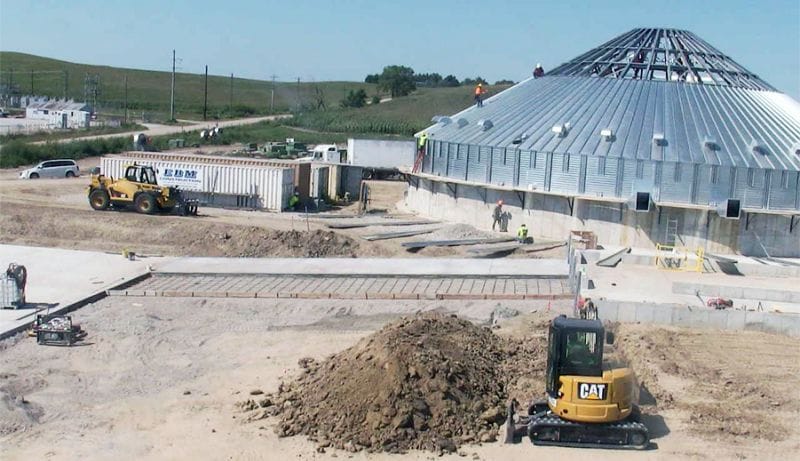
● Installation
Installation & Commissioning
Whether you choose your own subcontractor for the erection phase or you want to install everything together with us, a Richi supervisor will be around to make sure everything is mounted in a safe and thorough way.

● Training
Staff Training
We provide comprehensive training for the technicians of each project. We can also continue to provide support for the technicians during latter project operation.
● After-sales
Project Follow-Up
When everything is up and running our Richiers will help you further whenever needed. We are ready to answer your call 24/7.We’ll also visit you regularly to learn about your needs.
Who we are
RICHI Machinery is one of the world’s leading suppliers of technology and services for the animal feed, aqua feed and pet food industries, also the largest pellet production line manufacturer in China.
Since 1995, RICHI’s vision to build a first-class enterprise, to foster first-class employees, and to make first-class contributions to society has never wavered.
In the past three decades, we have expanded our business to a wide range of areas, including animal feed mill equipment, aqua feed equipment, pet feed equipment, biomass pellet equipment, fertilizer equipment, cat litter equipment, municipal solid waste pellets equipment, etc.

1995
RICHI Established

2000+
Serving More Than 2000 Customers

120+
RICHI Employees

140+
Exported To 140 Countries