 0086-138 3838 9622
Mini Wood Pellet Factory in Kenya
RICHI MACHINERY
Project Overview
A 0.3t/h mini wood pellet factory in Kenya was commissioned in early 2024 for a client in the Thika region, about 40km northeast of Nairobi.
The facility processes 912 tons of sawdust and wood shavings annually into 800 tons of biomass pellets for local industrial boilers, chicken farms, and household stoves. The plant operates one 8-hour shift per day, 300 days per year, with 30 employees. Total investment was $58,000 USD, including equipment, building modifications, and working capital.
What makes this 0.3t/h mini wood pellet factory in Kenya different from most small-scale lines we’ve built is the drying step. The client’s raw material arrived at 35-45% moisture – too wet for direct pelleting. Most mini plants skip drying to save money, but this client couldn’t.
His sawdust came from a local sawmill that stored its waste outside in the rain. So we designed a compact line with a drying furnace burning self-produced pellets as fuel. The dryer adds complexity and cost, but without it, the pellets would fall apart.
300KG/H
capacity
$58,000
investment
Kenya
location
Biofuel
project type
RICHI MACHINERY
The First Call – “I Have Wet Sawdust and a Small Budget”
The client called us in August 2023. He’d been running a small charcoal trading business for five years. Saw the market shifting toward cleaner fuels as Nairobi tightened air quality regulations. He had access to sawdust from three sawmills in Thika – but the sawdust was wet. Really wet. Piles sat outside for months. Moisture content was 35-45% depending on the season.
He had a building (1,200m² total, with 700m² production space and 300m² storage). He had $40,000 saved. He had no experience with pellet production.
His question: “Can I make pellets from wet sawdust with a small budget?”
We told him the truth: wet sawdust needs drying. Drying adds cost – both equipment and fuel. But if he could produce his own fuel (pellets) to run the dryer, the operating cost would be manageable.
He said yes. We designed a 0.3t/h mini wood pellet factory in Kenya with an integrated drying system. The dryer burns about 200 tons of pellets per year – which the plant produces itself. Closed loop.
RICHI MACHINERY
Why Drying Was Mandatory (And Why Most Small Plants Skip It)
Most mini biomass pellet plants avoid drying. They buy dry sawdust (10-15% moisture) from kiln-dried lumber operations. But dry sawdust costs more – often double the price of wet sawdust.
The client ran the numbers:
- Wet sawdust: $12/ton delivered (35-45% moisture)
- Dry sawdust: $28/ton delivered (12-15% moisture)
His annual requirement: 912 tons of raw material.
If he bought dry sawdust: 912 tons × $28 = $25,536 per year.
If he bought wet sawdust and dried it himself: 912 tons × $12 = $10,944 per year, plus drying fuel cost.
The drying fuel is self-produced pellets. The dryer consumes about 0.22 tons of pellets per ton of dry output. For 800 tons of finished pellets, the dryer uses about 176 tons. Those 176 tons cost him about $22/ton to produce (raw material + electricity + labor). So drying fuel cost: 176 × $22 = $3,872 per year.
Total cost with wet sawdust + self-drying: $10,944 (raw) + $3,872 (fuel) = $14,816 per year.
Savings vs buying dry sawdust: $25,536 – $14,816 = $10,720 per year.
The drying system cost $8,000 (including the drying oven, ductwork, and additional dust collection). Payback period on the dryer alone: 9 months.
Smart math.
RICHI MACHINERY
Raw Materials – One Feedstock, Variable Moisture
| Raw Material | Annual Input (tons) | As-Received Moisture | Cost (USD/ton) | Source |
|---|---|---|---|---|
| Sawdust and wood shavings | 912 | 35-45% | $12 | Three sawmills in Thika |
The client collects sawdust twice per week from each sawmill. The material is a mix of cypress, pine, and eucalyptus – all clean, no paint or glue. The sawmills are happy to have someone haul away their waste.
Annual output: 800 tons of finished pellets. The 112-ton difference is moisture loss (about 100 tons of water evaporated in the dryer) plus dust collected (about 12 tons).
The client also produces about 200 tons of pellets that are used as fuel for the dryer. Those never leave the facility. Net salable pellets: 800 tons per year.
RICHI MACHINERY
Equipment List – Compact but Complete
| Equipment | Quantity | Power | Function |
|---|---|---|---|
| Crusher | 1 | 15kW | Size reduction for larger chunks |
| Vibrating screen | 1 | 2.2kW | Remove oversize and contaminants |
| Drying furnace | 1 | Biomass-fired | Reduces moisture from 40% to 12% |
| Wood pellet mill | 1 | 55kW | Main pelleting (02-0.3 t/h) |
| Baler/bagging machine | 1 | 3kW | Finished product packaging |
| Belt conveyor | 1 | 2.2kW | Material transfer |
| Dust collection system | 1 | 5.5kW | Cyclone + baghouse, 2,000 m³/hr |
| Exhaust stack | 15m | — | Treated air discharge |
Equipment price (EXW Qingdao port): $42,000 USD
The client bought the crushers locally in Kenya (used units from a closed feed mill, $1,500 total). All other equipment came from us.
RICHI MACHINERY
Facility Layout – 1,200m² Total Space
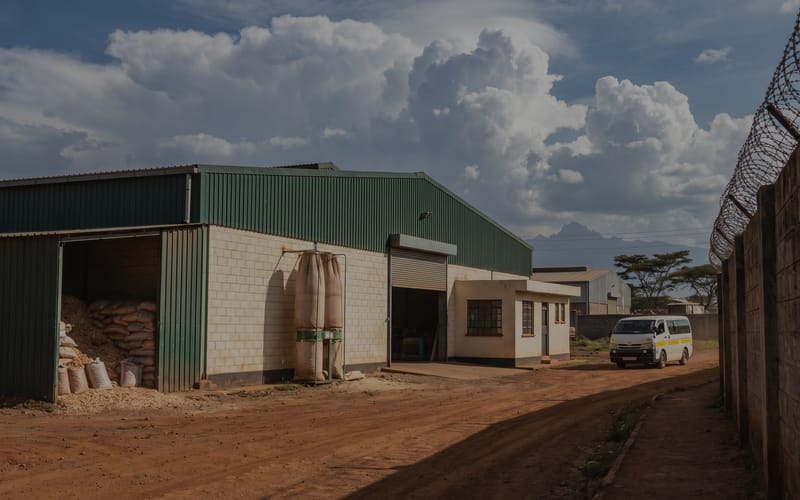
The client’s building was already standing – an old warehouse with a concrete floor and steel frame. Total area 1,200m². We divided it into zones.
| Area | Size (m²) | Function |
|---|---|---|
| Production workshop | 700 | Crushers, screen, dryer, pellet mill, bagging |
| Storage workshop | 300 | Raw material and finished goods |
| Office/rest area | 100 | Admin, breaks, paperwork |
| General waste storage | 6 | Dust collection fines, scrap metal |
The building height is 6 meters at the eaves – tight but workable. The dryer exhaust stack goes through the roof (15m total height). The dust collection system sits outside the building to save floor space.
RICHI MACHINERY
Process Flow – Seven Steps Including Drying
Here’s how the 0.3t/h mini wood pellet factory in Kenya actually runs.
Step 1 – Raw material receiving
Trucks dump wet sawdust in the storage workshop. The client stores about 50 tons at a time – enough for 2-3 weeks of production. The sawdust piles are turned weekly to prevent spontaneous combustion (wet sawdust can heat up internally).
Step 2 – Crushing and screening
Sawdust passes through two crushers in series (primary and secondary) to break down any large chunks. Then a vibrating screen removes oversize material (wood chunks larger than 10mm). Oversize goes back to the crushers.
Step 3 – Drying (The Critical Step)
Screened material feeds into the drying furnace. The furnace burns self-produced pellets – about 200 tons per year. Hot flue gases (indirect heating – no flame contact with the sawdust) pass through a rotating drum dryer. Retention time: 15-20 minutes. Output moisture: 10-12%.
The dryer is the most expensive part of this 0.3t/h mini wood pellet factory in Kenya ($8,000). But without it, the client couldn’t use his cheap wet sawdust.
Step 4 – Pelleting
Dried material (now at 12% moisture) feeds into the pellet mill. Single 55kW mill, 8mm die. Output: 0.3-0.35 t/h. The mill runs continuously during the 8-hour shift, producing 2.4-2.8 tons per day.
The pelleting process is purely physical. The lignin in the wood softens under pressure and heat (100-130°C) and binds the fibers together. No added binders.
Step 5 – Cooling
Pellets drop onto a belt conveyor and cool naturally during transport to the storage area. No forced-air cooler – the client found that ambient cooling works fine for his volumes. Pellets reach 35°C within 2 hours.
Step 6 – Bagging
A bagging machine fills 25kg bags. The client sells about 60% of output in bags (retail) and 40% in bulk (industrial).
Step 7 – Dust collection
A single dust collection system (cyclone + baghouse) captures dust from the crushers, screen, and pellet mill. Collected dust (about 12 tons per year) is mixed back into the feedstock. Nothing wasted.
RICHI MACHINERY
Operating Costs – After Six Months
The wood pellet manufacturing plant has been running since February 2024. Here are the numbers from July 2024 (six months of data).
| Cost Category | Monthly (USD) | Annual (USD) | Notes |
|---|---|---|---|
| Wet sawdust | $912 | $10,944 | 76 tons at $12/ton |
| Electricity | $400 | $4,800 | 1,670 kWh/month at $0.24/kWh |
| Labor (30 people) | $1,200 | $14,400 | $40/month per person (rural Kenya) |
| Maintenance & spares | $300 | $3,600 | Dies, bearings, conveyor belts |
| Building lease | $500 | $6,000 | 1,200m² |
| Total monthly | $3,312 | $39,744 |
Revenue:
| Product | Monthly Output (tons) | Price (USD/ton) | Monthly Revenue |
|---|---|---|---|
| Pellets (retail bags) | 40 | $160 | $6,400 |
| Pellets (bulk industrial) | 27 | $120 | $3,240 |
| Total | 67 | $9,640 |
Monthly net profit: $6,328 USD. Annual net profit (projected): $75,936 USD.
RICHI MACHINERY
What the Client Learned (The Hard Way)
The first two months were rough. Here are three problems that came up.
Problem 1 – The dryer was overheating.
The dryer temperature would spike to 300°C, scorching the sawdust. The client lost about 5 tons of material in the first week.
Fix: We added a temperature controller with a feedback loop to the furnace air intake. Cost $500. Now the dryer holds steady at 180-200°C.
Problem 2 – The pellet mill die kept jamming.
The dried sawdust was too fine. It would pack into the die holes and harden, blocking the mill.
Fix: The client added a small amount of water back into the material before pelleting (about 2% by weight). The slightly moist material lubricates the die holes. No more jams.
Problem 3 – Inconsistent pellet length.
The client’s pellets ranged from 10mm to 50mm. Customers complained.
Fix: The knife on the wood granulator machine was dull. The client sharpened it (takes 30 minutes) and adjusted the knife position closer to the die face. Now pellets are consistently 20-30mm.
RICHI MACHINERY
The Kenyan Market for Wood Pellets
Kenya is an interesting market for small wood pellet plants. The country has:
- Abundant sawdust from a growing timber industry
- Rising charcoal prices (charcoal is banned in many urban areas, but enforcement is inconsistent)
- Industrial demand for alternatives to diesel and heavy fuel oil
But the market is still young. Most Kenyan businesses don’t know what wood pellets are. The client spends a lot of time educating customers.
His current customers:
- A chicken farm in Thika (uses pellets for brooder heaters) – 10 tons/month
- Two small factories (uses pellets for process heat) – 15 tons/month combined
- A school in Nairobi (uses pellets for kitchen stoves) – 5 tons/month
- Retail customers (household stoves) – 20 tons/month
He can’t keep up with demand. He’s already planning to add a second wood pellet press in 2025 to double his output.
RICHI MACHINERY
What We Provided (For a First-Time Producer)
For this 0.3t/h mini wood pellet factory in Kenya, we delivered more than just equipment.
- Process design – Including the dryer sizing and integration. The client had no idea how to spec a dryer for wet sawdust.
- Equipment package – Pellet mill, screen, bagging machine, dust collection, dryer.
- Installation supervision – Our engineer spent 10 days in Thika, training the local crew.
- Operator training – Two days on moisture management, die changes, and temperature control.
- Spare parts kit – One spare die, two sets of hammer mill screens, bearings, belts.
We also provided a simple moisture meter ($150) and a temperature controller for the dryer ($500). The client bought these from us as add-ons.
RICHI MACHINERY
Thinking About a Mini Plant?
If you’re looking at a 0.3t/h mini wood pellet factory in Kenya – or anywhere in East Africa – here’s what we’ve learned from this project:
- Drying is expensive but necessary for wet raw material. If your sawdust is over 18% moisture, you need a dryer. Don’t skip it.
- Self-produced fuel for the dryer makes economic sense. The client’s dryer burns pellets that cost him $22/ton to produce. That’s cheaper than buying diesel or LPG.
- Start with one customer. The chicken farm contract gave the client predictable revenue while he built his retail customer base.
- Buy a spare die. The client’s first die wore out at 600 hours. He had a spare on the shelf. No downtime.
The client in Thika is already profitable. He’s expanding. If you have wet sawdust and a small budget, this model works.
Contact us for a site assessment or equipment quote. We can provide references from this biomass pellet project upon request.
● RICHI MACHINERY
RICHI Service

● Consulting
Customer Consultation
We want to have a deep understanding of your industrial process, to know your exact needs of feed, wood, biomass, fertilizer or other pellet processing.
● Design
biomass Pellet Plant Design
Based on your unique situation and industrial process, we will tailor complete pellet plant you need, and inform you of every additional detail that could facilitate operation, minimize total cost.
● Manufacturing
Equipment Manufacturing
The critical components of the of the complete pellet production line equipment are built in our own workshops in Asia. Additional equipment is manufactured by our worldwide network of reliable partners.
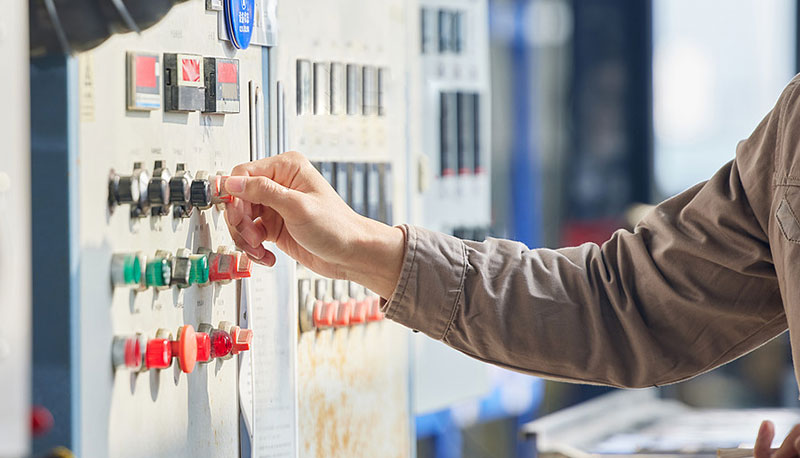
● Testing
Quality Inspection & Testing
Before leaving the factory, all equipment will be inspected by the quality inspection department. We can also provide customers with testing services from a single machine to a complete pellet plant system, and provide you with real actual data for “worry-free use.”

● Delivery
Equipment Delivery
In equipment boxing and packaging, we adopt professional packaging and modular solutions to ensure the safe and non-destructive delivery of pellet plant equipment.
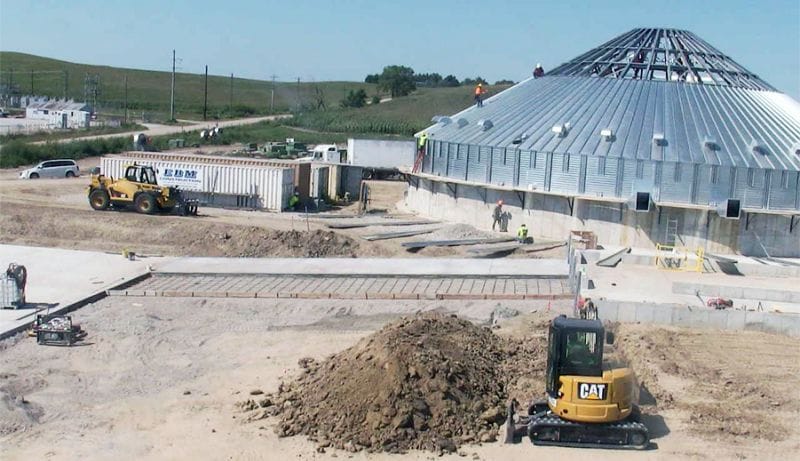
● Installation
Installation & Commissioning
Whether you choose your own subcontractor for the erection phase or you want to install everything together with us, a Richi supervisor will be around to make sure everything is mounted in a safe and thorough way.

● Training
Staff Training
We provide comprehensive training for the technicians of each project. We can also continue to provide support for the technicians during latter project operation.
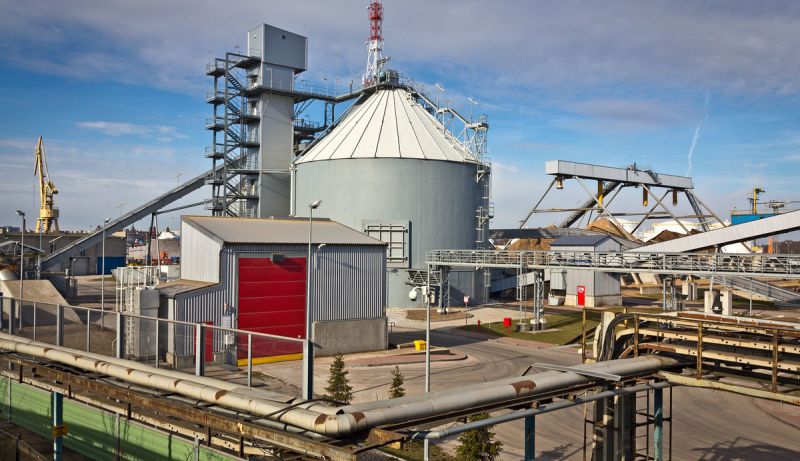
● After-sales
Project Follow-Up
When everything is up and running our Richiers will help you further whenever needed. We are ready to answer your call 24/7.We’ll also visit you regularly to learn about your needs.
Who we are
RICHI Machinery is one of the world’s leading suppliers of technology and services for the animal feed, aqua feed and pet food industries, also the largest pellet production line manufacturer in China.
Since 1995, RICHI’s vision to build a first-class enterprise, to foster first-class employees, and to make first-class contributions to society has never wavered.
In the past three decades, we have expanded our business to a wide range of areas, including animal feed mill equipment, aqua feed equipment, pet feed equipment, biomass pellet equipment, fertilizer equipment, cat litter equipment, municipal solid waste pellets equipment, etc.

1995
RICHI Established

2000+
Serving More Than 2000 Customers

120+
RICHI Employees

140+
Exported To 140 Countries