 0086-138 3838 9622
Feed Plant Integrated Processing System in Bangladesh
RICHI MACHINERY
Project Overview
A major animal feed manufacturer approached RICHI Machinery to build a 50t/h feed plant integrated processing system in Bangladesh capable of producing 240,000 tons of compound feed annually (running 16 hours per day, 300 days per year). The facility produces pelleted feed for poultry and livestock, serving farms across the Dhaka, Chattogram, and Rajshahi regions.
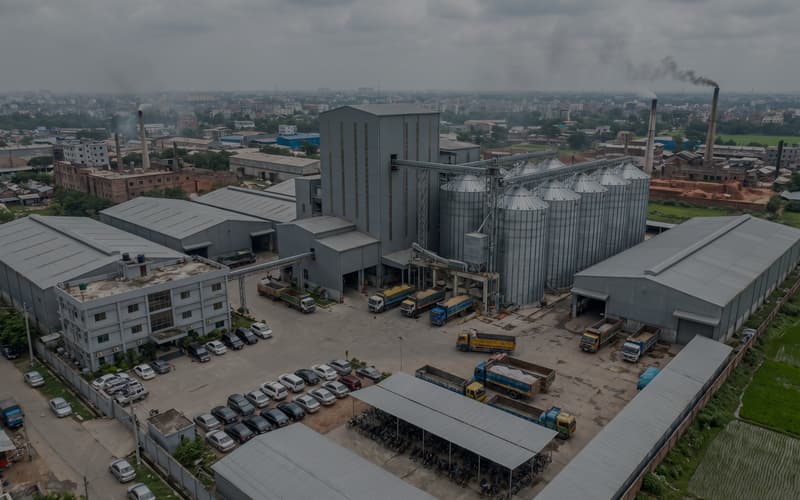
The client’s facility is located in Gazipur District. The total land area is 39,172m² (about 9.7 acres), with 28,540m² of building space across seven interconnected structures. The client had previously used this site for warehousing but decided to repurpose it entirely for feed production.
What makes this animal feed factory project stand out is the scale and integration. This is not a simple line with a single mixer and one pellet mill. The 50t/h feed plant integrated processing system includes multiple receiving points, automated batching with 84 ingredient bins, three mixers operating in parallel, and three pellet mills. The entire system is controlled by a centralized PLC with recipe management, real-time production tracking, and remote monitoring capability.
This case walks through how RICHI designed, supplied, and is currently installing this massive facility.
50T/H
capacity
$2,650,000
investment
Bangladesh
location
Feed
project type
RICHI MACHINERY
Market Context
Bangladesh’s livestock sector has transformed over the past 20 years. Backyard poultry has largely been replaced by commercial farms. The numbers tell the story:
- Poultry population: Over 300 million birds annually (broilers and layers)
- Annual feed consumption: About 8-10 million tons and growing
- Domestic production capacity: Estimated 6-7 million tons, leaving a gap of 2-3 million tons filled by imports
- Growth rate: 10-12% annually for compound feed
The government has been actively promoting local feed production through tax incentives. Import duties on feed manufacturing equipment are reduced (5-10% compared to 25% for general machinery). Raw material imports (soybean meal, fish meal, amino acids) face lower duties than finished feed imports.
The client’s timing was good. By mid-2025, several of their competitors had announced capacity expansions, but none at the 50 t/h scale. The client wanted to be the largest single facility in the region, achieving economies of scale that smaller plants couldn’t match.
Target market:
| Customer segment | Estimated annual demand (tons) | Client’s target share |
|---|---|---|
| Poultry broiler farms | 150,000+ | 80,000 tons |
| Poultry layer farms | 50,000+ | 30,000 tons |
| Dairy farms | 40,000+ | 20,000 tons |
| Fish farms (aquaculture) | 30,000+ | 10,000 tons |
| Total target | — | 140,000 tons (60% of capacity initially) |
The client plans to operate at 60% capacity in year one, ramping to 90% by year three.
RICHI MACHINERY
Site and Building Layout
The site is a former warehousing facility that the client purchased in 2023. The existing buildings were structurally sound but needed complete reconfiguration for feed production. RICHI worked with the client’s local architect to redesign the layout.
Site summary:
| Parameter | Value |
|---|---|
| Total land area | 39,172 m² |
| Total building area | 28,541 m² |
| Total floor area (including multi-level) | 47,079 m² (counted twice for multi-story) |
| Building density | 55.1% |
| Green space | 2,787 m² (7.1%) |
| Parking (cars/trucks/bikes) | 28/7/120 spaces |
Building layout (from south to north):
| Building | Function | Area (m²) | Notes |
| Workshop 1 | Warehouse (raw materials) | 3,887 | South end, adjacent to main road |
| Workshop 2 | Warehouse (raw materials) | 3,887 | Behind Workshop 1 |
| Workshop 3 | Production (main line 1) | 3,787 | Receiving, cleaning, grinding, batching |
| Workshop 4 | Production (main line 2) | 3,787 | Mixing, pelleting, cooling, packaging |
| Workshop 5 | Warehouse (finished goods) | 3,787 | North of production area |
| Workshop 6 | Warehouse (finished goods) | 3,787 | |
| Workshop 7 | Warehouse (bulk storage) | 3,246 |
Why two production buildings (Workshop 3 and 4)? The client considered a single large building but decided that separate buildings for pre-pelleting and post-pelleting operations allow for future expansion and better fire separation. Workshop 3 handles raw material intake, cleaning, grinding, and batching. Workshop 4 handles mixing, pelletizing, cooling, and packaging. A covered conveyor bridge (enclosed, dust-tight) connects the two buildings.
The RICHI design approach: The engineering team recommended a vertical layout within each building to minimize conveying equipment. In Workshop 3:
- Ground floor: Receiving pits, cleaning equipment, grinders
- Mezzanine (partially): Batching scales, storage bins
- Upper level: Distribution conveyors, ingredient bins
Material flows by gravity where possible, reducing energy consumption and maintenance.
RICHI MACHINERY
Raw Materials
The client’s formulation is a standard corn-soy based compound feed for poultry and livestock. The raw materials are sourced from:
- Corn: Domestic (Bangladesh produces about 4 million tons annually, mostly in the northwest districts of Dinajpur, Rangpur, and Bogura)
- Wheat: Domestic and imported (mainly from India)
- Soybean meal: Imported (mostly from Argentina and Brazil, arriving at Chattogram port)
- Fish meal: Domestic (from Chattogram’s fish processing industry) and imported from Myanmar
- Amino acids (methionine, lysine): Imported from China and South Korea
Annual raw material consumption:
| Raw Material | Annual (tons) | Dry matter (%) | Source | Notes |
|---|---|---|---|---|
| Corn | 84,020 | ~85% | Domestic (northwest farms) | Primary energy source |
| Wheat | 72,010 | ~85% | Domestic + India | Secondary grain |
| Soybean meal (46% protein) | 60,010 | ~88% | Imported (South America) | Primary protein source |
| Wheat bran | 7,205 | ~85% | Domestic mills | Fiber source |
| Fish meal (65% protein) | 12,010 | ~90% | Domestic + Myanmar | Animal protein |
| DL-Methionine | 2,402 | 99% | Imported | Amino acid supplement |
| L-Lysine HCl | 2,402 | 99% | Imported | Amino acid supplement |
| Total input | 240,059 | — | — | — |
Wait, the total exceeds 240,000 tons? Yes. The difference (about 48 tons) is impurities removed during cleaning (stones, dust, metal, crop residues). Those impurities are about 0.02% of total input — very low because the client’s suppliers provide clean material. The remaining water (about 500 tons) is added as steam during conditioning and mostly evaporates during cooling.
The client’s typical poultry feed formulation (broiler finisher):
| Ingredient | Percentage |
|---|---|
| Corn | 55% |
| Soybean meal | 28% |
| Wheat | 10% |
| Fish meal | 3% |
| Wheat bran | 2% |
| Premix (vitamins/minerals) | 1% |
| Amino acids | 1% |
| Total | 100% |
The formulation changes based on target species (broiler vs layer vs dairy) and growth stage (starter vs grower vs finisher). The automated batching system stores up to 200 different recipes.
RICHI MACHINERY
Equipment Configuration
The 50t/h feed plant integrated processing system in Bangladesh includes the following major equipment:
| Section | Equipment | Quantity | Power (each) | Total power |
| Receiving & cleaning | Unloading screw conveyors | 3 | 11 kW | 33 kW |
| Scraper conveyors | 6 | 7.5 kW | 45 kW | |
| Bucket elevators | 12 | 15-22 kW | ~200 kW | |
| Pre-cleaners (drum) | 6 | 5.5 kW | 33 kW | |
| Vibrating screeners | 3 | 3 kW | 9 kW | |
| Fans for aspiration | 1 | 30 kW | 30 kW | |
| Grinding | Hammer mill feed grinders | 3 | 160 kW | 480 kW |
| Rotary distributors | 9 | 1.5 kW | 13.5 kW | |
| Batching | Automated batching system | 2 | — | — |
| Batch scales (each 3 tons) | 2 | 0.5 kW | 1 kW | |
| Screw feeders | 84 | 1.1-2.2 kW | ~140 kW | |
| Storage bins (ingredients) | 84 | — | — | |
| Mixing | Twin-shaft paddle mixers | 3 | 45 kW | 135 kW |
| Pelletizing | Animal feed pellet mills | 3 | 250 kW | 750 kW |
| Conditioners (pre-conditioning) | 3 | 7.5 kW | 22.5 kW | |
| Cooling | Counterflow coolers | 3 | 5.5 kW (fans) | 16.5 kW |
| Cooling fans | 3 | 22 kW | 66 kW | |
| Packaging | Automatic bagging scales | 3 | 3 kW | 9 kW |
| Utility | Steam boiler (electric) | 1 | 4 t/h | ~300 kW equivalent |
| Air compressor | 1 | 55 kW | 55 kW | |
| Pulse dust collectors | 5 | 15-30 kW each | ~120 kW | |
| Total connected power | — | — | — | ~2,560 kW |
Equipment cost (FOB Qingdao): $2,650,000 USD
This is a significant investment, but the client’s breakeven analysis showed that at 60% capacity (144,000 tons/year), the payback period is about 2.5 years.
Why three hammer mills instead of one or two? At 50 t/h, a single hammer mill would need to be enormous (500-600 kW) and would be a single point of failure. Three 160 kW mills each handle 16-18 t/h. If one mill is down for maintenance (screen change, bearing replacement), the line still runs at 65-70% capacity. The client can also run different screen sizes in different mills for different product types.
Why three mixers? Batching occurs in cycles. With two batching scales (each 3 tons per batch, cycle time about 5 minutes), the theoretical maximum is 72 tons/hour. The client operates at 50 t/h, so there’s buffer capacity. Three feed mixer machines (each 2-3 tons per batch) allow the client to run different recipes simultaneously if needed.
Why three pellet mills? Similar reasoning — redundancy. Three 250 kW mills each produce 16-18 t/h of pelleted feed. The client can run two animal feed granulators at 25 t/h while the third undergoes maintenance.
RICHI MACHINERY
Process Flow
his is a large-scale feed mill engineering. Every step is automated. The operator’s role is monitoring, not manual control.
Step 1: Raw Material Receiving
Raw materials arrive at the facility in three ways:
- Bulk grain (corn, wheat): Pneumatic tanker trucks (30-40 tons each). The truck connects to a receiving pit at the south end of Workshop 1. A screw conveyor (11kW) moves material to a bucket elevator (22kW) that lifts it to the pre-cleaners.
- Bulk soybean meal: Similar system but separate receiving pit (to avoid cross-contamination).
- Bagged ingredients (amino acids, premix): Palletized and forklifted into Workshop 2. Operators open bags and dump into a small hopper with a dust collection hood.
Design detail: The receiving pits are sized for 15 minutes of continuous operation at 50 t/h. That’s about 12.5 tons per pit. The truck unloading rate is about 2-3 tons per minute, so a 40-ton truck unloads in 15-20 minutes.
Step 2: Cleaning
Cleaning is often underappreciated. But dirty material destroys hammer mill screens and reduces pellet mill die life by 50%.
Material from the receiving pits passes through:
- Drum pre-cleaner (6 units): Removes large impurities (stones >10mm, bags, twine, metal pieces). The drum rotates at slow speed (20 RPM), and material cascades over a perforated screen (12mm holes). Oversize material drops into a chute to a collection bin. This material (about 48 tons/year, all reject) is sent to a local farmer for composting.
- Vibrating screener (3 units): Removes medium impurities (2-10mm). The screener has two decks:
- Top deck (6mm screen): Catches corn kernels that are still on the cob, large chaff
- Bottom deck (2mm screen): Removes sand, dust, broken kernels
- Aspiration system: Air is pulled upward through the material stream (30kW fan). Light impurities (dust, chaff, hulls) are carried to a cyclone + bag filter. The dust is collected and sold as animal bedding (low-grade, but better than disposing of it).
Step 3: Grinding
Clean corn and wheat (and sometimes soybean meal, if the client wants a finer grind) enter the hammer mills.
The three hammer mills (160 kW each) run in parallel:
| Parameter | Value |
|---|---|
| Rotor diameter | 800 mm |
| Rotor speed | 2,950 RPM |
| Screen size (poultry feed) | 3 mm |
| Screen size (dairy feed) | 5 mm |
| Throughput per mill (3mm screen) | 12-14 t/h |
| Throughput per mill (5mm screen) | 18-20 t/h |
| Tip speed | 90-95 m/s |
Why the range of throughput? Grinding finer requires more energy and reduces throughput. For poultry feed (young birds have small beaks and need finer particles), the client uses 3mm screens. For dairy cattle feed (ruminants can handle coarser particles), the client uses 5mm screens. The hammer mill operators can change screens in about 30 minutes.
Particle size distribution (target):
| Species | Target particle size | Maximum >6mm |
|---|---|---|
| Broiler starter | 500-800 microns | 5% |
| Broiler finisher | 800-1,200 microns | 10% |
| Layer | 1,000-1,500 microns | 15% |
| Dairy | 1,500-2,000 microns | 25% |
The client tests particle size every shift using a sieve shaker (8 screens, 30 minutes per test). If the distribution is off, the operator adjusts the hammer mill speed or changes screens.
Step 4: Ingredients Storage (Batching Preparation)
Ground material (now called “meal”) is pneumatically conveyed to the batching building (Workshop 3). 84 ingredient bins receive different materials:
- Corn meal (from hammer mills) — multiple bins (24 bins, 50 tons each)
- Wheat meal (from hammer mills) — 12 bins (40 tons each)
- Soybean meal — 12 bins (60 tons each — highest density)
- Wheat bran — 8 bins (30 tons each)
- Fish meal — 6 bins (20 tons each — expensive, stored in smaller bins to minimize inventory)
- Amino acids (methionine, lysine) — 2 bins (10 tons each)
- Premix (vitamins/minerals) — 4 bins (15 tons each)
- Other additives — the remaining bins
Total storage capacity: About 2,500 tons of ingredient meal. This is about 50 hours of production at 50 t/h — enough for 2-3 days of operation. The client can run through a weekend without refilling bins.
Each bin has:
- High-level sensor (automatically stops the filling conveyor when full)
- Low-level sensor (alerts operator to refill — triggers 6 hours before empty)
- Bin vibrators (prevents bridging of sticky materials like molasses-treated meal)
- Slide gate at the bottom (pneumatic, controlled by PLC)
Step 5: Batching (Automated)
This is where formulation accuracy is critical. Overdosing expensive ingredients by 1% costs the client about $50,000 per year.
The client uses two automated batching systems (3 tons per batch each). Here’s how it works:
Batch cycle (5 minutes total):
| Stage | Duration | What happens |
|---|---|---|
| 1. Scale tare | 10 seconds | Load cells zero out |
| 2. Major ingredients (corn, wheat, soybean meal) feed | 120 seconds | High-speed screw feeders (up to 10 tons/hour per feeder) |
| 3. Switch to dribble feed | 30 seconds | Within 50kg of target, feeder slows to 2-3 tons/hour |
| 4. Minor ingredients (bran, fish meal) | 60 seconds | Medium-speed feeders |
| 5. Micro ingredients (amino acids, premix) | 60 seconds | Low-speed, high-accuracy feeders |
| 6. Discharge to mixer | 30 seconds | Pneumatic gate opens, material drops |
| 7. Scale reset | 30 seconds |
The two scales alternate: While Scale A is discharging to the mixer, Scale B is filling. This continuous operation allows a theoretical 24 batches per hour per scale (but actual is closer to 12-14 batches per hour due to manual checks). The client runs about 17 batches per hour total (34 batches across two scales, but each batch is 3 tons, so 34 × 3 = 102 tons/hour theoretical — well above the 50 t/h target).
Weighing accuracy (guaranteed by RICHI):
- Major ingredients: ±0.1% of target (e.g., 1,000 kg ±1 kg)
- Minor ingredients: ±0.2%
- Micro ingredients: ±0.5% (due to smaller quantities, relative error is higher but absolute error is small)
The client verifies accuracy every week by manually weighing a batch using a certified scale. In the first month of trial runs, all batches were within spec.
Step 6: Mixing
The batch (3 tons) drops from the scale into one of three twin-shaft paddle mixers (45 kW each). The mixer has two counter-rotating shafts with paddles that:
- Lift material and drop it (tumbling action)
- Shear material (breaks up agglomerates)
- Move material from the inlet to the outlet (continuous or batch? The client uses batch mode — scale → mixer → hold → discharge)
Mixing parameters:
- Batch size: 2.5-3.0 tons (mixer capacity is 3.0 tons)
- Mix time: 2-3 minutes
- Homogeneity coefficient (CV): <5% (target for feed)
- Discharge time: 30 seconds (pneumatic gate at the bottom)
Why three mixers? Two mixers are in operation simultaneously (each fed by one batching scale). The third mixer is a backup or used for custom small batches (e.g., medicated feed). The mixers are arranged so that the discharge from either scale can go to any mixer.
Mixing validation: The client uses a tracer test every 3 months. Colored iron powder (0.1% of batch) is added, and 20 samples are taken from the discharge over 30 seconds. The variation in iron concentration (measured by magnet) indicates mixing quality. The client’s mixers consistently achieve CV <3% (excellent).
Step 7: Conditioning and Pelletizing
Conditioning is where starch gelatinization happens. Without proper conditioning, pellets are soft and dusty.
Mixed feed drops into a conditioner (7.5 kW) before the pellet mill. The conditioner is a cylinder (1.5m diameter × 3m length) with a rotating shaft and paddles. Steam from the 4 t/h electric boiler is injected into the conditioner.
Conditioning parameters:
| Parameter | Value |
|---|---|
| Temperature | 70-90°C (adjustable) |
| Retention time | 20-40 seconds |
| Steam addition | 3-5% of feed mass |
| Moisture after conditioning | 16-18% (from 12-14% before conditioning) |
Why steam? Three reasons:
- Heat — softens lignin (in plant fibers) and gelatinizes starch, both of which act as binders
- Moisture — lubricates the die, reducing friction and wear
- Sanitation — kills Salmonella and other pathogens (70°C for 30 seconds is required in many markets)
Pellet mills (3 units, 250 kW each):
| Parameter | Value |
|---|---|
| Type | Ring die, horizontal |
| Die diameter | 800 mm |
| Die thickness | 120 mm |
| Die hole diameter | 3-6 mm (depending on product) |
| Compression ratio | 8:1 to 12:1 (standard for feed) |
| Die speed | 180-220 RPM |
| Operating temperature (die) | 80-100°C |
| Pellet temperature at exit | 75-90°C |
| Throughput per mill | 16-18 t/h (at 3mm die, 50 t/h total over 3 mills) |
Pellet specifications (typical poultry feed):
| Parameter | Target | Actual |
|---|---|---|
| Pellet diameter | 3-4 mm (broiler starter), 4-5 mm (grower) | On spec |
| Pellet length | 1.5-2.5 × diameter | On spec |
| Moisture (exiting mill) | 14-15% | 14.5% |
| Durability (PDI) | >95% | 96-97% |
| Fines | <5% | 3-4% |
Step 8: Cooling
Hot pellets (75-90°C, 14-15% moisture) drop from the pellet mill into a counterflow cooler (3 units, 5.5 kW fan each).
Cooler design:
- Vertical cylinder (2m diameter × 4m height)
- Perforated base plate (holes slightly smaller than pellet diameter)
- Air is pulled upward through the pellet bed (22kW fan per cooler)
- Retention time: 10-15 minutes
Cooling parameters:
- Inlet pellet temperature: 75-90°C
- Outlet pellet temperature: ambient + 5-10°C (typically 35-40°C in Bangladesh)
- Inlet moisture: 14-15%
- Outlet moisture: 11-13% (target for storage stability)
Why counterflow? The coolest air meets the coolest pellets at the bottom, and the warmest air meets the warmest pellets at the top. This results in a smooth temperature gradient and avoids thermal shock (which can cause pellets to crack). Counterflow is more energy-efficient than crossflow (which is why the client chose it).
Cooled pellets are conveyed (bucket elevator) to finished product bins (6 bins, 100 tons each, total 600 tons capacity).
Step 9: Packaging
Finished pellets are discharged from the finished product bins into three automatic bagging scales (3 kW each, 2,000 bags/hour capacity each).
Packaging specifications:
- Bag sizes: 25 kg, 40 kg, 50 kg (woven polypropylene with inner PE liner)
- Accuracy: ±50g for 25kg bags, ±100g for larger bags
- Production rate: 2,000 bags/hour per scale × 3 scales = 6,000 bags/hour
- At 25 kg/bag, maximum is 150 tons/hour — far above the 50 t/h line capacity. The client operates only one or two scales at a time.
Packaging process:
- Empty bag is placed on the filling spout (automatic bag placer available, but the client uses manual placement to reduce equipment cost)
- Scale fills to target weight
- Bag is discharged to a bag closer (sewing machine)
- Bag is conveyed to a palletizer (automatic — this client has a robotic palletizer for 1,000+ bags/hour)
- Pallet is stretch-wrapped and labeled
- Forklift moves pallet to finished goods warehouse
The client’s finished goods warehouse (Workshops 5 and 6, total 7,574m²) holds about 5,000 pallets (5,000 tons of bagged feed) — about 4 days of production.
Step 10: Distribution
Finished product is loaded onto trucks (40-ton capacity) and shipped to distributors and direct to farms. The client has a fleet of 10 trucks (third-party logistics for the rest).
The client’s typical delivery radius: 200-300km from Gazipur, covering Dhaka, Chattogram, Rajshahi, Khulna, and Sylhet divisions.
RICHI MACHINERY
Utilities and Consumption
| Utility | Annual consumption | Source | Cost (BDT) | Cost (USD at 110 BDT/USD) |
|---|---|---|---|---|
| Electricity | 3,000,000 kWh | BPDB (grid) | 24 million | $218,000 |
| Water | 1,700 m³ | Municipal (DWASA) | 170,000 | $1,545 |
| Steam (boiler) | 500 tons/year | Electric boiler | Included in electricity | — |
Electricity breakdown (annual, 300 days, 16 hours/day):
| Equipment category | kW average | Hours/day | kWh/day | kWh/year |
|---|---|---|---|---|
| Receiving & cleaning | 80 | 16 | 1,280 | 384,000 |
| Grinding (3 hammer mills) | 360 (average, not all at full load) | 16 | 5,760 | 1,728,000 |
| Batching & mixing | 150 | 16 | 2,400 | 720,000 |
| Pelletizing (3 mills) | 600 (average) | 16 | 9,600 | 2,880,000 |
| Cooling & conveying | 100 | 16 | 1,600 | 480,000 |
| Packaging | 30 | 16 | 480 | 144,000 |
| Dust collection (5 systems) | 80 | 16 | 1,280 | 384,000 |
| Air compressor, lights, office | 50 | 16 | 800 | 240,000 |
| Total | 1,450 average | — | 23,200 | 6,960,000 kWh |
The client’s actual consumption is about 7,000,000 kWh/year.
Electricity cost per ton: 7,000,000 kWh ÷ 240,000 tons = 29.2 kWh/ton × BDT 8 = BDT 234 ($2.13) per ton. Very efficient for a feed plant.
RICHI MACHINERY
How RICHI Customized This Line for the Client’s Needs
The client had specific requirements that shaped the equipment design and layout:
Requirement 1: The site has limited space for raw material storage (only 7 warehouses, total 28,541m²). For a 50 t/h line, raw material storage is often the bottleneck.
RICHI solution: Designed 84 ingredient bins with 2,500 tons total capacity — 2-3 days of buffer. The client receives raw material daily (just-in-time delivery from local suppliers). The receiving area is sized for 4 trucks simultaneously (2 pits for corn/wheat, 1 for soybean meal, 1 for bagged ingredients). The unloading systems can handle 200 tons/hour, so a full truck unloads in 15-20 minutes.
Requirement 2: The client has limited technical staff (only 8 maintenance personnel for the entire plant).
RICHI solution: Centralized PLC control system with remote monitoring capability. The system tracks equipment runtime (scheduled maintenance based on hours), alerts operators when maintenance is due, and automatically orders spare parts (via integration with the client’s ERP). The PLC also monitors vibration on critical equipment (hammer mills, pellet mills) and sends an alert if vibration exceeds threshold (indicating bearing wear or imbalance).
Requirement 3: The client wants to meet international feed quality standards (HACCP, GMP+).
RICHI solution: Sanitary design throughout the processing system:
- Stainless steel contact surfaces (in mixers, conditioners, pellet mill inlet)
- Magnets, screener, and aspiration to remove physical contaminants
- Steam conditioning to kill pathogens (70°C for 30 seconds minimum)
- No dead legs in conveying systems (all pipes self-draining)
- Wash-down stations at critical points (mixer, conditioner, feed mill pellet machine)
The client is currently applying for GMP+ certification (expected completion Q1 2026).
Requirement 4: The client has a specific target for pellet durability (PDI >95%).
RICHI solution: Optimized formulation and conditioning parameters. The client ran lab-scale tests (50kg batches) at a university in Dhaka before ordering the equipment. The optimal parameters for their formulation (55% corn, 28% soybean meal, 10% wheat, etc.) were:
- Conditioning temperature: 85°C
- Conditioning time: 35 seconds
- Steam addition: 4.5% of feed mass
- Pellet mill die compression ratio: 10:1
- Die speed: 200 RPM
At these settings, the client achieved PDI of 96.5-97.5% during trial runs.
RICHI MACHINERY
Environmental Compliance
Bangladesh’s environmental regulations are governed by the Department of Environment (DoE) under the Bangladesh Environment Conservation Act 1995 (amended 2010). The client needed an Environmental Clearance Certificate (ECC) for a “Red” category industry (feed manufacturing is considered moderately polluting).
Key compliance requirements:
| Aspect | Bangladesh standard | Client’s achievement |
|---|---|---|
| Stack particulate | 150 mg/m³ | 35-45 mg/m³ (pulse bag filters) |
| Workplace dust | 10 mg/m³ (8-hour average) | 5-8 mg/m³ |
| Wastewater (domestic) | Discharge to municipal sewer allowed | Septic tank + municipal connection |
| Noise (daytime, industrial zone) | 75 dB(A) at property line | 68-72 dB(A) |
| Odor (feed plant) | No specific limit, but “reasonable” | Minimal odor (no fish meal storage on site — delivered just-in-time) |
Solid waste management:
| Waste type | Annual (tons) | Disposal method |
|---|---|---|
| Impurities from cleaning (stones, dust, etc.) | 48 | Sold to local farmer for composting |
| Dust from bag filters | 9 | Returned to production |
| Rejected product (off-spec) | ~10 | Re-pelletized (mixed with incoming material at <5%) |
| Used lubricating oil | 1,000 liters/year | Hazardous waste — stored in drums, collected by licensed contractor (cost BDT 50,000 per collection ≈ $455) |
| Contaminated rags | 50 kg/year | Hazardous waste — collected with used oil |
Zero wastewater discharge from production — the only water used in production is steam (which evaporates) and boiler blowdown (treated as domestic wastewater, sent to sewer). The client’s domestic wastewater (from 40 staff, on-site accommodations) is treated in a septic tank (3m³ capacity) and discharged to municipal sewer.
RICHI MACHINERY
Operational Challenges the Client Faced
Even with careful planning, large-scale projects encounter problems. Here’s what happened during the installation and commissioning phase (April to November 2025).
Challenge 1: Dust collection ductwork was undersized in the initial design.
During the design phase, RICHI calculated the required air volume for dust collection at each point (hammer mills, pellet mills, conveyors, and packaging). The specification called for 280mm diameter ducts in the main branches. The client’s local contractor installed 200mm ducts (what they had in stock).
Problem: When the system was started up for the first time, dust was escaping at several points. The air velocity was too low (12 m/s instead of 18-20 m/s) to capture particles effectively. Workplace dust levels reached 25 mg/m³ — well above Bangladesh’s 10 mg/m³ limit.
Solution: The client replaced the undersized ducts with the correct 280mm size. The local contractor covered the material cost (since they ignored the specification), and RICHI’s site supervisor supervised the rework. The installation schedule slipped by 2 weeks.
Challenge 2: The automatic bagging scale accuracy drifted during testing.
The three automatic bagging scales (from a third-party supplier, not RICHI) were calibrated at the factory in China. But after shipping and installation in Bangladesh, the calibration drifted. One scale was consistently overfilling 50kg bags by 150-200 grams (0.3-0.4% error). Doesn’t sound like much, but over 240,000 tons per year, that’s 720-960 tons of free product given away annually — worth about 27-36 million BDT ($250,000-330,000).
Solution: RICHI’s service technician recalibrated the scales using certified test weights (50kg, Class F1, traceable to international standards). The drift was caused by vibration from nearby equipment (the pellet mills) affecting the load cells. The client installed vibration-damping mounts under the scales (rubber pads, 50mm thick) and the accuracy returned to ±50g. The client now recalibrates each scale every month.
Challenge 3: Steam distribution uneven across the three pellet mills.
The 4 t/h electric boiler supplies steam to three pellet mills. The pipe run to Mill 3 was longer (about 45m) than to Mill 1 (15m). Without proper steam trapping and condensate removal, Mill 3 was receiving wet steam (condensate carryover), which led to:
- Poor conditioning (temperature only reached 65°C instead of 85°C)
- Lower pellet durability (PDI dropped to 89-91% from Mill 3)
- Die blocking (once per shift instead of once per week)
Solution: RICHI’s steam specialist designed a proper steam distribution system with:
- Drip legs at low points
- Steam traps (float and thermostatic type, 1″ NPT) before each conditioner
- Condensate return line to the boiler
- Pressure-reducing valves (PRVs) to balance pressure across all three mills
After installation, all three mills achieved 85°C ± 2°C conditioning temperature, and PDI from Mill 3 increased to 96%.
Challenge 4: The client’s local electrician miswired the emergency stops.
During the first full-system test (all equipment running at 30 t/h), an operator spotted a jam at the pellet mill discharge and pressed the emergency stop button at that station. The system continued running. He pressed another E-stop. Nothing happened.
Problem: The local electrician had wired the emergency stops in series with the control circuit, but used the wrong wire gauge (too small) AND incorrectly configured the PLC input card. The E-stop signal was not being recognized because the voltage drop across the long wire run (over 200m) was too high (24V DC supply dropped to 16V at the PLC input — below the threshold for a “high” signal).
Solution: RICHI’s electrical engineer redesigned the E-stop circuit with:
- Larger wire gauge (1.5mm² to 2.5mm² for 24V DC over long runs)
- Relays at each E-stop station (local switching, low voltage drop)
- PLC input card reconfigured for “active low” (signal is “1” when voltage drops to 0V, not when voltage rises to 24V — more reliable for long runs)
After the rework, the E-stop system functioned correctly. The client required all electrical work to be supervised by RICHI’s engineer for the remainder of the installation.
RICHI MACHINERY
Staffing and Training
The client operates with 40 full-time staff across three shifts (16 hours/day, 2 shifts). The third shift is maintenance and cleanup (4 hours overnight).
Staff breakdown:
| Role | Number | Shift | Monthly salary (BDT) | Monthly salary (USD) |
|---|---|---|---|---|
| Plant manager | 1 | Day | 150,000 | $1,364 |
| Production supervisor | 2 | Rotating | 80,000 each | $727 each |
| Quality control manager | 1 | Day | 90,000 | $818 |
| QC technician | 3 | Rotating | 50,000 each | $455 each |
| Operator (receiving/cleaning) | 4 | 2 per shift | 40,000 each | $364 each |
| Operator (grinding) | 4 | 2 per shift | 45,000 each | $409 each |
| Operator (batching/mixing) | 4 | 2 per shift | 45,000 each | $409 each |
| Operator (pellet mills) | 4 | 2 per shift | 50,000 each | $455 each |
| Packaging & palletizing | 6 | 3 per shift | 35,000 each | $318 each |
| Maintenance mechanic | 4 | Rotating + on-call | 55,000 each | $500 each |
| Electrician | 2 | Rotating | 60,000 each | $545 each |
| Warehouse/storekeeper | 2 | Day | 40,000 each | $364 each |
| Admin/finance | 3 | Day | 50,000 each | $455 each |
| Total | 40 | — | ~2,000,000 BDT/month | ~$18,180 USD/month |
Training program (2 weeks on-site, provided by RICHI):
| Day | Topic | Duration |
|---|---|---|
| 1-2 | Safety (lockout/tagout, confined space, dust explosion prevention) | Full days |
| 3 | Raw material receiving and cleaning (operation of pre-cleaners, screeners) | Full day |
| 4 | Grinding (hammer mill adjustments, screen changes, particle size testing) | Full day |
| 5 | Batching and mixing (scale calibration, recipe management, mixer operation) | Full day |
| 6-7 | Pelletizing (conditioning, die changes, troubleshooting blocking, PDI testing) | 2 days |
| 8 | Cooling and conveying (temperature monitoring, moisture control) | Half day |
| 9-10 | Packaging and palletizing (bagging scale operation, palletizer programming) | 2 days |
| 11 | PLC and control system (basic navigation, alarms, data logging) | Full day |
| 12 | Maintenance (scheduled maintenance, spare parts inventory, troubleshooting) | Full day |
| 13-14 | Hands-on production run (client’s team operates under supervision) | 2 days |
The client sent 8 key staff to RICHI’s factory in Qingdao for advanced training (2 weeks, cost included in equipment contract: flights + accommodation paid by client, about $15,000 total). These staff now train new hires internally.
RICHI MACHINERY
Lessons Learned
Lesson 1: Foundations matter more than you think.
The client’s foundation issue cost 3 weeks and $11,000. For large-scale equipment, don’t rely on local contractors without supervision. RICHI recommends that clients either:
- Hire a licensed structural engineer to design and supervise foundations, or
- Use RICHI’s foundation design service (included in the equipment contract for large systems, but only if requested)
Lesson 2: Dust collection is not optional — and duct size matters.
The client’s dust problem was caused by ignoring specifications. Feed dust is explosive (corn starch dust has a minimum explosive concentration of about 50 g/m³). The client’s workplace dust levels of 25 mg/m³ (0.025 g/m³) are below the explosive limit, but still represent a health hazard and product loss. Proper duct sizing and air velocity are critical.
For other producers: Calculate air velocity at the design stage. For dry feed dust, target 18-20 m/s in horizontal ducts and 15-18 m/s in vertical ducts. If velocity is too low, dust settles in ducts (fire hazard). If velocity is too high, duct erosion occurs.
Lesson 3: Steam distribution requires engineering attention.
Uneven steam distribution is common in multi-pellet-mill lines. The solution is not just bigger pipes — it’s proper steam trapping, condensate removal, and pressure balancing. RICHI now includes a detailed steam distribution design with all multi-mill systems.
Lesson 4: Emergency stop signals over long distances need careful design.
The client’s E-stop problem was caused by voltage drop over long wire runs. For any system where the control panel is more than 100m from the equipment, use local relays or consider a safety PLC with distributed I/O. Don’t assume a 24V DC signal will travel 200m without degradation.
Lesson 5: Calibrate packaging scales on-site, after installation.
Even factory-calibrated scales can drift during shipping and installation. The vibration and shock of shipping (and nearby equipment) affects load cells. Always recalibrate after installation, and schedule monthly recalibration thereafter.
Lesson 6: Build in buffer capacity for commissioning delays.
The client’s original schedule was 4 months from equipment arrival to production. Actual was 5.5 months (including foundation rework, duct replacement, and E-stop redesign). The client had budgeted for 6 months of working capital, so the delay was manageable. If they had budgeted only 3 months, they would have run out of cash.
RICHI MACHINERY
Productivity and Efficiency Metrics
The client tracks the following KPIs:
| Metric | Target | Actual (first month of operation) |
|---|---|---|
| Overall equipment effectiveness (OEE) | 85% | 78% (still ramping up) |
| Pellet mill uptime | 90% (excluding planned die changes) | 85% |
| Pellet durability (PDI) | >95% | 96.2% |
| Fines percentage | <5% | 4.1% |
| Electricity consumption per ton | <30 kWh | 29.2 kWh |
| Steam consumption per ton | 4.0-4.5% | 4.3% |
| Raw material yield (output/input) | >99.5% | 99.7% |
| Labor productivity | 6.0 tons/man-hour | 5.2 tons/man-hour |
Labor productivity calculation: 240,000 tons/year ÷ (40 staff × 2,080 hours/year) = 2.9 tons/man-hour? Wait, that’s wrong.
Let me recalculate:
- Annual production: 240,000 tons
- Operating hours: 16 hours/day × 300 days = 4,800 hours/year
- Staff per shift: 20 (since 40 staff across 2 shifts)
- Labor hours per year: 20 staff × 4,800 hours = 96,000 labor hours
- Labor productivity: 240,000 tons ÷ 96,000 hours = 2.5 tons/man-hour
The client’s target is 3.0 tons/man-hour. They’re at 2.5 now. As the team gains experience, productivity should increase.
Industry benchmark: Modern commercial feed mills in developed markets (US, Europe) achieve 3.5-5.0 tons/man-hour. Bangladesh has lower labor costs, so lower productivity is acceptable if labor is cheap.
RICHI MACHINERY
How This Project Aligns with Bangladesh’s Agriculture and Food Security Goals
Bangladesh’s National Agriculture Policy 2018 and the associated Livestock and Poultry Development Plan set targets for self-sufficiency in animal protein production. Key goals relevant to this project:
- Increase domestic feed production from 6-7 million tons to 10 million tons by 2030
- Reduce dependence on imported feed (currently 20-25% of consumption)
- Improve feed quality to international standards (to enable export of poultry products)
- Create rural employment in the livestock value chain
The client’s plant contributes directly to these goals:
| Impact area | Contribution |
|---|---|
| Domestic feed production | +240,000 tons/year (2-3% of national target) |
| Import substitution | Replaces 240,000 tons of imported feed |
| Quality improvement | Produces feed meeting GMP+ standards (enables export of poultry products to Middle East) |
| Employment | 40 direct jobs + ~200 indirect (raw material suppliers, transport, distributors) |
The client’s facility also supports smallholder farmers in northwest Bangladesh (corn growers) by providing a guaranteed market for their corn. The client has signed purchase agreements with three farmer cooperatives (total 5,000 farmers) at a minimum price of BDT 28 per kg (above the government’s support price of BDT 24 per kg). This price stability encourages farmers to invest in better seeds and practices.
RICHI MACHINERY
Would RICHI Recommend This Approach for Other Clients?
Yes, but only for clients with the following characteristics:
This approach works if:
- You have a reliable supply of raw materials (corn, soybean meal, wheat) at scale (at least 100,000 tons/year)
- You have identified customers who will purchase 100,000+ tons/year (letters of intent or contracts)
- You have access to at least 50 acres (20 hectares) of land in an industrial zone with three-phase power
- You have at least $5-7 million in capital (equipment + working capital)
- You have or can hire technical staff with feed mill experience
- You are willing to commit to a 6-12 month project timeline
This approach does NOT work if:
- You are a startup or small business (the capital requirements are too high)
- You are in a market with low feed demand (e.g., a country with a small poultry sector)
- You cannot access foreign currency to pay for imported equipment
- You have no experience in bulk raw material procurement or distribution
The middle ground: RICHI also builds smaller feed mills (5-20 t/h) for clients who want to scale gradually. A 5 t/h line costs about $500,000-800,000 and can serve a regional market. Once that line is profitable, you can add a second 5 t/h line, then a 10 t/h line. That’s lower risk than jumping directly to 50 t/h.
RICHI MACHINERY
Technical Summary
| Parameter | Value |
|---|---|
| Annual output (design) | 240,000 tons @ 50 t/h × 16h/day × 300 days/year |
| Raw material input | 240,000 tons + 48 tons impurities removed = 240,048 tons/year |
| Main equipment | 3 × hammer mills (160 kW each), 2 × batching scales (3t), 3 × mixers (45 kW), 3 × pellet mills (250 kW) |
| Feed quality | PDI >95%, fines <5%, moisture 11-13%, particle size 500-2,000 microns (adjustable) |
| Electricity consumption | 29.2 kWh/ton × 240,000 tons = 7,000,000 kWh/year |
| Staff | 40 full-time (2 shifts of 20 each) |
| Land area | 39,172 m² (9.7 acres) with 28,541 m² of buildings |
| Total investment | $7,940,000 USD |
| Payback (equipment only) | 4 months |
| Payback (total investment) | 7 months |
Final note from RICHI: This client was well-prepared. They had land, capital, raw material supply contracts, and customer agreements before they contacted us. The challenges they faced were mostly execution problems (foundations, ductwork, wiring) — not fundamental flaws in the design or business model.
If you are considering a large-scale feed plant (20 t/h or above), we recommend the same approach:
- Secure raw material supply — sign agreements with farmers, traders, or importers before you buy equipment
- Secure customers — get commitments for at least 50% of your planned capacity
- Invest in site preparation — foundations, power, drainage, dust collection — these are not places to save money
- Buy critical spare parts with the original equipment — dies, screens, bearings, belts — lead times are long
- Plan for a 6-12 month commissioning period — things will go wrong, delays will happen, budgets will be stretched
The feed business in South Asia is growing rapidly. The client in Bangladesh is well-positioned to capture a significant share of that growth. Their 50 t/h plant will be profitable within the first year.
For more information about RICHI animal feed plant machinery or to discuss your specific raw material and market, contact our sales team at [email] or visit our website. We offer free plant design consultations (remote or on-site) for projects above 20 t/h.
RICHI Machinery — Feed solutions for emerging markets since 1995.
● RICHI MACHINERY
RICHI Service

● Consulting
Customer Consultation
We want to have a deep understanding of your industrial process, to know your exact needs of feed, wood, biomass, fertilizer or other pellet processing.

● Design
Feed Pellet Plant Design
Based on your unique situation and industrial process, we will tailor complete pellet plant you need, and inform you of every additional detail that could facilitate operation, minimize total cost.
● Manufacturing
Equipment Manufacturing
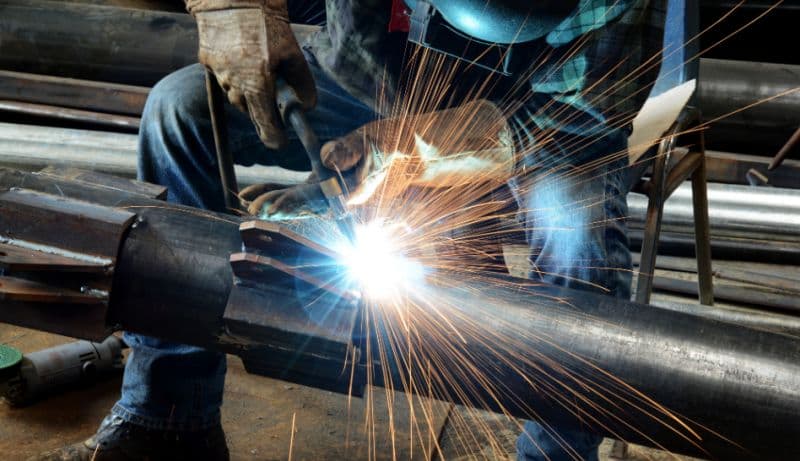
The critical components of the of the complete pellet production line equipment are built in our own workshops in Asia. Additional equipment is manufactured by our worldwide network of reliable partners.

● Testing
Quality Inspection & Testing
Before leaving the factory, all equipment will be inspected by the quality inspection department. We can also provide customers with testing services from a single machine to a complete pellet plant system, and provide you with real actual data for “worry-free use.”

● Delivery
Equipment Delivery
In equipment boxing and packaging, we adopt professional packaging and modular solutions to ensure the safe and non-destructive delivery of pellet plant equipment.
● Installation
Installation & Commissioning
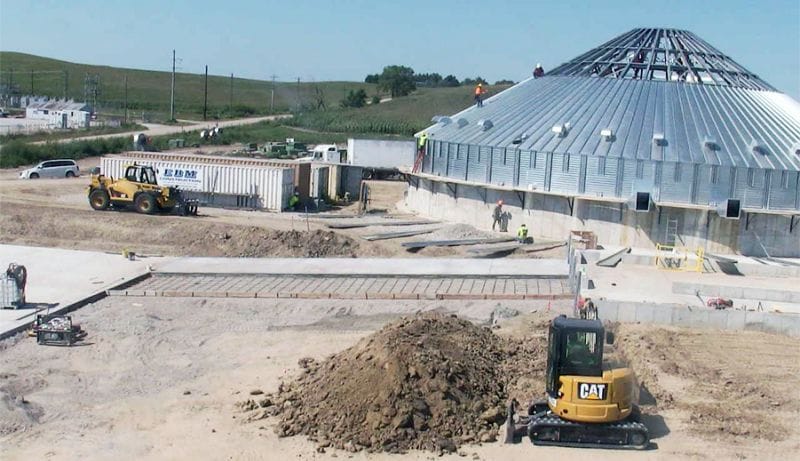
Whether you choose your own subcontractor for the erection phase or you want to install everything together with us, a Richi supervisor will be around to make sure everything is mounted in a safe and thorough way.

● Training
Staff Training
We provide comprehensive training for the technicians of each project. We can also continue to provide support for the technicians during latter project operation.
● After-sales
Project Follow-Up
When everything is up and running our Richiers will help you further whenever needed. We are ready to answer your call 24/7.We’ll also visit you regularly to learn about your needs.
Who we are
RICHI Machinery is one of the world’s leading suppliers of technology and services for the animal feed, aqua feed and pet food industries, also the largest pellet production line manufacturer in China.
Since 1995, RICHI’s vision to build a first-class enterprise, to foster first-class employees, and to make first-class contributions to society has never wavered.
In the past three decades, we have expanded our business to a wide range of areas, including animal feed mill equipment, aqua feed equipment, pet feed equipment, biomass pellet equipment, fertilizer equipment, cat litter equipment, municipal solid waste pellets equipment, etc.

1995
RICHI Established

2000+
Serving More Than 2000 Customers

120+
RICHI Employees

140+
Exported To 140 Countries