 0086-138 3838 9622
Biomass Pellet Production Factory in Tanzania
RICHI MACHINERY
Project Overview
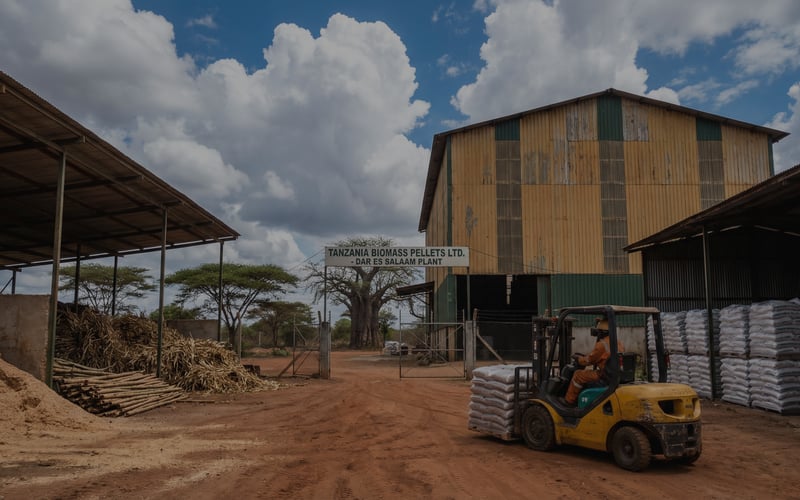
A 4t/h biomass pellet production factory in Tanzania was commissioned in late 2017 for a client in the Kibaha District, about 45km west of Dar es Salaam. The facility processes 23,000 tons of biomass feedstock annually into 20,000 tons of industrial-grade pellets for East African manufacturing, institutional heating, and export markets.
The biomass pellet plant operates two shifts per day, 8 hours per shift, 300 days per year (4,800 total operating hours), with 60 employees including production staff, maintenance, and administration. Total investment was $550,000 USD.
What makes this 4t/h biomass pellet production factory in Tanzania a significant industrial operation is the integration of drying, pelletizing, and emissions control at medium scale.
The client processes three feedstocks:sawdust – 11,000 t/yr, bamboo residue – 6,000 t/yr, and corn cobs, stalks, and husks – 6,000 t/yr. Total input 23,000 tons, output 20,000 tons. The 3,000-ton difference accounts for moisture loss (about 2,500 tons of water evaporated in the dryer) and dust collected (about 500 tons).
4T/H
capacity
$550,000
investment
Tanzania
location
Biofuel
project type
RICHI MACHINERY
The Investment Decision – From Trader to Producer
The client had been trading agricultural commodities for twelve years. He knew the biomass market in East Africa intimately. He saw three trends converging:
First: Dar es Salaam’s manufacturing sector was struggling with diesel and heavy fuel oil prices. The Tanzania Bureau of Standards had begun enforcing emissions limits on industrial boilers.
Second: The bamboo industry in Mbeya and Iringa was producing thousands of tons of residue. Bamboo grows fast, is harvested every 3-4 years, and the processing waste (branches, tops, sawdust) was being burned in the open.
Third: Corn and rice processing in Morogoro and Kibaha created consistent supplies of cobs and husks.
His question to us in early 2016: “Can you design a 4t/h biomass pellet production factory in Tanzania that meets Tanzanian and East African emissions standards, runs on three feedstocks, and pays back within 3 years?”
We spent three months on the design. The key challenges: drying (bamboo residue arrives at 35-45% moisture), dust control (multiple feedstocks create different dust characteristics), and emissions compliance (Tanzania’s NEMC has tightened rules on particulate matter).
RICHI MACHINERY
Raw Materials – Three Feedstocks, Year-Round Supply
The client set up supply agreements with sawmills, bamboo processing plants, and maize mills across three regions.
| Raw Material | Annual Input (tons) | As-Received Moisture | Cost (USD/ton) | Source |
|---|---|---|---|---|
| Sawdust | 11,000 | 25-35% | $28 | Sawmills in Morogoro |
| Bamboo residue | 6,000 | 35-45% | $22 | Bamboo processing, Mbeya |
| Corn cobs/stalks/husks | 6,000 | 20-30% | $18 | Maize mills, Kibaha |
| Total | 23,000 | Avg 28-35% | $24 avg |
All three feedstocks arrive wet. The bamboo residue is the wettest – fresh from the decorticating machines, it can be 45% moisture. The client built covered storage for 5,000 tons of raw material (about 2.5 months of supply) to allow natural pre-drying before mechanical drying.
The sawdust is mostly from teak and eucalyptus processing – clean, no paint or glue. The bamboo residue is fibrous and stringy. The corn material is the driest but has the highest ash content (3-4% vs 1-2% for wood and bamboo).
The client blends the three feedstocks before drying to balance moisture and fiber characteristics. Target blend: 50% sawdust, 25% bamboo, 25% corn residue.
RICHI MACHINERY
Why Drying Was Essential – And How We Designed It
At 28-35% average moisture, direct pelleting is impossible. Pellets would crack, mold, and fall apart. The client needed a dryer.
We specified a rotary drum dryer fired by a dedicated drying furnace burning self-produced pellets. The dryer consumes about 200 tons of pellets per year as fuel – 1% of total output.
Dryer specifications:
- Type: Rotary drum, counterflow
- Length: 12 meters
- Diameter: 2.2 meters
- Heat source: Biomass furnace (200 kg pellets/hour)
- Inlet moisture: 30-35%
- Outlet moisture: 12-15%
- Retention time: 20-25 minutes
- Flue gas treatment: Water bath scrubber + 15m stack
Tanzania’s NEMC limits are 150 mg/m³ for existing sources. The client’s emissions are about 45 mg/m³ – well below the limit.
The biomass dryer is the single most expensive piece of equipment in this 4t/h biomass pellet production factory in Tanzania – $180,000 including the furnace, scrubber, and ductwork. But without it, the client couldn’t use his lower-cost feedstocks.
RICHI MACHINERY
Equipment List – Complete Medium-Scale Line
| Equipment | Quantity | Power | Function |
|---|---|---|---|
| Wood chipper machine | 4 | 37kW each | Initial size reduction for bamboo and corn stalks |
| Wood pellet hammer mills | 2 | 75kW each | Fine grinding to 6mm particles |
| Rotary drum dryer | 1 | 45kW + furnace | Moisture reduction to 12-15% |
| Ring-die biomass pellet mills | 2 | 132kW each | Main pelleting (2t/h each) |
| Cyclone separators | 2 | 7.5kW each | Pre-dust collection |
| Baghouse filters | 2 | 15kW each | Final dust collection |
| Belt conveyors | 3 | 3-7.5kW | Material transfer |
| Water bath scrubber | 1 | 5.5kW | Furnace exhaust treatment |
| Forklift | 1 | Diesel | Finished goods handling |
| Wheel loaders | 2 | Diesel | Raw material handling |
| Trucks – 25 ton | 2 | Diesel | Product delivery |
Equipment price (EXW Qingdao port): $320,000 USD
The client bought the loaders, forklifts, and trucks locally in Tanzania – cheaper than importing and local service is available.
Shipping: Eight 40-foot containers. Departed Qingdao March 15, 2017. Arrived Dar es Salaam Port, Tanzania on May 10, 2017. Sea freight: $14,500 USD. Inland trucking to Kibaha (45km) added $1,500 USD.
RICHI MACHINERY
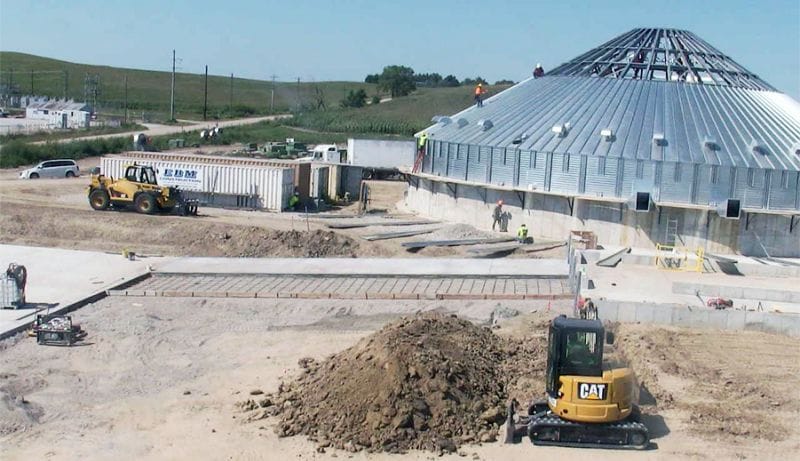
Facility Layout – 6,500m² Site, 4,500m² Built
The client leased a 6,500m² site in the Kibaha industrial area and constructed new buildings.
| Area | Size (m²) | Function |
|---|---|---|
| Production building | 2,750 | Chippers, hammer mills, dryer, pellet mills, bagging |
| Raw material storage | 1,000 | Covered storage for sawdust, bamboo, corn residue |
| Finished goods storage | 500 | Bagged pellets awaiting shipment |
| Office and reception | 200 | Administration, sales |
| Maintenance workshop | 150 | Equipment repair, spare parts storage |
| General waste storage | 50 | Collected dust, packaging waste |
| Hazardous waste storage | 20 | Used oil, lubricants |
| Fire water tank | 100m³ | Emergency fire suppression |
The production building is steel frame construction, 10 meters at the eaves – tall enough for the dryer and pellet mills. The layout follows the process flow: raw material reception at the north end, chipping and hammer milling in the middle, drying and pelleting at the south end, bagging and storage at the east side.
RICHI MACHINERY
Process Flow – Complete Production Line
Here’s how the 4t/h biomass pellet production factory in Tanzania runs.
Step 1 – Raw material receiving and storage
Trucks deliver sawdust, bamboo residue, and corn material to separate bays in the raw material storage area. The client stores about 2,500 tons at a time – enough for 10-12 days of production. The bamboo and corn material are stored under cover; the sawdust can be stored outside with tarpaulins.
Step 2 – Chipping
Bamboo residue and corn stalks need size reduction before hammer milling. Four chippers (running 3 at a time, 1 spare) reduce material to 20-30mm particles. Sawdust bypasses the chippers and goes directly to the hammer mills.
Step 3 – Hammer milling
Two 75kW hammer mills with 6mm screens run in parallel. Each mill processes about 2.5 t/h. The mills produce a uniform powder – 95% passing through a 2mm screen.
Step 4 – Drying
Ground material feeds into the rotary drum dryer. Retention time is 20-25 minutes. The dryer uses a counterflow design – hot gases (180-200°C) move opposite the material flow, maximizing heat transfer. Outlet moisture is 12-15%. The dryer can process 4-5 t/h of wet material.
The drying furnace burns about 200 tons of pellets per year. Flue gases pass through a water bath scrubber before exiting the 15m stack.
Step 5 – Pelleting
Dried material is distributed to 2 sets ring-die biomass pellet presses. Each mill produces 2 t/h. Total output: 4 t/h sustained.
Die size: 8mm for industrial boilers. Compression ratio: 1:5.5. The client tried a shorter die (1:4.5) but got soft pellets (PDI 88%). The longer die improved PDI to 94%.
Step 6 – Cooling and screening
Pellets drop onto belt conveyors and pass through a cooling tower (ambient air, 10-minute retention). Exit temperature: 35-40°C. A vibrating screen removes fines (about 3% of output). Fines go back to the hammer mills.
Step 7 – Bagging and storage
A semi-automatic bagging line fills 25kg and 50kg bags. The client also offers bulk delivery (20-ton truckloads) for industrial customers.
Step 8 – Dust collection
Two cyclone separators remove coarse dust from the hammer mills and dryer. Two baghouse filters remove fine dust from the pellet mills and bagging area. Collected dust (about 500 tons per year) is mixed back into the feedstock.
RICHI MACHINERY
The Tanzanian Market for Industrial Pellets
Tanzania’s biomass pellet market is still developing, but the client identified several customer segments.
Manufacturing: Textile factories, food processors, and brick kilns in Dar es Salaam and Morogoro are switching from heavy fuel oil to biomass. The client supplies 800 tons/month to three manufacturing plants.
Institutions: Schools, hospitals, and universities with central boilers. The client supplies 400 tons/month to institutional customers.
Export: The client is exploring exports to Kenya and Uganda, where biomass pellet markets are more mature. Rail freight from Dar es Salaam to Nairobi is about $80/ton – viable for premium pellets.
The client’s competitive advantage: He can produce pellets at $60/ton cost and sell at $135-160/ton. Imported pellets from China or South Africa cost $200-250/ton delivered to Dar es Salaam.
RICHI MACHINERY
What the Client Learned
We spoke with the client in 2019, 18 months after startup. Here are his observations.
What worked well:
- The dryer. “Without it, I couldn’t use bamboo or corn residue. Those are my cheapest feedstocks.”
- The five-mill configuration with one spare. “When a die cracks, I swap in the spare mill. Zero downtime.”
- The water bath scrubber. “NEMC inspects twice per year. We’ve never had a violation.”
What he would change:
- “I should have built more covered storage.” During the rainy season, material arriving at 45% moisture takes longer to dry. He’s adding another 1,000m² of covered storage.
- “The baghouse filter bags need replacement every 6 months, not 12.” He’s budgeting for more frequent replacements.
- “I need a second dryer.” One dryer runs 24/7. When it needs maintenance, the whole line stops. He’s planning a second dryer in 2025.
RICHI MACHINERY
What We Provided
For this 4t/h biomass pellet production factory in Tanzania, we delivered:
- Complete process design – Including dryer sizing, dust collection integration, and emissions control.
- Equipment package – Chippers, hammer mills, dryer, furnace, scrubber, biomass fuel pellet machines, cyclones, baghouses, conveyors.
- Installation supervision – Our engineer spent 45 days in Kibaha.
- Operator training – Two weeks on moisture management, die changes, and emissions monitoring.
- Spare parts kit – 2 spare dies (one per mill), ten sets of hammer mill screens, bearings, belts, and filter bags.
- Emissions testing support – We helped the client contract a local laboratory for NEMC compliance testing.
RICHI MACHINERY
Thinking About Medium-Scale Production?
If you’re looking at a 4t/h biomass pellet production factory in Tanzania – or anywhere in East Africa – here’s what we’ve learned:
- Drying is essential for agricultural residues and bamboo. Budget 15-20% of your equipment cost for drying and emissions control.
- Multiple feedstocks reduce raw material risk. The client isn’t dependent on any single supplier.
- Export is possible but not necessary. Domestic industrial demand in Tanzania is sufficient.
- NEMC compliance is achievable but requires investment. The client spent $15,000 on environmental controls – 10% of total investment.
The client in Kibaha is profitable and expanding. If you have access to biomass residues and a market for industrial heat, this model works.
Contact us for a site assessment or equipment quote. We can provide references from this biomass pellet project upon request.
● RICHI MACHINERY
RICHI Service

● Consulting
Customer Consultation
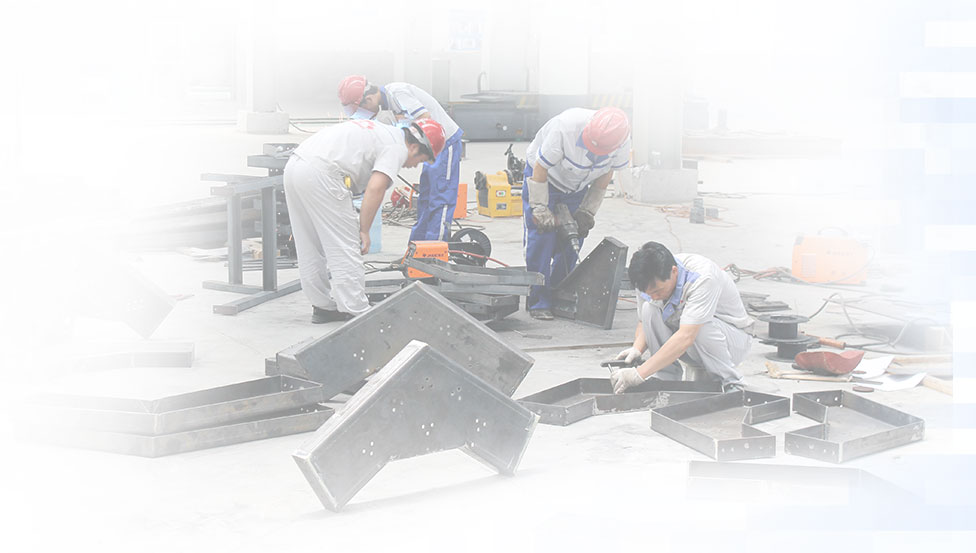
We want to have a deep understanding of your industrial process, to know your exact needs of feed, wood, biomass, fertilizer or other pellet processing.
● Design
biomass Pellet Plant Design
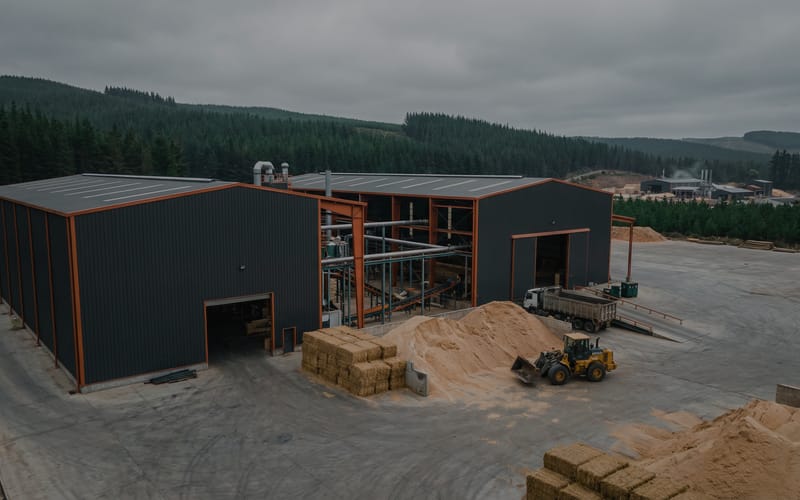
Based on your unique situation and industrial process, we will tailor complete pellet plant you need, and inform you of every additional detail that could facilitate operation, minimize total cost.
● Manufacturing
Equipment Manufacturing
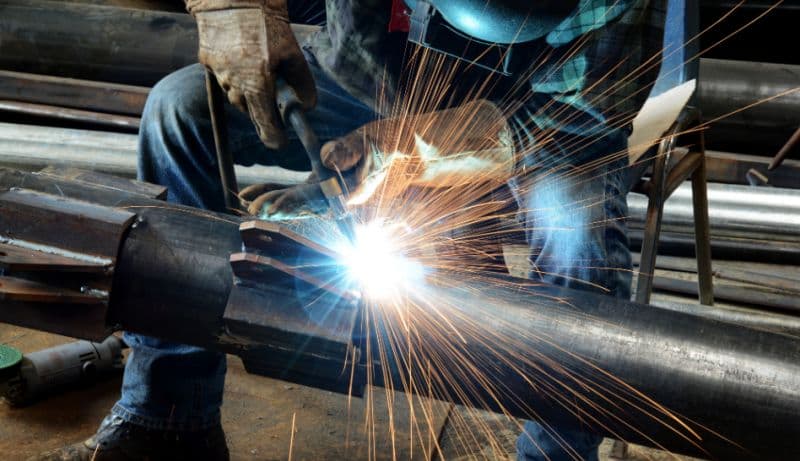
The critical components of the of the complete pellet production line equipment are built in our own workshops in Asia. Additional equipment is manufactured by our worldwide network of reliable partners.

● Testing
Quality Inspection & Testing
Before leaving the factory, all equipment will be inspected by the quality inspection department. We can also provide customers with testing services from a single machine to a complete pellet plant system, and provide you with real actual data for “worry-free use.”

● Delivery
Equipment Delivery
In equipment boxing and packaging, we adopt professional packaging and modular solutions to ensure the safe and non-destructive delivery of pellet plant equipment.
● Installation
Installation & Commissioning
Whether you choose your own subcontractor for the erection phase or you want to install everything together with us, a Richi supervisor will be around to make sure everything is mounted in a safe and thorough way.

● Training
Staff Training
We provide comprehensive training for the technicians of each project. We can also continue to provide support for the technicians during latter project operation.
● After-sales
Project Follow-Up
When everything is up and running our Richiers will help you further whenever needed. We are ready to answer your call 24/7.We’ll also visit you regularly to learn about your needs.
Who we are
RICHI Machinery is one of the world’s leading suppliers of technology and services for the animal feed, aqua feed and pet food industries, also the largest pellet production line manufacturer in China.
Since 1995, RICHI’s vision to build a first-class enterprise, to foster first-class employees, and to make first-class contributions to society has never wavered.
In the past three decades, we have expanded our business to a wide range of areas, including animal feed mill equipment, aqua feed equipment, pet feed equipment, biomass pellet equipment, fertilizer equipment, cat litter equipment, municipal solid waste pellets equipment, etc.

1995
RICHI Established

2000+
Serving More Than 2000 Customers

120+
RICHI Employees

140+
Exported To 140 Countries