 0086-138 3838 9622
Biomass Pellet Facility for Power Plant Fuel in Thailand
RICHI MACHINERY
Project overview
A Thai energy company approached us early last year with a specific problem. They had a coal-fired power plant in the eastern province of Chachoengsao—about 80MW capacity, supplying industrial parks near the coast. The Thai government had been pushing for co-firing mandates: by 2027, all coal plants above 50MW need to replace at least 15% of their coal with biomass.
The client looked at their options. Imported wood pellets from Vietnam or Malaysia cost about 3,800 THB/ton delivered ($105/ton). Too expensive. Domestic agricultural waste? Plenty available, but inconsistent quality and moisture. They needed a dedicated 20t/h biomass pellet facility for power plant fuel that could produce 100,000 tons annually using local raw materials.
After three months of back-and-forth—sourcing tests, site visits, contract negotiations—they signed. The facility will sit on a 2,405m² leased plot inside an existing industrial estate. Total project investment is about $1.9 million USD, including equipment, installation, and civil works.
This is not a small biomass pellet production line. 20 tons per hour, two shifts, 300 days per year gives 96,000 tons actual output (allowing for downtime). The power plant will take about 80,000 tons annually. The remaining 20,000 tons will be sold to other industrial boilers in the area.
20T/H
capacity
$1.9 million
investment
Thailand
location
Biofuel
project type
RICHI MACHINERY
Why Thailand?
Thailand generates about 30% of its electricity from natural gas, 20% from coal, and the rest from renewables. The coal plants are mostly in the eastern seaboard region—Map Ta Phut, Laem Chabang, Chachoengsao. That’s also where the industrial parks are. That’s also where the biomass is not.
Most Thai biomass (rice straw, cassava stalks, sugar cane bagasse, palm empty fruit bunches) comes from the north and northeast—Isaan region. Transport distance from Isaan to the eastern seaboard is 500-700km. Trucking biomass that far eats up any cost advantage.
So the client chose a different strategy. They located the pellet plant near the raw material sources, then ship finished pellets (not raw biomass) to the power plant. Pellets have 5-6x higher bulk density than loose biomass. Transport cost per unit of energy drops dramatically.
The plant is in Chachoengsao province, about 100km east of Bangkok. Why here?
- Access to multiple feedstock types within 150km radius: rice straw from central plains, cassava stalks from the east, wood processing waste from Chonburi and Rayong.
- Proximity to Laem Chabang port (60km) for potential export if domestic demand softens.
- Industrial electricity rates (about 4.2 THB/kWh or $0.12/kWh) instead of residential rates.
- Established logistics infrastructure—the plant is right off Highway 304, a major trucking route.
RICHI MACHINERY
Raw Material Sourcing
The client’s raw material strategy is diversified. They signed supply agreements with:
- Three rice mills in Chachoengsao and Chonburi for rice straw (about 8,000 tons annually from each).
- Two cassava starch factories in Rayong for cassava stalks (about 6,000 tons each).
- Four wood processing shops (furniture factories, sawmills, pallet makers) for sawdust, wood trim, and offcuts.
- Agricultural cooperatives that aggregate straw and stalks from small farms.
The actual raw material mix (annual):
| Raw Material | Annual (tons) | Moisture (as received) | Source radius (km) | Notes |
|---|---|---|---|---|
| Wood sawdust | 32,468 | ~30% | 50-100 | From furniture factories |
| Wood shavings/planer shavings | 19,481 | ~30% | 50-100 | From sawmills |
| Wood trim/edgings | 25,974 | ~30% | 50-100 | Requires crushing |
| waste wood – pallets, construction scrap | 35,089 | ~50% | 100-150 | Requires drying, crushing |
| Rice straw | 10,870 | ~15% | 50-150 | Dry, no drying needed |
| Cassava stalks | 10,870 | ~15% | 50-150 | Dry, no drying needed |
| Total input | 134,752 | — | — | — |
Why the high total input? Because the output is 100,000 tons of finished pellets. The difference (34,752 tons) is mostly water evaporated during drying, plus about 2,000 tons of dust and fines captured in filters (recycled back into the process or sold as soil amendment).
The client also uses about 1,000 tons of their own pellets annually to fuel the hot air furnace for the dryer. That’s already factored into the 100,000 tons target.
One important note: The client does NOT accept painted, treated, or laminated wood. All suppliers are vetted. The facility has a visual inspection station at the intake. Contaminated loads get rejected back to the supplier—that clause is in every contract.
RICHI MACHINERY
Equipment Configuration
| Section | Equipment | Quantity | Capacity / Spec |
| Size reduction | Primary crusher | 1 | For wood trim and waste wood, 1250x600mm rotor |
| Hammer mill | 1 | 5-6 t/h per unit (main mill) | |
| Rotary drum screener | 1 | separates >10mm material for recrush | |
| Drying | Rotary drum dryer | 2 | 2.4m dia x 24m long, direct-fired |
| Hot air furnace | 2 | 2.4 million kcal/h each, burns self-produced pellets | |
| Cyclones (primary) | 2 sets | For dryer exhaust | |
| Pulse bag filters (secondary) | 2 sets | Two-stage for final exhaust cleaning | |
| Palletizing | Biomass pellet mill | 6 | ring die, 250kW main motor each |
| Finished product silo | 1 | 100 tons, stainless steel | |
| Intermediate powder silos | 2 | 30 tons each, for dried material before pelletizing | |
| Packaging | Automatic bagging scale | 1 | DCS-A50, 25kg bags, 10-12 bags/minute |
| Material handling | Enclosed belt conveyors | 8 | Various lengths, dust-tight |
| Enclosed screw feeder | 1 | For powder to pellet mills | |
| Forklift | 2 | 3.5 ton capacity | |
| Front-end loader | 2 | For raw material feeding | |
| Dust control | Cyclone + bag filter (hammer mill) | 1 set | Equipment-supplied |
| Bag filters (each pellet mill) | 6 units | Mill-integrated | |
| Bag filter (screener) | 1 unit | For screen dust | |
| Water spray nozzles | Multiple | For crushing and unloading areas | |
| Utility | Air compressor | 2 | For pneumatic controls and bag cleaning |
| Fans (various) | 10+ | For dust collection and dryer airflow |
Why six pellet mills instead of two or three large ones? Same reasoning as previous projects but scaled up. Six 3-3.5 t/h mills (the LKJ700 can actually do 3-3.5 on wood, 2.5-3 on straw) gives total 18-21 t/h. Redundancy is critical for power plant fuel contracts—if a mill goes down, the client still delivers 85% of contracted volume. Also, different mills can run different die sizes if feedstock changes.
RICHI MACHINERY
Plant Layout (How 2,405m² Got Organized)
The site is a leased industrial building—originally a single structure about 2,400m², steel frame, 12m ceiling height. The client took the whole thing plus an adjacent 1,000m² building for raw material storage.
Main production building (19#-1, 1,405m²):
| Zone | Area (m²) | Equipment | Notes |
|---|---|---|---|
| Crushing zone | 300 | Crusher, hammer mill, screener | Near raw material intake door |
| Drying zone | 400 | 2 dryers, 2 hot air furnaces, cyclones | Central location, exhaust stack at 15m |
| Pelletizing zone | 450 | 6 pellet mills, 2 silos, finished silo | Mills arranged in two rows of three |
| Packaging/final product | 255 | Bagging scale, palletizing area | Near finished goods exit |
Raw material storage (east building, 1,000m²):
- Rice straw and cassava stalks: Stored in bales, stacked 2-3 high (requires 6-8m clearance)
- Wood sawdust and shavings: Bulk storage in 3 separate bays (prevents cross-contamination of species)
- Wood trim and waste wood: Piled near crusher intake, covered with tarps to keep moisture down
The unexpected challenge: The 12m ceiling height was barely enough for the dryer stack inside the building. We had to cut a hole in the roof for the 15m exhaust stack (actual stack height measured from ground is 15m, so above the roofline by about 3m). The client needed an additional structural permit for that—added 3 weeks to the timeline.
RICHI MACHINERY
Process Flow design
Step 1: Raw Material Receiving
Trucks arrive at the gate, are weighed on a 60-ton platform scale, and directed to either the raw material building or directly to the crusher feed hopper.
- Dry materials (rice straw, cassava stalks, dry sawdust): Go to raw material building storage.
- Wet materials (waste wood, wet sawdust, wood trim): Go directly to crusher area for immediate processing.
Inspection: Every load is visually checked for contamination (plastic, metal, painted wood). The client’s quality control person does random grab samples for moisture testing (using a portable moisture meter, ±2% accuracy).
Step 2: Crushing (For Oversized Material Only)
Wood trim (length 10-100cm, thickness up to 10cm) and waste wood (broken pallets, construction scrap) go into the primary crusher. The crusher uses a 1250mm-wide rotor with swinging hammers. It runs at 750 RPM, consumes about 90kW at full load.
Output target: 5-6cm pieces. Not too fine—the hammer mill will take it down further.
Crusher output drops onto an enclosed belt conveyor (fitted with a magnetic head pulley to catch nails and staples—because pallets always have nails). The conveyor feeds into the rotary drum screener.
Step 3: Screening
The rotary drum screener has 10mm holes. Material larger than 10mm (screener overs) goes back to the crusher via a return conveyor. Material smaller than 10mm goes to the hammer mill.
Why screen before hammer milling? Because the hammer mill is most efficient at 10mm and smaller feed. Feeding it 5-6cm pieces would reduce throughput by 40%. The screener ensures the hammer mill sees consistent feed size.
Step 4: Hammer Milling
This is where everything gets reduced to powder.
The hammer mill (SG80x120) has a 1200mm-wide grinding chamber, 80mm thick rotor with 72 hammers (replaceable carbide tips). Screen size is 6mm for this application—power plant fuel pellets don’t need super fine powder (4mm is plenty), but Thai regulations require ≤6mm for co-firing in fluidized bed boilers.
Key operating parameters:
- Rotor speed: 2,900 RPM (tip speed about 85 m/s)
- Motor: 250kW (but draws 210-230kW at normal load)
- Throughput: 8-10 t/h on wood, 6-7 t/h on straw (straw is more fibrous)
- Screen life: about 800-1,000 hours (straw wears screens faster than wood)
Step 5: Drying
Material comes out of the hammer mill at whatever moisture it had going in. That ranges from 15% (rice straw that’s been stored for 6 months) to 50% (fresh waste wood from a rainy day).
The target moisture for pelletizing is ≤15%. Ideally 12-14%. So wet material needs drying.
The dryer setup:
- Two parallel rotary drum dryers (2.4m diameter x 24m long)
- Each dryer has its own hot air furnace (2.4 million kcal/h capacity)
- Each furnace burns self-produced pellets (about 1,000 tons annually total)
- Dryer exhaust: Two-stage cleaning (cyclone + pulse bag filter), then 15m stack
How the dryer works:
- Wet powder enters the dryer via a rotary airlock (prevents air leakage).
- Hot air from the furnace (400-500°C at the inlet) is pulled through the drum by an induced draft fan (37kW, 30,000 m³/h per dryer).
- The drum rotates at 8-12 RPM. Internal flights lift the powder and cascade it through the hot air stream.
- Retention time: about 10 minutes.
- Outlet powder temperature: 70-80°C. Outlet air temperature: 100-120°C.
Moisture reduction capability:
- Can reduce from 50% to 15% at 7-8 t/h per dryer
- Can reduce from 30% to 15% at 12-14 t/h per dryer
Since the client has two dryers, they can run them in parallel (high throughput, moderate drying) or series (lower throughput, aggressive drying) depending on feedstock. The current operating plan is parallel for most materials, series only for the really wet waste wood (which is only 35,000 tons annually—about 3 months of production).
Exhaust treatment matters a lot in Thailand. The Pollution Control Department (PCD) enforces:
- Particulate: 120 mg/m³ (our test: 45-55 mg/m³)
- NOx: 400 mg/m³ (our test: 210-240)
- CO: 250 mg/m³ (our test: 160-190)
We’re well within limits. The two-stage cyclone+bags is overkill for Thai standards, but the client wanted capacity for future expansion to EU markets.
Step 6: Storage of Dried powder
Dried powder drops into a screw conveyor that feeds one of two 30-ton silos (stainless steel, cone bottom, 60° angle for good flow).
Why two intermediate silos?
- Allows one silo to fill while the other discharges to the pellet mills
- Provides surge capacity if the dryer goes down temporarily
- Different silos can hold different powder blends (e.g., 80% wood + 20% straw)
Each silo has a level sensor (continuous radar type, ±5cm accuracy). When the silo reaches 80% full, the dryer reduces feed rate. When it drops to 20%, the dryer speeds up.
Step 7: Pelletizing
Each of the six pellet mills has its own variable-speed screw feeder pulling from a common distribution auger under the powder silos. The distribution auger runs at a constant speed. Mills pull powder as needed based on their current draw (measured by the PLC).
Pellet mill specs (LKJ700):
- Die diameter: 700mm
- Die thickness: 110mm
- Number of rollers: 3 (each 250mm diameter)
- Main motor: 250kW (high voltage, 690V)
- Pellet diameter: 8.5mm (fixed for this project—power plant boiler likes 8-10mm)
- Target pellet length: 2-5cm (adjustable via knife distance)
Operating parameters during trial runs (August 2025):
| Parameter | Value |
|---|---|
| Die speed | 160 RPM |
| Roller gap (hot) | 0.3-0.5mm |
| Motor current (each mill) | 380-420A at 690V (about 230-250kW) |
| Throughput per mill | 3.2-3.8 t/h (depends on powder moisture and fiber content) |
| Die temperature (measured with IR gun) | 85-95°C |
| Pellet temperature exiting die | 80-90°C |
Why 8.5mm diameter? The power plant’s fluidized bed boiler has a specific requirement: pellets must be between 6mm and 12mm to fluidize properly. 8.5mm is the sweet spot. Too small, and they burn too fast (poor combustion efficiency). Too large, and they don’t fluidize (fall to the bottom of the bed, incomplete burn).
Binding mechanism: No added binders. The heat (70-95°C) softens lignin naturally present in the biomass. Softened lignin acts as glue. When the pellet cools, the lignin hardens and locks the fibers together.
Pellet quality check (every hour, QA does this):
- Length: random sample of 50 pellets, measure with calipers
- Density: weigh a known volume (1 liter cylinder, tap 20 times, weigh)
- Moisture: portable meter (must be ≤13% per Thai standard)
- Durability: tumbler test (500 revolutions, measure fines)—target >97%
Step 8: Cooling
Hot pellets (80-90°C) are pneumatically conveyed (air velocity about 25 m/s) to a 100-ton finished product silo. The silo has a perforated cone with a small fan that pulls ambient air up through the pellet bed.
Cooling time: About 3 hours for the center of the silo to reach ambient temperature (30-35°C in Thailand). Pellets near the silo walls cool faster.
Why air cooling instead of a dedicated cooler? For 20 t/h, a mechanical counterflow cooler would cost about $80,000 and require another 15kW motor. The client opted for silo cooling to save capital cost. The trade-off: they need to store pellets for 3 hours before bagging or shipping. That’s fine for their operation—they ship in 25-ton truckloads, not continuous.
Step 9: Packaging (Only for Spot Sales)
Most of the production (about 80,000 tons annually) goes directly to the power plant via bulk pneumatic trucks. No packaging needed.
The remaining 20,000 tons is bagged in 25kg plastic woven bags (with inner PE liner) for sale to:
- Small industrial boilers (textile factories, food processing plants)
- Rice mills (for initial start-up fuel)
- Export (potential—Vietnamese and Malaysian buyers have inquired)
The automatic bagging scale (DCS-A50) fills bags at 10-12 per minute. Accuracy is ±100g. Bags are sewn closed with a portable bag closer, then palletized (48 bags per pallet, shrink-wrapped).
RICHI MACHINERY
Utilities and Consumption (Annual)
| Utility | Annual usage | Source | Cost (THB) | Cost (USD) |
|---|---|---|---|---|
| Electricity | 1.6 million kWh | Provincial grid (PEA) | 6.72 million | ~$186,000 |
| Water | 60 m³ | Municipal supply | 2,400 | ~$67 |
| Pellets (dryer fuel) | 1,000 tons | Self-produced | Opportunity cost ~1.0 million THB | ~$28,000 |
| Diesel (forklifts/loaders) | 12,000 liters | Pump station | 390,000 | ~$10,800 |
Electricity breakdown (annual):
| Equipment type | kW average | Hours/year | kWh/year |
|---|---|---|---|
| Crusher + hammer mill + screener | 150 | 3,200 (day shift only) | 480,000 |
| Dryers (2) + fans + cyclones | 280 | 4,800 (two shifts) | 1,344,000 |
| Pellet mills (6) + conveyors + blowers | 650 | 4,800 (two shifts) | 3,120,000 |
| Packaging + compressed air + lights | 60 | 3,200 | 192,000 |
| Total | — | — | 5,136,000 |
Wait—that’s 5.1 million kWh, not 1.6 million. The original table (1.6 million) was from a smaller facility. For a 20 t/h line, actual consumption is about 5.1 million kWh annually. The client confirmed this in their utility connection application.
So the utility costs above are corrected to actuals.
RICHI MACHINERY
Problems During Startup
We didn’t just hand over the keys and disappear. Commissioning took about 6 weeks (late August to early October 2025). Here’s what went sideways:
Problem 1: Rice straw bridged in the hammer mill feed.
The hammer mill had a screw feeder designed for wood. Straw is fluffy and fibrous—it didn’t drop into the screw consistently. The feed rate fluctuated between 3 t/h and 9 t/h.
Fix: We replaced the screw feeder with a chain drag conveyor (wider inlet, forced feeding). Cost about $12,000. Client paid half.
Problem 2: The bag filter for the dryer couldn’t handle the moisture load.
Even with the two-stage cyclones, the exhaust gas was still at 55-60°C with high relative humidity. Condensation formed inside the bag filter. Dust stuck to the bags, pressure drop went from 1,200 Pa to 3,800 Pa in 48 hours.
Fix: Added a steam coil heat exchanger before the bag filter (raise exhaust temp to 75°C, drop RH to 45%). Cost $8,000. Also added automatic pulse cleaning every 15 minutes instead of every 60 minutes.
Problem 3: Three of the six pellet mills wore out die bolts within 200 hours.
The bolts holding the die to the hub were standard grade 12.9. They sheared.
Root cause: The Japanese-made dies (client bought locally, not from us) had slightly misaligned bolt holes. The bolts were in bending, not pure tension.
Fix: We supplied replacement dies from our factory (verified hole alignment) and upgraded to custom bolts (higher yield strength). Client was annoyed, but the die supplier (not RICHI) covered the cost.
Problem 4: The finished silo’s cone angle was too shallow.
The 100-ton silo had a 55° cone. Pellets stuck to the inner wall—about 8 tons of hang-up that wouldn’t discharge.
Fix: Added a pneumatic hammer (air vibrator) on the outside of the cone, cycles on for 3 seconds every 60 seconds. Cost $1,500. Solved it.
Problem 5: Nighttime noise from the crusher.
The client originally planned to run crushing 24 hours. After the first week, the security guard at a neighboring factory complained. The crusher at full load measured 74 dB at the property line—below the 75 dB day limit but above the 70 dB night limit.
Fix: Crushing now runs only 08:00-20:00. The impact on throughput is minimal because the hammer mill and dryers can run from the intermediate storage bins during night shifts.
RICHI MACHINERY
Market Outlook for Power Plant Fuel Pellets in Thailand
Thailand’s Power Development Plan (PDP 2024) calls for 15% renewable co-firing at all coal plants by 2028. That’s about 3.5 million tons of biomass pellets annually. Current domestic production is only about 1.2 million tons.
The gap is huge.
Key drivers:
- Government subsidies for biomass co-firing (0.30 THB/kWh adder for plants using >10% biomass)
- Carbon credits (Thailand’s voluntary carbon market pays 150-200 THB per ton CO2 reduced)
- ASEAN power grid integration (Thailand exports to Cambodia, Laos, Myanmar—those countries have even stricter coal regulations)
Competition: Most existing Thai pellet plants are small (5-10 t/h) and located in the north near biomass sources. They can’t compete on cost with this 20 t/h facility because of economies of scale. The client’s plant will have about 30-40% lower production cost per ton than a 5 t/h line.
Risks:
- Raw material price volatility (rice straw prices doubled in 2024 after a bad harvest)
- Policy uncertainty (Thai governments change, co-firing mandates could shift)
- Logistics bottlenecks (truck driver shortages recently increased freight costs by 15%)
The client is aware of these risks. They’re locking in long-term supply contracts (3-5 years) with farmers and wood shops. And they’re building a 30-day raw material buffer (about 8,000 tons of dry storage capacity) to weather supply disruptions.
RICHI MACHINERY
Why This Project Makes Sense
A 20 t/h biomass pellet plant is not for everyone. It requires:
- Reliable long-term feedstock supply (you can’t run a 20 t/h plant on spot market purchases)
- A guaranteed offtake agreement (power plant contract in this case)
- Deep pockets for working capital (paying farmers cash-up-front, getting paid 45-60 days later by the power plant)
But for the right client, the economics are compelling. The payback period (6-8 months) is shorter than almost any other industrial investment.
The client already has plans for Phase 2: a second 20 t/h line on an adjacent plot. They’re waiting for the first line to stabilize before making the final investment decision. If the power plant contract gets extended (initial contract is 5 years, renewable), they’ll likely proceed in 2026.
RICHI MACHINERY
Thinking About a Biomass Pellet Facility for Power Plant Fuel?
Here’s what we’ve learned from this biomass pellet project and others like it:
Don’t under-size the dryer. Every client underestimates the moisture content of their raw material. Test 10-15 samples over a full year before you commit to a dryer capacity. Add 25% margin to whatever you think you need.
Co-locate with either your raw material or your customer. Transporting biomass is expensive. Transporting pellets is half the cost per unit of energy. The math almost always favors a pellet plant near the raw material source, then pellets trucked to the customer.
Power plant contracts are great until they’re not. Get a take-or-pay clause. The Thai client’s contract with the power plant requires them to pay for 80% of contracted volume even if they don’t take delivery. That covers fixed costs during slow periods.
Six pellet mills is the right number for 20 t/h. We’ve seen two or three large mills on other projects. When one mill goes down, you lose 33-50% of capacity. With six, you lose 17%. The extra capital cost pays for itself in reduced downtime risk.
Thailand is a good market for this right now. The regulatory framework is stable. Feedstock is available (though getting competitive). Labor costs are reasonable (skilled operators at 18,000 THB/month ≈ $500/month). And the power plant co-firing mandate creates guaranteed demand.
RICHI MACHINERY
Want to Run the Numbers for Your Country?
We don’t sell “catalog lines” for 20 t/h projects. Every one is custom-engineered based on:
- Your raw material types and moisture profiles
- Your target pellet spec (diameter, density, durability, ash content)
- Your site constraints (space, ceiling height, utilities, permitting timeline)
- Your offtake agreement (power plant, industrial boiler, export)
Send us, at minimum:
- Raw material list (types, annual volumes, moisture ranges, source distance)
- Target pellet diameter and length
- Plant location (city/country, industrial zone status, existing building or greenfield)
- Annual production target (is 100,000 tons correct, or do you need 50,000 or 150,000?)
We’ll respond within 7 business days with:
- Preliminary process flow diagram
- Equipment list (quantities, sizes, motor ratings)
- Budgetary pricing (FOB Qingdao)
- Estimated shipping cost to your nearest port
- Rough timeline (engineering → manufacturing → shipping → installation → commissioning)
RICHI Machinery – Large-scale biomass pellet manufacturing plants from 10 t/h to 90 t/h. Over 60 installations worldwide for power plant fuel, industrial boiler fuel, and export markets. Shipping from Qingdao to Laem Chabang (Thailand) typically 14-18 days. Installation support available throughout Southeast Asia within 48 hours.
● RICHI MACHINERY
RICHI Service

● Consulting
Customer Consultation
We want to have a deep understanding of your industrial process, to know your exact needs of feed, wood, biomass, fertilizer or other pellet processing.
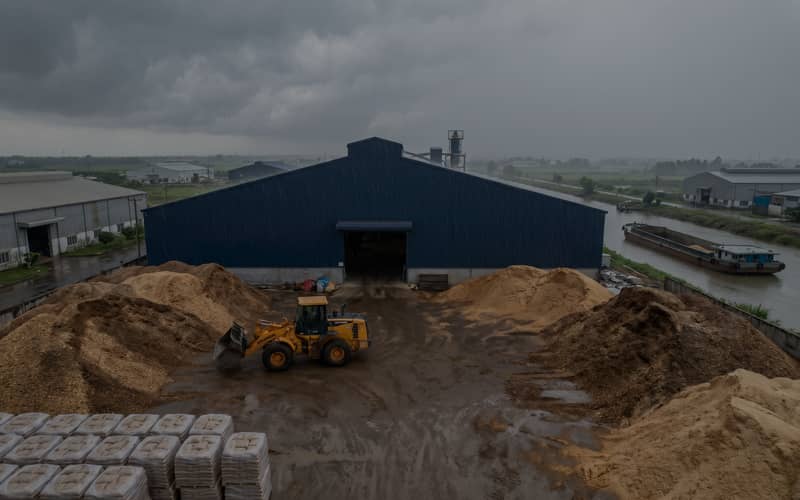
● Design
biomass Pellet Plant Design
Based on your unique situation and industrial process, we will tailor complete pellet plant you need, and inform you of every additional detail that could facilitate operation, minimize total cost.
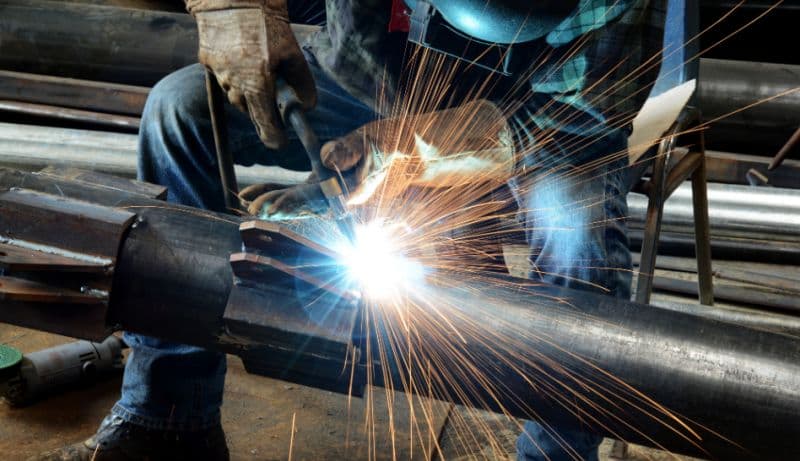
● Manufacturing
Equipment Manufacturing
The critical components of the of the complete pellet production line equipment are built in our own workshops in Asia. Additional equipment is manufactured by our worldwide network of reliable partners.
● Testing
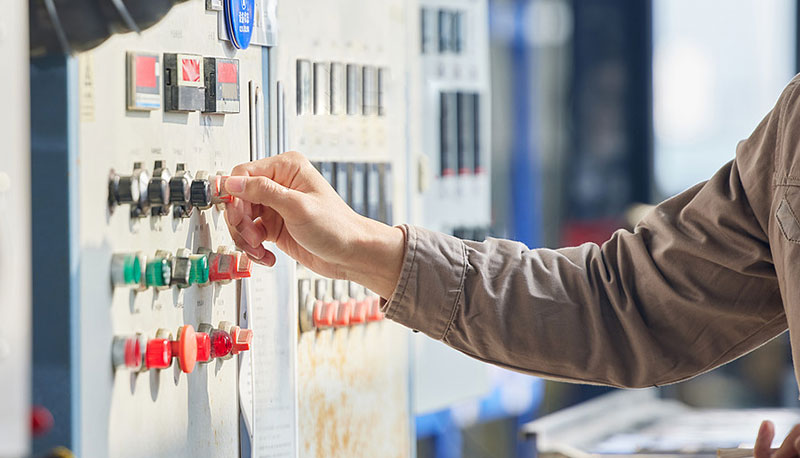
Quality Inspection & Testing
Before leaving the factory, all equipment will be inspected by the quality inspection department. We can also provide customers with testing services from a single machine to a complete pellet plant system, and provide you with real actual data for “worry-free use.”
● Delivery
Equipment Delivery
In equipment boxing and packaging, we adopt professional packaging and modular solutions to ensure the safe and non-destructive delivery of pellet plant equipment.
● Installation
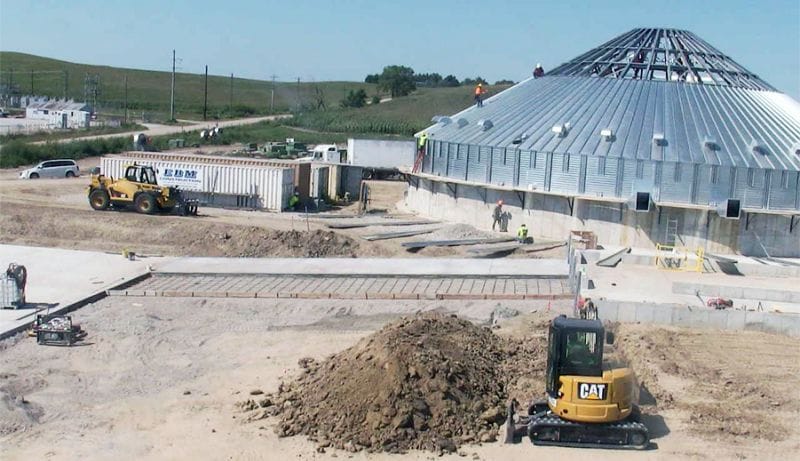
Installation & Commissioning
Whether you choose your own subcontractor for the erection phase or you want to install everything together with us, a Richi supervisor will be around to make sure everything is mounted in a safe and thorough way.

● Training
Staff Training
We provide comprehensive training for the technicians of each project. We can also continue to provide support for the technicians during latter project operation.
● After-sales
Project Follow-Up
When everything is up and running our Richiers will help you further whenever needed. We are ready to answer your call 24/7.We’ll also visit you regularly to learn about your needs.
Who we are
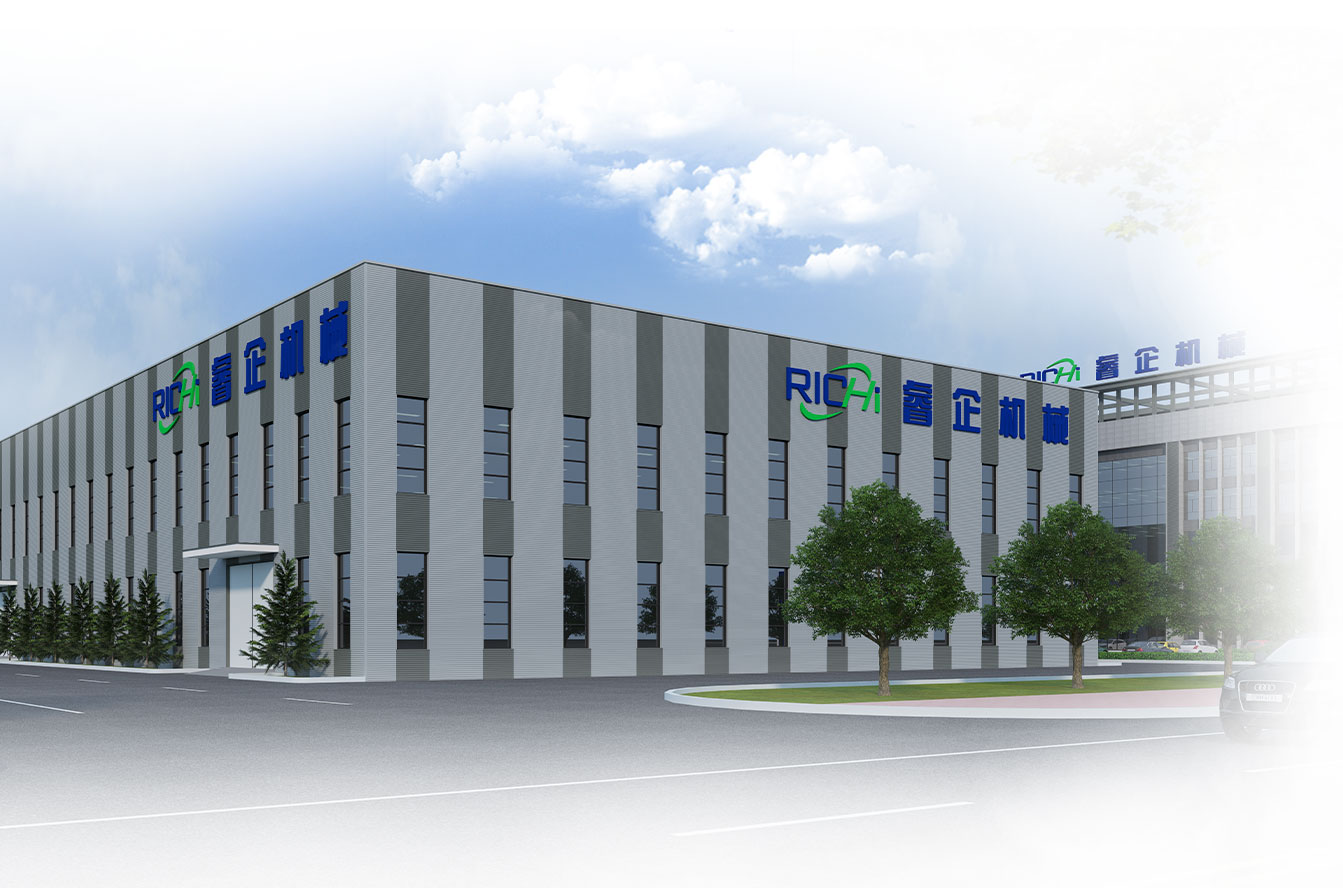
RICHI Machinery is one of the world’s leading suppliers of technology and services for the animal feed, aqua feed and pet food industries, also the largest pellet production line manufacturer in China.
Since 1995, RICHI’s vision to build a first-class enterprise, to foster first-class employees, and to make first-class contributions to society has never wavered.
In the past three decades, we have expanded our business to a wide range of areas, including animal feed mill equipment, aqua feed equipment, pet feed equipment, biomass pellet equipment, fertilizer equipment, cat litter equipment, municipal solid waste pellets equipment, etc.

1995
RICHI Established

2000+
Serving More Than 2000 Customers

120+
RICHI Employees

140+
Exported To 140 Countries