 0086-138 3838 9622
Biomass Based Animal Bedding Pellet Production Line in Romania
RICHI MACHINERY
overview
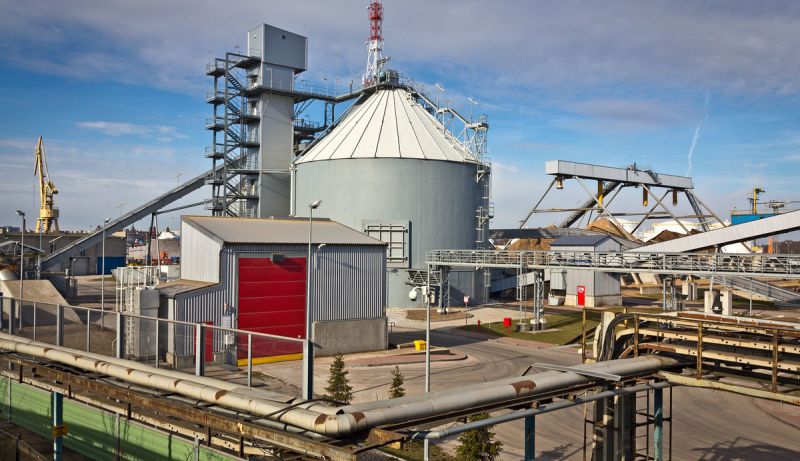
This Biomass Based Animal Bedding Pellet Production Line in Romania was developed near Cluj-Napoca for an established biomass processor expanding from a small local operation into a 30,000 T/A commercial bedding business. The product is aimed at horse stables, dairy farms, poultry operations and distributors that value clean, low-dust, absorbent bedding rather than fuel performance.
The installed pelletizing capacity is approximately 8–9 T/H. The plant operates about 250 days per year on two 8-hour production shifts, giving 4,000 scheduled production hours for the 30,000 T/A plan. Three MZLH678 biomass pellet mills, each with a 200 kW main motor, provide the required throughput with maintenance margin while avoiding the five-small-mill configuration.
The feedstock program combines clean sawdust, untreated wood trim/offcuts and cereal straw. Wood residues provide the main bedding-grade fiber, while straw is controlled by moisture, dust and mineral contamination. Wet feedstock is dried before pelletizing; dry straw and selected dry sawdust can bypass part of the thermal load.
The completed project represents a fixed total implementation investment of USD 1.28 million, including a USD 760,000 RICHI equipment and control package. The customer already had an approximately 11,000 m² industrial property, but the bedding operation actively uses about 6,500 m² rather than occupying the entire site.
8T/H
capacity
$1.28 million
investment
Romania
location
Bedding
project type
RICHI MACHINERY
What the Client Actually Needed
The client was not starting from zero. A smaller biomass operation had already established local suppliers and customers, but the existing setup could not support a stable 30,000 T/A bedding business. The new project therefore focuses on throughput, moisture control, dust capture, magnetic protection, mechanical cooling and repeatable packaging.
The product route is animal bedding, not fuel. That changes the release priorities: absorbency, dust, cleanliness, friability after wetting and package stability matter more than achieving a premium fuel-pellet density or the lowest possible ash.
| Commercial Target | Project Requirement | Design Response |
|---|---|---|
| Horse stables | Clean, low-dust bedding with good absorbency | Wood-rich 6–8 mm bedding grade |
| Dairy farms | Bulk handling and moisture control | 25–50 kg bags and distributor deliveries |
| Poultry / specialty farms | Consistent dry bedding | Screening and controlled fines |
| Farm-supply distributors | Stable retail product | Batch coding and moisture-protective packaging |
The annual target remains 30,000 T/A. With 250 operating days and two 8-hour shifts, the project needs high utilization, so the pelletizing section is installed at 8–9 T/H rather than being sized exactly to the annual average. This leaves room for die changes, product transitions and short maintenance stops.
The customer also wanted to reuse existing buildings rather than construct a new greenfield plant. That made layout discipline especially important: raw intake, grinding, drying, pelletizing, cooling and packing had to be rearranged into one-direction flow inside the available structures.
RICHI MACHINERY
Site Conditions: What We Found in March
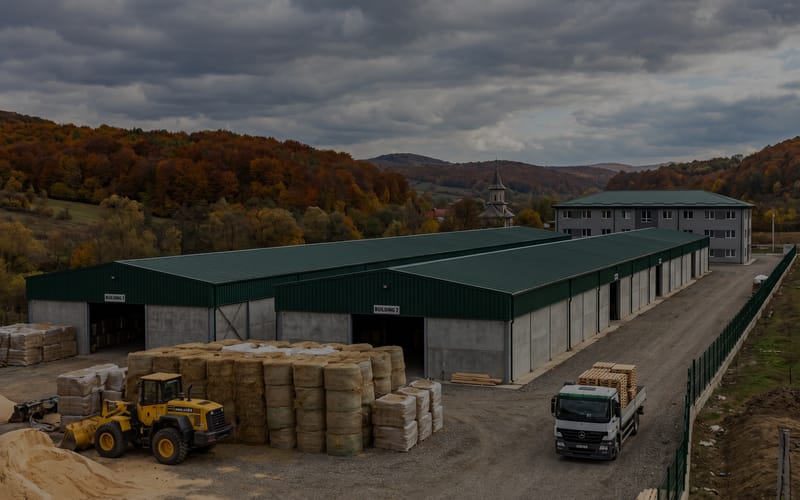
The industrial property outside Cluj-Napoca is approximately 11,000 m² and already includes two steel-frame buildings. The project uses the better sections of those buildings rather than treating all existing floor area as mandatory production space.
| Existing Area | Approx. Active Use | Project Function |
|---|---|---|
| Building 1 | About 3,500–4,000 m² | Main production, dryer interface, pelletizing and packing |
| Building 2 | About 2,000–2,500 m² | Raw-material buffer, finished goods and maintenance |
| Office / welfare | Existing separate area | Administration, QC and staff facilities |
| Outdoor circulation / fire access | Balance of active site | Truck movement, furnace separation and emergency access |
The 8 m eaves height is sufficient for conveyors, day bins, coolers and the three MZLH678 machines. The dryer and hot-air furnace remain positioned toward an exterior wall so the combustion system, exhaust treatment and fire separation do not consume unnecessary indoor production area.
The main constraints were not building size but process quality: cross-traffic between process areas, grinding dust, insufficient drying capacity for expansion and weak magnetic protection all had to be addressed in the new layout.
The revised site plan keeps raw biomass on the intake side, moves dried material only forward through pelletizing, and places packing near finished-goods storage. This shortens conveying distance and reduces the number of transfer points that create dust.
RICHI MACHINERY
Raw Material Realities
The feedstock mix is based on clean wood-processing residues and cereal straw available in Transylvania and surrounding regions. The plant does not accept mixed demolition wood or composite panels merely because they are inexpensive.
| Raw Material | Approx. Annual Intake | Typical Receiving Moisture | Role |
|---|---|---|---|
| Clean sawdust / shavings | 13,000 T/A | About 22–32% | Main absorbent fiber |
| Untreated wood trim / offcuts | 13,000 T/A | About 24–35% | Crushed and blended with sawdust |
| Wheat / barley straw | 11,000 T/A | About 12–20% | Controlled agricultural bedding fraction |
| Gross external input | Approx. 37,000 T/A | Weighted around 25% | Supports about 30,000 T/A finished bedding |
At roughly 25% weighted incoming moisture, 37,000 tons of feedstock contains about 27,750 tons of dry matter. Finished bedding at 30,000 T/A and around 10% moisture contains about 27,000 tons of dry matter. The balance covers mineral contamination, screening rejects and unrecoverable handling loss while the dryer and cooling sections remove several thousand tonnes of water.
- Painted, preservative-treated, laminated and composite-board residues are excluded.
- Wood offcuts pass magnetic separation before crushing because nails and staples remain a realistic contamination risk.
- Straw is rejected if it is visibly moldy, soil-heavy or stored wet.
- Sawdust suppliers are tracked separately because species mix and moisture can change die load and absorbency.
- Raw-material moisture is measured by lot and used to determine whether drying is required.
The plant does not assume freshly baled straw routinely arrives at extremely high moisture. Commercial cereal straw is normally purchased dry enough for storage, while badly weathered or wet bales are either reconditioned off-line or rejected.
Feedstock quality is managed for animal-contact use. Cleanliness and odor are therefore just as important as whether a material can physically be pelletized.
RICHI MACHINERY
How We Redesigned the Production Flow
The production layout is organized around a straight-through process rather than around where individual machines happen to fit. Raw materials move from receiving through preparation and drying, then into pelletizing, cooling, screening and packing without repeated cross-building transfers.
Building 1 (Production – 4,000m²)
The active production area is divided into receiving/preparation, drying, pelletizing/cooling and packing zones. Crusher and hammer-mill dust collection is separated from dryer exhaust treatment so each system can be sized for its actual air volume and dust characteristics.
| Production Zone | Approx. Area | Main Equipment |
|---|---|---|
| Receiving / pre-processing | 800–900 m² | Inspection, magnets, crusher and straw preparation |
| Grinding / dry-material handling | 800–900 m² | Hammer mills, aspiration and buffers |
| Drying / furnace interface | 900–1,000 m² | Rotary dryer, furnace and exhaust control |
| Pelletizing / cooling / screening | 900–1,000 m² | 3 × MZLH678, cooler and screener |
| Packing / dispatch interface | 300–400 m² | Bagging, pallet handling and finished transfer |
Building 2 (Storage – 3,700m²)
Only part of Building 2 is required for the first-stage 30,000 T/A operation. Covered raw materials use about 1,200–1,400 m², finished goods use about 700–900 m², and the rest provides maintenance, aisles, seasonal buffer and future expansion.
This reduces unnecessary stock. Straw and wood residues are supplied on scheduled contracts, while finished bedding is dispatched regularly to distributors and farm customers instead of sitting for weeks in the warehouse.
The dryer furnace is physically separated from bagged bedding storage, and forklift routes do not cross the main pelletizing service aisle. Fire access and maintenance clearance are treated as part of the layout rather than unused leftover floor area.
RICHI MACHINERY
Equipment Configuration
The upgraded line uses three correctly sized biomass pellet mills instead of five small parallel units. The MZLH678 configuration provides practical maintenance access, fewer feeders and lower mechanical complexity while still offering redundancy.
| Section | Main Equipment | Project Configuration |
|---|---|---|
| Receiving / protection | Inspection station, magnets and metal detector | Protects crusher and hammer mills |
| Primary size reduction | Heavy-duty crusher | For clean wood offcuts and trim |
| Straw preparation | Bale breaker / straw cutter | For wheat and barley straw |
| Fine grinding | 2 × hammer mills + aspiration | Combined prepared-material capacity above line rate |
| Drying | Rotary drum dryer + biomass hot-air furnace | Sized from peak water evaporation |
| Dry buffer | Intermediate bins with metered discharge | Stabilizes pellet-mill feed |
| Pelletizing | 3 × MZLH678 animal-bedding biomass pellet mills | 200 kW each; combined 8–9 T/H |
| Cooling | Counterflow cooler | Matched to line output |
| Screening | Vibrating screener + fines return | Controls loose fines before packing |
| Packing | Semi-automatic / automatic 25–50 kg bagging | Retail and farm-supply formats |
| Dust / exhaust | Cyclones, bag filters and dryer particulate control | Separate systems by process |
| Controls | Central PLC / MCC | Interlocks, alarms and load balancing |
The fixed RICHI equipment and controls package is USD 760,000. The completed USD 1.28 million project total also includes electrical upgrading, dryer/furnace civil works, local steelwork, dust-control ducting, fire protection, installation, commissioning and startup spare parts.
Three MZLH678 units provide maintenance flexibility: one unit can be stopped for die or roller service while the remaining two continue production at reduced rate. The plant does not need five separate feeders, five control groups and five small-machine maintenance programs.
The counterflow cooler is retained because bedding product still needs controlled cooling before screening and packing. It is not acceptable to use storage space as the primary cooling system at this capacity.
RICHI MACHINERY
Detailed Process Steps
The process is built around clean raw material, controlled moisture and low-dust handling. Wood and straw follow different preparation routes before they join the common bedding blend.
Step 1: Raw Material Receiving and Pre-sorting
Incoming material is identified by supplier and checked for moisture, visible mold, coatings, plastic, metal and excessive soil. Clean sawdust unloads to covered bays; wood trim is separated for crushing; straw bales are kept dry and fed through the straw-preparation route.
Magnetic separators protect the main conveyors before crushing and grinding, while an inline metal detector downstream of grinding provides a second level of protection against metal fragments that magnets may not capture.
Step 2: Crushing
Clean untreated wood offcuts are reduced to manageable chips before fine grinding. Sawdust bypasses the crusher. Straw uses a bale breaker/cutter rather than the wood crusher so long fibers do not wrap around the feed system.
Step 3: Hammer Milling
Two hammer mills reduce prepared material to a few-millimeter fiber size suitable for bedding pellet production. Screen selection is adjusted by feedstock campaign. Bedding does not require an ultra-fine powder, but the particle distribution must remain consistent enough for stable ring-die feeding.
Grinding aspiration uses cyclone and bag-filter separation. Filtered return air is handled only where the applicable workplace-air and fire-risk assessment allows it; the plant does not rely on one invented dust number as proof that recirculation is always acceptable.
Step 4: Drying and Cooling
Material above the pelletizing moisture window enters the rotary dryer heated by a biomass hot-air furnace. Dry straw and dry sawdust can bypass part of this stage. Dryer throughput is controlled from incoming moisture and actual water-removal demand rather than from one fixed wet-tonnage figure.
The normal target before pelletizing is approximately 10–14% moisture, depending on blend and bedding specification. Dryer discharge is buffered and allowed to equalize before it reaches the pellet mills.
Step 5: Pelletizing
Three MZLH678 pellet mills receive dried prepared material through individual feeders. Each 200 kW unit is from the biomass pellet-machine series and is commissioned against the actual wood/straw blend, target diameter and desired bedding friability.
The standard bedding product is 6–8 mm diameter. Die compression, roller gap and feeder speed are tuned from motor load, pellet appearance, durability and absorbency rather than fixed to one universal RPM, gap or die-life figure.
The project does not describe lignin as the only binding mechanism. Fiber structure, moisture, temperature and wood-to-straw ratio all influence pellet formation, and some bedding recipes may require different tooling even when no external binder is added.
Step 6: Cooling and Screening
Fresh pellets enter a counterflow cooler and are brought close to ambient temperature before screening. The screener removes loose fines and abnormally long pieces; clean fines return to a controlled subsequent batch.
Finished bedding is checked for moisture, diameter, length, loose dust and a defined absorbency/breakdown method. The product is designed to remain intact through packaging but break down appropriately when used in stalls or livestock housing.
Step 7: Packaging and Storage
The main commercial packs are 25 kg and 50 kg, with larger FIBC available for farm or distributor orders. Bags are weighed, closed, coded and palletized before entering the finished-goods zone.
Finished stock is kept dry and rotated quickly because bedding pellets readily absorb ambient moisture. The warehouse is sized for short commercial inventory rather than long-term seasonal storage.
RICHI MACHINERY
Utility Consumption
Electricity is the main purchased utility, while the dryer furnace uses clean biomass residue or a controlled share of off-spec bedding pellets. Utility figures are based on the 30,000 T/A operating plan rather than on nominal motor power multiplied by every scheduled hour.
| Utility | Practical Annual Planning Range | Engineering Basis |
|---|---|---|
| Electricity | Approx. 2.6–3.2 million kWh/year | Three MZLH678 mills, grinding, dryer fans, cooling, conveyors and packing |
| Electrical service | Approx. 1.25–1.6 MVA | Supports 600 kW pellet-mill main motors plus auxiliaries |
| Dryer biomass fuel | Approx. 1,800–2,500 T/A residue equivalent | Depends on incoming moisture and furnace efficiency |
| Fresh / domestic water | Approx. 500–800 m³/year | Staff, cleaning and utility use |
| Scrubber / exhaust-water demand | Project-specific | Only if the selected exhaust treatment uses a wet stage |
| Forklift / loader fuel | Approx. 6,000–9,000 L/year | Receiving and warehouse movement |
The plant normally operates 4,000 production hours per year. Crusher and dryer operating time varies with feedstock condition, while pelletizing follows the two-shift schedule more closely.
A workforce of about 18–24 people is appropriate for two shifts, covering receiving, preparation, dryer/furnace operation, pelletizing, packing, warehouse, maintenance, QC and supervision.
Energy performance is reviewed per finished tonne. A rise in hammer-mill electricity can indicate blunt hammers or excess moisture; a rise in pellet-mill kWh/t can indicate die wear, poor moisture control or an unfavorable straw ratio.
RICHI MACHINERY
Environmental Compliance
The project is developed under Romania’s national environmental-permitting framework and applicable EU law. Project screening and environmental-impact requirements are handled under Law 292/2018, while the operating environmental authorization follows the national authorization procedure administered through the competent environmental authority.
The biomass-fired dryer furnace is assessed separately as a combustion source. If its rated thermal input falls within the medium-combustion-plant range of at least 1 MW and below 50 MW, Romania’s Law 188/2018 and the EU Medium Combustion Plant Directive framework apply to pollutants such as SO2, NOx and particulate matter.
| Environmental Aspect | Project Control | Compliance Basis |
|---|---|---|
| Grinding / transfer dust | Enclosed aspiration + bag filters | Environmental permit and workplace-risk assessment |
| Dryer / furnace emissions | Cyclone / bag filter or other approved particulate control | Combustion-plant category and permit conditions |
| Combustible dust / fire | Grounding, metal control, housekeeping and fire separation | Risk assessment and fire-protection design |
| Noise | Acoustic treatment and daytime scheduling for high-noise equipment | Site-specific environmental / community limits |
| Used oil / maintenance waste | Contained labeled storage | Authorized waste-management route |
| Solid clean fines | Controlled return to production | Quality and contamination checks |
| Wastewater | Mostly domestic / limited utility wastewater | Approved sewer or site treatment arrangement |
Romania’s Ministry of Environment lists Law 278/2013 for industrial emissions and Law 188/2018 for medium combustion plants within the current industrial-emissions framework. The project therefore does not publish stack test results or one generic Cluj permit limit without the actual permit and furnace rating.
The bedding product itself is not treated as an environmental permit substitute. Supplier traceability, treated-wood exclusion, dust control and waste records remain part of the operating management system.
RICHI MACHINERY
What Went Wrong During Startup
Commissioning focuses on predictable process interfaces in a mixed wood/straw bedding line: raw-material moisture, metal control, dryer response and pellet-mill load balance.
| Startup Issue | Why It Happens | Project Response |
|---|---|---|
| Wet sawdust reduces dryer throughput | Supplier moisture rises after rain | Segregate wet lots and reduce dryer feed rate |
| Straw bridges in feeders | Low bulk density and long fibers | Use forced-feed conveyors and proper bale preparation |
| Metal reaches grinding section | Wood offcuts contain nails / staples | Use staged magnets plus downstream metal detection |
| Pellet-mill load is uneven | Three mills see different feed rates | PLC balances feeder speed from motor load |
| Pellets leave cooler too warm | Insufficient airflow or retention | Adjust bed depth and fan settings |
| Dust-filter differential pressure rises | Wet fine dust or poor pulse cleaning | Control dew point and maintain cleaning sequence |
The plant commissions wood-rich bedding first, then increases straw content in controlled campaigns. This gives operators a stable baseline for moisture, die load and cooling before more variable agricultural fiber is introduced.
Critical spares include MZLH dies, rollers, hammer-mill screens, bearings and belts. Planned maintenance is scheduled by operating hours and condition rather than by a fixed promise of several thousand tonnes per die.
The customer also maintains retained samples from each finished batch so dust, moisture and absorbency complaints can be traced back to the corresponding raw-material lot.
RICHI MACHINERY
Why Bedding Pellets? (Market Context in Romania)
Romania has a substantial livestock sector, including one of the EU’s largest sheep populations and a meaningful bovine sector. Eurostat’s 2024 data place Romania among the larger livestock-producing member states, which supports a broad agricultural market for bedding materials even though bedding choice varies widely by farm type.
Horse stables remain an important premium customer segment, but the project does not rely on an unverified national horse-population claim. Commercial sales are built from actual stable, dairy, poultry and distributor accounts in Romania and neighboring Central European markets.
| Customer Segment | Why Pellet Bedding Can Fit | Product Emphasis |
|---|---|---|
| Horse stables | Clean handling and low loose dust | Wood-rich premium grade |
| Dairy farms | Moisture control and compact storage | 6–8 mm standard bedding grade |
| Poultry / specialty farms | Dry litter and easy delivery | Screened low-fines product |
| Farm-supply distributors | Retail-ready packs | 25 kg branded packaging |
| Cross-border distributors | Truck-scale repeat orders | Consistent specification and pallet handling |
Pellets are not automatically cheaper than loose straw or sawdust. Their commercial value is higher bulk density, easier bagged distribution, predictable moisture, cleaner storage and controlled product quality.
The project also avoids unsupported fixed selling prices and margin comparisons between bedding and fuel pellets. Romania, Hungary and Austria have changing raw-material, freight and retail prices, so the business case is based on actual customer contracts and distributor terms.
RICHI MACHINERY
What We Learned
Moisture management remains the first design priority. A dryer should be sized from peak water removal, but procurement rules are equally important: paying to evaporate avoidable water from low-value residues can destroy margin.
Metal control should combine magnets with downstream detection where clean wood offcuts remain part of the feedstock. Magnets are excellent for ferrous contamination but they should not be treated as the only barrier against all foreign metal.
Parallel pellet mills work best when feed is balanced automatically. Three MZLH678 units are easier to manage than five small machines, but each feeder still needs stable distribution and motor-load monitoring.
Environmental permitting should be based on the actual furnace thermal rating and project category. Romania’s national rules implement EU requirements, while the final permit can impose site-specific monitoring and operating conditions.
Finally, bedding must be evaluated as bedding. Absorbency, dust, cleanliness, friability and farm handling matter more to the buyer than fuel-pellet density or a headline calorific value.
RICHI MACHINERY
Would We Do This Project Again?
Yes—this project type is technically sound when the customer has a stable supply of clean wood fiber, access to dry cereal straw and an established agricultural sales channel. The 30,000 T/A scale is large enough to justify mechanical drying, three MZLH678 mills and automated cooling/packing without becoming an oversized export-only factory.
The two existing steel buildings are also an advantage because the project can expand within an industrial property without buying a large new greenfield site. The active operating footprint remains around 6,500 m² even though the overall property is larger.
The main commercial condition is product differentiation. The customer needs to sell a clean bedding grade with measured absorbency and low loose dust—not simply a biomass pellet in a different bag.
Future expansion should first use higher operating hours or add packaging/storage capacity if sales require it. A second pelletizing module should only be considered after feedstock and contracted demand justify the additional throughput.
RICHI MACHINERY
Thinking About a Similar Project?
A bedding-pellet proposal should begin with actual raw-material samples and customer requirements. Moisture, fiber type, coatings, soil contamination and seasonal storage determine the process far more than a catalogue capacity number.
For a 30,000 T/A project, the customer should confirm monthly feedstock availability, realistic wet-season moisture, electrical-service capacity, building dimensions and the target animal sectors before equipment is finalized.
The Romanian biomass pellet project uses a larger electrical service, thermal dryer and three MZLH678 units because its raw materials and annual output justify them. A smaller horse-bedding plant would not need the same configuration.
Equipment can be shipped from Qingdao to Constanța Port and then moved inland by road or rail to Cluj County. Constanța is Romania’s principal Black Sea gateway and serves Central and Eastern European cargo flows.
A project of this scale should normally be planned over roughly 6–9 months from final engineering through commissioning, depending on building modification, electrical work, environmental permitting and local contractor readiness.
RICHI MACHINERY
Ready to Talk?
For a bedding-pellet project, the most useful starting information is raw-material type, monthly volume, moisture range, source distance, animal applications, required pack sizes, building dimensions and available power.
- Separate sawdust, wood offcuts and straw in the raw-material data.
- Identify which materials need drying and which can bypass the dryer.
- Define bedding diameter, moisture, loose-dust and absorbency targets.
- Confirm whether sales are retail bags, farm bulk bags or distributor pallets.
- Provide the actual site ceiling height, floor loading and electrical capacity.
- Separate machinery budget from civil works, utility upgrades and working capital.
RICHI configures the Biomass pellet production line around those inputs. The same engineering basis can also be adapted to a biomass pellet plant or wood pellet production line when the end product and feedstock are different.
RICHI scope covers process engineering, equipment manufacture, factory inspection, export packing, installation guidance, commissioning and operator training. The goal is to match the plant to the real bedding market rather than force every project into the same equipment list.
Additional project references include biomass pellet mill.
● RICHI MACHINERY
RICHI Service

● Consulting
Customer Consultation
We want to have a deep understanding of your industrial process, to know your exact needs of feed, wood, biomass, fertilizer or other pellet processing.
● Design
biomass Pellet Plant Design
Based on your unique situation and industrial process, we will tailor complete pellet plant you need, and inform you of every additional detail that could facilitate operation, minimize total cost.

● Manufacturing
Equipment Manufacturing
The critical components of the of the complete pellet production line equipment are built in our own workshops in Asia. Additional equipment is manufactured by our worldwide network of reliable partners.

● Testing
Quality Inspection & Testing
Before leaving the factory, all equipment will be inspected by the quality inspection department. We can also provide customers with testing services from a single machine to a complete pellet plant system, and provide you with real actual data for “worry-free use.”

● Delivery
Equipment Delivery
In equipment boxing and packaging, we adopt professional packaging and modular solutions to ensure the safe and non-destructive delivery of pellet plant equipment.
● Installation
Installation & Commissioning
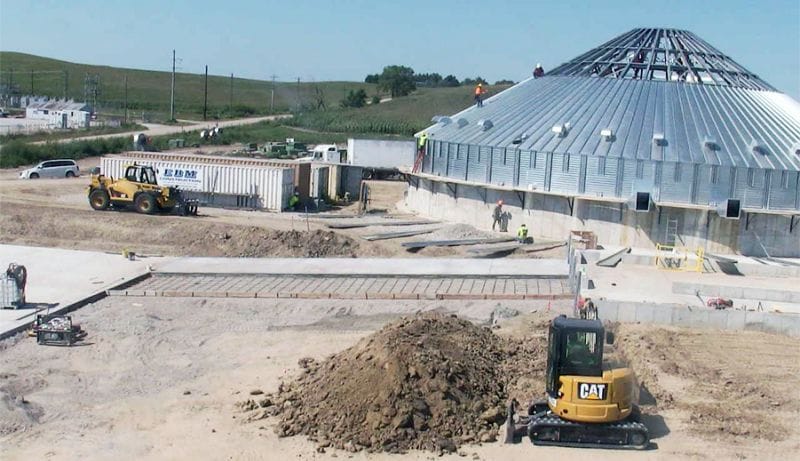
Whether you choose your own subcontractor for the erection phase or you want to install everything together with us, a Richi supervisor will be around to make sure everything is mounted in a safe and thorough way.

● Training
Staff Training
We provide comprehensive training for the technicians of each project. We can also continue to provide support for the technicians during latter project operation.
● After-sales
Project Follow-Up
When everything is up and running our Richiers will help you further whenever needed. We are ready to answer your call 24/7.We’ll also visit you regularly to learn about your needs.
Who we are
RICHI Machinery is one of the world’s leading suppliers of technology and services for the animal feed, aqua feed and pet food industries, also the largest pellet production line manufacturer in China.
Since 1995, RICHI’s vision to build a first-class enterprise, to foster first-class employees, and to make first-class contributions to society has never wavered.
In the past three decades, we have expanded our business to a wide range of areas, including animal feed mill equipment, aqua feed equipment, pet feed equipment, biomass pellet equipment, fertilizer equipment, cat litter equipment, municipal solid waste pellets equipment, etc.

1995
RICHI Established

2000+
Serving More Than 2000 Customers

120+
RICHI Employees

140+
Exported To 140 Countries