 0086-138 3838 9622
SRF Fuel Pellet Production Line Project in Turkey
RICHI MACHINERY
Project Overview
The SRF fuel pellet production line in Turkey is a large-scale industrial initiative designed to convert non-recyclable but combustible industrial residues into high-quality Solid Recovered Fuel (SRF) pellets. Built within an existing industrial facility with a total construction area of 6,055 m², the project establishes a single, fully automated production line with an annual output of 100,000 tons of SRF fuel pellets, corresponding to a designed capacity of 15 tons per hour.
The total investment for this project amounts to approximately USD 1.25 million, including equipment procurement, civil construction, electrical systems, and environmental protection measures. Out of this, around USD 65,000 is dedicated specifically to environmental protection systems such as dust collection, odor control, and waste management.
This fuel pellet plant project is a flagship example of how Turkey is gradually adopting advanced waste-to-fuel technologies to support its energy diversification goals, reduce dependency on imported coal, and minimize landfilling of industrial by-products.
15T/H
capacity
USD 1.25 million
investment
Turkey
location
Fuel
project type
RICHI MACHINERY
Project Background
The SRF Fuel Pellet Production Line in Turkey was initiated by a forward-looking industrial enterprise aiming to address both energy and waste management challenges in Turkey. The client, a medium-to-large-scale energy solutions company located in western Turkey, identified a growing market demand for high-calorific alternative fuels, particularly for industrial boilers, cement factories, and small power plants.
Turkey generates substantial volumes of non-recyclable but combustible industrial residues, including wood offcuts, shredded paper, plastic residues, and residual municipal solid waste. By transforming these materials into Solid Recovered Fuel (SRF) pellets, the project not only provides an environmentally responsible solution to industrial waste management but also contributes to Turkey’s energy diversification strategy, reducing reliance on imported coal and fossil fuels.
The decision to adopt a fully automated, large-scale production line with a designed capacity of 15 t/h was driven by:
- The need to handle 100,000 tons of feedstock per year efficiently.
- Compliance with national environmental standards.
- The desire to deliver uniform, high-quality SRF pellets suitable for industrial fuel applications.
This SRF fuel pellet production line in Turkey project aligns with Turkey’s waste-to-energy policy, offering economic, environmental, and social benefits while establishing a benchmark for similar initiatives in the region.
RICHI MACHINERY
Engineering Content and Scale
The SRF fuel pellet production line in Turkey project makes full use of an existing 6,055 m² industrial building that has been reinforced and upgraded for SRF production. The facility includes:
- Main Production Workshop (5,705 m², 12m height)
- 1# Raw Material Warehouse (1,300 m²) – storage of mixed textile residues and wood offcuts.
- 2# Raw Material Warehouse (990 m²) – primarily textile waste and auxiliary feedstocks.
- Sorting Zone (500 m²) – manual and semi-automated sorting of unsuitable materials (plastics, leather, cardboard).
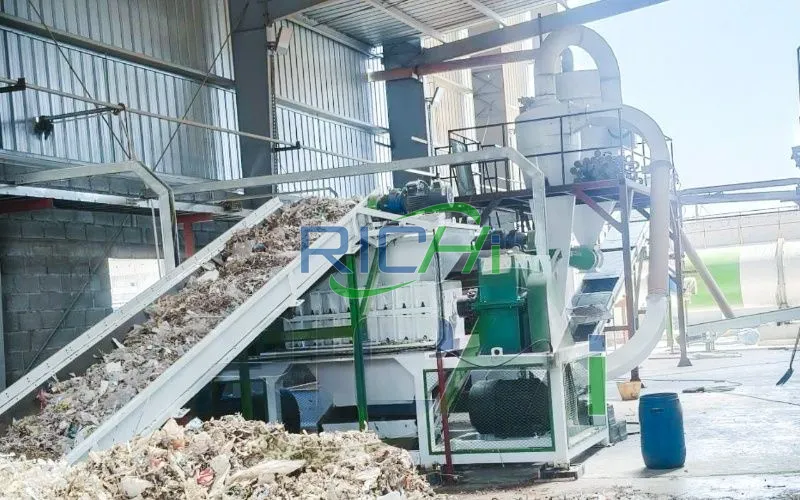
- Main Processing Hall (1,800 m²) – housing crushing, screening, mixing, and pelletizing systems.
- Finished Product Warehouse (400 m²) – for SRF pellets before dispatch.
- Supporting Facilities
- Office building (300 m²)
- Electrical supply system (connected to municipal grid, no backup generator)
- Internal water supply (municipal water, 916 tons/year usage)
- Internal drainage system with stormwater/industrial separation
- No separate dormitories or canteen—employees commute from nearby towns.
- Environmental Facilities
- Bag filter + alkaline scrubber system (capacity: 15,000 m³/h) for dust and odor removal.
- Spraying system with plant-based odor neutralizer.
- Solid waste storage rooms (general 216 m², hazardous 5 m²).
- Noise reduction and vibration isolation equipment.
The layout ensures fully indoor storage and processing, eliminating any outdoor dumping. Both raw materials and finished SRF pellets are stored in controlled indoor environments with maximum pile heights (raw material ≤3m, pellets ≤4.5m).
RICHI MACHINERY
Raw Materials
The SRF fuel pellet production line in Turkey project utilizes a carefully selected mix of industrial and municipal residues, chosen for their combustible properties and availability in Turkey. Material pre-treatment and moisture management are critical for achieving optimal pellet quality.
| Raw Material Type | Annual Supply (t/a) | Average Moisture Content | Source / Remarks |
|---|---|---|---|
| Wood Offcuts | 40,000 | 8–12% | Furniture factories and sawmills across western Turkey |
| Paper & Cardboard | 25,000 | 10–15% | Collected from municipal and industrial paper processing centers |
| Plastic Combustible Fractions | 15,000 | 5–10% | Pre-sorted plastics from recycling facilities |
| Mixed Industrial Waste | 20,000 | 15–20% | Residual sorted combustible waste from industrial parks |
Storage and Handling:
Raw materials are stored in covered, ventilated warehouses totaling 3,500 m², ensuring protection from moisture and contamination. Conveyors and automated feed systems maintain a continuous supply to the crushing and pelletizing units, supporting the line’s 15 t/h capacity.
RICHI MACHINERY
Main Equipment and Facilities
The SRF fuel pellet production line in Turkey is designed for fully automated operation, integrating high-efficiency equipment tailored to SRF pellet production. Key components include:
| No. | Equipment Name | Model/Specification | Quantity | Notes |
|---|---|---|---|---|
| 1 | Industrial Shredder | / | 2 | Reduces large, heterogeneous feedstock to manageable sizes |
| 2 | Multifunctional Crusher | / | 3 | Reduces shredded material to 3–8 mm, ensures consistent pellet feed |
| 3 | Fule Pellet Making Machine | MZLH | 5 | Produces 6–10 mm diameter SRF pellets |
| 4 | Steam Cooling Dust Removal Tower | / | 2 | Removes residual heat, cools and hardens pellets, captures dust |
| 5 | Closed Wind Cooling Hardening Dust Tower | / | 2 | Minimizes dust emissions and improves pellet durability |
| 6 | Automated Feeding Screw Conveyors | / | 10 | Uniformly feeds material into pelletizing machines |
| 7 | Bagging and Palletizing Unit | / | 4 | Automated packaging of finished SRF pellets |
Energy and Water Consumption:
| Resource | Annual Consumption | Remarks |
|---|---|---|
| Electricity | 4.2 million kWh | Supplied by regional grid |
| Water | 540 t/a | For dust suppression and minimal cooling purposes |
| Diesel | 50 t/a | Backup generators and material handling |
| Natural Gas | / | Not used in pelletizing process |
| Wastewater | 432 t/a | Domestic wastewater treated and reused for landscaping |
Environmental Control:
Approximately USD 65,000 of the total investment is allocated to dust collection, odor control, and waste management systems. Industrial dust is captured via bag filters and cyclones at crushing and pelletizing stages. Odor control units ensure minimal emissions, meeting Turkish environmental standards. Noise reduction measures include soundproof enclosures and vibration damping for major equipment.
RICHI MACHINERY
Production Process Flow
The SRF Fuel Pellet Production Line in Turkey follows a highly automated process flow, ensuring uniform pellet quality and minimal environmental impact.
Shredding
Large, heterogeneous industrial residues are first fed into the industrial shredders, reducing particle size to <50 mm. This stage addresses bulky waste handling and ensures smooth downstream processing. Noise generation is controlled through equipment enclosures.
Crushing
Shredded material is processed in multifunctional crushers to achieve a particle size of 3–8 mm, ideal for pelletization. Crushers are equipped with sealed inlets and outlets to minimize dust escape. Dust is captured by closed wind dust towers, and noise is mitigated with vibration-dampening mounts.
Pelletizing
Crushed material is transported via screw conveyors into pellet machine hoppers. Inside the SRF pellet machine, high pressure and friction between rollers and die generate heat (up to 120°C), softening fibers and sterilizing material. Uniform 6–10 mm SRF pellets are produced without external heat sources. Dust and noise are managed through integrated systems.
Cooling and Hardening
Pellets are transferred to steam cooling and hardening dust towers for 3–5 minutes, ensuring optimal hardness and temperature reduction. Residual dust and heat are extracted through strong suction ducts. Minimal emissions are reported.
Inspection and Packaging
Finished pellets are inspected for size, calorific value, and moisture content. Substandard pellets are recycled back into the line. Qualified pellets are automatically bagged and palletized, stored in 1,200 m² warehouse ready for dispatch.
RICHI MACHINERY
Labor and Operations
The facility operates two shifts per day, with 25 skilled operators managing automated equipment. Each shift runs 16 hours, totaling 4,800 operating hours per year, achieving the designed annual output of 100,000 tons. Staff are trained in:
- Equipment operation and preventive maintenance
- Safety protocols and emergency response
- Environmental compliance and quality control
Automation reduces manual handling and ensures consistent pellet quality.
RICHI MACHINERY
Market Prospects in Turkey
Turkey’s industrial sector and energy policy increasingly support waste-to-fuel solutions. The SRF pellet market is particularly promising due to:
- High demand from cement, ceramic, and power industries
- Government incentives for renewable and alternative fuels
- Substantial industrial waste availability in urban and industrial regions
With 100,000 tons of SRF pellets produced annually, this facility can supply multiple industrial clients, generating a stable revenue stream while reducing landfill disposal costs. Turkey’s ongoing energy diversification and waste management policies make SRF production an attractive long-term investment.
RICHI MACHINERY
Conclusion
The SRF Fuel Pellet Production Line in Turkey showcases the integration of industrial automation, advanced environmental controls, and sustainable waste management. The project not only converts non-recyclable industrial residues into high-quality SRF pellets but also contributes to Turkey’s energy independence and environmental sustainability.
- Key Advantages:
- High-efficiency automated production
- Compliance with Turkish environmental and safety standards
- Large annual production capacity of 100,000 tons
- Sustainable utilization of industrial waste
With RICHI Machinery’s turnkey solutions, this project exemplifies professional engineering design, high-quality equipment, and long-term operational support, establishing a benchmark for similar SRF fuel initiatives across Turkey and Europe.
● RICHI MACHINERY
RICHI Service

● Consulting
Customer Consultation
We want to have a deep understanding of your industrial process, to know your exact needs of feed, wood, biomass, fertilizer or other pellet processing.

● Design
Fuel Pellet Plant Design
Based on your unique situation and industrial process, we will tailor complete pellet plant you need, and inform you of every additional detail that could facilitate operation, minimize total cost.
● Manufacturing
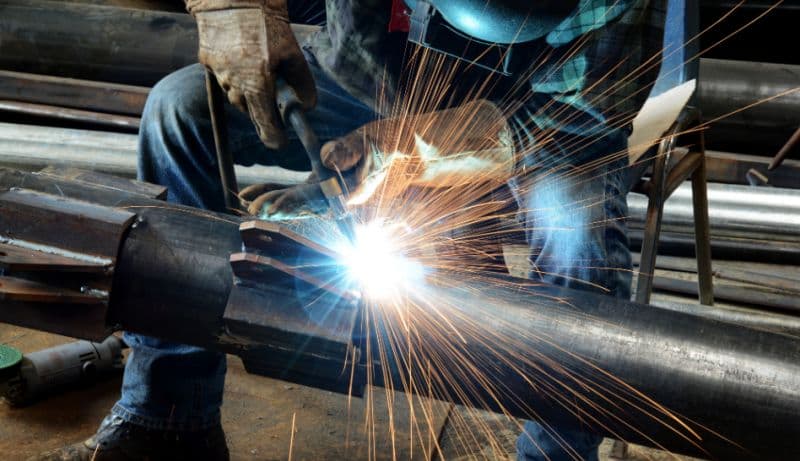
Equipment Manufacturing
The critical components of the of the complete pellet production line equipment are built in our own workshops in Asia. Additional equipment is manufactured by our worldwide network of reliable partners.
● Testing
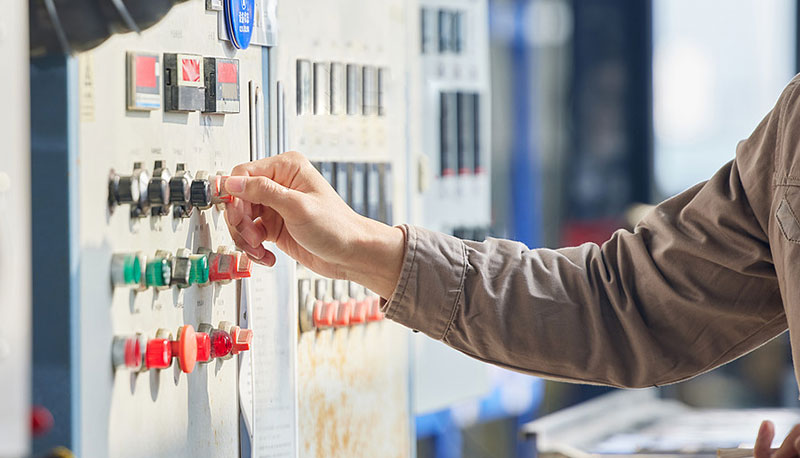
Quality Inspection & Testing
Before leaving the factory, all equipment will be inspected by the quality inspection department. We can also provide customers with testing services from a single machine to a complete pellet plant system, and provide you with real actual data for “worry-free use.”

● Delivery
Equipment Delivery
In equipment boxing and packaging, we adopt professional packaging and modular solutions to ensure the safe and non-destructive delivery of pellet plant equipment.
● Installation
Installation & Commissioning
Whether you choose your own subcontractor for the erection phase or you want to install everything together with us, a Richi supervisor will be around to make sure everything is mounted in a safe and thorough way.

● Training
Staff Training
We provide comprehensive training for the technicians of each project. We can also continue to provide support for the technicians during latter project operation.
● After-sales
Project Follow-Up
When everything is up and running our Richiers will help you further whenever needed. We are ready to answer your call 24/7.We’ll also visit you regularly to learn about your needs.
Who we are
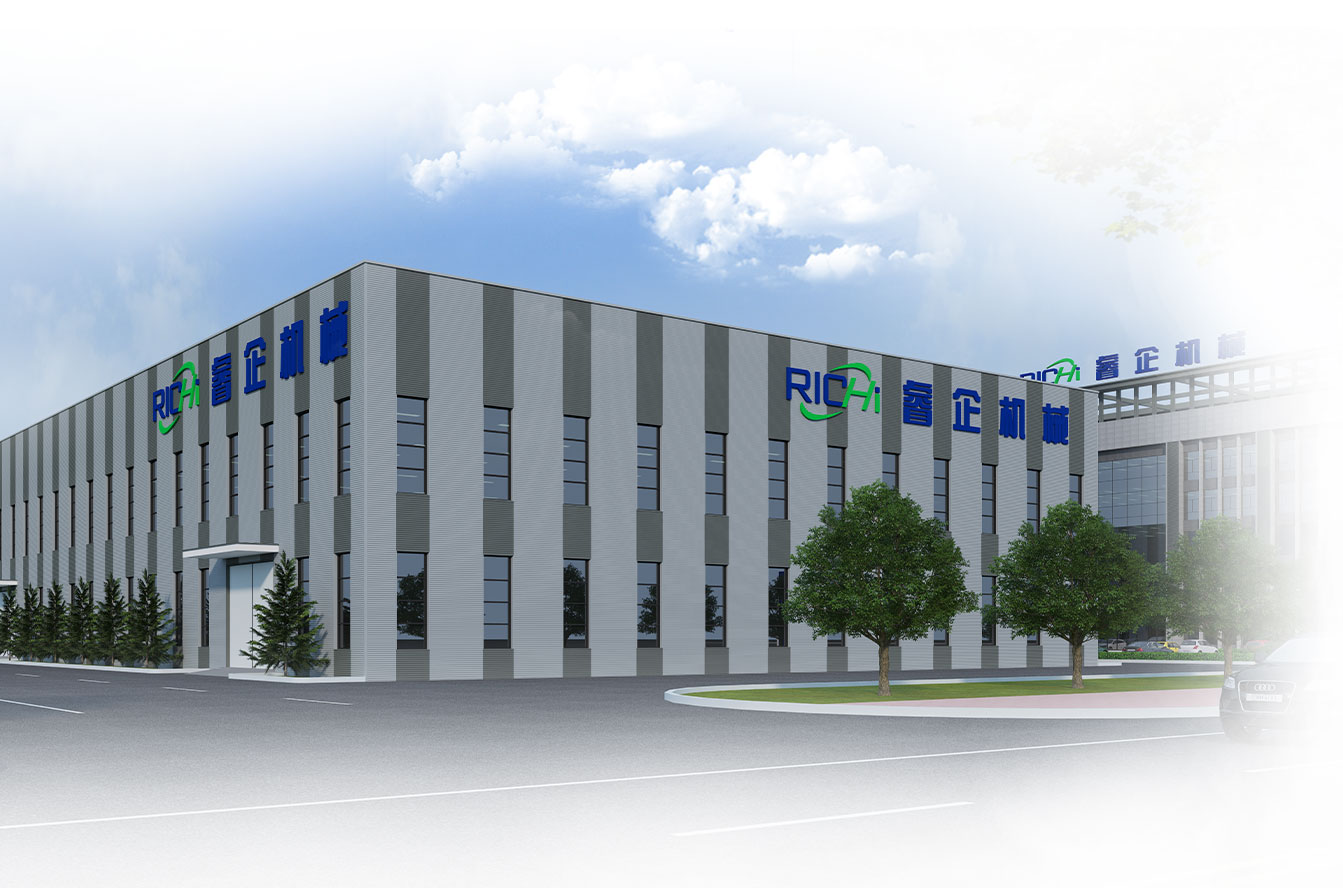
RICHI Machinery is one of the world’s leading suppliers of technology and services for the animal feed, aqua feed and pet food industries, also the largest pellet production line manufacturer in China.
Since 1995, RICHI’s vision to build a first-class enterprise, to foster first-class employees, and to make first-class contributions to society has never wavered.
In the past three decades, we have expanded our business to a wide range of areas, including animal feed mill equipment, aqua feed equipment, pet feed equipment, biomass pellet equipment, fertilizer equipment, cat litter equipment, municipal solid waste pellets equipment, etc.

1995
RICHI Established

2000+
Serving More Than 2000 Customers

120+
RICHI Employees

140+
Exported To 140 Countries