 0086-138 3838 9622
Wood Husk Crop Pellet Production Line in Greece
RICHI MACHINERY
Overview
This 4t/h wood husk crop pellet production line in Greece is designed to convert mixed agricultural and forestry residues into standardized fuel pellets. The plant runs 300 days per year, with 10 workers, using a compact but complete production setup including crushing, drying, pelletizing, and packaging.
Unlike some projects that rely on single raw materials, this pelletizing line handles a blended biomass structure—wood waste, crop residues, and husk materials. That changes everything, from drying design to pellet stability.
The client didn’t ask for “a pellet production line” at the beginning.
What they asked was:
“We have different materials every week. Can your system handle that without constant adjustments?”
That question shaped the whole design.
So this biomass pelletizing plant in Greece was built with:
- flexible feeding
- stable drying control
- dual pellet mills for load balancing
4T/H
capacity
$210,000
investment
Greece
location
Fuel
project type
RICHI MACHINERY
What this project looks like when you first walk into the plant
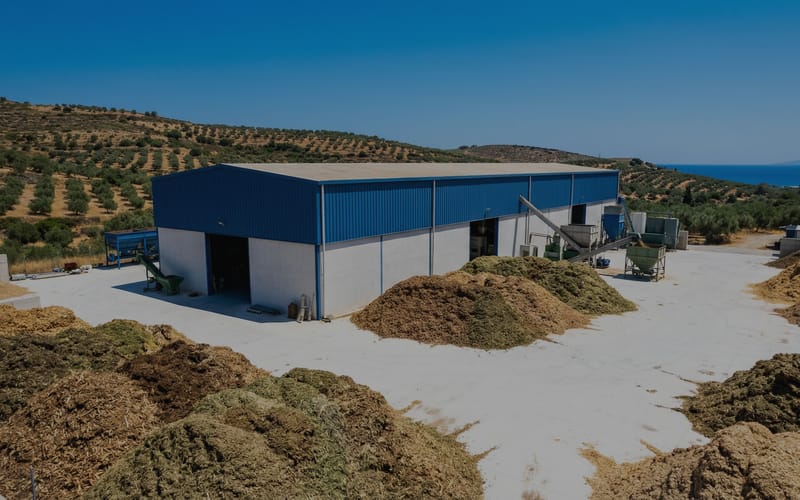
The first impression of this 4t/h wood husk crop pellet production line in Greece is not the machines—it’s the raw material yard.
Stacks of straw, rice husk, bark, and sawdust are piled in sections, not perfectly organized, but clearly planned. You can tell this is not a single-material plant. It’s built around flexibility.
This project delivers 20,000 tons per year of biomass pellets, running on a two-shift schedule. The client didn’t go for an oversized system. Instead, they chose a steady 4t/h biomass pellet plant in Greece that matches local feedstock supply and labor conditions.
RICHI MACHINERY
Project background
The biomass pellet project is located near Larissa, a region where agricultural residues are abundant.
The client operates a mid-sized biomass collection business:
- crop straw from nearby farms
- rice husk from milling facilities
- wood residues from small sawmills
Before this Wood Husk Crop Pellet Production Line in Greece project, most of these materials were either burned in the field or sold cheaply.
Initial inquiry came in January 2024.
Contract signed in April 2024.
The client’s goal was simple but practical:
- stabilize income from waste biomass
- reduce seasonal price fluctuations
- supply local heating fuel market
RICHI MACHINERY
Facility layout
The site is not large, but it’s well utilized.
| Section | Area | Function |
|---|---|---|
| Total land | 4400 m² | Entire plant |
| Production workshop | 2200 m² | Crushing, drying, pelletizing |
| Raw material yard | 2000 m² | Storage of mixed biomass |
| Office area | 200 m² | Administration |
One thing we adjusted early:
The raw material yard needed more separation zones. Mixed materials behave differently in drying.
RICHI MACHINERY
Raw materials
In Greece, biomass supply is seasonal and diverse. The client’s material mix looks like this:
| Material Type | Annual Volume (t) | Moisture Range | Source |
|---|---|---|---|
| Sawdust | 12,000 | 8–12% | Wood workshops |
| Crop straw | 8,000 | 15–25% | Local farms |
| Rice husk | 5,000 | 10–18% | Rice mills |
| Bark | 3,000 | 20–30% | Logging residues |
| Tobacco stems | 2,000 | 18–28% | Agricultural waste |
Total raw material handled annually exceeds 30,000 tons.
Some batches came in wetter than expected. First week of commissioning, we had to slow down the biomass dryer slightly—otherwise pellets cracked.
RICHI MACHINERY
Main equipment configuration
The client already understood basic pellet production, so we focused on reliability rather than over-configuration.
Crushing section
| Equipment | Quantity |
|---|---|
| Feeding inlet | 1 |
| Multifunction crusher | 1 |
| Airlock | 1 |
| Fan | 1 |
| Bag filter | 1 |
Drying section
| Equipment | Quantity |
|---|---|
| Biomass hot air furnace | 1 |
| Belt conveyor | 1 |
| Airlock feeder | 1 |
| Rotary dryer | 1 |
| Discharge airlock | 1 |
| Fan | 1 |
| Wet scrubber (water film dust collector) | 1 |
| Conveyor | 1 |
| Raw material bin | 1 |
The decision to use a biomass furnace instead of fossil fuel saved long-term cost. The client burns low-grade residues for heat.
Pelletizing section
| Equipment | Quantity |
|---|---|
| Feeder | 1 |
| Ring die biomass pellet mills | 2 |
| Bag filter | 1 |
| Fan | 1 |
| Conveyor | 1 |
| Airlock | 1 |
The two biomass granulators give flexibility. If one stops, production doesn’t drop to zero.
Cooling & packaging
| Equipment | Quantity |
|---|---|
| Cooler & screener combo | 1 |
| Vibrating unit | 1 |
| Cyclone separator | 1 |
| Bag filter | 1 |
| Conveyor | 1 |
| Finished product bin | 1 |
| Packing machine | 1 |
RICHI MACHINERY
Process flow
The 4t/h wood husk crop pellet production line in Greece runs through these steps:
- Chipping / Pre-sizing
Larger materials reduced before crushing. - Crushing
Mixed biomass processed into uniform particles.
Dust generated—handled by bag filters. - Drying
- Biomass furnace provides heat
- Moisture reduced to ~10–12%
- Mixing (natural blending)
No separate mixer—blending happens during conveying. - Pelletizing
- Double ring die biomass pellet press system
- One-step compression
- No carbonization
- Cooling
Fresh pellets are hot and soft. Cooling stabilizes them. - Screening & packaging
Fine powder recycled.
RICHI MACHINERY
Environmental measures
The client needed compliance with local environmental inspections.
- Dust control:
- Bag filters across key points
- Water film dust collector in drying
- Wastewater:
- Small sedimentation tank (5 m³)
- Septic tank (10 m³)
- Solid waste:
- Reused internally where possible
- Noise:
- Equipment isolation + structural damping
RICHI MACHINERY
Utilities
| Item | Source |
|---|---|
| Electricity | Local grid |
| Water | Municipal supply |
RICHI MACHINERY
Investment and cost control
The client was cautious about investment.
- Equipment cost: ~$210,000
- Total project cost: ~$380,000
Given EU labor costs, this is considered moderate for a 4t/h biomass pellet plant in Greece.
RICHI MACHINERY
Logistics
All equipment was shipped from Qingdao Port to Port of Piraeus.
Delivery took about 32 days.
RICHI MACHINERY
What actually happened during commissioning
Not everything went perfectly.
- First batch: moisture uneven
- Second batch: pellet density too low
- Third batch: stable output
After adjusting feed rate and drying temperature, the line stabilized.
That’s pretty typical for mixed biomass projects.
RICHI MACHINERY
A few things the client cared about
- Can different materials be used together? → Yes, but moisture must be controlled
- Is drying always necessary? → For mixed biomass, almost always
- How many operators are needed? → Around 10 is enough
RICHI MACHINERY
Market situation in Greece
Pellet demand in Greece is steady, especially in:
- residential heating
- small industrial boilers
Local supply is still not fully stable, especially for blended biomass pellets.
That creates space for plants like this.
This 4t/h wood husk crop pellet production line in Greece works not because it is large, but because it matches:
- local raw materials
- realistic labor
- manageable investment
If you’re planning something similar, the first thing to figure out isn’t the machine—it’s your raw material consistency. Everything else follows from that.
● RICHI MACHINERY
RICHI Service

● Consulting
Customer Consultation
We want to have a deep understanding of your industrial process, to know your exact needs of feed, wood, biomass, fertilizer or other pellet processing.

● Design
biomass Pellet Plant Design
Based on your unique situation and industrial process, we will tailor complete pellet plant you need, and inform you of every additional detail that could facilitate operation, minimize total cost.
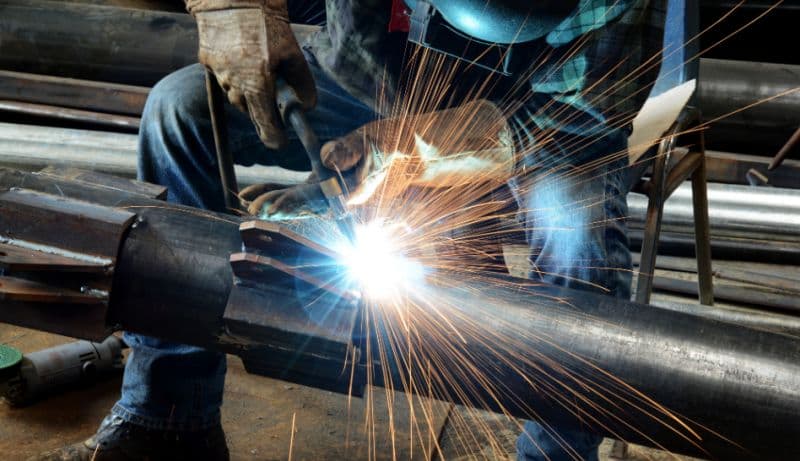
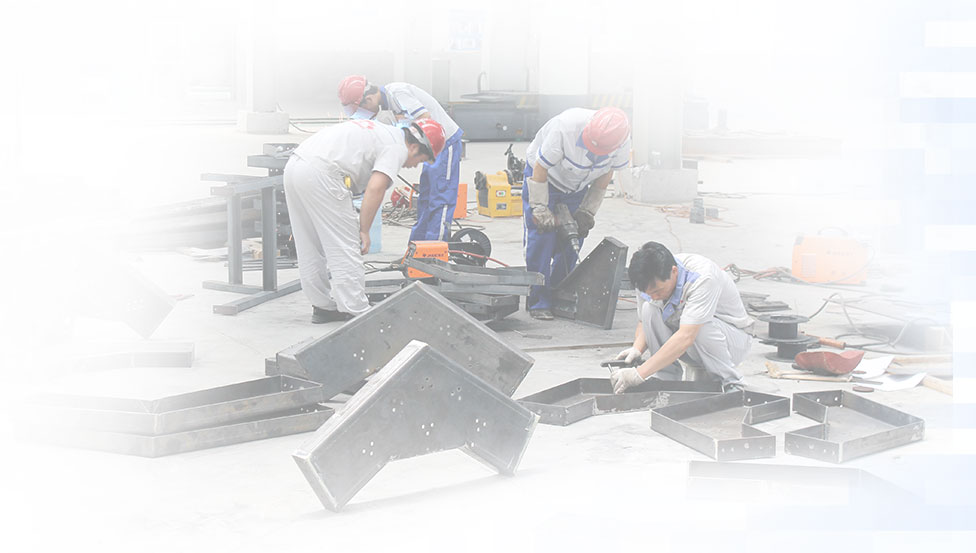
● Manufacturing
Equipment Manufacturing
The critical components of the of the complete pellet production line equipment are built in our own workshops in Asia. Additional equipment is manufactured by our worldwide network of reliable partners.
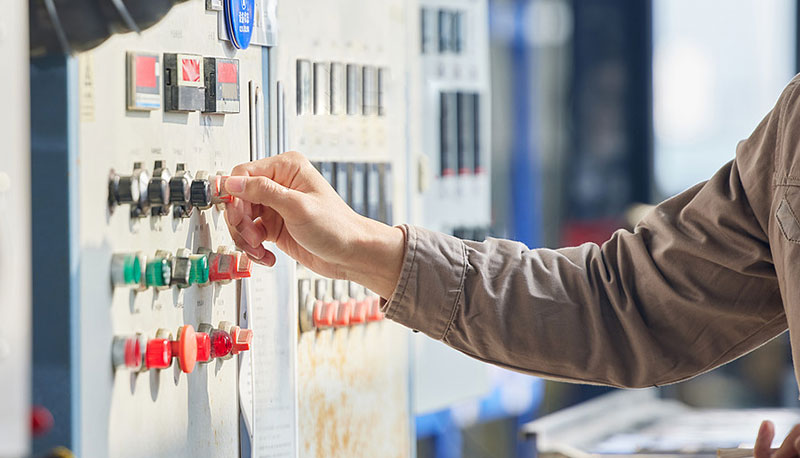
● Testing
Quality Inspection & Testing
Before leaving the factory, all equipment will be inspected by the quality inspection department. We can also provide customers with testing services from a single machine to a complete pellet plant system, and provide you with real actual data for “worry-free use.”

● Delivery
Equipment Delivery
In equipment boxing and packaging, we adopt professional packaging and modular solutions to ensure the safe and non-destructive delivery of pellet plant equipment.
● Installation
Installation & Commissioning
Whether you choose your own subcontractor for the erection phase or you want to install everything together with us, a Richi supervisor will be around to make sure everything is mounted in a safe and thorough way.

● Training
Staff Training
We provide comprehensive training for the technicians of each project. We can also continue to provide support for the technicians during latter project operation.
● After-sales
Project Follow-Up
When everything is up and running our Richiers will help you further whenever needed. We are ready to answer your call 24/7.We’ll also visit you regularly to learn about your needs.
Who we are
RICHI Machinery is one of the world’s leading suppliers of technology and services for the animal feed, aqua feed and pet food industries, also the largest pellet production line manufacturer in China.
Since 1995, RICHI’s vision to build a first-class enterprise, to foster first-class employees, and to make first-class contributions to society has never wavered.
In the past three decades, we have expanded our business to a wide range of areas, including animal feed mill equipment, aqua feed equipment, pet feed equipment, biomass pellet equipment, fertilizer equipment, cat litter equipment, municipal solid waste pellets equipment, etc.

1995
RICHI Established

2000+
Serving More Than 2000 Customers

120+
RICHI Employees

140+
Exported To 140 Countries