 0086-138 3838 9622
Waste Wood Pellet Processing Factory in Turkey
RICHI MACHINERY
Overview
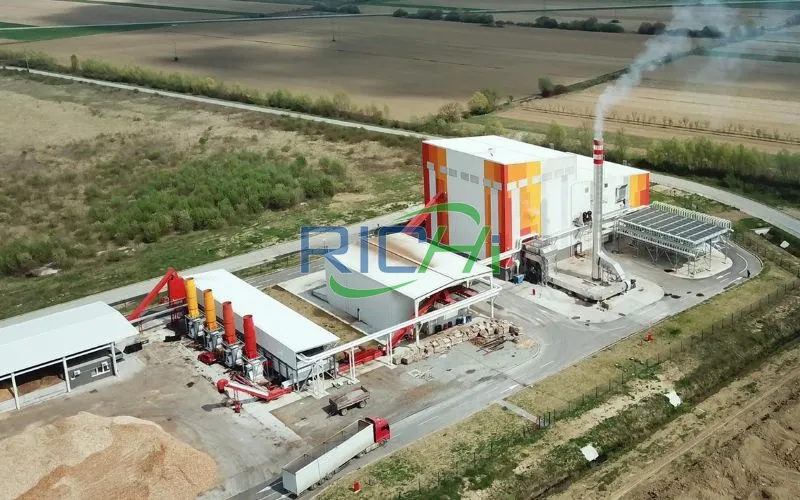
The establishment of a 9~12t/h waste wood pellet processing factory in Turkey marks a significant step in the country’s ongoing transition toward renewable energy and sustainable waste management. Situated in an industrial area near İzmit, Kocaeli Province, the project utilizes Turkey’s abundant forestry residues and wood processing by-products to produce high-quality biomass pellets. The plant is designed with a total annual output of 65,000 tons of pellets, which are cylindrical in shape, with a diameter of 8–10 mm, a lower heating value ≥16.9 MJ/kg, and ash content ≤6%.
The production line operates continuously with a three-shift system, each shift lasting 8 hours, and 300 working days per year. The factory covers a total area of 3,210 m², divided into raw material storage (870 m²), processing area (1,100 m²), and finished product storage (1,200 m²). Supporting facilities such as an office (40 m²), a 10 m² power distribution room, and environmental management facilities are also integrated.
This 9~12t/h waste wood pellet processing factory in Turkey is not only an industrial investment but also an environmental project, converting waste wood, sawdust, and tree stumps into clean energy fuel. The project reduces open burning of waste wood, cuts down on carbon emissions, and provides a sustainable alternative to coal and natural gas in Turkey’s domestic heating and industrial sectors.
9-12T/H
capacity
$760,000
investment
Turkey
location
Biofuel
project type
RICHI MACHINERY
Project Background
Turkey is a country with a strong woodworking and furniture industry, especially concentrated in Marmara and Aegean regions. Each year, thousands of tons of sawdust, offcuts, and old wooden materials are generated from sawmills, panel factories, and construction activities. Much of this material is either landfilled or openly burned, causing environmental problems.
The client in this case is a mid-sized renewable energy entrepreneur who previously operated a timber trading business. Faced with rising waste disposal costs and increasing demand for biomass fuel in Turkey and neighboring EU countries, the client decided to invest in a pellet production facility.
The main drivers for the 9~12t/h waste wood pellet processing factory in Turkey project include:
- Rising energy costs: Natural gas and coal imports are expensive for Turkey, while locally sourced biomass offers a cost-competitive solution.
- EU export opportunities: Turkey’s proximity to Europe allows pellet exports to Italy, Greece, and other countries where biomass heating is popular.
- Government incentives: Turkey has been promoting renewable energy projects, offering certain tax benefits and favorable loan terms for clean energy investments.
- Sustainability goals: The client wanted to diversify their business, reduce waste, and align with global sustainability trends.
With a design capacity of 9~12t/h, this factory is capable of balancing domestic supply and export demand, positioning itself as a reliable pellet producer in the region.
RICHI MACHINERY
Construction Content and Layout
The construction area totals 3,210 m², with clear functional zoning to ensure smooth production flow:
- Raw Material Storage Zone (870 m²): Stores sawdust, waste wood, and stumps with a maximum holding capacity of 1,886 tons.
- Processing Area (1,100 m²): Hosts crushing, grinding, drying, pelletizing, and packaging processes.
- Finished Product Warehouse (1,200 m²): Dedicated to cooling, bagging, and palletizing pellets for storage and shipment.
- Auxiliary Facilities: Includes a 40 m² office and a 10 m² power distribution room.
- Environmental Facilities: A cyclone and baghouse dust removal system with a 15 m chimney, wastewater treatment via septic and storage tanks, and noise and waste management solutions.
The entire production flow moves west to east, ensuring efficient logistics: raw materials enter from the west, are processed in the central workshop, and finished pellets are stored and dispatched from the east.
RICHI MACHINERY
Product Scheme
The 9~12t/h waste wood pellet processing factory in Turkey produces biomass pellets with the following specifications:
| Parameter | Value | Standard Reference |
|---|---|---|
| Diameter | 8–10 mm | NY/T 2909-2016 |
| Lower heating value | ≥16.9 MJ/kg | NY/T 1878-2010 |
| Ash content | ≤6% | – |
| Sulfur content | 0.06% | – |
| Fixed carbon | 14.41% | – |
| Volatile matter | 80.33% | – |
| Moisture content | ≤13% | – |
Annual output: 65,000 tons, which matches the designed processing capacity when considering equipment utilization and working hours.
RICHI MACHINERY
Raw Materials and Resource Consumption
Turkey’s forestry industry provides a consistent supply of sawdust and offcuts, while construction activities generate substantial waste wood.
Raw Materials
| Raw Material | Annual Use (t) | Storage (t) | Source | Storage Zone |
|---|---|---|---|---|
| Sawdust | 75,000 | 1,000 | Sawmills | Raw material area |
| Waste wood | 33,145.8 | 552 | Panel factories, construction sites | Raw material area |
| Tree stumps | 20,000 | 334 | Wood processing factories | Raw material area |
Utilities
- Water: 150 m³/year, mainly for domestic use.
- Electricity: 900,000 kWh/year, supplied by the local power grid.
The factory’s raw material area capacity (870 m²) allows for 1,500 m³ of storage, which is sufficient for operational needs.
RICHI MACHINERY
Major Equipment
The wood pellet production line is designed for reliability and efficiency, incorporating both crushing and drying systems before pelletizing.
| Equipment | Model | Capacity | Quantity |
|---|---|---|---|
| Wood Chipper Machine | YMPJ216 | 10 t/h | 1 |
| Wood Pellet Hammer Mill | YGFS120×75 | 5 t/h | 2 |
| Wood Chip Dryer | LMHG3.0-10 | 5 t/h | 2 |
| Wood Pellet Mill | MZLH420 | 1.5–2 t/h | 6 |
| Baler | YBZJ50 | 9 t/h | 1 |
| Wheel Loader | – | – | 2 |
| Forklift | – | – | 2 |
With this setup, the waste wood pellet processing factory in Turkey operates at a throughput of 9–12 t/h, which equals 64,800–86,400 tons annually. Considering downtime and utilization, the effective capacity of 65,000 tons/year is realistic and achievable.
RICHI MACHINERY
Process Flow
The production process of the 9~12t/h waste wood pellet processing factory in Turkey includes:
- Crushing: Large waste wood and stumps are broken down to smaller sizes. Dust and noise are generated here.
- Grinding: Sawdust and crushed wood are milled into <6 mm powder, suitable for pelletizing. Dust and noise are also produced.
- Drying: Moisture content is reduced to below 13% using electric-powered dryers. Steam emissions occur.
- Pelletizing: Material is pressed under high temperature and pressure through ring dies, forming dense pellets. Dust and heat emissions occur.
- Cooling and Packaging: Pellets are naturally cooled, then bagged and stored.
This closed-loop process ensures consistent pellet quality while minimizing environmental impact.
RICHI MACHINERY
Labor and Work System
The wood pellet factory employs 18 workers, covering production, maintenance, packaging, logistics, and administration.
- Work Shifts: 3 shifts/day, 8 hours each.
- Working Days: 300 days/year.
- Accommodation & Canteen: Not provided on site, workers commute from nearby towns.
RICHI MACHINERY
Environmental Measures
The wood pellet plant construction project integrates several systems to meet Turkey’s environmental regulations:
- Dust Control: Cyclone separator + baghouse filter, with emissions released through a 15 m chimney.
- Wastewater: Domestic sewage is treated and reused for green belt irrigation. No industrial wastewater is generated.
- Noise: Equipment foundations are vibration-dampened, and acoustic barriers are installed where necessary.
- Solid Waste: General solid waste is temporarily stored in a 15 m² room; hazardous waste is stored in an 8 m² sealed room for specialized disposal.
RICHI MACHINERY
Market Outlook in Turkey
Biomass energy in Turkey is expanding due to:
- Heating Demand: Many rural households still use solid fuels; pellets are a cleaner, higher-efficiency alternative.
- Industrial Use: Brick kilns, textile factories, and greenhouses are increasingly adopting biomass.
- Export Potential: Turkey is geographically well-placed to supply Southern Europe, where pellet demand is surging.
Pellet prices in Turkey range between USD 120–150/ton, depending on quality and delivery. At an annual output of 65,000 tons, the factory can generate USD 8–9 million in annual revenue, with strong profitability.
RICHI MACHINERY
Conclusion and RICHI’s Role
The 9~12t/h waste wood pellet processing factory in Turkey demonstrates how waste-to-energy projects can create economic, environmental, and social value. By converting sawdust, waste wood, and stumps into renewable pellets, the client is turning local challenges into business opportunities.
RICHI Machinery provided comprehensive support: from process design, equipment selection, layout planning, to installation and training. The client valued RICHI’s ability to deliver a turnkey solution tailored to Turkey’s raw material characteristics and market needs.
With rising pellet demand in Turkey and Europe, this project positions the client as a pioneer in the region’s biomass sector. RICHI’s advanced technology and service capabilities ensure the plant’s long-term stability and competitiveness.
● RICHI MACHINERY
RICHI Service

● Consulting
Customer Consultation
We want to have a deep understanding of your industrial process, to know your exact needs of feed, wood, biomass, fertilizer or other pellet processing.

● Design
biomass Pellet Plant Design
Based on your unique situation and industrial process, we will tailor complete pellet plant you need, and inform you of every additional detail that could facilitate operation, minimize total cost.

● Manufacturing
Equipment Manufacturing
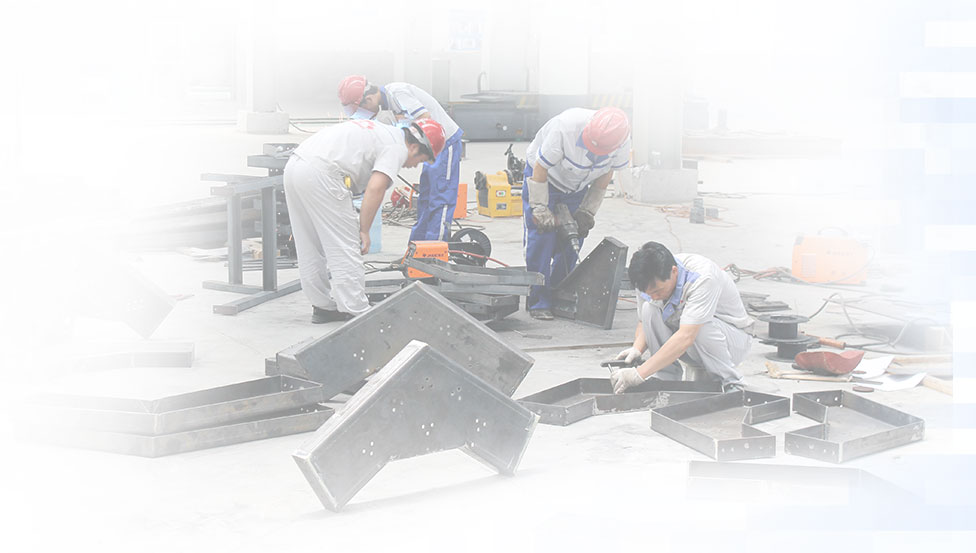
The critical components of the of the complete pellet production line equipment are built in our own workshops in Asia. Additional equipment is manufactured by our worldwide network of reliable partners.

● Testing
Quality Inspection & Testing
Before leaving the factory, all equipment will be inspected by the quality inspection department. We can also provide customers with testing services from a single machine to a complete pellet plant system, and provide you with real actual data for “worry-free use.”

● Delivery
Equipment Delivery
In equipment boxing and packaging, we adopt professional packaging and modular solutions to ensure the safe and non-destructive delivery of pellet plant equipment.
● Installation
Installation & Commissioning
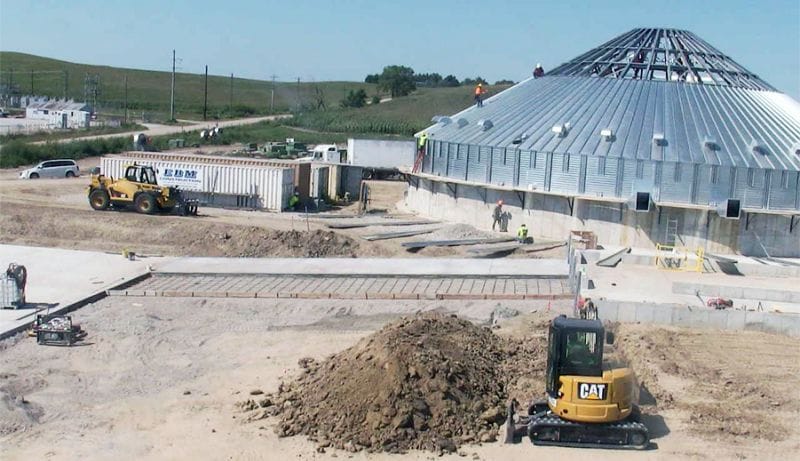
Whether you choose your own subcontractor for the erection phase or you want to install everything together with us, a Richi supervisor will be around to make sure everything is mounted in a safe and thorough way.

● Training
Staff Training
We provide comprehensive training for the technicians of each project. We can also continue to provide support for the technicians during latter project operation.
● After-sales
Project Follow-Up
When everything is up and running our Richiers will help you further whenever needed. We are ready to answer your call 24/7.We’ll also visit you regularly to learn about your needs.
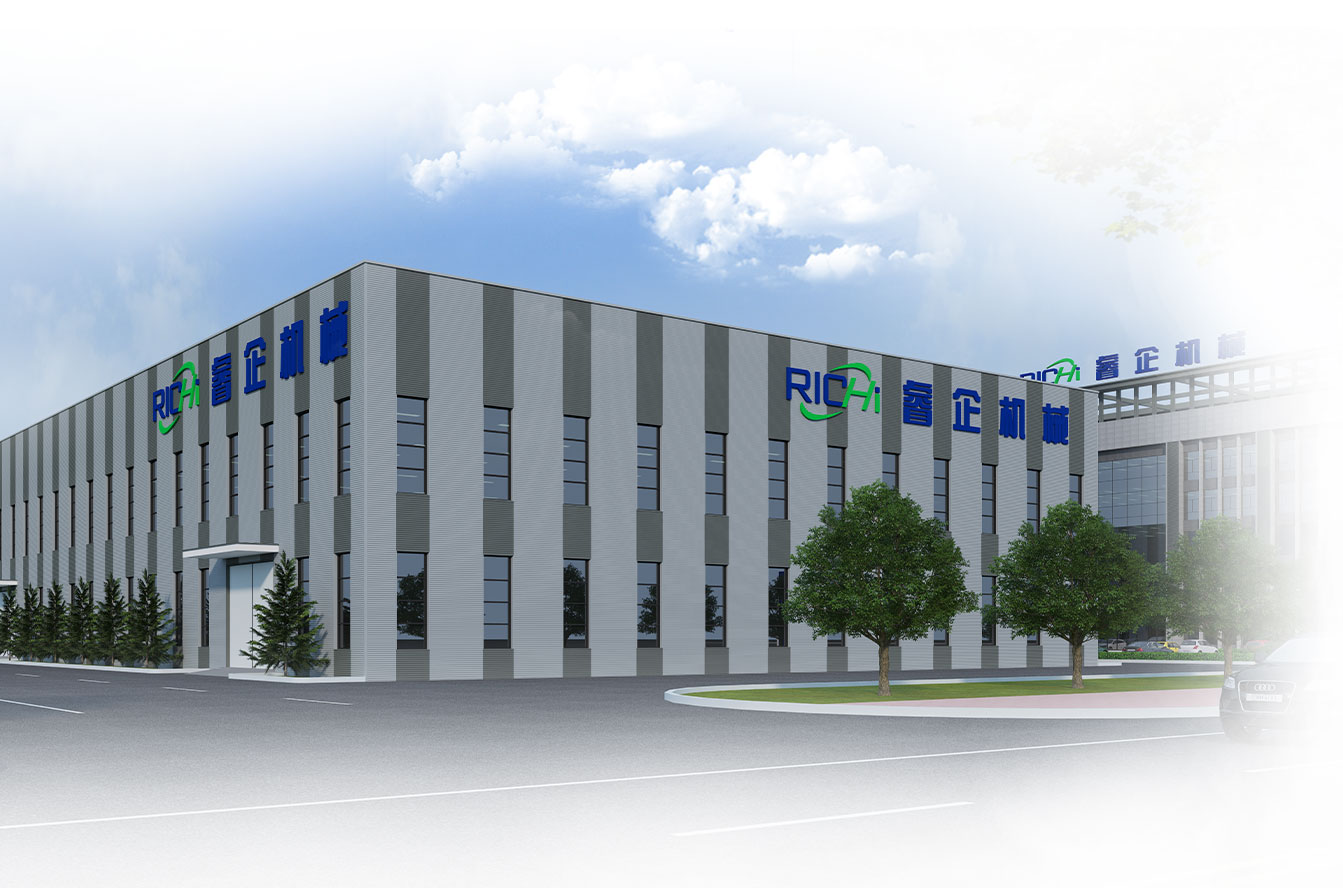
Who we are
RICHI Machinery is one of the world’s leading suppliers of technology and services for the animal feed, aqua feed and pet food industries, also the largest pellet production line manufacturer in China.
Since 1995, RICHI’s vision to build a first-class enterprise, to foster first-class employees, and to make first-class contributions to society has never wavered.
In the past three decades, we have expanded our business to a wide range of areas, including animal feed mill equipment, aqua feed equipment, pet feed equipment, biomass pellet equipment, fertilizer equipment, cat litter equipment, municipal solid waste pellets equipment, etc.

1995
RICHI Established

2000+
Serving More Than 2000 Customers

120+
RICHI Employees

140+
Exported To 140 Countries