
 0086-138 3838 9622
Cat Food Manufacturing Plant


A cat food manufacturing plant cannot be treated as a dog food line fitted with a smaller die. Commercial dry cat food places its own demands on ingredient preparation, micro-dosing, extrusion, kibble uniformity, fat application and palatant coating. That matters whether the buyer is an established pet food manufacturer adding new formulas, a dog food producer expanding into cat food, a conventional feed company entering the pet sector, a private-label manufacturer, or a brand building its first cat food factory.
RICHI develops complete plants for dry extruded cat food, from compact commercial systems to automated cat food processing plants. A project can be built as a dedicated cat kibble production line or designed to manufacture both cat and dog food where the business requires it. We match grinding, batching, mixing, extrusion, drying, coating, cooling and packing to the customer’s raw materials, formulas, kibble specifications and workshop conditions, supported by project experience across different countries and production scales.
The goal is not simply to supply machines, but to give the manufacturer a dry cat food production line that can handle today’s products and leave room for future recipe and capacity changes.
Discuss Your Cat Food Factory
Dry Cat Food Formula Systems We Can Process
A cat food manufacturing plant should be designed around more than tonnage. Animal-protein source, fat level, starch system, kibble size and coating requirement all affect grinding, extrusion, drying and finished-product handling. RICHI can manufacture dry cat kibble in different shapes and typically within a 2–10 mm size range, with the die and process settings matched to the actual formula and target cat food product.

Poultry-Based Cat Kibble
Chicken, poultry meal and turkey ingredients are widely used in commercial dry cat food. Small 2–4 mm kibble can be produced for products requiring easier intake, while 4–8 mm products suit many standard adult-cat ranges. Grinding, extrusion and fat or palatant coating are adjusted to the protein and starch combination rather than using one fixed recipe setting.
Typical Kibble Size: 2–8mm

Fish & Marine-Protein Cat Food
Fish meal, salmon ingredients and marine oils are common in fish-based cat kibble. These formulas can be made as small round, triangular, fish-shaped or other extruded pieces, while oil handling and post-extrusion coating require particular attention when the recipe contains higher levels of marine-derived fats.
Typical Kibble Size: 2–8mm

Meat-Based Cat Food
Beef, lamb and other mammalian protein ingredients can be processed into standard or larger dry cat kibble. Protein composition, fat level and starch availability affect expansion and density, so extrusion parameters and drying conditions are matched to the recipe and required 3–10 mm finished product rather than simply changing the die.
Typical Kibble Size: 3–10mm

Multi-Protein Premium Cat Food
Commercial formulas may combine poultry, fish, meat or egg-derived proteins in one product. These products often require greater recipe flexibility, especially when a cat food factory runs several shapes, densities or coating levels. Twin-screw extrusion is particularly useful when ingredient combinations and product specifications change frequently.
Typical Kibble Size: 2–8mm
Cat Food Premix
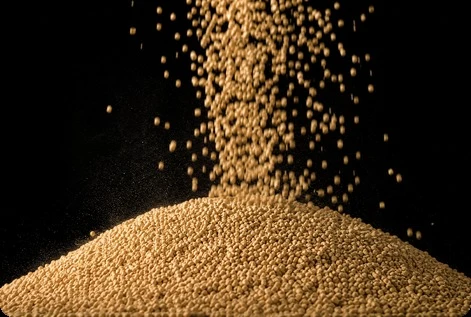
Vitamin, mineral, amino-acid and other micro-ingredient premixes follow a separate dosing, mixing and packing route rather than extrusion. A cat food manufacturing plant can include this section for in-house premix preparation, with accurate micro-dosing particularly important for low-inclusion ingredients such as taurine, vitamins and trace minerals.
Typical Product Form: Fine Powder, Not Kibble
Kibble diameter is only one part of product design. RICHI can also change die shape, cutting length, expansion, bulk density and surface coating so the same dry cat food production line can manufacture several commercial products instead of being locked into one kibble specification.
Tell Us Your Cat Food Specification
Cat Food Manufacturing Plant Videos
These videos show how RICHI adapts a cat food manufacturing plant to different production goals. Some customers focus on dry cat and dog kibble, while others combine cat food extrusion with aquatic feed or conventional livestock-feed processing. The common point is that each system is designed around the actual product mix rather than forcing every buyer into one standard cat food production line.


【Video 1 — 5 T/H Dry Cat & Dog Food Plant in Russia】This 5 T/H project is dedicated to commercial dry cat and dog food production. It represents a larger cat food processing plant where stable kibble quality, recipe changes and continuous production matter more than simply increasing extruder output.

【Video 2 — 1 T/H Cat Dog & Aquatic Feed Line in Iran】This 1 T/H combined extrusion project produces dry cat food, dog food and aquatic feed. It shows how one flexible cat kibble production line can share upstream preparation while switching downstream settings for products with different size, density and extrusion requirements.
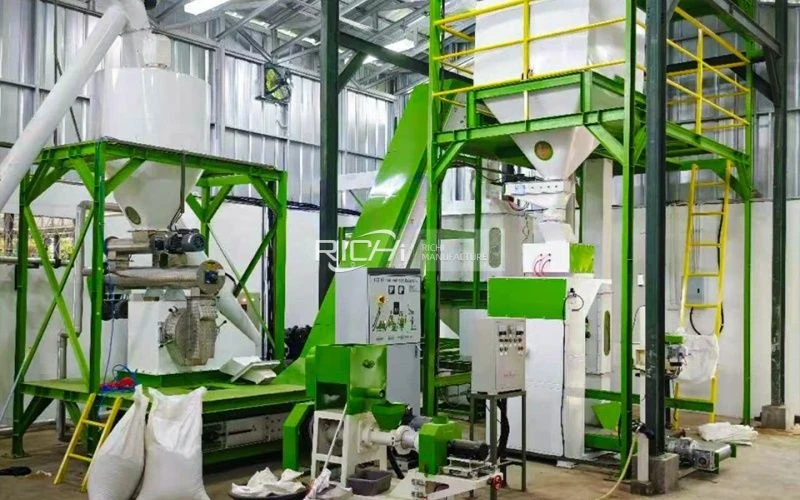
【Video 3 —500 KG/H Pet Food + 1 T/H Livestock Feed Plant in Indonesia】The Indonesia project combines a 500 kg/h dry pet food section with a 1 T/H livestock-feed section. For a feed manufacturer entering cat food production, this layout creates a second product category without abandoning the company’s existing animal-feed business.

【Video 3 —2 T/H Dry Cat & Dog Food Plant in Belarus】This 2 T/H project focuses on dry cat and dog kibble rather than a broad multi-feed portfolio. It is a practical commercial-scale solution for manufacturers that need more output than a starter line but do not yet require a large industrial dry pet feed mill plant.

【Video 3 —400 KG/H Cat Dog Fish & Poultry Feed Line in Bangladesh】This compact project combines dry cat food, dog food, extruded fish feed and poultry feed. The value of the design is flexibility: a smaller factory can serve several feed markets while using separate extrusion and pelleting routes for products that require different forming processes.
Custom Dry Cat Food Manufacturing Process Design
A cat food manufacturing plant should be designed from the finished kibble backward. Ingredient structure, grinding fineness, micro-ingredient accuracy, target kibble size, extrusion method, fat level, palatant application, final moisture and available workshop space all influence the process. For dry cat food, smaller and more uniform kibble, accurate premix dosing and stable post-extrusion coating often deserve more attention than in a generic feed plant. RICHI develops the cat food manufacturing process around these real production requirements instead of supplying one fixed layout.
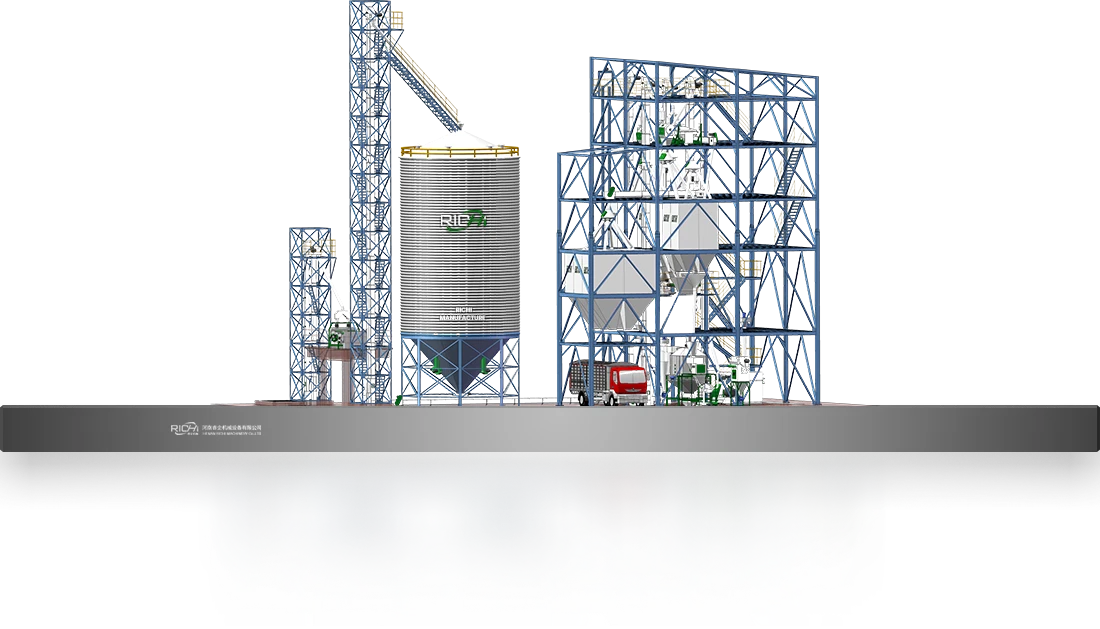
A complete cat food processing system can include raw-material receiving and storage, cleaning, grinding or fine grinding, batching and micro-dosing, mixing and liquid addition, conditioning, extrusion, drying, coating, cooling, screening, conveying and packing. Silos, automatic batching, vacuum coating, bulk storage and centralized controls can be added according to the project scale. For customers producing both cat and dog food, or combining pet food with other feed products, suitable upstream systems can also be shared while keeping the product-specific forming and finishing sections separate.
From initial cat food plant design and equipment selection to manufacturing, installation, commissioning and operator training, RICHI configures the dry cat food production line around the customer’s actual formulas, factory dimensions and investment plan.
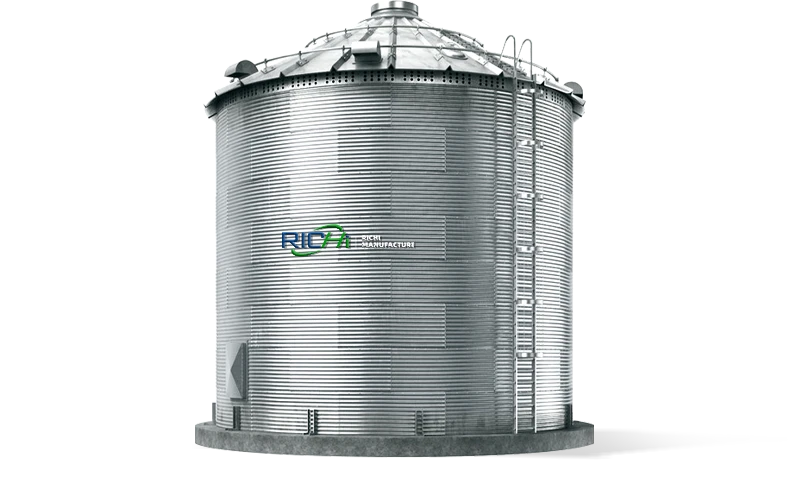
Silo system
01
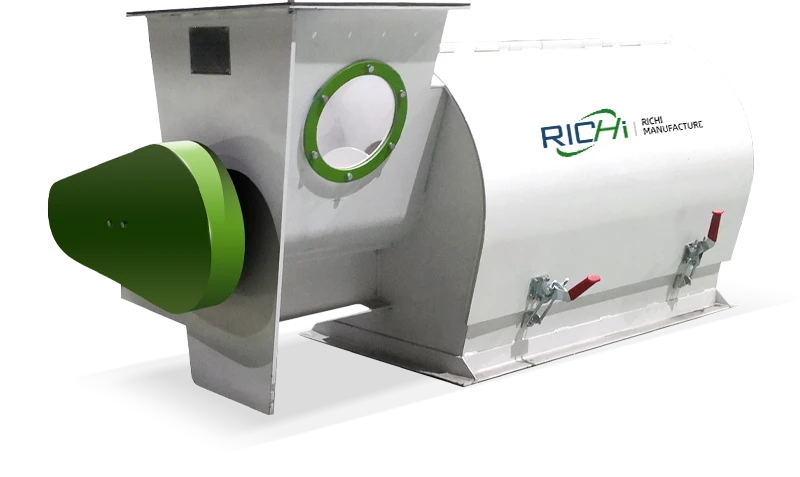
Cleaning system
02
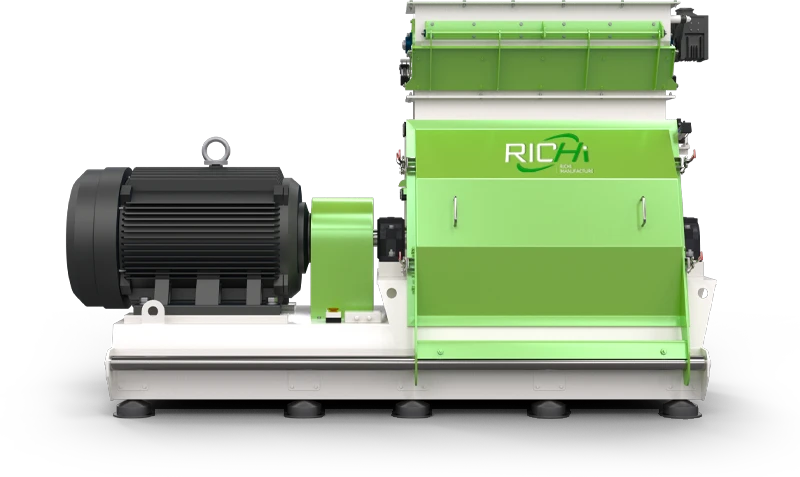
Grinding system
03
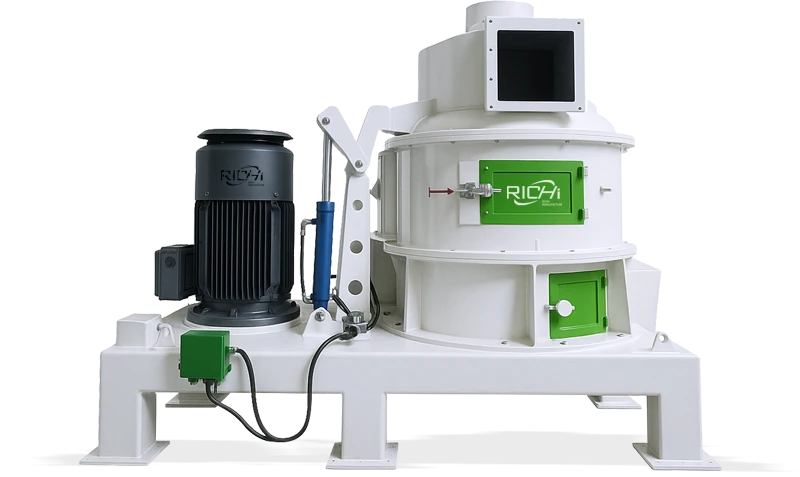
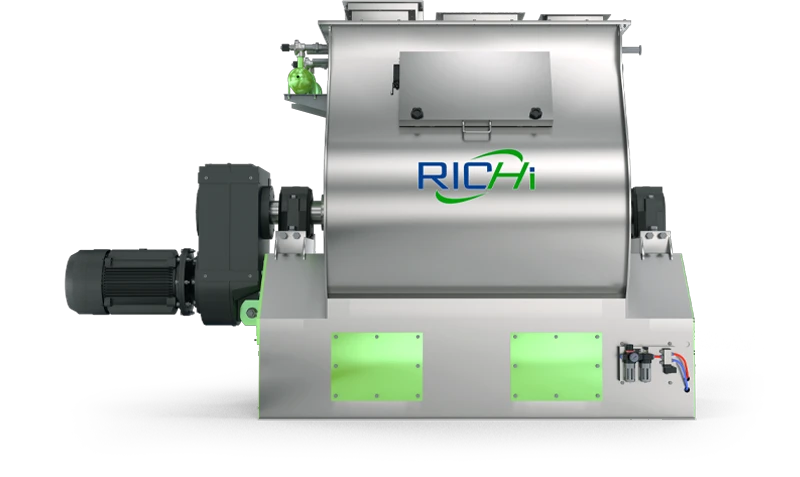
Mixing system
04
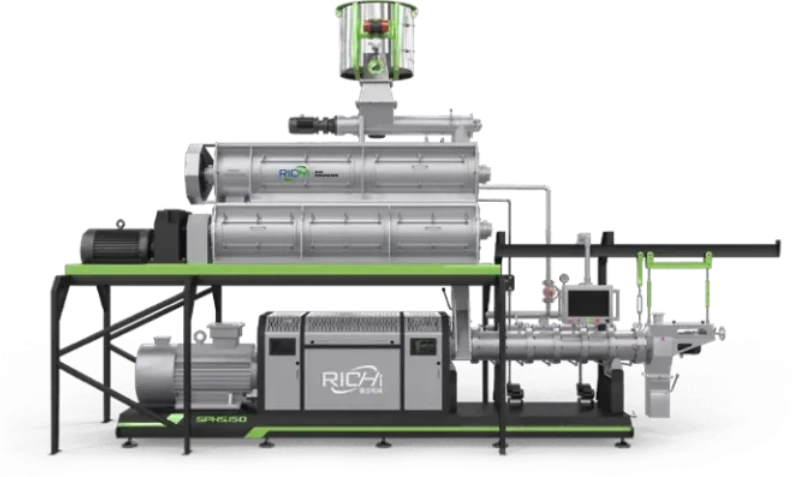
Pelleting system
05
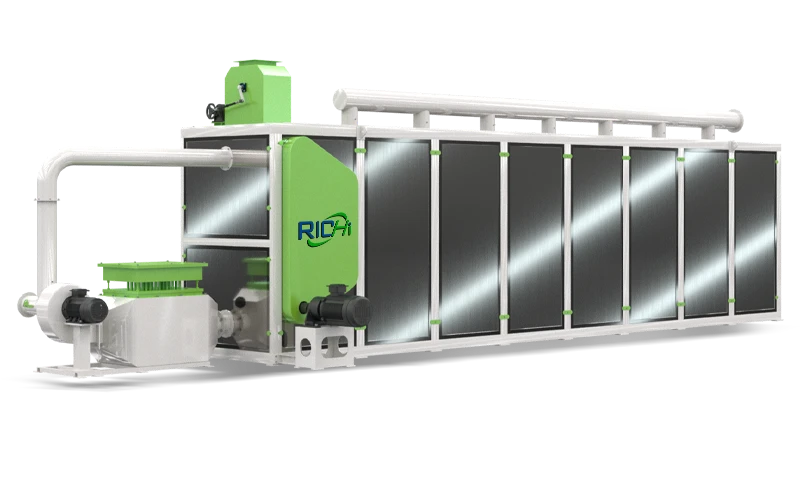
Cooling system
06
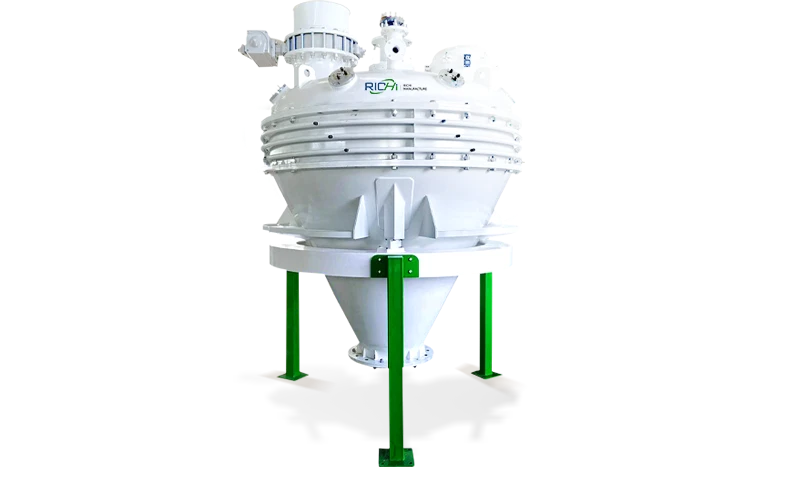
Screening system
07
Conveying system
10
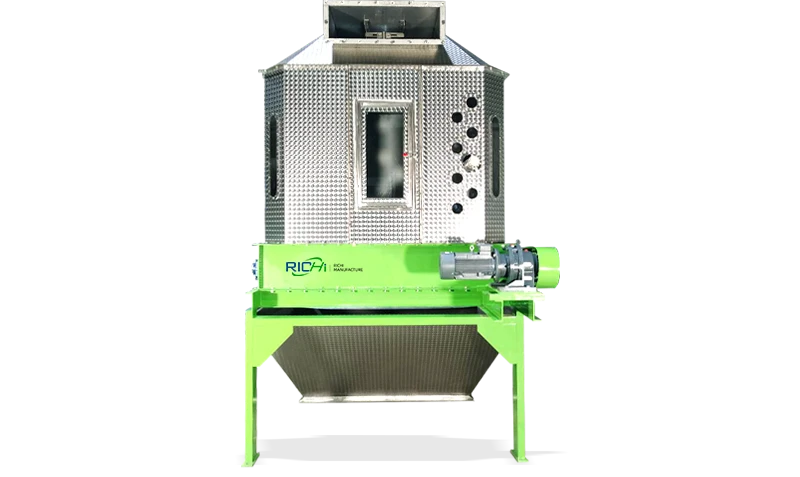
Dust removal system
09
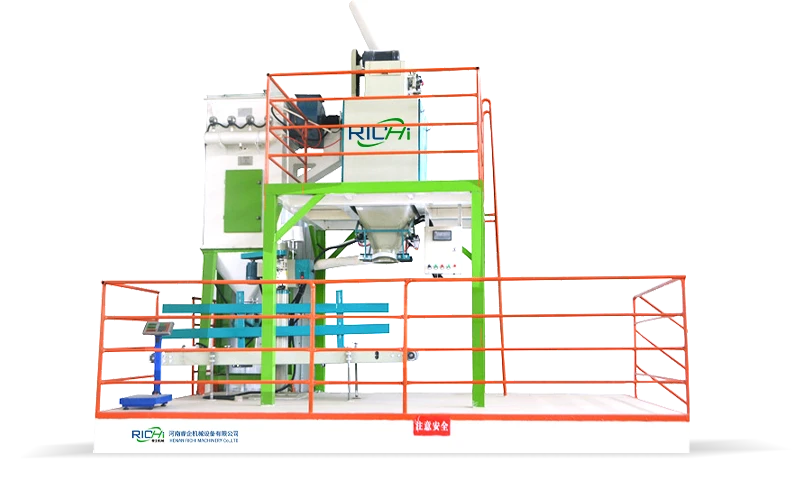
Packaging system
08
Custom Cat Food Manufacturing Plant Designs
A cat food manufacturing plant can be built as a dedicated dry-kibble factory or integrated with dog food, aquatic feed, pellet feed and mash-feed production. These eight layouts show how RICHI changes extrusion technology, grinding depth, automation, building arrangement and downstream finishing according to the customer’s actual products rather than repeating one standard cat food production line.
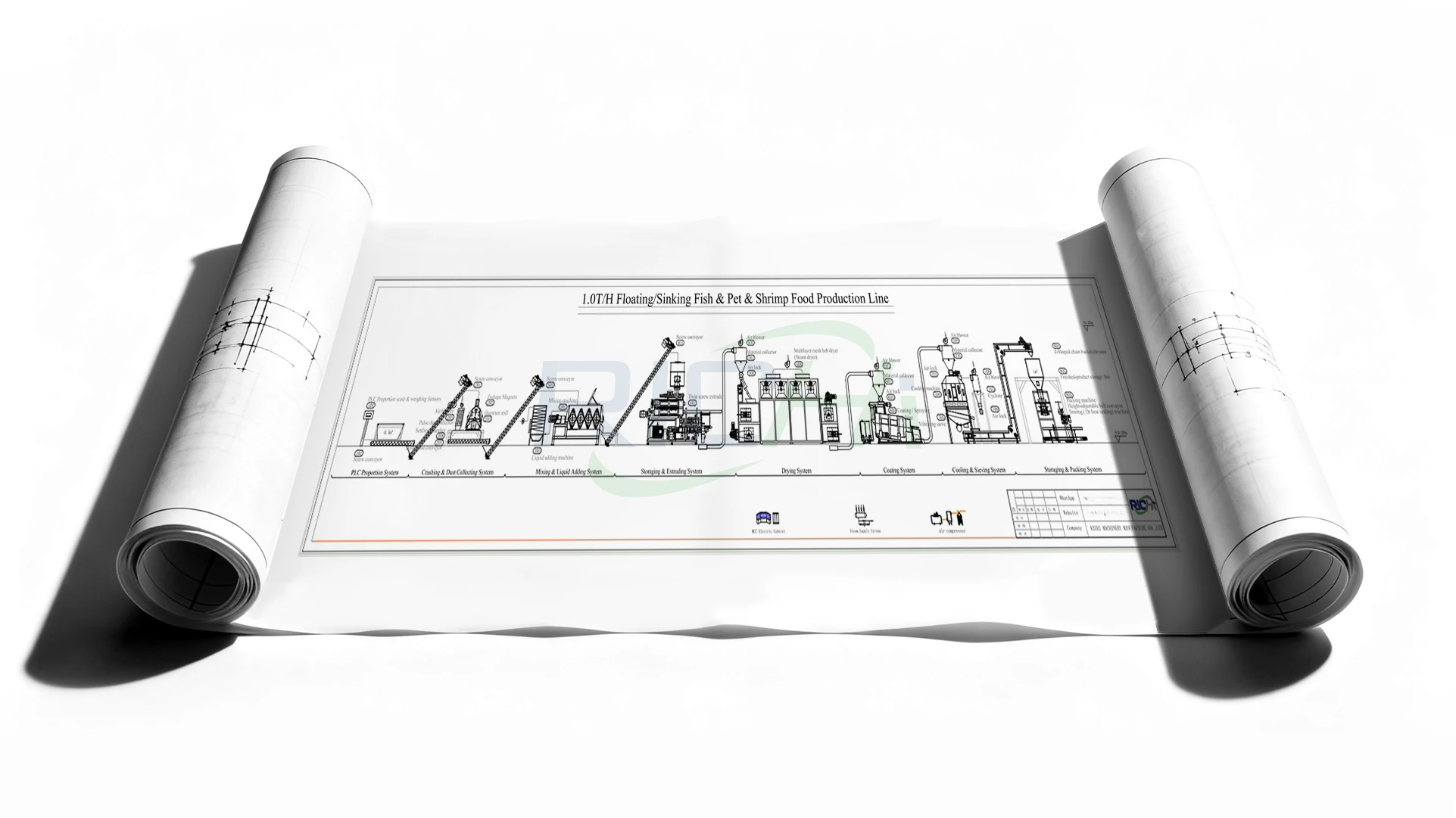
1 T/H Low-Height Twin-Screw Plant
This Indonesia project uses twin-screw wet extrusion for dry cat food, dog food, floating feed, sinking feed and shrimp feed. PLC batching and a horizontal arrangement keep the equipment height at about 6 m, making the design suitable for workshops where vertical space is limited. Process: PLC batching & weighing → grinding → mixing & liquid addition → twin-screw extrusion → belt drying → drum coating → cooling → screening → automatic packing.
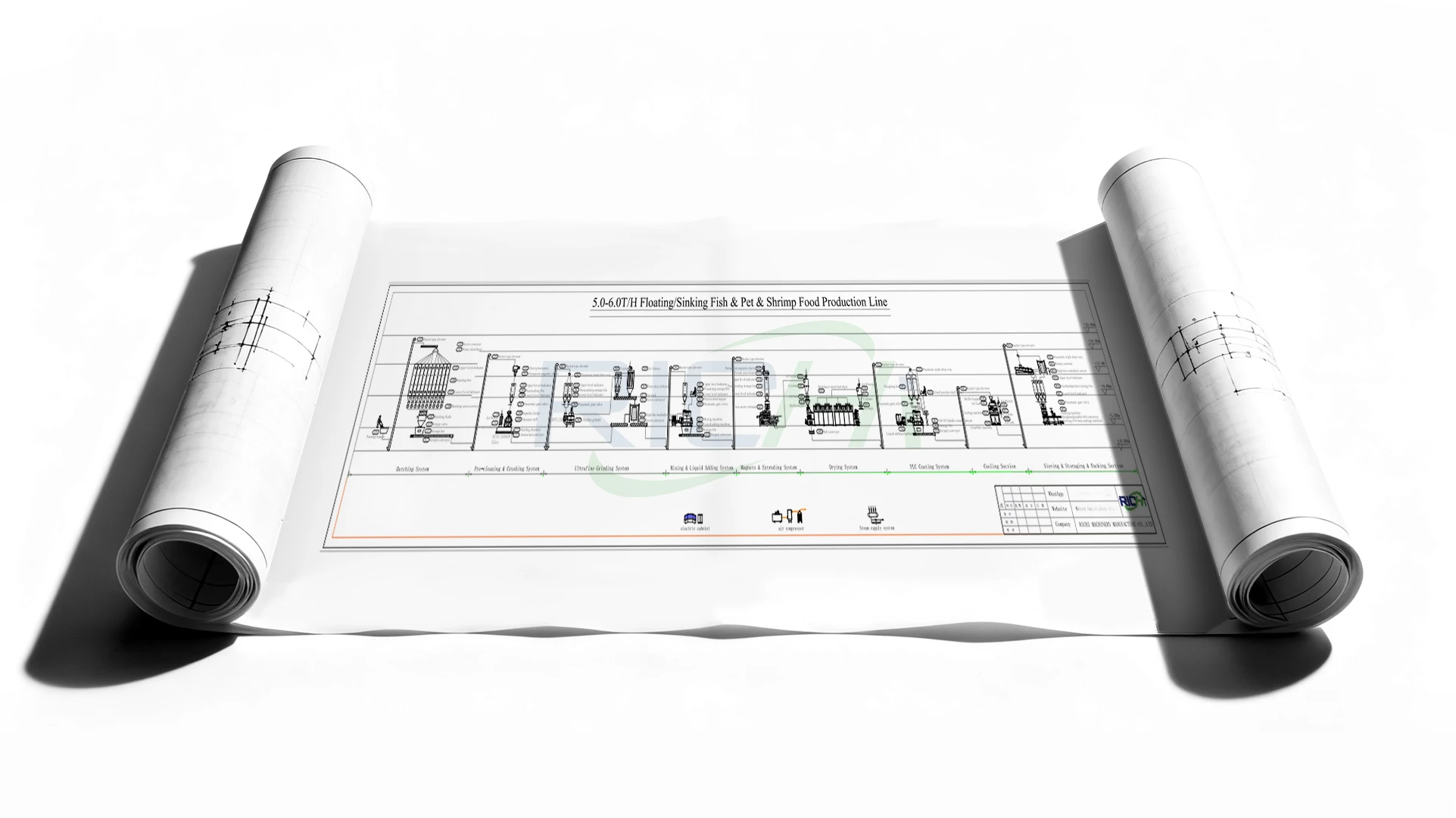
5–6 T/H Fine-Grinding Extrusion Plant
Designed for an Iraq project, this line handles dry cat and dog food together with several aquatic-feed products. Two-stage grinding improves material preparation before extrusion, while higher automation supports a wider commercial product range and more frequent recipe changes. Process design: manual feeding → automatic batching → coarse grinding → fine grinding → mixing & liquid addition → twin-screw extrusion → belt drying → coating → cooling → optional crumbling → screening → automatic packing.
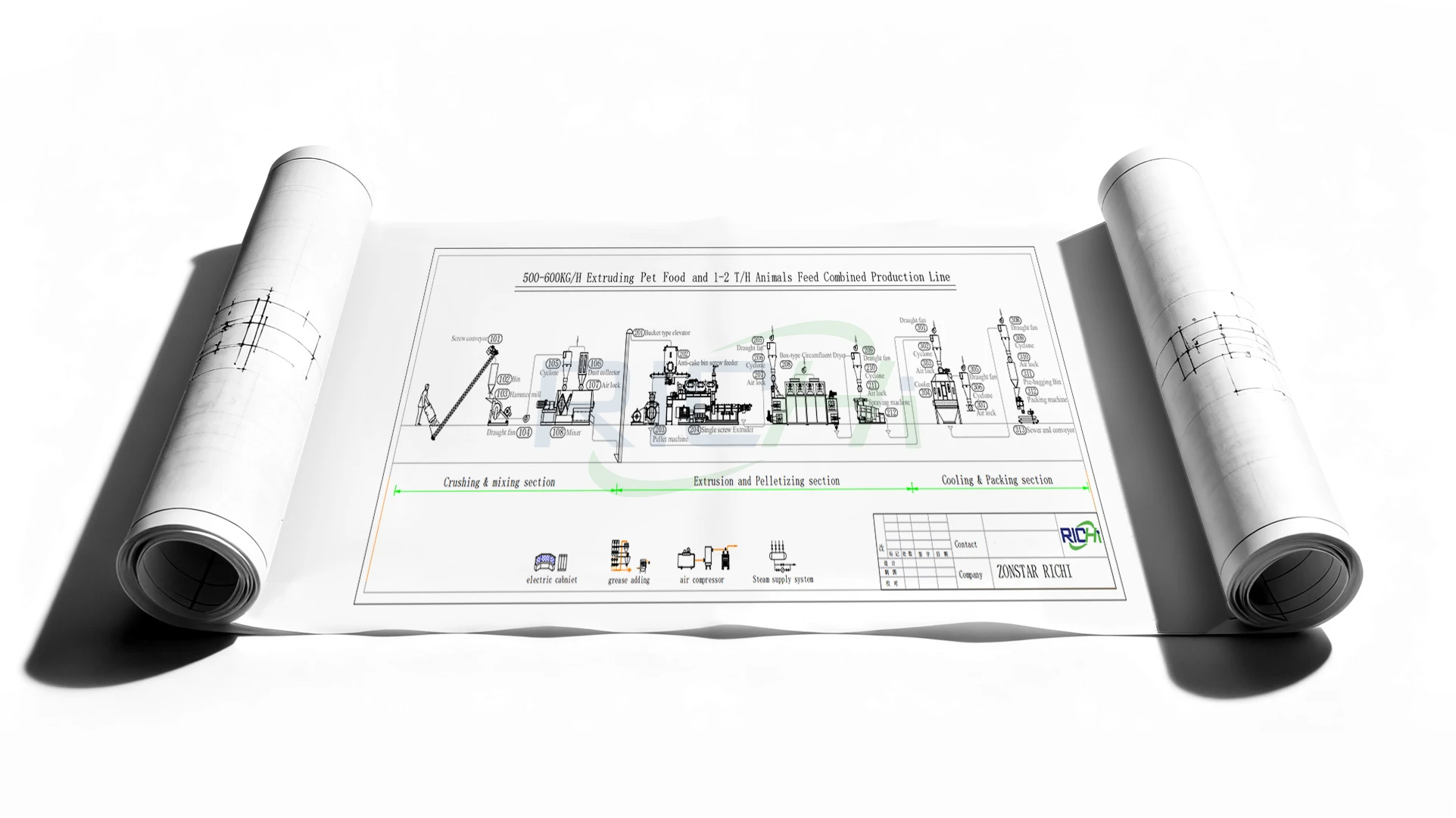
500–600 KG/H Cat Food + Pellet Feed Plant Design
This Kenya project combines single-screw wet extrusion with conventional pelleting. The customer can manufacture dry cat and dog kibble while retaining a separate route for livestock pellet feed, making better use of one small factory and shared upstream preparation. Process: manual feeding → small-scale grinding → ribbon mixing → extrusion / pelleting → drying → coating → cooling → automatic packing.
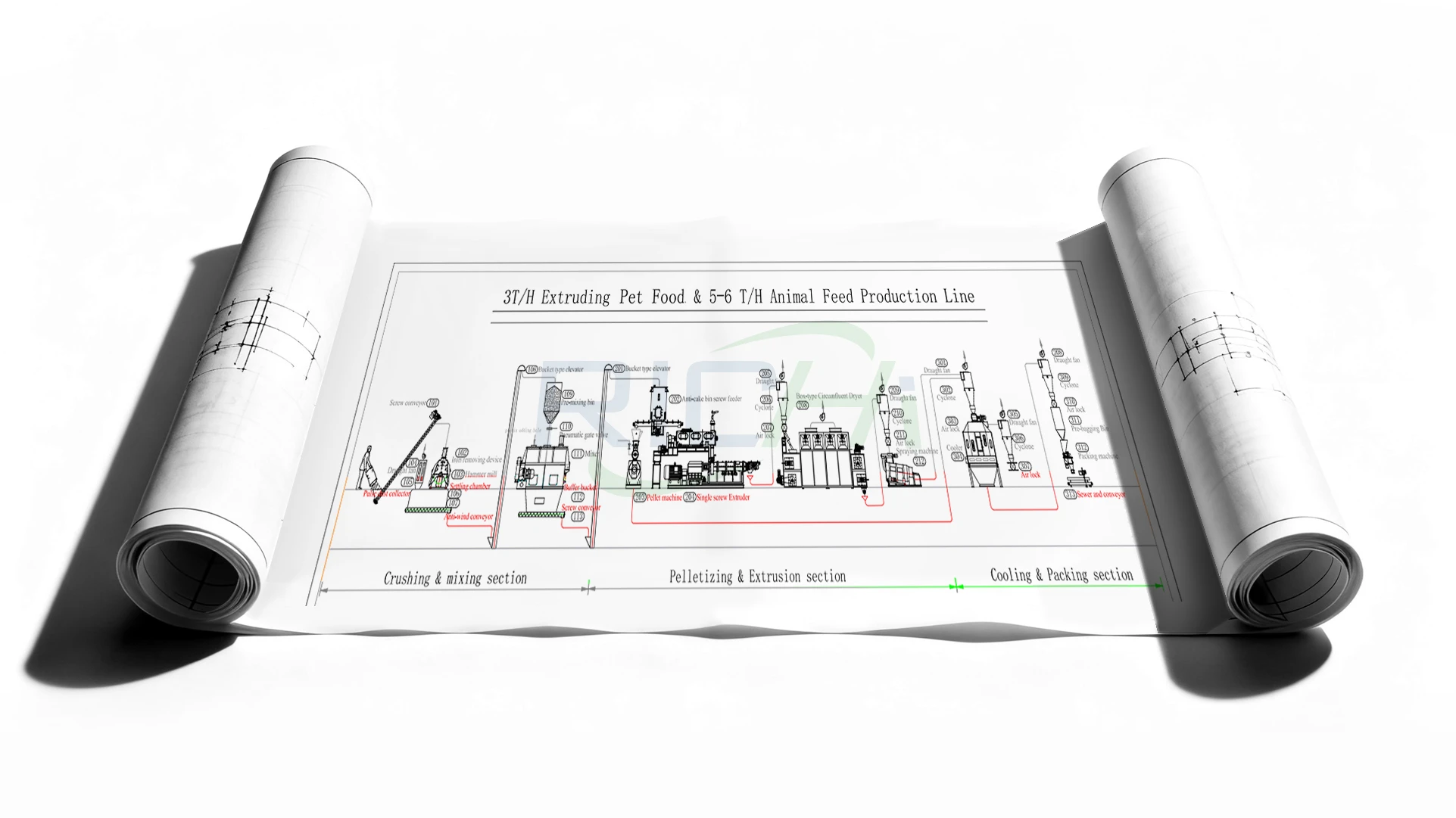
3 T/H Commercial Multi-Feed Plant Design
Developed for a Brazil project, this design follows the same extrusion-plus-pelleting concept at a larger commercial scale. A hammer mill and paddle mixer replace the smaller equipment used in the compact line, giving the plant more stable throughput for dry pet food and conventional feed production. Process: manual feeding → hammer milling → paddle mixing → extrusion / pelleting → drying → coating → cooling → automatic packing.
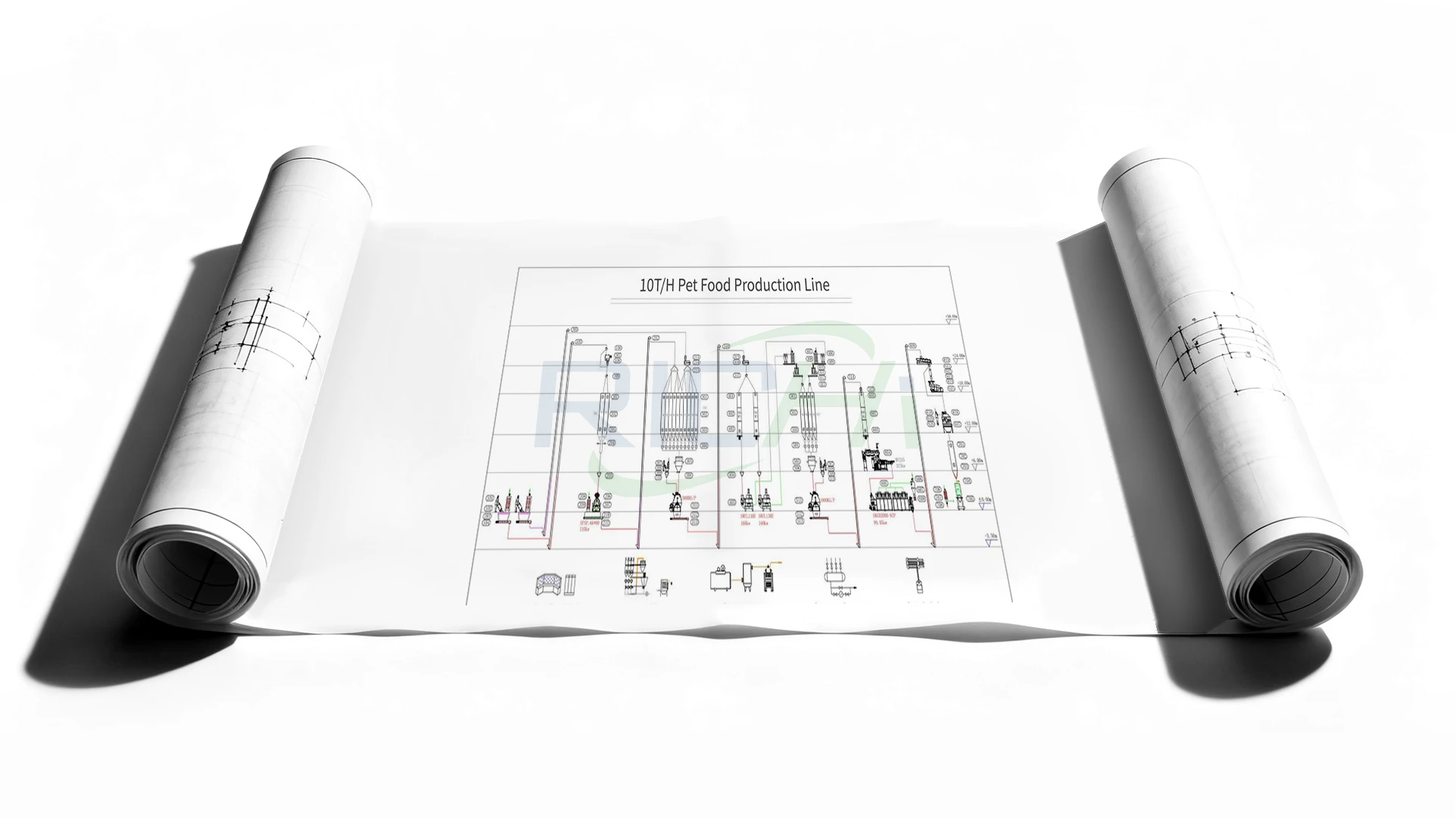
10 T/H Cat Food Factory Expansion Design
This U.S. project was designed in 2024 for installation inside an existing livestock feed plant. Instead of rebuilding the entire factory, the customer added a dry pet-food route with two-stage material preparation, extrusion, drying and coating while making use of suitable existing infrastructure. Process: manual feeding → first grinding → first batching & mixing → fine grinding → second batching & mixing → extrusion → drying → screening → coating → cooling → packing.
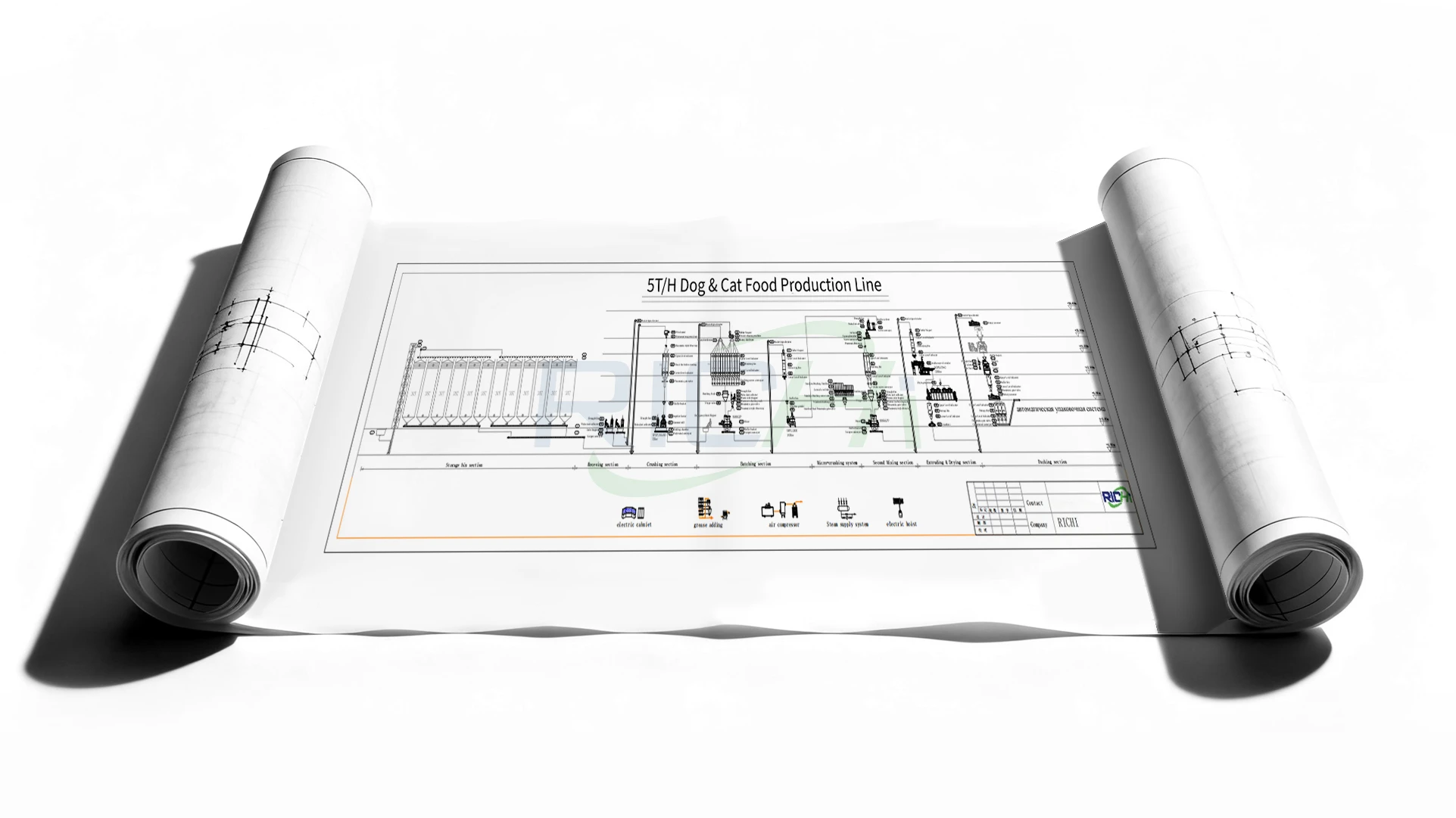
5 T/H Silo-Integrated Cat & Dog Food Plant Design
This Russia project is dedicated to dry cat and dog food and includes twelve 30-ton raw-material silos. The line combines bulk storage, automatic batching, two-stage grinding and extrusion, with equipment and silo investment totaling nearly US$1.4 million. Process: raw-material storage → feeding → first grinding → automatic batching → first mixing & liquid addition → fine grinding → second batching & mixing → extrusion → drying → screening → cooling → coating → bulk storage → existing packing section.
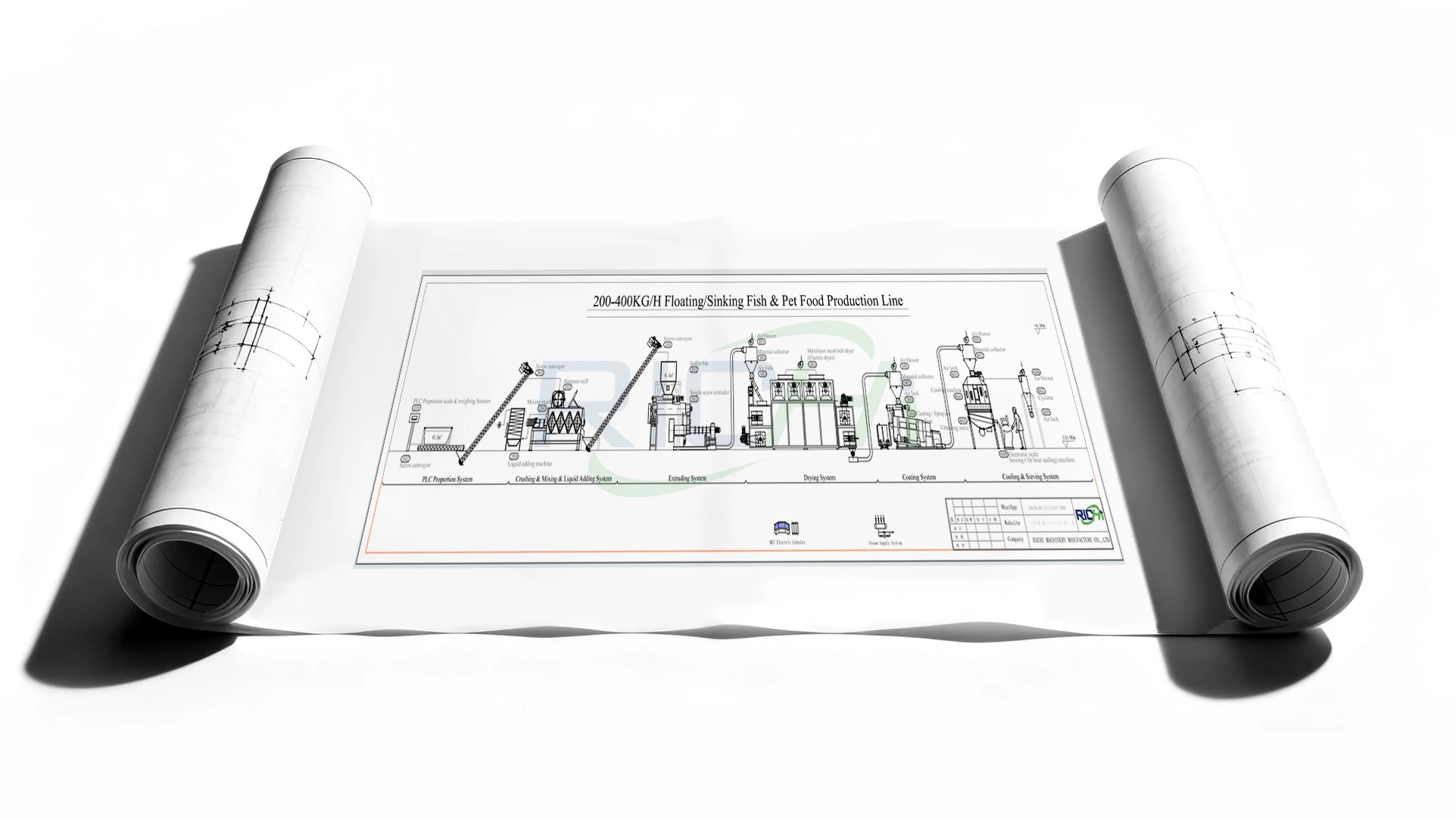
0.2–0.4 T/H Compact Dry-Extrusion Plant Design
This Bangladesh project uses single-screw dry extrusion for dry cat food, dog food and selected fish feeds. PLC batching and a compact horizontal layout keep the system relatively simple, making it suitable for customers entering commercial extrusion production with a controlled initial investment. Process: PLC batching & weighing → grinding → mixing & liquid addition → single-screw extrusion → belt drying → drum coating → cooling → screening → manual packing.
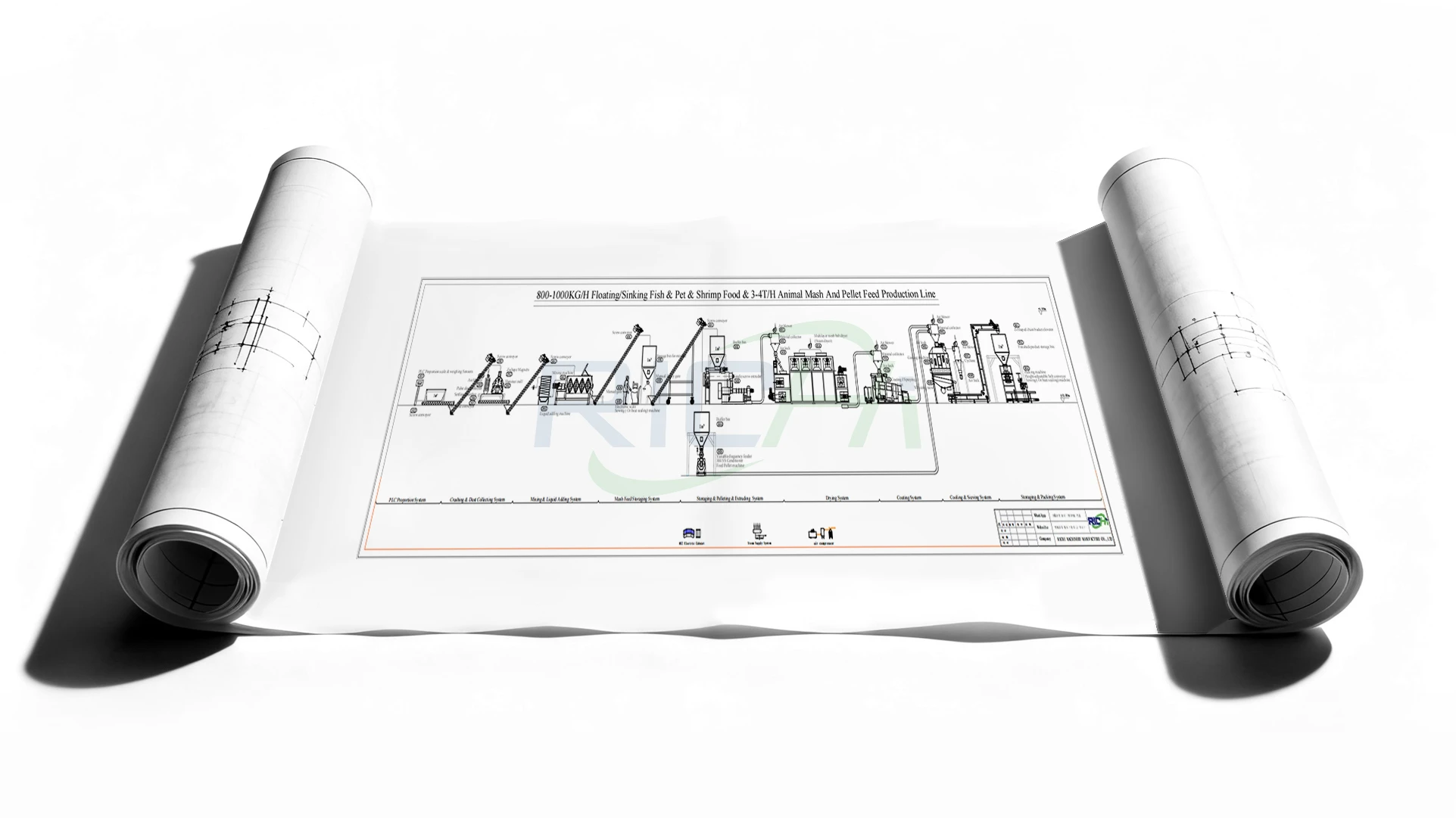
0.8–1 T/H Cat Food + Mash + Pellet Plant Design
This Côte d’Ivoire project combines dry cat and dog food extrusion with livestock pellet and mash-feed production. Mash feed can be packed after mixing, while other formulas continue into extrusion or pelleting, allowing one factory to serve several product markets without duplicating the full upstream system. Process: PLC batching & weighing → grinding → mixing & liquid addition → mash packing / extrusion / pelleting → drying → coating → cooling → screening → automatic packing.
Cat Food Manufacturing Plant Projects Worldwide
RICHI Machinery has supplied cat food manufacturing plant solutions for dedicated dry kibble production and for factories combining cat food with dog food, aquatic feed or conventional animal feed. These projects cover different customer types, formula strategies and factory conditions, showing how a commercial cat food production line can be adapted without forcing every customer into the same configuration.
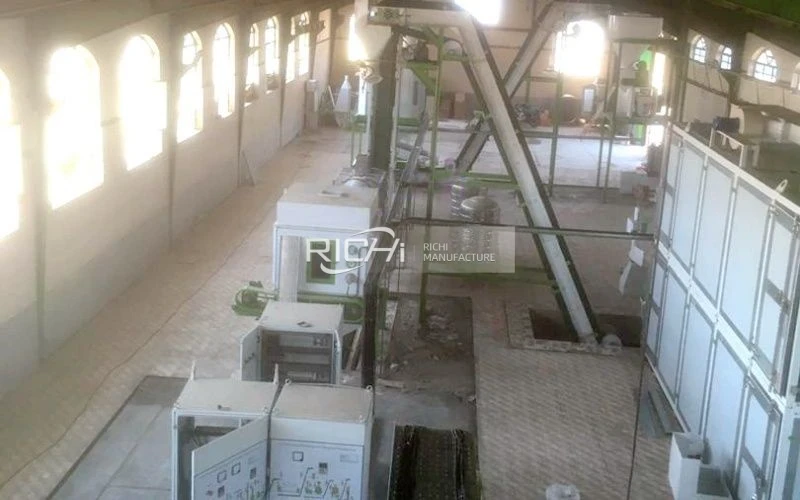
1 T/H Conditioned Kibble Plant Project
Peru
This project uses conditioned single-screw extrusion for commercial dry cat and dog food. Steam and moisture conditioning improve material preparation before extrusion, while drying and coating remain part of the finished dry-kibble process.
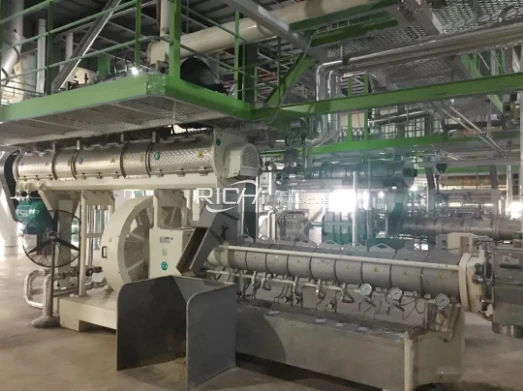
5 T/H Regional Pet Food Plant Project
Mexico
A regional feed producer expanded into dry cat and dog food manufacturing with a dedicated extrusion section. Existing infrastructure was considered during plant planning so useful upstream systems could be retained instead of duplicated.

2 T/H Flexible Pet Food Factory Project
UAE
This plant was configured for several dry cat and dog food products using different protein and coating systems. The project prioritizes product flexibility rather than maximizing capacity, making it suitable for a diversified commercial pet food business.
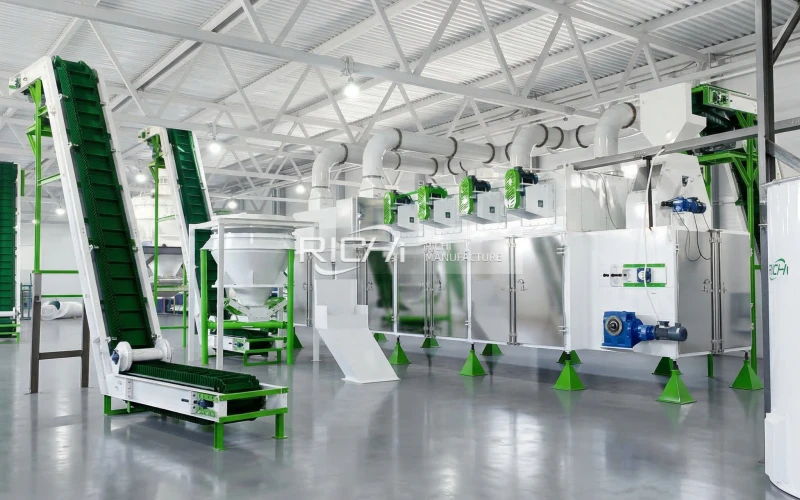
3 T/H Automated Kibble Factory Project
South Korea
This project focuses on dry cat and dog kibble with a relatively high level of batching and process automation. The layout was configured for manufacturers that need stable recipe control and compact use of factory space.
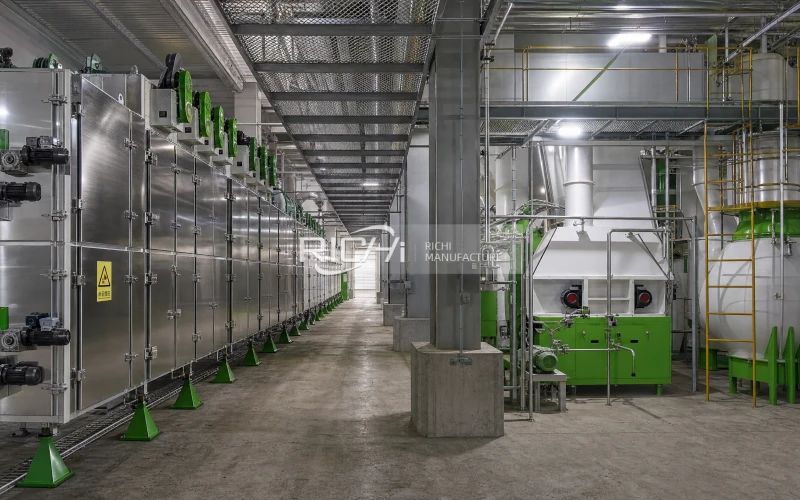
4 T/H Cat Aquatic Feed Hub Project
Poland
The customer wanted dry cat food, dog food and selected extruded aquatic feeds from one factory. Shared upstream preparation reduces duplicated equipment, while extrusion settings and downstream finishing are adjusted for each product family.

0.5 T/H Compact Kibble Business Project
Egypt
This small-scale cat food manufacturing plant is suitable for a regional producer entering dry kibble production with controlled investment. The line can manufacture cat and dog food while a separate pelleting section supports conventional feed products.
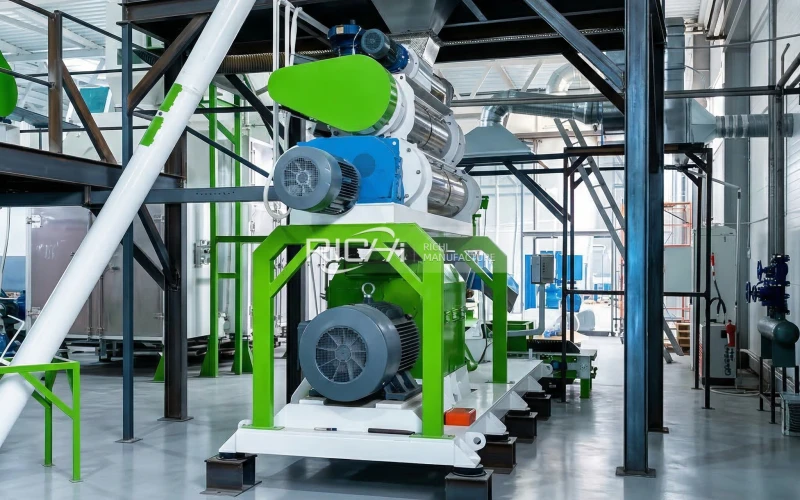
2 T/H Private Label Facility Project
Italy
Designed for a private-label manufacturer, this line handles several dry cat food recipes and packaging specifications. Greater emphasis was placed on formula switching, consistent small kibble and flexible coating for different retail products.

0.8–1 T/H Regional Extrusion Line Project
Kazakhstan
The customer required dry cat and dog food together with floating fish feed. A compact single-screw dry extrusion route keeps the system relatively simple while allowing one factory to serve several regional feed markets.
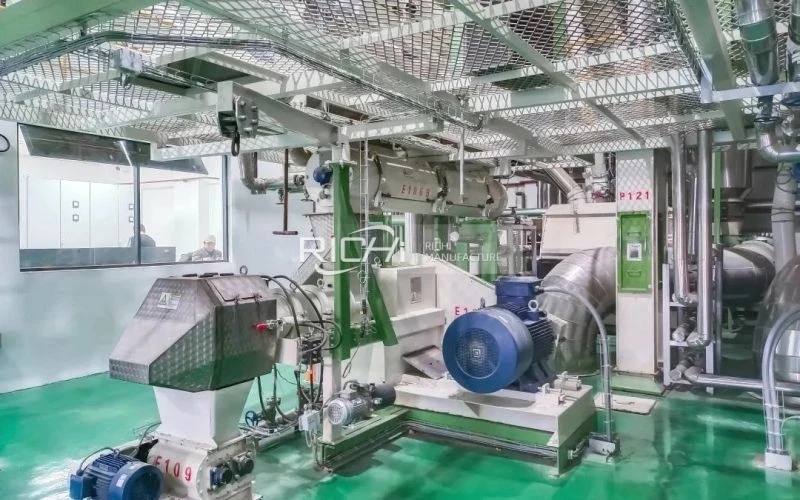
6 T/H Export-Oriented Feed Plant Project
Thailand
This larger project combines dry cat food, dog food and extruded aquatic feed. The cat food processing factory was designed for wider product coverage, continuous production and formula flexibility across several commercial markets.
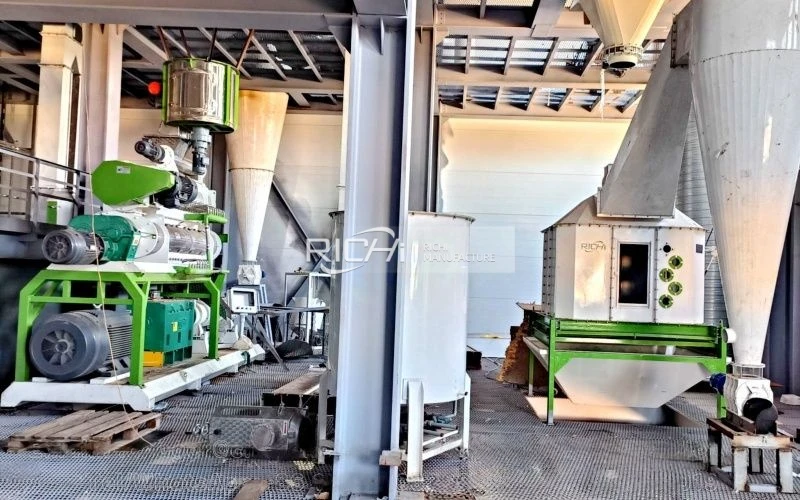
5 T/H Premium Kibble Factory Project
Russia
Built for dry cat and dog food, this project combines automatic batching, fine grinding and flexible extrusion for several kibble specifications. The customer required stable commercial production rather than a single fixed recipe.
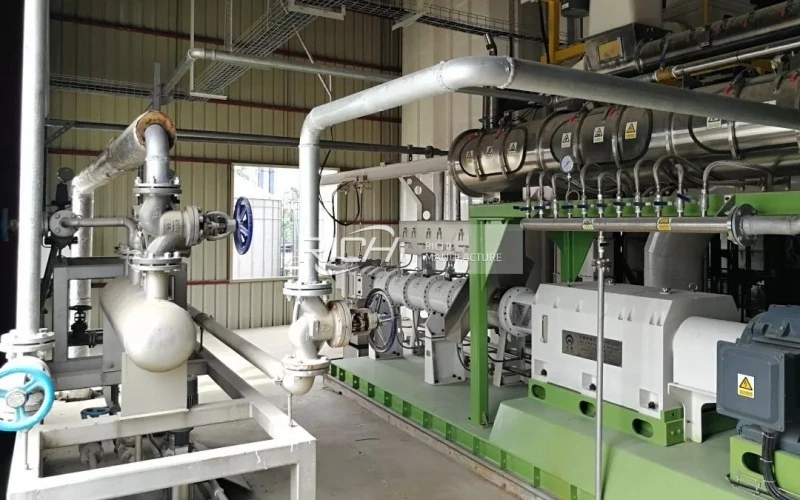
3 T/H Multi-Formula Kibble Plant Project
Turkey
This cat food manufacturing plant serves a producer running several poultry-, fish- and meat-based dry cat food formulas. Twin-screw extrusion supports frequent recipe changes and different kibble shapes without building separate production lines.
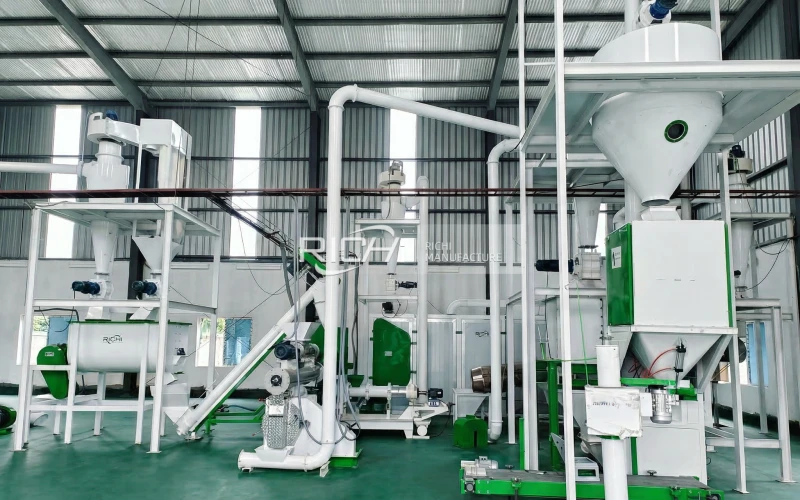
0.5–0.6 T/H Starter Cat Food Plant Project
Serbia
This compact cat kibble manufacturing line was planned for a customer moving from feed trading into production. The configuration focuses on dry cat and dog kibble with straightforward operation and room for later automation upgrades.
For a cat food manufacturing plant, customers usually judge more than whether the extruder runs. Kibble consistency, formula changeover, coating performance, operator control and the ability to handle several dry cat food products all affect daily production. The following feedback focuses on the parts manufacturers notice most after the plant enters regular operation.


2 T/H Cat Food Project in Spain
- Customer Type: Regional Cat Food Manufacturer
- Role: Production Manager
“We needed several small-kibble products with different poultry and fish formulas, so repeatability was very important. RICHI helped us balance fine grinding, extrusion and coating instead of treating each recipe as the same product. Our operators also found the changeover procedure practical.”

1 T/H Cat & Dog Food Project in Chile
- Customer Type: Private-Label Pet Food Producer
- Role: Factory Director
“Our plan was to make both cat and dog food, but cat kibble required tighter control of size and surface coating. The line was arranged so we could change dies, recipes and coating settings without rebuilding the process. That flexibility mattered more to us than simply buying a larger extruder.”

3 T/H Dry Cat Food Project in Czech Republic
- Customer Type: Commercial Pet Food Processor
- Role: Technical Manager
“We use several animal-protein systems and low-inclusion micro-ingredients, so batching accuracy was one of our main concerns. The cat food manufacturing plant was designed with more attention to fine material preparation and micro-dosing, which made the process easier to manage across different recipes.”

1–2 T/H Cat Kibble Project in Malaysia
- Customer Type: Growing Pet Food Brand
- Role: Managing Partner
“Our market needs several dry cat food products rather than one standard kibble. RICHI adjusted the process around smaller kibble, oil addition and palatant coating, and also left room for future automation upgrades. The project felt designed around our product plan, not around a fixed machine list.”

What Does a Cat Food Manufacturing Plant Cost?
The investment in a cat food manufacturing plant is determined by much more than extruder capacity. Fine grinding, micro-ingredient dosing, recipe automation, dryer size, oil and palatant coating, kibble handling and packing can all change the final budget. A 1 T/H cat food plant designed for one basic formula may cost far less than another 1 T/H factory built for frequent recipe changes, higher automation and several premium dry-kibble products.
Whole cat food plant set up investment : $60,000 – $40,000,000
Main Cat Food Equipment Cost:
Raw Material Receiving & Conveying :
$1,000–120,000+
Cleaning & Magnetic Separation :
$2,000–30,000
Grinding & Fine Grinding :
$3,000–$200,000
Batching & Micro-Dosing :
$4,000–$230,000
Mixing & Liquid Addition :
$2,000–$80,000
Single-Screw Extrusion :
$4,000–60,000+
Twin-Screw Extrusion :
$30,000–200,000+
Belt Drying System :
$5,000–180,000+
Oil & Palatant Coating :
$2,000–120,000+
Cooling & Screening :
$2,000–60,000
Packing System :
$5,000–150,000+
Silos & Bulk Storage :
$5,000–300,000+
Dust Collection & Central Control :
$10,000–200,000+
The cost of setting up a cat food factory therefore depends heavily on what the customer already has. An existing feed or pet food manufacturer may reuse buildings, storage, utilities or selected upstream equipment, while a greenfield project must budget for these items from the beginning.For an accurate cat food manufacturing plant cost, send us your target capacity, main formulas, preferred extrusion route, workshop dimensions and automation requirements. RICHI can then prepare the process layout, equipment list and quotation together, rather than giving a misleading one-machine price.
Engineering Support
RICHI supports cat food manufacturing plant projects from early engineering through startup and long-term operation. Whether the customer is building a new cat food factory, adding dry cat food to an existing pet food business, or upgrading a conventional feed plant, our engineering work is based on the actual formulas, kibble specifications, workshop conditions and production plan rather than a standard equipment package.
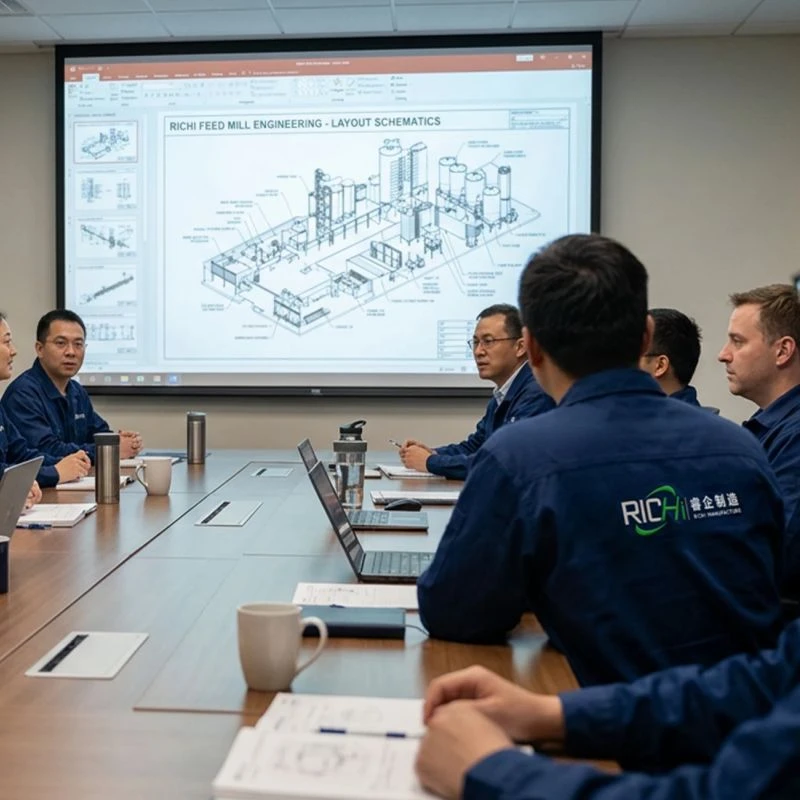
Process & Factory Design
We develop the process flow, cat food factory layout, equipment arrangement and utility interfaces around the customer’s dry kibble products. Fine grinding, micro-dosing, extrusion, drying, coating and packaging are coordinated so small kibble production and recipe changes can be handled as one complete system.
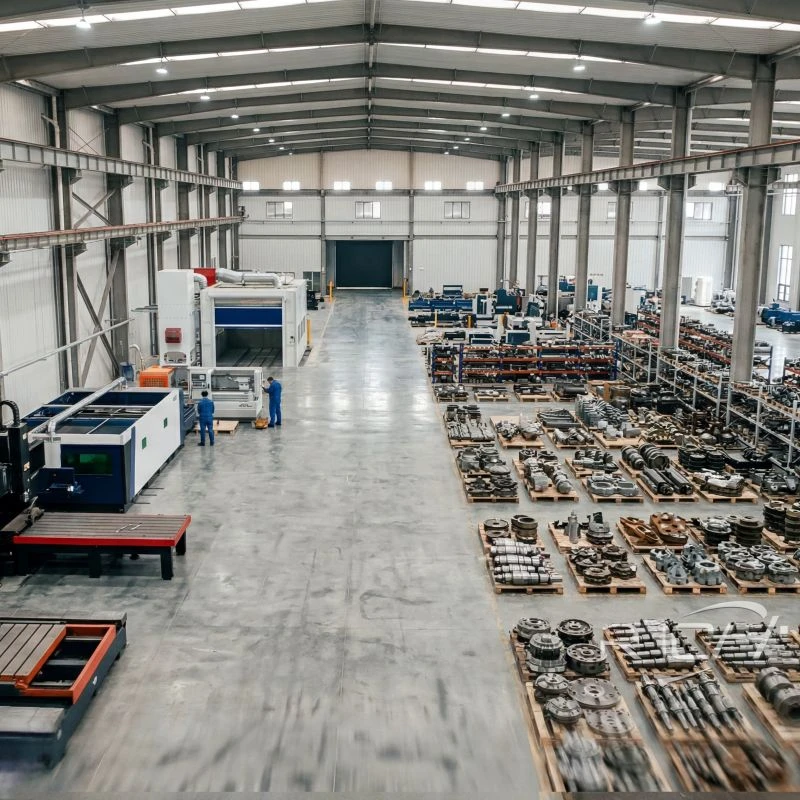
Equipment Manufacturing
RICHI manufactures the core cat food manufacturing equipment required for material preparation, extrusion and downstream finishing. Equipment interfaces are planned together so the grinder, mixer, extruder, dryer, coating system, cooler and packing section match in throughput instead of creating bottlenecks.
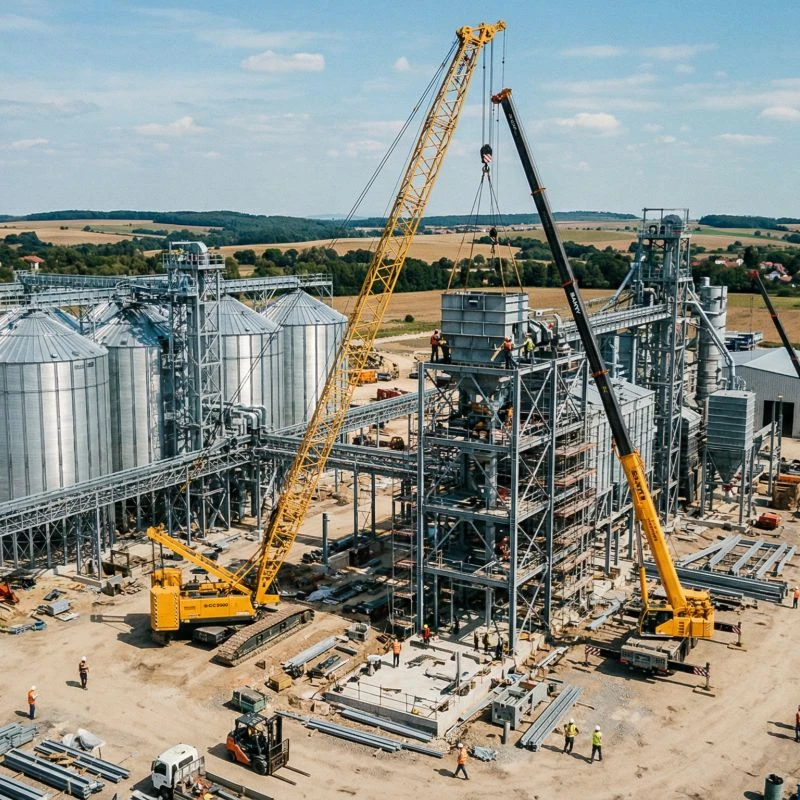
Installation Commissioning & Training
Installation guidance, commissioning and operator training cover equipment connection, startup sequence, trial production and basic process adjustment. For cat food projects, particular attention is given to recipe switching, die changes, drying conditions and coating settings so operators understand how the line responds to different products.
Lifetime Technical & Spare Parts Support
After commissioning, RICHI continues to provide technical assistance, maintenance guidance and spare-parts support. If the customer later adds new cat kibble products, increases automation or expands into dog food production, the existing cat food processing plant can be reviewed for practical upgrading rather than starting again from zero.
Free Custom Support
Before equipment manufacturing begins, RICHI can provide a range of free planning and engineering services to help customers evaluate the cat food manufacturing plant more clearly. These services support early decisions on process flow, factory layout, civil preparation, electrical planning and project feasibility before the final equipment configuration is confirmed.

Free Project Cost Estimate
Free 3D Plant Layout Design
Free Civil & Steel Structure Design
Free Production Testing & Project Reference Support
Free Process Flow Design
Free Factory Area Planning
Free Electrical System Design
Free Lifetime Remote Technical & Training Support
Cat Food Manufacturing Equipment Supply
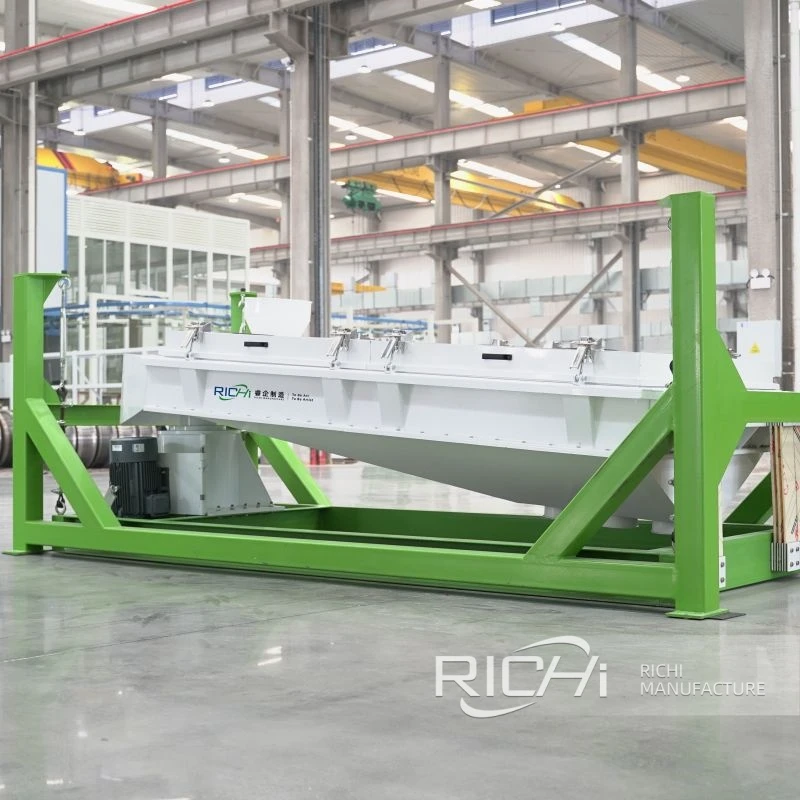
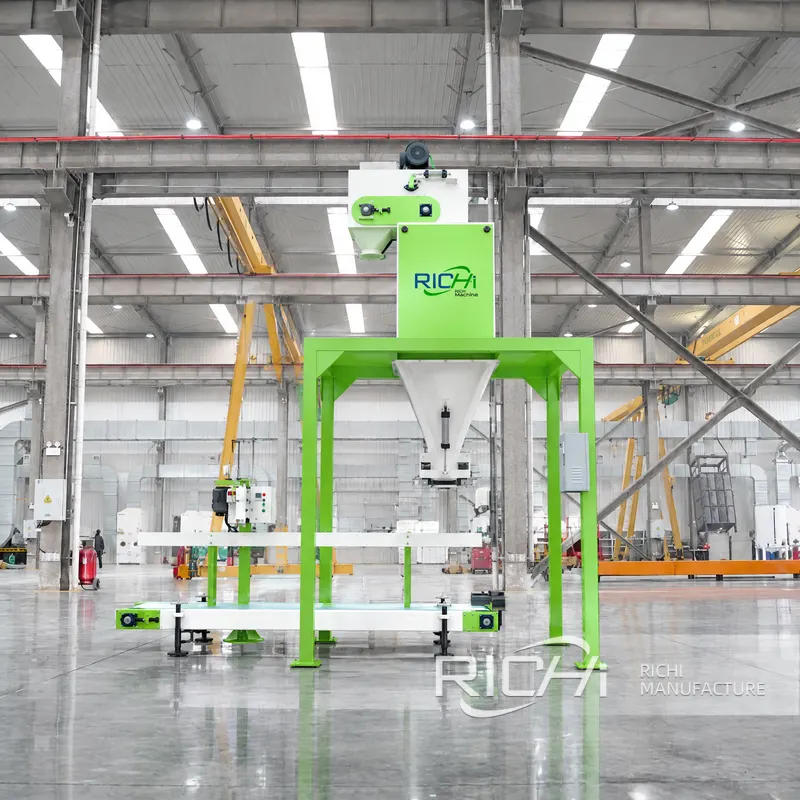
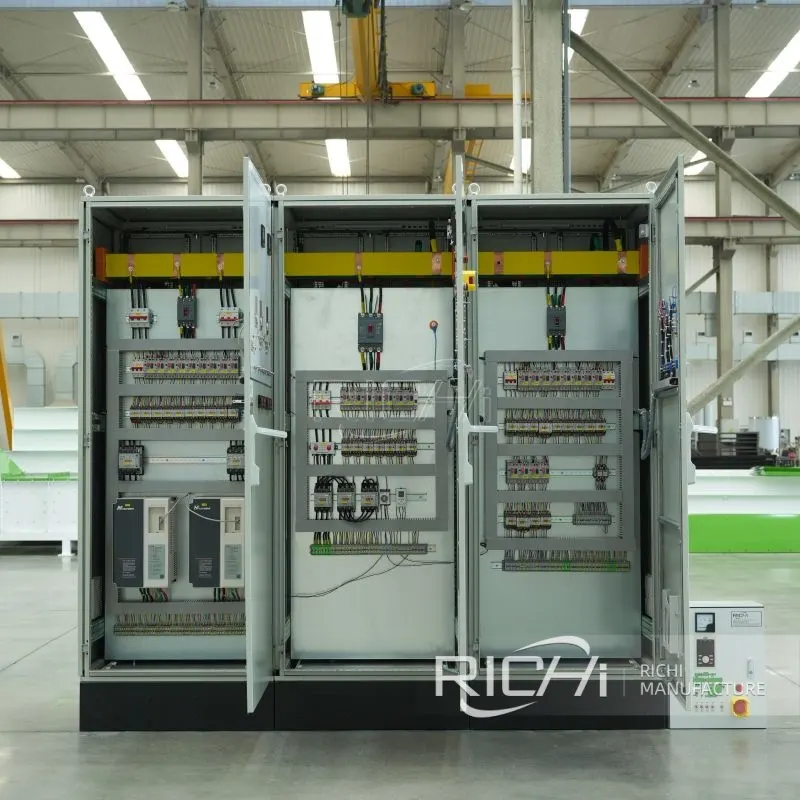
RICHI supplies the complete cat food manufacturing equipment required for dry kibble production, from raw-material preparation to finished-product packing. Depending on the formula and plant scale, the system can include cleaning equipment, hammer mills, ultrafine grinders, batching and micro-dosing units, mixers, liquid-addition systems, conditioners, single-screw or twin-screw cat food extruders, belt dryers, drum or vacuum coating systems, coolers, screens, conveyors, silos, dust collectors and automatic packing equipment.
For dry cat food, equipment matching is especially important because smaller kibble, low-inclusion micro-ingredients, fat addition and palatant coating can place tighter demands on grinding, dosing and downstream finishing. A compact cat kibble production line may use simpler storage and packing, while a commercial cat food manufacturing plant can add two-stage grinding, automatic ingredient handling, vacuum coating, centralized control and larger finished-product storage.
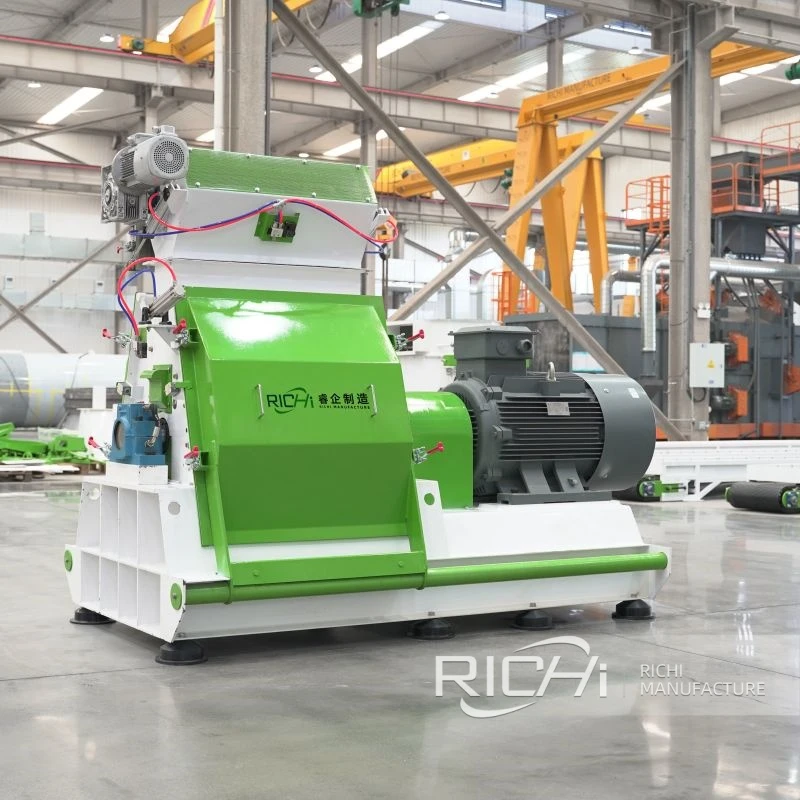
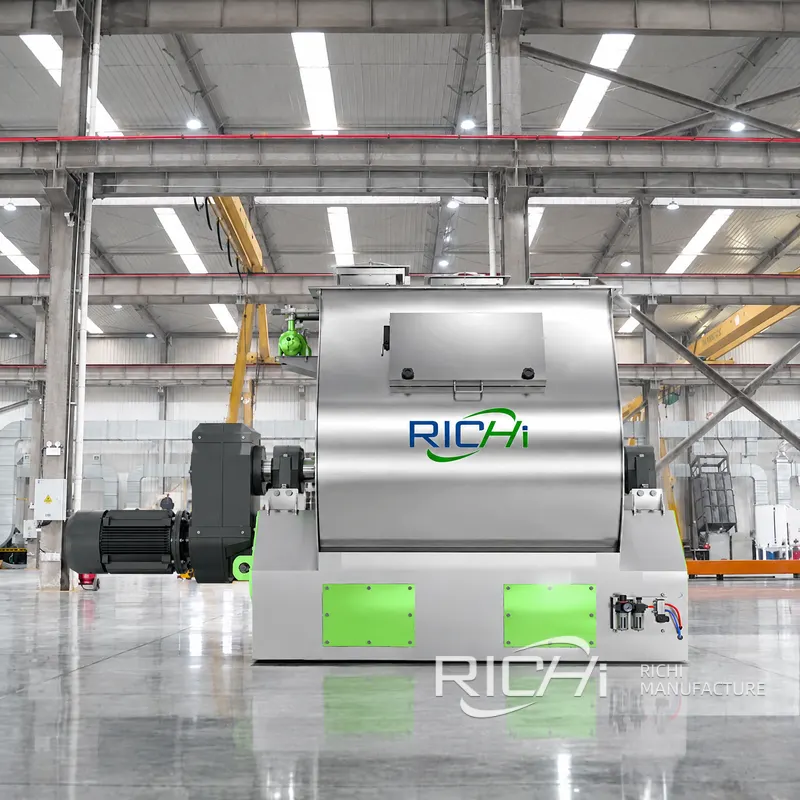
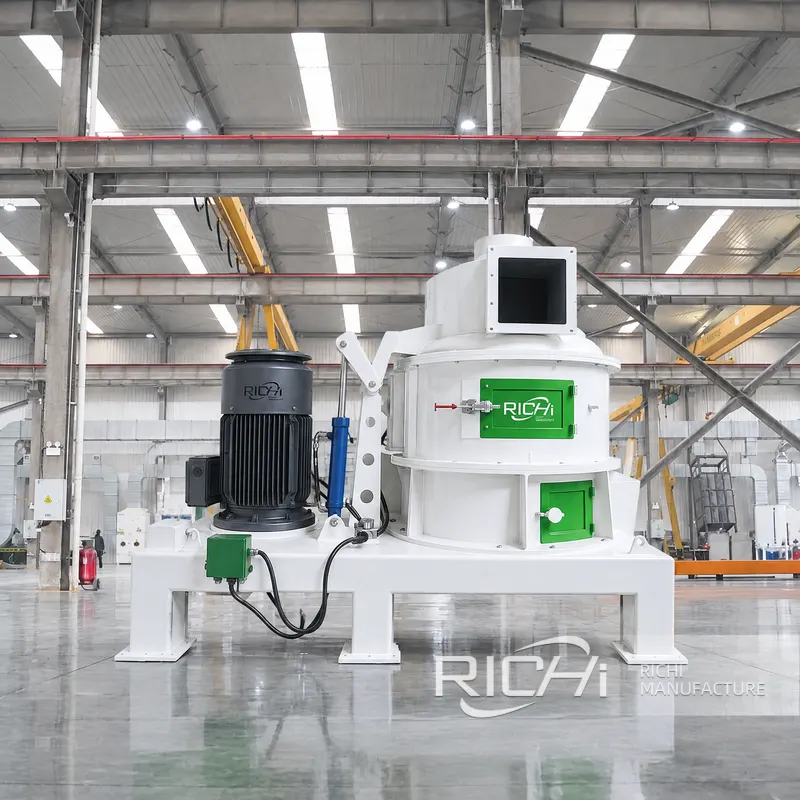
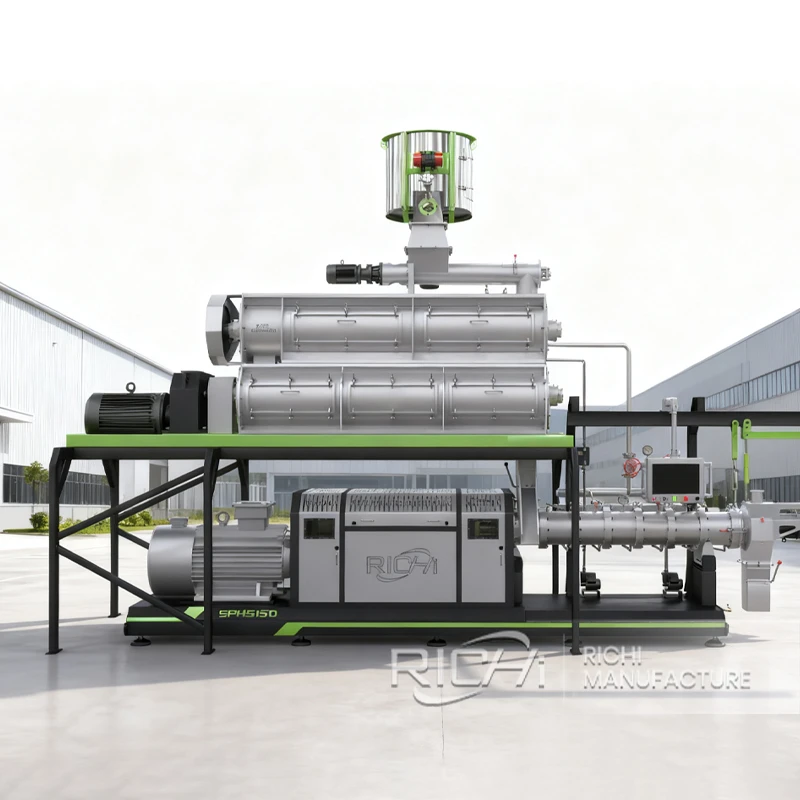
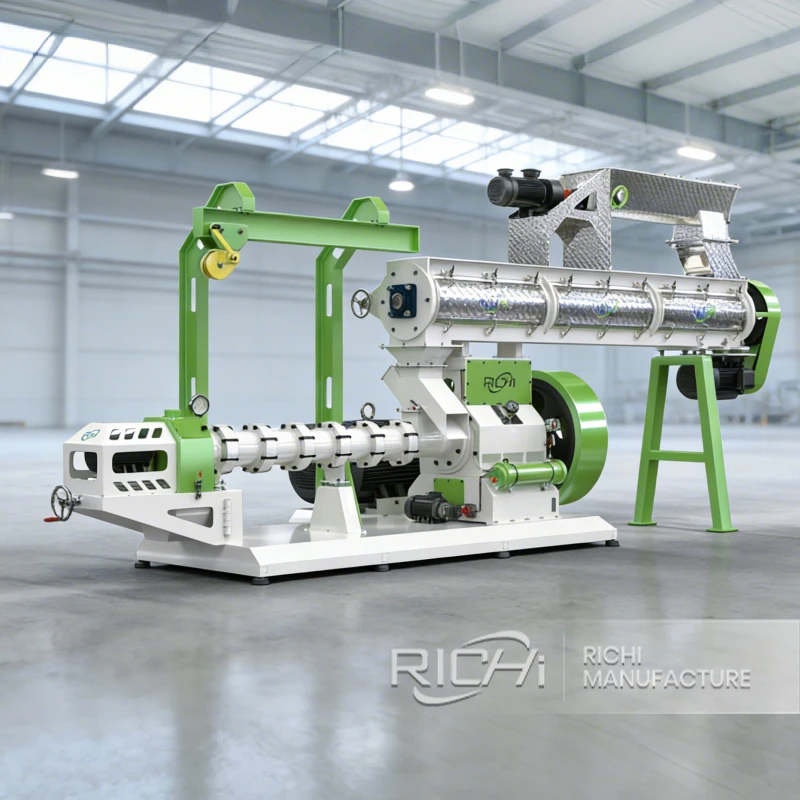
single screw extruder
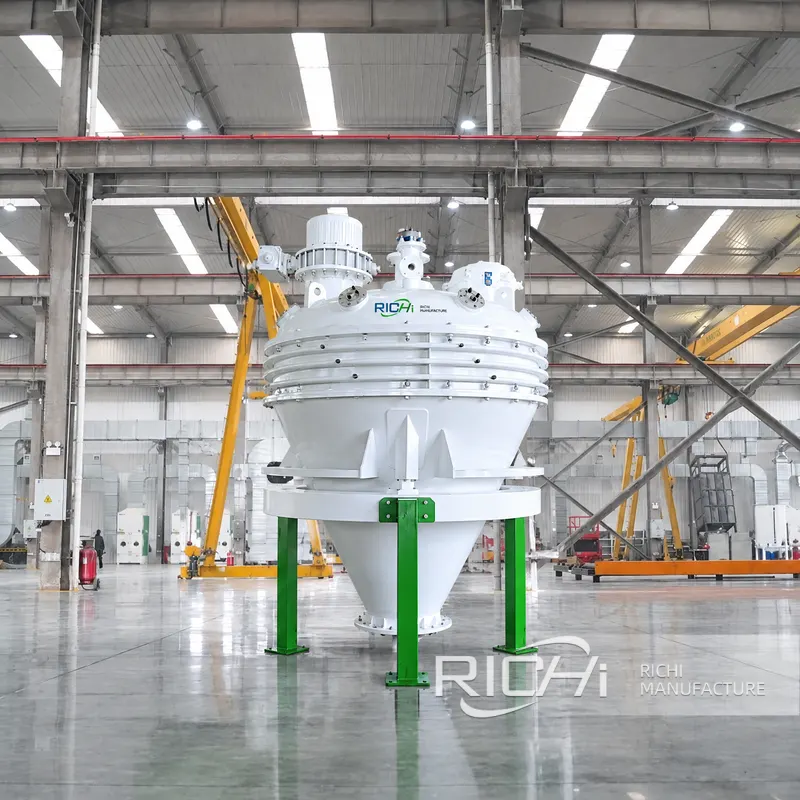
Vacuum spraying machine
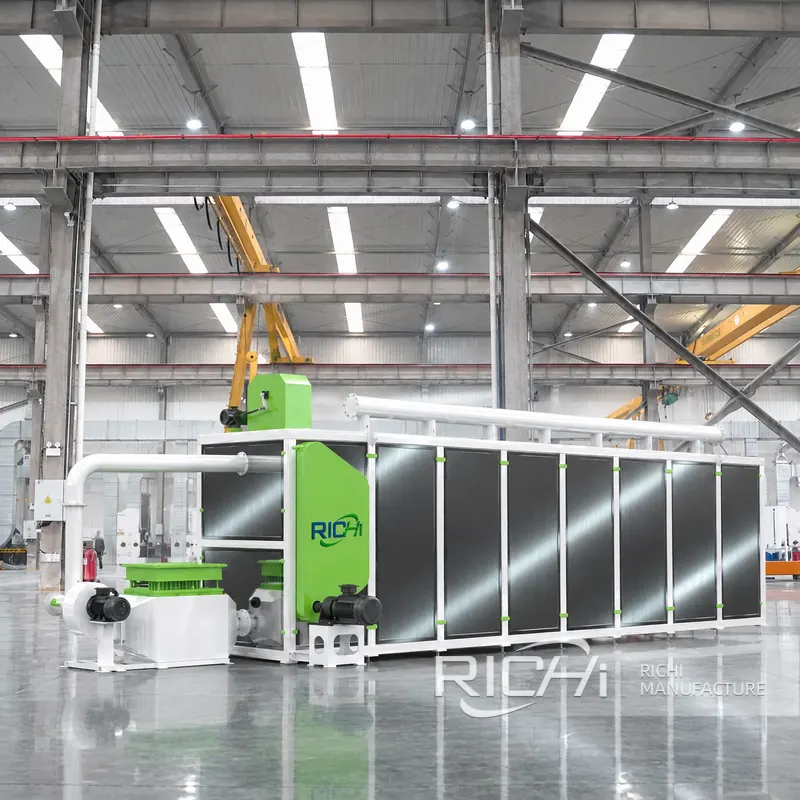
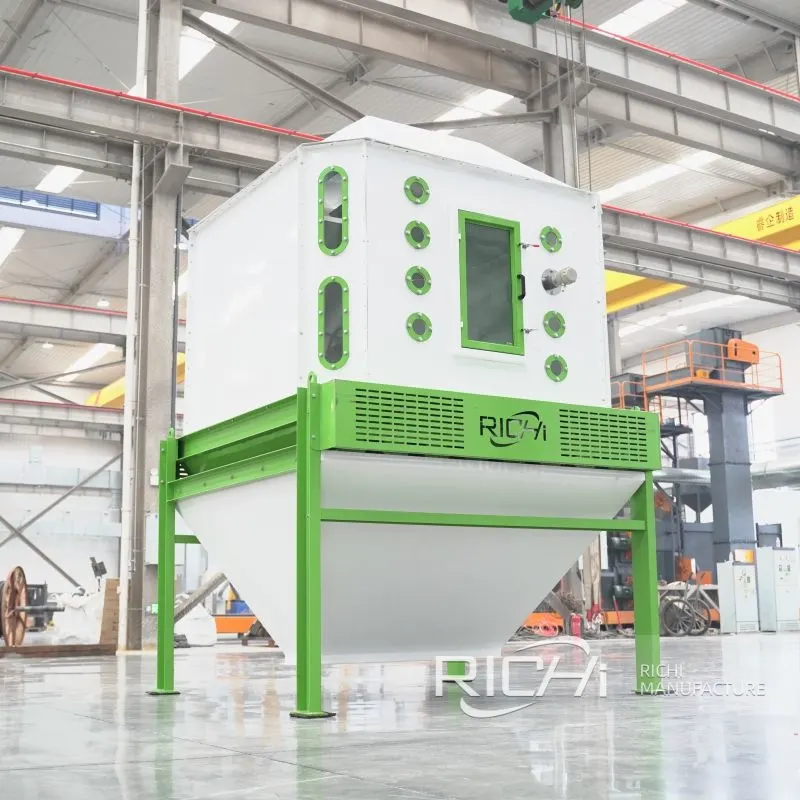
Electrical control cabinet
RICHI selects each cat food machine as part of one coordinated system rather than as an isolated unit, helping the grinder, mixer, extruder, dryer, coating system and packing section work at compatible capacities.
Why Build a Dry Cat Food Manufacturing Plant?
A cat food manufacturing plant gives manufacturers access to a product category built around repeat household consumption rather than one-time equipment or seasonal demand.
Dry cat food is particularly practical for commercial production because it can be stored, transported and packed efficiently while supporting many product variations—from different protein systems and kibble shapes to economy, mainstream and premium ranges. For ingredient companies, feed manufacturers, pet brands and distributors, producing finished cat kibble can also create more value than remaining only in raw-material trading or conventional feed.
The strongest opportunity is usually not a factory limited to one recipe. A flexible dry cat food manufacturing plant can produce several kibble sizes, protein combinations and coating levels, allowing manufacturers to serve different price points, private-label customers and regional markets.
Companies already producing dog food can often add cat food through a shared upstream system with product-specific formula, extrusion and finishing settings, while conventional feed mills can integrate pet food processing with existing operations where technically suitable. This makes a complete dry cat food production line useful not only for new factories, but also for businesses expanding into higher-value pet food manufacturing.
Explore My Cat Food Business Plan
Raw Materials and Formula Flexibility
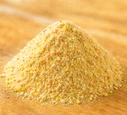
A cat food manufacturing plant has to handle ingredients with very different physical and processing properties. Commercial dry cat food may use poultry meal, meat meal, fish meal, egg products, rice, corn, wheat, peas, potato or other starch sources, animal fats, fish oil, fiber ingredients, palatants and vitamin-mineral-amino-acid premixes. RICHI uses the customer’s actual ingredient list to determine grinding fineness, dosing accuracy, extrusion conditions, dryer load and coating configuration rather than designing the plant around one standard formula.
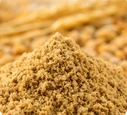
Chicken Meal
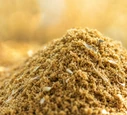
Fish Meal

Corn

Rice Bran
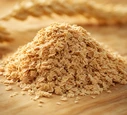
Wheat
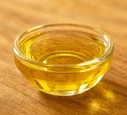
Fats Oils
Premixes

Kitten & Growth Cat Food
Kitten formulas are developed for growth and require a different nutrient balance from adult-maintenance products. Smaller kibble is commonly requested for this market, while fine grinding, accurate micro-dosing and controlled extrusion help manufacturers maintain uniform 2–4 mm dry kibble across repeated production batches.
Design My Kitten & Growth Cat Food Line

Adult Maintenance Cat Food
This category covers healthy adult cats that are not in gestation or lactation. It is the broadest commercial dry cat food segment and can include poultry-, fish- or meat-based formulas at different price points. Stable long-run extrusion, consistent coating and efficient recipe switching are particularly important for manufacturers producing several retail SKUs.
Get Adult Cat Food Line Configuration

Gestation & Lactation Cat Food
Pregnant and nursing cats require a different nutritional profile from standard adult-maintenance cats. Kibble size itself is a product-design choice rather than a nutritional rule, so manufacturers may keep a familiar 3–8 mm format while adjusting formula density, fat level, premix addition and coating to the intended product specification.
Configure Gestation & Lactation Cat Food Line

Senior Cat Food
Senior cat food is a commercial market segment rather than a separate AAFCO nutritional adequacy life stage. Manufacturers may choose smaller or easier-to-eat kibble, different energy density, fiber levels or protein systems for older cats, while using the same core cat kibble production line with adjusted recipes and process settings.
Explore Senior Cat Food Line Options
Example Dry Cat Food Formula Structures
Poultry & Rice Cat Kibble
This type of formulation is suitable for mainstream dry cat kibble production. Uniform fine grinding and controlled coating help maintain small kibble structure while allowing different fat and palatability targets.
Poultry / chicken protein ingredients
28–38%
Rice and other starch sources
28–40%
Plant protein / fiber ingredients
5–12%
Animal fat / poultry fat
7–13%
Premix, taurine & palatants
2–6%
…
…
Fish & Poultry Cat Kibble
Fish-based recipes can require more attention to oil handling and surface coating. The dry cat food production line must still maintain enough suitable starch and process control to form stable extruded kibble.
Fish-derived protein ingredients
15–25%
Poultry protein ingredients
12–22%
Rice / cereal / starch ingredients
25–38%
Oils, fat and fiber sources
10–18%
Premix, taurine & palatants
2–6%
…
…
Multi-Protein Cat Food
This type of recipe is useful for manufacturers developing several premium or private-label products. More frequent ingredient changes make accurate batching, recipe control and flexible extrusion particularly valuable.
Poultry protein ingredients
15–25%
Fish / meat / egg protein ingredients
12–22%
Starch and carbohydrate sources
25–38%
Fiber, fats and oils
10–18%
Premix, taurine & palatants
2–6%
…
…
Grain-Free Cat Kibble
Removing conventional grains does not remove the need for a suitable starch system. Extrusion still depends on the relationship between protein, fat, moisture and starch to produce stable dry cat kibble.
Poultry / fish / meat protein ingredients
30–42%
Peas / legumes
10–20%
Potato or other non-grain starches
18–30%
Fiber, fats and oils
10–18%
Premix, taurine & palatants
2–6%
…
…
The aboves are process-planning examples rather than complete nutritional formulas. Exact ingredient levels must be developed and validated by a qualified formulator for the intended life stage, market and regulatory standard. RICHI can adjust the cat kibble manufacturing process for different ingredient systems by changing grinding configuration, batching accuracy, liquid addition, conditioning, extrusion settings, drying load and coating method. This allows one cat food manufacturing plant to support several commercial formulas without treating every recipe as mechanically identical.
Questions We Actually Get From Buyers
What options are available for your cat food manufacturing plant capacity, and what are the prices?
+
The right capacity for a cat food manufacturing plant depends on expected sales, number of formulas, operating hours, automation and future expansion—not simply the largest extruder within budget. RICHI can configure small single-screw systems, commercial twin-screw lines and larger industrial plants for dry cat kibble production. For the same nominal output, the final plant design can still differ significantly according to formula complexity and product positioning.
0.2–0.4 T/H Starter Dry-Extrusion Plant
Suitable for new cat food brands, feed businesses entering pet food production and small regional manufacturers. Single-screw dry extrusion keeps the initial system compact while still supporting complete dry kibble processing.
Equipment Investment: US$60,000–80,000
0.5–0.6 T/H Small Cat Food Plant
A practical scale for customers moving from trial production into regular commercial sales. Single-screw dry or wet extrusion can be selected according to formula, conditioning requirements and available utilities.
Equipment Investment: US$70,000–100,000
0.8–1 T/H Small Commercial Plant
This capacity suits growing brands, private-label producers and existing feed companies adding dry cat food. It offers more daily output while remaining manageable in workshop area, staffing and overall investment.
Equipment Investment: US$130,000–170,000
0.5–1 T/H Twin-Screw Cat Food Line
For buyers who value formula flexibility more than minimum investment. Twin-screw extrusion is better suited to several protein systems, frequent recipe changes, different small-kibble shapes or tighter control of expansion and density.
Equipment Investment: US$150,000–200,000
1.5–2 T/H Commercial Cat Food Plant
A common scale for regional manufacturers supplying several retailers or private-label customers. Automatic batching, finer grinding and more controlled coating become increasingly useful as the product portfolio expands.
Equipment Investment: US$440,000–560,000
3–4 T/H Commercial Manufacturing Plant
Designed for established dry cat food producers handling several formulas and longer production runs. This scale can support higher automation, more ingredient bins and continuous drying without moving into a very large industrial factory.
Equipment Investment: US$530,000–650,000
5–6 T/H High-Output Cat Food Factory
Suitable for manufacturers with proven sales, broader distribution or contract-manufacturing business. Two-stage grinding, larger storage systems, automatic recipe control and higher-capacity coating or packing are commonly considered at this level.
Equipment Investment: US$670,000–840,000
8–10 T/H Industrial Cat Food Production Line
This scale is intended for established manufacturers serving large domestic or export markets. Raw-material storage, automatic dosing, dryer balance, finished-product handling and packing capacity become as important as the extruder itself.
Equipment Investment: US$880,000–1,200,000
10–12 T/H Industrial Cat Food Manufacturing Plant
A large dry cat food manufacturing facility at this output requires coordinated storage, fine grinding, batching, extrusion, drying, coating and packing systems. Process redundancy and recipe scheduling become more important when several products run continuously.
Equipment Investment: Quoted according to the final equipment and automation configuration.
15–20 T/H Multi-Line Cat Food Factory
At 15–20 T/H, total factory output is better achieved through multiple extrusion trains or parallel production modules rather than treating the project as one oversized machine. This allows recipe changes, maintenance and production scheduling without stopping the entire plant.
Equipment Investment: Project-specific quotation based on the number of extrusion lines and automation level.
A 1 T/H single-screw line and a 1 T/H twin-screw line should not be compared by capacity alone. Formula flexibility, kibble size range, coating demand, automation and future product development can justify very different cat food plant costs at the same output.
We have about US$200,000. What kind of cat food manufacturing plant can we actually build?
+
At this budget, a 0.5–1 T/H complete cat food production line is the realistic range to evaluate. Our reference equipment investment is about US$70,000–100,000 for a 0.5–0.6 T/H single-screw line, US$130,000–170,000 for 0.8–1 T/H single-screw, and US$150,000–200,000 for a 0.5–1 T/H twin-screw line. Civil works, freight and local utilities are separate.
We expect to sell only 3–4 tons of kibble per day at first. Is a 1 T/H line already too large?
+
Not necessarily, but a 500–600 kg/h plant may give better utilization during the startup period. A 1 T/H small cat food production line makes more sense if you already have distributors, private-label orders or plans to run several cat and dog food products from the same equipment.
Our business is growing quickly. Should we skip 1 T/H and start at 1.5–2 T/H?
+
If your sales channel already supports the volume, that can be reasonable. A 1.5–2 T/H commercial cat food production line gives more room for multiple SKUs and future growth, but building excess capacity before distribution is ready increases capital tied up in equipment, storage and working inventory.
We mainly want to make 3–6 mm cat kibble. Do we really need twin-screw extrusion?
+
Not simply because the kibble is small. Single-screw extrusion can produce many conventional dry cat foods. Twin-screw becomes more valuable when small kibble is combined with frequent recipe changes, higher animal-protein inclusion, different starch systems or more demanding density and texture targets.
Our supplier says twin-screw is always better for cat food. Is that true?
+
No. It is more flexible, but it is not automatically the best economic choice for every project. A simple and stable formula may work well on a single-screw system, while twin-screw is particularly useful for more difficult formulations and wider product portfolios. ANDRITZ also distinguishes twin-screw systems by their greater formulation flexibility and suitability for higher meat inclusion.
What exactly is a single-screw wet extrusion line?
+
It uses added moisture and normally steam conditioning before extrusion. The finished product is still dry cat kibble after drying and coating. A wet single-screw cat food extrusion line should therefore not be confused with canned, pouch or other wet cat food processing equipment.
We already manufacture dog kibble. What should be checked before adding cat food?
+
Start with grinding fineness, micro-dosing accuracy, die range, extrusion control and coating capability. Cat products often use smaller kibble and place greater emphasis on micronutrients and palatability, so an existing dog food production line may need targeted upgrades rather than a complete replacement.
Can we make dog and cat food on the same extrusion line every day?
+
Yes. Many manufacturers use one flexible dry pet food line for both. Formula storage, production sequencing, die changes, extrusion settings and coating programs should be planned so product changeover is controlled rather than improvised during production.
We plan to make kitten food at about 2–4 mm. Will the kibble break easily?
+
Small kibble requires good particle-size uniformity, controlled extrusion and careful drying, cooling and conveying. The solution is not simply a smaller die; the complete cat kibble processing line needs to minimize excessive impacts and control product hardness through the formula and process.
Our adult cat food will be 5–7 mm. Can the same machine also make 3 mm kitten kibble?
+
Yes. Die and cutting changes allow one cat kibble production line to cover different dimensions. Grinding, expansion, drying and screening parameters should also be adjusted because smaller kibble does not behave exactly like a larger product.
Can we make round, triangle and fish-shaped cat kibble on one line?
+
Usually yes. Different dies and cutting settings allow multiple commercial shapes on the same cat food extrusion line. More complex shapes should still be tested against the formula because expansion and mechanical strength affect whether the finished geometry remains clean and stable.
We want a very dense kibble rather than a highly expanded one. How is that controlled?
+
Bulk density is affected by formula composition, moisture, starch behavior, extrusion energy, die conditions and drying. It is a processing target that should be defined before the cat food extruder is selected, not something controlled only by changing the die.
Our formula contains a lot of chicken meal. Is that suitable for dry extrusion?
+
Yes, poultry-based formulas are widely used in dry cat food manufacturing. We still need to review protein, fat, ash, starch and moisture balance because the extruder responds to the complete formulation rather than one ingredient.
We want fish to be the main protein source. What changes in the plant?
+
Fish meal and marine oils can be processed, but oil handling, formula balance, extrusion stability and post-extrusion coating deserve extra attention. If you plan several fish-based products, we would also review cleaning and recipe sequencing to reduce unnecessary carryover between batches.
Can we use salmon oil or fish oil after extrusion instead of mixing it all before extrusion?
+
Yes, and post-extrusion addition is often useful because excessive pre-extrusion fat can affect cooking and expansion. A cat food coating system can meter oil and palatant after drying according to the finished-product specification.
Our premium recipe contains much more animal protein than our economy formula. Can one line handle both?
+
Potentially yes. This is exactly where formula flexibility matters. A twin-screw cat food extruder production line may be preferred if the protein, fat and starch systems differ substantially between products, because the processing window becomes more demanding.
We want a grain-free cat food range. Does that require different machinery?
+
Not necessarily different machinery, but it can require different process settings. Grain-free recipes still need suitable structure-forming ingredients, such as appropriate non-grain starch sources, because stable dry kibble cannot be produced by simply removing cereal ingredients without reformulating the matrix.
What information about our recipe do you need before sizing the extruder?
+
Give us the main animal-protein sources, starch sources, approximate fat level, fiber ingredients, target kibble size and production capacity. You do not need to disclose every micro-ingredient for a preliminary quotation, but more detail is required before the final dry cat food manufacturing process is confirmed.
Our cat food contains taurine. How is such a small ingredient dosed accurately?
+
Taurine and other low-inclusion ingredients should enter through an appropriately accurate premix or micro-dosing system and then be uniformly mixed into the batch. Cats have species-specific nutritional requirements, and AAFCO specifically identifies taurine as particularly important to cats.
Should taurine be added directly, or should we prepare a premix first?
+
That decision belongs to the approved formula and dosing strategy, but very low-inclusion ingredients are commonly incorporated through a premix or controlled micro-dosing route to improve distribution. The equipment should accurately reproduce the formula; RICHI does not determine the nutritional dosage itself.
We use many vitamins and minerals. Is manual weighing accurate enough?
+
For a very small plant with limited recipes, controlled manual weighing may be workable, but commercial production with frequent batches benefits from dedicated micro-dosing or premix preparation. AAFCO notes that micronutrients can be required in very small amounts and that excesses can also matter, so dosage control should not be treated casually.
Do we need our final nutritional formula before ordering the factory?
+
You can begin factory planning without it, but the detailed formula should be available before the final process is frozen. Cats and dogs do not have identical nutritional requirements, and complete cat food formulas should be developed for the intended life stage and market.
Can RICHI formulate our kitten or adult cat food for us?
+
Our primary responsibility is cat food manufacturing equipment and plant engineering. We can evaluate how your proposed formula affects grinding, extrusion, drying and coating, but complete nutritional formulation should be developed or validated by a qualified formulator according to the regulations and nutrition standards of your target market.
We buy poultry meal from several suppliers. Will changes in raw-material quality affect production?
+
They can. Particle size, fat, protein, ash, moisture and bulk density can vary between suppliers, which can change feeding and extrusion behavior. A good cat food manufacturing line needs enough process adjustment to handle reasonable raw-material variation without relying on one fixed machine setting.
Some of our ingredients bridge in bins and do not flow well. How should that be handled?
+
Ingredient flow properties need to be considered when feeders and hoppers are selected. Coperion notes that dry premixes can be difficult to feed and that stable, accurate feeding is critical to extrusion performance, which is why feeder selection is part of the process design rather than an afterthought.
Is one hammer mill enough for a 1 T/H cat food production line?
+
For some conventional formulas, yes. If you require very small kibble, tighter particle uniformity or more demanding recipes, a finer grinding stage may be justified. We decide from the product specification rather than automatically adding an ultrafine grinder to every small cat food plant.
At 3–4 T/H, would you recommend two-stage grinding?
+
It becomes much more relevant at this scale, particularly when several formulas require consistently fine preparation. Two-stage grinding can separate coarse size reduction from finer preparation and reduce the risk that grinding becomes the bottleneck for a commercial cat food manufacturing plant.
Our existing grinder reaches the required capacity. Is that enough to reuse it?
+
Capacity alone is not enough. We also check particle-size distribution, wear condition, hygiene, discharge arrangement and whether it can feed the downstream system steadily. If those conditions are acceptable, there is no reason to replace useful existing equipment simply to make the supply package larger.
Why does my cat kibble come out with uneven size even though the die is correct?
+
Possible causes include inconsistent feed rate, particle-size variation, unstable moisture, extrusion conditions, cutter settings or die flow. The extruder depends on stable upstream feeding, so we would troubleshoot the complete cat food processing process rather than assuming the die is the only cause.
Our kibble surface looks rough. Is that a formulation problem or a machine problem?
+
It can be either—or both. Raw-material fineness, starch/protein balance, extrusion temperature and pressure, die condition, cutter performance and drying all influence surface appearance. A technical review should therefore start with process data and formula information rather than immediately replacing the cat food machine.
We want the kibble to smell stronger to cats. Is that mainly an extrusion issue?
+
Usually not. Palatability is influenced by the formula and post-extrusion surface treatment as well as the cooked product itself. A properly controlled oil and palatant coating stage is therefore an important part of many commercial dry cat food production lines.
How precise does the coating system need to be?
+
Precise enough to reproduce the approved recipe consistently across batches. Coating affects product palatability, fat content and ingredient cost, so unstable liquid addition can create both quality and cost problems. Automated liquid metering becomes increasingly valuable as the product portfolio grows.
Is vacuum coating necessary for premium cat food?
+
Not automatically. Drum coating is suitable for many commercial cat foods. Vacuum coating is more appropriate when the recipe requires higher or more controlled penetration of liquids into the kibble, so it should be justified by product requirements rather than used simply because the factory is positioned as premium.
We run a salmon recipe and then a chicken recipe. How do we reduce odor and flavor carryover?
+
Plan production sequencing, cleanable conveying paths and cleaning or flushing procedures around the product portfolio. Where a palatant or oil system handles very different products, separate storage tanks, dosing circuits or cleaning steps may also be considered.
We manufacture many private-label SKUs in short batches. Can the plant handle frequent changeovers?
+
Yes, but the cat food plant design should be built for that business model. Recipe management, ingredient bins, quick die access, cleaning strategy and coating changeover matter more to a private-label factory than to a plant running one formula continuously.
Is a fully automatic cat food production line necessary for private-label production?
+
It is often useful because frequent recipe changes benefit from controlled batching and stored production parameters. However, full automation should still be justified by SKU count, labor cost and traceability requirements rather than being treated as mandatory for every project.
We want to sell kitten, adult, sterilized and indoor cat foods. Do we need four lines?
+
No. These are product and formulation categories, not four separate mechanical processes. One flexible cat kibble manufacturing line can manufacture multiple SKUs by changing formulas, dies, process settings and coating programs, provided changeover and production control are designed correctly.
Is “sterilized cat food” a different extrusion technology?
+
No. Sterilized/neutered cat food is a product-positioning and formulation category, not a unique extrusion process. The nutritional formulation changes, while the same core dry cat food manufacturing equipment can usually be used.
Is senior cat food made with a different machine?
+
No. Senior is also a product category rather than a separate extrusion technology. Formula composition, kibble size, hardness and coating may change, while the core dry cat food processing line remains the same.
We only have a low workshop. Can a cat food factory be arranged horizontally?
+
Yes. Lower-height layouts can use more horizontal conveying and intermediate bins instead of relying heavily on gravity flow. This is particularly practical for small and medium cat food processing plants installed inside existing buildings.
Do we really need an underground receiving pit?
+
No. Above-ground bag feeding or bulk receiving arrangements are possible where excavation is difficult or expensive. The best option depends on raw-material delivery method, site level, throughput and available floor space.
We mainly buy raw materials in 25 kg bags. Would silos be unnecessary?
+
For many 0.5–1 T/H projects, bag feeding can be entirely reasonable. Silos become more attractive when high-volume ingredients are purchased in bulk and the daily turnover justifies automated storage and conveying. There is no benefit in building a large silo system that does not match your purchasing model.
Our existing factory has 380 V, 50 Hz power. Can the plant be built for that?
+
Yes. Motors, control panels and electrical components are specified according to the confirmed site voltage and frequency. We also need the available transformer capacity so total connected load can be checked before manufacturing.
Do I need steam if I choose a twin-screw cat food extrusion line?
+
Many twin-screw pet food processes use moisture and steam as part of conditioning or extrusion, although the exact arrangement depends on the equipment design. Coperion and ANDRITZ both describe water, steam and liquid addition as important parts of industrial pet food extruder systems.
Our plant is in a very humid climate. Will cooling and storage need to change?
+
Potentially yes. High ambient humidity can affect cooling, moisture pickup and finished-product storage conditions. The dry cat food processing line and warehouse plan should therefore be developed together rather than assuming that equipment operating conditions are identical in every country.
What should we compare when evaluating two cat food production line suppliers?
+
Compare the complete scope: feeding accuracy, grinding, batching, extruder type, real dryer capacity, coating method, cooling, conveying, controls, packaging, spare parts, engineering drawings and startup support. An extrusion supplier should be evaluated as an integrated-system partner because upstream feeding and downstream equipment directly affect product quality and changeover efficiency.
One supplier is much cheaper but uses the same-size extruder. Why?
+
The extruder is only one component. Check whether the cheaper quotation has reduced grinding capacity, manual batching, a smaller dryer, basic coating, fewer conveyors or a simpler packing system. A lower cat food production line price is not comparable unless the full equipment scope and performance assumptions are also comparable.
Can you build only the extrusion section, or do you supply the entire factory?
+
Both are possible. RICHI can supply individual cat food processing equipment or a complete cat food manufacturing plant covering receiving, grinding, batching, mixing, extrusion, drying, coating, cooling, conveying and packing. For a greenfield project, one integrated engineering interface normally makes commissioning easier than coordinating unrelated machine suppliers.
We want to expand later from 1 T/H to 2 T/H. What should be reserved now?
+
Reserve electrical capacity, building access, conveying routes, dryer/packing expansion space and suitable connection points. Even if you do not buy the future equipment today, a good cat food factory design should avoid placing structures or machines where they block the next phase.
What information should I send to get a real quotation instead of a generic price list?
+
Send your required capacity, main ingredients or approximate formula, target kibble sizes and shapes, number of planned SKUs, single- or twin-screw preference if already known, workshop dimensions, voltage/frequency, packaging requirements and whether the factory will also make dog or aquatic feed. With that information, we can prepare a relevant cat food manufacturing plant layout, equipment list and project quotation.